DEPRECIATION


               1
FIXED ASSETS
• Assets acquired not for resale.

• Help to earn revenue for more than 1 financial year.


Examples :

- A printing machine in a printing company.

- A van in a courier service company.
                                                         2
DEFINITION OF DEPRECIATION

• Applies only to fixed assets.

• The whole cost of the fixed assets must be spread over
  its useful life.

• The portion of the cost allocated to a particular accounting
   period is charged as an expense against revenue
  (Matching principle).

• This portion of the cost is called Depreciation.


                                                                 3
CAUSES OF DEPRECIATION

 Physical Deterioration

 Obsolescence

 Depletion of an asset

 Passage of Time
                           4
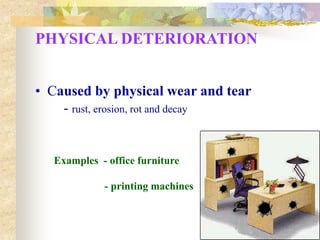
PHYSICAL DETERIORATION


• Caused by physical wear and tear
    - rust, erosion, rot and decay


  Examples - office furniture

            - printing machines


                                     5
OBSOLESCENCE

• Fixed assets become out-of-date
  - when new model or more efficient tool come into existence.


                          Pentium I
Examples - cars

         - computers
                                         Pentium IV

                                                            6
DEPLETION OF FIXED ASSETS

• An asset that depletes over time as resources
  are extracted from it.             Little Guilin


Examples - Gold mines

         - Quarries
          - Little Guilin is a depleted granite quarry now
            turned into a beautiful lake.
                                                             7
PASSAGE OF TIME
• Some assets confer upon their holders the
  exclusive rights to enjoy certain privileges
  for a fixed period of time.


 Examples - copyrights

          - patent rights

          - leases on land
                                                 8
METHODS OF DEPRECIATION


• Straight-Line
 Units-of-output
• Reducing Balance
Double-declining-balance
• Revaluation
 Sum-of-the-years'-digits
STRAIGHT LINE METHOD


• A fixed asset is depreciated by an equal amount per year.


Example:

If an asset is depreciated by $1,000 in the first full year of
usage, it will also be depreciated by $1,000 in the second
year; $1,000 in the third year and this continues annually
until it is fully depreciated.

                                                                 10
STRAIGHT LINE METHOD

• Advantages
- Easy to calculate.
- Easy to understand.


•Disadvantage
- Assumes fixed asset gives same amount of service annually
   throughout its useful life.

                                                              11
STRAIGHT LINE METHOD (I)

A machine X costs $20,000 is expected to last 4 years.
At the end of the 4th year, it can be sold for $2,000 as scrap.
( Scrap value is the same as residual value.)


 Depreciation per year = Original cost - Residual value
                            Expected useful life
                              20,000 - 2000
                         =
                                     4

                         = $4,500

                                                                  12
Balance Sheet as at 31 Dec 1999

 Fixed asset
 Office equipment      $16,000
 Less Prov. for dep.     2,000 $14,000


                       Balance Sheet as at 31 Dec 2000


Fixed asset
Office equipment $16,000
Less Prov. For dep. 4,000        $12,000

                                                         Dep
         O/E
                                                               13
IMPORTANT FEATURES:


• Fixed asset account shows original cost of asset.

• Provision for Depreciation account shows
  accumulated depreciation of fixed asset.

• Net book value of fixed asset (in Balance Sheet)
  is original cost less Provision for Depreciation.

                                                  14
REDUCING

BALANCE METHOD OF

DEPRECIATION


                    15
REDUCING BALANCE METHOD
• The amount of depreciation per year diminishes with
  every successive year.


Example:

- If an asset is depreciated by $2,000 in the first full year
  of usage, it will be depreciated by less than $2,000
  (eg $1,600) in the second year; and even less (eg $1,300)
  in the third year. This continues until it is fully depreciated.

                                                                     16
REDUCING BALANCE METHOD


•Advantage
- Overall expenses ( including repairs and maintenance)
  charged for the use of a fixed asset would be fairly
  constant.

•Disadvantages
- Difficult to calculate.
- Assets are always left with a small value at the end of
  useful life.
                                                            17
REDUCING BALANCE METHOD


Depreciation per year


= Rate of depreciation   X Net book value at beginning of
                           accounting period

Net book value = Original cost - Accumulated depreciation
Accumulated depreciation is the sum of the yearly depreciation.

                                                            18
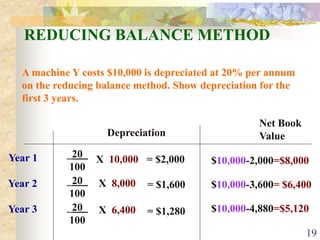
REDUCING BALANCE METHOD

  A machine Y costs $10,000 is depreciated at 20% per annum
  on the reducing balance method. Show depreciation for the
  first 3 years.

                                                   Net Book
                   Depreciation                    Value

Year 1      20   X 10,000 = $2,000       $10,000-2,000=$8,000
           100
Year 2      20    X 8,000   = $1,600     $10,000-3,600= $6,400
           100
Year 3      20    X 6,400   = $1,280     $10,000-4,880=$5,120
           100
                                                              19
REVALUATION

METHOD OF

DEPRECIATION
               20
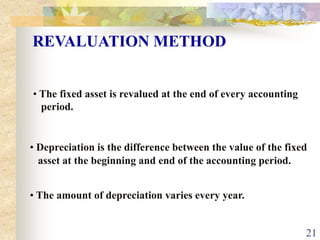
REVALUATION METHOD


• The fixed asset is revalued at the end of every accounting
  period.


• Depreciation is the difference between the value of the fixed
  asset at the beginning and end of the accounting period.


• The amount of depreciation varies every year.


                                                               21
REVALUATION METHOD


Example:

- An asset can be depreciated by $1,000 in the first full year
  of usage, it can be depreciated by a different amount in the
  second year (eg $500 ); and a different amount in the third
  year (eg $1,200 ) depending on the valuation at the end of
  the accounting period and the cost or valuation at the
  beginning of the accounting period.


                                                                 22
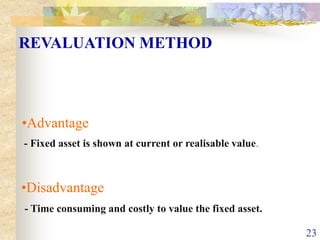
REVALUATION METHOD


•Advantage
- Fixed asset is shown at current or realisable value.


•Disadvantage
- Time consuming and costly to value the fixed asset.

                                                         23
REVALUATION METHOD (I)

Cost of printing machine on 1 Jan 2000 = $15,000.
Market value on 31 Dec 2000           = $13,000.


Depreciation of printing machine for FY2000

= cost on 1 Jan 2000 – market value on 31 Dec 2000

= 15,000 – 13,000

= $2,000
                                                     24
REVALUATION METHOD (II)

This method is normally used for loose tools where it is
difficult to estimate the rate of depreciation.
The value of the asset may be inflated by new purchases
and this has to be taken into account when calculating
depreciation.

Depreciation expense

= Value of asset     - Value of asset     + Any new
  at the beginning     at the end           purchases


                                                           25
REVALUATION METHOD (II)
On 1 Jan 2000 loose tools in the workshop were valued at
$2,000. During the year, tools worth $1,000 were bought.
On 31 Dec 2000, the estimated market value of the tools was
$2,600.

Depreciation expense

 = Value of tools - Value of tools + New purchases
   on 1 Jan 2000 on 31 Dec 2000

 = 2,000    - 2,600      + 1,000

 = $400
                                                              26
THE UNITS-OF-OUTPUT METHOD


                             27
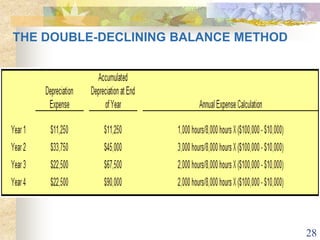
THE DOUBLE-DECLINING BALANCE METHOD


                                      28
THE SUM-OF-THE-YEARS'-DIGITS METHOD


                                      29

8 depreciation

  • 1.
  • 2.
    FIXED ASSETS • Assetsacquired not for resale. • Help to earn revenue for more than 1 financial year. Examples : - A printing machine in a printing company. - A van in a courier service company. 2
  • 3.
    DEFINITION OF DEPRECIATION •Applies only to fixed assets. • The whole cost of the fixed assets must be spread over its useful life. • The portion of the cost allocated to a particular accounting period is charged as an expense against revenue (Matching principle). • This portion of the cost is called Depreciation. 3
  • 4.
    CAUSES OF DEPRECIATION Physical Deterioration  Obsolescence  Depletion of an asset  Passage of Time 4
  • 5.
    PHYSICAL DETERIORATION • Causedby physical wear and tear - rust, erosion, rot and decay Examples - office furniture - printing machines 5
  • 6.
    OBSOLESCENCE • Fixed assetsbecome out-of-date - when new model or more efficient tool come into existence. Pentium I Examples - cars - computers Pentium IV 6
  • 7.
    DEPLETION OF FIXEDASSETS • An asset that depletes over time as resources are extracted from it. Little Guilin Examples - Gold mines - Quarries - Little Guilin is a depleted granite quarry now turned into a beautiful lake. 7
  • 8.
    PASSAGE OF TIME •Some assets confer upon their holders the exclusive rights to enjoy certain privileges for a fixed period of time. Examples - copyrights - patent rights - leases on land 8
  • 9.
    METHODS OF DEPRECIATION •Straight-Line Units-of-output • Reducing Balance Double-declining-balance • Revaluation Sum-of-the-years'-digits
  • 10.
    STRAIGHT LINE METHOD •A fixed asset is depreciated by an equal amount per year. Example: If an asset is depreciated by $1,000 in the first full year of usage, it will also be depreciated by $1,000 in the second year; $1,000 in the third year and this continues annually until it is fully depreciated. 10
  • 11.
    STRAIGHT LINE METHOD •Advantages - Easy to calculate. - Easy to understand. •Disadvantage - Assumes fixed asset gives same amount of service annually throughout its useful life. 11
  • 12.
    STRAIGHT LINE METHOD(I) A machine X costs $20,000 is expected to last 4 years. At the end of the 4th year, it can be sold for $2,000 as scrap. ( Scrap value is the same as residual value.) Depreciation per year = Original cost - Residual value Expected useful life 20,000 - 2000 = 4 = $4,500 12
  • 13.
    Balance Sheet asat 31 Dec 1999 Fixed asset Office equipment $16,000 Less Prov. for dep. 2,000 $14,000 Balance Sheet as at 31 Dec 2000 Fixed asset Office equipment $16,000 Less Prov. For dep. 4,000 $12,000 Dep O/E 13
  • 14.
    IMPORTANT FEATURES: • Fixedasset account shows original cost of asset. • Provision for Depreciation account shows accumulated depreciation of fixed asset. • Net book value of fixed asset (in Balance Sheet) is original cost less Provision for Depreciation. 14
  • 15.
  • 16.
    REDUCING BALANCE METHOD •The amount of depreciation per year diminishes with every successive year. Example: - If an asset is depreciated by $2,000 in the first full year of usage, it will be depreciated by less than $2,000 (eg $1,600) in the second year; and even less (eg $1,300) in the third year. This continues until it is fully depreciated. 16
  • 17.
    REDUCING BALANCE METHOD •Advantage -Overall expenses ( including repairs and maintenance) charged for the use of a fixed asset would be fairly constant. •Disadvantages - Difficult to calculate. - Assets are always left with a small value at the end of useful life. 17
  • 18.
    REDUCING BALANCE METHOD Depreciationper year = Rate of depreciation X Net book value at beginning of accounting period Net book value = Original cost - Accumulated depreciation Accumulated depreciation is the sum of the yearly depreciation. 18
  • 19.
    REDUCING BALANCE METHOD A machine Y costs $10,000 is depreciated at 20% per annum on the reducing balance method. Show depreciation for the first 3 years. Net Book Depreciation Value Year 1 20 X 10,000 = $2,000 $10,000-2,000=$8,000 100 Year 2 20 X 8,000 = $1,600 $10,000-3,600= $6,400 100 Year 3 20 X 6,400 = $1,280 $10,000-4,880=$5,120 100 19
  • 20.
  • 21.
    REVALUATION METHOD • Thefixed asset is revalued at the end of every accounting period. • Depreciation is the difference between the value of the fixed asset at the beginning and end of the accounting period. • The amount of depreciation varies every year. 21
  • 22.
    REVALUATION METHOD Example: - Anasset can be depreciated by $1,000 in the first full year of usage, it can be depreciated by a different amount in the second year (eg $500 ); and a different amount in the third year (eg $1,200 ) depending on the valuation at the end of the accounting period and the cost or valuation at the beginning of the accounting period. 22
  • 23.
    REVALUATION METHOD •Advantage - Fixedasset is shown at current or realisable value. •Disadvantage - Time consuming and costly to value the fixed asset. 23
  • 24.
    REVALUATION METHOD (I) Costof printing machine on 1 Jan 2000 = $15,000. Market value on 31 Dec 2000 = $13,000. Depreciation of printing machine for FY2000 = cost on 1 Jan 2000 – market value on 31 Dec 2000 = 15,000 – 13,000 = $2,000 24
  • 25.
    REVALUATION METHOD (II) Thismethod is normally used for loose tools where it is difficult to estimate the rate of depreciation. The value of the asset may be inflated by new purchases and this has to be taken into account when calculating depreciation. Depreciation expense = Value of asset - Value of asset + Any new at the beginning at the end purchases 25
  • 26.
    REVALUATION METHOD (II) On1 Jan 2000 loose tools in the workshop were valued at $2,000. During the year, tools worth $1,000 were bought. On 31 Dec 2000, the estimated market value of the tools was $2,600. Depreciation expense = Value of tools - Value of tools + New purchases on 1 Jan 2000 on 31 Dec 2000 = 2,000 - 2,600 + 1,000 = $400 26
  • 27.
  • 28.
  • 29.