DEPRECIATION
BY
Y.MADHU VENKATA SAINATH
171FC01085
madhusainath.y2017@gmail.com
CONTENTS
• Concepts
• Definition
• Objectives
• Causes
• How to calculate Depreciation
• Depreciation Methods
CONCEPT
• Depreciation is the cost of lost
usefulness or cost of diminution of
service yield from a use of fixed assets.
• A permanent fall in value of fixed assets
arising through wear and tear from the
use of those assets in business.
Definition
“depreciation is a measure of the wearing out,
consumption or other loss of value of
depreciation arising from use, efflux ion of time
or obsolesance through technology and market
changes. Depreciation is allocated so as to
charge a fair proportion of the depreciable
amount in each accounting period during the
expected useful life of the asset. Depreciation
includes amortization of assets whose useful life
is predetermined.”
Causes for depreciation
• Internal Causes: wear and tear, disuse ,
maintenance, change in production,
restriction of production, reduced demand,
technical progress & depletion.
• External Causes: obsolescence and efflux ion
of time.
objective
• To calculate proper profit.
• To show the assets its reasonable value.
• To maintain original monetary investment of the
asset intact.
• Provision of depreciation results in some
incidental advantage also.
• To provide for replacement of an asset.
• Depreciation is permitted to be deducted from
profits for tax purposes.
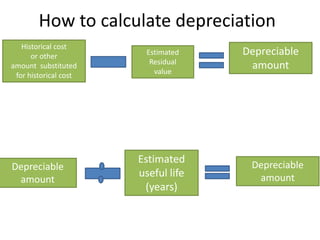
How to calculate depreciation
Historical cost
or other
amount substituted
for historical cost
Estimated
Residual
value
Depreciable
amount
Depreciable
amount
Estimated
useful life
(years)
Depreciable
amount
Depreciation methods
• Straight line method
• Declining balance method
• Sum of years digit method
• Inventory method
• Annuity method
• Depreciation fund method
• Machine hour (or) production unit method
• Depletion method
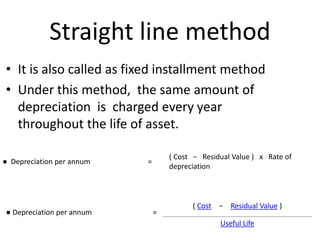
Straight line method
• It is also called as fixed installment method
• Under this method, the same amount of
depreciation is charged every year
throughout the life of asset.
• The formula
● Depreciation per annum =
( Cost − Residual Value ) x Rate of
depreciation
● Depreciation per annum =
( Cost − Residual Value )
Useful Life
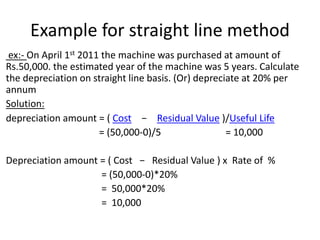
Example for straight line method
ex:- On April 1st 2011 the machine was purchased at amount of
Rs.50,000. the estimated year of the machine was 5 years. Calculate
the depreciation on straight line basis. (Or) depreciate at 20% per
annum
Solution:
depreciation amount = ( Cost − Residual Value )/Useful Life
= (50,000-0)/5 = 10,000
Depreciation amount = ( Cost − Residual Value ) x Rate of %
= (50,000-0)*20%
= 50,000*20%
= 10,000
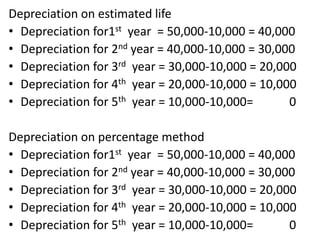
Depreciation on estimated life
• Depreciation for1st year = 50,000-10,000 = 40,000
• Depreciation for 2nd year = 40,000-10,000 = 30,000
• Depreciation for 3rd year = 30,000-10,000 = 20,000
• Depreciation for 4th year = 20,000-10,000 = 10,000
• Depreciation for 5th year = 10,000-10,000= 0
Depreciation on percentage method
• Depreciation for1st year = 50,000-10,000 = 40,000
• Depreciation for 2nd year = 40,000-10,000 = 30,000
• Depreciation for 3rd year = 30,000-10,000 = 20,000
• Depreciation for 4th year = 20,000-10,000 = 10,000
• Depreciation for 5th year = 10,000-10,000= 0
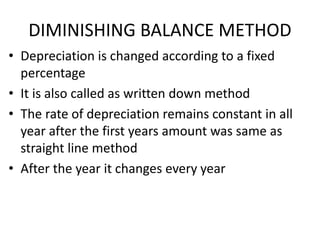
DIMINISHING BALANCE METHOD
• Depreciation is changed according to a fixed
percentage
• It is also called as written down method
• The rate of depreciation remains constant in all
year after the first years amount was same as
straight line method
• After the year it changes every year
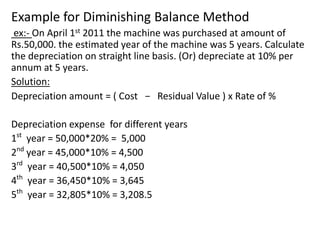
Example for Diminishing Balance Method
ex:- On April 1st 2011 the machine was purchased at amount of
Rs.50,000. the estimated year of the machine was 5 years. Calculate
the depreciation on straight line basis. (Or) depreciate at 10% per
annum at 5 years.
Solution:
Depreciation amount = ( Cost − Residual Value ) x Rate of %
Depreciation expense for different years
1st
year = 50,000*20% = 5,000
2nd
year = 45,000*10% = 4,500
3rd
year = 40,500*10% = 4,050
4th
year = 36,450*10% = 3,645
5th
year = 32,805*10% = 3,208.5
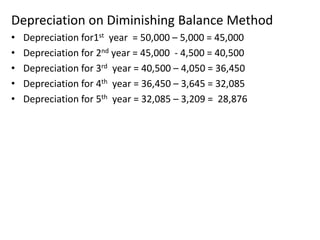
Depreciation on Diminishing Balance Method
• Depreciation for1st year = 50,000 – 5,000 = 45,000
• Depreciation for 2nd year = 45,000 - 4,500 = 40,500
• Depreciation for 3rd year = 40,500 – 4,050 = 36,450
• Depreciation for 4th year = 36,450 – 3,645 = 32,085
• Depreciation for 5th year = 32,085 – 3,209 = 28,876
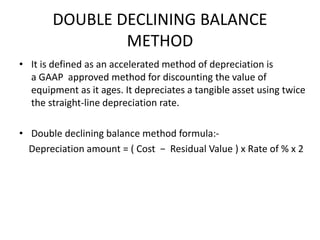
DOUBLE DECLINING BALANCE
METHOD
• It is defined as an accelerated method of depreciation is
a GAAP approved method for discounting the value of
equipment as it ages. It depreciates a tangible asset using twice
the straight-line depreciation rate.
• Double declining balance method formula:-
Depreciation amount = ( Cost − Residual Value ) x Rate of % x 2
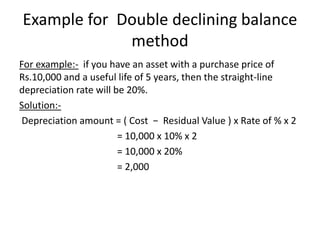
Example for Double declining balance
method
For example:- if you have an asset with a purchase price of
Rs.10,000 and a useful life of 5 years, then the straight-line
depreciation rate will be 20%.
Solution:-
Depreciation amount = ( Cost − Residual Value ) x Rate of % x 2
= 10,000 x 10% x 2
= 10,000 x 20%
= 2,000
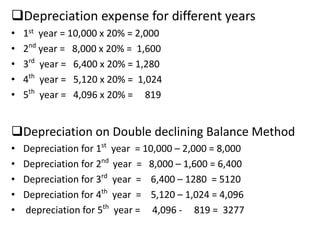
Depreciation expense for different years
• 1st year = 10,000 x 20% = 2,000
• 2nd
year = 8,000 x 20% = 1,600
• 3rd
year = 6,400 x 20% = 1,280
• 4th
year = 5,120 x 20% = 1,024
• 5th
year = 4,096 x 20% = 819
Depreciation on Double declining Balance Method
• Depreciation for 1st
year = 10,000 – 2,000 = 8,000
• Depreciation for 2nd
year = 8,000 – 1,600 = 6,400
• Depreciation for 3rd
year = 6,400 – 1280 = 5120
• Depreciation for 4th
year = 5,120 – 1,024 = 4,096
• depreciation for 5th
year = 4,096 - 819 = 3277
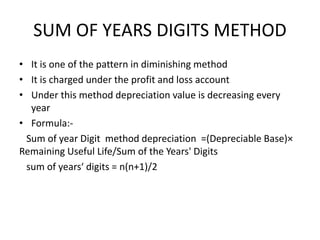
SUM OF YEARS DIGITS METHOD
• It is one of the pattern in diminishing method
• It is charged under the profit and loss account
• Under this method depreciation value is decreasing every
year
• Formula:-
Sum of year Digit method depreciation =(Depreciable Base)×
Remaining Useful Life/Sum of the Years' Digits
sum of years‘ digits = n(n+1)/2
Example for syd method
Ex:- cost of machine was Rs.45,000, residual value of
machine was Rs.5,000, useful life of the machine was 4
years. depreciation on syd
Solution:-
Sum of years = n(n+1)/2
= 4(4+1)/2
= 10
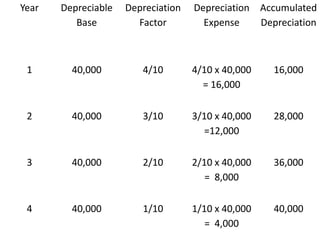
Depreciation base = 45,000 – 5,000 = 40,000
Year Depreciable
Base
Depreciation
Factor
Depreciation
Expense
Accumulated
Depreciation
1 40,000 4/10 4/10 x 40,000
= 16,000
16,000
2 40,000 3/10 3/10 x 40,000
=12,000
28,000
3 40,000 2/10 2/10 x 40,000
= 8,000
36,000
4 40,000 1/10 1/10 x 40,000
= 4,000
40,000
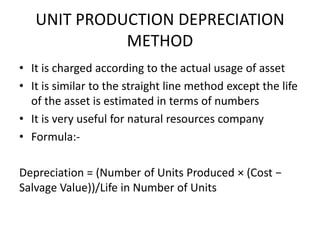
UNIT PRODUCTION DEPRECIATION
METHOD
• It is charged according to the actual usage of asset
• It is similar to the straight line method except the life
of the asset is estimated in terms of numbers
• It is very useful for natural resources company
• Formula:-
Depreciation = (Number of Units Produced × (Cost −
Salvage Value))/Life in Number of Units
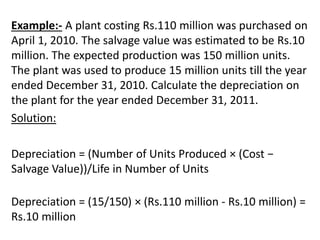
Example:- A plant costing Rs.110 million was purchased on
April 1, 2010. The salvage value was estimated to be Rs.10
million. The expected production was 150 million units.
The plant was used to produce 15 million units till the year
ended December 31, 2010. Calculate the depreciation on
the plant for the year ended December 31, 2011.
Solution:
Depreciation = (Number of Units Produced × (Cost −
Salvage Value))/Life in Number of Units
Depreciation = (15/150) × (Rs.110 million - Rs.10 million) =
Rs.10 million
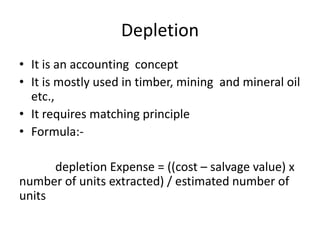
Depletion
• It is an accounting concept
• It is mostly used in timber, mining and mineral oil
etc.,
• It requires matching principle
• Formula:-
depletion Expense = ((cost – salvage value) x
number of units extracted) / estimated number of
units
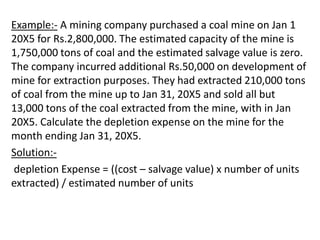
Example:- A mining company purchased a coal mine on Jan 1
20X5 for Rs.2,800,000. The estimated capacity of the mine is
1,750,000 tons of coal and the estimated salvage value is zero.
The company incurred additional Rs.50,000 on development of
mine for extraction purposes. They had extracted 210,000 tons
of coal from the mine up to Jan 31, 20X5 and sold all but
13,000 tons of the coal extracted from the mine, with in Jan
20X5. Calculate the depletion expense on the mine for the
month ending Jan 31, 20X5.
Solution:-
depletion Expense = ((cost – salvage value) x number of units
extracted) / estimated number of units
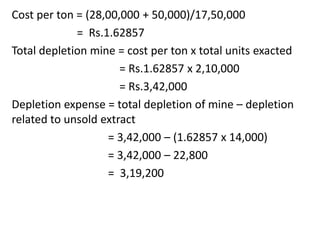
Cost per ton = (28,00,000 + 50,000)/17,50,000
= Rs.1.62857
Total depletion mine = cost per ton x total units exacted
= Rs.1.62857 x 2,10,000
= Rs.3,42,000
Depletion expense = total depletion of mine – depletion
related to unsold extract
= 3,42,000 – (1.62857 x 14,000)
= 3,42,000 – 22,800
= 3,19,200
Depreciation

Depreciation

  • 1.
  • 2.
    CONTENTS • Concepts • Definition •Objectives • Causes • How to calculate Depreciation • Depreciation Methods
  • 3.
    CONCEPT • Depreciation isthe cost of lost usefulness or cost of diminution of service yield from a use of fixed assets. • A permanent fall in value of fixed assets arising through wear and tear from the use of those assets in business.
  • 4.
    Definition “depreciation is ameasure of the wearing out, consumption or other loss of value of depreciation arising from use, efflux ion of time or obsolesance through technology and market changes. Depreciation is allocated so as to charge a fair proportion of the depreciable amount in each accounting period during the expected useful life of the asset. Depreciation includes amortization of assets whose useful life is predetermined.”
  • 5.
    Causes for depreciation •Internal Causes: wear and tear, disuse , maintenance, change in production, restriction of production, reduced demand, technical progress & depletion. • External Causes: obsolescence and efflux ion of time.
  • 6.
    objective • To calculateproper profit. • To show the assets its reasonable value. • To maintain original monetary investment of the asset intact. • Provision of depreciation results in some incidental advantage also. • To provide for replacement of an asset. • Depreciation is permitted to be deducted from profits for tax purposes.
  • 7.
    How to calculatedepreciation Historical cost or other amount substituted for historical cost Estimated Residual value Depreciable amount Depreciable amount Estimated useful life (years) Depreciable amount
  • 8.
    Depreciation methods • Straightline method • Declining balance method • Sum of years digit method • Inventory method • Annuity method • Depreciation fund method • Machine hour (or) production unit method • Depletion method
  • 9.
    Straight line method •It is also called as fixed installment method • Under this method, the same amount of depreciation is charged every year throughout the life of asset. • The formula ● Depreciation per annum = ( Cost − Residual Value ) x Rate of depreciation ● Depreciation per annum = ( Cost − Residual Value ) Useful Life
  • 10.
    Example for straightline method ex:- On April 1st 2011 the machine was purchased at amount of Rs.50,000. the estimated year of the machine was 5 years. Calculate the depreciation on straight line basis. (Or) depreciate at 20% per annum Solution: depreciation amount = ( Cost − Residual Value )/Useful Life = (50,000-0)/5 = 10,000 Depreciation amount = ( Cost − Residual Value ) x Rate of % = (50,000-0)*20% = 50,000*20% = 10,000
  • 11.
    Depreciation on estimatedlife • Depreciation for1st year = 50,000-10,000 = 40,000 • Depreciation for 2nd year = 40,000-10,000 = 30,000 • Depreciation for 3rd year = 30,000-10,000 = 20,000 • Depreciation for 4th year = 20,000-10,000 = 10,000 • Depreciation for 5th year = 10,000-10,000= 0 Depreciation on percentage method • Depreciation for1st year = 50,000-10,000 = 40,000 • Depreciation for 2nd year = 40,000-10,000 = 30,000 • Depreciation for 3rd year = 30,000-10,000 = 20,000 • Depreciation for 4th year = 20,000-10,000 = 10,000 • Depreciation for 5th year = 10,000-10,000= 0
  • 12.
    DIMINISHING BALANCE METHOD •Depreciation is changed according to a fixed percentage • It is also called as written down method • The rate of depreciation remains constant in all year after the first years amount was same as straight line method • After the year it changes every year
  • 13.
    Example for DiminishingBalance Method ex:- On April 1st 2011 the machine was purchased at amount of Rs.50,000. the estimated year of the machine was 5 years. Calculate the depreciation on straight line basis. (Or) depreciate at 10% per annum at 5 years. Solution: Depreciation amount = ( Cost − Residual Value ) x Rate of % Depreciation expense for different years 1st year = 50,000*20% = 5,000 2nd year = 45,000*10% = 4,500 3rd year = 40,500*10% = 4,050 4th year = 36,450*10% = 3,645 5th year = 32,805*10% = 3,208.5
  • 14.
    Depreciation on DiminishingBalance Method • Depreciation for1st year = 50,000 – 5,000 = 45,000 • Depreciation for 2nd year = 45,000 - 4,500 = 40,500 • Depreciation for 3rd year = 40,500 – 4,050 = 36,450 • Depreciation for 4th year = 36,450 – 3,645 = 32,085 • Depreciation for 5th year = 32,085 – 3,209 = 28,876
  • 15.
    DOUBLE DECLINING BALANCE METHOD •It is defined as an accelerated method of depreciation is a GAAP approved method for discounting the value of equipment as it ages. It depreciates a tangible asset using twice the straight-line depreciation rate. • Double declining balance method formula:- Depreciation amount = ( Cost − Residual Value ) x Rate of % x 2
  • 16.
    Example for Doubledeclining balance method For example:- if you have an asset with a purchase price of Rs.10,000 and a useful life of 5 years, then the straight-line depreciation rate will be 20%. Solution:- Depreciation amount = ( Cost − Residual Value ) x Rate of % x 2 = 10,000 x 10% x 2 = 10,000 x 20% = 2,000
  • 17.
    Depreciation expense fordifferent years • 1st year = 10,000 x 20% = 2,000 • 2nd year = 8,000 x 20% = 1,600 • 3rd year = 6,400 x 20% = 1,280 • 4th year = 5,120 x 20% = 1,024 • 5th year = 4,096 x 20% = 819 Depreciation on Double declining Balance Method • Depreciation for 1st year = 10,000 – 2,000 = 8,000 • Depreciation for 2nd year = 8,000 – 1,600 = 6,400 • Depreciation for 3rd year = 6,400 – 1280 = 5120 • Depreciation for 4th year = 5,120 – 1,024 = 4,096 • depreciation for 5th year = 4,096 - 819 = 3277
  • 18.
    SUM OF YEARSDIGITS METHOD • It is one of the pattern in diminishing method • It is charged under the profit and loss account • Under this method depreciation value is decreasing every year • Formula:- Sum of year Digit method depreciation =(Depreciable Base)× Remaining Useful Life/Sum of the Years' Digits sum of years‘ digits = n(n+1)/2
  • 19.
    Example for sydmethod Ex:- cost of machine was Rs.45,000, residual value of machine was Rs.5,000, useful life of the machine was 4 years. depreciation on syd Solution:- Sum of years = n(n+1)/2 = 4(4+1)/2 = 10 Depreciation base = 45,000 – 5,000 = 40,000
  • 20.
    Year Depreciable Base Depreciation Factor Depreciation Expense Accumulated Depreciation 1 40,0004/10 4/10 x 40,000 = 16,000 16,000 2 40,000 3/10 3/10 x 40,000 =12,000 28,000 3 40,000 2/10 2/10 x 40,000 = 8,000 36,000 4 40,000 1/10 1/10 x 40,000 = 4,000 40,000
  • 21.
    UNIT PRODUCTION DEPRECIATION METHOD •It is charged according to the actual usage of asset • It is similar to the straight line method except the life of the asset is estimated in terms of numbers • It is very useful for natural resources company • Formula:- Depreciation = (Number of Units Produced × (Cost − Salvage Value))/Life in Number of Units
  • 22.
    Example:- A plantcosting Rs.110 million was purchased on April 1, 2010. The salvage value was estimated to be Rs.10 million. The expected production was 150 million units. The plant was used to produce 15 million units till the year ended December 31, 2010. Calculate the depreciation on the plant for the year ended December 31, 2011. Solution: Depreciation = (Number of Units Produced × (Cost − Salvage Value))/Life in Number of Units Depreciation = (15/150) × (Rs.110 million - Rs.10 million) = Rs.10 million
  • 23.
    Depletion • It isan accounting concept • It is mostly used in timber, mining and mineral oil etc., • It requires matching principle • Formula:- depletion Expense = ((cost – salvage value) x number of units extracted) / estimated number of units
  • 24.
    Example:- A miningcompany purchased a coal mine on Jan 1 20X5 for Rs.2,800,000. The estimated capacity of the mine is 1,750,000 tons of coal and the estimated salvage value is zero. The company incurred additional Rs.50,000 on development of mine for extraction purposes. They had extracted 210,000 tons of coal from the mine up to Jan 31, 20X5 and sold all but 13,000 tons of the coal extracted from the mine, with in Jan 20X5. Calculate the depletion expense on the mine for the month ending Jan 31, 20X5. Solution:- depletion Expense = ((cost – salvage value) x number of units extracted) / estimated number of units
  • 25.
    Cost per ton= (28,00,000 + 50,000)/17,50,000 = Rs.1.62857 Total depletion mine = cost per ton x total units exacted = Rs.1.62857 x 2,10,000 = Rs.3,42,000 Depletion expense = total depletion of mine – depletion related to unsold extract = 3,42,000 – (1.62857 x 14,000) = 3,42,000 – 22,800 = 3,19,200