DEPRECIATION &
DEPLETION
By
Prof. Dr. Sajjad Mubin
DEPRECIATION
PART-1
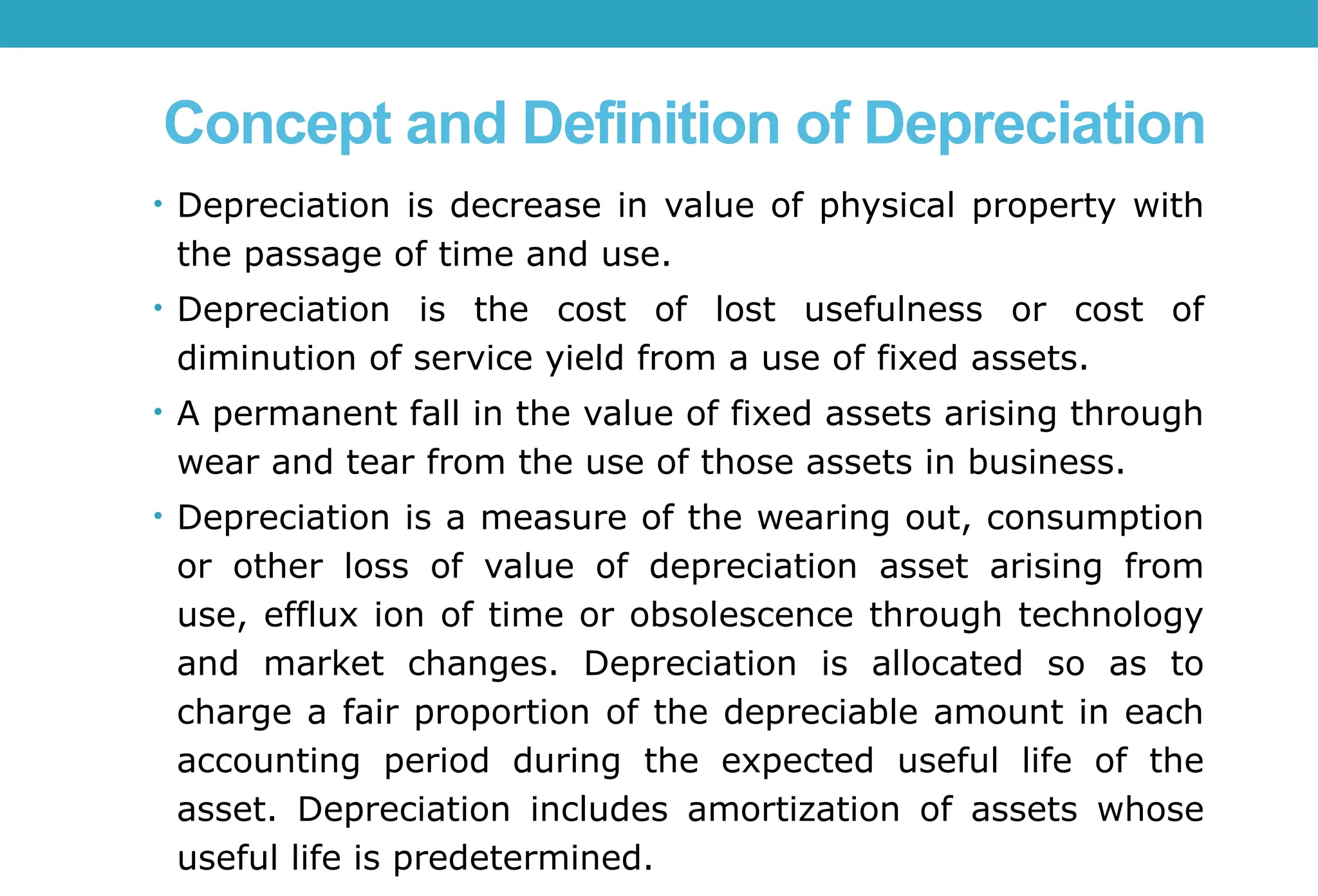
Concept and Definition of Depreciation
• Depreciation is decrease in value of physical property with
the passage of time and use.
• Depreciation is the cost of lost usefulness or cost of
diminution of service yield from a use of fixed assets.
• A permanent fall in the value of fixed assets arising through
wear and tear from the use of those assets in business.
• Depreciation is a measure of the wearing out, consumption
or other loss of value of depreciation asset arising from
use, efflux ion of time or obsolescence through technology
and market changes. Depreciation is allocated so as to
charge a fair proportion of the depreciable amount in each
accounting period during the expected useful life of the
asset. Depreciation includes amortization of assets whose
useful life is predetermined.
Depreciation
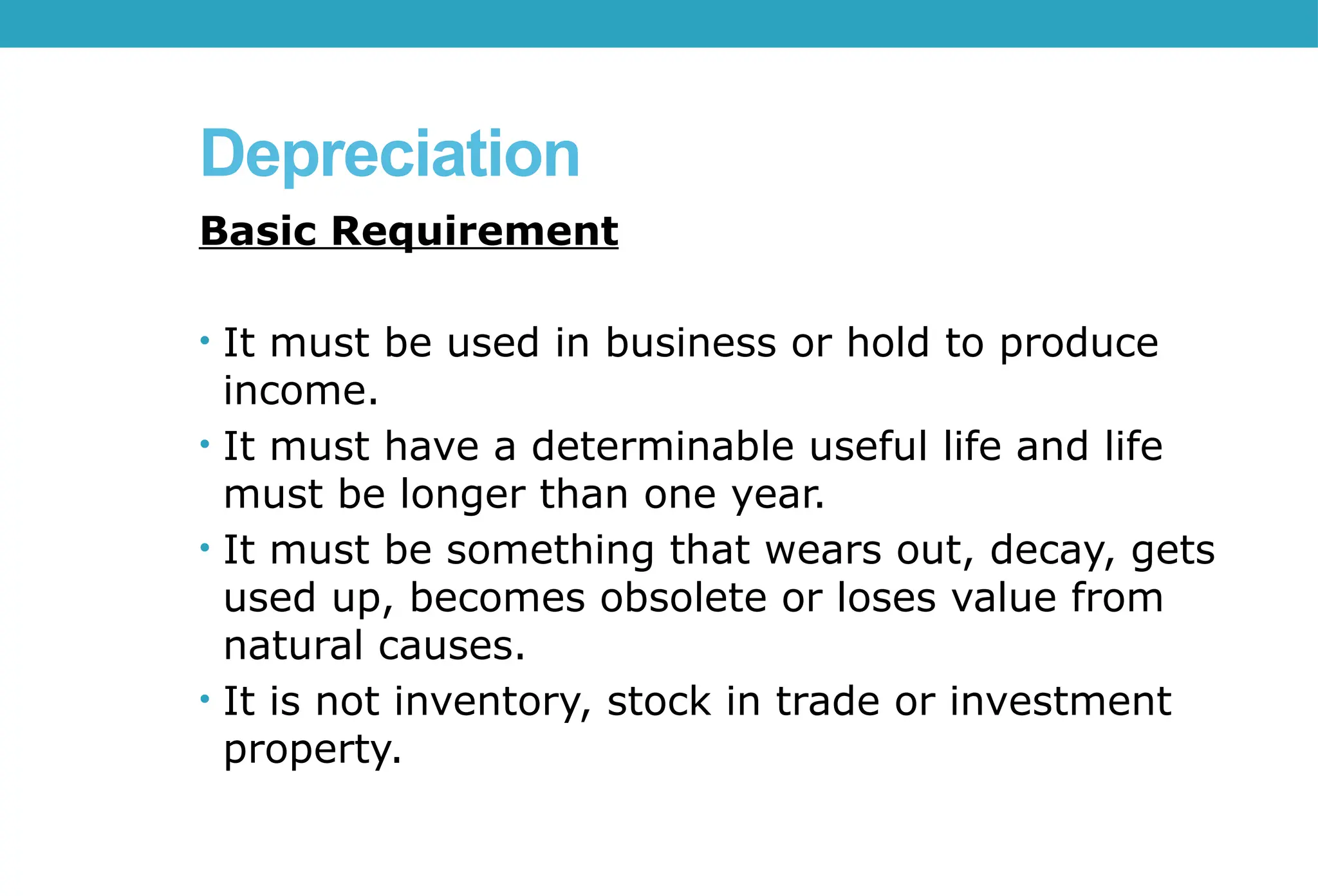
Basic Requirement
• It must be used in business or hold to produce
income.
• It must have a determinable useful life and life
must be longer than one year.
• It must be something that wears out, decay, gets
used up, becomes obsolete or loses value from
natural causes.
• It is not inventory, stock in trade or investment
property.
Depreciation
• Tangible product/property is that which can be
touched, feel or seen.
• Intangible product/property is usually the services
that are rendered or provided. It is personal property
such as copy right, patent or franchise.
• Real property is land and any thing erected on or
attached to land. Land itself is not depreciable
because it does not have a determined value.
• Personal property may include assets such as
machinery, vehicles, equipments, furniture and etc.
Adjusted Cost Basis
The original cost basis of the asset, adjusted by allowable increase or
decrease is used to compute depreciation and depletion.
Basis/ Cost basis
The initial cost of acquiring an asset (purchase price plus any sales
taxes) including transportation expenses and other normal costs of
making the asset serviceable for its indented use. It is also called the
unadjusted cost basis.
Book Value
The worth of a depreciable property is shown on the accounting records
of the company. It is original cost basis of the property, thus represents
the amount of capital that remains invested in the property and must
be recovered in the future through accounting process.
Book Value (BV) = Adjusted cost basis – k
j=1 (Depreciation deduction)
Terms regarding Depreciation
Market Value (MV)
The amount that will be paid by a willing buyer to a willing
seller or a property where each has equal advantage and is
under no compulsion to buy or sell. The MV approximates
the present value of what will be received through
ownership of the property, including the time value of money
(or profit).
Recovery Period
The number of years over which the basis of a property is
recovered through the accounting process.
Recovery Rate
A percentage (expressed in decimal form) for each year of
the MACRS recovery period that is utilized to compute an
annual depreciation deduction.
Terms regarding Depreciation
Salvage Value
The estimated value of a property at the end of its useful
life. It is the expected selling price of a property when the
asset can no longer be used productively by its owner. The
term net salvage value is used when the owner will incur
expenses in disposing of the property, and these each
outflows must be deducted from the cse inflows to obtain a
final net SV.
Useful Life
The expected (estimated) period of time that a property will
be used in a trade or business or to produce income. It is not
how long the property will last but how long the owner
expected to productively use it. Useful lift is sometimes
referred to as depreciable lift. Actual useful life of an asset,
however, may be different than its depreciable lift.
Terms regarding Depreciation
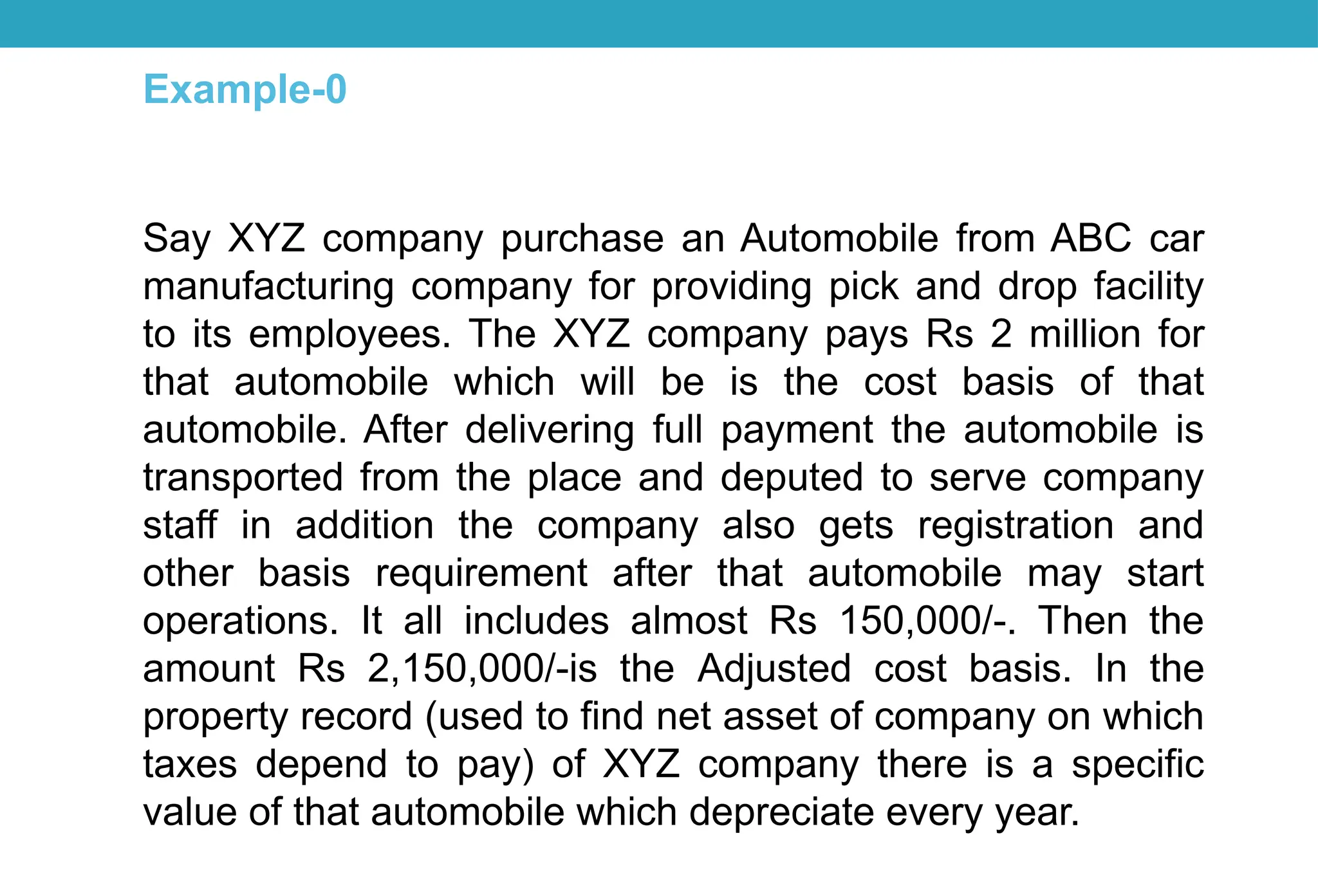
Say XYZ company purchase an Automobile from ABC car
manufacturing company for providing pick and drop facility
to its employees. The XYZ company pays Rs 2 million for
that automobile which will be is the cost basis of that
automobile. After delivering full payment the automobile is
transported from the place and deputed to serve company
staff in addition the company also gets registration and
other basis requirement after that automobile may start
operations. It all includes almost Rs 150,000/-. Then the
amount Rs 2,150,000/-is the Adjusted cost basis. In the
property record (used to find net asset of company on which
taxes depend to pay) of XYZ company there is a specific
value of that automobile which depreciate every year.
Example-0
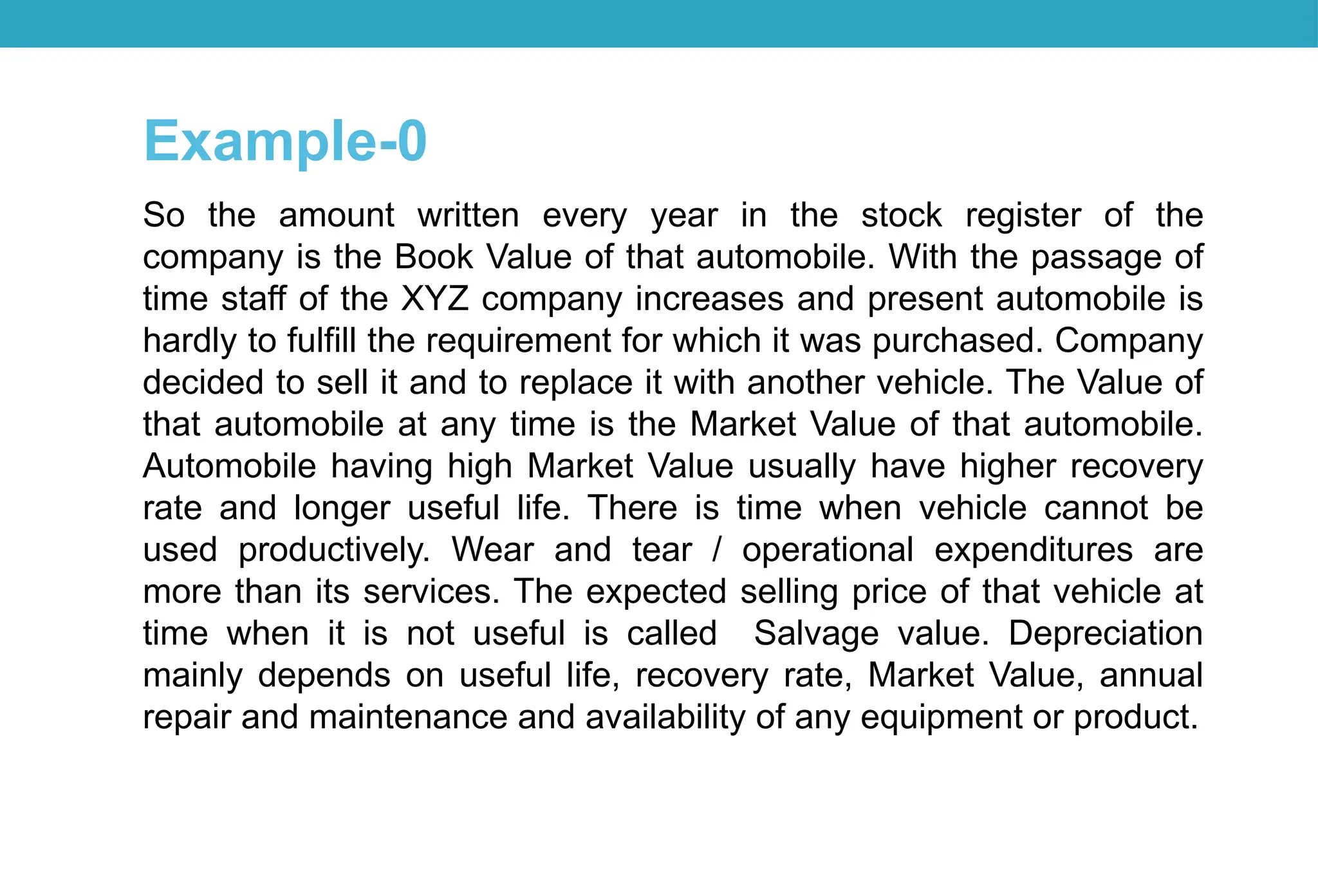
So the amount written every year in the stock register of the
company is the Book Value of that automobile. With the passage of
time staff of the XYZ company increases and present automobile is
hardly to fulfill the requirement for which it was purchased. Company
decided to sell it and to replace it with another vehicle. The Value of
that automobile at any time is the Market Value of that automobile.
Automobile having high Market Value usually have higher recovery
rate and longer useful life. There is time when vehicle cannot be
used productively. Wear and tear / operational expenditures are
more than its services. The expected selling price of that vehicle at
time when it is not useful is called Salvage value. Depreciation
mainly depends on useful life, recovery rate, Market Value, annual
repair and maintenance and availability of any equipment or product.
Example-0
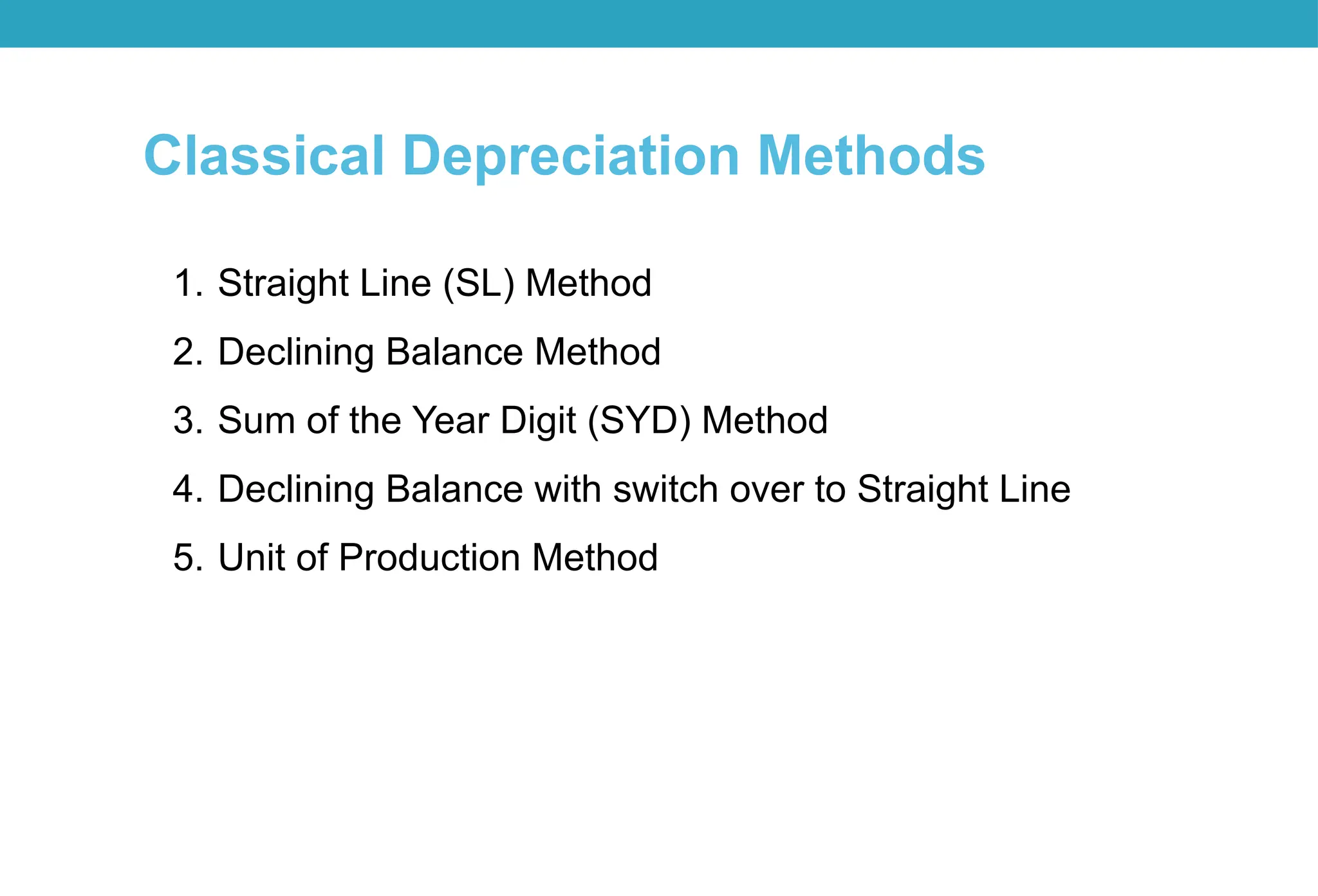
Classical Depreciation Methods
1. Straight Line (SL) Method
2. Declining Balance Method
3. Sum of the Year Digit (SYD) Method
4. Declining Balance with switch over to Straight Line
5. Unit of Production Method
Classical Depreciation Methods
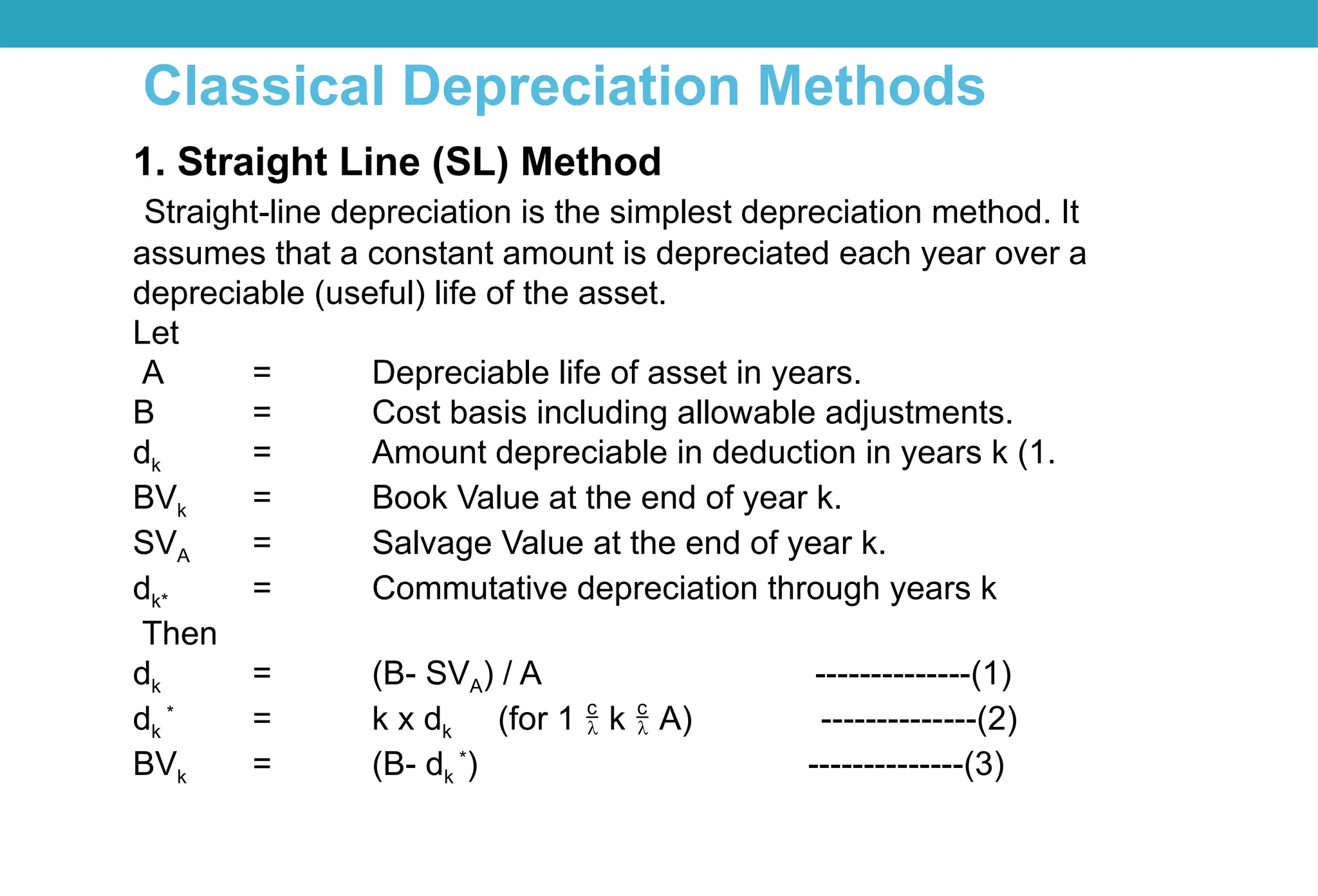
1. Straight Line (SL) Method
Straight-line depreciation is the simplest depreciation method. It
assumes that a constant amount is depreciated each year over a
depreciable (useful) life of the asset.
Let
A = Depreciable life of asset in years.
B = Cost basis including allowable adjustments.
dk = Amount depreciable in deduction in years k (1.
BVk = Book Value at the end of year k.
SVA = Salvage Value at the end of year k.
dk* = Commutative depreciation through years k
Then
dk = (B- SVA) / A --------------(1)
dk
*
= k x dk (for 1  k  A) --------------(2)
BVk = (B- dk
*
) --------------(3)
Classical Depreciation Methods
1. Straight Line (SL) Method
Example- 1
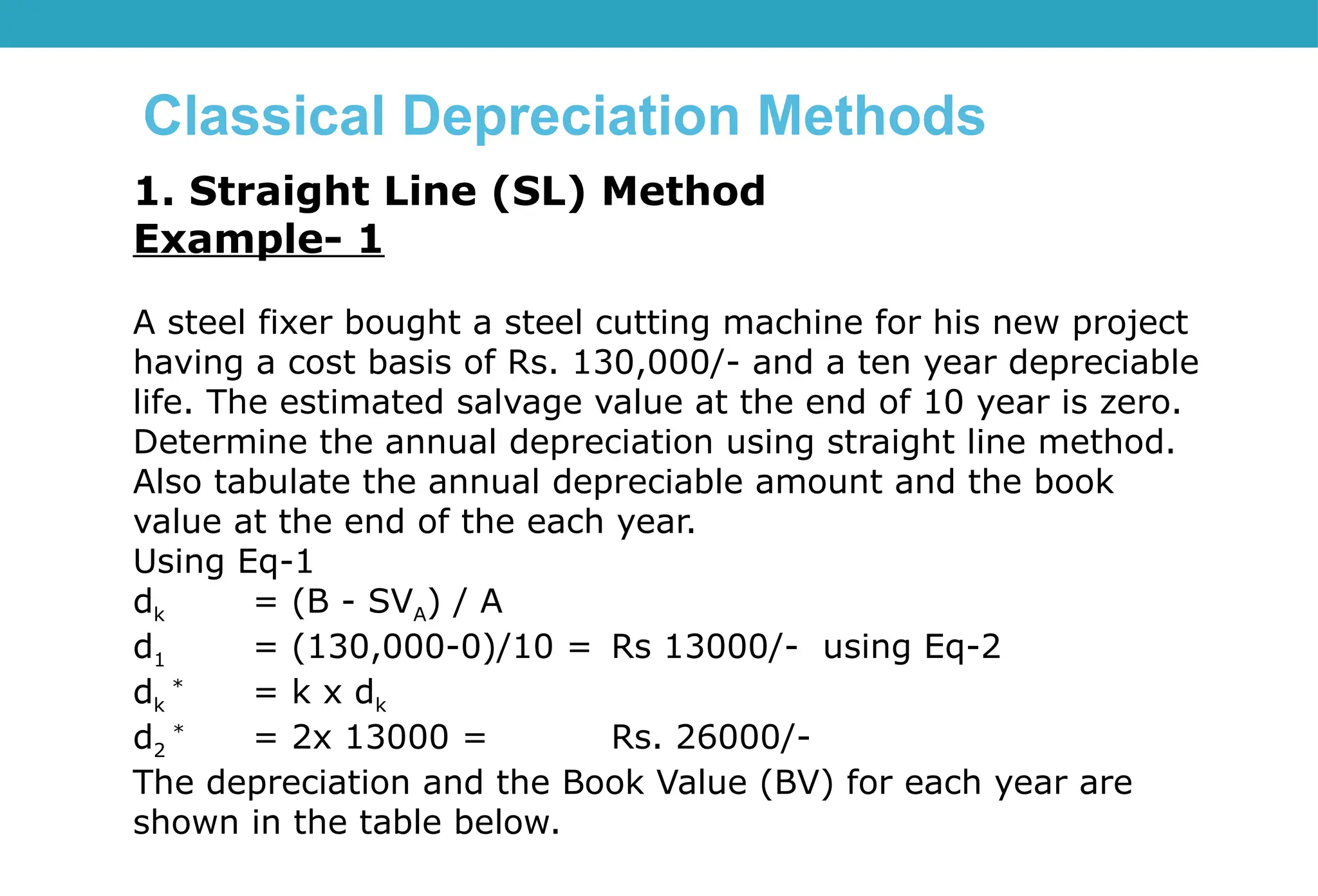
A steel fixer bought a steel cutting machine for his new project
having a cost basis of Rs. 130,000/- and a ten year depreciable
life. The estimated salvage value at the end of 10 year is zero.
Determine the annual depreciation using straight line method.
Also tabulate the annual depreciable amount and the book
value at the end of the each year.
Using Eq-1
dk = (B - SVA) / A
d1 = (130,000-0)/10 = Rs 13000/- using Eq-2
dk
*
= k x dk
d2
*
= 2x 13000 = Rs. 26000/-
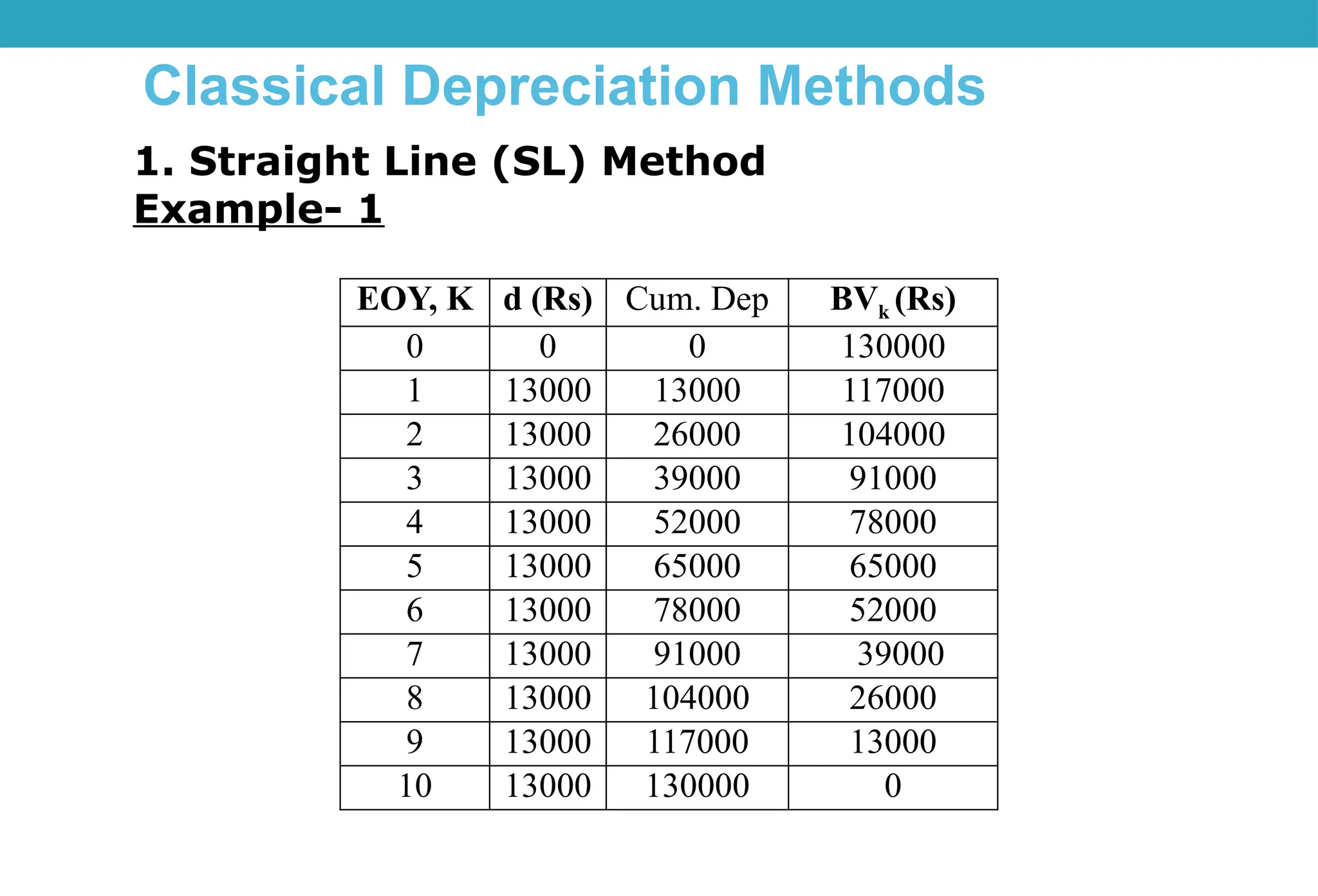
The depreciation and the Book Value (BV) for each year are
shown in the table below.
Classical Depreciation Methods
1. Straight Line (SL) Method
Example- 1
EOY, K d (Rs) Cum. Dep BVk (Rs)
0 0 0 130000
1 13000 13000 117000
2 13000 26000 104000
3 13000 39000 91000
4 13000 52000 78000
5 13000 65000 65000
6 13000 78000 52000
7 13000 91000 39000
8 13000 104000 26000
9 13000 117000 13000
10 13000 130000 0
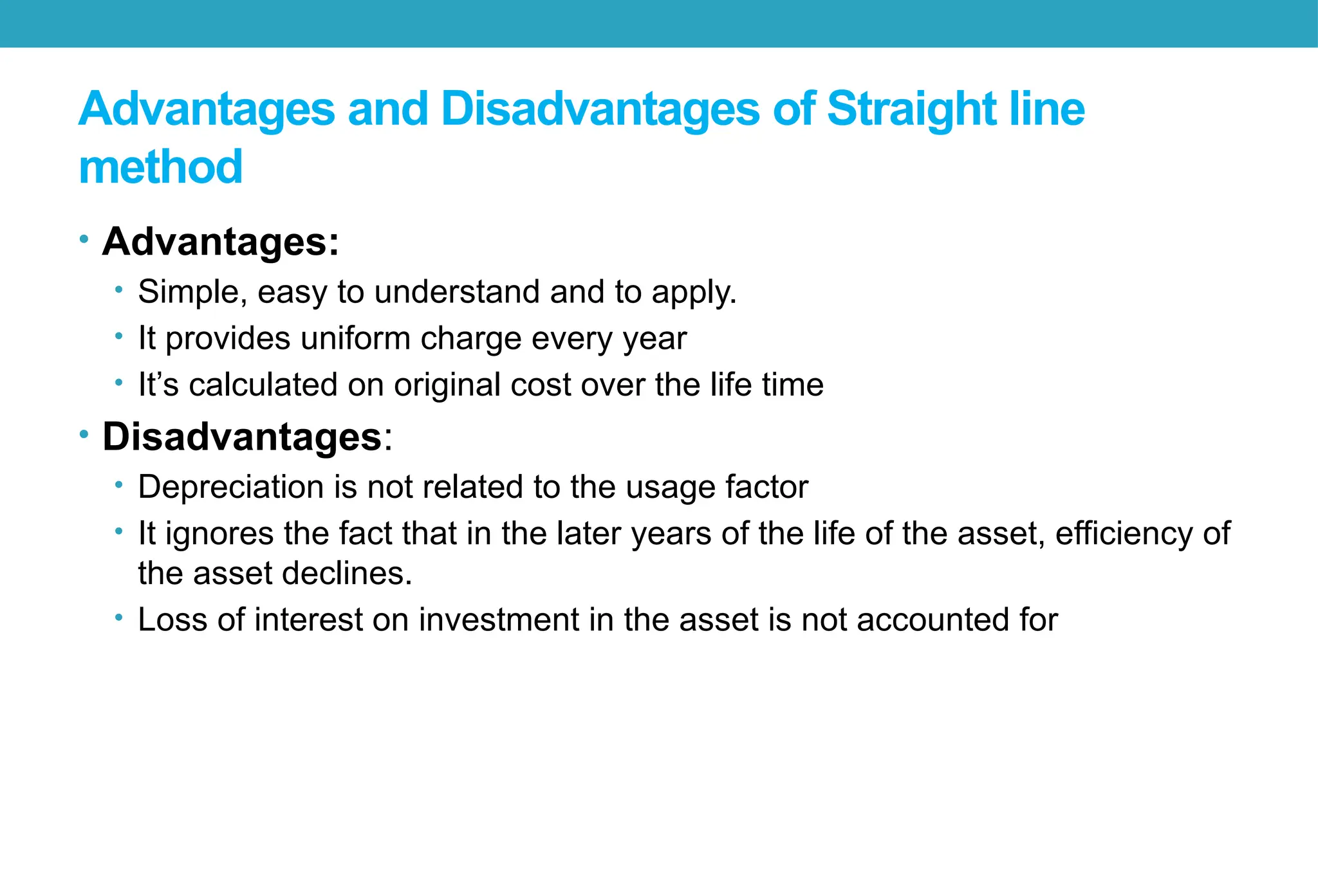
Advantages and Disadvantages of Straight line
method
• Advantages:
• Simple, easy to understand and to apply.
• It provides uniform charge every year
• It’s calculated on original cost over the life time
• Disadvantages:
• Depreciation is not related to the usage factor
• It ignores the fact that in the later years of the life of the asset, efficiency of
the asset declines.
• Loss of interest on investment in the asset is not accounted for
Classical Depreciation Methods
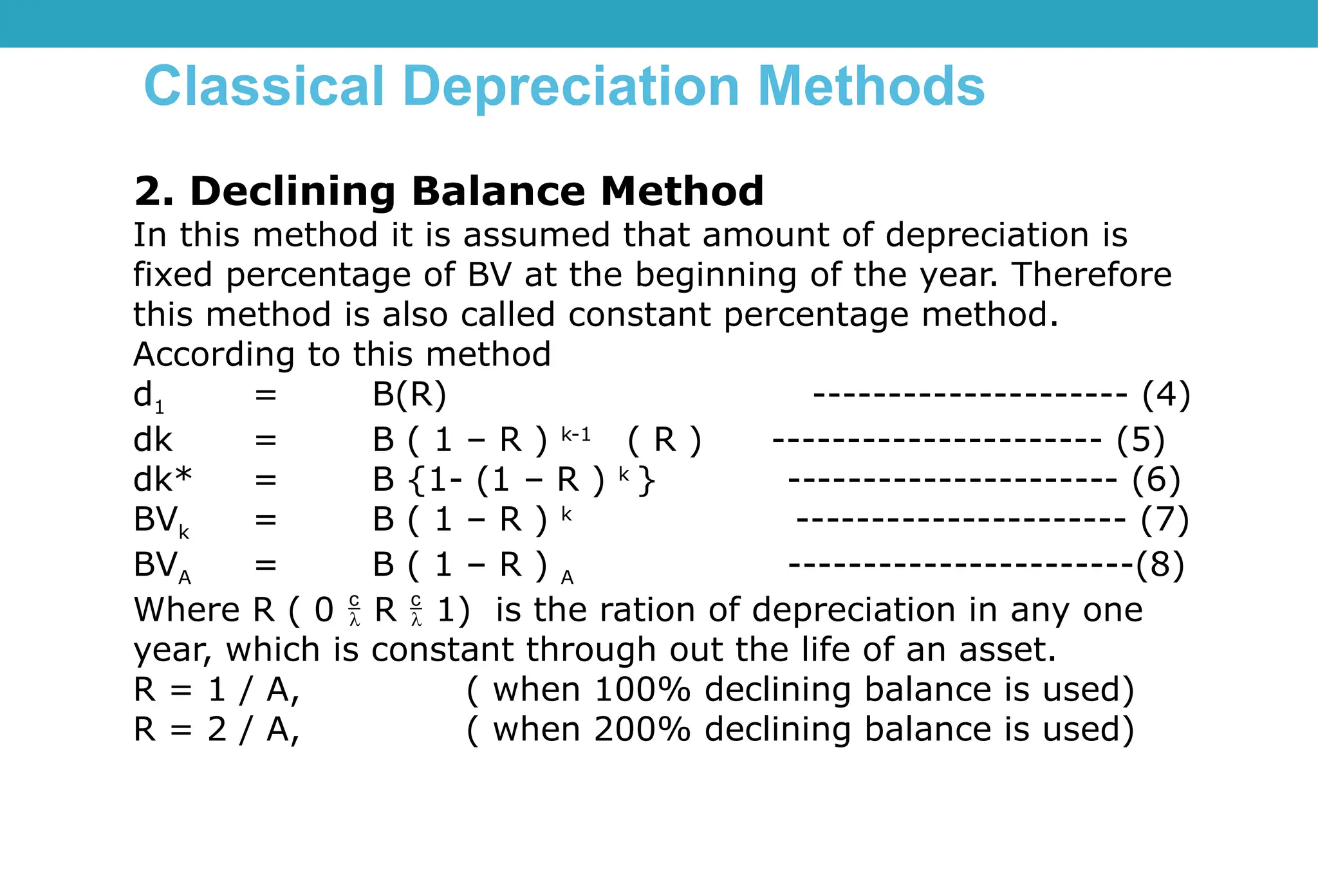
2. Declining Balance Method
In this method it is assumed that amount of depreciation is
fixed percentage of BV at the beginning of the year. Therefore
this method is also called constant percentage method.
According to this method
d1 = B(R) --------------------- (4)
dk = B ( 1 – R ) k-1
( R ) ---------------------- (5)
dk* = B {1- (1 – R ) k
} ---------------------- (6)
BVk = B ( 1 – R ) k
---------------------- (7)
BVA = B ( 1 – R ) A -----------------------(8)
Where R ( 0  R  1) is the ration of depreciation in any one
year, which is constant through out the life of an asset.
R = 1 / A, ( when 100% declining balance is used)
R = 2 / A, ( when 200% declining balance is used)
Classical Depreciation Methods
2. Declining Balance Method
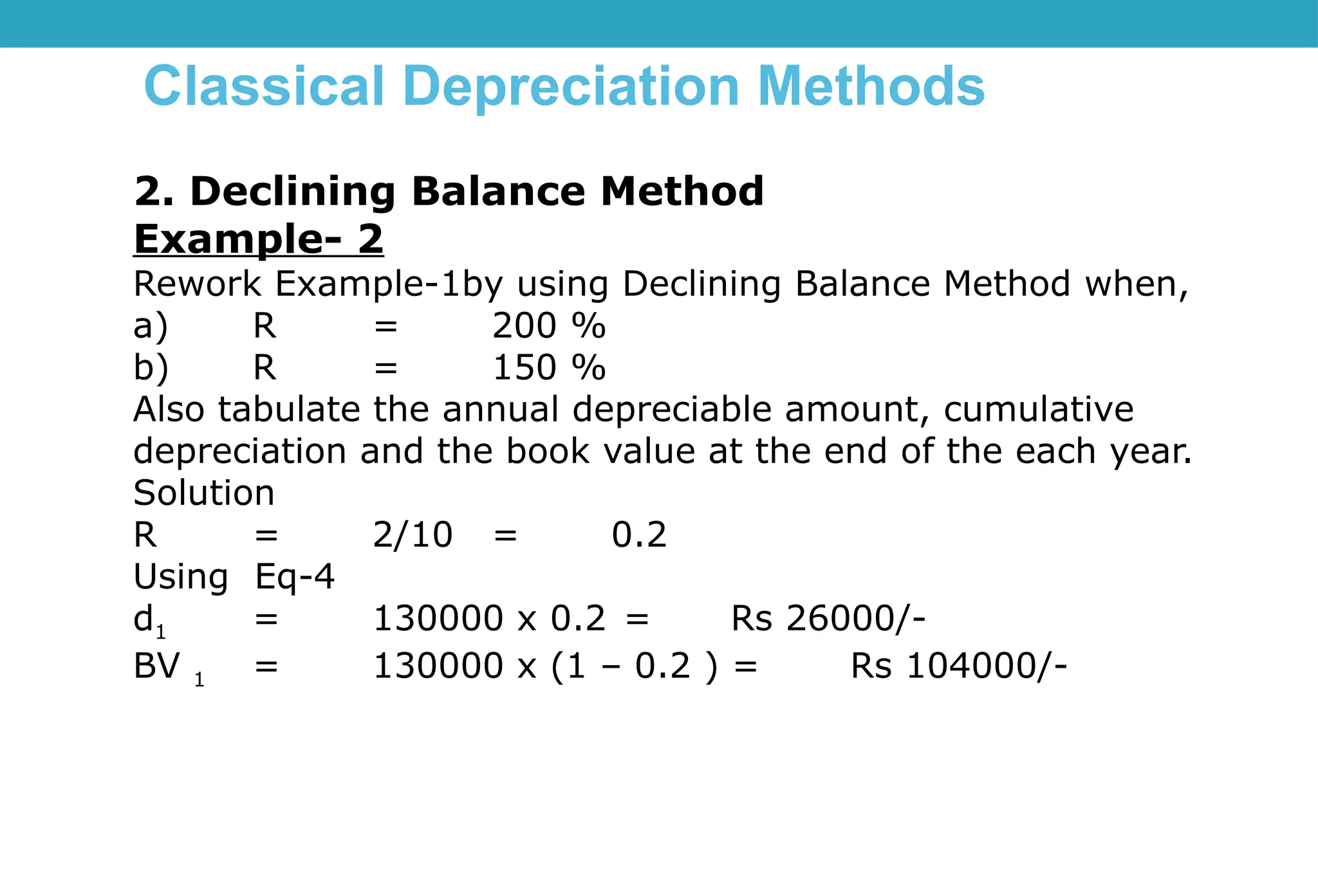
Example- 2
Rework Example-1by using Declining Balance Method when,
a) R = 200 %
b) R = 150 %
Also tabulate the annual depreciable amount, cumulative
depreciation and the book value at the end of the each year.
Solution
R = 2/10 = 0.2
Using Eq-4
d1 = 130000 x 0.2 = Rs 26000/-
BV 1 = 130000 x (1 – 0.2 ) = Rs 104000/-
Classical Depreciation Methods
2. Declining Balance Method
Example- 2
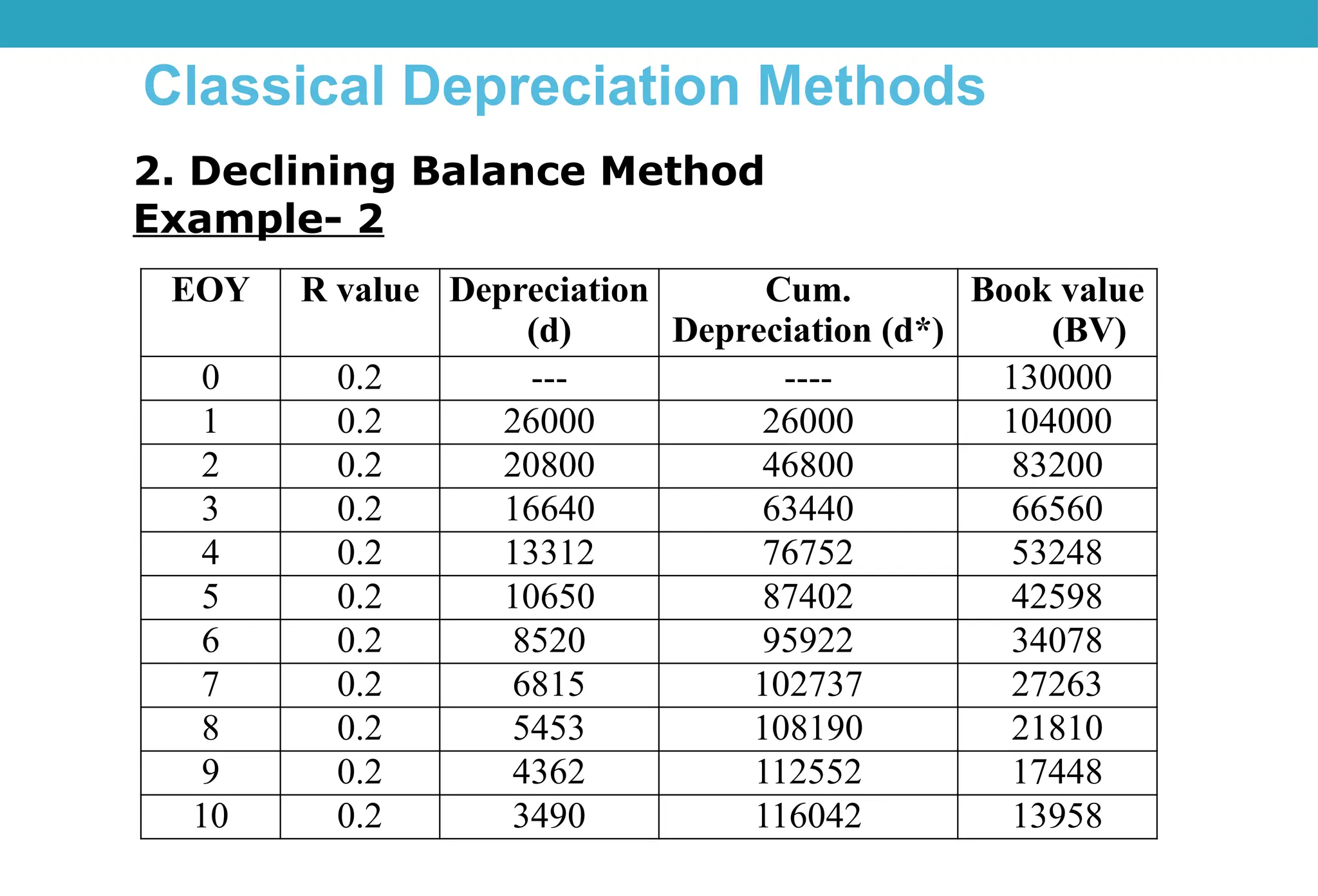
EOY R value Depreciation
(d)
Cum.
Depreciation (d*)
Book value
(BV)
0 0.2 --- ---- 130000
1 0.2 26000 26000 104000
2 0.2 20800 46800 83200
3 0.2 16640 63440 66560
4 0.2 13312 76752 53248
5 0.2 10650 87402 42598
6 0.2 8520 95922 34078
7 0.2 6815 102737 27263
8 0.2 5453 108190 21810
9 0.2 4362 112552 17448
10 0.2 3490 116042 13958
Classical Depreciation Methods
3. Sum of the Year Digit (SYD) Method
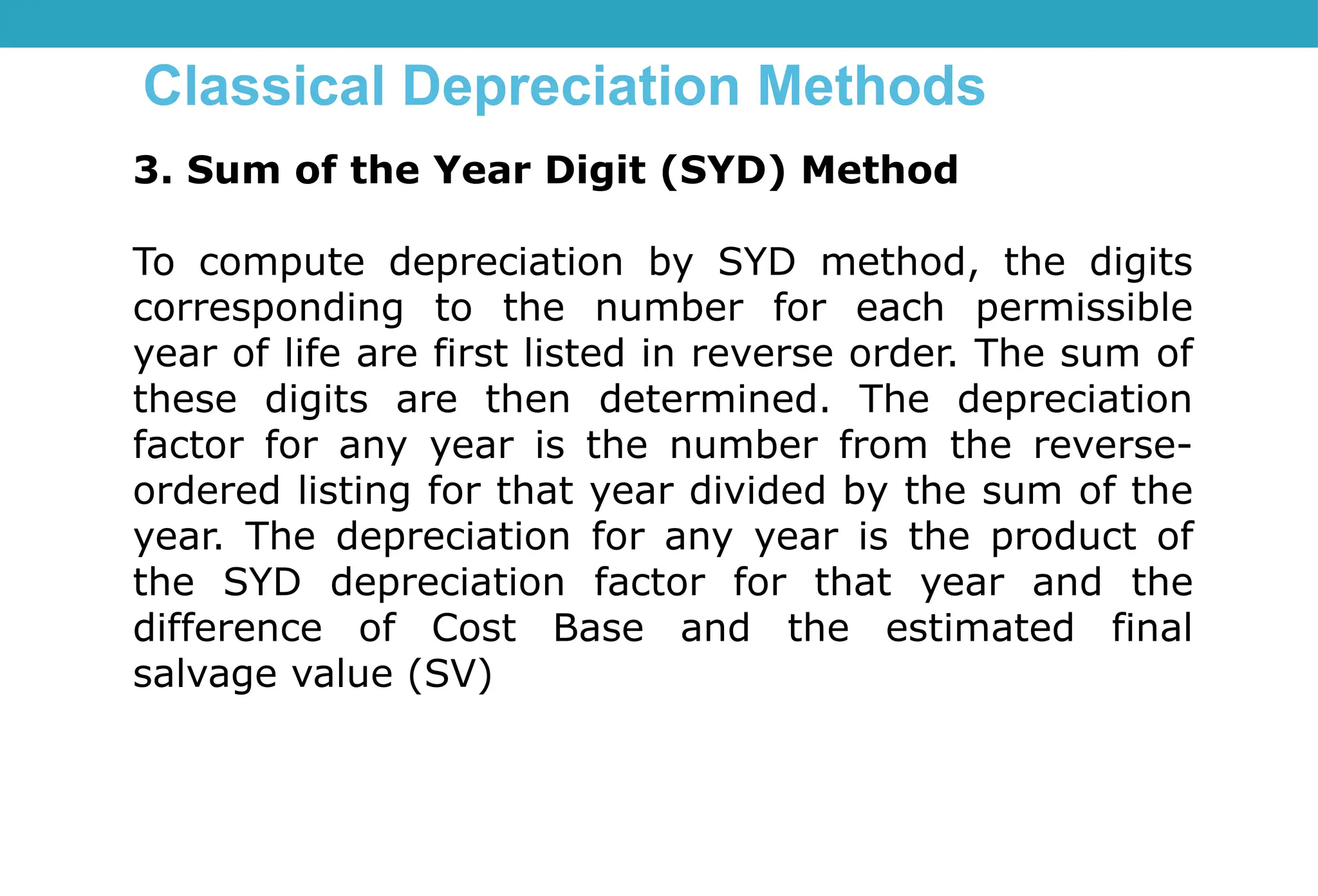
To compute depreciation by SYD method, the digits
corresponding to the number for each permissible
year of life are first listed in reverse order. The sum of
these digits are then determined. The depreciation
factor for any year is the number from the reverse-
ordered listing for that year divided by the sum of the
year. The depreciation for any year is the product of
the SYD depreciation factor for that year and the
difference of Cost Base and the estimated final
salvage value (SV)
Classical Depreciation Methods
3. Sum of the Year Digit (SYD) Method
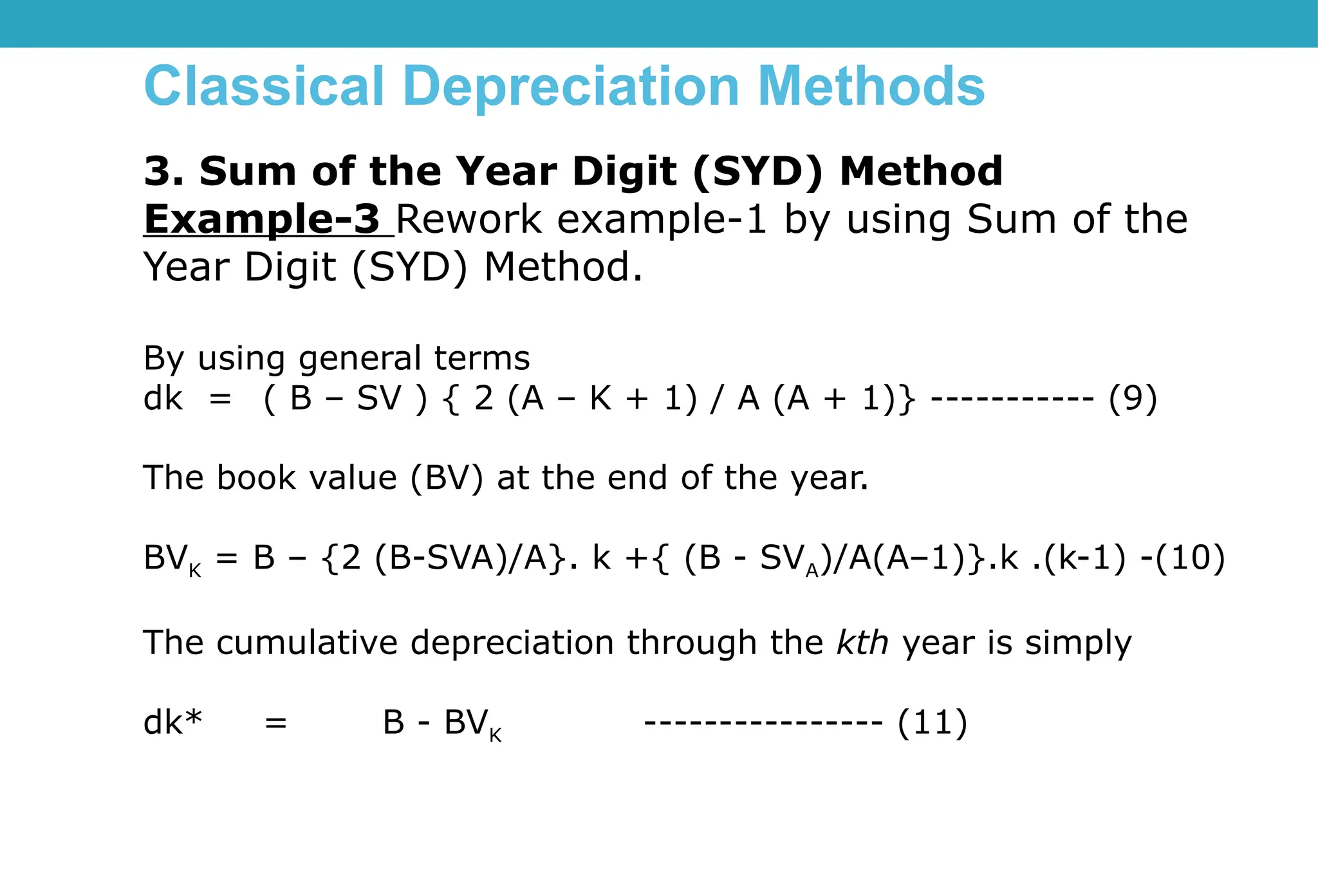
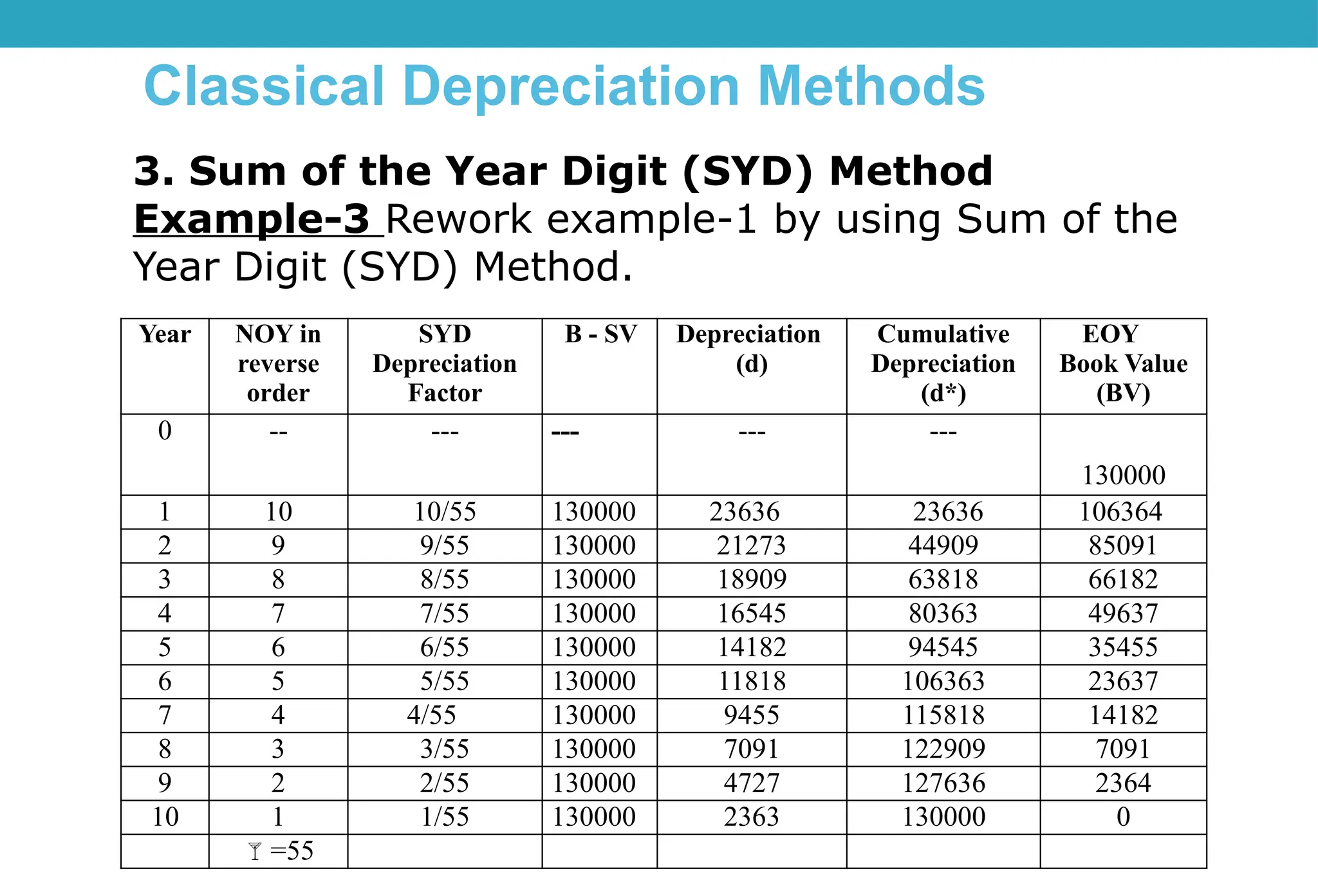
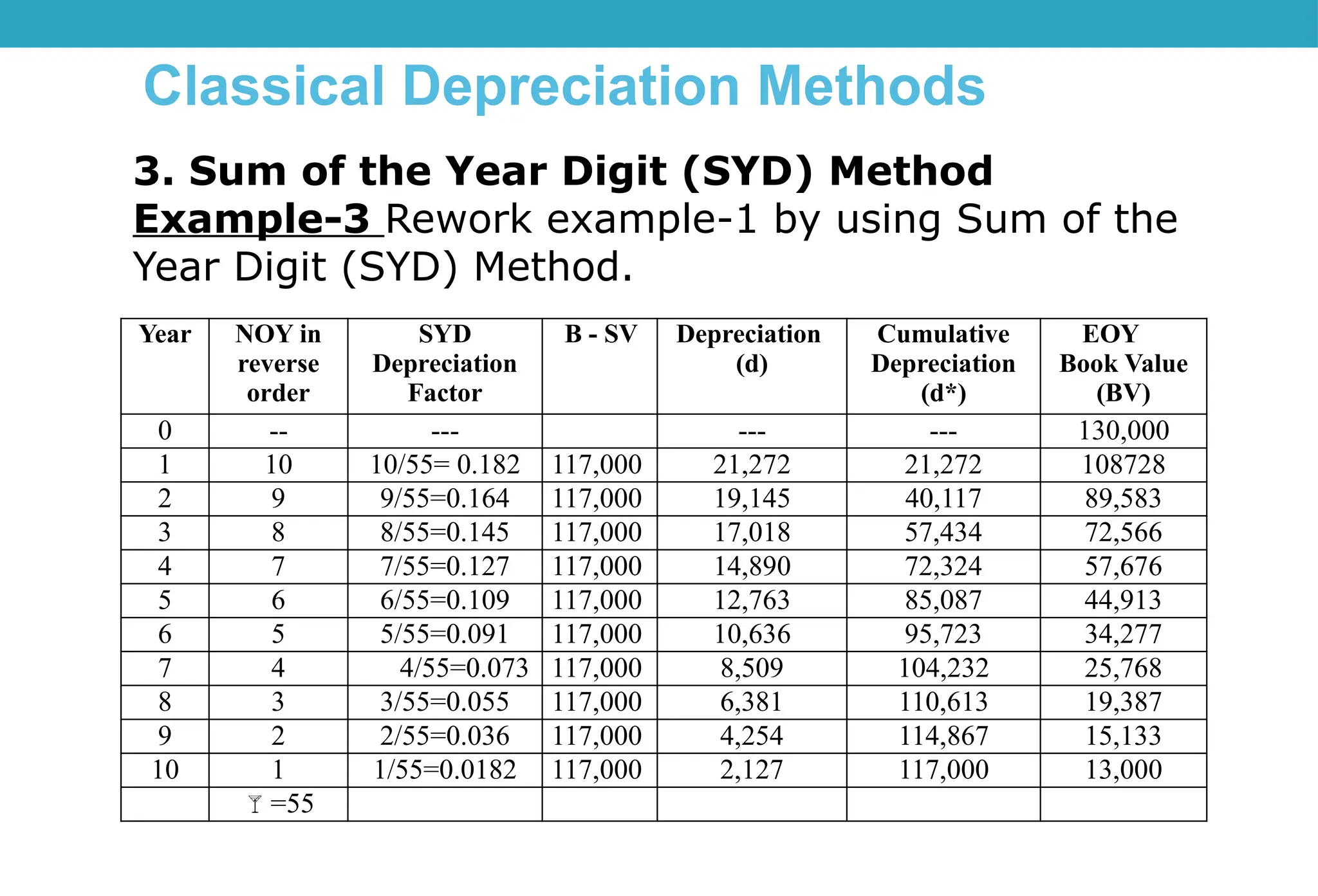
Example-3 Rework example-1 by using Sum of the
Year Digit (SYD) Method.
By using general terms
dk = ( B – SV ) { 2 (A – K + 1) / A (A + 1)} ----------- (9)
The book value (BV) at the end of the year.
BVK = B – {2 (B-SVA)/A}. k +{ (B - SVA)/A(A–1)}.k .(k-1) -(10)
The cumulative depreciation through the kth year is simply
dk* = B - BVK ---------------- (11)
Classical Depreciation Methods
3. Sum of the Year Digit (SYD) Method
Example-3 Rework example-1 by using Sum of the
Year Digit (SYD) Method.
Year NOY in
reverse
order
SYD
Depreciation
Factor
B - SV Depreciation
(d)
Cumulative
Depreciation
(d*)
EOY
Book Value
(BV)
0 -- --- --- --- ---
130000
1 10 10/55 130000 23636 23636 106364
2 9 9/55 130000 21273 44909 85091
3 8 8/55 130000 18909 63818 66182
4 7 7/55 130000 16545 80363 49637
5 6 6/55 130000 14182 94545 35455
6 5 5/55 130000 11818 106363 23637
7 4 4/55 130000 9455 115818 14182
8 3 3/55 130000 7091 122909 7091
9 2 2/55 130000 4727 127636 2364
10 1 1/55 130000 2363 130000 0
=55
Classical Depreciation Methods
3. Sum of the Year Digit (SYD) Method
Example-3 Rework example-1 by using Sum of the
Year Digit (SYD) Method.
Year NOY in
reverse
order
SYD
Depreciation
Factor
B - SV Depreciation
(d)
Cumulative
Depreciation
(d*)
EOY
Book Value
(BV)
0 -- --- --- --- 130,000
1 10 10/55= 0.182 117,000 21,272 21,272 108728
2 9 9/55=0.164 117,000 19,145 40,117 89,583
3 8 8/55=0.145 117,000 17,018 57,434 72,566
4 7 7/55=0.127 117,000 14,890 72,324 57,676
5 6 6/55=0.109 117,000 12,763 85,087 44,913
6 5 5/55=0.091 117,000 10,636 95,723 34,277
7 4 4/55=0.073 117,000 8,509 104,232 25,768
8 3 3/55=0.055 117,000 6,381 110,613 19,387
9 2 2/55=0.036 117,000 4,254 114,867 15,133
10 1 1/55=0.0182 117,000 2,127 117,000 13,000
=55
Classical Depreciation Methods
4. Declining Balance with switch over to
Straight Line
Because the declining balance method never
reaches a BV of zero it is permissible to switch from
this method to the straight line method so that the
asset’s SVA will be zero (or some other desired
value).
Classical Depreciation Methods
4. Declining Balance with switch over to
Straight Line
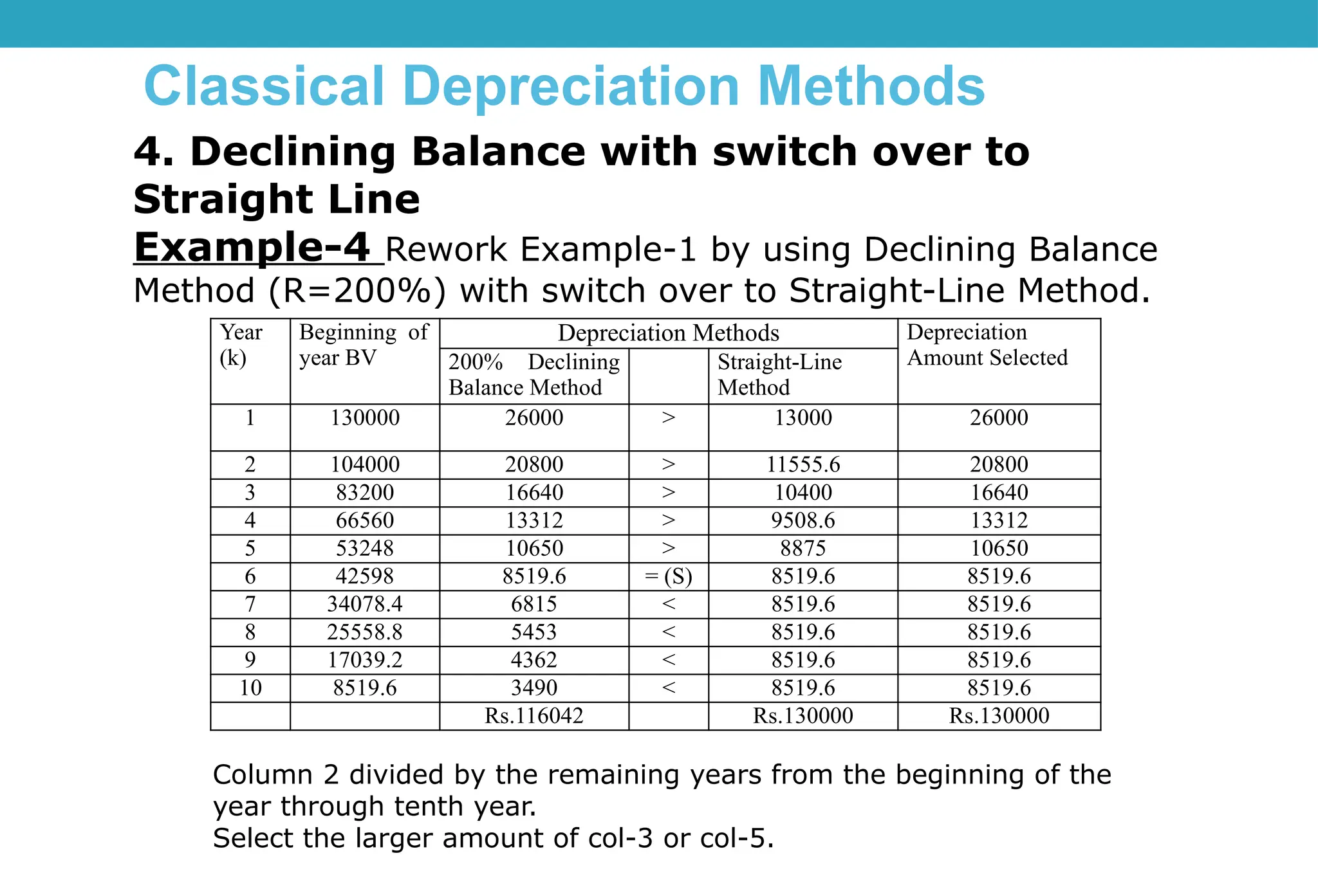
Example-4 Rework Example-1 by using Declining Balance
Method (R=200%) with switch over to Straight-Line Method.
Year
(k)
Beginning of
year BV
Depreciation Methods Depreciation
Amount Selected
200% Declining
Balance Method
Straight-Line
Method
1 130000 26000 > 13000 26000
2 104000 20800 > 11555.6 20800
3 83200 16640 > 10400 16640
4 66560 13312 > 9508.6 13312
5 53248 10650 > 8875 10650
6 42598 8519.6 = (S) 8519.6 8519.6
7 34078.4 6815 < 8519.6 8519.6
8 25558.8 5453 < 8519.6 8519.6
9 17039.2 4362 < 8519.6 8519.6
10 8519.6 3490 < 8519.6 8519.6
Rs.116042 Rs.130000 Rs.130000
Column 2 divided by the remaining years from the beginning of the
year through tenth year.
Select the larger amount of col-3 or col-5.
Classical Depreciation Methods
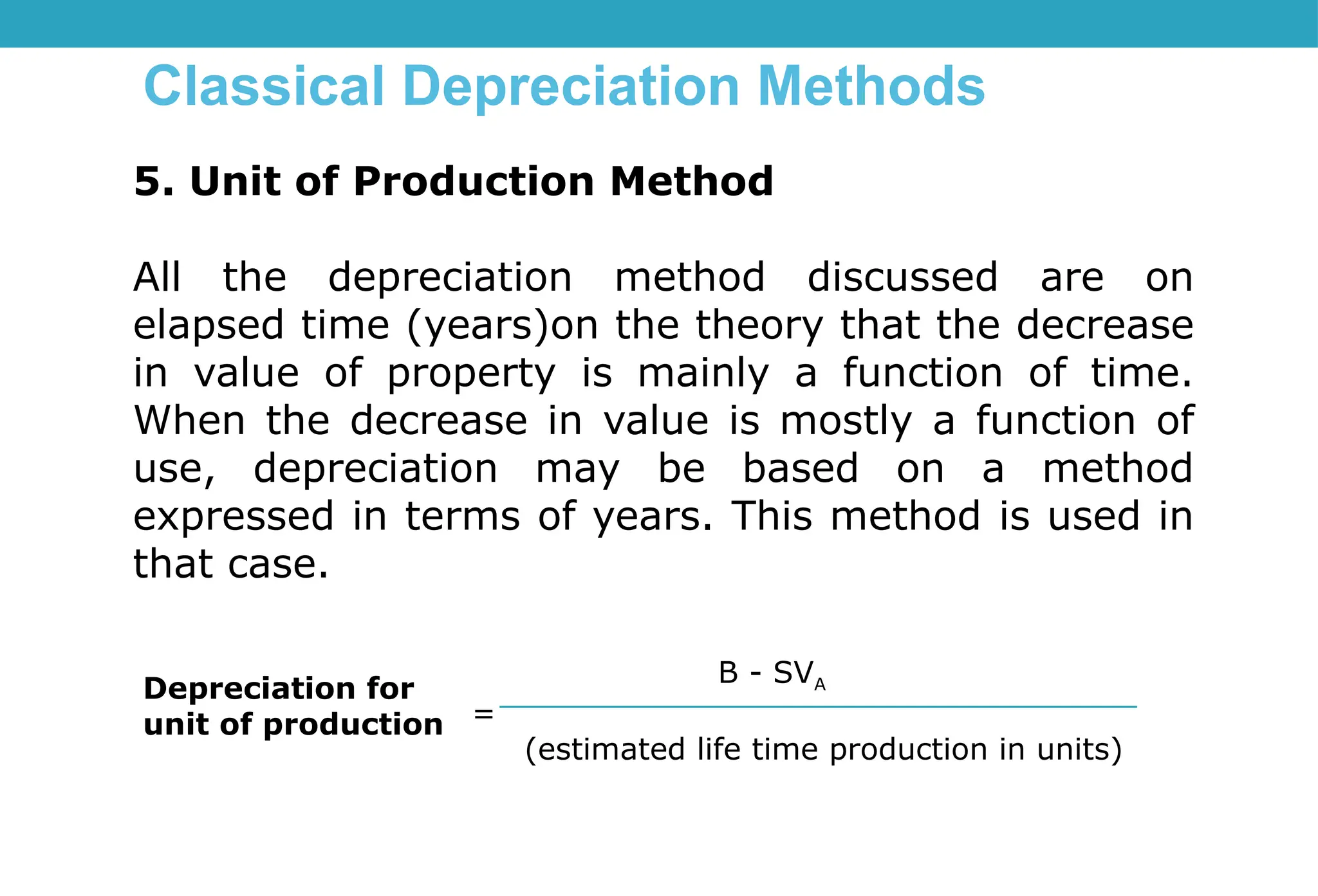
5. Unit of Production Method
All the depreciation method discussed are on
elapsed time (years)on the theory that the decrease
in value of property is mainly a function of time.
When the decrease in value is mostly a function of
use, depreciation may be based on a method
expressed in terms of years. This method is used in
that case.
Depreciation for
unit of production
B - SVA
=
(estimated life time production in units)
Classical Depreciation Methods
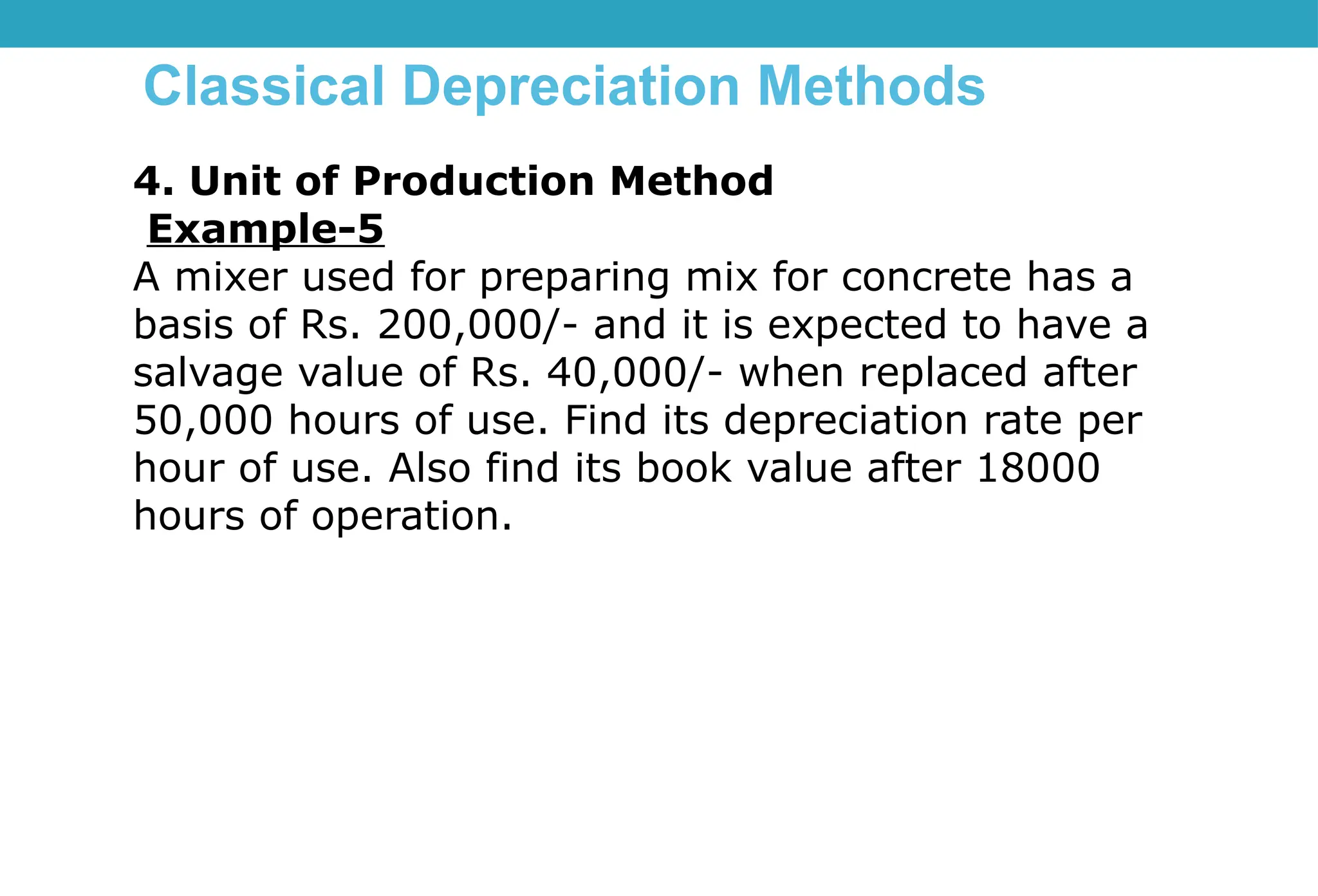
4. Unit of Production Method
Example-5
A mixer used for preparing mix for concrete has a
basis of Rs. 200,000/- and it is expected to have a
salvage value of Rs. 40,000/- when replaced after
50,000 hours of use. Find its depreciation rate per
hour of use. Also find its book value after 18000
hours of operation.
Classical Depreciation Methods
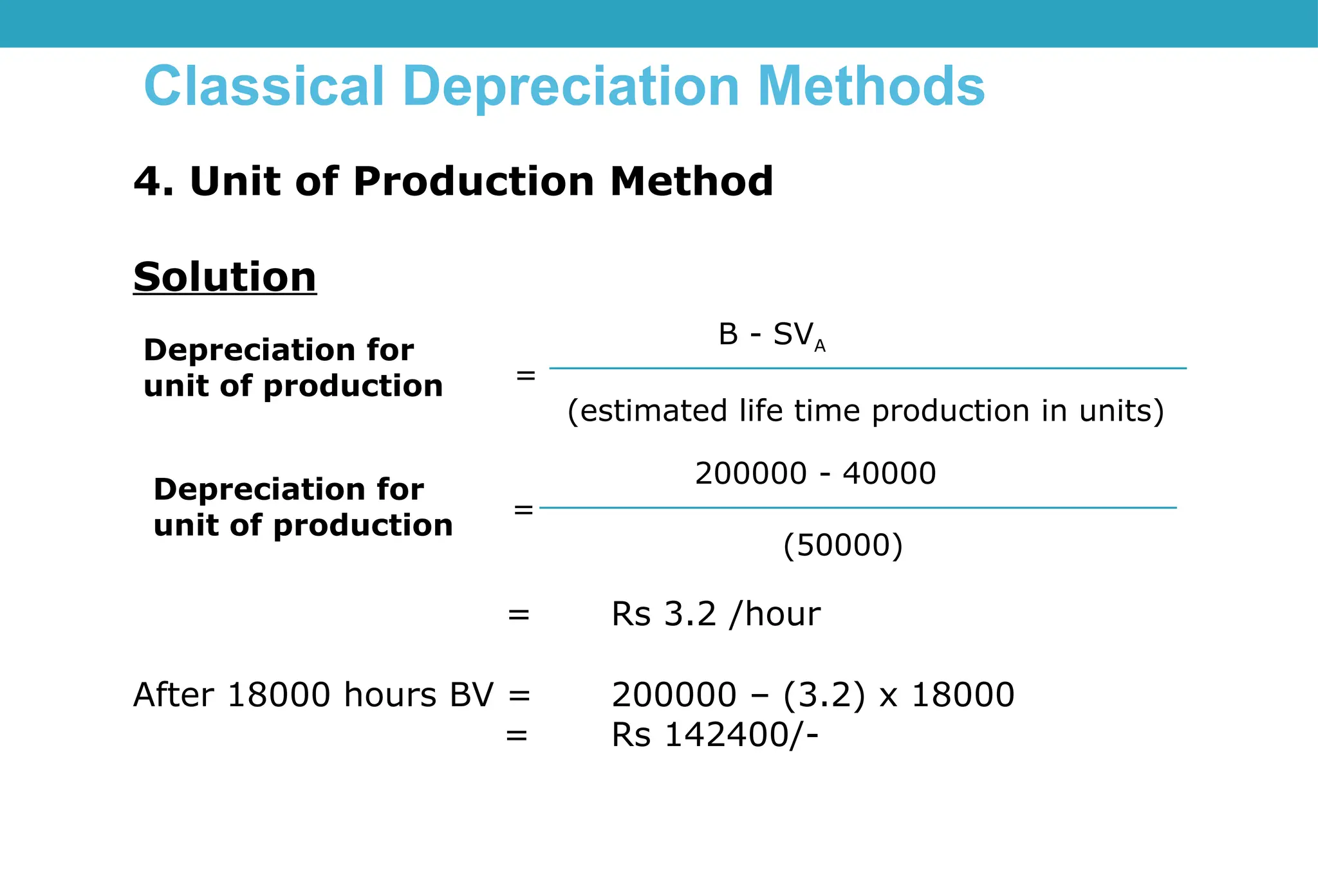
4. Unit of Production Method
Solution
= Rs 3.2 /hour
After 18000 hours BV = 200000 – (3.2) x 18000
= Rs 142400/-
Depreciation for
unit of production
B - SVA
=
(estimated life time production in units)
Depreciation for
unit of production
200000 - 40000
=
(50000)
DEPLETION
When natural resources are being consumed in producing
products or services, the tern depletion is used to indicate
decrease in value of the resources base that has
occurred. The term is commonly used in connection with
mining properties, oil and gas wells, timberland and so on.
In a given parcel of mineral property there is definite
quantity of ore or oil or gas available. As some of the
resources is extracted and sold, the reserves decreases
and the value of the property normally diminished. There
is difference in the manner in which amount recovered
through depletion and depreciation must be handled. In
case of depreciation the property involved usually may be
replaced with similar property when becomes fully
depreciated.
Depletion
In case of depletion of mineral or other natural
resources such replacement is not possible. Once the
gold has been recovered from a mine, it cannot be
replaced. In manufacturing or in another business
where the depreciation occurs, the principal of
maintenance of capital is practiced and the amount
charged for depreciation expenses are reinvested in in
a new equipment so that the business may continue
in operation in definitely. On the other hand, in case
of mining or other mineral or oil and gas industry, the
amount charged as depletion cannot be used to
replace the sold natural resource, the company, in
effect, may sell itself out of business as it caries out
its normal operation. Such companies pay out to the
owners each year the amount recovered as depletion.
Depletion
Thus the annual payment to owner is made in two
parts;
1.The profit that has been earned
2.A portion of owners capital that is being retuned,
marked as depletion.
In operation of many natural resources business, the
depletion funds may be used to acquire new
properties, such as new mines and oil and gas
producing properties, and thus give continuity of the
enterprise.
There are two ways to calculate depletion allowances.
3. Cost Method.
4. Percentage Method
Depletion Calculations
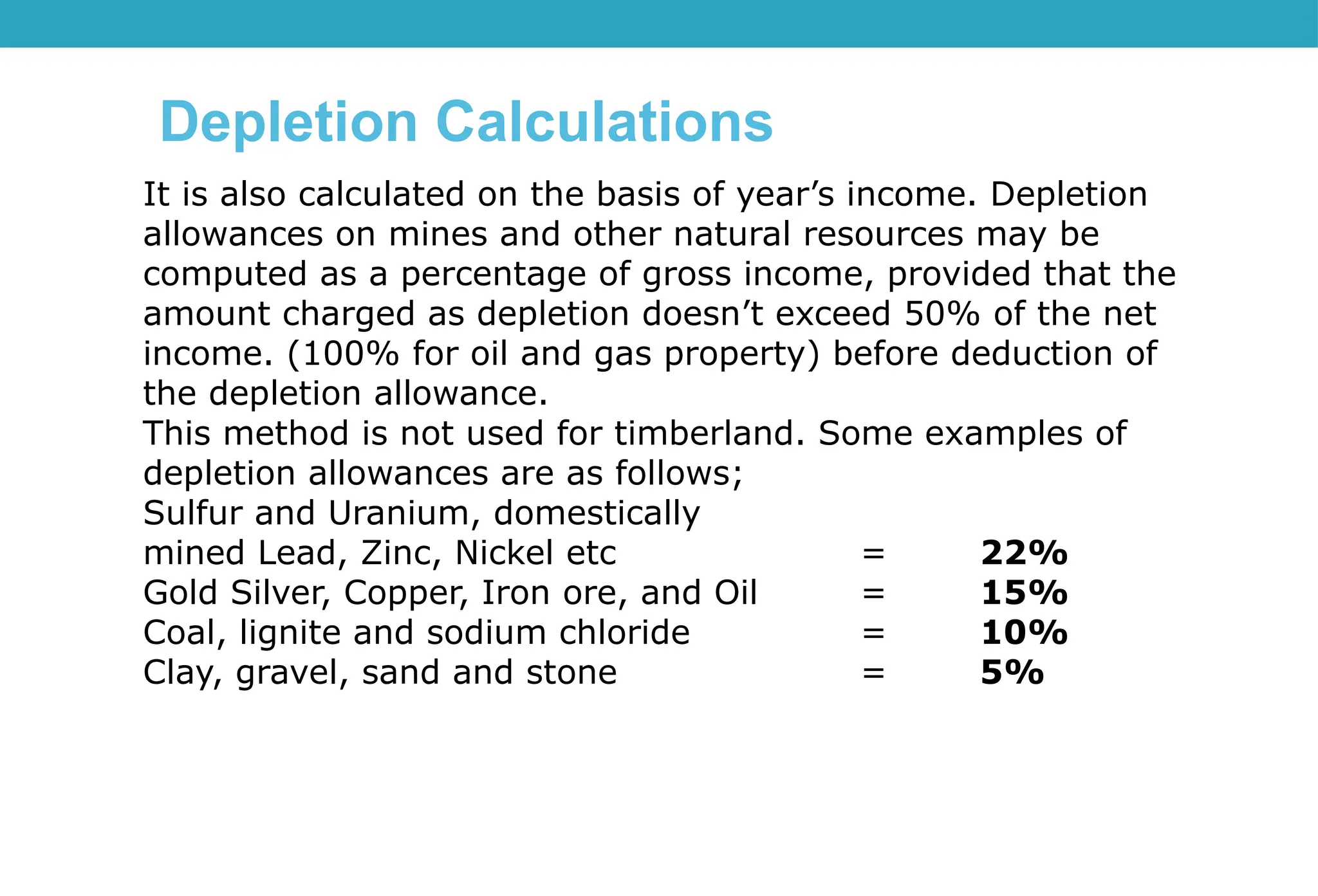
It is also calculated on the basis of year’s income. Depletion
allowances on mines and other natural resources may be
computed as a percentage of gross income, provided that the
amount charged as depletion doesn’t exceed 50% of the net
income. (100% for oil and gas property) before deduction of
the depletion allowance.
This method is not used for timberland. Some examples of
depletion allowances are as follows;
Sulfur and Uranium, domestically
mined Lead, Zinc, Nickel etc = 22%
Gold Silver, Copper, Iron ore, and Oil = 15%
Coal, lignite and sodium chloride = 10%
Clay, gravel, sand and stone = 5%
Depletion Calculations
THANK YOU FOR PARTICIPATION

Lecture 7 Depreciation.pptx Lecture 7 Depreciation.pptx

  • 2.
  • 3.
  • 4.
    Concept and Definitionof Depreciation • Depreciation is decrease in value of physical property with the passage of time and use. • Depreciation is the cost of lost usefulness or cost of diminution of service yield from a use of fixed assets. • A permanent fall in the value of fixed assets arising through wear and tear from the use of those assets in business. • Depreciation is a measure of the wearing out, consumption or other loss of value of depreciation asset arising from use, efflux ion of time or obsolescence through technology and market changes. Depreciation is allocated so as to charge a fair proportion of the depreciable amount in each accounting period during the expected useful life of the asset. Depreciation includes amortization of assets whose useful life is predetermined.
  • 5.
    Depreciation Basic Requirement • Itmust be used in business or hold to produce income. • It must have a determinable useful life and life must be longer than one year. • It must be something that wears out, decay, gets used up, becomes obsolete or loses value from natural causes. • It is not inventory, stock in trade or investment property.
  • 6.
    Depreciation • Tangible product/propertyis that which can be touched, feel or seen. • Intangible product/property is usually the services that are rendered or provided. It is personal property such as copy right, patent or franchise. • Real property is land and any thing erected on or attached to land. Land itself is not depreciable because it does not have a determined value. • Personal property may include assets such as machinery, vehicles, equipments, furniture and etc.
  • 7.
    Adjusted Cost Basis Theoriginal cost basis of the asset, adjusted by allowable increase or decrease is used to compute depreciation and depletion. Basis/ Cost basis The initial cost of acquiring an asset (purchase price plus any sales taxes) including transportation expenses and other normal costs of making the asset serviceable for its indented use. It is also called the unadjusted cost basis. Book Value The worth of a depreciable property is shown on the accounting records of the company. It is original cost basis of the property, thus represents the amount of capital that remains invested in the property and must be recovered in the future through accounting process. Book Value (BV) = Adjusted cost basis – k j=1 (Depreciation deduction) Terms regarding Depreciation
  • 8.
    Market Value (MV) Theamount that will be paid by a willing buyer to a willing seller or a property where each has equal advantage and is under no compulsion to buy or sell. The MV approximates the present value of what will be received through ownership of the property, including the time value of money (or profit). Recovery Period The number of years over which the basis of a property is recovered through the accounting process. Recovery Rate A percentage (expressed in decimal form) for each year of the MACRS recovery period that is utilized to compute an annual depreciation deduction. Terms regarding Depreciation
  • 9.
    Salvage Value The estimatedvalue of a property at the end of its useful life. It is the expected selling price of a property when the asset can no longer be used productively by its owner. The term net salvage value is used when the owner will incur expenses in disposing of the property, and these each outflows must be deducted from the cse inflows to obtain a final net SV. Useful Life The expected (estimated) period of time that a property will be used in a trade or business or to produce income. It is not how long the property will last but how long the owner expected to productively use it. Useful lift is sometimes referred to as depreciable lift. Actual useful life of an asset, however, may be different than its depreciable lift. Terms regarding Depreciation
  • 10.
    Say XYZ companypurchase an Automobile from ABC car manufacturing company for providing pick and drop facility to its employees. The XYZ company pays Rs 2 million for that automobile which will be is the cost basis of that automobile. After delivering full payment the automobile is transported from the place and deputed to serve company staff in addition the company also gets registration and other basis requirement after that automobile may start operations. It all includes almost Rs 150,000/-. Then the amount Rs 2,150,000/-is the Adjusted cost basis. In the property record (used to find net asset of company on which taxes depend to pay) of XYZ company there is a specific value of that automobile which depreciate every year. Example-0
  • 11.
    So the amountwritten every year in the stock register of the company is the Book Value of that automobile. With the passage of time staff of the XYZ company increases and present automobile is hardly to fulfill the requirement for which it was purchased. Company decided to sell it and to replace it with another vehicle. The Value of that automobile at any time is the Market Value of that automobile. Automobile having high Market Value usually have higher recovery rate and longer useful life. There is time when vehicle cannot be used productively. Wear and tear / operational expenditures are more than its services. The expected selling price of that vehicle at time when it is not useful is called Salvage value. Depreciation mainly depends on useful life, recovery rate, Market Value, annual repair and maintenance and availability of any equipment or product. Example-0
  • 12.
    Classical Depreciation Methods 1.Straight Line (SL) Method 2. Declining Balance Method 3. Sum of the Year Digit (SYD) Method 4. Declining Balance with switch over to Straight Line 5. Unit of Production Method
  • 13.
    Classical Depreciation Methods 1.Straight Line (SL) Method Straight-line depreciation is the simplest depreciation method. It assumes that a constant amount is depreciated each year over a depreciable (useful) life of the asset. Let A = Depreciable life of asset in years. B = Cost basis including allowable adjustments. dk = Amount depreciable in deduction in years k (1. BVk = Book Value at the end of year k. SVA = Salvage Value at the end of year k. dk* = Commutative depreciation through years k Then dk = (B- SVA) / A --------------(1) dk * = k x dk (for 1  k  A) --------------(2) BVk = (B- dk * ) --------------(3)
  • 14.
    Classical Depreciation Methods 1.Straight Line (SL) Method Example- 1 A steel fixer bought a steel cutting machine for his new project having a cost basis of Rs. 130,000/- and a ten year depreciable life. The estimated salvage value at the end of 10 year is zero. Determine the annual depreciation using straight line method. Also tabulate the annual depreciable amount and the book value at the end of the each year. Using Eq-1 dk = (B - SVA) / A d1 = (130,000-0)/10 = Rs 13000/- using Eq-2 dk * = k x dk d2 * = 2x 13000 = Rs. 26000/- The depreciation and the Book Value (BV) for each year are shown in the table below.
  • 15.
    Classical Depreciation Methods 1.Straight Line (SL) Method Example- 1 EOY, K d (Rs) Cum. Dep BVk (Rs) 0 0 0 130000 1 13000 13000 117000 2 13000 26000 104000 3 13000 39000 91000 4 13000 52000 78000 5 13000 65000 65000 6 13000 78000 52000 7 13000 91000 39000 8 13000 104000 26000 9 13000 117000 13000 10 13000 130000 0
  • 16.
    Advantages and Disadvantagesof Straight line method • Advantages: • Simple, easy to understand and to apply. • It provides uniform charge every year • It’s calculated on original cost over the life time • Disadvantages: • Depreciation is not related to the usage factor • It ignores the fact that in the later years of the life of the asset, efficiency of the asset declines. • Loss of interest on investment in the asset is not accounted for
  • 17.
    Classical Depreciation Methods 2.Declining Balance Method In this method it is assumed that amount of depreciation is fixed percentage of BV at the beginning of the year. Therefore this method is also called constant percentage method. According to this method d1 = B(R) --------------------- (4) dk = B ( 1 – R ) k-1 ( R ) ---------------------- (5) dk* = B {1- (1 – R ) k } ---------------------- (6) BVk = B ( 1 – R ) k ---------------------- (7) BVA = B ( 1 – R ) A -----------------------(8) Where R ( 0  R  1) is the ration of depreciation in any one year, which is constant through out the life of an asset. R = 1 / A, ( when 100% declining balance is used) R = 2 / A, ( when 200% declining balance is used)
  • 18.
    Classical Depreciation Methods 2.Declining Balance Method Example- 2 Rework Example-1by using Declining Balance Method when, a) R = 200 % b) R = 150 % Also tabulate the annual depreciable amount, cumulative depreciation and the book value at the end of the each year. Solution R = 2/10 = 0.2 Using Eq-4 d1 = 130000 x 0.2 = Rs 26000/- BV 1 = 130000 x (1 – 0.2 ) = Rs 104000/-
  • 19.
    Classical Depreciation Methods 2.Declining Balance Method Example- 2 EOY R value Depreciation (d) Cum. Depreciation (d*) Book value (BV) 0 0.2 --- ---- 130000 1 0.2 26000 26000 104000 2 0.2 20800 46800 83200 3 0.2 16640 63440 66560 4 0.2 13312 76752 53248 5 0.2 10650 87402 42598 6 0.2 8520 95922 34078 7 0.2 6815 102737 27263 8 0.2 5453 108190 21810 9 0.2 4362 112552 17448 10 0.2 3490 116042 13958
  • 20.
    Classical Depreciation Methods 3.Sum of the Year Digit (SYD) Method To compute depreciation by SYD method, the digits corresponding to the number for each permissible year of life are first listed in reverse order. The sum of these digits are then determined. The depreciation factor for any year is the number from the reverse- ordered listing for that year divided by the sum of the year. The depreciation for any year is the product of the SYD depreciation factor for that year and the difference of Cost Base and the estimated final salvage value (SV)
  • 21.
    Classical Depreciation Methods 3.Sum of the Year Digit (SYD) Method Example-3 Rework example-1 by using Sum of the Year Digit (SYD) Method. By using general terms dk = ( B – SV ) { 2 (A – K + 1) / A (A + 1)} ----------- (9) The book value (BV) at the end of the year. BVK = B – {2 (B-SVA)/A}. k +{ (B - SVA)/A(A–1)}.k .(k-1) -(10) The cumulative depreciation through the kth year is simply dk* = B - BVK ---------------- (11)
  • 22.
    Classical Depreciation Methods 3.Sum of the Year Digit (SYD) Method Example-3 Rework example-1 by using Sum of the Year Digit (SYD) Method. Year NOY in reverse order SYD Depreciation Factor B - SV Depreciation (d) Cumulative Depreciation (d*) EOY Book Value (BV) 0 -- --- --- --- --- 130000 1 10 10/55 130000 23636 23636 106364 2 9 9/55 130000 21273 44909 85091 3 8 8/55 130000 18909 63818 66182 4 7 7/55 130000 16545 80363 49637 5 6 6/55 130000 14182 94545 35455 6 5 5/55 130000 11818 106363 23637 7 4 4/55 130000 9455 115818 14182 8 3 3/55 130000 7091 122909 7091 9 2 2/55 130000 4727 127636 2364 10 1 1/55 130000 2363 130000 0 =55
  • 23.
    Classical Depreciation Methods 3.Sum of the Year Digit (SYD) Method Example-3 Rework example-1 by using Sum of the Year Digit (SYD) Method. Year NOY in reverse order SYD Depreciation Factor B - SV Depreciation (d) Cumulative Depreciation (d*) EOY Book Value (BV) 0 -- --- --- --- 130,000 1 10 10/55= 0.182 117,000 21,272 21,272 108728 2 9 9/55=0.164 117,000 19,145 40,117 89,583 3 8 8/55=0.145 117,000 17,018 57,434 72,566 4 7 7/55=0.127 117,000 14,890 72,324 57,676 5 6 6/55=0.109 117,000 12,763 85,087 44,913 6 5 5/55=0.091 117,000 10,636 95,723 34,277 7 4 4/55=0.073 117,000 8,509 104,232 25,768 8 3 3/55=0.055 117,000 6,381 110,613 19,387 9 2 2/55=0.036 117,000 4,254 114,867 15,133 10 1 1/55=0.0182 117,000 2,127 117,000 13,000 =55
  • 24.
    Classical Depreciation Methods 4.Declining Balance with switch over to Straight Line Because the declining balance method never reaches a BV of zero it is permissible to switch from this method to the straight line method so that the asset’s SVA will be zero (or some other desired value).
  • 25.
    Classical Depreciation Methods 4.Declining Balance with switch over to Straight Line Example-4 Rework Example-1 by using Declining Balance Method (R=200%) with switch over to Straight-Line Method. Year (k) Beginning of year BV Depreciation Methods Depreciation Amount Selected 200% Declining Balance Method Straight-Line Method 1 130000 26000 > 13000 26000 2 104000 20800 > 11555.6 20800 3 83200 16640 > 10400 16640 4 66560 13312 > 9508.6 13312 5 53248 10650 > 8875 10650 6 42598 8519.6 = (S) 8519.6 8519.6 7 34078.4 6815 < 8519.6 8519.6 8 25558.8 5453 < 8519.6 8519.6 9 17039.2 4362 < 8519.6 8519.6 10 8519.6 3490 < 8519.6 8519.6 Rs.116042 Rs.130000 Rs.130000 Column 2 divided by the remaining years from the beginning of the year through tenth year. Select the larger amount of col-3 or col-5.
  • 26.
    Classical Depreciation Methods 5.Unit of Production Method All the depreciation method discussed are on elapsed time (years)on the theory that the decrease in value of property is mainly a function of time. When the decrease in value is mostly a function of use, depreciation may be based on a method expressed in terms of years. This method is used in that case. Depreciation for unit of production B - SVA = (estimated life time production in units)
  • 27.
    Classical Depreciation Methods 4.Unit of Production Method Example-5 A mixer used for preparing mix for concrete has a basis of Rs. 200,000/- and it is expected to have a salvage value of Rs. 40,000/- when replaced after 50,000 hours of use. Find its depreciation rate per hour of use. Also find its book value after 18000 hours of operation.
  • 28.
    Classical Depreciation Methods 4.Unit of Production Method Solution = Rs 3.2 /hour After 18000 hours BV = 200000 – (3.2) x 18000 = Rs 142400/- Depreciation for unit of production B - SVA = (estimated life time production in units) Depreciation for unit of production 200000 - 40000 = (50000)
  • 29.
  • 30.
    When natural resourcesare being consumed in producing products or services, the tern depletion is used to indicate decrease in value of the resources base that has occurred. The term is commonly used in connection with mining properties, oil and gas wells, timberland and so on. In a given parcel of mineral property there is definite quantity of ore or oil or gas available. As some of the resources is extracted and sold, the reserves decreases and the value of the property normally diminished. There is difference in the manner in which amount recovered through depletion and depreciation must be handled. In case of depreciation the property involved usually may be replaced with similar property when becomes fully depreciated. Depletion
  • 31.
    In case ofdepletion of mineral or other natural resources such replacement is not possible. Once the gold has been recovered from a mine, it cannot be replaced. In manufacturing or in another business where the depreciation occurs, the principal of maintenance of capital is practiced and the amount charged for depreciation expenses are reinvested in in a new equipment so that the business may continue in operation in definitely. On the other hand, in case of mining or other mineral or oil and gas industry, the amount charged as depletion cannot be used to replace the sold natural resource, the company, in effect, may sell itself out of business as it caries out its normal operation. Such companies pay out to the owners each year the amount recovered as depletion. Depletion
  • 32.
    Thus the annualpayment to owner is made in two parts; 1.The profit that has been earned 2.A portion of owners capital that is being retuned, marked as depletion. In operation of many natural resources business, the depletion funds may be used to acquire new properties, such as new mines and oil and gas producing properties, and thus give continuity of the enterprise. There are two ways to calculate depletion allowances. 3. Cost Method. 4. Percentage Method Depletion Calculations
  • 33.
    It is alsocalculated on the basis of year’s income. Depletion allowances on mines and other natural resources may be computed as a percentage of gross income, provided that the amount charged as depletion doesn’t exceed 50% of the net income. (100% for oil and gas property) before deduction of the depletion allowance. This method is not used for timberland. Some examples of depletion allowances are as follows; Sulfur and Uranium, domestically mined Lead, Zinc, Nickel etc = 22% Gold Silver, Copper, Iron ore, and Oil = 15% Coal, lignite and sodium chloride = 10% Clay, gravel, sand and stone = 5% Depletion Calculations
  • 34.
    THANK YOU FORPARTICIPATION