Presented by:
          Rakesh Roshan
Roll       :20069
COMPANIES ACT 1956
It was enacted by the Parliament of India on
January 18, 1956 and started on April 1, 1956
The Companies Act, 1956 is an Act in which rules
and regulations for maintaining the books of
accounts of a company are written. No company in
India can violate the regulations of this Act.
It contains special laws which a company has to
follow while maintaining its books of accounts.
Registration of all companies in India are
undertaken by this Act. If any company does not
follow these rules and regulations, it is prohibited
to perform by law of India
CONTENTS :
   Nature and kinds of compaines
   Formation of a company
   Company management
   Company meetings
   Winding up of a company
COMPANY

        A company is a form of
         business organization. of
          A company is a form
           business organization.
    It is a collection of individuals
      and a collection of individuals
      It is physical assets with a
        common aim assets with a
         and physical of gaining
          common aim of gaining
                 profits.
                    profits.
     This collection exists in Law
     and therefore a company Law
        This collection exists in is
        and therefore a company is
    considered a "Legal Person".
      considered a "Legal Person".
         A company is a form of
         business organization’ of
           A company is a form
           business organization’
CLASSIFICATION OF
COMPANY
 Classification on the basis of incorporation
 Classification on the basis of liability

 Classification on the basis of No of
  member
 Classification on the basis of control

 Classification on the basis of ownership
ON THE BASIS OF INCORPORATION


Statutory company


Registered company
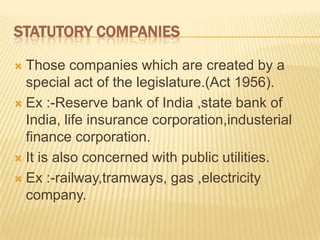
STATUTORY COMPANIES

 Those companies which are created by a
  special act of the legislature.(Act 1956).
 Ex :-Reserve bank of India ,state bank of
  India, life insurance corporation,industerial
  finance corporation.
 It is also concerned with public utilities.

 Ex :-railway,tramways, gas ,electricity
  company.
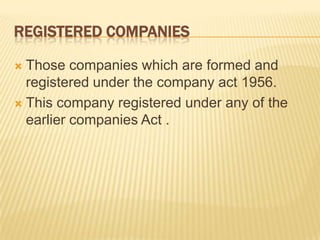
REGISTERED COMPANIES

 Those companies which are formed and
  registered under the company act 1956.
 This company registered under any of the
  earlier companies Act .
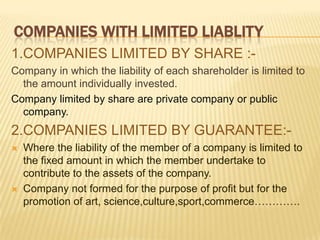
COMPANIES WITH LIMITED LIABLITY
1.COMPANIES LIMITED BY SHARE :-
Company in which the liability of each shareholder is limited to
  the amount individually invested.
Company limited by share are private company or public
  company.
2.COMPANIES LIMITED BY GUARANTEE:-
   Where the liability of the member of a company is limited to
    the fixed amount in which the member undertake to
    contribute to the assets of the company.
   Company not formed for the purpose of profit but for the
    promotion of art, science,culture,sport,commerce………….
UNLIMITED COMPANIES

 A company without a share capital or
  limited liablity.
 Every member is liable for the debt of the
  company.
 It may or may not have a share capital. if it
  has share capital it will private company or
  public company.
ON THE BASIS OF NO OF MEMBER

   PRIVATE COMPANY:-
   A company which has minimum paid-up capital of
    100,000.
   Its dot invites the general public to subscribe for the
    share ,debenture of the company.
   It hasn't right to transfer share and debenture.
   Private company become public company.
             conversion by default
             conversion by choice
PUBLIC COMPANY

 A company which has minimum paid-up
  capital of 5 lakh.
 Minimum no of person 7.
WHEN DOES A PRIVATE COMPANY BECOMES A
PUBLIC COMPANY
   Conversion by default : A private company
    makes a default in complying with the essential
    statutory requirements as laid down in Section
    3(1')(iii)of the Actiie., if-its membership exceeds
    50 and it does not restrict transfer of share by its
    members and gives invitation to public to buy its
    shares or to make deposits, the company cease
    to be entilted to be the privilege and exemptions
    conferred on private companies by or under this
    Act, under this circumstances , the act shall
    apply to the company as if it were a public not a
    private company.
CONVERSION OF A PRIVATE COMPANY INTO
 A PUBLIC COMPANY BY CHOICE:
a) if a private company alter its article in such a manner that the no
longer include the provision due to which it is catogorised as a
private company, the company shall cease to be a private company.
It shall then, within a period of 30 days after the said date , file with
the registrar either a prospectous or a statement in lieu of
prospectous.
b) A copy of special resolution in form 23 must be filled with R.O.C
within 30 days thereof.
c) If the members are less than 7 steps must be taken to increase
this no. to Atleast seven
d) If the No. of he director are less than 3 steps must be taken to
increase this no. to Atleast 3
e) If the paid up share capital is less than 500000, steps must be
taken to increase.
f) The name of the company must be changed by deleting the word
“Pvt
CONVERSION OF A PUBLIC COMPANY INTO A PRIVATE
COMPANY (SEC 31(1)(2A)

1) A general meeting must be held a special resolution must be passed for
altering the Articles of association that means restrictions, limitations and
prohibitions which are necessary according to sec 3(1)(iii) are included.
2) An application must be made to the central government in the form 1B
for necessary approval.
3) A copy of a special resolution in form 23 must be filed with the registrar
within 30 days thereof along with altered articles.
4) A copy of order of central government must be filed with R.O.C within
one month of receipt.
5) Where the no. members are more than 50 steps must be taken to reduce
to 50 or less.
6) The name of the company must be changed by adding the word “Pvt”
registrar under the new name of the company.
7) A fresh certificate of incorporation must be obtained from the registrar
under the new name of the company.
ON THE BASIS OF CONTROL
1.HOLDING COMPANY:-
A holding company is a company or firm that owns other
  companies' outstanding stock. It usually refers to a company
  which does not produce goods or services itself; rather, its
  only purpose is owning shares of other companiesa
  company which has which has control over that other
  company.
2.SUBSIDIARY COMPANY:-
   A company is known as a subsidiary of another
    company when control is exercised by the latter (called
    holding to company) over the former called a subsidiary
    company.
   A company is deemed to be a subsidiary of another
    company in the following 3 cases:
(1)COMPANY CONTROLLING COMPOSITION OF
BOARD OF DIRECTORS

 Where a company (Company A) controls the
 composition of board of directors of another
 company (Company B), the latter (Company
 B) becomes the subsidiary of the former
 (Company A).
(2)HOLDING OF MAJORITY OF SHARES:

   Where a company (Company A) holds more
    than half in nominal value of equity share
    capital of another company (Company B) the
    latter (Company B) becomes the subsidiary
    of the former (Company A).
(3)SUBSIDIARY OF ANOTHER SUBSIDIARY:

   Where a company (Company B) is subsidiary
    of anther company (say Company A1) which
    is itself subsidiary of the controlling company
    (Company A), the former (Company B)
    becomes the subsidiary of the controlling
    company (Company A).
(V)ON THE BASIS OF OWNERSHIP


   Government company, or
   Non-government company
   Government Company:
   A Government company means any company in which
    not less than 51 per cent of the paid-up share capital is
    held by.
    The central government, or
    Any state government or governments, or
    Partly by the central Government and partly by one or
    more state Governments.
Thank you

Company act 1956

  • 1.
    Presented by: Rakesh Roshan Roll :20069
  • 2.
    COMPANIES ACT 1956 Itwas enacted by the Parliament of India on January 18, 1956 and started on April 1, 1956 The Companies Act, 1956 is an Act in which rules and regulations for maintaining the books of accounts of a company are written. No company in India can violate the regulations of this Act. It contains special laws which a company has to follow while maintaining its books of accounts. Registration of all companies in India are undertaken by this Act. If any company does not follow these rules and regulations, it is prohibited to perform by law of India
  • 3.
    CONTENTS :  Nature and kinds of compaines  Formation of a company  Company management  Company meetings  Winding up of a company
  • 4.
    COMPANY A company is a form of business organization. of A company is a form business organization. It is a collection of individuals and a collection of individuals It is physical assets with a common aim assets with a and physical of gaining common aim of gaining profits. profits. This collection exists in Law and therefore a company Law This collection exists in is and therefore a company is considered a "Legal Person". considered a "Legal Person". A company is a form of business organization’ of A company is a form business organization’
  • 5.
    CLASSIFICATION OF COMPANY  Classificationon the basis of incorporation  Classification on the basis of liability  Classification on the basis of No of member  Classification on the basis of control  Classification on the basis of ownership
  • 6.
    ON THE BASISOF INCORPORATION Statutory company Registered company
  • 7.
    STATUTORY COMPANIES  Thosecompanies which are created by a special act of the legislature.(Act 1956).  Ex :-Reserve bank of India ,state bank of India, life insurance corporation,industerial finance corporation.  It is also concerned with public utilities.  Ex :-railway,tramways, gas ,electricity company.
  • 8.
    REGISTERED COMPANIES  Thosecompanies which are formed and registered under the company act 1956.  This company registered under any of the earlier companies Act .
  • 9.
    COMPANIES WITH LIMITEDLIABLITY 1.COMPANIES LIMITED BY SHARE :- Company in which the liability of each shareholder is limited to the amount individually invested. Company limited by share are private company or public company. 2.COMPANIES LIMITED BY GUARANTEE:-  Where the liability of the member of a company is limited to the fixed amount in which the member undertake to contribute to the assets of the company.  Company not formed for the purpose of profit but for the promotion of art, science,culture,sport,commerce………….
  • 10.
    UNLIMITED COMPANIES  Acompany without a share capital or limited liablity.  Every member is liable for the debt of the company.  It may or may not have a share capital. if it has share capital it will private company or public company.
  • 11.
    ON THE BASISOF NO OF MEMBER  PRIVATE COMPANY:-  A company which has minimum paid-up capital of 100,000.  Its dot invites the general public to subscribe for the share ,debenture of the company.  It hasn't right to transfer share and debenture.  Private company become public company. conversion by default conversion by choice
  • 12.
    PUBLIC COMPANY  Acompany which has minimum paid-up capital of 5 lakh.  Minimum no of person 7.
  • 13.
    WHEN DOES APRIVATE COMPANY BECOMES A PUBLIC COMPANY  Conversion by default : A private company makes a default in complying with the essential statutory requirements as laid down in Section 3(1')(iii)of the Actiie., if-its membership exceeds 50 and it does not restrict transfer of share by its members and gives invitation to public to buy its shares or to make deposits, the company cease to be entilted to be the privilege and exemptions conferred on private companies by or under this Act, under this circumstances , the act shall apply to the company as if it were a public not a private company.
  • 14.
    CONVERSION OF APRIVATE COMPANY INTO A PUBLIC COMPANY BY CHOICE: a) if a private company alter its article in such a manner that the no longer include the provision due to which it is catogorised as a private company, the company shall cease to be a private company. It shall then, within a period of 30 days after the said date , file with the registrar either a prospectous or a statement in lieu of prospectous. b) A copy of special resolution in form 23 must be filled with R.O.C within 30 days thereof. c) If the members are less than 7 steps must be taken to increase this no. to Atleast seven d) If the No. of he director are less than 3 steps must be taken to increase this no. to Atleast 3 e) If the paid up share capital is less than 500000, steps must be taken to increase. f) The name of the company must be changed by deleting the word “Pvt
  • 15.
    CONVERSION OF APUBLIC COMPANY INTO A PRIVATE COMPANY (SEC 31(1)(2A) 1) A general meeting must be held a special resolution must be passed for altering the Articles of association that means restrictions, limitations and prohibitions which are necessary according to sec 3(1)(iii) are included. 2) An application must be made to the central government in the form 1B for necessary approval. 3) A copy of a special resolution in form 23 must be filed with the registrar within 30 days thereof along with altered articles. 4) A copy of order of central government must be filed with R.O.C within one month of receipt. 5) Where the no. members are more than 50 steps must be taken to reduce to 50 or less. 6) The name of the company must be changed by adding the word “Pvt” registrar under the new name of the company. 7) A fresh certificate of incorporation must be obtained from the registrar under the new name of the company.
  • 16.
    ON THE BASISOF CONTROL 1.HOLDING COMPANY:- A holding company is a company or firm that owns other companies' outstanding stock. It usually refers to a company which does not produce goods or services itself; rather, its only purpose is owning shares of other companiesa company which has which has control over that other company. 2.SUBSIDIARY COMPANY:-  A company is known as a subsidiary of another company when control is exercised by the latter (called holding to company) over the former called a subsidiary company.  A company is deemed to be a subsidiary of another company in the following 3 cases:
  • 17.
    (1)COMPANY CONTROLLING COMPOSITIONOF BOARD OF DIRECTORS Where a company (Company A) controls the composition of board of directors of another company (Company B), the latter (Company B) becomes the subsidiary of the former (Company A).
  • 18.
    (2)HOLDING OF MAJORITYOF SHARES:  Where a company (Company A) holds more than half in nominal value of equity share capital of another company (Company B) the latter (Company B) becomes the subsidiary of the former (Company A).
  • 19.
    (3)SUBSIDIARY OF ANOTHERSUBSIDIARY:  Where a company (Company B) is subsidiary of anther company (say Company A1) which is itself subsidiary of the controlling company (Company A), the former (Company B) becomes the subsidiary of the controlling company (Company A).
  • 20.
    (V)ON THE BASISOF OWNERSHIP  Government company, or  Non-government company  Government Company:  A Government company means any company in which not less than 51 per cent of the paid-up share capital is held by. The central government, or Any state government or governments, or Partly by the central Government and partly by one or more state Governments.
  • 21.