MODIFICATIONS OF ANGLE`S
CLASSIFICATION
Guided By-
Dr Alka Benker,
Dr Rahul Muchchadia,
Dr Meghna Rao,
Dr Yagnesh Rajpara,
Dr Vidhi Pandya
Presented By-
Lipi Bhatt
3rd year
Batch-A
Roll no-6
Department of orthodontics &
WHAT IS ANGLE`S CLASSIFICATION?
 Angle`s system of classification is based on
the anteroposterior relationship of the teeth
with each other.
 Angle introduced this classification with the
concept of key of occlusion & line of
occlusion.
 Maxillary first permanent molar is considered
to be the key of occlusion & angle stated thet
the position of the maxillary first permanent
molar is relatively constant.
THERE ARE TWO MODIFICATION OF
ANGLE`S CLASSIFICATION
1. Lischer`s modification
2. Deway`s modification
LISCHER`S MODIFICATION
Lischer introduced the following names to
angle`s classification.
Neutrocclusion-class I
Distocclusion-class II
Mesiocclusion-class III
It consist of adding the suffix “ version “ to
the word. these indicates the direction of
deviation from normal position.
Lischer also introduced nomenclature to describe
malpositions of individual teeth.
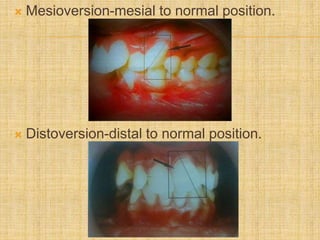
 Mesioversion-mesial to normal position.
 Distoversion-distal to normal position.
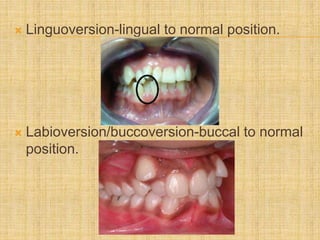
 Linguoversion-lingual to normal position.
 Labioversion/buccoversion-buccal to normal
position.
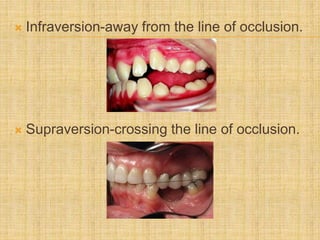
 Infraversion-away from the line of occlusion.
 Supraversion-crossing the line of occlusion.
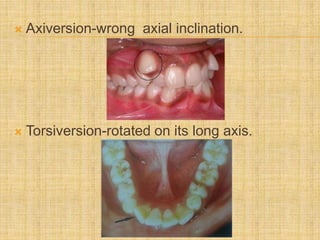
 Axiversion-wrong axial inclination.
 Torsiversion-rotated on its long axis.
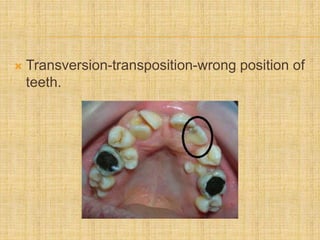
 Transversion-transposition-wrong position of
teeth.
DEWAY`S MODIFICATION
 Martin Deway divided angle`s class I &
III into further types
 Class I is divided into five types.
 Class III is divided into three types.
 Class II has no types.
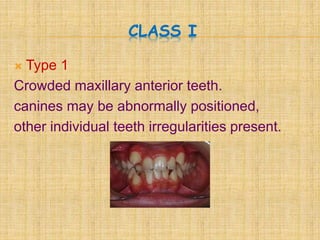
CLASS I
 Type 1
Crowded maxillary anterior teeth.
canines may be abnormally positioned,
other individual teeth irregularities present.
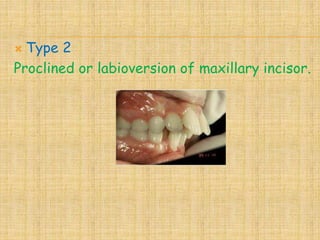
 Type 2
Proclined or labioversion of maxillary incisor.
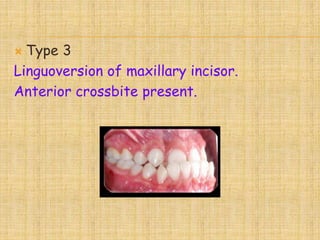
 Type 3
Linguoversion of maxillary incisor.
Anterior crossbite present.
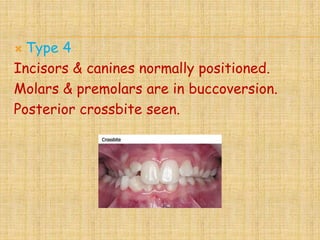
 Type 4
Incisors & canines normally positioned.
Molars & premolars are in buccoversion.
Posterior crossbite seen.
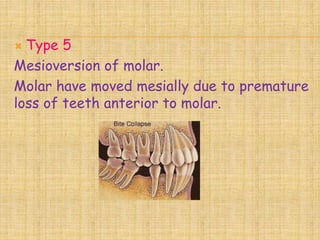
 Type 5
Mesioversion of molar.
Molar have moved mesially due to premature
loss of teeth anterior to molar.
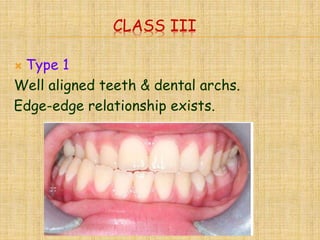
CLASS III
 Type 1
Well aligned teeth & dental archs.
Edge-edge relationship exists.
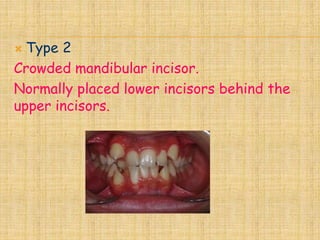
 Type 2
Crowded mandibular incisor.
Normally placed lower incisors behind the
upper incisors.
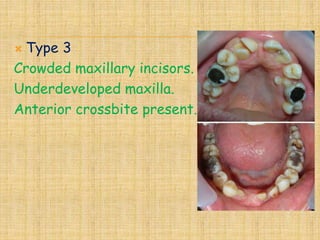
 Type 3
Crowded maxillary incisors.
Underdeveloped maxilla.
Anterior crossbite present.

Modifications of angle`s classification

  • 1.
    MODIFICATIONS OF ANGLE`S CLASSIFICATION GuidedBy- Dr Alka Benker, Dr Rahul Muchchadia, Dr Meghna Rao, Dr Yagnesh Rajpara, Dr Vidhi Pandya Presented By- Lipi Bhatt 3rd year Batch-A Roll no-6 Department of orthodontics &
  • 2.
    WHAT IS ANGLE`SCLASSIFICATION?  Angle`s system of classification is based on the anteroposterior relationship of the teeth with each other.  Angle introduced this classification with the concept of key of occlusion & line of occlusion.  Maxillary first permanent molar is considered to be the key of occlusion & angle stated thet the position of the maxillary first permanent molar is relatively constant.
  • 3.
    THERE ARE TWOMODIFICATION OF ANGLE`S CLASSIFICATION 1. Lischer`s modification 2. Deway`s modification
  • 4.
    LISCHER`S MODIFICATION Lischer introducedthe following names to angle`s classification. Neutrocclusion-class I Distocclusion-class II Mesiocclusion-class III
  • 5.
    It consist ofadding the suffix “ version “ to the word. these indicates the direction of deviation from normal position. Lischer also introduced nomenclature to describe malpositions of individual teeth.
  • 6.
     Mesioversion-mesial tonormal position.  Distoversion-distal to normal position.
  • 7.
     Linguoversion-lingual tonormal position.  Labioversion/buccoversion-buccal to normal position.
  • 8.
     Infraversion-away fromthe line of occlusion.  Supraversion-crossing the line of occlusion.
  • 9.
     Axiversion-wrong axialinclination.  Torsiversion-rotated on its long axis.
  • 10.
  • 11.
    DEWAY`S MODIFICATION  MartinDeway divided angle`s class I & III into further types  Class I is divided into five types.  Class III is divided into three types.  Class II has no types.
  • 12.
    CLASS I  Type1 Crowded maxillary anterior teeth. canines may be abnormally positioned, other individual teeth irregularities present.
  • 13.
     Type 2 Proclinedor labioversion of maxillary incisor.
  • 14.
     Type 3 Linguoversionof maxillary incisor. Anterior crossbite present.
  • 15.
     Type 4 Incisors& canines normally positioned. Molars & premolars are in buccoversion. Posterior crossbite seen.
  • 16.
     Type 5 Mesioversionof molar. Molar have moved mesially due to premature loss of teeth anterior to molar.
  • 17.
    CLASS III  Type1 Well aligned teeth & dental archs. Edge-edge relationship exists.
  • 18.
     Type 2 Crowdedmandibular incisor. Normally placed lower incisors behind the upper incisors.
  • 19.
     Type 3 Crowdedmaxillary incisors. Underdeveloped maxilla. Anterior crossbite present.