ZINC PHOSPHATE
Made By:-
Alisha Karmali.
Candidate at D. Y. Patil Institute of Dental
Sciences and Research Centre.
• Introduction
• Classification
• Available as
• Commercial Name
• Composition
• Manufacture
• Manipulation
• Setting Reaction
• Control of Working Time
• Properties
• Advantages
• Disadvantages
• Applications
• Modifications of Zinc
Phosphate
Introduction:
Zinc Phosphate is the oldest of the luting
cements and served as a standard for newer cements
that can be compared.
Classification:
Type 1 – fine grained for luting.
(film thickness not more than 25 micrometre)
Type 2 – medium grained for luting and filling.
(film thickness not more than 40 micrometre)
Available as:
• Powder and Liquid form
• Capsules for pre-proportioned Powder
and Liquid
Commercial Names:
 Confit
 Harvard
 Zinc Cement Improved
 Modern Tenacin
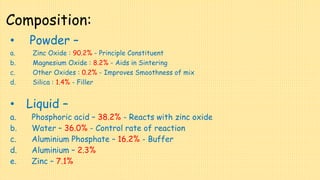
Composition:
• Powder –
a. Zinc Oxide : 90.2% - Principle Constituent
b. Magnesium Oxide : 8.2% - Aids in Sintering
c. Other Oxides : 0.2% - Improves Smoothness of mix
d. Silica : 1.4% - Filler
• Liquid –
a. Phosphoric acid – 38.2% - Reacts with zinc oxide
b. Water – 36.0% - Control rate of reaction
c. Aluminium Phosphate – 16.2% - Buffer
d. Aluminium – 2.3%
e. Zinc – 7.1%
Note :
• The liquid controls the pH and the rate of the
liquid-powder (acid-base) reaction.
• Finer the particle size, faster the cement sets.
Manufacture :
• The ingredients are mixed and heated at
temperature between 1000’C-1400’C.
(SINTERING)
• After this, cake formed is cooled quickly.
• This causes material to crack which helps in
grinding of the fine material to a fine powder.
(FRITTING)
Manipulation:
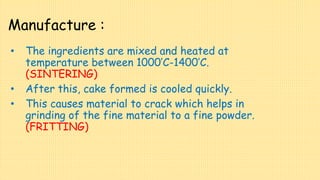
1. Stainless steel spatula and clean cool glass slab are use for
mixing.
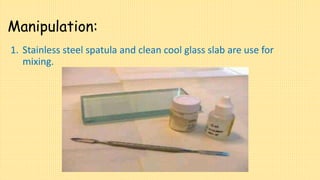
2. Mixing Time:-1 min. 15 sec.
3. P/L Ratio:-1.4 gm/0.5ml.
4. The powder is added in small increments.
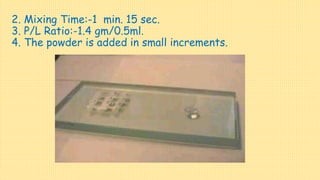
5. Mixing is done with stainless steel spatula using brisk
circular motion.
6. Each increments is mixed for 15-20 sec.
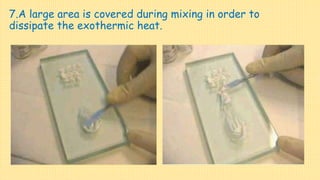
7.A large area is covered during mixing in order to
dissipate the exothermic heat.
Setting Reaction:-
• When powder is mixed with liquid, phosphoric acid attacks the
surface of the particles and releases the zinc ions.
• The aluminium in the liquid is essential for cement formation. The
aluminium complexes with the phosphoric acid and the zinc ions to
form a zinc-aluminophosphate gel.
• Reaction is EXOTHERMIC.
• Loss of water from the liquid lengthens the setting reaction and
vise versa.
• SETTING TIME : 2.5-8 minutes.
• MIXING TIME: 1min 8 sec.
Control of Working Time:-
The length of the working time may be varied to some degree to fit the
clinical situation. For ex. A fixed dental prosthetics with multiple crowns
require more working time for cementation. Four techniques can
extend the working time of ZP Cement:-
1. P/L ratio can be reduced to produce a thinner mixture. This however,
reduces initial pH and adversely affect the properties.
2. Smaller portions of powder should be mixed for the first few
increments. This reduces the acidity of the liquid and retards the rate
of reaction.
3. Prolong the spatulation of the last increment of the powder. This
destroys the matrix formed, thus extra time is needed to rebuild the
bulk of the matrix. This is however, not a preffered method for
prolonging the working time.
contd.. Control of working time:-
4. A cooler mixing temperature retards the chemical reaction between
powder and the liquid, thereby delay formation of matrix.
However, the temperature of the slab should be above the dew point,
otherwise water condenses, dilutes the liquid and reduces the
compressive and tensile strength of the cement.
This is the most viable method of extending the working time of zinc
phosphate cement.
Properties of zinc phosphate:-
• Compressive Strength – 104MPa
• Tensile Strength – 5.5MPa
• Modulus of Elasticity – 13GPa
• Solubility – 0.06% (relatively low)
• Thermal Properties – Good
• Adhesive Properties – No bond formation
• Biological Properties – starting pH: 3.5, at the time of cementation,
pH is: 2 and after 24hrs, pH is 5.5
• Optical Properties - Opaque
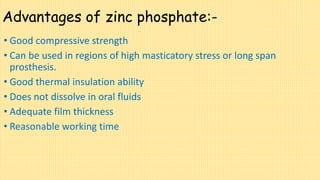
Advantages of zinc phosphate:-
• Good compressive strength
• Can be used in regions of high masticatory stress or long span
prosthesis.
• Good thermal insulation ability
• Does not dissolve in oral fluids
• Adequate film thickness
• Reasonable working time
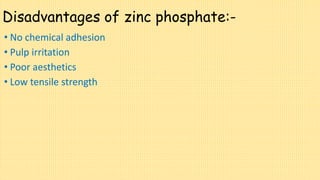
Disadvantages of zinc phosphate:-
• No chemical adhesion
• Pulp irritation
• Poor aesthetics
• Low tensile strength
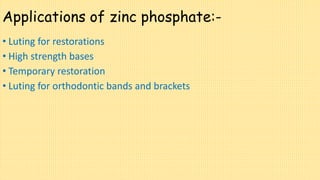
Applications of zinc phosphate:-
• Luting for restorations
• High strength bases
• Temporary restoration
• Luting for orthodontic bands and brackets
Thank you!

Zinc Phosphate Cement

  • 1.
    ZINC PHOSPHATE Made By:- AlishaKarmali. Candidate at D. Y. Patil Institute of Dental Sciences and Research Centre.
  • 2.
    • Introduction • Classification •Available as • Commercial Name • Composition • Manufacture • Manipulation • Setting Reaction • Control of Working Time • Properties • Advantages • Disadvantages • Applications • Modifications of Zinc Phosphate
  • 3.
    Introduction: Zinc Phosphate isthe oldest of the luting cements and served as a standard for newer cements that can be compared.
  • 4.
    Classification: Type 1 –fine grained for luting. (film thickness not more than 25 micrometre) Type 2 – medium grained for luting and filling. (film thickness not more than 40 micrometre)
  • 5.
    Available as: • Powderand Liquid form • Capsules for pre-proportioned Powder and Liquid
  • 6.
    Commercial Names:  Confit Harvard  Zinc Cement Improved  Modern Tenacin
  • 7.
    Composition: • Powder – a.Zinc Oxide : 90.2% - Principle Constituent b. Magnesium Oxide : 8.2% - Aids in Sintering c. Other Oxides : 0.2% - Improves Smoothness of mix d. Silica : 1.4% - Filler • Liquid – a. Phosphoric acid – 38.2% - Reacts with zinc oxide b. Water – 36.0% - Control rate of reaction c. Aluminium Phosphate – 16.2% - Buffer d. Aluminium – 2.3% e. Zinc – 7.1%
  • 8.
    Note : • Theliquid controls the pH and the rate of the liquid-powder (acid-base) reaction. • Finer the particle size, faster the cement sets.
  • 9.
    Manufacture : • Theingredients are mixed and heated at temperature between 1000’C-1400’C. (SINTERING) • After this, cake formed is cooled quickly. • This causes material to crack which helps in grinding of the fine material to a fine powder. (FRITTING)
  • 10.
    Manipulation: 1. Stainless steelspatula and clean cool glass slab are use for mixing.
  • 11.
    2. Mixing Time:-1min. 15 sec. 3. P/L Ratio:-1.4 gm/0.5ml. 4. The powder is added in small increments.
  • 12.
    5. Mixing isdone with stainless steel spatula using brisk circular motion. 6. Each increments is mixed for 15-20 sec.
  • 13.
    7.A large areais covered during mixing in order to dissipate the exothermic heat.
  • 14.
    Setting Reaction:- • Whenpowder is mixed with liquid, phosphoric acid attacks the surface of the particles and releases the zinc ions. • The aluminium in the liquid is essential for cement formation. The aluminium complexes with the phosphoric acid and the zinc ions to form a zinc-aluminophosphate gel. • Reaction is EXOTHERMIC. • Loss of water from the liquid lengthens the setting reaction and vise versa. • SETTING TIME : 2.5-8 minutes. • MIXING TIME: 1min 8 sec.
  • 15.
    Control of WorkingTime:- The length of the working time may be varied to some degree to fit the clinical situation. For ex. A fixed dental prosthetics with multiple crowns require more working time for cementation. Four techniques can extend the working time of ZP Cement:- 1. P/L ratio can be reduced to produce a thinner mixture. This however, reduces initial pH and adversely affect the properties. 2. Smaller portions of powder should be mixed for the first few increments. This reduces the acidity of the liquid and retards the rate of reaction. 3. Prolong the spatulation of the last increment of the powder. This destroys the matrix formed, thus extra time is needed to rebuild the bulk of the matrix. This is however, not a preffered method for prolonging the working time.
  • 16.
    contd.. Control ofworking time:- 4. A cooler mixing temperature retards the chemical reaction between powder and the liquid, thereby delay formation of matrix. However, the temperature of the slab should be above the dew point, otherwise water condenses, dilutes the liquid and reduces the compressive and tensile strength of the cement. This is the most viable method of extending the working time of zinc phosphate cement.
  • 17.
    Properties of zincphosphate:- • Compressive Strength – 104MPa • Tensile Strength – 5.5MPa • Modulus of Elasticity – 13GPa • Solubility – 0.06% (relatively low) • Thermal Properties – Good • Adhesive Properties – No bond formation • Biological Properties – starting pH: 3.5, at the time of cementation, pH is: 2 and after 24hrs, pH is 5.5 • Optical Properties - Opaque
  • 18.
    Advantages of zincphosphate:- • Good compressive strength • Can be used in regions of high masticatory stress or long span prosthesis. • Good thermal insulation ability • Does not dissolve in oral fluids • Adequate film thickness • Reasonable working time
  • 19.
    Disadvantages of zincphosphate:- • No chemical adhesion • Pulp irritation • Poor aesthetics • Low tensile strength
  • 20.
    Applications of zincphosphate:- • Luting for restorations • High strength bases • Temporary restoration • Luting for orthodontic bands and brackets
  • 21.