Dental curing light
Application & working
Author: Lokender Yadav
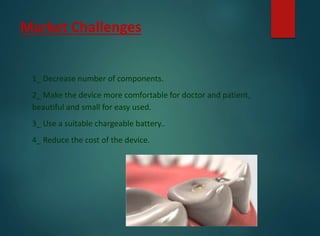
Market Challenges
1_ Decrease number of components.
2_ Make the device more comfortable for doctor and patient,
beautiful and small for easy used.
3_ Use a suitable chargeable battery..
4_ Reduce the cost of the device.
Dental curing light
Usage of device:
 Dryness of the white composite for teeth by using
laser blue led.
 What is the Composite?
It is A mixture of plastic and fine glass particles.
Used for: Small and large fillings, especially in front teeth
or the visible parts of teeth; also for inlays
Lasts: At least five years
Product In the market:-
 A dental curing light is a piece of dental
equipment that is used for polymerization of light
cure
 There are two main dental curing lights are the
halogen and Blue LED.

Need of light cure
 The crucial point to contemplate during restorative
dentistry procedures with composite resins is to obtain
satisfactory restorations with an adequate photo
polymerization technique. This procedure requires
sufficient light energy intensity and an adequate
wavelength in order to activate the photo initiator within
these materials, which will react with the reducer agent
to form free radicals and initiate the polymerization
process.
What is photo
polymerization?
 In polymer chemistry, polymerization is a process of
reacting monomer molecules together in a chemical
reaction to form polymer chains or three-dimensional
networks.
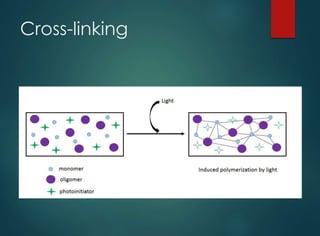
 A photopolymer is a polymer that changes its
properties when exposed to light, often in
the ultraviolet or visible region of the electromagnetic
spectrum. These changes are often manifested
structurally, for example hardening of the material
occurs as a result of cross-linking when exposed to
light. An example is shown below depicting a mixture
of monomers, oligomers, and photo initiators that
conform into a hardened polymeric material through
a process called curing.
Cross-linking
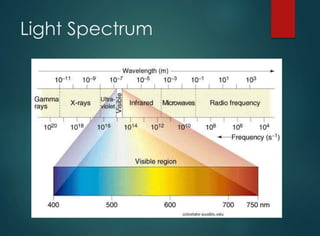
Light Spectrum
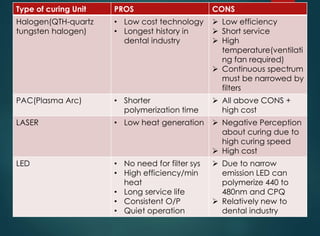
Type of curing Unit PROS CONS
Halogen(QTH-quartz
tungsten halogen)
• Low cost technology
• Longest history in
dental industry
 Low efficiency
 Short service
 High
temperature(ventilati
ng fan required)
 Continuous spectrum
must be narrowed by
filters
PAC(Plasma Arc) • Shorter
polymerization time
 All above CONS +
high cost
LASER • Low heat generation  Negative Perception
about curing due to
high curing speed
 High cost
LED • No need for filter sys
• High efficiency/min
heat
• Long service life
• Consistent O/P
• Quiet operation
 Due to narrow
emission LED can
polymerize 440 to
480nm and CPQ
 Relatively new to
dental industry
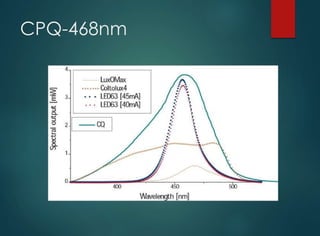
CPQ-468nm
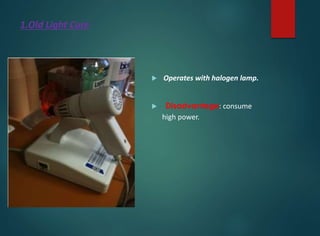
1.Old Light Cure
 Operates with halogen lamp.
 Disadvantage: consume
high power.
principle of Tungsten
halogen
 In order for the light to be produced, an electric current
flows through a thin tungsten filament, which functions as
a resistor.
 This resistor is then “heated to temperatures of about
3,000 Kelvin, it becomes incandescent and emits infrared
and electromagnetic radiation in the form of visible light”.
 It provides a blue light of about 400 and 500 nm, with an
intensity of 400- 600 mW
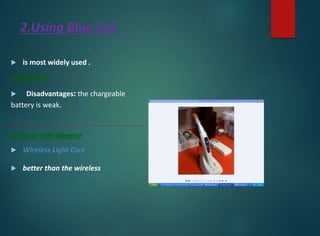
2.Using Blue Led
 is most widely used .
2.1wireless:
 Disadvantages: the chargeable
battery is weak.
2.2hand with adaptor
 Wireless Light Cure
 better than the wireless
Principle of using blue led
 it uses light-emitting diodes that produce
blue light that cures the dental material.
 This light uses a gallium nitride as a
semiconductor that is the basis for the blue
emission.
 “In LED’s, a voltage is applied across the
junctions of two doped semi- conductors (n-
doped and p-doped), resulting in the
generation and emission of light in a specific
wavelength range.
 By controlling the chemical composition of
the semiconductor combination, one can
control the wavelength range.
Principle of blue led:
 The dental LED curing lights use LED’s
that produce a narrow spectrum of blue
light in the 400- to 500-nm range (with a
peak wavelength of about 460nm),
which is the useful energy range for
activating the CPQ molecule most
commonly used to initiate the photo
polymerization of dental monomers.
 These curing lights are much different
than the Halogen curing lights.
 They are more lightweight, portable and
effective.
Principle of blue led:
 The heat generated from LED
curing lights is much less which
means it does not require a fan to
cool it. Now that the fan is not
needed, a more lightweight and
smaller light could be designed.
The portability of it comes from the
low consumption of power.
 The LED can now use rechargeable
batteries, making it much more
comfortable and easier to use
What is CPQ
Camphor Quinone (CQ) is the most common photo initiator used
in composites, and it presents maximum energy absorption at 468
nm within the electromagnetic spectrum close to the emission
spectrum of the light-emitting diode (LED λ- X: 450-490 nm) light-
curing unit (LCU).
Modes of the curing unit:-
1. Continuous lightning for 15 sec.
2. Pulsed lighting every sec for 15 sec.
3. Graduate increasing in light intensity for 15 sec.
Why modes in curing unit
Because of the theory, which says that when the composite
material is exposed to light directly, it expands and cracks .
Instrument Function
 Harden of the white composite for teeth by using light
blue led .
 visible spectrum output (lights)that lies within a specific
wavelength range .
 The idea is that the setting catalyst contained by this
particular color (wavelength) of light.
 Actually dentist use curing lights to activate the set of a
wide range of different types of dental materials.
 With most dental products including most dental
composites the light wavelength needed to activate the
curing process lies somewhere within the range of 420
to 450 nm .
 This means that the light emitted from the typical dental
curing light will have a violet to blue coloration
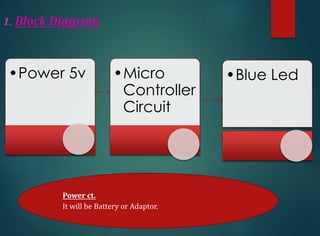
1. Block Diagram
Power ct.
It will be Battery or Adaptor.
•Power 5v •Micro
Controller
Circuit
•Blue Led
MYTH 1: Intensity is the most important factor
in Choosing a curing light.
Actually, matching the wavelength of the curing light to the absorption
spectrum of the photo initiator is the most important factor in curing dental
materials. Only when this is done correctly will intensity change the outcome
of the cure.
For example, it is possible for a curing light to be more intense than another
but leave a material uncured because the wavelength didn’t match the
photo initiator value.
MYTH 2: The more LEDs that a curing light
contains, the better it is at curing materials.
The no of LEDs in curing light doesn’t necessarily have any bearing on the
spectral output of the unit, no matter if it has 64, 19 or one LED. In culture
where more is better is difficult to understand , but there are multiple types of
LEDs and each is unique in its performance.
Different LEDs have different intensities , so curing light with one very intense
LED could be more powerful than a curing light with 64 less-intense LEDs.
Curing Light Output depends on three things:
 Spectral output of the LED Wavelength
 Intensity of the LEDs
 Optical Light Delivery
So judging the LED curing by no of LEDs present is does not make any sense.
MYTH 3: LED curing lights are a very slow way to cure material.
LED curing lights are able to cure materials in time comparable to
conventional halogen lights. They can do this by utilizing a narrow wavelength
that most closely matches CPQ, the Photointiator mainly used in composite
materials. This narrow and well matched wavelength to efficiently cure
materials with little wasted light output.
Why BLUE Light is used…… in dental curing?
Because all the photointiator used in dental materials absorb the light
in the range of 400-500nm range and this range of wavelength is lying
in blue light region
Dental Light Cure

Dental Light Cure

  • 1.
    Dental curing light Application& working Author: Lokender Yadav
  • 2.
    Market Challenges 1_ Decreasenumber of components. 2_ Make the device more comfortable for doctor and patient, beautiful and small for easy used. 3_ Use a suitable chargeable battery.. 4_ Reduce the cost of the device.
  • 3.
    Dental curing light Usageof device:  Dryness of the white composite for teeth by using laser blue led.  What is the Composite? It is A mixture of plastic and fine glass particles. Used for: Small and large fillings, especially in front teeth or the visible parts of teeth; also for inlays Lasts: At least five years
  • 4.
    Product In themarket:-  A dental curing light is a piece of dental equipment that is used for polymerization of light cure  There are two main dental curing lights are the halogen and Blue LED. 
  • 5.
    Need of lightcure  The crucial point to contemplate during restorative dentistry procedures with composite resins is to obtain satisfactory restorations with an adequate photo polymerization technique. This procedure requires sufficient light energy intensity and an adequate wavelength in order to activate the photo initiator within these materials, which will react with the reducer agent to form free radicals and initiate the polymerization process.
  • 6.
    What is photo polymerization? In polymer chemistry, polymerization is a process of reacting monomer molecules together in a chemical reaction to form polymer chains or three-dimensional networks.  A photopolymer is a polymer that changes its properties when exposed to light, often in the ultraviolet or visible region of the electromagnetic spectrum. These changes are often manifested structurally, for example hardening of the material occurs as a result of cross-linking when exposed to light. An example is shown below depicting a mixture of monomers, oligomers, and photo initiators that conform into a hardened polymeric material through a process called curing.
  • 7.
  • 8.
  • 10.
    Type of curingUnit PROS CONS Halogen(QTH-quartz tungsten halogen) • Low cost technology • Longest history in dental industry  Low efficiency  Short service  High temperature(ventilati ng fan required)  Continuous spectrum must be narrowed by filters PAC(Plasma Arc) • Shorter polymerization time  All above CONS + high cost LASER • Low heat generation  Negative Perception about curing due to high curing speed  High cost LED • No need for filter sys • High efficiency/min heat • Long service life • Consistent O/P • Quiet operation  Due to narrow emission LED can polymerize 440 to 480nm and CPQ  Relatively new to dental industry
  • 11.
  • 12.
    1.Old Light Cure Operates with halogen lamp.  Disadvantage: consume high power.
  • 13.
    principle of Tungsten halogen In order for the light to be produced, an electric current flows through a thin tungsten filament, which functions as a resistor.  This resistor is then “heated to temperatures of about 3,000 Kelvin, it becomes incandescent and emits infrared and electromagnetic radiation in the form of visible light”.  It provides a blue light of about 400 and 500 nm, with an intensity of 400- 600 mW
  • 14.
    2.Using Blue Led is most widely used . 2.1wireless:  Disadvantages: the chargeable battery is weak. 2.2hand with adaptor  Wireless Light Cure  better than the wireless
  • 15.
    Principle of usingblue led  it uses light-emitting diodes that produce blue light that cures the dental material.  This light uses a gallium nitride as a semiconductor that is the basis for the blue emission.  “In LED’s, a voltage is applied across the junctions of two doped semi- conductors (n- doped and p-doped), resulting in the generation and emission of light in a specific wavelength range.  By controlling the chemical composition of the semiconductor combination, one can control the wavelength range.
  • 16.
    Principle of blueled:  The dental LED curing lights use LED’s that produce a narrow spectrum of blue light in the 400- to 500-nm range (with a peak wavelength of about 460nm), which is the useful energy range for activating the CPQ molecule most commonly used to initiate the photo polymerization of dental monomers.  These curing lights are much different than the Halogen curing lights.  They are more lightweight, portable and effective.
  • 17.
    Principle of blueled:  The heat generated from LED curing lights is much less which means it does not require a fan to cool it. Now that the fan is not needed, a more lightweight and smaller light could be designed. The portability of it comes from the low consumption of power.  The LED can now use rechargeable batteries, making it much more comfortable and easier to use
  • 18.
    What is CPQ CamphorQuinone (CQ) is the most common photo initiator used in composites, and it presents maximum energy absorption at 468 nm within the electromagnetic spectrum close to the emission spectrum of the light-emitting diode (LED λ- X: 450-490 nm) light- curing unit (LCU).
  • 19.
    Modes of thecuring unit:- 1. Continuous lightning for 15 sec. 2. Pulsed lighting every sec for 15 sec. 3. Graduate increasing in light intensity for 15 sec.
  • 20.
    Why modes incuring unit Because of the theory, which says that when the composite material is exposed to light directly, it expands and cracks .
  • 21.
    Instrument Function  Hardenof the white composite for teeth by using light blue led .  visible spectrum output (lights)that lies within a specific wavelength range .  The idea is that the setting catalyst contained by this particular color (wavelength) of light.  Actually dentist use curing lights to activate the set of a wide range of different types of dental materials.  With most dental products including most dental composites the light wavelength needed to activate the curing process lies somewhere within the range of 420 to 450 nm .  This means that the light emitted from the typical dental curing light will have a violet to blue coloration
  • 22.
    1. Block Diagram Powerct. It will be Battery or Adaptor. •Power 5v •Micro Controller Circuit •Blue Led
  • 24.
    MYTH 1: Intensityis the most important factor in Choosing a curing light. Actually, matching the wavelength of the curing light to the absorption spectrum of the photo initiator is the most important factor in curing dental materials. Only when this is done correctly will intensity change the outcome of the cure. For example, it is possible for a curing light to be more intense than another but leave a material uncured because the wavelength didn’t match the photo initiator value.
  • 25.
    MYTH 2: Themore LEDs that a curing light contains, the better it is at curing materials. The no of LEDs in curing light doesn’t necessarily have any bearing on the spectral output of the unit, no matter if it has 64, 19 or one LED. In culture where more is better is difficult to understand , but there are multiple types of LEDs and each is unique in its performance. Different LEDs have different intensities , so curing light with one very intense LED could be more powerful than a curing light with 64 less-intense LEDs. Curing Light Output depends on three things:  Spectral output of the LED Wavelength  Intensity of the LEDs  Optical Light Delivery So judging the LED curing by no of LEDs present is does not make any sense.
  • 26.
    MYTH 3: LEDcuring lights are a very slow way to cure material. LED curing lights are able to cure materials in time comparable to conventional halogen lights. They can do this by utilizing a narrow wavelength that most closely matches CPQ, the Photointiator mainly used in composite materials. This narrow and well matched wavelength to efficiently cure materials with little wasted light output.
  • 27.
    Why BLUE Lightis used…… in dental curing? Because all the photointiator used in dental materials absorb the light in the range of 400-500nm range and this range of wavelength is lying in blue light region