DENTURE BASE RESIN
Dr. Ashwini
CONTENT
• Introduction
• Terminology
• Evolution of denture base
resins
• Ideal requirements
• Classification
• Heat cure resin
• Cold cure resin
• Newer material
INTRODUCTION
• Acrylic resin was introduced to dentistry in 1936 and received a great response
from the dental professionals such that by 1946, 98% of all denture were made
with methyl methacrylate polymer or copolymer.
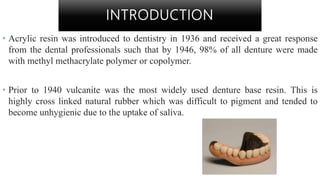
• Prior to 1940 vulcanite was the most widely used denture base resin. This is
highly cross linked natural rubber which was difficult to pigment and tended to
become unhygienic due to the uptake of saliva.
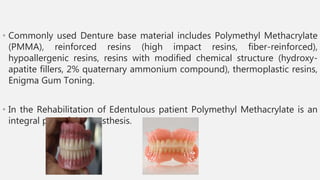
• Commonly used Denture base material includes Polymethyl Methacrylate
(PMMA), reinforced resins (high impact resins, fiber-reinforced),
hypoallergenic resins, resins with modified chemical structure (hydroxy-
apatite fillers, 2% quaternary ammonium compound), thermoplastic resins,
Enigma Gum Toning.
• In the Rehabilitation of Edentulous patient Polymethyl Methacrylate is an
integral part of the Prosthesis.
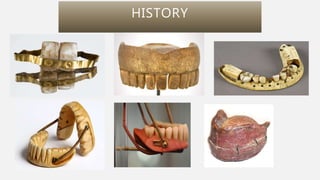
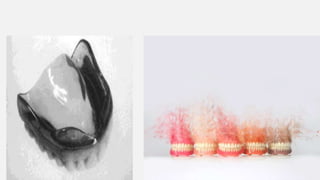
HISTORY
• Denture base material; Any substance of which a denture base may
be made
-GPT
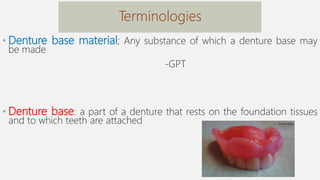
• Denture base: a part of a denture that rests on the foundation tissues
and to which teeth are attached
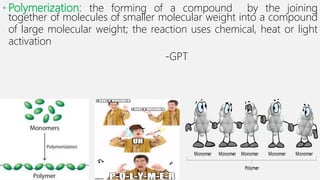
• Polymerization: the forming of a compound by the joining
together of molecules of smaller molecular weight into a compound
of large molecular weight; the reaction uses chemical, heat or light
activation
-GPT
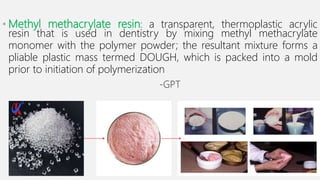
• Methyl methacrylate resin: a transparent, thermoplastic acrylic
resin that is used in dentistry by mixing methyl methacrylate
monomer with the polymer powder; the resultant mixture forms a
pliable plastic mass termed DOUGH, which is packed into a mold
prior to initiation of polymerization
-GPT
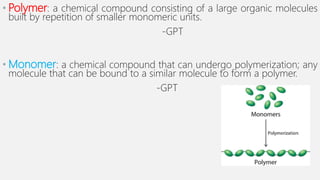
• Polymer: a chemical compound consisting of a large organic molecules
built by repetition of smaller monomeric units.
-GPT
• Monomer: a chemical compound that can undergo polymerization; any
molecule that can be bound to a similar molecule to form a polymer.
-GPT
REQUIREMENTS OF DENTURE
BASE MATERIAL
• Biocompatible
• Unaffected by oral fluids(insoluble, non-absorbent, inert)
• Mechanical properties
• High modulus of elasticity
• High proportional limit
• Sufficient resilience
• High impact strength
• Abrasion resistance
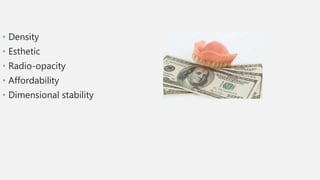
• Density
• Esthetic
• Radio-opacity
• Affordability
• Dimensional stability
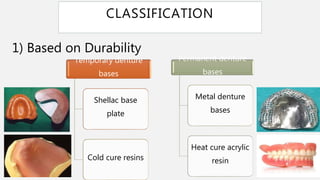
CLASSIFICATION
Temporary denture
bases
Shellac base
plate
Cold cure resins
Permanent denture
bases
Metal denture
bases
Heat cure acrylic
resin
1) Based on Durability
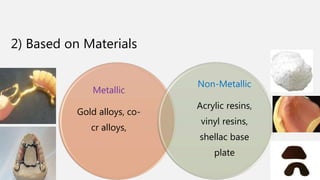
Metallic
Gold alloys, co-
cr alloys,
Non-Metallic
Acrylic resins,
vinyl resins,
shellac base
plate
2) Based on Materials
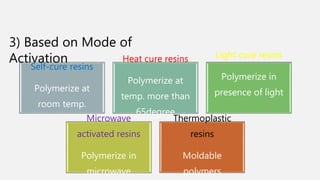
Self-cure resins
Polymerize at
room temp.
Heat cure resins
Polymerize at
temp. more than
65degree
Light cure resins
Polymerize in
presence of light
Microwave
activated resins
Polymerize in
microwave
Thermoplastic
resins
Moldable
polymers
3) Based on Mode of
Activation
Types of polymerization reactions
Condensation polymerization
Those in which polymerization is accompanied by repeated
elimination of small molecules, i.e. the primary compounds
react with the formation of by-products such as water, halogen
acids, etc. called condensation polymerization.
Addition polymerization
There is no change in the chemical composition & no by-products are
formed. One of the requisites of an addition polymerized compound is
the presence of an unsaturated group, i.e. double bond
Chemical stages of polymerization
1.Induction
To start the addition polymerization process, free radicals must be
present.
The free radical chemical that is used to start the polymerization enters
into the chemical reaction & becomes the part of of the final product.
Termed as initiator.
The initiator may be activated to provide the free radicals by 3 methods.
a.Heat activation.
The free radicals liberated by heating benzoyl peroxide will initiate the
Chemical activation
The use of benzoyl peroxide & an aromatic amine (dimethyl-p-toluidine)
in self cure dental resins.
Light activation.
The photons of light energy activate the initiator to generate the free
radicals, e.g. camphorquinone & amine will react to form free radicals,
when they are irradiated with visible light.
Propagation
Because little energy is required once the growth has started, the process
continues with considerable velocity. Theoretically, the polymerization
should continue with evolution of heat, until all the monomer has been
converted to a polymer. However, the polymerization is never complete.
Termination
The chain reactions can be terminated either by direct coupling or by
exchange of hydrogen atom from one growing chain to another.
When hydrogen atom is transferred from one growing chain to another,
there is formation of double bond in the latter.
Inhibition
The polymerization reaction can be inhibited by :
Impurities. These reacts with the activated initiator or activated nucleus
or or with an activated growing chain to prevent further growth, e.g.
hydroquinone. It is added to prevent polymerization of monomer
during storage.
Oxygen. Presence of air also inhibits polymerization.
POWDER
• Polymer-PMMA, either beads
produced by polymerizing methyi
methacrylate in water, or irregular
particles ground from a block of
polymer
• Initiater-0.2-0.5% benzoyl
peroxide
• Pigments-1%, ground into
polymer particle
• Monomer-methyl methacrylate
• Stabiliser-0.006%hydroquinone
• Crosslinking agent-ethylene glycol
dimethacrylate
LIQUID
HEAT CURED ACRYLIC MATERIAL
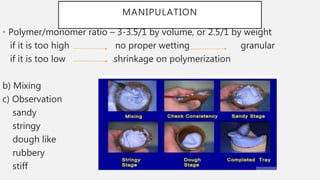
MANIPULATION
• Polymer/monomer ratio – 3-3.5/1 by volume, or 2.5/1 by weight
if it is too high no proper wetting granular
if it is too low shrinkage on polymerization
b) Mixing
c) Observation
sandy
stringy
dough like
rubbery
stiff
D) Dough time depend on
• The particle size of the polymer-the smaller the particle, the more rapid is
the dissolution and dough formation.
• The molecular weight of the olymer-the lower this is, the faster is the
dough formation.
• A plasticizer
• The temperature-delayed by refrigeration of the mix
Compression molding technique.
The technique can be described in following steps :
1.Preparation of mold.
2.Selection & application of separating media.
3.Polymer-monomer ratio.
4.Polymer-monomer interaction.
5.Dough forming time.
6.Working time.
7.Packing
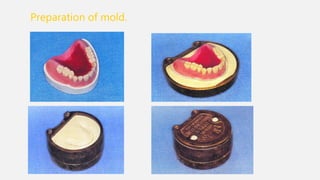
Preparation of mold.
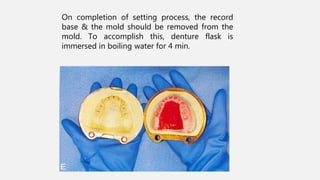
On completion of setting process, the record
base & the mold should be removed from the
mold. To accomplish this, denture flask is
immersed in boiling water for 4 min.
Selection & application of a separating media.
This medium must prevent direct contact between the denture base
resin & the mold cavity. Failure to place an appropriate separating
media may cause 2 major difficulties:
i.If water is permitted to pass from the mold surface to denture base
resin, it may affect polymerization rate as well as the optical & physical
properties of the processed resin.
ii.If dissolved polymer or free monomer is permitted to soak into the
mold surface, portions of the investing medium may become fused to
the denture base.
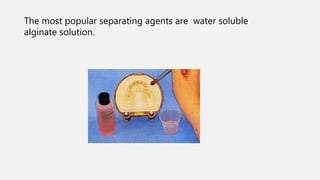
The most popular separating agents are water soluble
alginate solution.
Polymer-monomer ratio.
The accepted polymer monomer ratio is 3:1 by volume.
This provides sufficient monomer to thoroughly wet the polymer
particles but does not contribute excess monomer that would lead to
increased polymerization shrinkage.
Polymer-Monomer interaction
When polymer & monomer are mixed in proper proportions, a
workable mass is
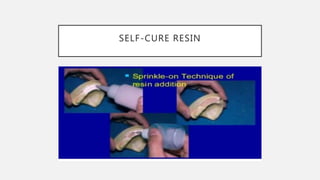
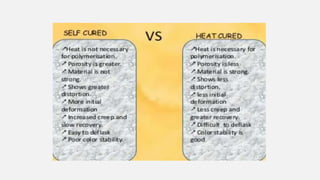
SELF-CURE RESIN
A DENTURE BASE RESIN
WITH LOW WATER
ABSORPTION
J. DENT. 1992; 20: 240-44
AIM OF THE STUDY
• To investigate poly(isobuty1 methacrylate) as a potential denture
base material.
• It was found to have very low water absorption but poor mechanical
properties and a low glass transition temperature.
MATERIAL AND METHOD
• Poly(isobuty1 methacrylate) polymer (Cole Polymers Ltd. Croydon, UK)
was used in combination with isobutyl methacrylate monomer of 98 per
cent purity (0876K Koch- Light Laboratories Ltd. Colnbrook. UK).
• Manipulative properties were investigated by using a range of powder :
liquid ratios to determine the most suitable proportions to produce a
workable ‘dough’.
• It was found possible to use a higher powder : liquid ratio than that
commonly employed with conventional poly(methy1 methacrylate)-
based materials. A powder : liquid ratio of 3 g : 1 ml was chosen and
specimens were processed in the form of rods and flat sheets using a
dry-heat curing cycle of 7 h at 70°C followed by 3 h at 100”.
• The density of the monomer was determined at room temperature (21 f
1 “C) using a specific gravity bottle, and that of the polymerized material
by weighing a sample first in air and then in water.
CONCLUSION
• Although the experimental materials formed doughs. these were very
difficult to handle with regard to packing in a mould due to their rubbery
consistency and stickiness.
• The addition of both ethylene glycol dimethacrylate and methacrylic acid
appeared to shorten the working time. The mechanical properties of the
experimental materials were disappointing. The low values achieved for
tensile, impact and flexural strength tests and for Young’s modulus,
mean that the material unsuitable for use as a denture base material.
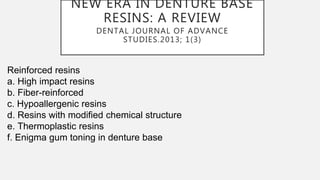
NEW ERA IN DENTURE BASE
RESINS: A REVIEW
DENTAL JOURNAL OF ADVANCE
STUDIES.2013; 1(3)
Reinforced resins
a. High impact resins
b. Fiber-reinforced
c. Hypoallergenic resins
d. Resins with modified chemical structure
e. Thermoplastic resins
f. Enigma gum toning in denture base
CONCLUSION
• The various advancements in denture base resins have provided
promising results. Today many imitations of poly-methyl
methacrylate denture base resins have been overcome.
• And its certain to have additional new applications in the future, to
provide a better treatment & care to the patients
REFERENCES
• PHILLIP’S Sciences of dental material. 12th Edition
• CRAIGE’S. Restorative dental material. 14TH Edition
• GPT-9
• A denture base resin with low water absorption. J. Dent. 1992; 20: 240-44
• New Era in Denture Base Resins: A Review. Dental Journal of Advance Studies.2013; 1(3)
• Polyamide as a Denture Base Material: A Literature Review. 2015 Mar; 16(1): 1–9
• Monomer Modifications of Denture Base Acrylic Resin: A Systematic Review and Meta-
analysis. j pharma bioallied sci.2019 May; 11(2): 112–25.
• A review on enhancements of PMMA Denture Base Material with Different Nano-Fillers.
MATERIALS ENGINEERING :202; 8(1)
•
THANK YOU

DENTURE BASE RESIN

  • 1.
  • 2.
    CONTENT • Introduction • Terminology •Evolution of denture base resins • Ideal requirements • Classification • Heat cure resin • Cold cure resin • Newer material
  • 3.
    INTRODUCTION • Acrylic resinwas introduced to dentistry in 1936 and received a great response from the dental professionals such that by 1946, 98% of all denture were made with methyl methacrylate polymer or copolymer. • Prior to 1940 vulcanite was the most widely used denture base resin. This is highly cross linked natural rubber which was difficult to pigment and tended to become unhygienic due to the uptake of saliva.
  • 4.
    • Commonly usedDenture base material includes Polymethyl Methacrylate (PMMA), reinforced resins (high impact resins, fiber-reinforced), hypoallergenic resins, resins with modified chemical structure (hydroxy- apatite fillers, 2% quaternary ammonium compound), thermoplastic resins, Enigma Gum Toning. • In the Rehabilitation of Edentulous patient Polymethyl Methacrylate is an integral part of the Prosthesis.
  • 5.
  • 7.
    • Denture basematerial; Any substance of which a denture base may be made -GPT • Denture base: a part of a denture that rests on the foundation tissues and to which teeth are attached
  • 8.
    • Polymerization: theforming of a compound by the joining together of molecules of smaller molecular weight into a compound of large molecular weight; the reaction uses chemical, heat or light activation -GPT
  • 9.
    • Methyl methacrylateresin: a transparent, thermoplastic acrylic resin that is used in dentistry by mixing methyl methacrylate monomer with the polymer powder; the resultant mixture forms a pliable plastic mass termed DOUGH, which is packed into a mold prior to initiation of polymerization -GPT
  • 10.
    • Polymer: achemical compound consisting of a large organic molecules built by repetition of smaller monomeric units. -GPT • Monomer: a chemical compound that can undergo polymerization; any molecule that can be bound to a similar molecule to form a polymer. -GPT
  • 11.
    REQUIREMENTS OF DENTURE BASEMATERIAL • Biocompatible • Unaffected by oral fluids(insoluble, non-absorbent, inert) • Mechanical properties • High modulus of elasticity • High proportional limit • Sufficient resilience • High impact strength • Abrasion resistance
  • 12.
    • Density • Esthetic •Radio-opacity • Affordability • Dimensional stability
  • 13.
    CLASSIFICATION Temporary denture bases Shellac base plate Coldcure resins Permanent denture bases Metal denture bases Heat cure acrylic resin 1) Based on Durability
  • 14.
    Metallic Gold alloys, co- cralloys, Non-Metallic Acrylic resins, vinyl resins, shellac base plate 2) Based on Materials
  • 15.
    Self-cure resins Polymerize at roomtemp. Heat cure resins Polymerize at temp. more than 65degree Light cure resins Polymerize in presence of light Microwave activated resins Polymerize in microwave Thermoplastic resins Moldable polymers 3) Based on Mode of Activation
  • 16.
    Types of polymerizationreactions Condensation polymerization Those in which polymerization is accompanied by repeated elimination of small molecules, i.e. the primary compounds react with the formation of by-products such as water, halogen acids, etc. called condensation polymerization.
  • 17.
    Addition polymerization There isno change in the chemical composition & no by-products are formed. One of the requisites of an addition polymerized compound is the presence of an unsaturated group, i.e. double bond
  • 18.
    Chemical stages ofpolymerization 1.Induction To start the addition polymerization process, free radicals must be present. The free radical chemical that is used to start the polymerization enters into the chemical reaction & becomes the part of of the final product. Termed as initiator. The initiator may be activated to provide the free radicals by 3 methods. a.Heat activation. The free radicals liberated by heating benzoyl peroxide will initiate the
  • 19.
    Chemical activation The useof benzoyl peroxide & an aromatic amine (dimethyl-p-toluidine) in self cure dental resins. Light activation. The photons of light energy activate the initiator to generate the free radicals, e.g. camphorquinone & amine will react to form free radicals, when they are irradiated with visible light.
  • 20.
    Propagation Because little energyis required once the growth has started, the process continues with considerable velocity. Theoretically, the polymerization should continue with evolution of heat, until all the monomer has been converted to a polymer. However, the polymerization is never complete. Termination The chain reactions can be terminated either by direct coupling or by exchange of hydrogen atom from one growing chain to another. When hydrogen atom is transferred from one growing chain to another, there is formation of double bond in the latter.
  • 21.
    Inhibition The polymerization reactioncan be inhibited by : Impurities. These reacts with the activated initiator or activated nucleus or or with an activated growing chain to prevent further growth, e.g. hydroquinone. It is added to prevent polymerization of monomer during storage. Oxygen. Presence of air also inhibits polymerization.
  • 22.
    POWDER • Polymer-PMMA, eitherbeads produced by polymerizing methyi methacrylate in water, or irregular particles ground from a block of polymer • Initiater-0.2-0.5% benzoyl peroxide • Pigments-1%, ground into polymer particle • Monomer-methyl methacrylate • Stabiliser-0.006%hydroquinone • Crosslinking agent-ethylene glycol dimethacrylate LIQUID HEAT CURED ACRYLIC MATERIAL
  • 23.
    MANIPULATION • Polymer/monomer ratio– 3-3.5/1 by volume, or 2.5/1 by weight if it is too high no proper wetting granular if it is too low shrinkage on polymerization b) Mixing c) Observation sandy stringy dough like rubbery stiff
  • 24.
    D) Dough timedepend on • The particle size of the polymer-the smaller the particle, the more rapid is the dissolution and dough formation. • The molecular weight of the olymer-the lower this is, the faster is the dough formation. • A plasticizer • The temperature-delayed by refrigeration of the mix
  • 25.
    Compression molding technique. Thetechnique can be described in following steps : 1.Preparation of mold. 2.Selection & application of separating media. 3.Polymer-monomer ratio. 4.Polymer-monomer interaction. 5.Dough forming time. 6.Working time. 7.Packing
  • 26.
  • 27.
    On completion ofsetting process, the record base & the mold should be removed from the mold. To accomplish this, denture flask is immersed in boiling water for 4 min.
  • 28.
    Selection & applicationof a separating media. This medium must prevent direct contact between the denture base resin & the mold cavity. Failure to place an appropriate separating media may cause 2 major difficulties: i.If water is permitted to pass from the mold surface to denture base resin, it may affect polymerization rate as well as the optical & physical properties of the processed resin. ii.If dissolved polymer or free monomer is permitted to soak into the mold surface, portions of the investing medium may become fused to the denture base.
  • 29.
    The most popularseparating agents are water soluble alginate solution.
  • 30.
    Polymer-monomer ratio. The acceptedpolymer monomer ratio is 3:1 by volume. This provides sufficient monomer to thoroughly wet the polymer particles but does not contribute excess monomer that would lead to increased polymerization shrinkage. Polymer-Monomer interaction When polymer & monomer are mixed in proper proportions, a workable mass is
  • 31.
  • 33.
    A DENTURE BASERESIN WITH LOW WATER ABSORPTION J. DENT. 1992; 20: 240-44
  • 34.
    AIM OF THESTUDY • To investigate poly(isobuty1 methacrylate) as a potential denture base material. • It was found to have very low water absorption but poor mechanical properties and a low glass transition temperature.
  • 35.
    MATERIAL AND METHOD •Poly(isobuty1 methacrylate) polymer (Cole Polymers Ltd. Croydon, UK) was used in combination with isobutyl methacrylate monomer of 98 per cent purity (0876K Koch- Light Laboratories Ltd. Colnbrook. UK). • Manipulative properties were investigated by using a range of powder : liquid ratios to determine the most suitable proportions to produce a workable ‘dough’.
  • 36.
    • It wasfound possible to use a higher powder : liquid ratio than that commonly employed with conventional poly(methy1 methacrylate)- based materials. A powder : liquid ratio of 3 g : 1 ml was chosen and specimens were processed in the form of rods and flat sheets using a dry-heat curing cycle of 7 h at 70°C followed by 3 h at 100”. • The density of the monomer was determined at room temperature (21 f 1 “C) using a specific gravity bottle, and that of the polymerized material by weighing a sample first in air and then in water.
  • 37.
    CONCLUSION • Although theexperimental materials formed doughs. these were very difficult to handle with regard to packing in a mould due to their rubbery consistency and stickiness. • The addition of both ethylene glycol dimethacrylate and methacrylic acid appeared to shorten the working time. The mechanical properties of the experimental materials were disappointing. The low values achieved for tensile, impact and flexural strength tests and for Young’s modulus, mean that the material unsuitable for use as a denture base material.
  • 38.
    NEW ERA INDENTURE BASE RESINS: A REVIEW DENTAL JOURNAL OF ADVANCE STUDIES.2013; 1(3) Reinforced resins a. High impact resins b. Fiber-reinforced c. Hypoallergenic resins d. Resins with modified chemical structure e. Thermoplastic resins f. Enigma gum toning in denture base
  • 39.
    CONCLUSION • The variousadvancements in denture base resins have provided promising results. Today many imitations of poly-methyl methacrylate denture base resins have been overcome. • And its certain to have additional new applications in the future, to provide a better treatment & care to the patients
  • 40.
    REFERENCES • PHILLIP’S Sciencesof dental material. 12th Edition • CRAIGE’S. Restorative dental material. 14TH Edition • GPT-9 • A denture base resin with low water absorption. J. Dent. 1992; 20: 240-44
  • 41.
    • New Erain Denture Base Resins: A Review. Dental Journal of Advance Studies.2013; 1(3) • Polyamide as a Denture Base Material: A Literature Review. 2015 Mar; 16(1): 1–9 • Monomer Modifications of Denture Base Acrylic Resin: A Systematic Review and Meta- analysis. j pharma bioallied sci.2019 May; 11(2): 112–25. • A review on enhancements of PMMA Denture Base Material with Different Nano-Fillers. MATERIALS ENGINEERING :202; 8(1) •
  • 42.