Impression materials                                                                     by Bibinbhaskaran
Impression  materials Definition :-  (GPT): A negative likeness or copy in reverse of the surface or object.2)  An imprint of the teeth and adjacent structures for use in dentistry
Impression material:-    Any substance or combination of substances used for making an impression or negative reproduction.Impression technique:-     A method and manner used in making a negative likeness.
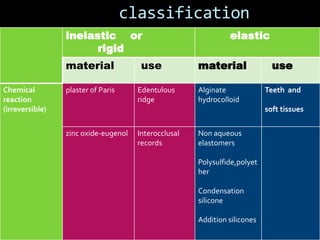
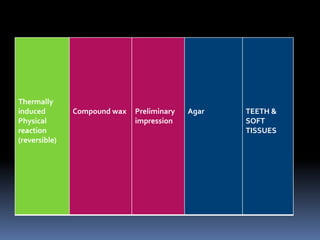
classification
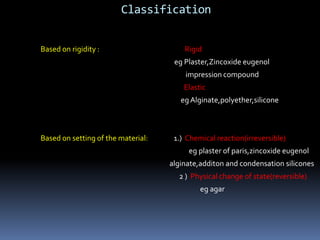
Classification Based on rigidity :                                                     Rigid egPlaster,Zincoxideeugenol                                                                                          impression compound                                                                                         ElasticegAlginate,polyether,siliconeBased on setting of the material:                1.)  Chemical reaction(irreversible)eg plaster of paris,zincoxideeugenolalginate,additon and condensation silicones                                                                                                        2 )  Physical change of state(reversible)eg agar
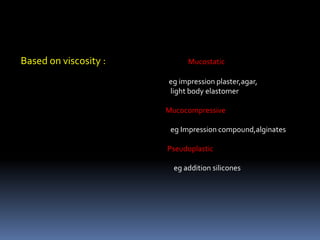
Based on viscosity :                                       Mucostaticeg impression plaster,agar,                                                                                             light body elastomerMucocompressiveeg Impression compound,alginatesPseudoplasticeg addition silicones
Based on interaction with saliva                 and water     :                                               Hydrophobiceg polysulfide ,condensation                                                                                               silicones       Hydrophilicegputty,impression plasterBased on use  :                                                                                                   Primary                                                                               impression materialeg impression compound,alginate                                                                                         Secondary                                                                               Impression materialegZoe,medium bodied elastomers                                                                                          Duplicating                                                                                               material  eg agar
Based on Chemical composition :                                 impression plaster                                                                                impression compound                                                                                 metal oxide(zinc oxide eugenol)                                                                                                                         pastes                                                                                   agar hydrocolloid                                                                                  alginate hydrocolloidpolysulfides                                                                                   condensation silicones                                                                                   addition siliconespolythers                                                                                    light curing polyether                                                                                      (urethane  dimethacrylate)
Desirable qualitiesPleasant odor taste and colorAbsence of toxic irritantsAdequate shelf lifeEconomical Easy to useSetting that meet clinical requirementsSatisfactory consistency
Readily wet oral tissuesElastic Adequate strenghtDimensional stabilityCompatiblity with cast and die materialsAccuracy Disinfection
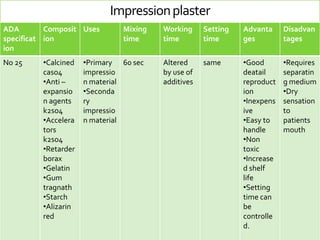
Impression plaster
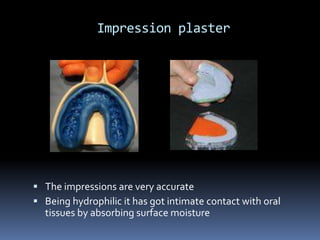
Impression plaster The impressions are very accurateBeing hydrophilic it has got intimate contact with oral tissues by absorbing surface moisture
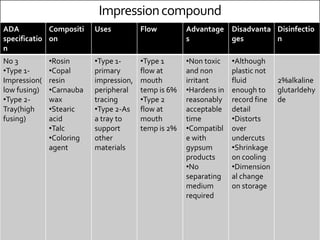
Impression compound
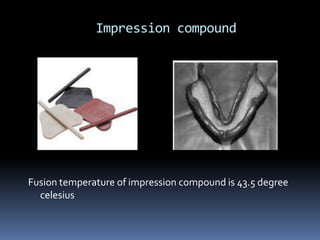
Impression compound Fusion temperature of impression compound is 43.5 degree celesius
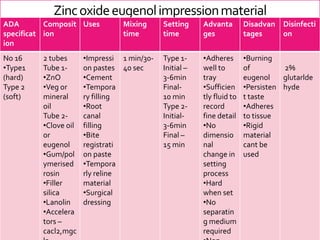
Zinc oxide eugenol impression material
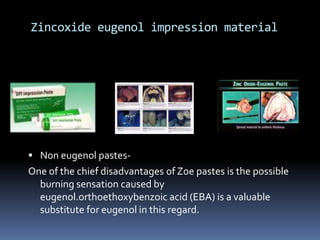
Zincoxideeugenol impression materialNon eugenol pastes-One of the chief disadvantages of Zoe pastes is the possible burning sensation caused by eugenol.orthoethoxybenzoic acid (EBA) is a valuable substitute for eugenol in this regard.
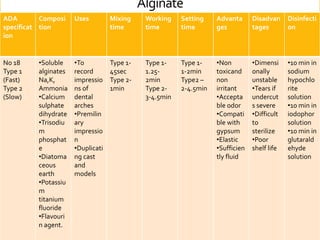
Alginate
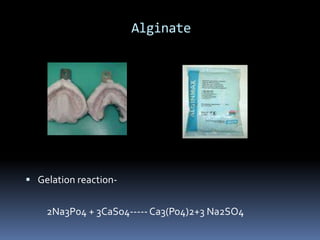
Alginate Gelation reaction-          2Na3P04 + 3CaSo4----- Ca3(Po4)2+3 Na2SO4
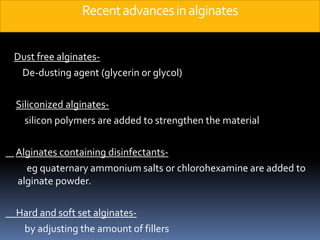
Recent advances in alginatesDust free alginates-        De-dusting agent (glycerin or glycol)Siliconized alginates-          silicon polymers are added to strengthen the materialAlginates containing disinfectants-eg quaternary ammonium salts or chlorohexamine are added to alginate powder.     Hard and soft set alginates-         by adjusting the amount of fillers
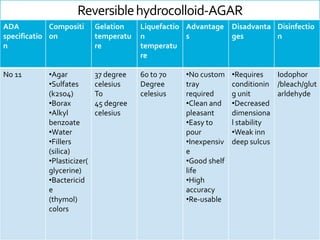
Reversible hydrocolloid-AGAR
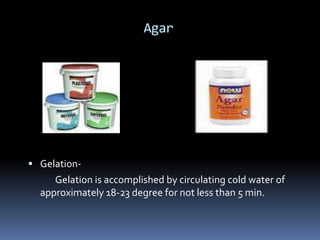
Agar Gelation-Gelation is accomplished by circulating cold water of                approximately 18-23 degree for not less than 5 min.
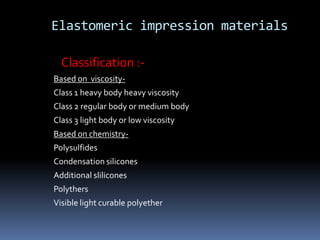
Elastomeric impression materialsClassification :-Based on  viscosity-Class 1 heavy body heavy viscosityClass 2 regular body or medium bodyClass 3 light body or low viscosityBased on chemistry-PolysulfidesCondensation siliconesAdditional sliliconesPolythersVisible light curable polyether
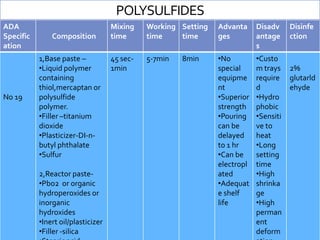
POLYSULFIDES
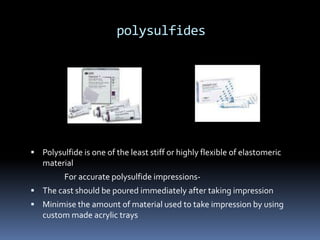
polysulfidesPolysulfide is one of the least stiff or highly flexible of elastomeric material                   For accurate polysulfide impressions-The cast should be poured immediately after taking impressionMinimise the amount of material used to take impression by using custom made acrylic trays
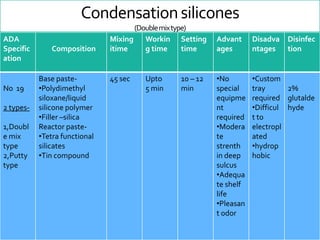
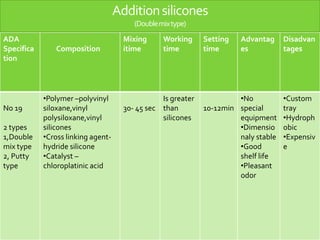
Condensation silicones(Double mix type)
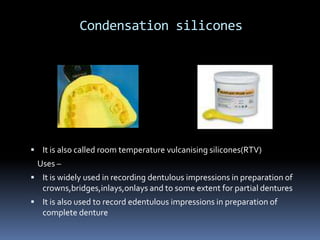
Condensation siliconesIt is also called room temperature vulcanising silicones(RTV)    Uses –It is widely used in recording dentulous impressions in preparation of crowns,bridges,inlays,onlays and to some extent for partial denturesIt is also used to record edentulous impressions in preparation of complete denture
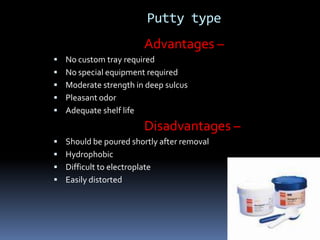
Putty typeAdvantages –No custom tray requiredNo special equipment requiredModerate strength in deep sulcusPleasant odorAdequate shelf life                                Disadvantages –Should be poured shortly after removalHydrophobicDifficult to electroplateEasily distorted
Addition silicones(Double mix type)
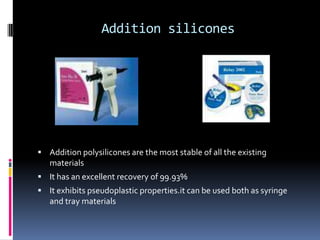
Addition siliconesAddition polysilicones are the most stable of all the existing materialsIt has an excellent recovery of 99.93%It exhibits pseudoplasticproperties.it can be used both as syringe and tray materials
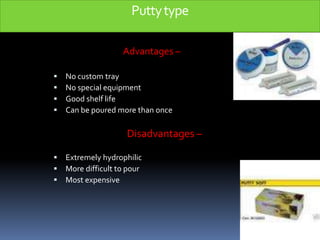
Putty type                                  Advantages –No custom trayNo special equipmentGood shelf lifeCan be poured more than once                                 Disadvantages –Extremely hydrophilicMore difficult to pourMost expensive
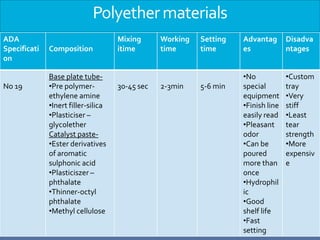
Polyether materials
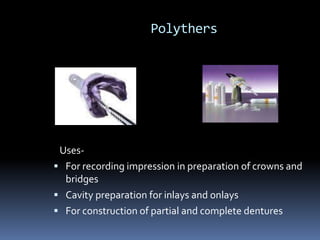
Polythers   Uses-For recording impression in preparation of crowns and bridgesCavity preparation for inlays and onlaysFor construction of partial and complete dentures
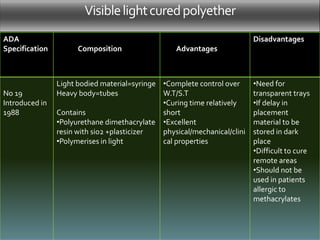
Visible light cured polyether
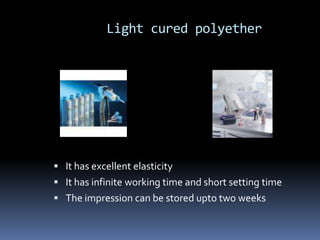
Light cured polyetherIt has excellent elasticityIt has infinite working time and short setting timeThe impression can be stored upto two weeks
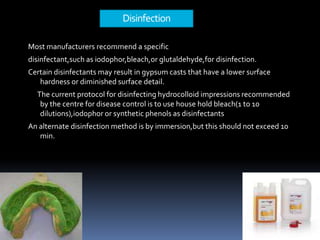
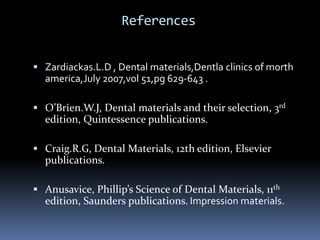
Disinfection Most manufacturers recommend a specificdisinfectant,such as iodophor,bleach,orglutaldehyde,for disinfection.Certain disinfectants may result in gypsum casts that have a lower surface hardness or diminished surface detail.      The current protocol for disinfecting hydrocolloid impressions recommended by the centre for disease control is to use house hold bleach(1 to 10 dilutions),iodophor or synthetic phenols as disinfectantsAn alternate disinfection method is by immersion,but this should not exceed 10 min.
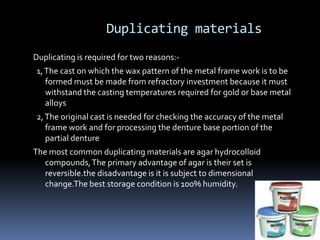
Duplicating materialsDuplicating is required for two reasons:-  1, The cast on which the wax pattern of the metal frame work is to be formed must be made from refractory investment because it must withstand the casting temperatures required for gold or base metal alloys  2, The original cast is needed for checking the accuracy of the metal frame work and for processing the denture base portion of the partial dentureThe most common duplicating materials are agar hydrocolloid compounds, The primary advantage of agar is their set is reversible.the disadvantage is it is subject to dimensional change.The best storage condition is 100% humidity.
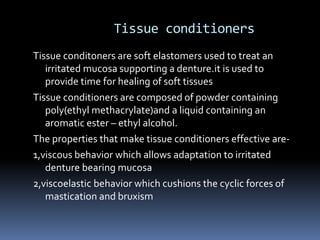
Tissue conditionersTissue conditoners are soft elastomers used to treat an irritated mucosa supporting a denture.it is used to provide time for healing of soft tissuesTissue conditioners are composed of powder containing poly(ethyl methacrylate)and a liquid containing an aromatic ester – ethyl alcohol.The properties that make tissue conditioners effective are-1,viscous behavior which allows adaptation to irritated denture bearing mucosa2,viscoelastic behavior which cushions the cyclic forces of mastication and bruxism
References Zardiackas.L.D , Dental materials,Dentla clinics of morthamerica,July 2007,vol 51,pg 629-643 .O’Brien.W.J, Dental materials and their selection, 3rd edition, Quintessence publications.Craig.R.G, Dental Materials, 12th edition, Elsevier publications.Anusavice, Phillip’s Science of Dental Materials, 11th edition, Saunders publications. Impression materials.

Impression materials

  • 1.
    Impression materials by Bibinbhaskaran
  • 2.
    Impression materialsDefinition :- (GPT): A negative likeness or copy in reverse of the surface or object.2) An imprint of the teeth and adjacent structures for use in dentistry
  • 3.
    Impression material:- Any substance or combination of substances used for making an impression or negative reproduction.Impression technique:- A method and manner used in making a negative likeness.
  • 4.
  • 6.
    Classification Based onrigidity : Rigid egPlaster,Zincoxideeugenol impression compound ElasticegAlginate,polyether,siliconeBased on setting of the material: 1.) Chemical reaction(irreversible)eg plaster of paris,zincoxideeugenolalginate,additon and condensation silicones 2 ) Physical change of state(reversible)eg agar
  • 7.
    Based on viscosity: Mucostaticeg impression plaster,agar, light body elastomerMucocompressiveeg Impression compound,alginatesPseudoplasticeg addition silicones
  • 8.
    Based on interactionwith saliva and water : Hydrophobiceg polysulfide ,condensation silicones Hydrophilicegputty,impression plasterBased on use : Primary impression materialeg impression compound,alginate Secondary Impression materialegZoe,medium bodied elastomers Duplicating material eg agar
  • 9.
    Based on Chemicalcomposition : impression plaster impression compound metal oxide(zinc oxide eugenol) pastes agar hydrocolloid alginate hydrocolloidpolysulfides condensation silicones addition siliconespolythers light curing polyether (urethane dimethacrylate)
  • 10.
    Desirable qualitiesPleasant odortaste and colorAbsence of toxic irritantsAdequate shelf lifeEconomical Easy to useSetting that meet clinical requirementsSatisfactory consistency
  • 11.
    Readily wet oraltissuesElastic Adequate strenghtDimensional stabilityCompatiblity with cast and die materialsAccuracy Disinfection
  • 12.
  • 13.
    Impression plaster Theimpressions are very accurateBeing hydrophilic it has got intimate contact with oral tissues by absorbing surface moisture
  • 14.
  • 15.
    Impression compound Fusiontemperature of impression compound is 43.5 degree celesius
  • 16.
    Zinc oxide eugenolimpression material
  • 17.
    Zincoxideeugenol impression materialNoneugenol pastes-One of the chief disadvantages of Zoe pastes is the possible burning sensation caused by eugenol.orthoethoxybenzoic acid (EBA) is a valuable substitute for eugenol in this regard.
  • 18.
  • 19.
    Alginate Gelation reaction- 2Na3P04 + 3CaSo4----- Ca3(Po4)2+3 Na2SO4
  • 20.
    Recent advances inalginatesDust free alginates- De-dusting agent (glycerin or glycol)Siliconized alginates- silicon polymers are added to strengthen the materialAlginates containing disinfectants-eg quaternary ammonium salts or chlorohexamine are added to alginate powder. Hard and soft set alginates- by adjusting the amount of fillers
  • 21.
  • 22.
    Agar Gelation-Gelation isaccomplished by circulating cold water of approximately 18-23 degree for not less than 5 min.
  • 23.
    Elastomeric impression materialsClassification:-Based on viscosity-Class 1 heavy body heavy viscosityClass 2 regular body or medium bodyClass 3 light body or low viscosityBased on chemistry-PolysulfidesCondensation siliconesAdditional sliliconesPolythersVisible light curable polyether
  • 24.
  • 25.
    polysulfidesPolysulfide is oneof the least stiff or highly flexible of elastomeric material For accurate polysulfide impressions-The cast should be poured immediately after taking impressionMinimise the amount of material used to take impression by using custom made acrylic trays
  • 26.
  • 27.
    Condensation siliconesIt isalso called room temperature vulcanising silicones(RTV) Uses –It is widely used in recording dentulous impressions in preparation of crowns,bridges,inlays,onlays and to some extent for partial denturesIt is also used to record edentulous impressions in preparation of complete denture
  • 28.
    Putty typeAdvantages –Nocustom tray requiredNo special equipment requiredModerate strength in deep sulcusPleasant odorAdequate shelf life Disadvantages –Should be poured shortly after removalHydrophobicDifficult to electroplateEasily distorted
  • 29.
  • 30.
    Addition siliconesAddition polysiliconesare the most stable of all the existing materialsIt has an excellent recovery of 99.93%It exhibits pseudoplasticproperties.it can be used both as syringe and tray materials
  • 31.
    Putty type Advantages –No custom trayNo special equipmentGood shelf lifeCan be poured more than once Disadvantages –Extremely hydrophilicMore difficult to pourMost expensive
  • 32.
  • 33.
    Polythers Uses-For recording impression in preparation of crowns and bridgesCavity preparation for inlays and onlaysFor construction of partial and complete dentures
  • 34.
  • 35.
    Light cured polyetherIthas excellent elasticityIt has infinite working time and short setting timeThe impression can be stored upto two weeks
  • 36.
    Disinfection Most manufacturersrecommend a specificdisinfectant,such as iodophor,bleach,orglutaldehyde,for disinfection.Certain disinfectants may result in gypsum casts that have a lower surface hardness or diminished surface detail. The current protocol for disinfecting hydrocolloid impressions recommended by the centre for disease control is to use house hold bleach(1 to 10 dilutions),iodophor or synthetic phenols as disinfectantsAn alternate disinfection method is by immersion,but this should not exceed 10 min.
  • 37.
    Duplicating materialsDuplicating isrequired for two reasons:- 1, The cast on which the wax pattern of the metal frame work is to be formed must be made from refractory investment because it must withstand the casting temperatures required for gold or base metal alloys 2, The original cast is needed for checking the accuracy of the metal frame work and for processing the denture base portion of the partial dentureThe most common duplicating materials are agar hydrocolloid compounds, The primary advantage of agar is their set is reversible.the disadvantage is it is subject to dimensional change.The best storage condition is 100% humidity.
  • 38.
    Tissue conditionersTissue conditonersare soft elastomers used to treat an irritated mucosa supporting a denture.it is used to provide time for healing of soft tissuesTissue conditioners are composed of powder containing poly(ethyl methacrylate)and a liquid containing an aromatic ester – ethyl alcohol.The properties that make tissue conditioners effective are-1,viscous behavior which allows adaptation to irritated denture bearing mucosa2,viscoelastic behavior which cushions the cyclic forces of mastication and bruxism
  • 39.
    References Zardiackas.L.D ,Dental materials,Dentla clinics of morthamerica,July 2007,vol 51,pg 629-643 .O’Brien.W.J, Dental materials and their selection, 3rd edition, Quintessence publications.Craig.R.G, Dental Materials, 12th edition, Elsevier publications.Anusavice, Phillip’s Science of Dental Materials, 11th edition, Saunders publications. Impression materials.

Editor's Notes