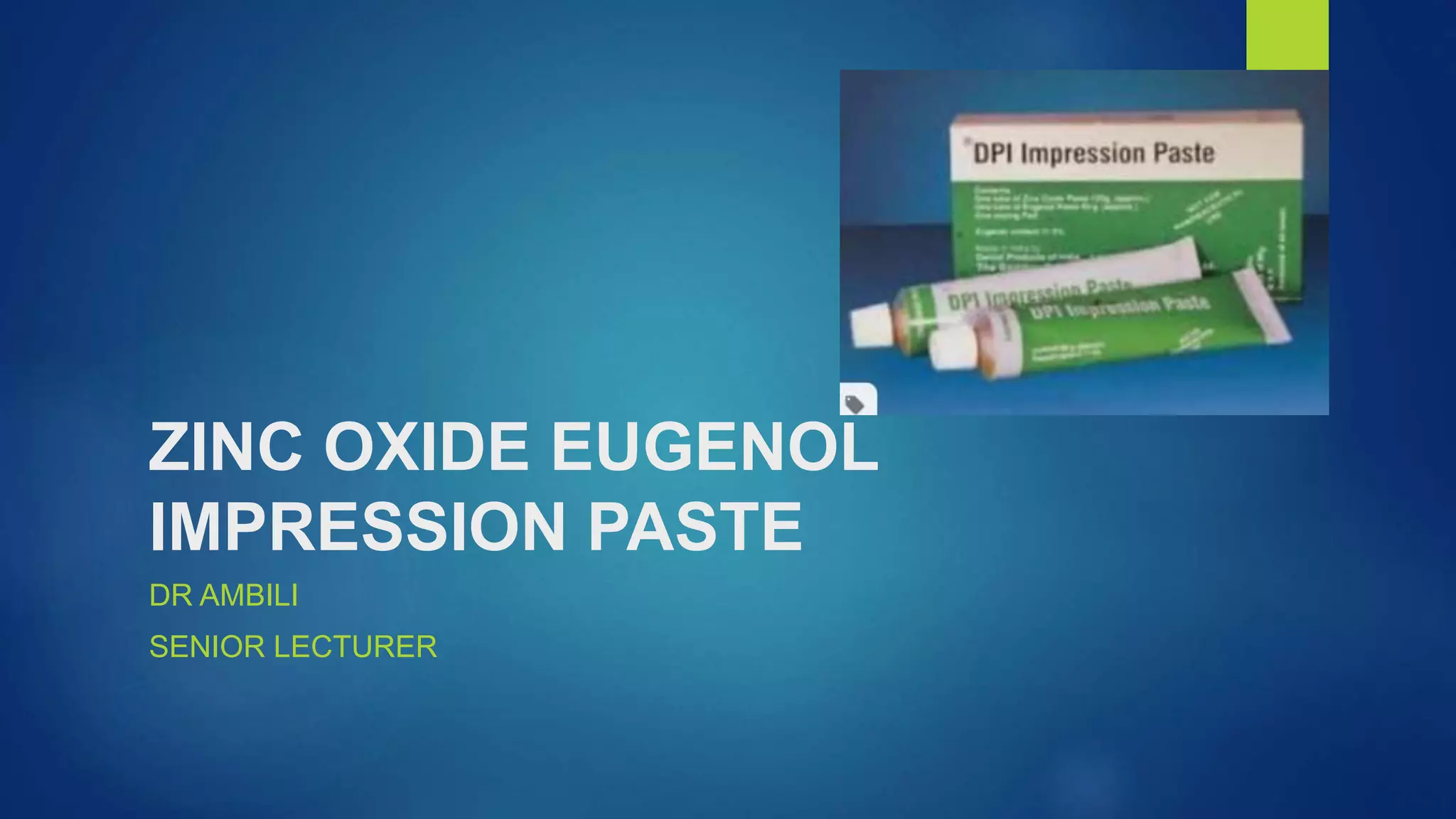
ZINC OXIDE EUGENOL
IMPRESSION PASTE
DR AMBILI
SENIOR LECTURER
MODE OF SETTING RIGID ELASTIC
CHEMICAL REACTION
[IRREVERSIBLE]
IMPRESSION PLASTER ,
ZINCOXIDE EUGENOL
ALGINATE
HYDROCOLLOID,
NONAQUOUS
ELASTOMERS.
TEMPERATURE
CHANGE [
REVERSIBLE ]
IMPRESSION
COMPOUND , WAXES
AGAR
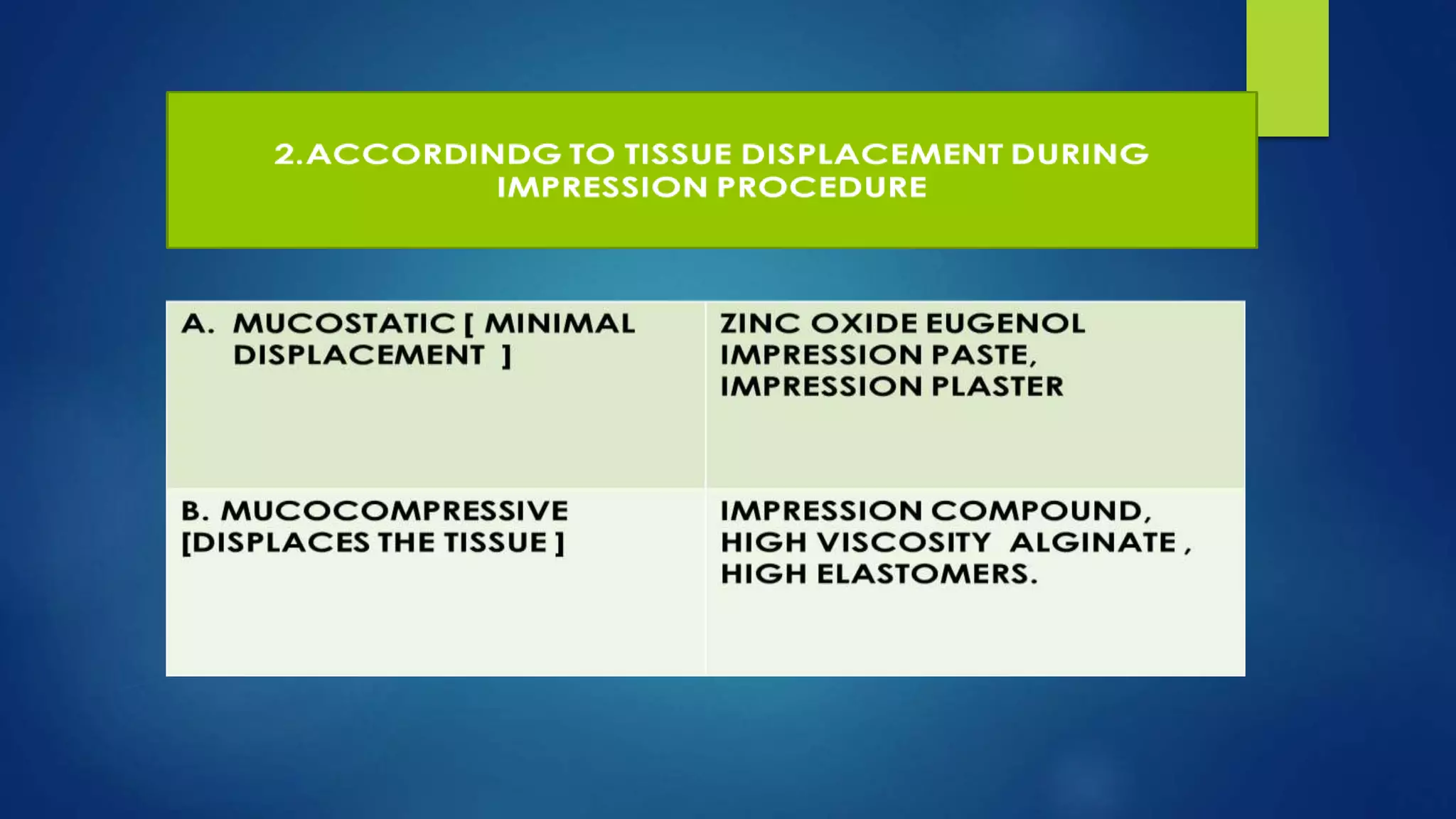
1. CLASSIFICATION OF IMPRESSION MATERIALS ACCORDING TO MODE OF
SETTING & ELASTICITY
IMRESSION MATERIALS USED FOR
COMPLETE DENTURE PROSTHESIS
IMPRESSION PLASTER , IMPRESSION
COMPOUND, ZINC OXIDE EUGENOL
IMPRESSION PASTE.
IMRESSION MATERIALS USED FOR
DENTULOUS MOUTH
ALGINATE , RUBBER BASE
IMPRESSIONS
3.. ACCORDING TO THEIR USES IN DENTISTRY
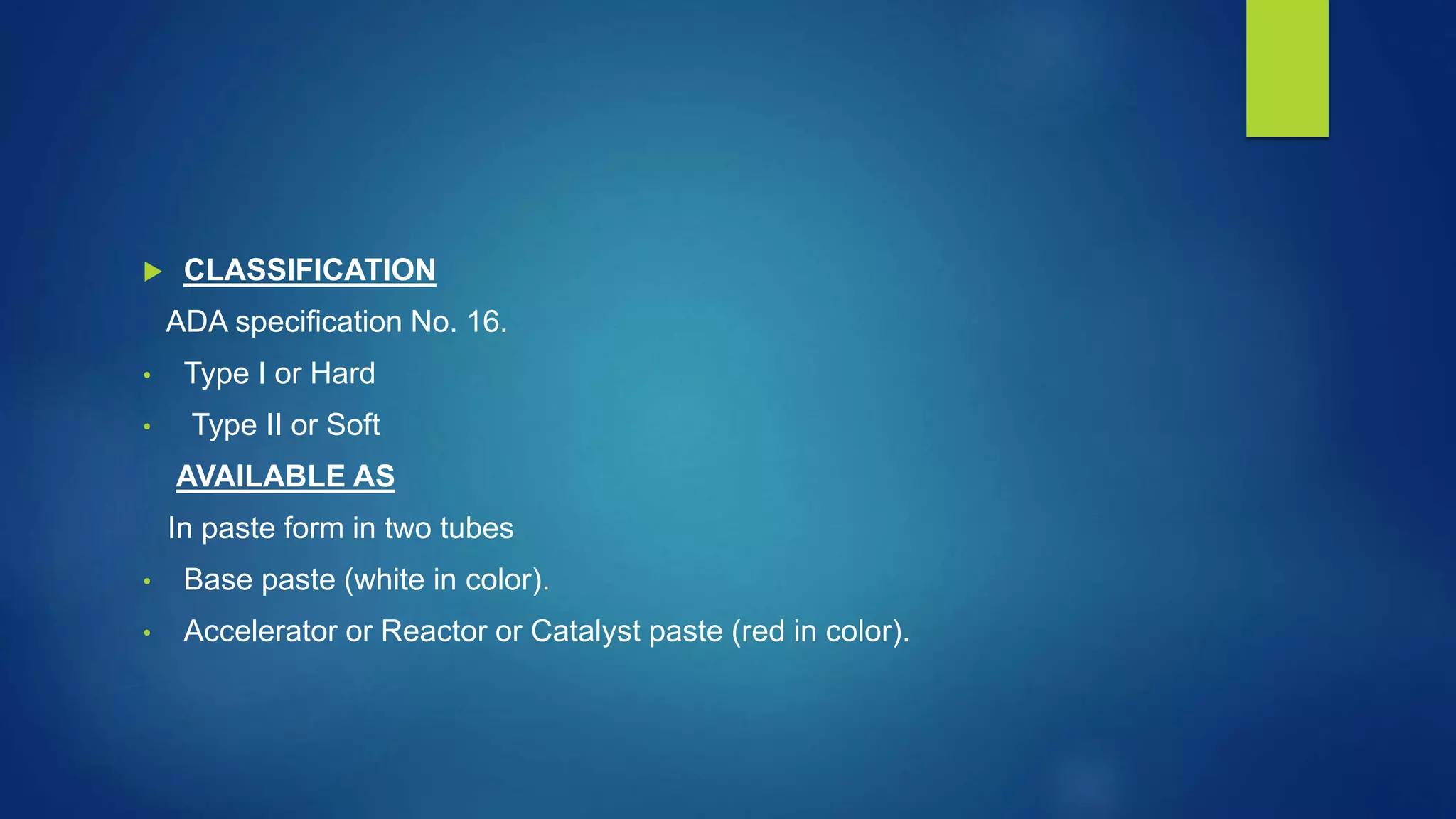
 CLASSIFICATION
ADA specification No. 16.
• Type I or Hard
• Type II or Soft
AVAILABLE AS
In paste form in two tubes
• Base paste (white in color).
• Accelerator or Reactor or Catalyst paste (red in color).
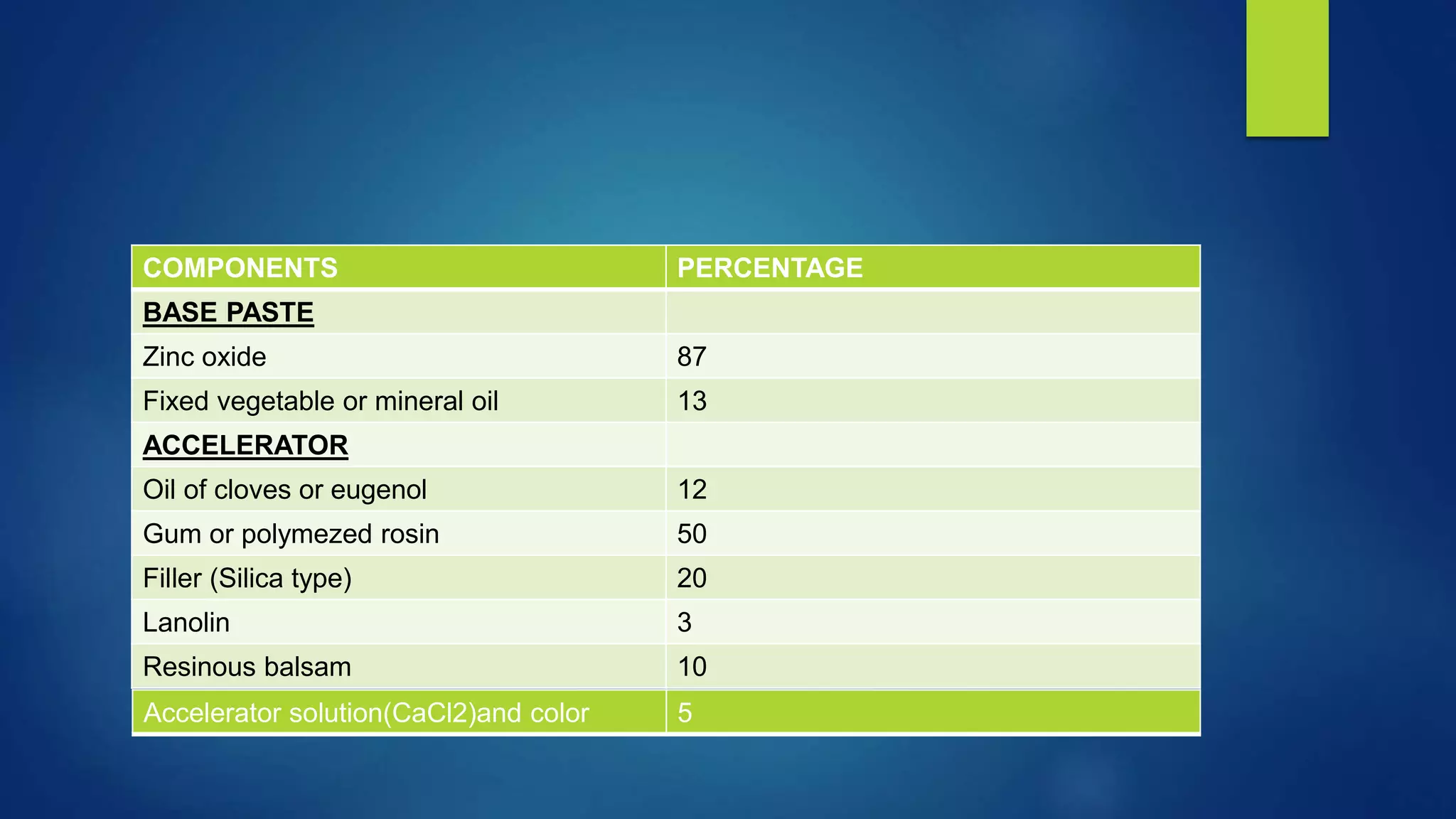
COMPONENTS PERCENTAGE
BASE PASTE
Zinc oxide 87
Fixed vegetable or mineral oil 13
ACCELERATOR
Oil of cloves or eugenol 12
Gum or polymezed rosin 50
Filler (Silica type) 20
Lanolin 3
Resinous balsam 10
Accelerator solution(CaCl2)and color 5
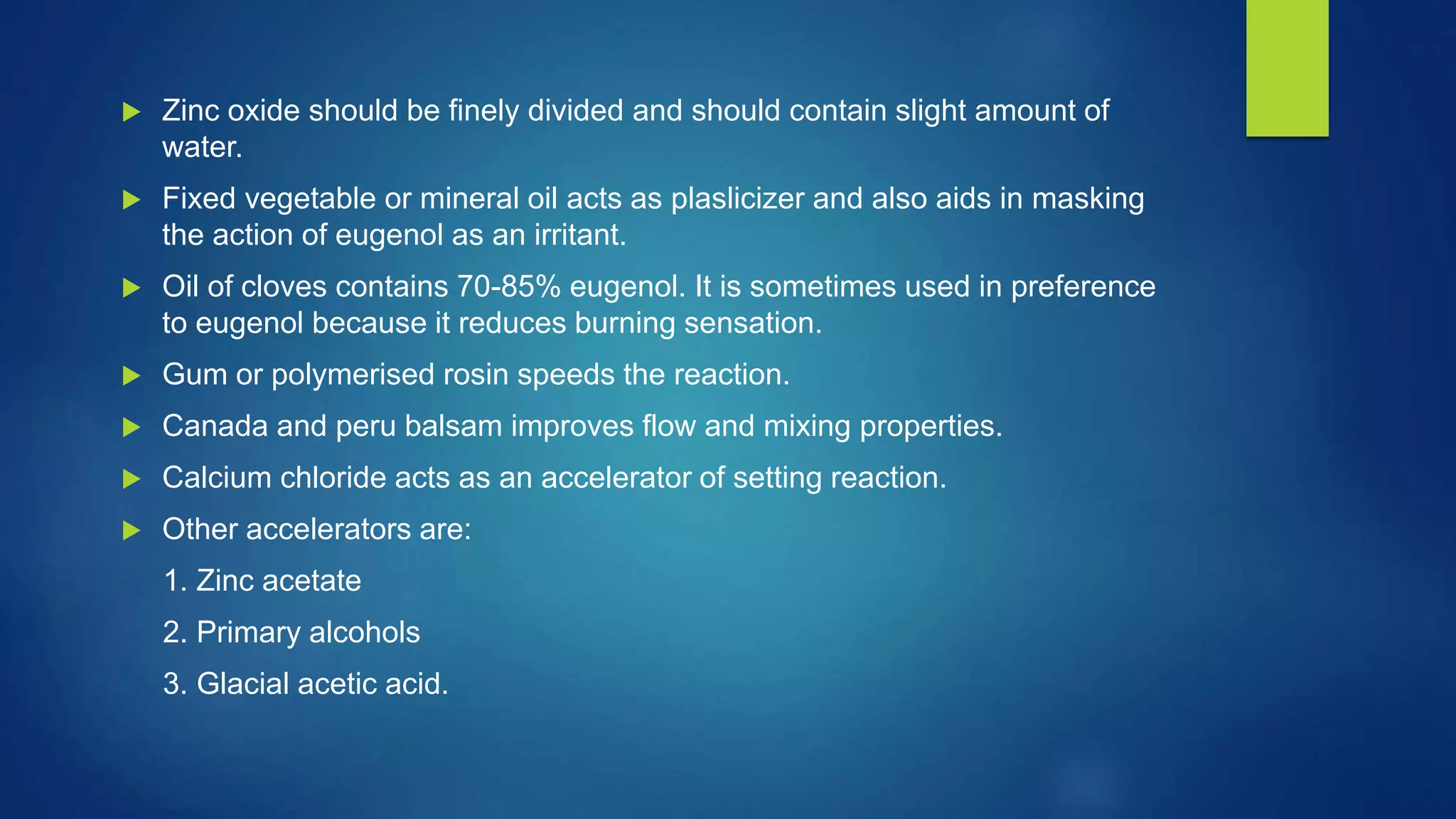
 Zinc oxide should be finely divided and should contain slight amount of
water.
 Fixed vegetable or mineral oil acts as plaslicizer and also aids in masking
the action of eugenol as an irritant.
 Oil of cloves contains 70-85% eugenol. It is sometimes used in preference
to eugenol because it reduces burning sensation.
 Gum or polymerised rosin speeds the reaction.
 Canada and peru balsam improves flow and mixing properties.
 Calcium chloride acts as an accelerator of setting reaction.
 Other accelerators are:
1. Zinc acetate
2. Primary alcohols
3. Glacial acetic acid.
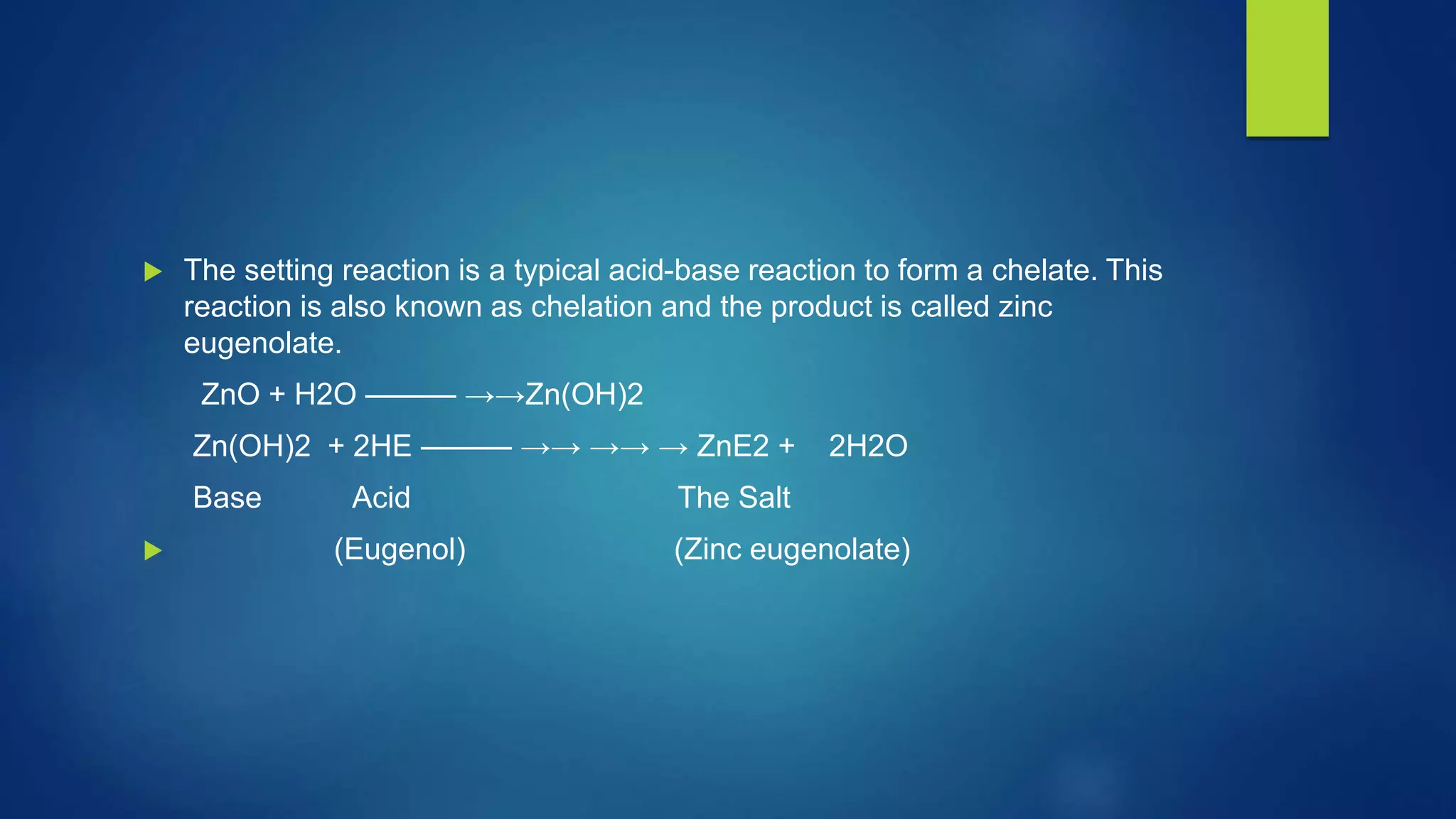
 The setting reaction is a typical acid-base reaction to form a chelate. This
reaction is also known as chelation and the product is called zinc
eugenolate.
ZnO + H2O ——— →→Zn(OH)2
Zn(OH)2 + 2HE ——— →→ →→ → ZnE2 + 2H2O
Base Acid The Salt
 (Eugenol) (Zinc eugenolate)
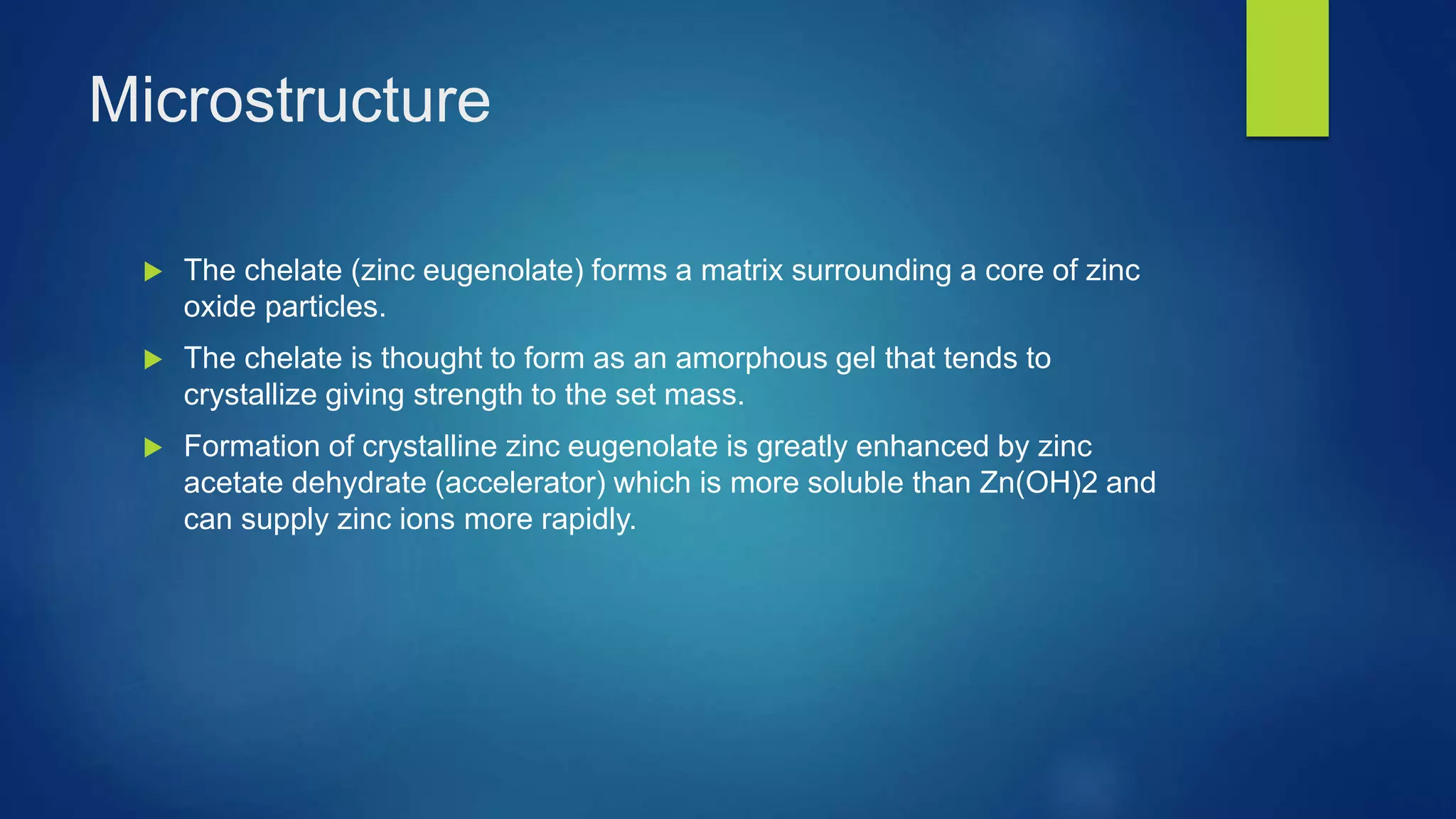
Microstructure
 The chelate (zinc eugenolate) forms a matrix surrounding a core of zinc
oxide particles.
 The chelate is thought to form as an amorphous gel that tends to
crystallize giving strength to the set mass.
 Formation of crystalline zinc eugenolate is greatly enhanced by zinc
acetate dehydrate (accelerator) which is more soluble than Zn(OH)2 and
can supply zinc ions more rapidly.
 Working Time
 There should be sufficient time for mixing, loading onto the tray and seating
the impression into the mouth.
 Setting Time
 Once the material is in place, it should set fast.
 Initial setting time is the period from the beginning of the mixing until the
material ceases to pull away or string out when its surface is touched with a
metal rod of specified dimensions. The impressions should be seated in the
mouth before the initial set.
 The final set occurs when a needle of specified dimension fails to penetrate
the surface of the specimen more than 0.2 mm under a load of 50 gm.
Factors Controlling Setting Time
 Particle size of zinc oxide powder: If the particle size is small and if it is
acid coated, the setting time is less.
 Setting time can be decreased by adding zinc acetate or a drop of water
or acetic acid (acetic acid is a more effective than water. It increases speed
of formation of the zinc hydroxide).
 Longer the mixing time, shorter is the setting time.
 High atmospheric temperature and humidity accelerate setting.
 Setting can be delayed by cooling the mixing slab, spatula or adding small
amounts of retarder or oils or waxes.
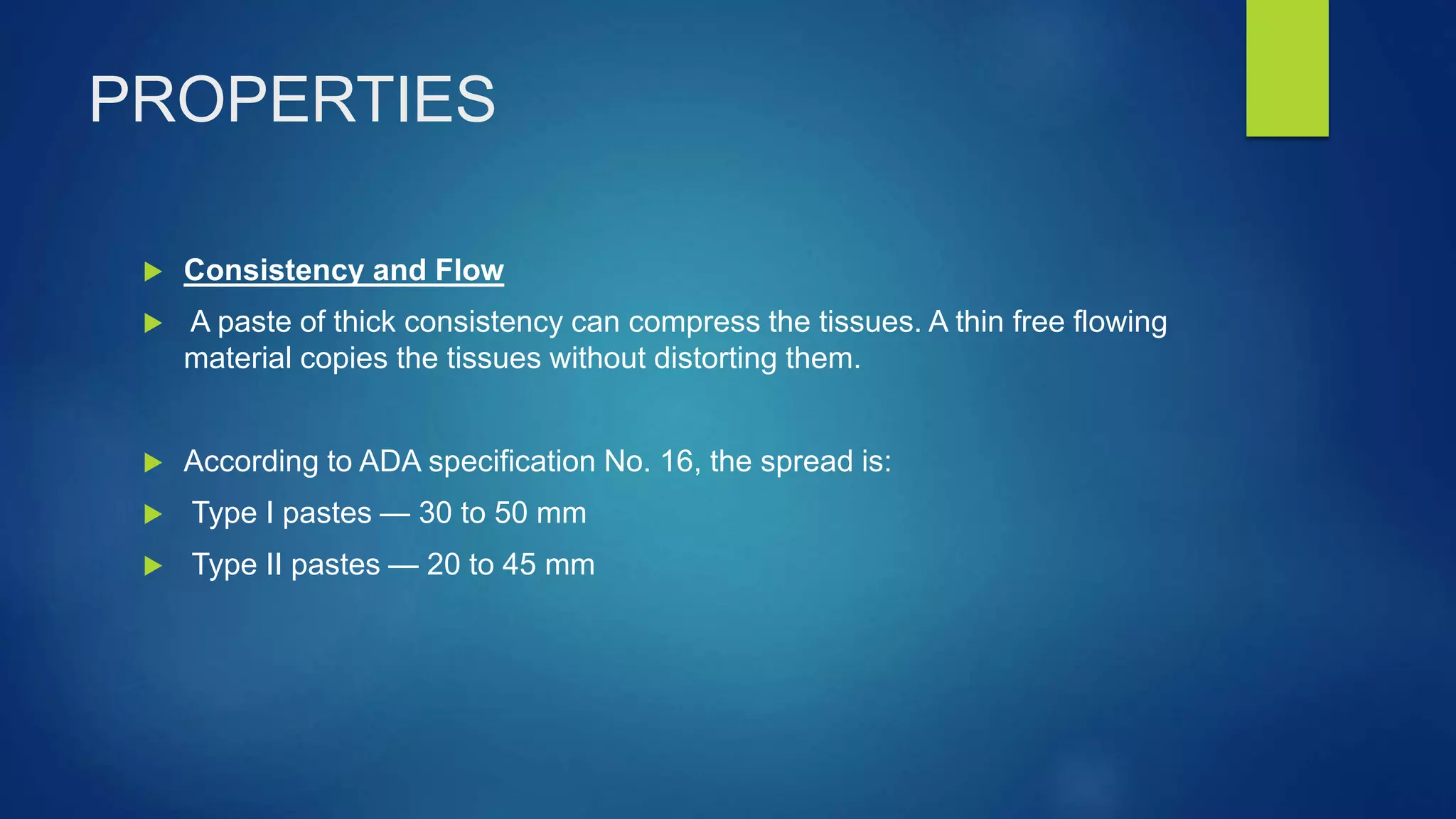
PROPERTIES
 Consistency and Flow
 A paste of thick consistency can compress the tissues. A thin free flowing
material copies the tissues without distorting them.
 According to ADA specification No. 16, the spread is:
 Type I pastes — 30 to 50 mm
 Type II pastes — 20 to 45 mm
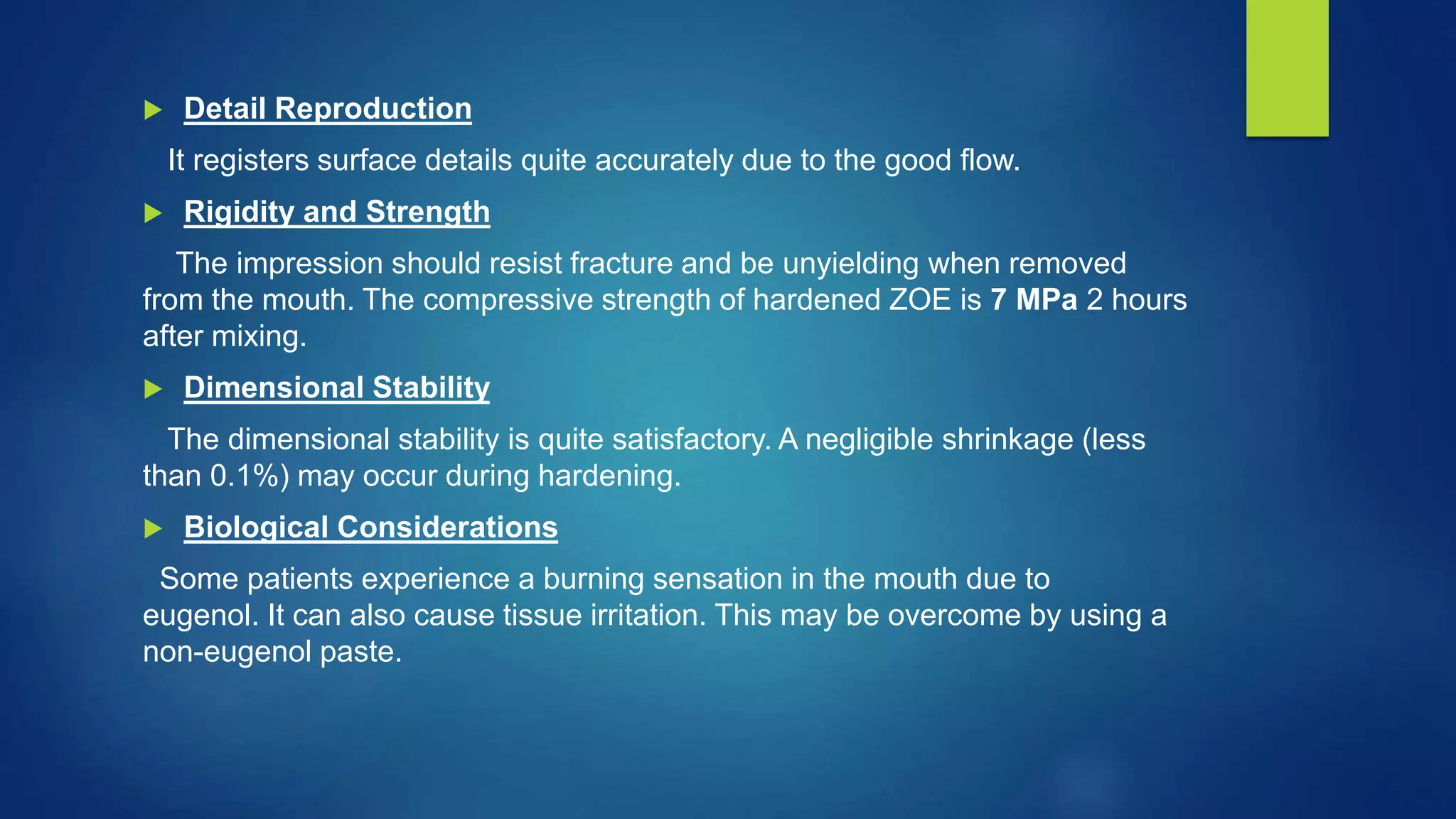
 Detail Reproduction
It registers surface details quite accurately due to the good flow.
 Rigidity and Strength
The impression should resist fracture and be unyielding when removed
from the mouth. The compressive strength of hardened ZOE is 7 MPa 2 hours
after mixing.
 Dimensional Stability
The dimensional stability is quite satisfactory. A negligible shrinkage (less
than 0.1%) may occur during hardening.
 Biological Considerations
Some patients experience a burning sensation in the mouth due to
eugenol. It can also cause tissue irritation. This may be overcome by using a
non-eugenol paste.
MANIPULATION
 The mixing is done on an oil-impervious paper or glass slab. Two ropes of
paste of same length and width , one from each tube are squeezed onto
the mixing slab . A flexible stainless steel spatula is used. The two ropes
are combined with the first sweep of the spatula and mixed until a uniform
color is observed
 Mixing time
1 minute.
 Mechanical mixing
 A rotary mixing device can also be used .Special circular mixing pads are
available. These are attached to the circular table of the device. After
dispensing the material, the machine is switched on. As the table rotates,
the operator first collects the material using the sides of the spatula. He
then spreads the material by flattening the spatula. The process of
collecting and flattening is repeated alternately until a uniform mix is
obtained. Mechanical mixing gives a faster, uniform mix with less voids
and bubbles.
ADVANTAGES
 It has sufficient body so as to make up for any minor under extensions in
the tray itself during impression making.
 It has enough working time to complete border moulding.
 It can be checked in the mouth repeatedly without deforming.
 It registers accurate surface details.
 It is dimensionally stable.
 It does not require any separating media since it does not stick to the cast
material.
 Minor defects can be corrected locally without discarding a good
impression
DISADVANTAGES
 It requires a special tray for impression making.
 It is sticky in nature and adheres to tissues.
 Eugenol can cause burning sensation and tissue irritation.
 It cannot be used for making impression of teeth and under-cut areas as it
is inelastic in nature
OTHER ZINC OXIDE PASTES
 SURGICAL PASTES
 After certain periodontal surgeries (e.g. gingivectomy, i.e. surgical removal of
diseased gingival tissues) where suture cannot be placed, a zinc oxide
eugenol surgical paste may be placed over the wound to aid in the retention of
the medicament, to protect the wound and to promote healing (also known as
periodontal pack).
 These surgical pastes are less brittle and weaker after hardening. The setting
time is longer.
 The paste is mixed and formed into a rope that is packed over the gingival
wounds and into the interproximal spaces to provide retention. The final
product after setting should be sufficiently strong so that it is not readily
displaced during mastication.
 These pastes may also contain more eugenol and the accelerator content is
less.
NON-EUGENOL PASTES
 The chief disadvantage of zinc oxide eugenol paste is the burning
sensation caused by eugenol.
 Some patients find the taste of eugenol disagreeable and in cases where
the surgical pack is worn for several weeks chronic gastric disturbance
may result. Hence non-eugenol pastes were developed.
 Here, the zinc oxide is reacted with a carboxylic acid.
ZnO + 2RCOOH ——— →→ →→ → (RCOO)2 Zn + H2O
 The reaction is not greatly affected by temperature or humidity.
Bactericides and other medicaments can be incorporated. This reaction
can be substituted for the zinc oxide eugenol reaction to form any type of
dental paste.
BITE REGISTRATION PASTES
 These are materials used for recording the occlusal relationship between
teeth or occlusion rims.
 ZOE pastes used for this purpose have slightly different properties.
 Shorter setting time to prevent distortion.
 More plasticizers to prevent it from sticking to the teeth or occlusion
rims.
 ZOE registrations are more rigid than registrations made in wax. They are
more stable, and offer less resistance to the closing of the jaw.

ZINC OXIDE EUGENOL IMPRESSION PASTE (1).pptx

  • 1.
    ZINC OXIDE EUGENOL IMPRESSIONPASTE DR AMBILI SENIOR LECTURER
  • 2.
    MODE OF SETTINGRIGID ELASTIC CHEMICAL REACTION [IRREVERSIBLE] IMPRESSION PLASTER , ZINCOXIDE EUGENOL ALGINATE HYDROCOLLOID, NONAQUOUS ELASTOMERS. TEMPERATURE CHANGE [ REVERSIBLE ] IMPRESSION COMPOUND , WAXES AGAR 1. CLASSIFICATION OF IMPRESSION MATERIALS ACCORDING TO MODE OF SETTING & ELASTICITY
  • 4.
    IMRESSION MATERIALS USEDFOR COMPLETE DENTURE PROSTHESIS IMPRESSION PLASTER , IMPRESSION COMPOUND, ZINC OXIDE EUGENOL IMPRESSION PASTE. IMRESSION MATERIALS USED FOR DENTULOUS MOUTH ALGINATE , RUBBER BASE IMPRESSIONS 3.. ACCORDING TO THEIR USES IN DENTISTRY
  • 5.
     CLASSIFICATION ADA specificationNo. 16. • Type I or Hard • Type II or Soft AVAILABLE AS In paste form in two tubes • Base paste (white in color). • Accelerator or Reactor or Catalyst paste (red in color).
  • 6.
    COMPONENTS PERCENTAGE BASE PASTE Zincoxide 87 Fixed vegetable or mineral oil 13 ACCELERATOR Oil of cloves or eugenol 12 Gum or polymezed rosin 50 Filler (Silica type) 20 Lanolin 3 Resinous balsam 10 Accelerator solution(CaCl2)and color 5
  • 7.
     Zinc oxideshould be finely divided and should contain slight amount of water.  Fixed vegetable or mineral oil acts as plaslicizer and also aids in masking the action of eugenol as an irritant.  Oil of cloves contains 70-85% eugenol. It is sometimes used in preference to eugenol because it reduces burning sensation.  Gum or polymerised rosin speeds the reaction.  Canada and peru balsam improves flow and mixing properties.  Calcium chloride acts as an accelerator of setting reaction.  Other accelerators are: 1. Zinc acetate 2. Primary alcohols 3. Glacial acetic acid.
  • 8.
     The settingreaction is a typical acid-base reaction to form a chelate. This reaction is also known as chelation and the product is called zinc eugenolate. ZnO + H2O ——— →→Zn(OH)2 Zn(OH)2 + 2HE ——— →→ →→ → ZnE2 + 2H2O Base Acid The Salt  (Eugenol) (Zinc eugenolate)
  • 9.
    Microstructure  The chelate(zinc eugenolate) forms a matrix surrounding a core of zinc oxide particles.  The chelate is thought to form as an amorphous gel that tends to crystallize giving strength to the set mass.  Formation of crystalline zinc eugenolate is greatly enhanced by zinc acetate dehydrate (accelerator) which is more soluble than Zn(OH)2 and can supply zinc ions more rapidly.
  • 10.
     Working Time There should be sufficient time for mixing, loading onto the tray and seating the impression into the mouth.  Setting Time  Once the material is in place, it should set fast.  Initial setting time is the period from the beginning of the mixing until the material ceases to pull away or string out when its surface is touched with a metal rod of specified dimensions. The impressions should be seated in the mouth before the initial set.  The final set occurs when a needle of specified dimension fails to penetrate the surface of the specimen more than 0.2 mm under a load of 50 gm.
  • 11.
    Factors Controlling SettingTime  Particle size of zinc oxide powder: If the particle size is small and if it is acid coated, the setting time is less.  Setting time can be decreased by adding zinc acetate or a drop of water or acetic acid (acetic acid is a more effective than water. It increases speed of formation of the zinc hydroxide).  Longer the mixing time, shorter is the setting time.  High atmospheric temperature and humidity accelerate setting.  Setting can be delayed by cooling the mixing slab, spatula or adding small amounts of retarder or oils or waxes.
  • 12.
    PROPERTIES  Consistency andFlow  A paste of thick consistency can compress the tissues. A thin free flowing material copies the tissues without distorting them.  According to ADA specification No. 16, the spread is:  Type I pastes — 30 to 50 mm  Type II pastes — 20 to 45 mm
  • 13.
     Detail Reproduction Itregisters surface details quite accurately due to the good flow.  Rigidity and Strength The impression should resist fracture and be unyielding when removed from the mouth. The compressive strength of hardened ZOE is 7 MPa 2 hours after mixing.  Dimensional Stability The dimensional stability is quite satisfactory. A negligible shrinkage (less than 0.1%) may occur during hardening.  Biological Considerations Some patients experience a burning sensation in the mouth due to eugenol. It can also cause tissue irritation. This may be overcome by using a non-eugenol paste.
  • 14.
    MANIPULATION  The mixingis done on an oil-impervious paper or glass slab. Two ropes of paste of same length and width , one from each tube are squeezed onto the mixing slab . A flexible stainless steel spatula is used. The two ropes are combined with the first sweep of the spatula and mixed until a uniform color is observed  Mixing time 1 minute.
  • 15.
     Mechanical mixing A rotary mixing device can also be used .Special circular mixing pads are available. These are attached to the circular table of the device. After dispensing the material, the machine is switched on. As the table rotates, the operator first collects the material using the sides of the spatula. He then spreads the material by flattening the spatula. The process of collecting and flattening is repeated alternately until a uniform mix is obtained. Mechanical mixing gives a faster, uniform mix with less voids and bubbles.
  • 16.
    ADVANTAGES  It hassufficient body so as to make up for any minor under extensions in the tray itself during impression making.  It has enough working time to complete border moulding.  It can be checked in the mouth repeatedly without deforming.  It registers accurate surface details.  It is dimensionally stable.  It does not require any separating media since it does not stick to the cast material.  Minor defects can be corrected locally without discarding a good impression
  • 17.
    DISADVANTAGES  It requiresa special tray for impression making.  It is sticky in nature and adheres to tissues.  Eugenol can cause burning sensation and tissue irritation.  It cannot be used for making impression of teeth and under-cut areas as it is inelastic in nature
  • 18.
    OTHER ZINC OXIDEPASTES  SURGICAL PASTES  After certain periodontal surgeries (e.g. gingivectomy, i.e. surgical removal of diseased gingival tissues) where suture cannot be placed, a zinc oxide eugenol surgical paste may be placed over the wound to aid in the retention of the medicament, to protect the wound and to promote healing (also known as periodontal pack).  These surgical pastes are less brittle and weaker after hardening. The setting time is longer.  The paste is mixed and formed into a rope that is packed over the gingival wounds and into the interproximal spaces to provide retention. The final product after setting should be sufficiently strong so that it is not readily displaced during mastication.  These pastes may also contain more eugenol and the accelerator content is less.
  • 19.
    NON-EUGENOL PASTES  Thechief disadvantage of zinc oxide eugenol paste is the burning sensation caused by eugenol.  Some patients find the taste of eugenol disagreeable and in cases where the surgical pack is worn for several weeks chronic gastric disturbance may result. Hence non-eugenol pastes were developed.  Here, the zinc oxide is reacted with a carboxylic acid. ZnO + 2RCOOH ——— →→ →→ → (RCOO)2 Zn + H2O  The reaction is not greatly affected by temperature or humidity. Bactericides and other medicaments can be incorporated. This reaction can be substituted for the zinc oxide eugenol reaction to form any type of dental paste.
  • 20.
    BITE REGISTRATION PASTES These are materials used for recording the occlusal relationship between teeth or occlusion rims.  ZOE pastes used for this purpose have slightly different properties.  Shorter setting time to prevent distortion.  More plasticizers to prevent it from sticking to the teeth or occlusion rims.  ZOE registrations are more rigid than registrations made in wax. They are more stable, and offer less resistance to the closing of the jaw.