By
KAUSHAL KUMAR SAHU
Assistant Professor (Ad Hoc)
Department of Biotechnology
Govt. Digvijay Autonomous P. G. College
Raj-Nandgaon ( C. G. )
 Introduction
 Definiation
 Principle
 Fundamental of dencitometry
 Types
transmission dencitometry
reflection dencitometry
combination dencitometry
 Application
 Bibliography
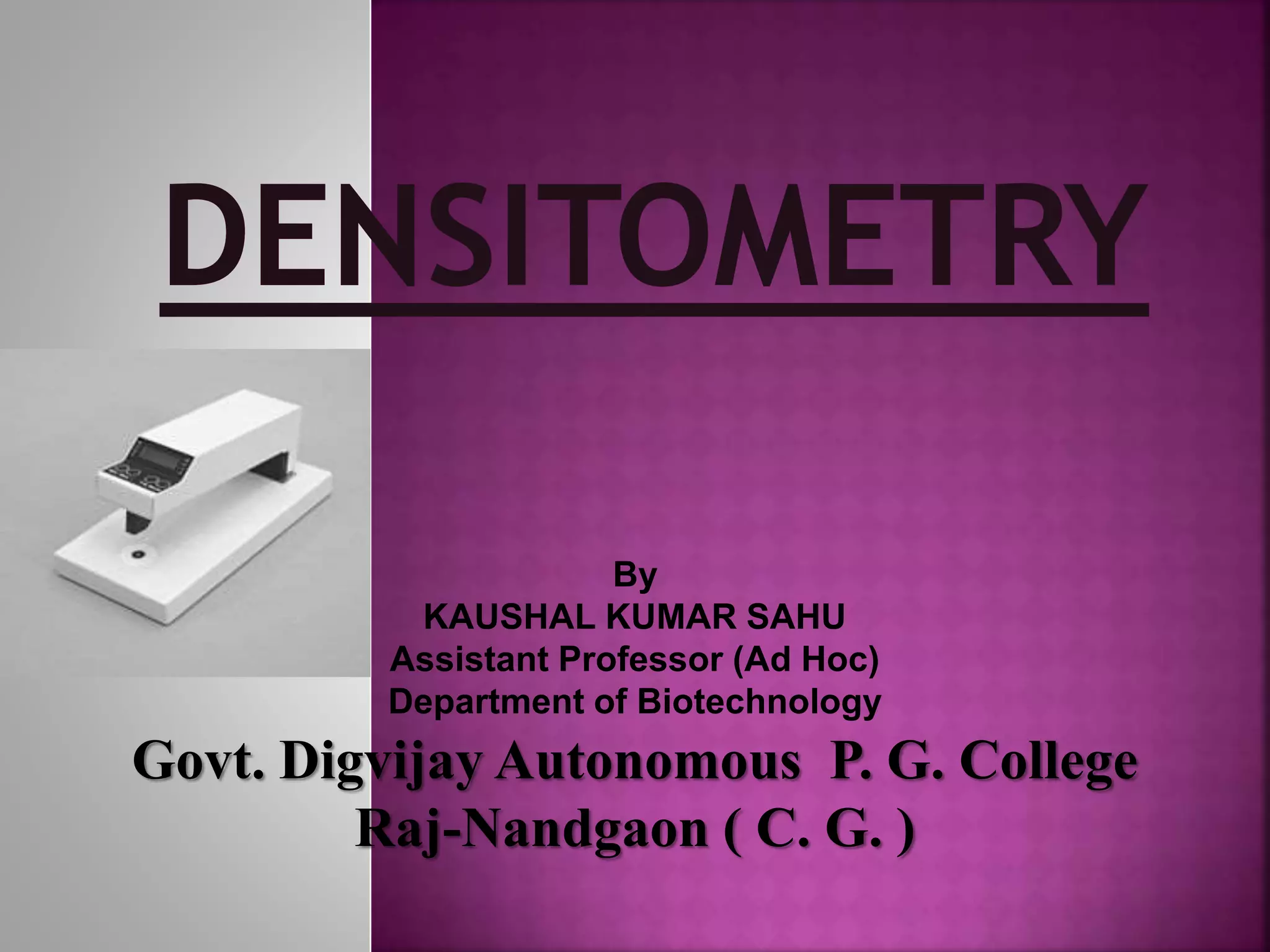
Densitometer is a tool used for
measuring the optical density of a
material.
Such as photographic negative.
In pressroom for printing work.
To calculate and display the density
color value it measure.
Densitometer is a device that measure the
degree of darkness (the optical density) of
a photographic or semitransparent
material.
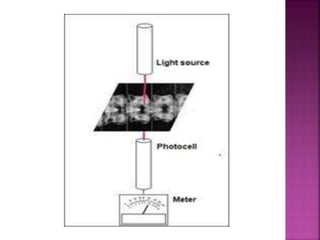
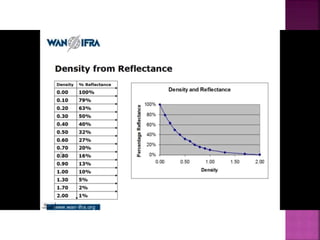
 It is measurement of optical density in light
sensitive material due to expose of light.
 Optical density result of darkness developed picture
& number of darkness in a given area.
 Density measured by decrease in amount of light
which shines through transparent film called
absorptiometry.
 DMAX & DMIN refers maximum and minimum density
recorded in the material.
 Described by Beer and Lambert.
 Lamberts law-Amount of light absorbed is
proportional to the thickness of absorbing material .
 Beers law-Amount of light absorbed by material is
proportional to concentration of absorbing solution.
Mainly 3 types of densitometer are found:-
1) Transmission densitometer
2) Reflection densitometer
3) Combination densitometer
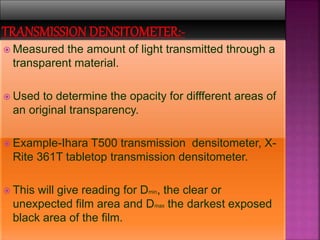
 Measured the amount of light transmitted through a
transparent material.
 Used to determine the opacity for diffferent areas of
an original transparency.
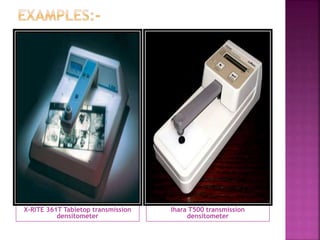
 Example-Ihara T500 transmission densitometer, X-
Rite 361T tabletop transmission densitometer.
 This will give reading for Dmin, the clear or
unexpected film area and Dmax the darkest exposed
black area of the film.
X-RITE 361T Tabletop transmission
densitometer
Ihara T500 transmission
densitometer
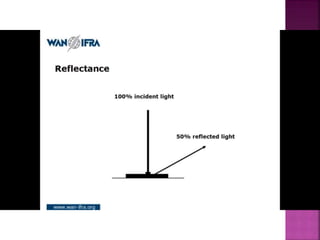
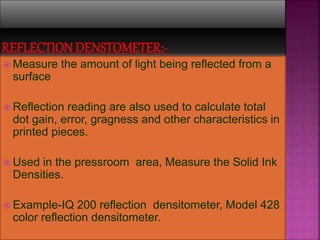
 Measure the amount of light being reflected from a
surface
 Reflection reading are also used to calculate total
dot gain, error, gragness and other characteristics in
printed pieces.
 Used in the pressroom area, Measure the Solid Ink
Densities.
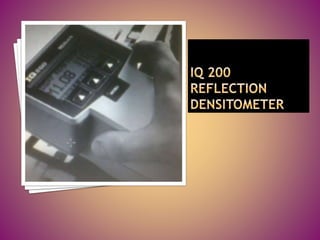
 Example-IQ 200 reflection densitometer, Model 428
color reflection densitometer.
 Measure both reflection and transmission densities.
Examples-
 RT 120 Techkon
 Betacolour 54 xpress
 X- Rite
 Density is the mass of an object divided by
its volume. Density often has units of grams
per cubic centimeter (g/cm3). Remember,
grams is a mass and cubic centimeters is a
volume.
 Print media
 Photography
 Bone densitometry is most accurate and quickest
process to determine osteoporosis in patient.
 Single beam gamma densitometer is used to
measure the average void fraction in a small
diameter stainless steel pipe under critical flow
condition.
 http://en.m.wikipedia.org/wiki/Densitometry.
 http:www.google.co.in= ncbi+ e:book +
densitometer.
 NCBI E. book – Densitometry
 Textbook of quantitative chemistry (NCBI)
 E. book- Webster J.G Medical instrumentation,
Application and Design, Boston, Houghton Miffin,
Company- 1978.

Densitometry by kk sahu

  • 1.
    By KAUSHAL KUMAR SAHU AssistantProfessor (Ad Hoc) Department of Biotechnology Govt. Digvijay Autonomous P. G. College Raj-Nandgaon ( C. G. )
  • 2.
     Introduction  Definiation Principle  Fundamental of dencitometry  Types transmission dencitometry reflection dencitometry combination dencitometry  Application  Bibliography
  • 3.
    Densitometer is atool used for measuring the optical density of a material. Such as photographic negative. In pressroom for printing work. To calculate and display the density color value it measure.
  • 4.
    Densitometer is adevice that measure the degree of darkness (the optical density) of a photographic or semitransparent material.
  • 5.
     It ismeasurement of optical density in light sensitive material due to expose of light.  Optical density result of darkness developed picture & number of darkness in a given area.  Density measured by decrease in amount of light which shines through transparent film called absorptiometry.  DMAX & DMIN refers maximum and minimum density recorded in the material.
  • 7.
     Described byBeer and Lambert.  Lamberts law-Amount of light absorbed is proportional to the thickness of absorbing material .  Beers law-Amount of light absorbed by material is proportional to concentration of absorbing solution.
  • 10.
    Mainly 3 typesof densitometer are found:- 1) Transmission densitometer 2) Reflection densitometer 3) Combination densitometer
  • 11.
     Measured theamount of light transmitted through a transparent material.  Used to determine the opacity for diffferent areas of an original transparency.  Example-Ihara T500 transmission densitometer, X- Rite 361T tabletop transmission densitometer.  This will give reading for Dmin, the clear or unexpected film area and Dmax the darkest exposed black area of the film.
  • 12.
    X-RITE 361T Tabletoptransmission densitometer Ihara T500 transmission densitometer
  • 13.
     Measure theamount of light being reflected from a surface  Reflection reading are also used to calculate total dot gain, error, gragness and other characteristics in printed pieces.  Used in the pressroom area, Measure the Solid Ink Densities.  Example-IQ 200 reflection densitometer, Model 428 color reflection densitometer.
  • 15.
     Measure bothreflection and transmission densities. Examples-  RT 120 Techkon  Betacolour 54 xpress  X- Rite
  • 16.
     Density isthe mass of an object divided by its volume. Density often has units of grams per cubic centimeter (g/cm3). Remember, grams is a mass and cubic centimeters is a volume.
  • 17.
     Print media Photography  Bone densitometry is most accurate and quickest process to determine osteoporosis in patient.  Single beam gamma densitometer is used to measure the average void fraction in a small diameter stainless steel pipe under critical flow condition.
  • 18.
     http://en.m.wikipedia.org/wiki/Densitometry.  http:www.google.co.in=ncbi+ e:book + densitometer.  NCBI E. book – Densitometry  Textbook of quantitative chemistry (NCBI)  E. book- Webster J.G Medical instrumentation, Application and Design, Boston, Houghton Miffin, Company- 1978.