MOOCS
…and the future of Indian Higher Education

Master Class, FICCI HES 2013, November 14
 Chair: Dr. B N Jain, Vice Chancellor, BITS Pilani
 Expert: Mohan Kannegal, Manipal Global Education
 Facilitator: Viplav Baxi, LearnOS Consulting Services
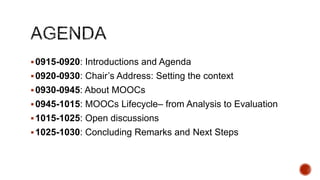
 0915-0920: Introductions and Agenda
 0920-0930: Chair’s Address: Setting the context

 0930-0945: About MOOCs
 0945-1015: MOOCs Lifecycle– from Analysis to Evaluation
 1015-1025: Open discussions

 1025-1030: Concluding Remarks and Next Steps
Chair’s Address
Origins, Types, Current State
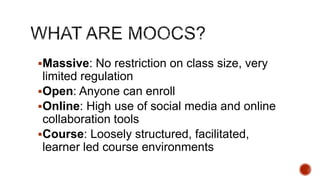
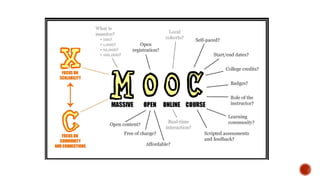
Massive: No restriction on class size, very

limited regulation
Open: Anyone can enroll
Online: High use of social media and online
collaboration tools
Course: Loosely structured, facilitated,
learner led course environments
Types of MOOCs
cMOOCs

http://www.edgex.in

The founders of the cMOOCs – George Siemens, Stephen Downes and Dave Cormier
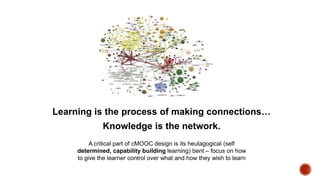
Learning is the process of making connections…

Knowledge is the network.
A critical part of cMOOC design is its heutagogical (self
determined, capability building learning) bent – focus on
how to give the learner control over what and how they wish to
learn
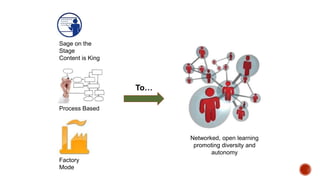
Sage on the
Stage
Content is King

To
…
Process Based

Networked, open learning
promoting diversity and
autonomy
Factory
Mode
xMOOCs

Daphne Koller

Andrew Ng

Mike Sokolsky David Stavens Sebastian Thrun

Anant Agarwal

Eren Bali

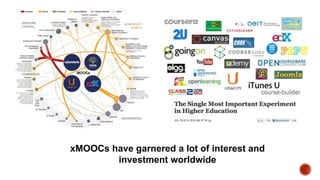
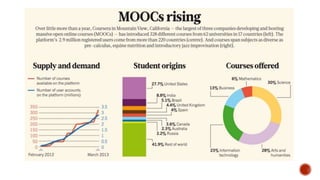
xMOOCs have garnered the MOOC moniker and taken a substantial part of the investment and hype
xMOOCs have garnered a lot of interest and
investment worldwide
In the instructivist learning theory, knowledge exists independently of the learner, and is transferred
to the student by the teacher. As a teacher-centered model, the instructivist view is exhibited by the
dispensing of information to the student through the lecture format.
Andragogy is the underlying theory of adult learning behind xMOOCs. It presumes active (via instructor) or implicit
(via curriculum and sequencing) “rules” for the learning process
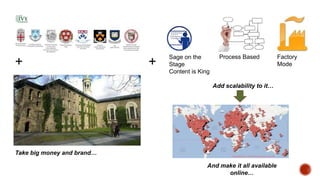
+

+

Sage on the
Stage
Content is King

Process Based

Factory
Mode

Add scalability to it…

Take big money and brand…

And make it all available
online…
•

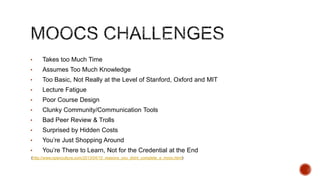
Takes too Much Time

•

Assumes Too Much Knowledge

•

Too Basic, Not Really at the Level of Stanford, Oxford and MIT

•

Lecture Fatigue

•

Poor Course Design

•

Clunky Community/Communication Tools

•

Bad Peer Review & Trolls

•

Surprised by Hidden Costs

•

You’re Just Shopping Around

•

You’re There to Learn, Not for the Credential at the End

(http://www.openculture.com/2013/04/10_reasons_you_didnt_complete_a_mooc.html)
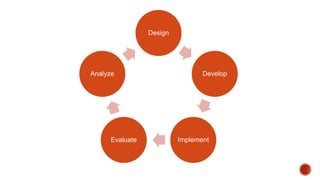
Analyze, Design, Develop, Implement, Evaluate
Design

Analyze

Evaluate

Develop

Implement
Getting the requirements in place
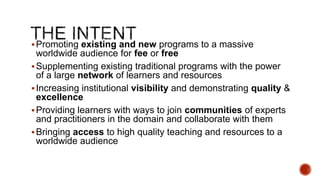
 Promoting existing and new programs to a massive

worldwide audience for fee or free
 Supplementing existing traditional programs with the
power of a large network of learners and resources
 Increasing institutional visibility and demonstrating
quality & excellence
 Providing learners with ways to join communities of
experts and practitioners in the domain and collaborate
with them
 Bringing access to high quality teaching and resources to a
worldwide audience
Institutions are rapidly adopting this new model for a variety of purposes…
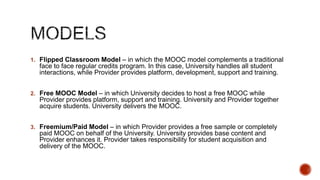
1. Flipped Classroom Model – in which the MOOC model complements a

traditional face to face regular credits program. In this case, University handles all
student interactions, while Provider provides platform, development, support and
training.

2. Free MOOC Model – in which University decides to host a free MOOC while

Provider provides platform, support and training. University and Provider
together acquire students. University delivers the MOOC.

3. Freemium/Paid Model – in which Provider provides a free sample or

completely paid MOOC on behalf of the University. University provides base
content and Provider enhances it. Provider takes responsibility for student
acquisition and delivery of the MOOC.
1.
2.
3.
4.
5.
6.
7.
8.

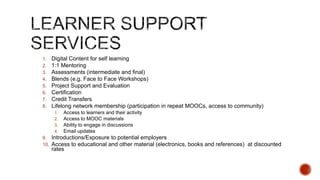
Digital Content for self learning
1:1 Mentoring
Assessments (intermediate and final)
Blends (e.g. Face to Face Workshops)
Project Support and Evaluation
Certification
Credit Transfers
Lifelong network membership (participation in repeat MOOCs, access to community)
1.
2.
3.
4.

Access to learners and their activity
Access to MOOC materials
Ability to engage in discussions
Email updates

9. Introductions/Exposure to potential employers
10. Access to educational and other material (electronics, books and references) at discounted

rates
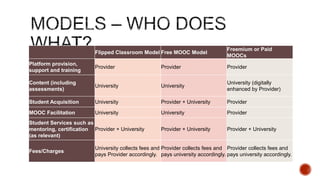
Flipped Classroom
Model

Free MOOC Model

Freemium or Paid
MOOCs

Platform provision,
support and training

Provider

Provider

Provider

Content (including
assessments)

University

University

University (digitally
enhanced by Provider)

Student Acquisition

University

Provider + University

Provider

MOOC Facilitation

University

University

Provider

Provider + University

Provider + University

Student Services such as
mentoring, certification Provider + University
(as relevant)

Fees/Charges

University collects fees
and pays Provider
accordingly.

Provider collects fees and Provider collects fees and
pays university
pays university
accordingly.
accordingly.
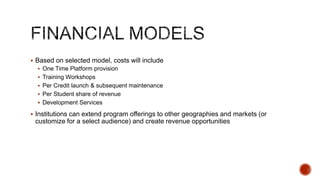
 Based on selected model, costs will include
 One Time Platform provision
 Training Workshops
 Per Credit launch & subsequent maintenance

 Per Student share of revenue
 Development Services

 Institutions can extend program offerings to other geographies and markets (or

customize for a select audience) and create revenue opportunities
Important considerations and models
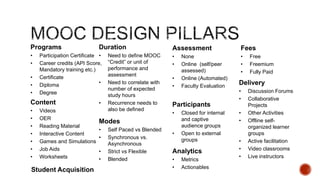
Programs
•
•
•
•
•

Participation Certificate •
Career credits (API Score,
Mandatory training etc.)
Certificate
•
Diploma
Degree

Content
•
•
•
•
•
•
•

Duration

Videos
OER
Reading Material
Interactive Content
Games and Simulations
Job Aids
Worksheets

Student Acquisition

•

Need to define MOOC
“Credit” or unit of
performance and
assessment
Need to correlate with
number of expected
study hours
Recurrence needs to
also be defined

Assessment
•
•
•
•

Participants
•

Modes
•
•
•
•

Self Paced vs Blended
Synchronous vs.
Asynchronous
Strict vs Flexible
Blended

None
Online (self/peer
assessed)
Online
(Automated)
Faculty Evaluation

•

Closed for internal
and captive
audience groups
Open to external
groups

Analytics
•
•

Metrics
Actionables

Fees
•
•
•

Free
Freemium
Fully Paid

Delivery
•
•
•
•

•
•
•

Discussion Forums
Collaborative
Projects
Other Activities
Offline selforganized learner
groups
Active facilitation
Video classrooms
Live instructors
•

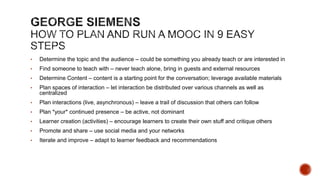
Determine the topic and the audience – could be something you already teach or are interested
in

•

Find someone to teach with – never teach alone, bring in guests and external resources

•

Determine Content – content is a starting point for the conversation; leverage available
materials

•

Plan spaces of interaction – let interaction be distributed over various channels as well as
centralized

•

Plan interactions (live, asynchronous) – leave a trail of discussion that others can follow

•

Plan *your* continued presence – be active, not dominant

•

Learner creation (activities) – encourage learners to create their own stuff and critique others

•

Promote and share – use social media and your networks

•

Iterate and improve – adapt to learner feedback and recommendations
•

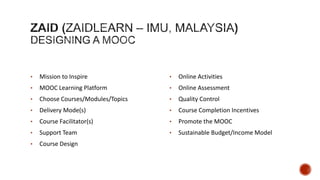
Mission to Inspire

•

Online Activities

•

MOOC Learning Platform

•

Online Assessment

•

Choose Courses/Modules/Topics

•

Quality Control

•

Delivery Mode(s)

•

Course Completion Incentives

•

Course Facilitator(s)

•

Promote the MOOC

•

Support Team

•

Sustainable Budget/Income Model

•

Course Design
Steps and Tools
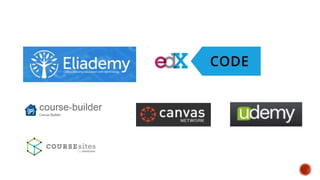
A plethora of tools are now available and many more to come
Important considerations
Needs to be tightly planned. Interventions could include:
 Prompting students to complete the curricular unit
 Highlighting important contributions

 Elaborating on or clarifying concepts through discussions
 Seeding conversations
 Bringing in external experts
 Regular alerts and reminders
 Connecting students with each others
 Counselling
Typically required in discussion forums, moderation may be exercised when:
 Objectional behavior or language needs to be addressed
 Code of Conduct is violated in any way (for example, no cheating or plagiarism)

 Any other pattern of behavior that may be considered objectionable
Based on the services you have offered, such as 1:1 mentoring or Certification, you
must:
 Ensure that you have staffed or procured services to the right scale
 Monitor quality of service delivery
 Treat the MOOC overall as a service and measure quality
 Conduct student demographics and satisfaction surveys
 Have a FAQ page where you can take in complaints as well
Each recurrence may see changes in:
 Content and Assessments
 Schedule of delivery

 Services offered

Please make sure you are able to leverage past occurrences for insights on how to
make future occurrences better.
Important considerations
Very important to track learner progress and performance through the course:
 Resources accessed
 Assessments taken

 Discussions participation
 Performance in activities, quizzes, project work etc
 cMOOC Metrics will differ, primarily because they are worried about:
 autonomy, diversity, open-ness and interactivity & connectedness (Stephen Downes)

 These distinguish a knowledge-generating network from a mere set of connected

elements

 Autonomy – how independently are members of the network/community?
 Diversity – how different are the members?
 Open-ness – how easy is it to communicate across the course barriers

 Connectedness – who are we connected with and what are the ties that bind us
 (Indicative Metrics - http://learnos.wordpress.com/2009/03/08/connectivis-metrics/ )
Q&A, Discussions
Reach Viplav
www.learnos.com
+91-98110-48940
vb@learnos.com
http://learnos.wordpress.com

Viplavbaxi
Viplavbaxi

MOOCs and the Future of Indian Higher Education - FICCI Higher Education Summit - 2013

  • 1.
    MOOCS …and the futureof Indian Higher Education Master Class, FICCI HES 2013, November 14
  • 2.
     Chair: Dr.B N Jain, Vice Chancellor, BITS Pilani  Expert: Mohan Kannegal, Manipal Global Education  Facilitator: Viplav Baxi, LearnOS Consulting Services
  • 3.
     0915-0920: Introductionsand Agenda  0920-0930: Chair’s Address: Setting the context  0930-0945: About MOOCs  0945-1015: MOOCs Lifecycle– from Analysis to Evaluation  1015-1025: Open discussions  1025-1030: Concluding Remarks and Next Steps
  • 4.
  • 5.
  • 6.
    Massive: No restrictionon class size, very limited regulation Open: Anyone can enroll Online: High use of social media and online collaboration tools Course: Loosely structured, facilitated, learner led course environments
  • 7.
  • 8.
    cMOOCs http://www.edgex.in The founders ofthe cMOOCs – George Siemens, Stephen Downes and Dave Cormier
  • 9.
    Learning is theprocess of making connections… Knowledge is the network. A critical part of cMOOC design is its heutagogical (self determined, capability building learning) bent – focus on how to give the learner control over what and how they wish to learn
  • 10.
    Sage on the Stage Contentis King To … Process Based Networked, open learning promoting diversity and autonomy Factory Mode
  • 11.
    xMOOCs Daphne Koller Andrew Ng MikeSokolsky David Stavens Sebastian Thrun Anant Agarwal Eren Bali xMOOCs have garnered the MOOC moniker and taken a substantial part of the investment and hype
  • 12.
    xMOOCs have garnereda lot of interest and investment worldwide
  • 15.
    In the instructivistlearning theory, knowledge exists independently of the learner, and is transferred to the student by the teacher. As a teacher-centered model, the instructivist view is exhibited by the dispensing of information to the student through the lecture format. Andragogy is the underlying theory of adult learning behind xMOOCs. It presumes active (via instructor) or implicit (via curriculum and sequencing) “rules” for the learning process
  • 16.
    + + Sage on the Stage Contentis King Process Based Factory Mode Add scalability to it… Take big money and brand… And make it all available online…
  • 17.
    • Takes too MuchTime • Assumes Too Much Knowledge • Too Basic, Not Really at the Level of Stanford, Oxford and MIT • Lecture Fatigue • Poor Course Design • Clunky Community/Communication Tools • Bad Peer Review & Trolls • Surprised by Hidden Costs • You’re Just Shopping Around • You’re There to Learn, Not for the Credential at the End (http://www.openculture.com/2013/04/10_reasons_you_didnt_complete_a_mooc.html)
  • 18.
    Analyze, Design, Develop,Implement, Evaluate
  • 19.
  • 20.
  • 21.
     Promoting existingand new programs to a massive worldwide audience for fee or free  Supplementing existing traditional programs with the power of a large network of learners and resources  Increasing institutional visibility and demonstrating quality & excellence  Providing learners with ways to join communities of experts and practitioners in the domain and collaborate with them  Bringing access to high quality teaching and resources to a worldwide audience Institutions are rapidly adopting this new model for a variety of purposes…
  • 22.
    1. Flipped ClassroomModel – in which the MOOC model complements a traditional face to face regular credits program. In this case, University handles all student interactions, while Provider provides platform, development, support and training. 2. Free MOOC Model – in which University decides to host a free MOOC while Provider provides platform, support and training. University and Provider together acquire students. University delivers the MOOC. 3. Freemium/Paid Model – in which Provider provides a free sample or completely paid MOOC on behalf of the University. University provides base content and Provider enhances it. Provider takes responsibility for student acquisition and delivery of the MOOC.
  • 23.
    1. 2. 3. 4. 5. 6. 7. 8. Digital Content forself learning 1:1 Mentoring Assessments (intermediate and final) Blends (e.g. Face to Face Workshops) Project Support and Evaluation Certification Credit Transfers Lifelong network membership (participation in repeat MOOCs, access to community) 1. 2. 3. 4. Access to learners and their activity Access to MOOC materials Ability to engage in discussions Email updates 9. Introductions/Exposure to potential employers 10. Access to educational and other material (electronics, books and references) at discounted rates
  • 24.
    Flipped Classroom Model Free MOOCModel Freemium or Paid MOOCs Platform provision, support and training Provider Provider Provider Content (including assessments) University University University (digitally enhanced by Provider) Student Acquisition University Provider + University Provider MOOC Facilitation University University Provider Provider + University Provider + University Student Services such as mentoring, certification Provider + University (as relevant) Fees/Charges University collects fees and pays Provider accordingly. Provider collects fees and Provider collects fees and pays university pays university accordingly. accordingly.
  • 25.
     Based onselected model, costs will include  One Time Platform provision  Training Workshops  Per Credit launch & subsequent maintenance  Per Student share of revenue  Development Services  Institutions can extend program offerings to other geographies and markets (or customize for a select audience) and create revenue opportunities
  • 26.
  • 27.
    Programs • • • • • Participation Certificate • Careercredits (API Score, Mandatory training etc.) Certificate • Diploma Degree Content • • • • • • • Duration Videos OER Reading Material Interactive Content Games and Simulations Job Aids Worksheets Student Acquisition • Need to define MOOC “Credit” or unit of performance and assessment Need to correlate with number of expected study hours Recurrence needs to also be defined Assessment • • • • Participants • Modes • • • • Self Paced vs Blended Synchronous vs. Asynchronous Strict vs Flexible Blended None Online (self/peer assessed) Online (Automated) Faculty Evaluation • Closed for internal and captive audience groups Open to external groups Analytics • • Metrics Actionables Fees • • • Free Freemium Fully Paid Delivery • • • • • • • Discussion Forums Collaborative Projects Other Activities Offline selforganized learner groups Active facilitation Video classrooms Live instructors
  • 28.
    • Determine the topicand the audience – could be something you already teach or are interested in • Find someone to teach with – never teach alone, bring in guests and external resources • Determine Content – content is a starting point for the conversation; leverage available materials • Plan spaces of interaction – let interaction be distributed over various channels as well as centralized • Plan interactions (live, asynchronous) – leave a trail of discussion that others can follow • Plan *your* continued presence – be active, not dominant • Learner creation (activities) – encourage learners to create their own stuff and critique others • Promote and share – use social media and your networks • Iterate and improve – adapt to learner feedback and recommendations
  • 29.
    • Mission to Inspire • OnlineActivities • MOOC Learning Platform • Online Assessment • Choose Courses/Modules/Topics • Quality Control • Delivery Mode(s) • Course Completion Incentives • Course Facilitator(s) • Promote the MOOC • Support Team • Sustainable Budget/Income Model • Course Design
  • 30.
  • 31.
    A plethora oftools are now available and many more to come
  • 40.
  • 41.
    Needs to betightly planned. Interventions could include:  Prompting students to complete the curricular unit  Highlighting important contributions  Elaborating on or clarifying concepts through discussions  Seeding conversations  Bringing in external experts  Regular alerts and reminders  Connecting students with each others  Counselling
  • 42.
    Typically required indiscussion forums, moderation may be exercised when:  Objectional behavior or language needs to be addressed  Code of Conduct is violated in any way (for example, no cheating or plagiarism)  Any other pattern of behavior that may be considered objectionable
  • 43.
    Based on theservices you have offered, such as 1:1 mentoring or Certification, you must:  Ensure that you have staffed or procured services to the right scale  Monitor quality of service delivery  Treat the MOOC overall as a service and measure quality  Conduct student demographics and satisfaction surveys  Have a FAQ page where you can take in complaints as well
  • 44.
    Each recurrence maysee changes in:  Content and Assessments  Schedule of delivery  Services offered Please make sure you are able to leverage past occurrences for insights on how to make future occurrences better.
  • 45.
  • 46.
    Very important totrack learner progress and performance through the course:  Resources accessed  Assessments taken  Discussions participation  Performance in activities, quizzes, project work etc
  • 47.
     cMOOC Metricswill differ, primarily because they are worried about:  autonomy, diversity, open-ness and interactivity & connectedness (Stephen Downes)  These distinguish a knowledge-generating network from a mere set of connected elements  Autonomy – how independently are members of the network/community?  Diversity – how different are the members?  Open-ness – how easy is it to communicate across the course barriers  Connectedness – who are we connected with and what are the ties that bind us  (Indicative Metrics - http://learnos.wordpress.com/2009/03/08/connectivis-metrics/ )
  • 48.
  • 50.

Editor's Notes

  • #52 Capability, however, is concerned with unknowncontexts that extend beyond competence. Modern workplaces are complexadaptive systems that provide continuous and rapidly changing contexts.Our research and thinking has concerned how the self-determined learningthat occurs in the normal course of work leads to capability can be understoodand harnessed.