Solutions
Is it really solving a problem?
Are you building a tool or attacking the problem?
Are you over-engineering the technique and
process?
Is it really a shared passion?
How do you know?
 Are they all directly solving the problem?
 Are they inspired by competition or by a fad?
 Are they needed at first go?
 Will they tell you more about the customer’s problems?
 How much important do you place on customer mistakes? What are
the mistakes they make?
 Are you building it just because it sounds cool?
 How do you know it is a MVP? Do you even want one?
 Is your differentiator aligned with your core competence?
You have cool features. But does your customer
need something else to start using them?
When can some services add real value to the
customer or her environment?
DO NOT IGNORE THE POWER LAWS
How do you scale the human touch?
How do you know what you know?
How will you know what the customers will tell you?
How will you determine their constraints?
Are their proxies / indicators that can substitute or
complement what you know?
How will you capture, measure and analyse data?
Neither technology nor content nor distribution is King
Culture, values and attitudes are. So are barriers to
technology.
Education system is culturally a feudal system
The niche is more important than the scale to begin with
Engagement trumps technology or content every time
UX is really important
 Common sense is probably not that common
 Your ideals may not be your customer’s ideals
 Take customers with you, one simple step at a time
 Don’t take extremist positions
 Often, the product is the (initially) least important thing you will
build
 Revenue will rarely scale unless it is demonstrable in small,
repeatable ways today
 Sharing is better than hoarding
WHAT IMPORTANT TRUTH DO VERY FEW
PEOPLE AGREE WITH YOU ON?
WHAT VALUABLE COMPANY IS NO ONE
BUILDING?
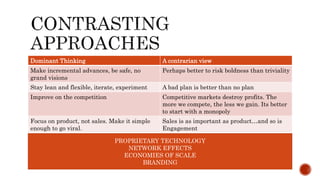
Dominant Thinking A contrarian view
Make incremental advances, be safe, no
grand visions
Perhaps better to risk boldness than triviality
Stay lean and flexible, iterate, experiment A bad plan is better than no plan
Improve on the competition Competitive markets destroy profits. The
more we compete, the less we gain. Its better
to start with a monopoly
Focus on product, not sales. Make it simple
enough to go viral.
Sales is as important as product…and so is
Engagement
PROPRIETARY TECHNOLOGY
NETWORK EFFECTS
ECONOMIES OF SCALE
BRANDING
Viplavbaxi
+91-98110-48940
http://learnos.wordpress.com
viplav.baxi@learnos.com
Viplavbaxi
Reach Viplav
www.learnos.com

Start Edu delhi bootcamp

  • 1.
  • 2.
    Is it reallysolving a problem? Are you building a tool or attacking the problem? Are you over-engineering the technique and process? Is it really a shared passion? How do you know?
  • 3.
     Are theyall directly solving the problem?  Are they inspired by competition or by a fad?  Are they needed at first go?  Will they tell you more about the customer’s problems?  How much important do you place on customer mistakes? What are the mistakes they make?  Are you building it just because it sounds cool?  How do you know it is a MVP? Do you even want one?  Is your differentiator aligned with your core competence?
  • 4.
    You have coolfeatures. But does your customer need something else to start using them? When can some services add real value to the customer or her environment? DO NOT IGNORE THE POWER LAWS How do you scale the human touch?
  • 5.
    How do youknow what you know? How will you know what the customers will tell you? How will you determine their constraints? Are their proxies / indicators that can substitute or complement what you know? How will you capture, measure and analyse data?
  • 6.
    Neither technology norcontent nor distribution is King Culture, values and attitudes are. So are barriers to technology. Education system is culturally a feudal system The niche is more important than the scale to begin with Engagement trumps technology or content every time UX is really important
  • 7.
     Common senseis probably not that common  Your ideals may not be your customer’s ideals  Take customers with you, one simple step at a time  Don’t take extremist positions  Often, the product is the (initially) least important thing you will build  Revenue will rarely scale unless it is demonstrable in small, repeatable ways today  Sharing is better than hoarding
  • 8.
    WHAT IMPORTANT TRUTHDO VERY FEW PEOPLE AGREE WITH YOU ON? WHAT VALUABLE COMPANY IS NO ONE BUILDING?
  • 9.
    Dominant Thinking Acontrarian view Make incremental advances, be safe, no grand visions Perhaps better to risk boldness than triviality Stay lean and flexible, iterate, experiment A bad plan is better than no plan Improve on the competition Competitive markets destroy profits. The more we compete, the less we gain. Its better to start with a monopoly Focus on product, not sales. Make it simple enough to go viral. Sales is as important as product…and so is Engagement PROPRIETARY TECHNOLOGY NETWORK EFFECTS ECONOMIES OF SCALE BRANDING
  • 10.