MABITSELA KHUTSO
http://www.slideshare.net/Mabitselakhutso
03 August 2015
Online and eLearning Conference
CHRONICLES OF THE
MOOCs
Why MOOC??
“In completely rational society, the best of us would
aspire to be teachers, and the rest of us would have
to settle for something less”_____ Lee Lacocca
What is a MOOC?
http://youtube.com/watch?v=eW3gMGqcZQc
 Anant Agarwal: Why massively open online courses
(still)
matter//https://www.youtube.com/watch?v=rYwTA5R
A9eU
]
Contents… Lets get to it now!!
 What is a MOOC?
 The Chronicle of Open Learning
 Brief History of MOOCs
 Types of MOOCs
 Hot Issues in MOOCs
 Participating in or building MOOCs
 Discussion
Characteristics… Hooked??
 No submission of assignments or examinations
 Scale of numbers – no participation limit
 No formal entry requirement
 Virtual Learning Environment is not the center of the
course
 Use a variety of (new) social media and online tools
 Accommodative and engages
 Increased student participation and self-direction
 Facilitators create the environment not way of learning
 J Green 2015
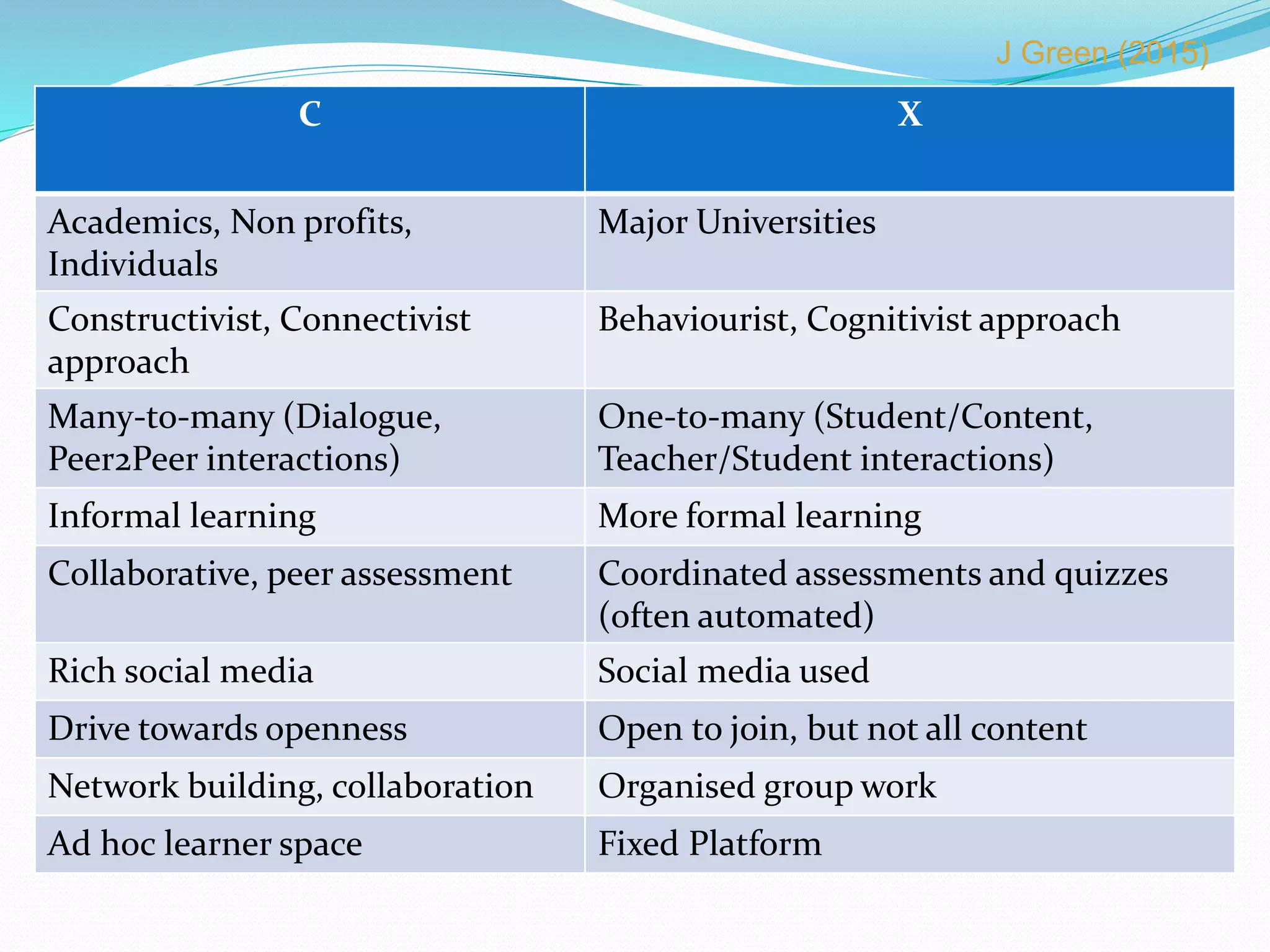
MOOC TypesC X
Academics, Non profits,
Individuals
Major Universities
Constructivist, Connectivist
approach
Behaviourist, Cognitivist approach
Many-to-many (Dialogue,
Peer2Peer interactions)
One-to-many (Student/Content,
Teacher/Student interactions)
Informal learning More formal learning
Collaborative, peer assessment Coordinated assessments and quizzes
(often automated)
Rich social media Social media used
Drive towards openness Open to join, but not all content
Network building, collaboration Organised group work
Ad hoc learner space Fixed Platform
J Green (2015)
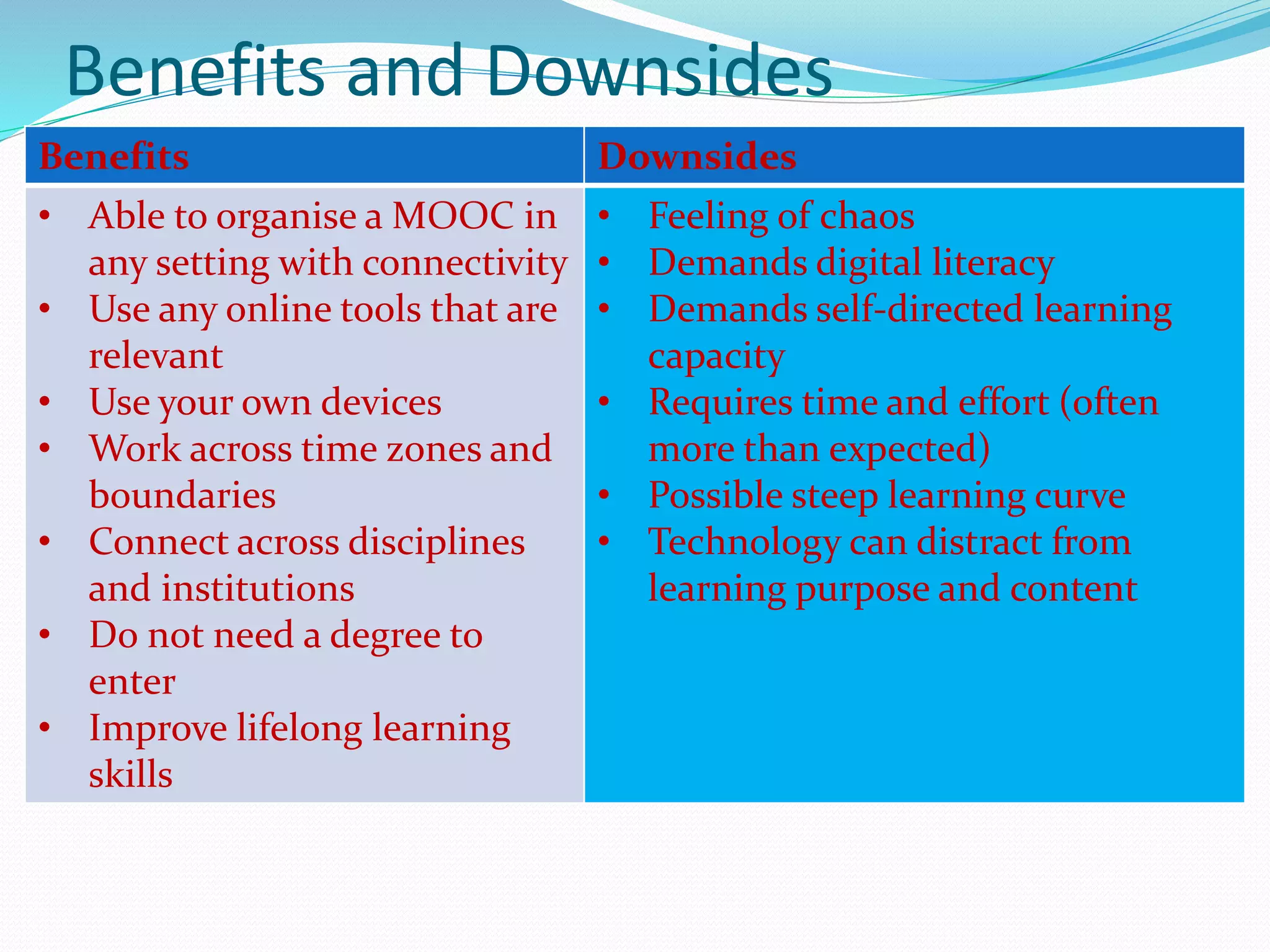
Benefits and Downsides
Benefits Downsides
• Able to organise a MOOC in
any setting with connectivity
• Use any online tools that are
relevant
• Use your own devices
• Work across time zones and
boundaries
• Connect across disciplines
and institutions
• Do not need a degree to
enter
• Improve lifelong learning
skills
• Feeling of chaos
• Demands digital literacy
• Demands self-directed learning
capacity
• Requires time and effort (often
more than expected)
• Possible steep learning curve
• Technology can distract from
learning purpose and content
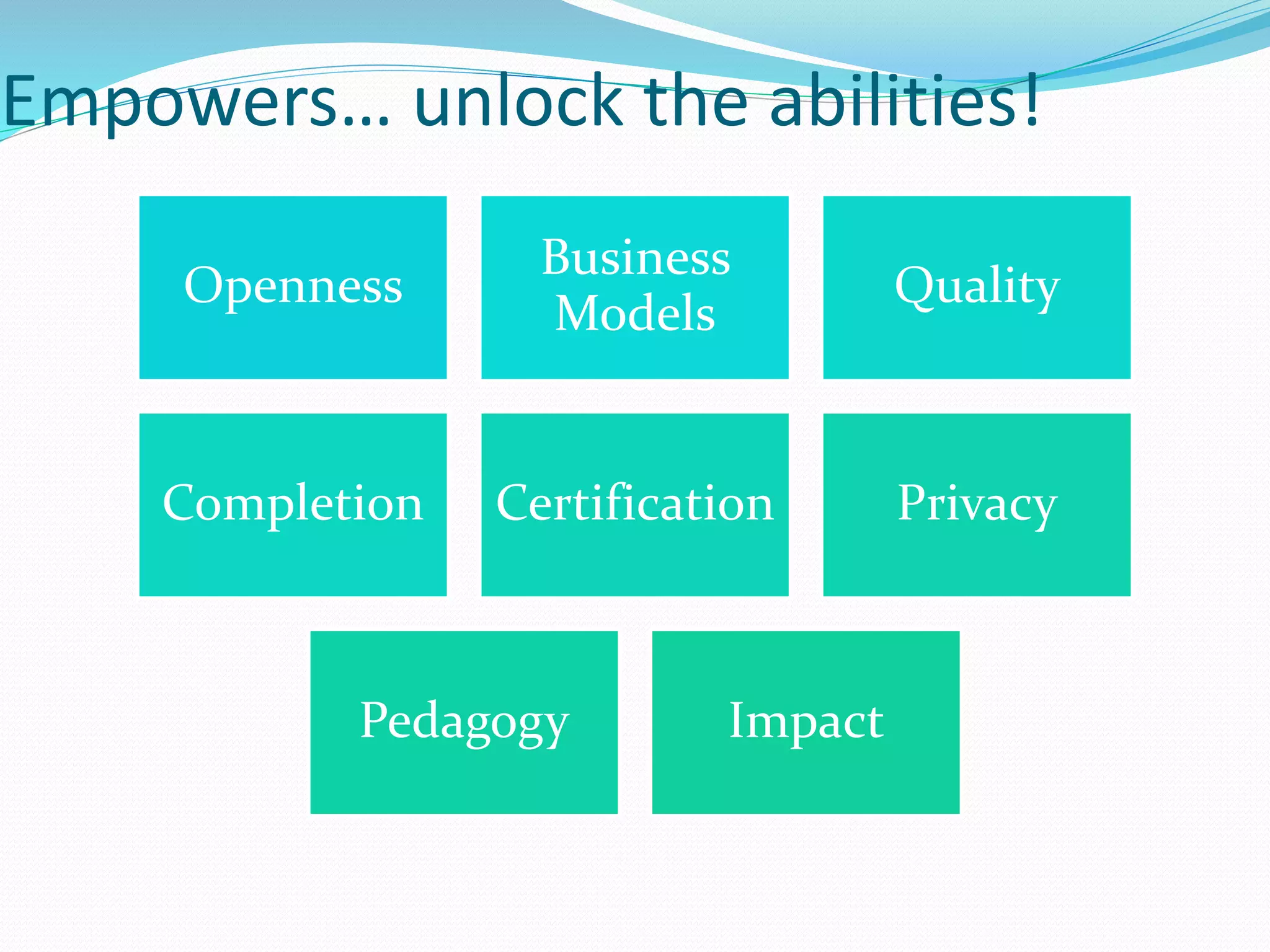
Empowers… unlock the abilities!
Openness
Business
Models
Quality
Completion Certification Privacy
Pedagogy Impact
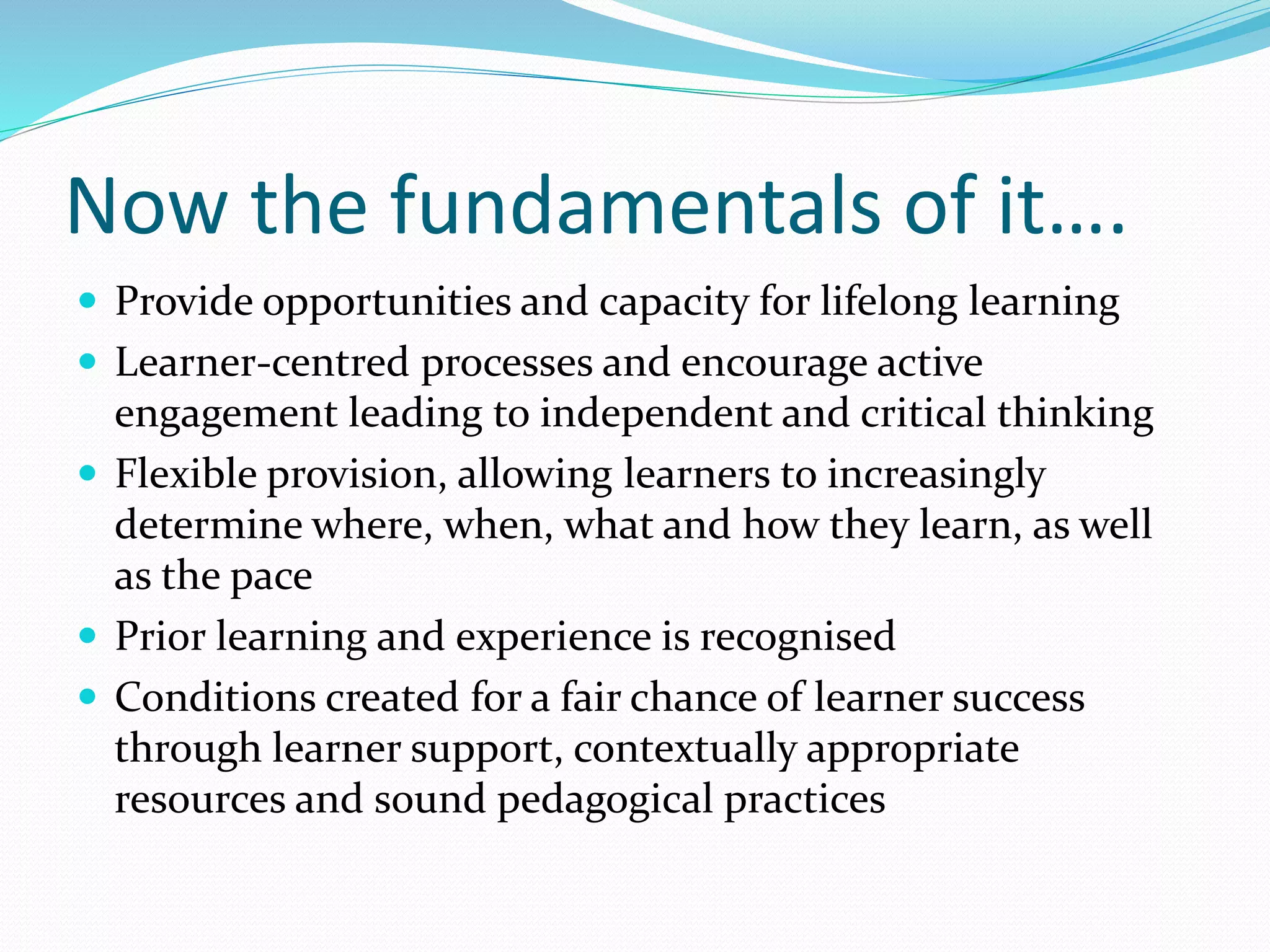
Now the fundamentals of it….
 Provide opportunities and capacity for lifelong learning
 Learner-centred processes and encourage active
engagement leading to independent and critical thinking
 Flexible provision, allowing learners to increasingly
determine where, when, what and how they learn, as well
as the pace
 Prior learning and experience is recognised
 Conditions created for a fair chance of learner success
through learner support, contextually appropriate
resources and sound pedagogical practices
Business Models…..
 Certification – pay for badge or certificate
 Secure assessments – pay for proctored exams
 Recruitment – employers pay for access to records [Privacy]
 Marking – students pay for markers or tutoring
 Platform sales – sell platform to institutions
 Third party Sponsorships
 Tuition fees
 Publishers – reach new readers and sell more books
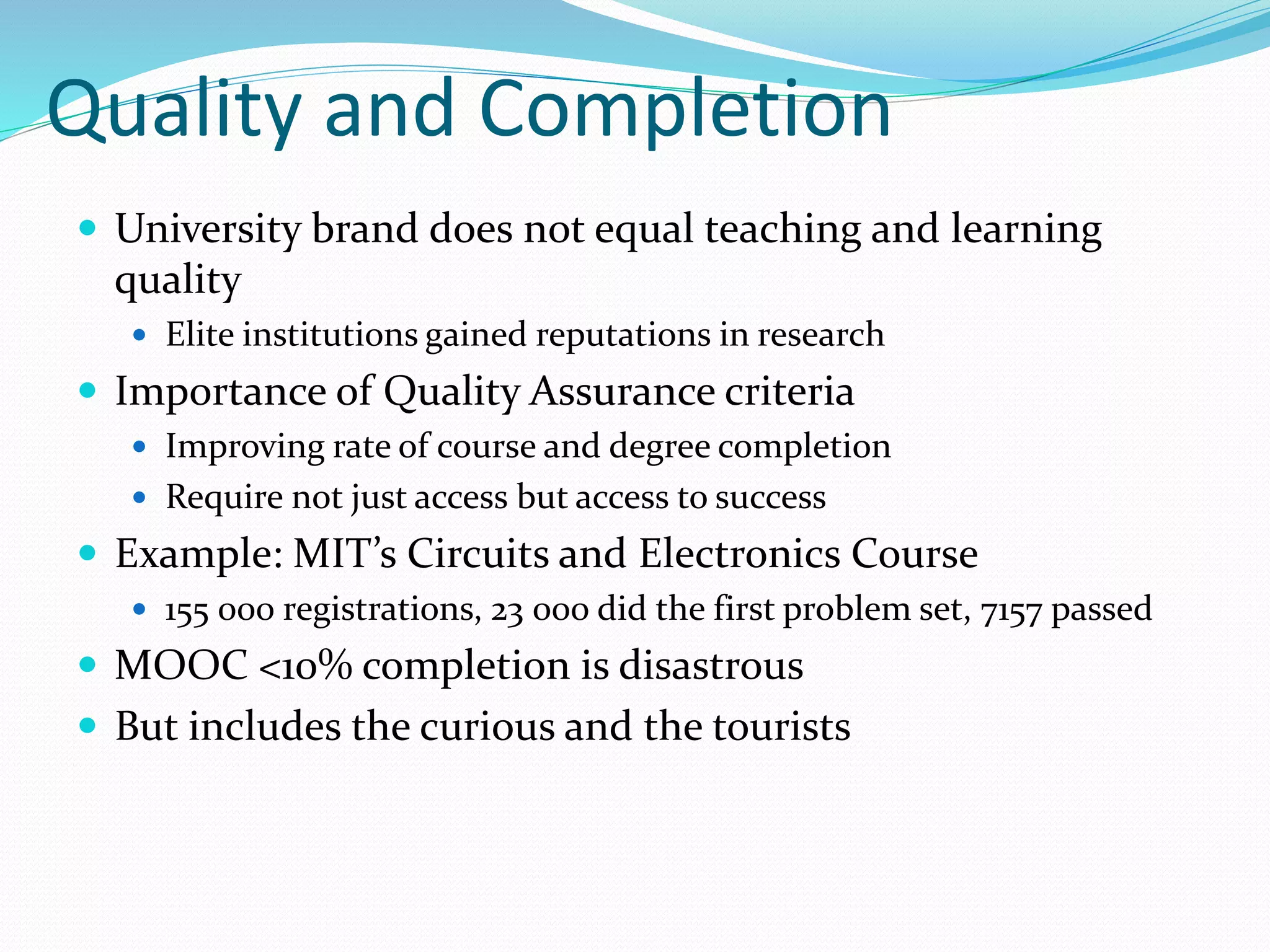
Quality and Completion
 University brand does not equal teaching and learning
quality
 Elite institutions gained reputations in research
 Importance of Quality Assurance criteria
 Improving rate of course and degree completion
 Require not just access but access to success
 Example: MIT’s Circuits and Electronics Course
 155 000 registrations, 23 000 did the first problem set, 7157 passed
 MOOC <10% completion is disastrous
 But includes the curious and the tourists
Certification and specialities
 Mostly, success in a MOOC does not lead to credit
but to a certificate
 Elite institutions define quality by numbers of
applicants that they exclude, not after admission
 Certificates can be traded for credit but very
expensive
Pedagogy
 Linked to a learning strategy (costs, resources)
 Interactive content design and feedback
 Safe learning environment with guidelines
 Clear learning pathways
 Roles of facilitators and tutors
 Extent of learner support, assessment and
feedback
 Match to technical infrastructure (technology
should not be a distractor)
More benefits… Still not hooked??
 MOOCs may encourage development of eLearning
 MOOCs will not address the challenge of
expanding higher education in the developing
world
 However it will…
 Access to technology
 Independent learning and study skills
Considering a MOOC….
 http://www.mooc-list.com/
 http://www.openculture.com/free_certificate_courses
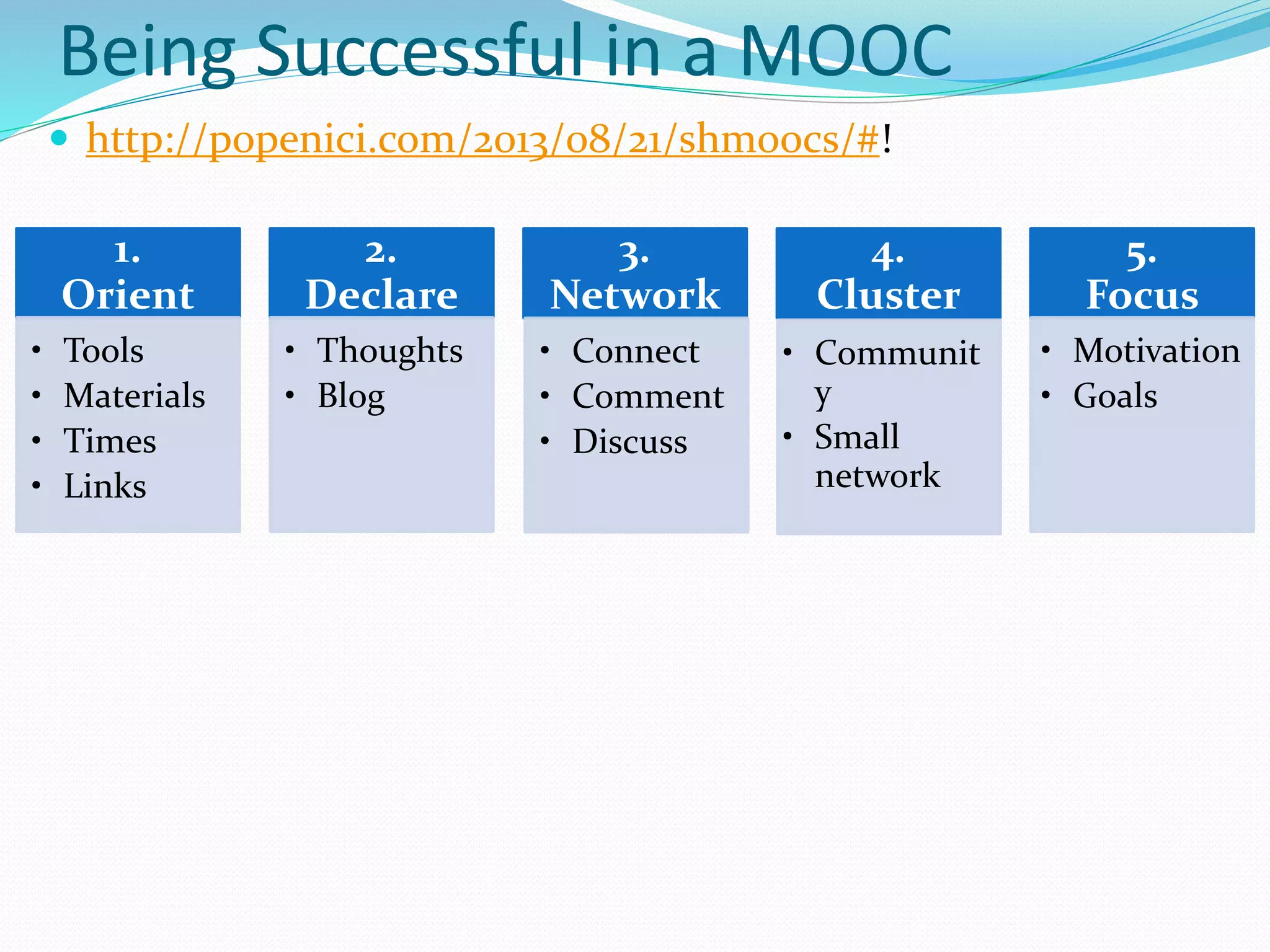
Being Successful in a MOOC
 http://popenici.com/2013/08/21/shmoocs/#!
1.
Orient
• Tools
• Materials
• Times
• Links
2.
Declare
• Thoughts
• Blog
3.
Network
• Connect
• Comment
• Discuss
4.
Cluster
• Communit
y
• Small
network
5.
Focus
• Motivation
• Goals
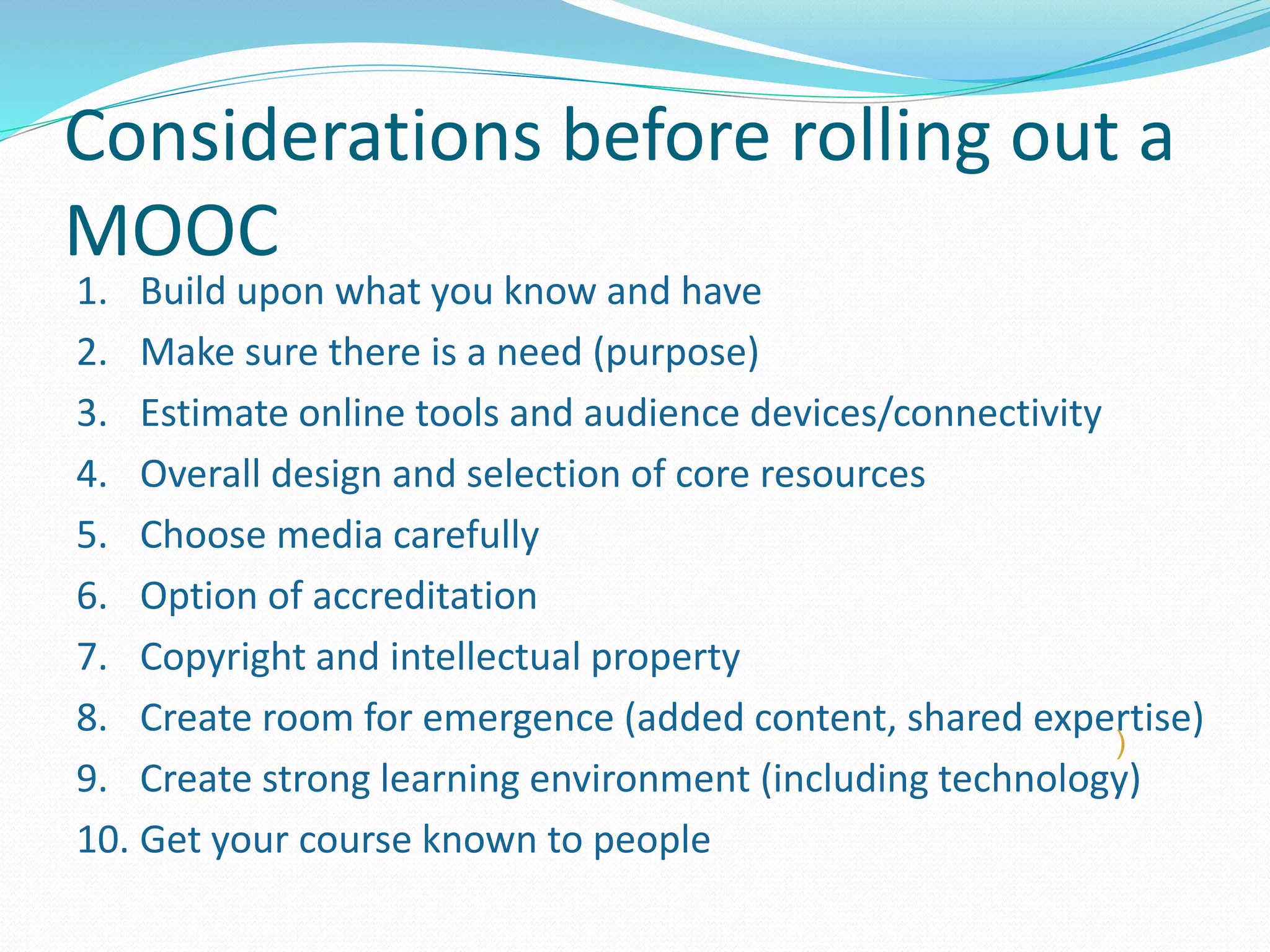
Considerations before rolling out a
MOOC
1. Build upon what you know and have
2. Make sure there is a need (purpose)
3. Estimate online tools and audience devices/connectivity
4. Overall design and selection of core resources
5. Choose media carefully
6. Option of accreditation
7. Copyright and intellectual property
8. Create room for emergence (added content, shared expertise)
9. Create strong learning environment (including technology)
10. Get your course known to people
)
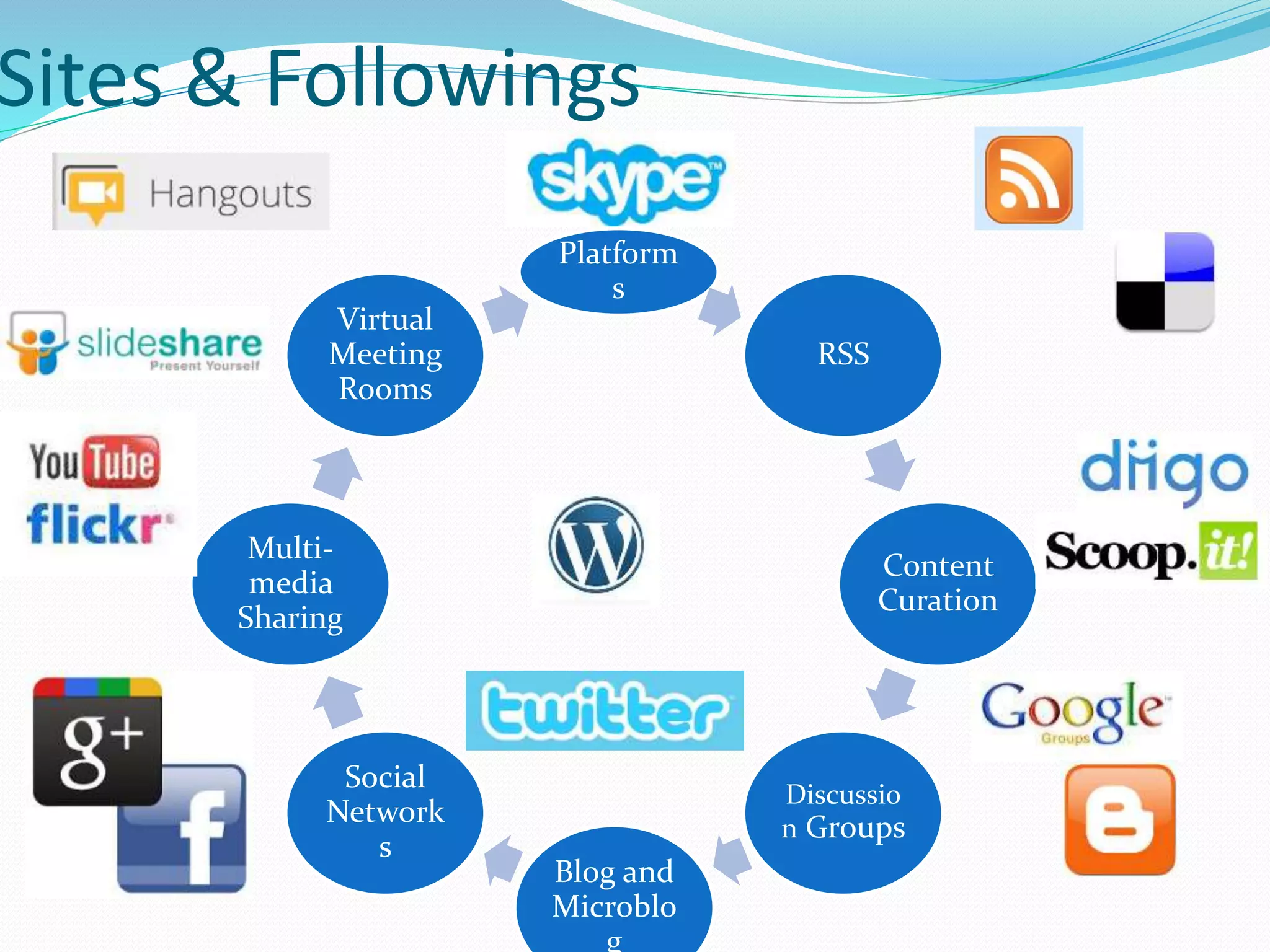
Platform
s
RSS
Content
Curation
Discussio
n Groups
Blog and
Microblo
g
Social
Network
s
Multi-
media
Sharing
Virtual
Meeting
Rooms
Sites & Followings
Reflections on MOOCs
 Impact on the high costs of higher education
 Extent of the “presence of the teacher”
 In experimentation phase, changes lie ahead
 Keeps continuous focus on teaching and pedagogy
 Reassessment of the intellectual quality and rigour
of institutions
 Emergence of institutions and commercial
partners
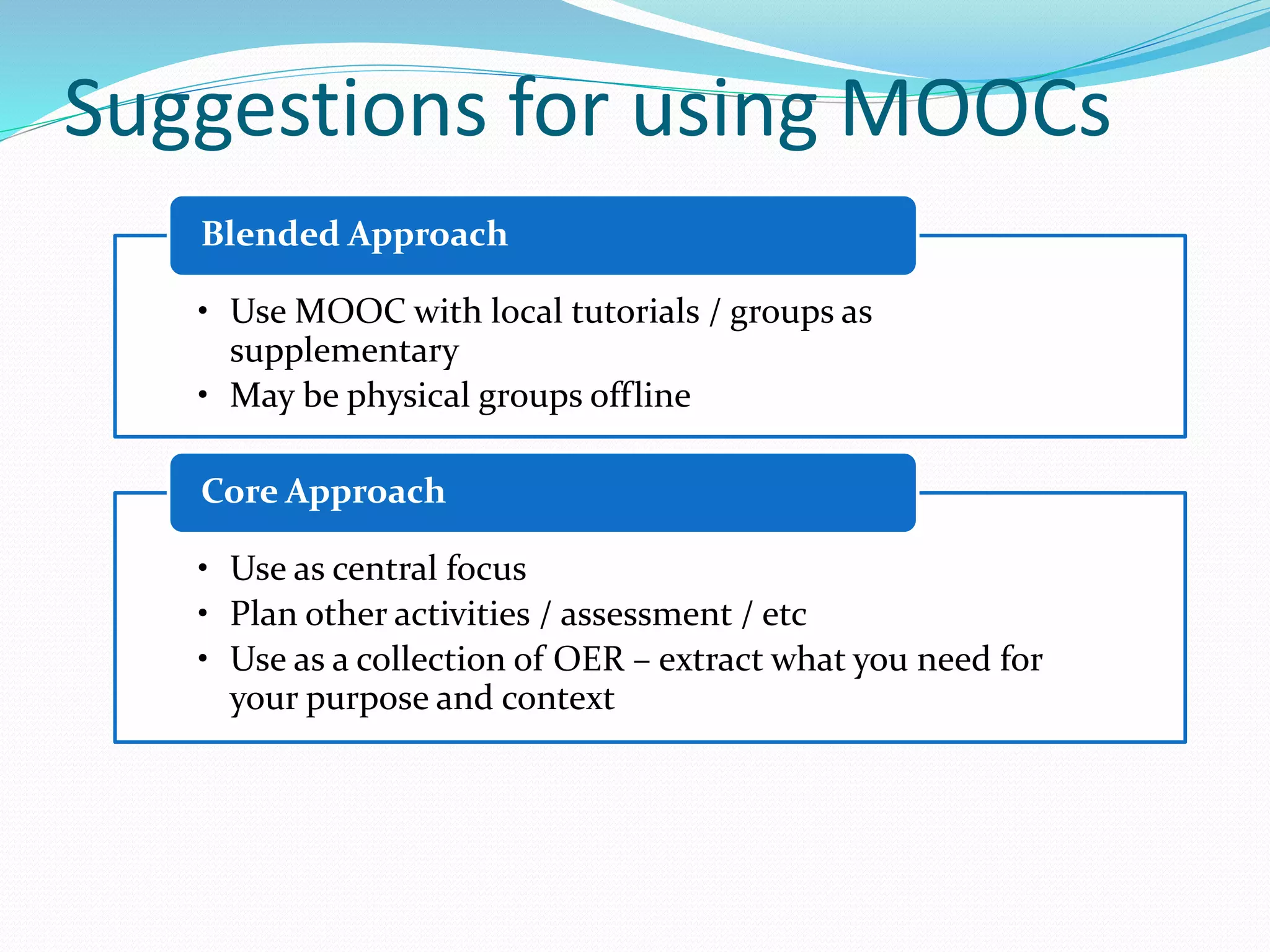
Suggestions for using MOOCs
• Use MOOC with local tutorials / groups as
supplementary
• May be physical groups offline
Blended Approach
• Use as central focus
• Plan other activities / assessment / etc
• Use as a collection of OER – extract what you need for
your purpose and context
Core Approach
My field of interest
1. I'm interested in social development, relationships
and communications
2. I'm also interested writing, prose and poetry
My topic…..?
 My topic is going to be communications and social
developments
 My second to pic is going to be Writing and linguistics
 I will be studying and developing my communication
skills and accommodative language. I will also
developing my writing and literature skills
Mabitselakcm@mail.com
http://www.slideshare.net/Mabitselakhutso
References and available online
courses
 Popenici, S (2013). MOOCs and The Change of Higher
Education. http://popenici.com/2013/08/21/shmoocs/#!
 Saide (2012). Empowering Learners through Open Learning.
[CC-BY] http://www.saide.org.za/design-guide/11-open-learning
 Daphne Koller: What we're learning from online
education//https://www.youtube.com/watch?v=U6FvJ6jMGHU
 Anant Agarwal: Why massively open online courses (still)
matter//https://www.youtube.com/watch?v=rYwTA5RA9eUslid
 ePaper Towns | John Green |
TEDxIndianapolishttps://www.youtube.com/watch?v=1mUDw0
sRZV0
hare.net/oerafrica/the-

Tst20 b3 moo cs

  • 1.
    MABITSELA KHUTSO http://www.slideshare.net/Mabitselakhutso 03 August2015 Online and eLearning Conference CHRONICLES OF THE MOOCs
  • 2.
    Why MOOC?? “In completelyrational society, the best of us would aspire to be teachers, and the rest of us would have to settle for something less”_____ Lee Lacocca
  • 3.
    What is aMOOC? http://youtube.com/watch?v=eW3gMGqcZQc  Anant Agarwal: Why massively open online courses (still) matter//https://www.youtube.com/watch?v=rYwTA5R A9eU ]
  • 4.
    Contents… Lets getto it now!!  What is a MOOC?  The Chronicle of Open Learning  Brief History of MOOCs  Types of MOOCs  Hot Issues in MOOCs  Participating in or building MOOCs  Discussion
  • 5.
    Characteristics… Hooked??  Nosubmission of assignments or examinations  Scale of numbers – no participation limit  No formal entry requirement  Virtual Learning Environment is not the center of the course  Use a variety of (new) social media and online tools  Accommodative and engages  Increased student participation and self-direction  Facilitators create the environment not way of learning  J Green 2015
  • 6.
    MOOC TypesC X Academics,Non profits, Individuals Major Universities Constructivist, Connectivist approach Behaviourist, Cognitivist approach Many-to-many (Dialogue, Peer2Peer interactions) One-to-many (Student/Content, Teacher/Student interactions) Informal learning More formal learning Collaborative, peer assessment Coordinated assessments and quizzes (often automated) Rich social media Social media used Drive towards openness Open to join, but not all content Network building, collaboration Organised group work Ad hoc learner space Fixed Platform J Green (2015)
  • 7.
    Benefits and Downsides BenefitsDownsides • Able to organise a MOOC in any setting with connectivity • Use any online tools that are relevant • Use your own devices • Work across time zones and boundaries • Connect across disciplines and institutions • Do not need a degree to enter • Improve lifelong learning skills • Feeling of chaos • Demands digital literacy • Demands self-directed learning capacity • Requires time and effort (often more than expected) • Possible steep learning curve • Technology can distract from learning purpose and content
  • 8.
    Empowers… unlock theabilities! Openness Business Models Quality Completion Certification Privacy Pedagogy Impact
  • 9.
    Now the fundamentalsof it….  Provide opportunities and capacity for lifelong learning  Learner-centred processes and encourage active engagement leading to independent and critical thinking  Flexible provision, allowing learners to increasingly determine where, when, what and how they learn, as well as the pace  Prior learning and experience is recognised  Conditions created for a fair chance of learner success through learner support, contextually appropriate resources and sound pedagogical practices
  • 10.
    Business Models…..  Certification– pay for badge or certificate  Secure assessments – pay for proctored exams  Recruitment – employers pay for access to records [Privacy]  Marking – students pay for markers or tutoring  Platform sales – sell platform to institutions  Third party Sponsorships  Tuition fees  Publishers – reach new readers and sell more books
  • 11.
    Quality and Completion University brand does not equal teaching and learning quality  Elite institutions gained reputations in research  Importance of Quality Assurance criteria  Improving rate of course and degree completion  Require not just access but access to success  Example: MIT’s Circuits and Electronics Course  155 000 registrations, 23 000 did the first problem set, 7157 passed  MOOC <10% completion is disastrous  But includes the curious and the tourists
  • 12.
    Certification and specialities Mostly, success in a MOOC does not lead to credit but to a certificate  Elite institutions define quality by numbers of applicants that they exclude, not after admission  Certificates can be traded for credit but very expensive
  • 13.
    Pedagogy  Linked toa learning strategy (costs, resources)  Interactive content design and feedback  Safe learning environment with guidelines  Clear learning pathways  Roles of facilitators and tutors  Extent of learner support, assessment and feedback  Match to technical infrastructure (technology should not be a distractor)
  • 14.
    More benefits… Stillnot hooked??  MOOCs may encourage development of eLearning  MOOCs will not address the challenge of expanding higher education in the developing world  However it will…  Access to technology  Independent learning and study skills
  • 15.
    Considering a MOOC…. http://www.mooc-list.com/  http://www.openculture.com/free_certificate_courses
  • 16.
    Being Successful ina MOOC  http://popenici.com/2013/08/21/shmoocs/#! 1. Orient • Tools • Materials • Times • Links 2. Declare • Thoughts • Blog 3. Network • Connect • Comment • Discuss 4. Cluster • Communit y • Small network 5. Focus • Motivation • Goals
  • 17.
    Considerations before rollingout a MOOC 1. Build upon what you know and have 2. Make sure there is a need (purpose) 3. Estimate online tools and audience devices/connectivity 4. Overall design and selection of core resources 5. Choose media carefully 6. Option of accreditation 7. Copyright and intellectual property 8. Create room for emergence (added content, shared expertise) 9. Create strong learning environment (including technology) 10. Get your course known to people )
  • 18.
  • 19.
    Reflections on MOOCs Impact on the high costs of higher education  Extent of the “presence of the teacher”  In experimentation phase, changes lie ahead  Keeps continuous focus on teaching and pedagogy  Reassessment of the intellectual quality and rigour of institutions  Emergence of institutions and commercial partners
  • 20.
    Suggestions for usingMOOCs • Use MOOC with local tutorials / groups as supplementary • May be physical groups offline Blended Approach • Use as central focus • Plan other activities / assessment / etc • Use as a collection of OER – extract what you need for your purpose and context Core Approach
  • 21.
    My field ofinterest 1. I'm interested in social development, relationships and communications 2. I'm also interested writing, prose and poetry
  • 22.
    My topic…..?  Mytopic is going to be communications and social developments  My second to pic is going to be Writing and linguistics  I will be studying and developing my communication skills and accommodative language. I will also developing my writing and literature skills
  • 23.
  • 24.
    References and availableonline courses  Popenici, S (2013). MOOCs and The Change of Higher Education. http://popenici.com/2013/08/21/shmoocs/#!  Saide (2012). Empowering Learners through Open Learning. [CC-BY] http://www.saide.org.za/design-guide/11-open-learning  Daphne Koller: What we're learning from online education//https://www.youtube.com/watch?v=U6FvJ6jMGHU  Anant Agarwal: Why massively open online courses (still) matter//https://www.youtube.com/watch?v=rYwTA5RA9eUslid  ePaper Towns | John Green | TEDxIndianapolishttps://www.youtube.com/watch?v=1mUDw0 sRZV0 hare.net/oerafrica/the-

Editor's Notes

  • #2 The Educational Technology buzzword of 2012 and 2013
  • #3 Salmon (2013) - learners demanding their own choices and pathways, following their own motivations not those of providers
  • #4 MOOC = Massive amounts of people register for a course situated in an open and online environment
  • #7 Smith “in an xMOOC you watch videos, in a cMOOC you make videos” Reality is many more types of MOOCs Others (Donald Clark): transfer Moocs (take existing course and moocify it where focus is transferring knowledge from teacher to students); synchMOOCs with defined timeframes/deadlines, where asynchMOOCs are looser in terms of deadlines; adaptiveMOOCs – aim to personalise epxeriences driven by analytics; groupMOOCs or projectMOOCs: add small collaborative (sometimes physical) groups
  • #10 Is it still open if you have to pay for it? Even a nominal fee would reduce interest dramatically How do MOOCs stack up against these principles? Who owns the data?
  • #11 Is it still open if you have to pay for it? Even a nominal fee would reduce interest dramatically Business models still in the development stage
  • #12 People already had the content knowledge = successful Learner support is required for success - remain on the course Learner expectations matching what is promised in the course
  • #13 Is the issue of certification important now and will it be in the future?
  • #14 Link to openness Do MOOCs help us to answer the large scale question? What examples of success? What does success mean? e.g. certificate Need to define prior learning and experience to succeed One of the biggest issues with *some* MOOCs is their use of traditional face-to-face transmission of knowledge and not using what we have learnt about elearning over the past 20+ years
  • #15 Bates (2012) Formal education should be “developing and fostering such abilities so that learners can participate meaningfully in MOOCs and other forms of self-learning.” Sink or swim / flexible offering may suit the 1st world, and a small proportion of people in Africa, but not the average developing country learner for whom access to education is very precious
  • #17 Link to Salmon model, particularly to Stage 1: guidance on use of tools
  • #18 Purpose – include purpose and who you are added Who is the audience of the course? And what is their context? This will inform your choice of course mode – one option that may emerge is a MOOC – but what is the motivation for wanting to deploy the course via a MOOC
  • #20 Not only learner expectations – but what is the intention of the provider – other than the learning intention 3 presences: Social, Teacher, Cognitivisit – evident in MOOCs? 3 presences – is that part of an old paradigm? – is it still relevant? – has the balance between the 3 presences changed(if so, how)?
  • #21 Rather look at MOOCs as learning opportunities for learners at a particular level (possibly post-graduate), providing the necessary requirements
  • #22 To always bear in mind for learning: What is your purpose? Who is your learner group?
  • #25 Other readings: Salmon (2013) MOOOCs, Butcher (2013) OERs and MOOCs: Old Wine in New Skins? Anything by Stephen Downes and George Siemens http://www.moocresearch.com