Trends and Issues in Open Educational
Resources (OER) & Massive Open Online
Courses (MOOCs)
Seminar Discussion in College of Education, Ege University
August 25th 2015
Presented by Ava (Shu-Hsiang) Chen, Ph.D.
avachen.org
This work is licensed under a Creative Commons
Attribution 4.0 International License
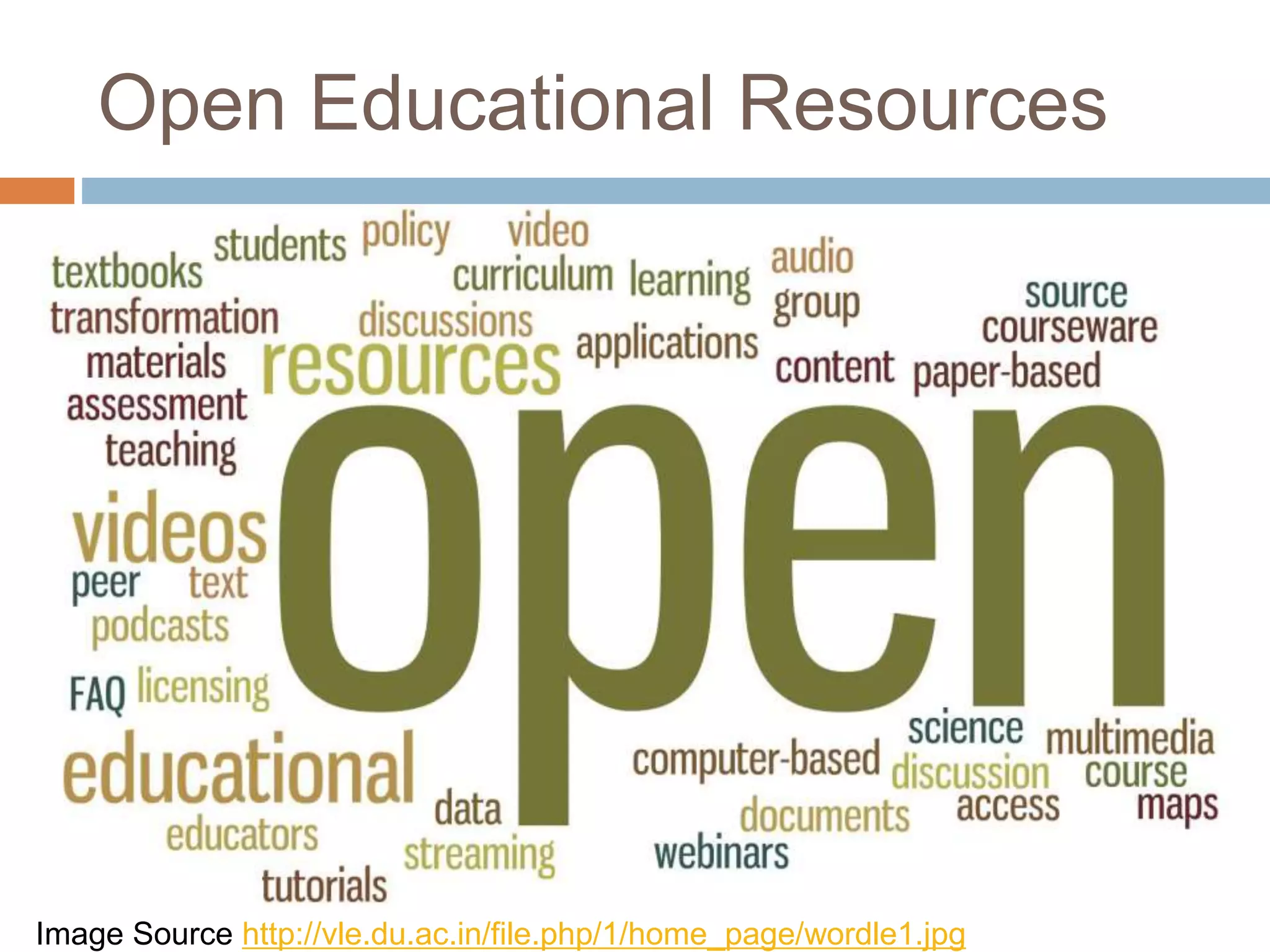
Open Educational Resources
Image Source http://vle.du.ac.in/file.php/1/home_page/wordle1.jpg
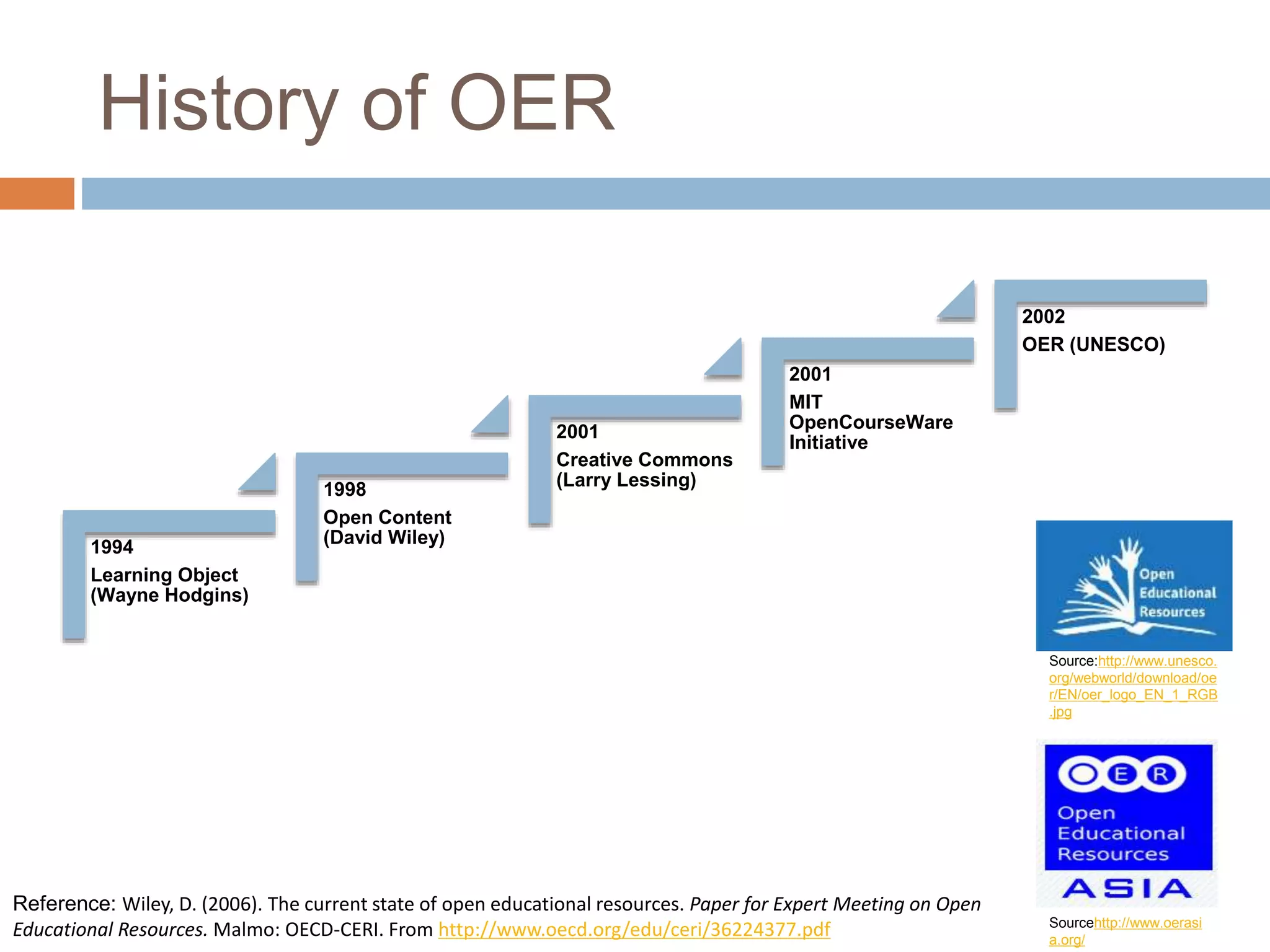
History of OER
1994
Learning Object
(Wayne Hodgins)
1998
Open Content
(David Wiley)
2001
Creative Commons
(Larry Lessing)
2001
MIT
OpenCourseWare
Initiative
2002
OER (UNESCO)
Reference: Wiley, D. (2006). The current state of open educational resources. Paper for Expert Meeting on Open
Educational Resources. Malmo: OECD-CERI. From http://www.oecd.org/edu/ceri/36224377.pdf
Source:http://www.unesco.
org/webworld/download/oe
r/EN/oer_logo_EN_1_RGB
.jpg
Sourcehttp://www.oerasi
a.org/
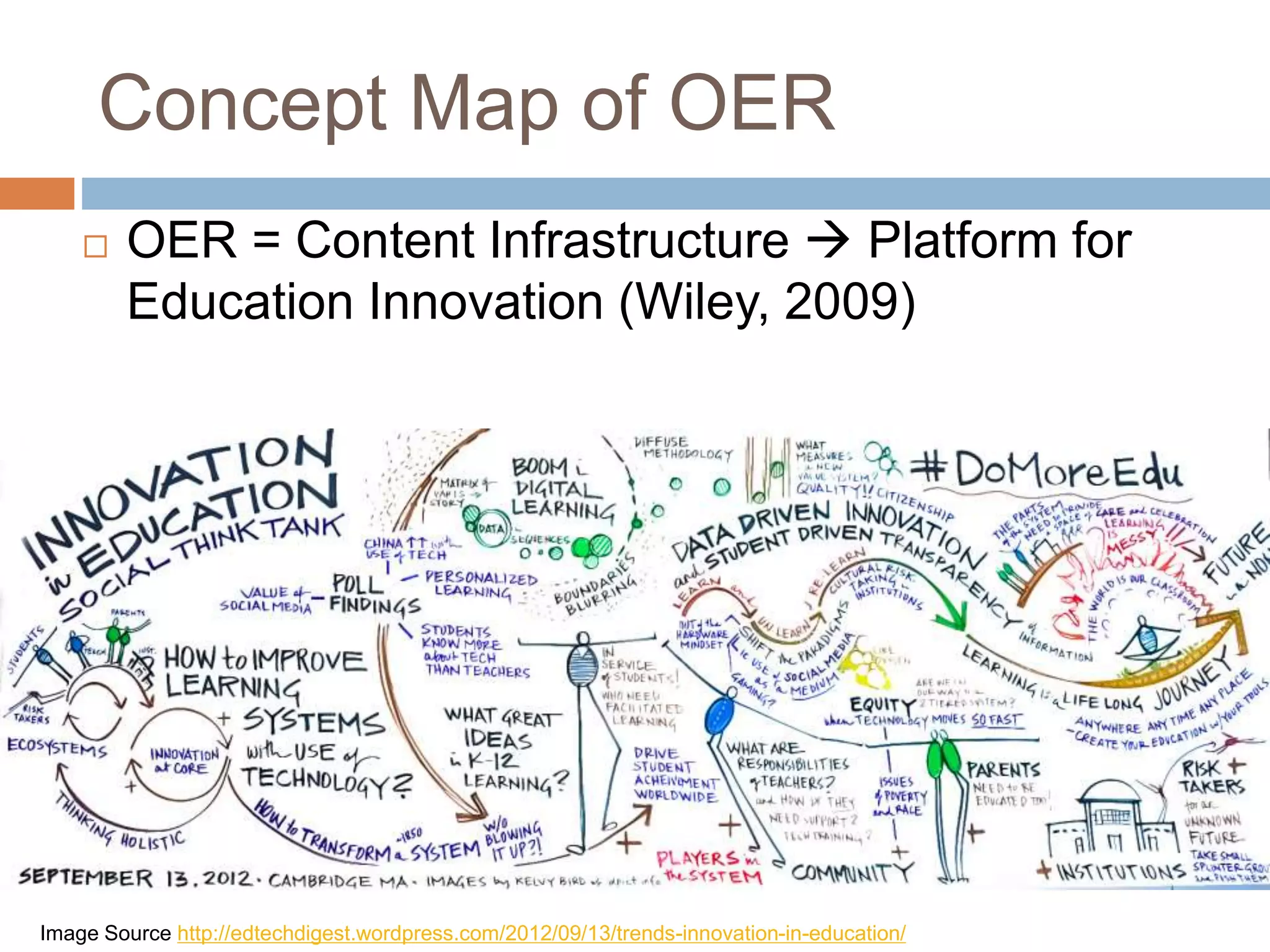
Concept Map of OER
 OER = Content Infrastructure  Platform for
Education Innovation (Wiley, 2009)
Image Source http://edtechdigest.wordpress.com/2012/09/13/trends-innovation-in-education/
Openness in Higher Education
 Plays an important role in driving educational
innovation & transforming HEI
 Is the fundamental value & critical attribute HEI
 Offers opportunities for sharing ideas,
collaborating between institutions, educators,
and learners locally & internationally (Wiley, et
al., 2009).
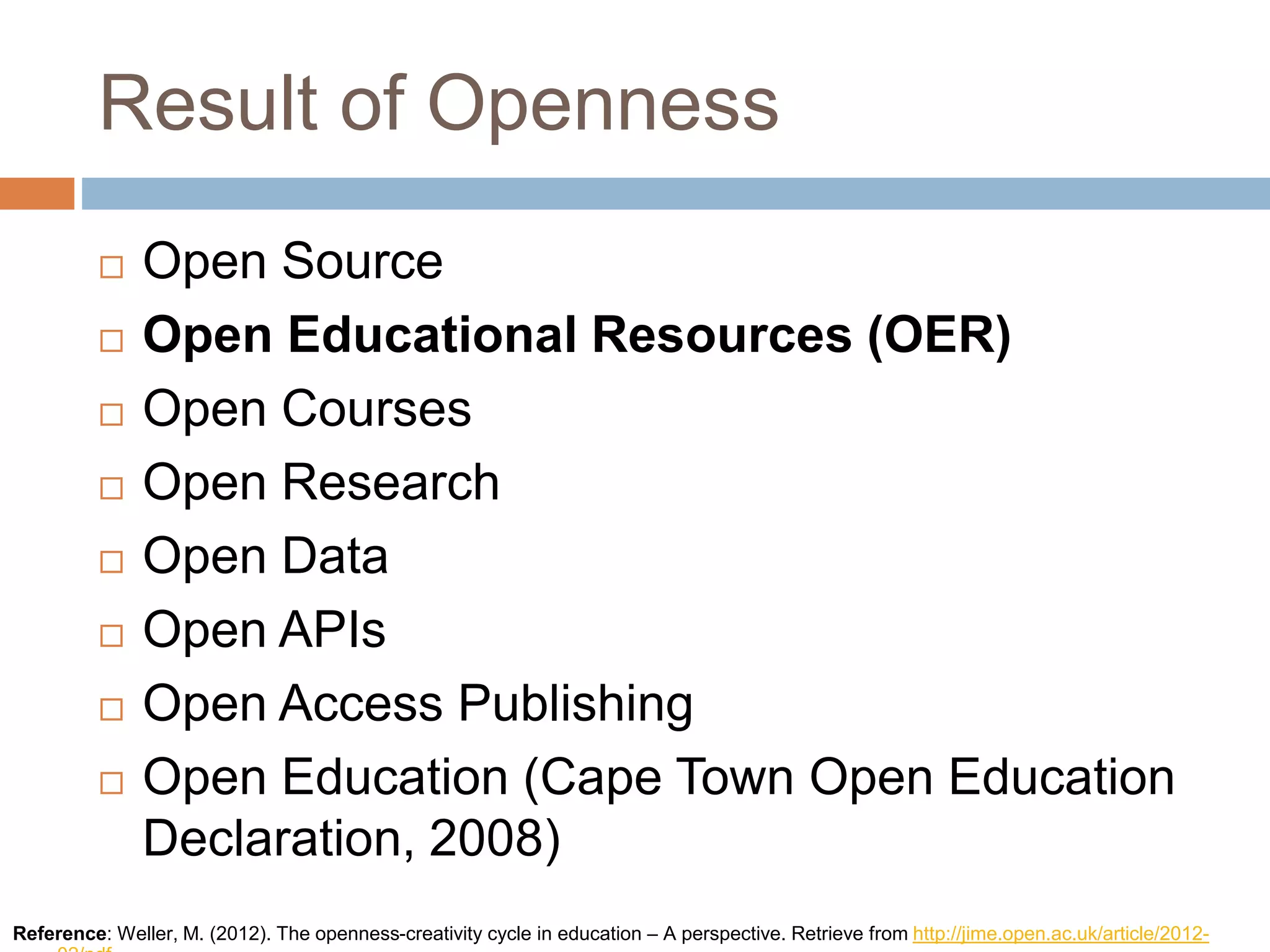
Result of Openness
 Open Source
 Open Educational Resources (OER)
 Open Courses
 Open Research
 Open Data
 Open APIs
 Open Access Publishing
 Open Education (Cape Town Open Education
Declaration, 2008)
Reference: Weller, M. (2012). The openness-creativity cycle in education – A perspective. Retrieve from http://jime.open.ac.uk/article/2012-
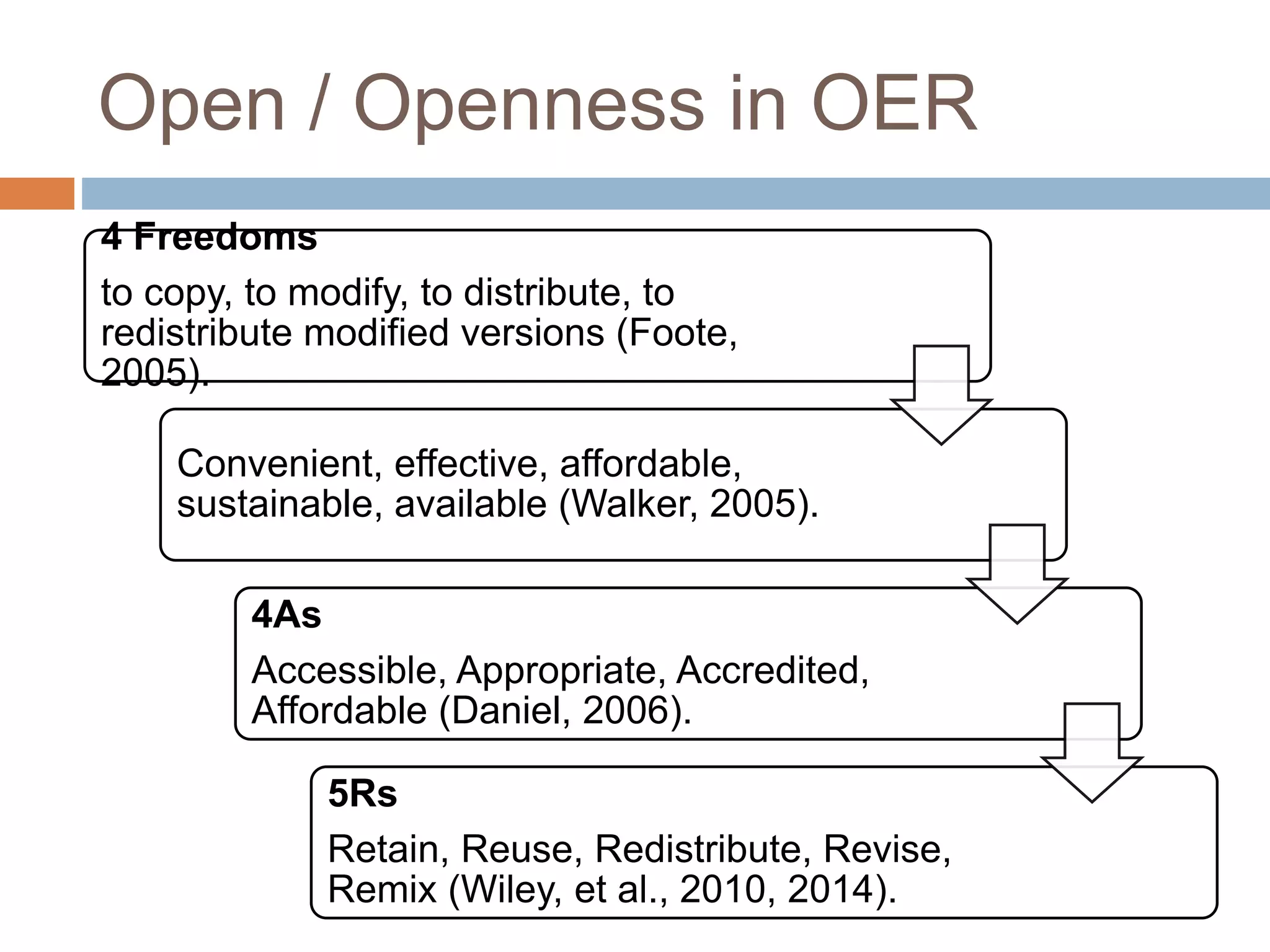
Open / Openness in OER
4 Freedoms
to copy, to modify, to distribute, to
redistribute modified versions (Foote,
2005).
Convenient, effective, affordable,
sustainable, available (Walker, 2005).
4As
Accessible, Appropriate, Accredited,
Affordable (Daniel, 2006).
5Rs
Retain, Reuse, Redistribute, Revise,
Remix (Wiley, et al., 2010, 2014).
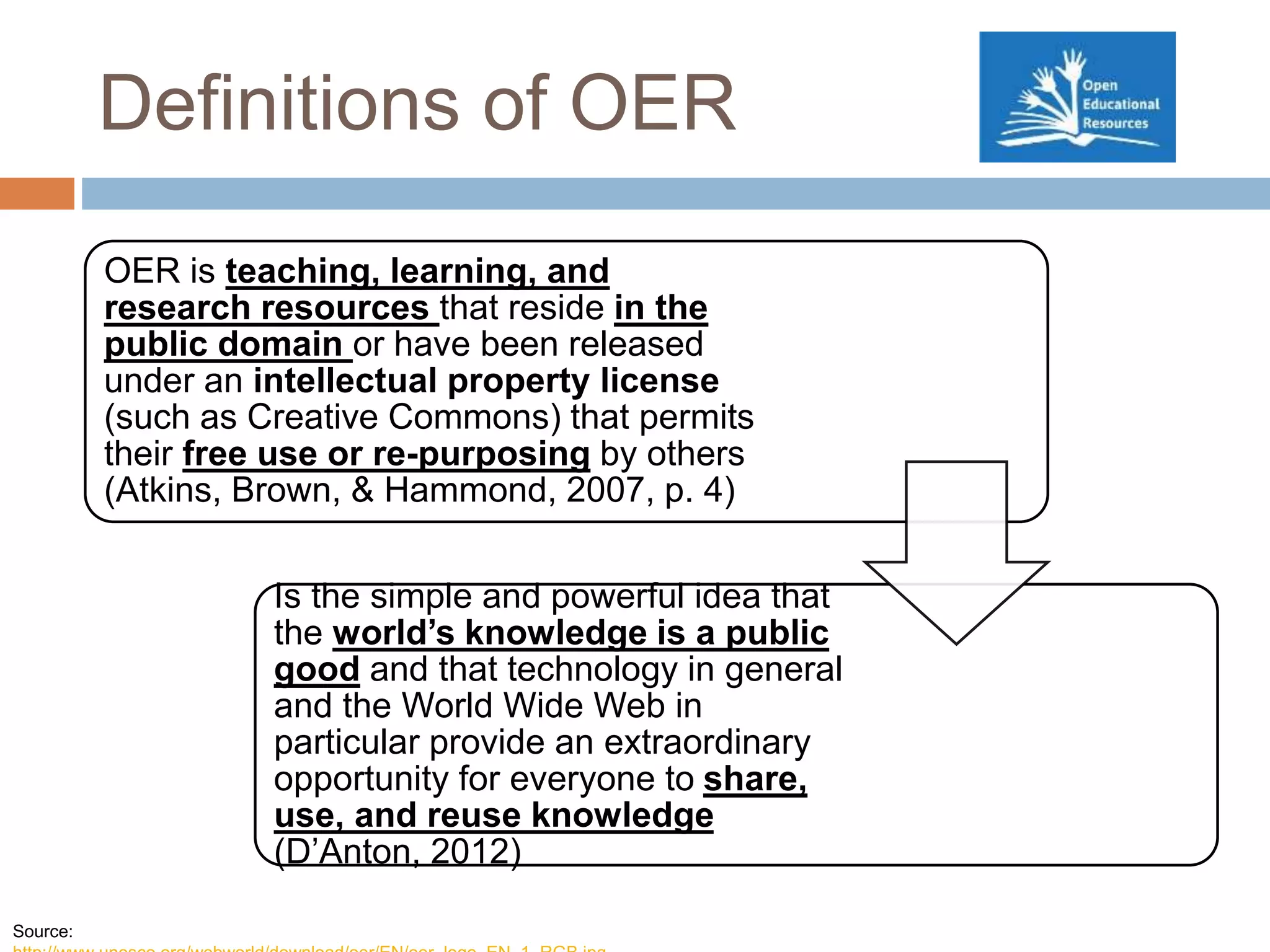
Definitions of OER
OER is teaching, learning, and
research resources that reside in the
public domain or have been released
under an intellectual property license
(such as Creative Commons) that permits
their free use or re-purposing by others
(Atkins, Brown, & Hammond, 2007, p. 4)
Is the simple and powerful idea that
the world’s knowledge is a public
good and that technology in general
and the World Wide Web in
particular provide an extraordinary
opportunity for everyone to share,
use, and reuse knowledge
(D’Anton, 2012)
Source:
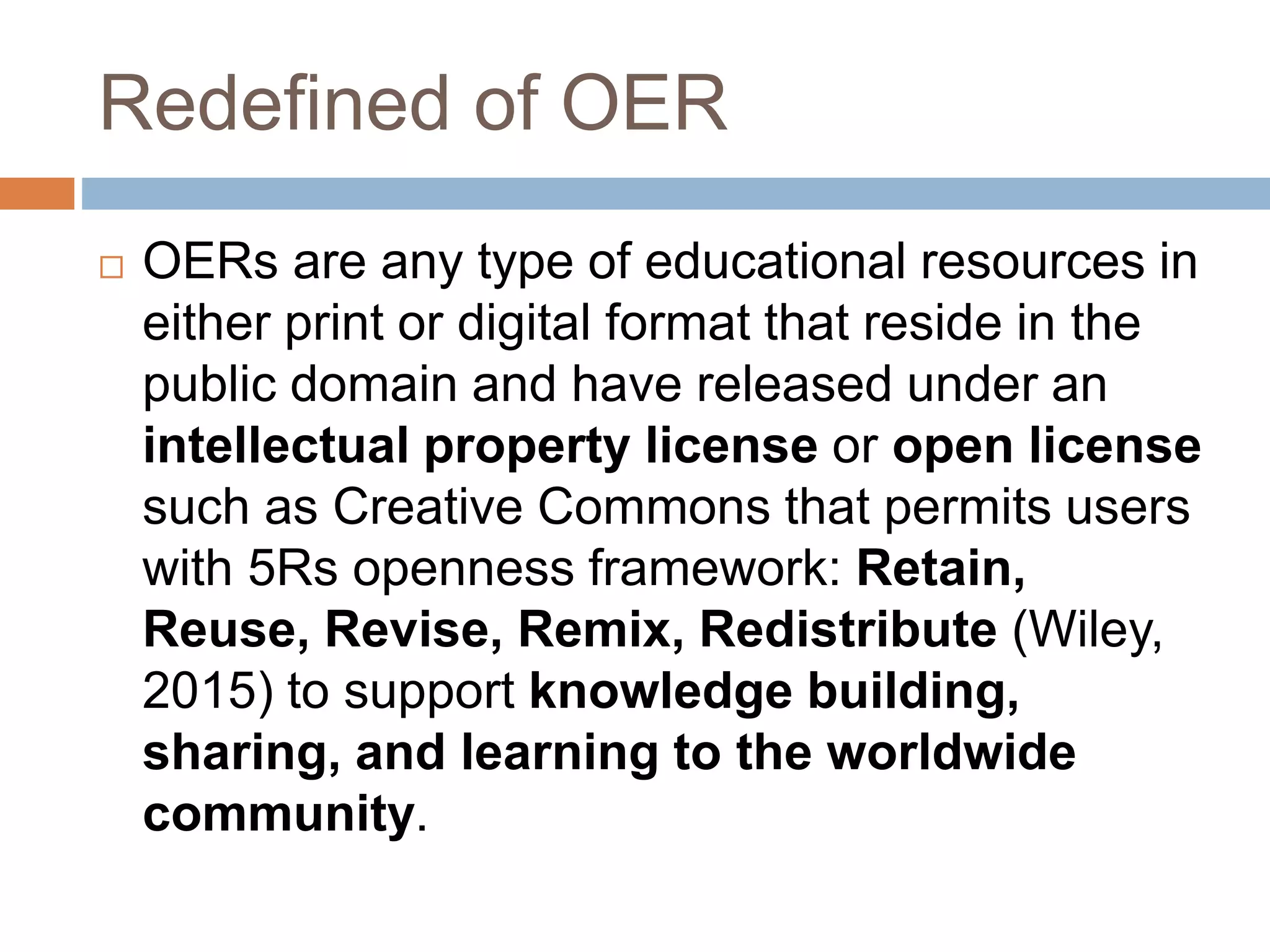
Redefined of OER
 OERs are any type of educational resources in
either print or digital format that reside in the
public domain and have released under an
intellectual property license or open license
such as Creative Commons that permits users
with 5Rs openness framework: Retain,
Reuse, Revise, Remix, Redistribute (Wiley,
2015) to support knowledge building,
sharing, and learning to the worldwide
community.
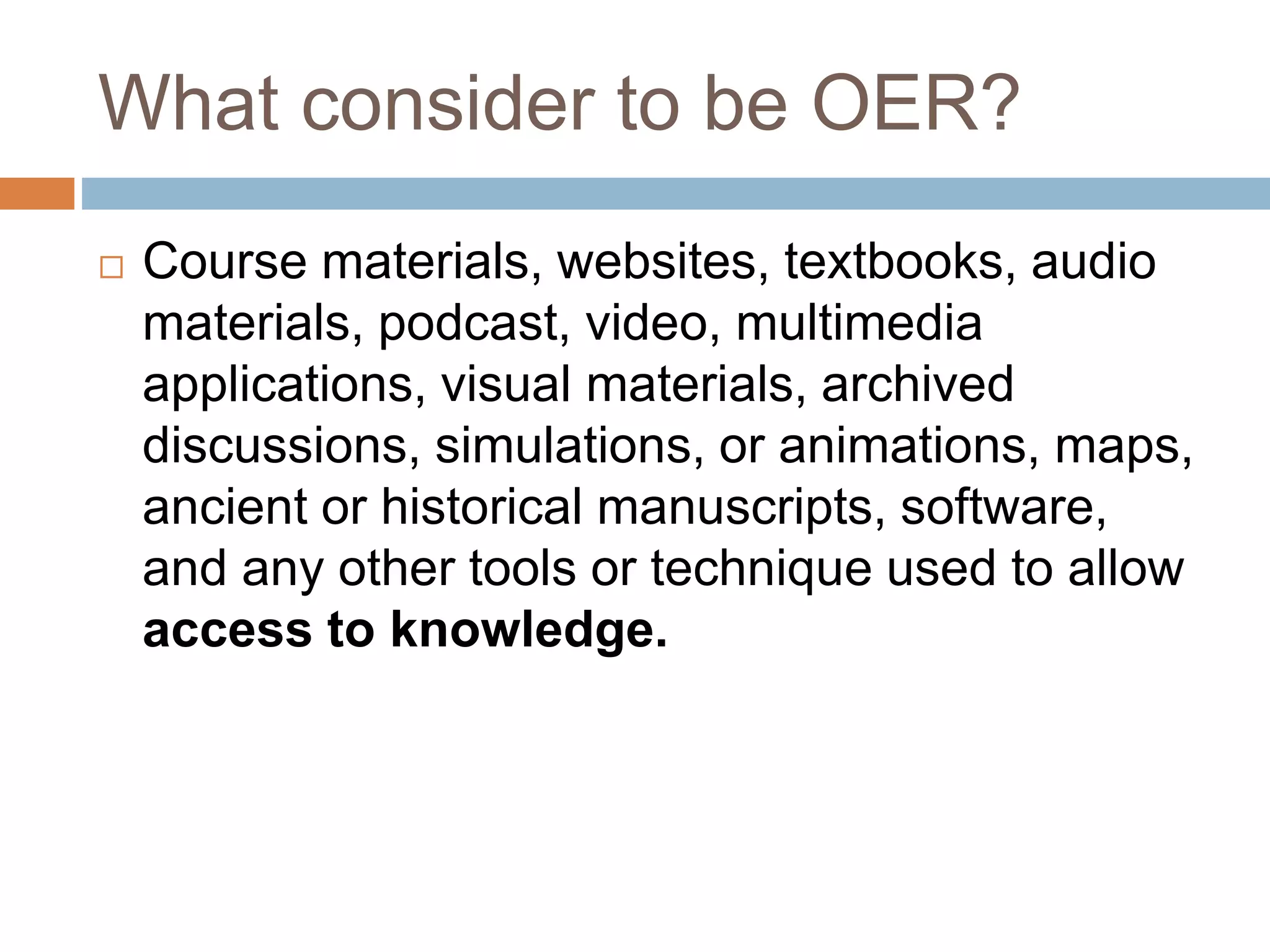
What consider to be OER?
 Course materials, websites, textbooks, audio
materials, podcast, video, multimedia
applications, visual materials, archived
discussions, simulations, or animations, maps,
ancient or historical manuscripts, software,
and any other tools or technique used to allow
access to knowledge.
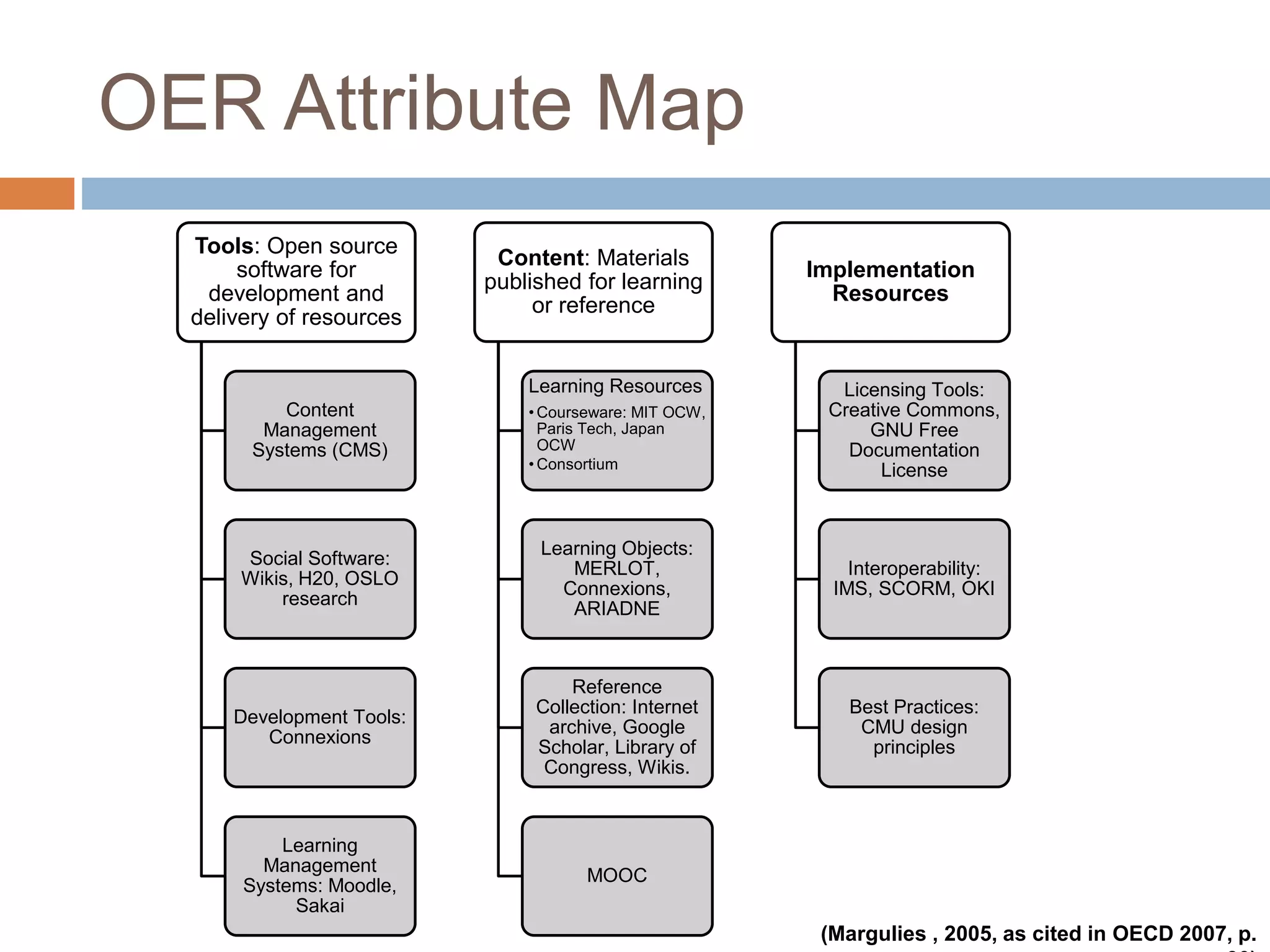
OER Attribute Map
Tools: Open source
software for
development and
delivery of resources
Content
Management
Systems (CMS)
Social Software:
Wikis, H20, OSLO
research
Development Tools:
Connexions
Learning
Management
Systems: Moodle,
Sakai
Content: Materials
published for learning
or reference
Learning Resources
• Courseware: MIT OCW,
Paris Tech, Japan
OCW
• Consortium
Learning Objects:
MERLOT,
Connexions,
ARIADNE
Reference
Collection: Internet
archive, Google
Scholar, Library of
Congress, Wikis.
MOOC
Implementation
Resources
Licensing Tools:
Creative Commons,
GNU Free
Documentation
License
Interoperability:
IMS, SCORM, OKI
Best Practices:
CMU design
principles
(Margulies , 2005, as cited in OECD 2007, p.
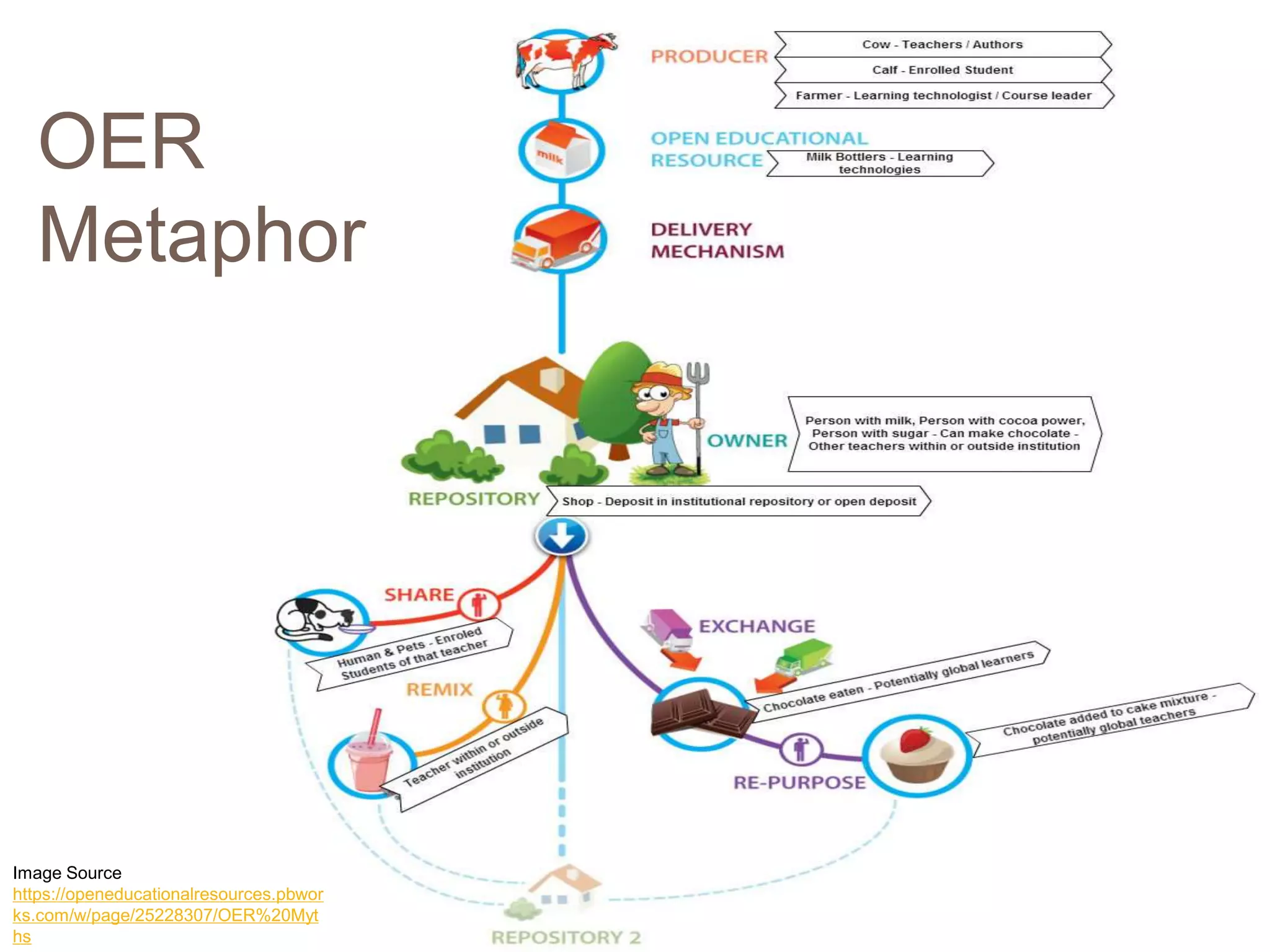
OER
Metaphor
Image Source
https://openeducationalresources.pbwor
ks.com/w/page/25228307/OER%20Myt
hs
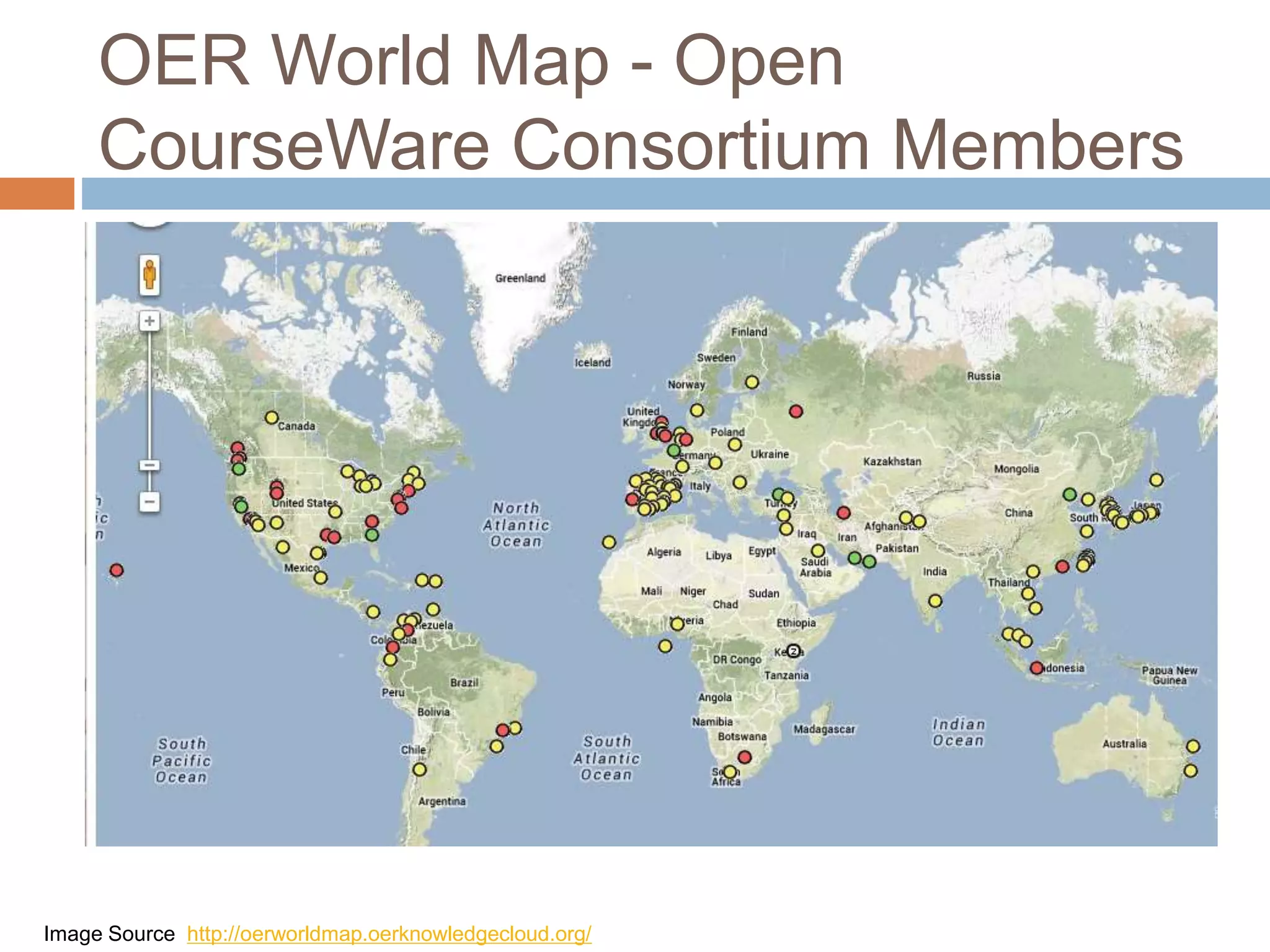
OER World Map - Open
CourseWare Consortium Members
Image Source http://oerworldmap.oerknowledgecloud.org/
Current Status of OER
 Over 150 universities in China
participate in China Open Resources
 11 universities in France have
formed the ParisTech OCT project
 7 universities in Japan have formed
the Japanese OCW
 7 universities in U.S. with OER
projects, and offer over 1400 courses
(Wiley, 2006)
Sourcehttps://www.fac
ebook.com/COL4D
Benefits of OER
 Freedom of access.
 Freedom from proprietary systems and
corporations.
 Save time and effort for content development.
 Co-creation empowers more collaboration and
creativity.
 Sharing development costs among institutions.
 Contributes to the local and global community.
 Accessibility of resources previously unavailable
to specific groups of people.
 Lowers costs to students.
Reference: Zaid Ali Alsagoff (2013). Embracing OER & MOOCs to Transforming Education? & SteveYuen.Org
Challenges of OER
 Quality varies.
 Varying degrees of time commitment.
 Teachers sometimes not rewarded by the system for
their efforts.
 May not meet accessibility requirements for persons
with disabilities.
 May need a high degree of customization (or
localization).
 Technical requirements vary and some require you
to use a particular software.
 Requires varying degrees of continual financial
support.
 Licensing and obtaining copyright clearance can be
difficult.
 Some institutions may be concerned about “giving itReference: Zaid Ali Alsagoff (2013). Embracing OER & MOOCs to Transforming Education? & SteveYuen.Org
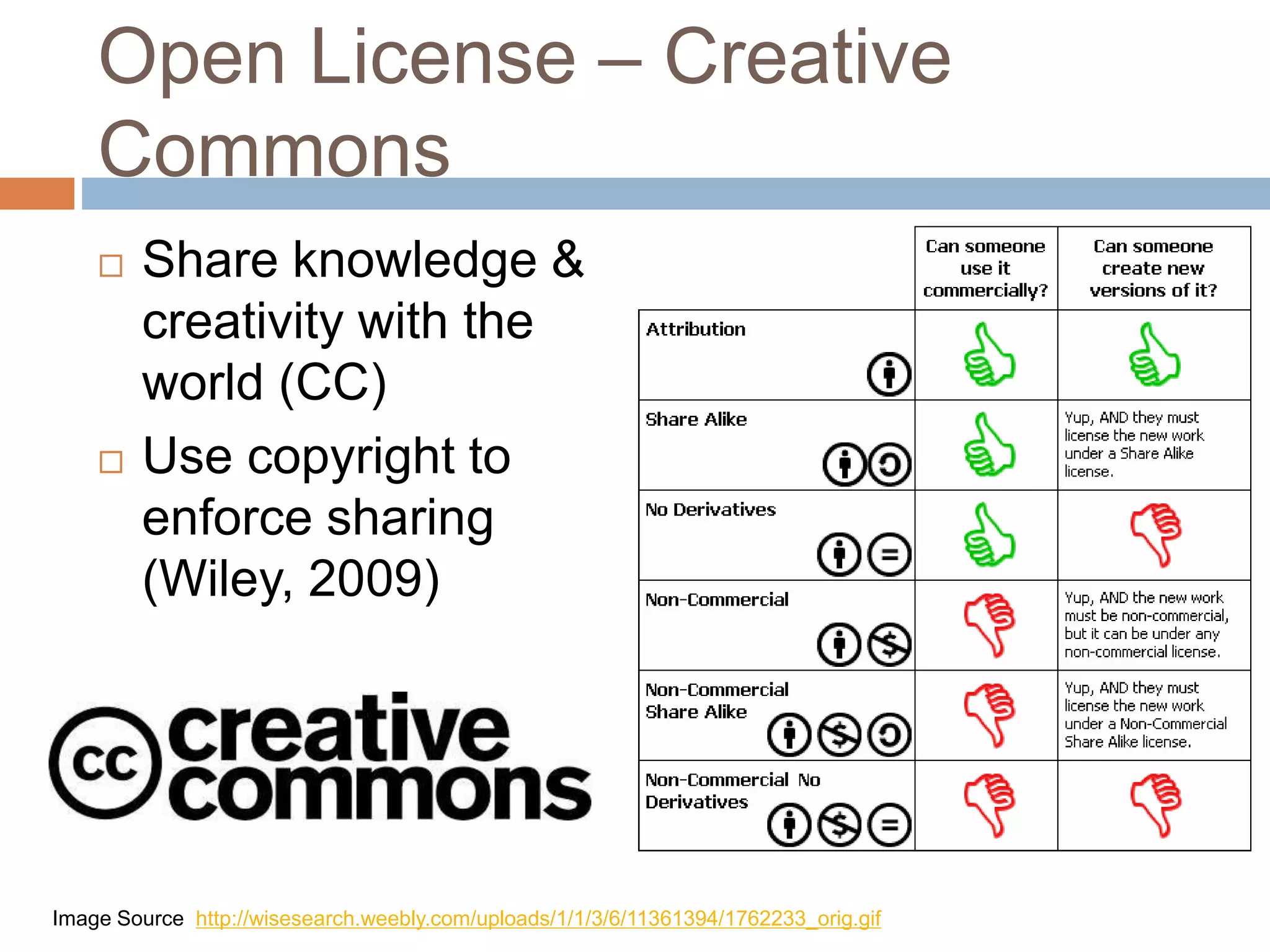
Open License – Creative
Commons
 Share knowledge &
creativity with the
world (CC)
 Use copyright to
enforce sharing
(Wiley, 2009)
Image Source http://wisesearch.weebly.com/uploads/1/1/3/6/11361394/1762233_orig.gif
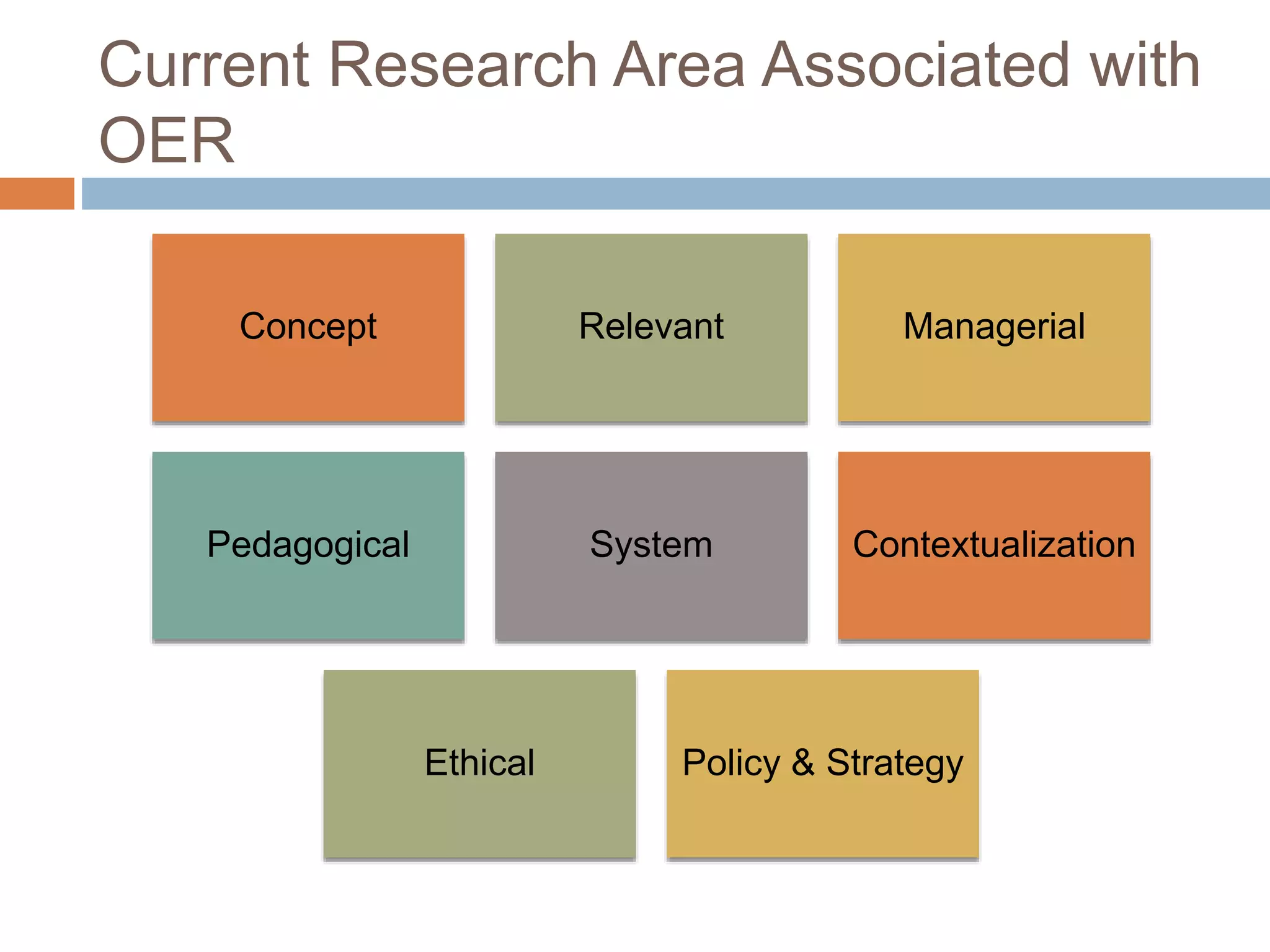
Current Research Area Associated with
OER
Concept Relevant Managerial
Pedagogical System Contextualization
Ethical Policy & Strategy
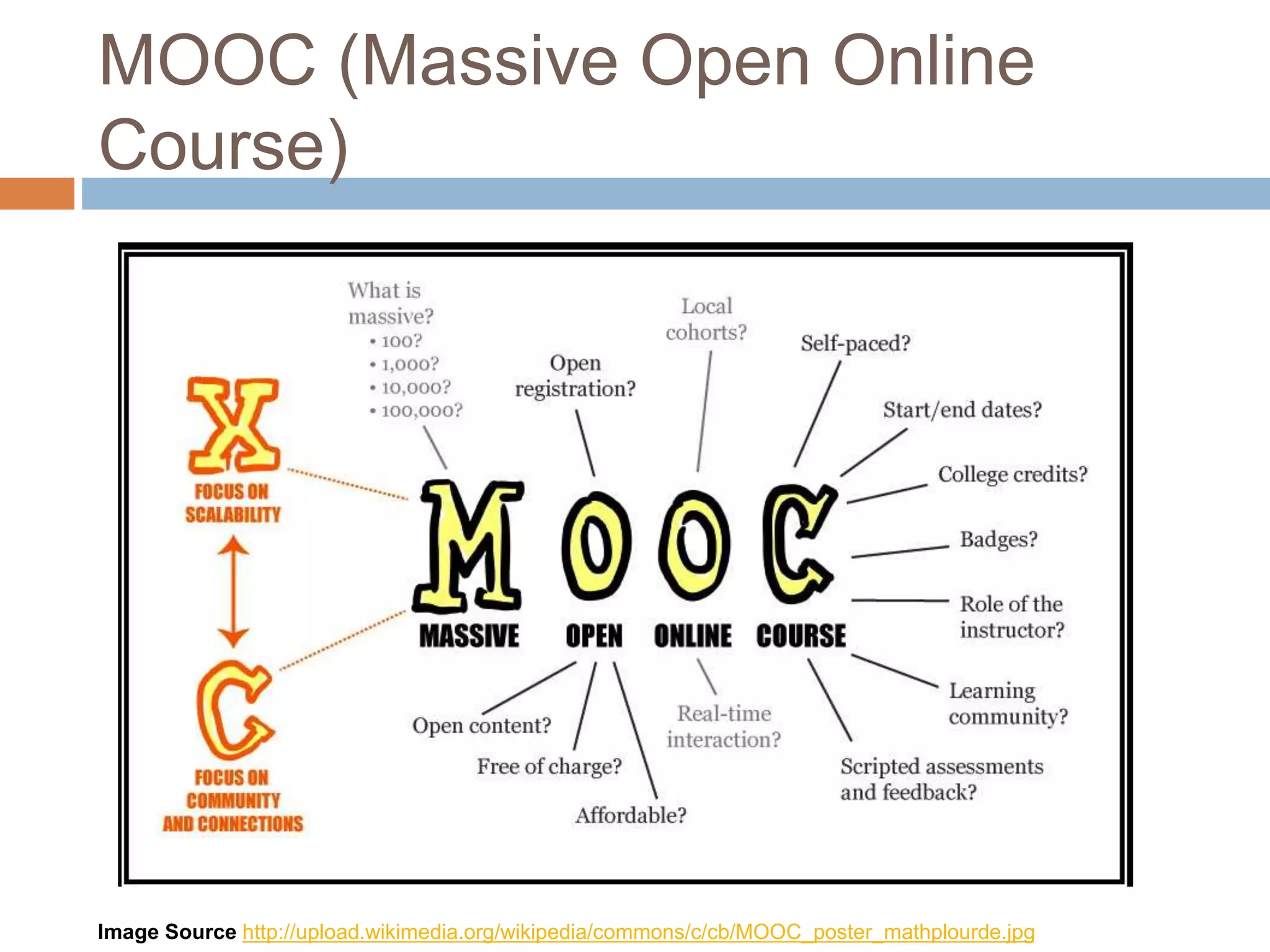
MOOC (Massive Open Online
Course)
Image Source http://upload.wikimedia.org/wikipedia/commons/c/cb/MOOC_poster_mathplourde.jpg
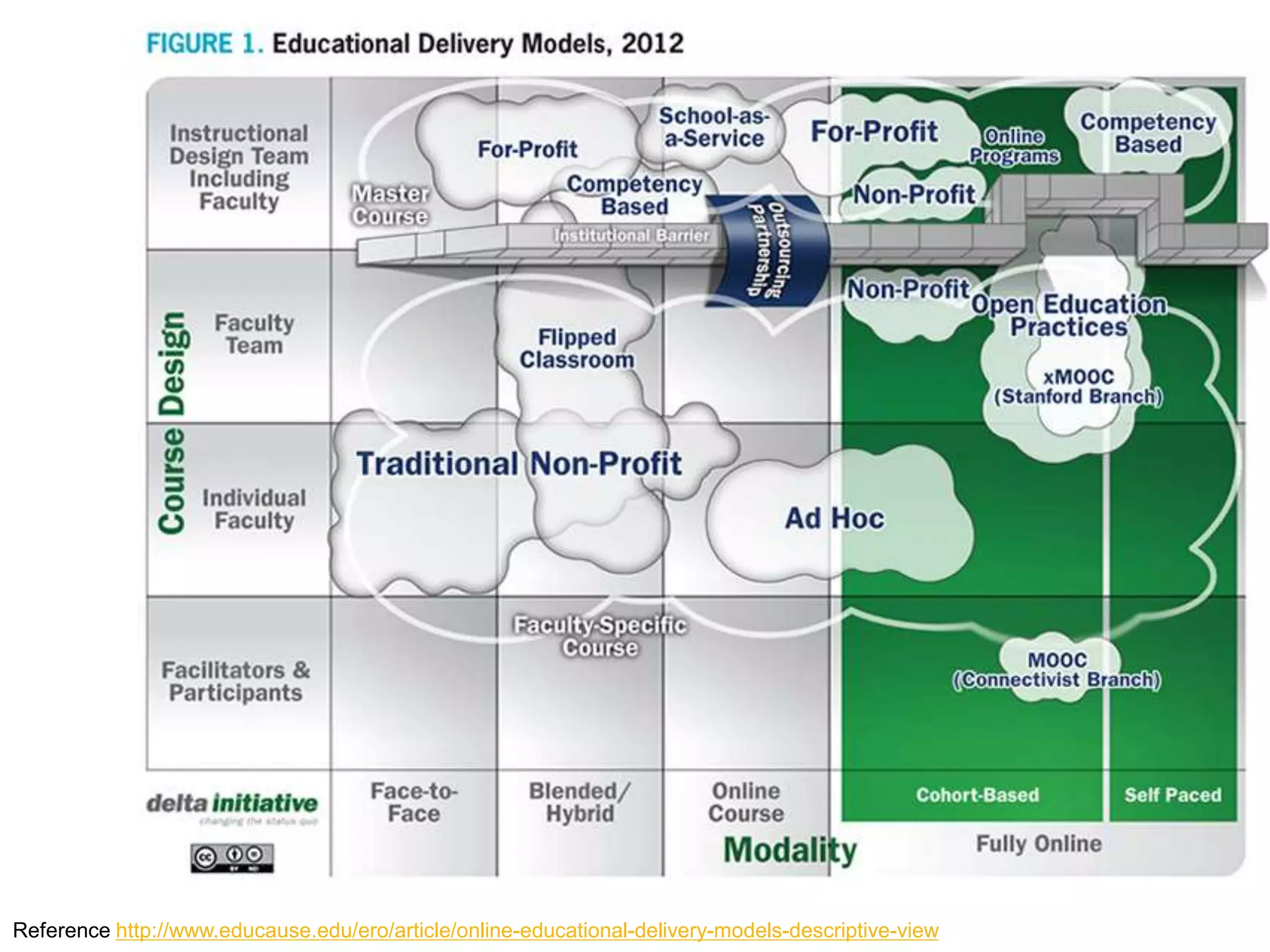
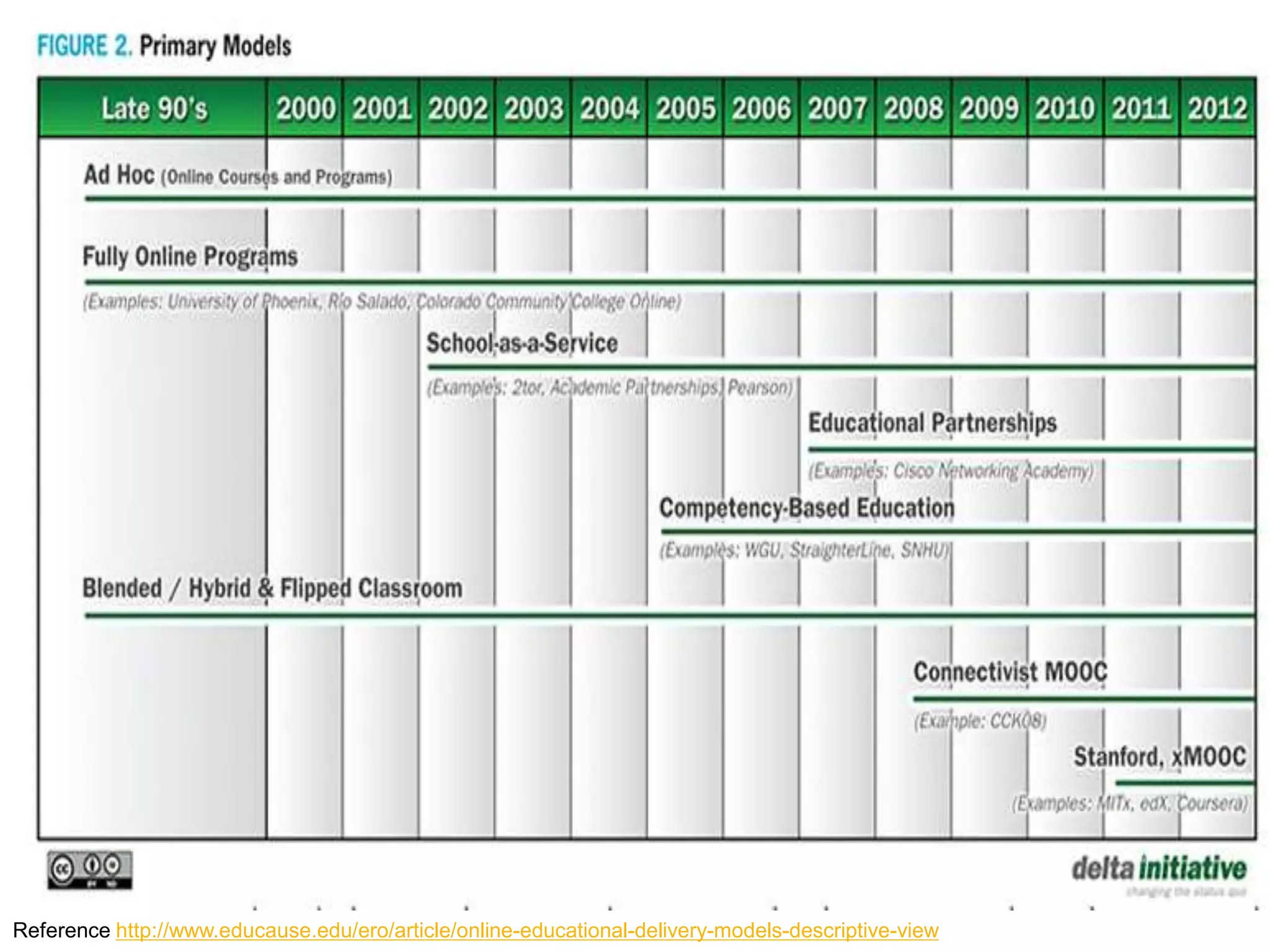
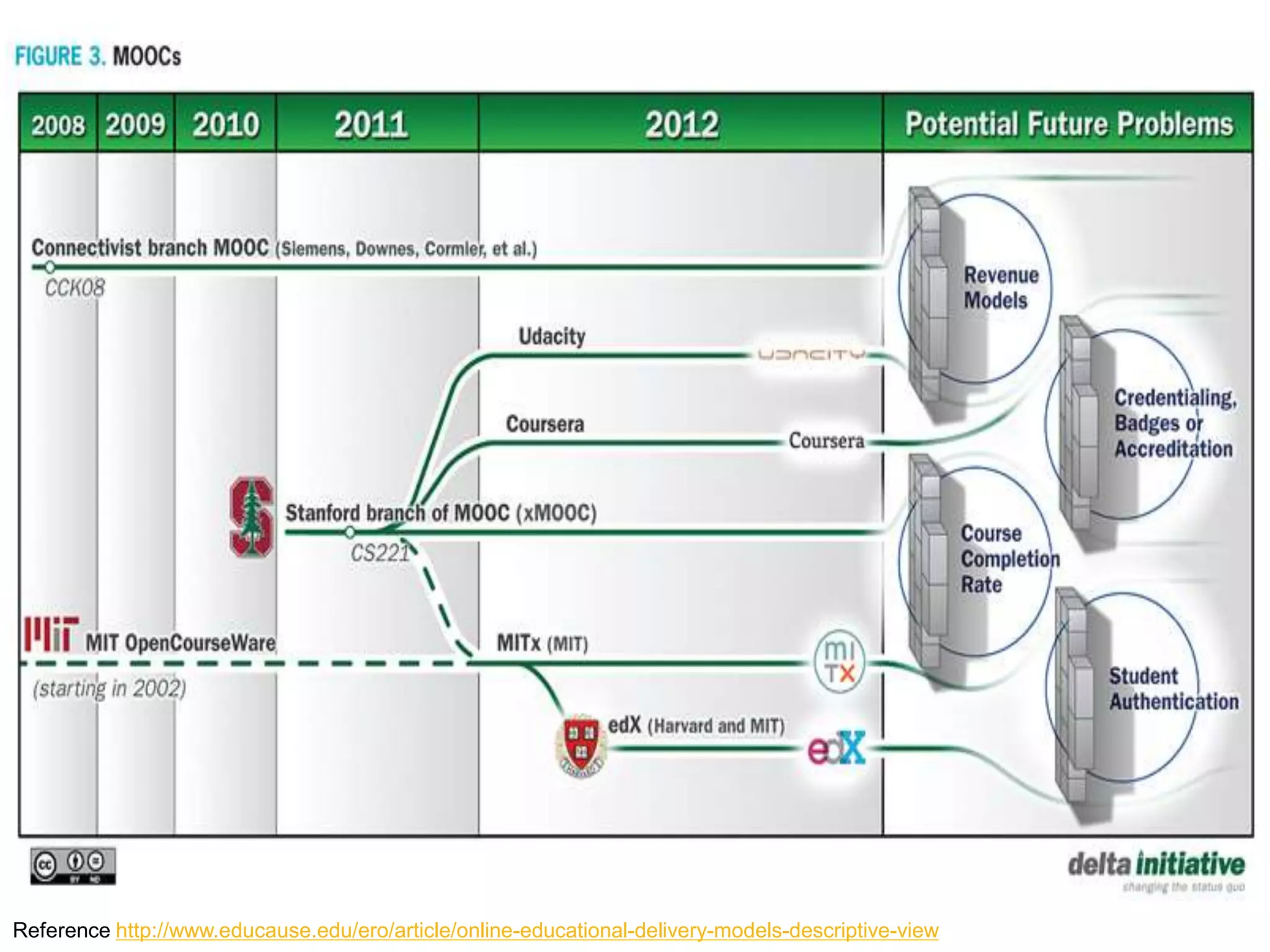
Reference http://www.educause.edu/ero/article/online-educational-delivery-models-descriptive-view
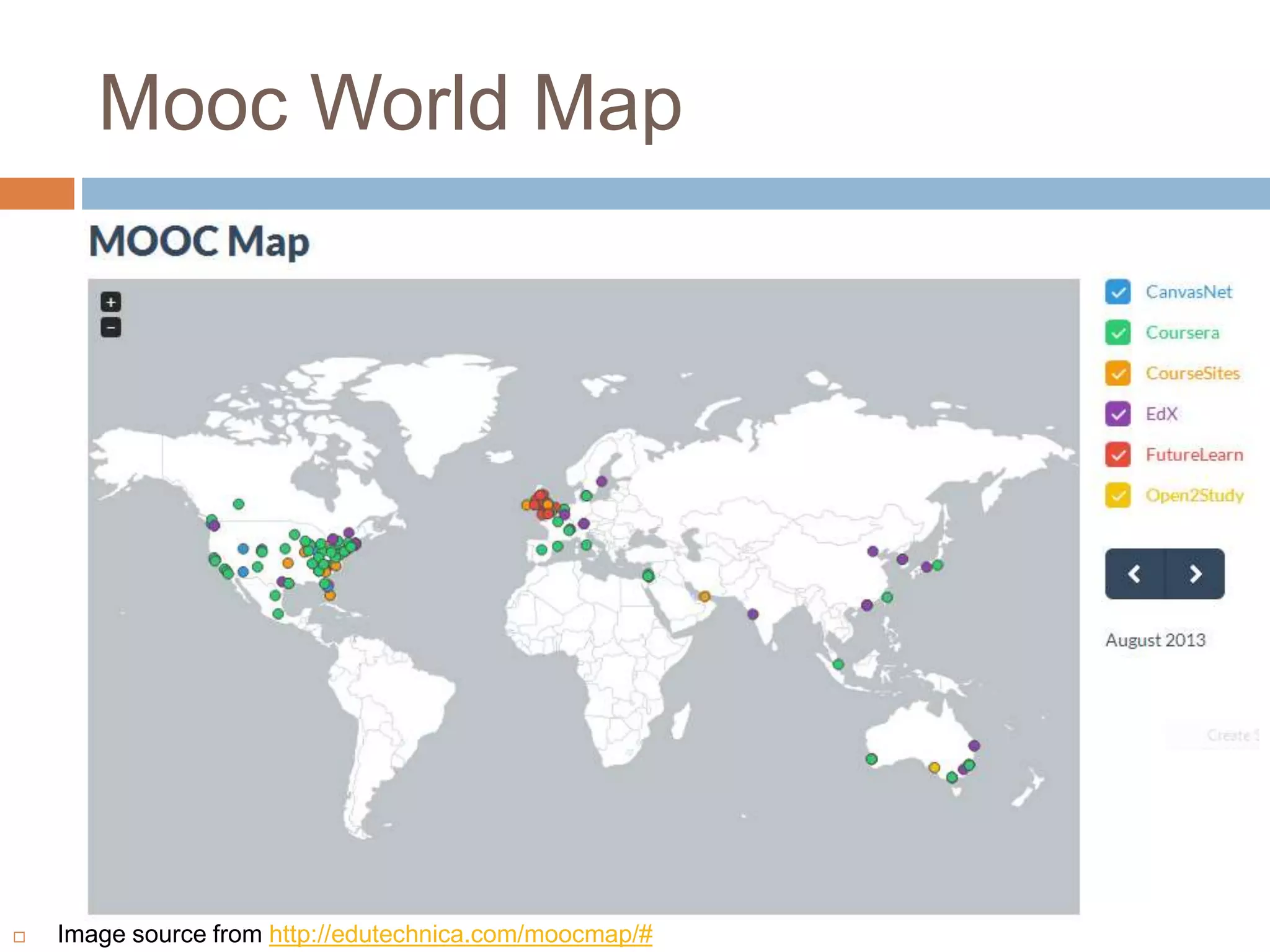
Mooc World Map
 Image source from http://edutechnica.com/moocmap/#
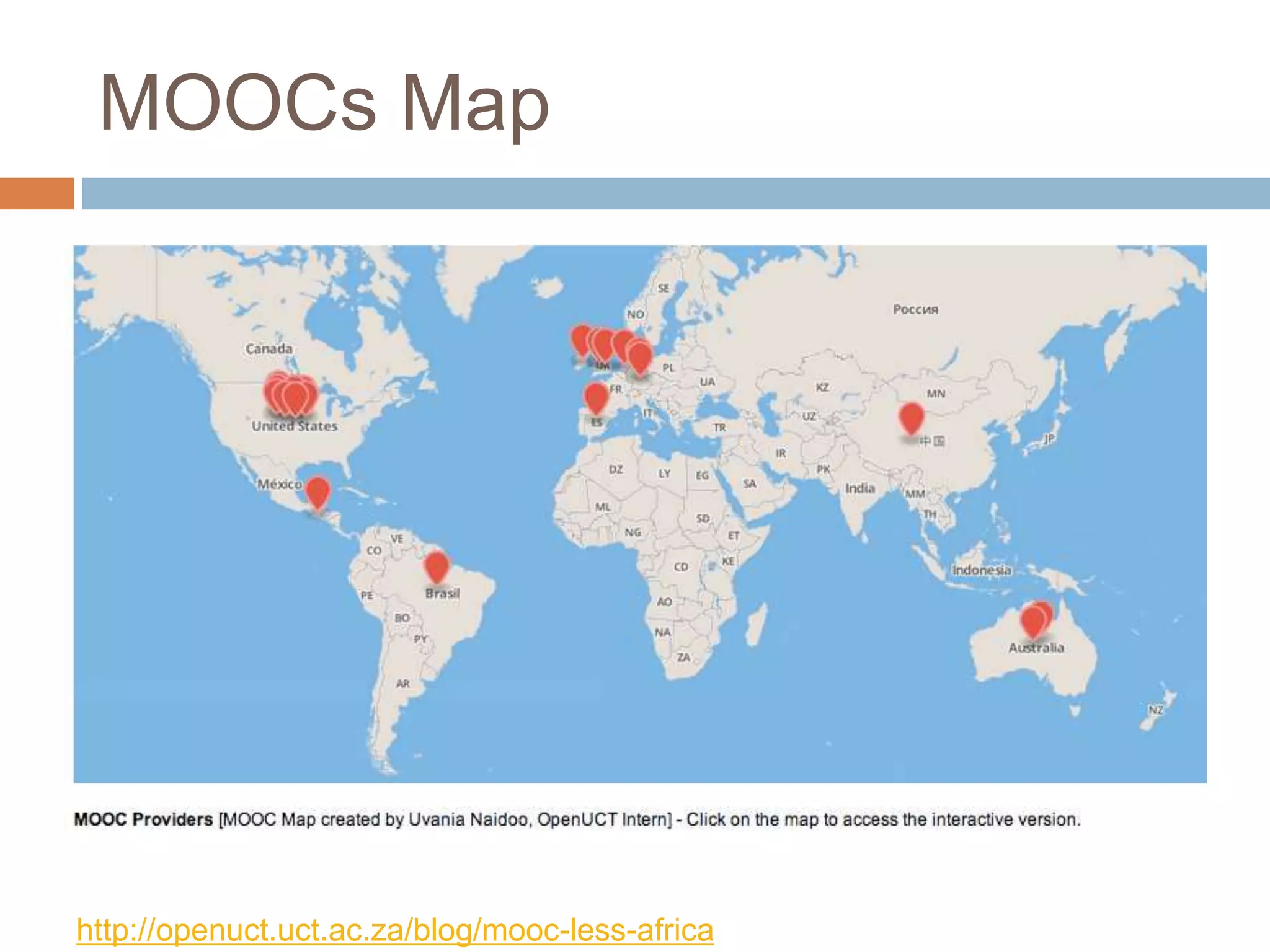
MOOCs Map
http://openuct.uct.ac.za/blog/mooc-less-africa
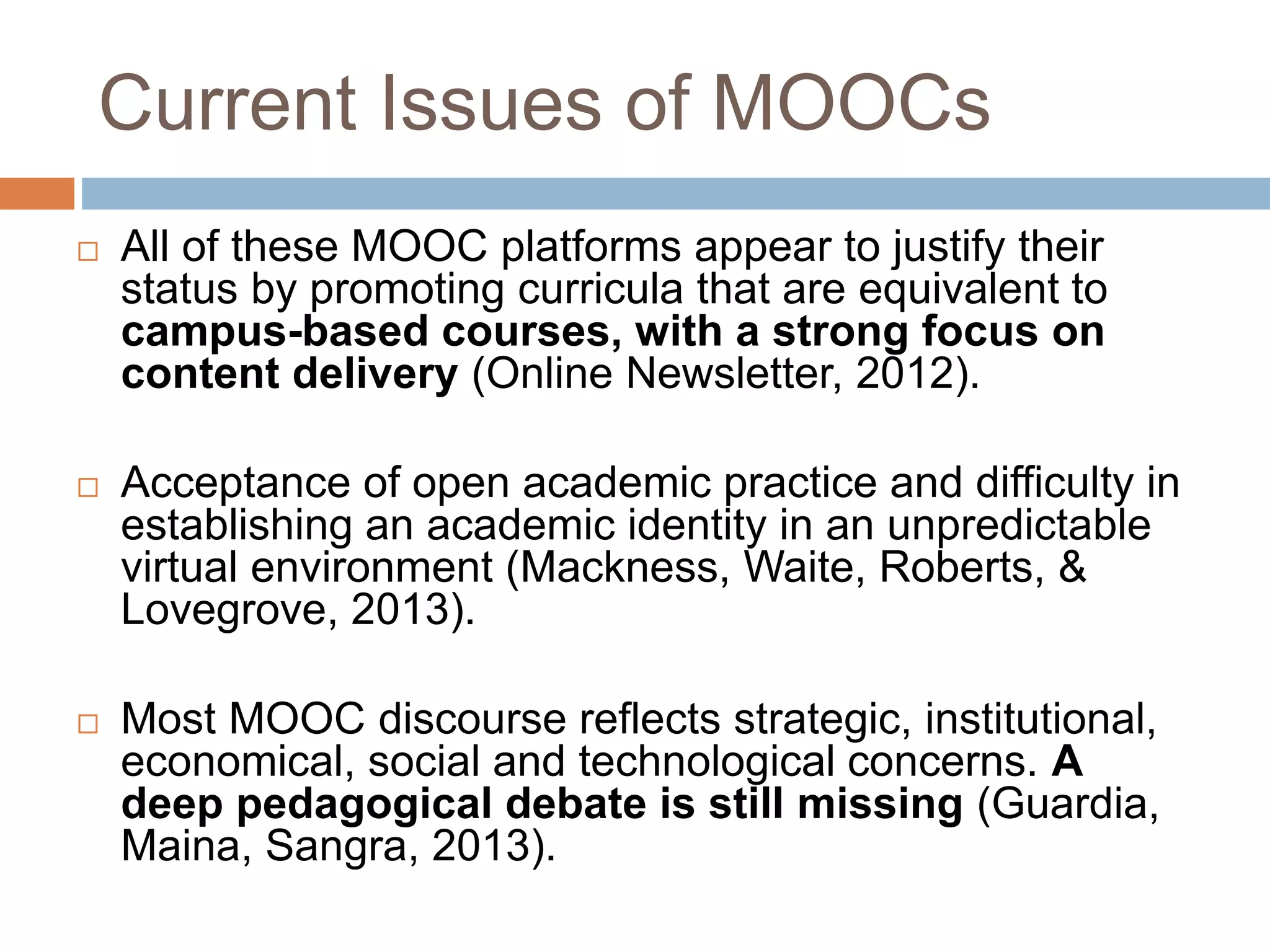
Current Issues of MOOCs
 All of these MOOC platforms appear to justify their
status by promoting curricula that are equivalent to
campus-based courses, with a strong focus on
content delivery (Online Newsletter, 2012).
 Acceptance of open academic practice and difficulty in
establishing an academic identity in an unpredictable
virtual environment (Mackness, Waite, Roberts, &
Lovegrove, 2013).
 Most MOOC discourse reflects strategic, institutional,
economical, social and technological concerns. A
deep pedagogical debate is still missing (Guardia,
Maina, Sangra, 2013).
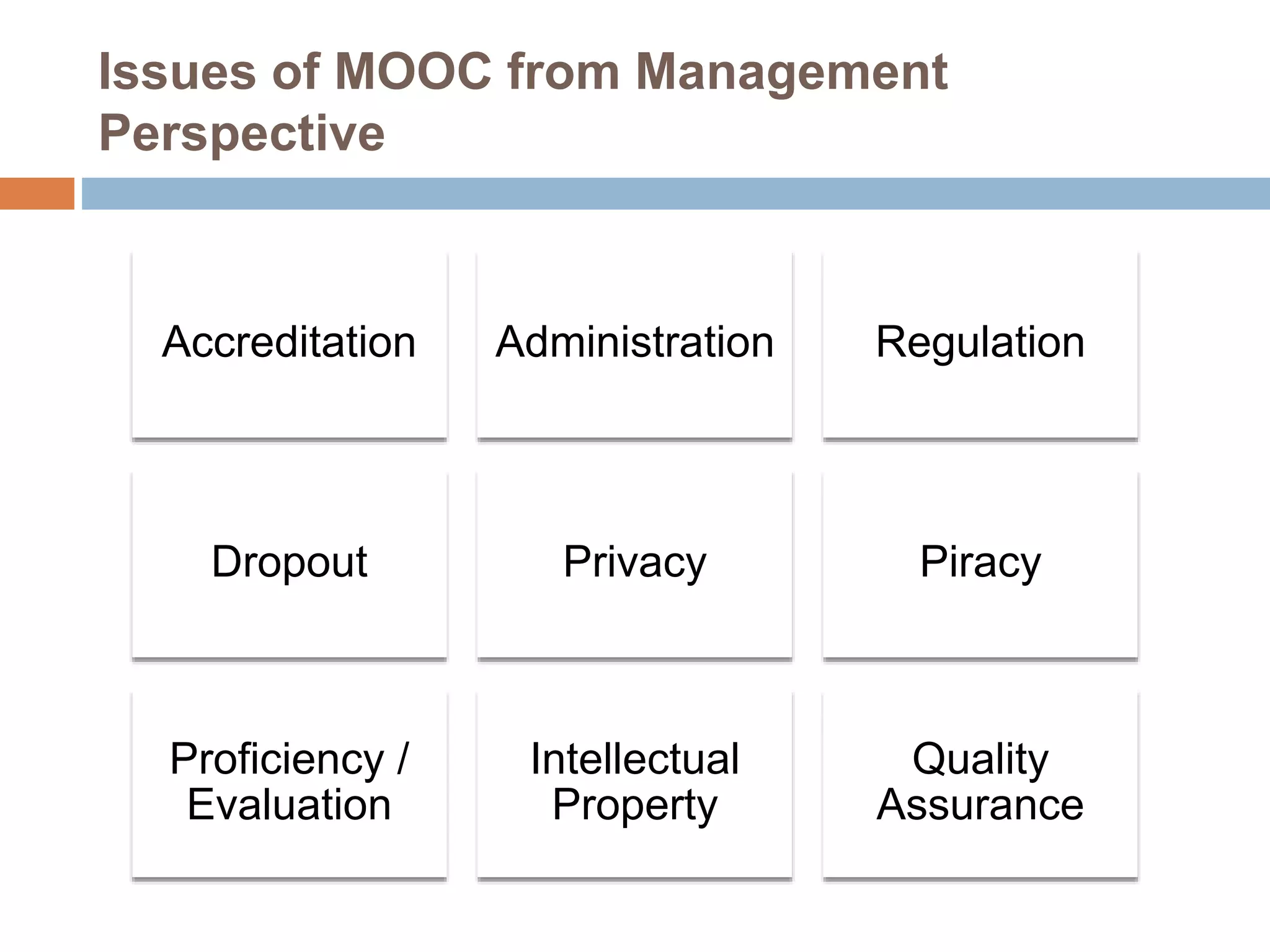
Issues of MOOC from Management
Perspective
Accreditation Administration Regulation
Dropout Privacy Piracy
Proficiency /
Evaluation
Intellectual
Property
Quality
Assurance
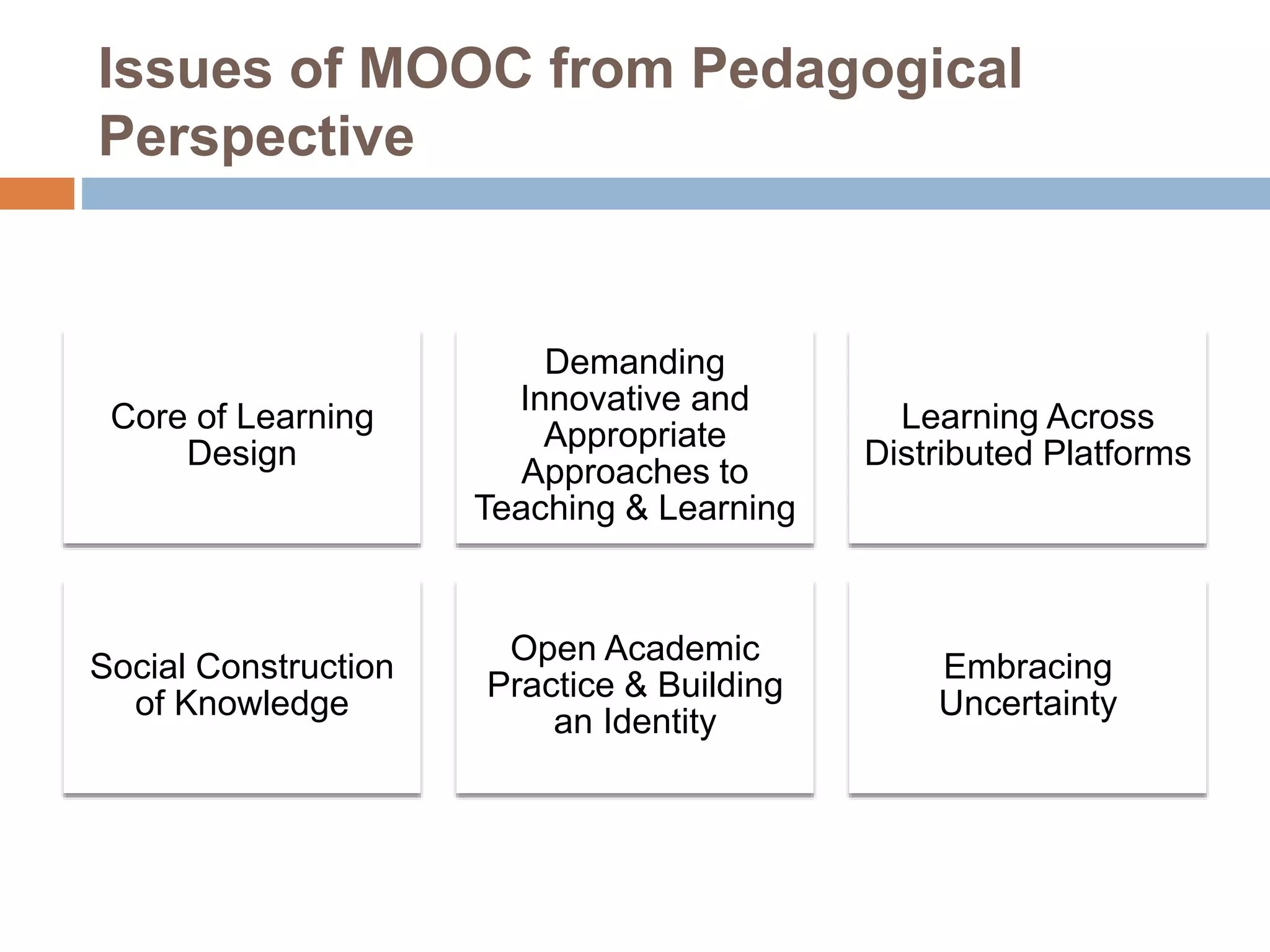
Issues of MOOC from Pedagogical
Perspective
Core of Learning
Design
Demanding
Innovative and
Appropriate
Approaches to
Teaching & Learning
Learning Across
Distributed Platforms
Social Construction
of Knowledge
Open Academic
Practice & Building
an Identity
Embracing
Uncertainty
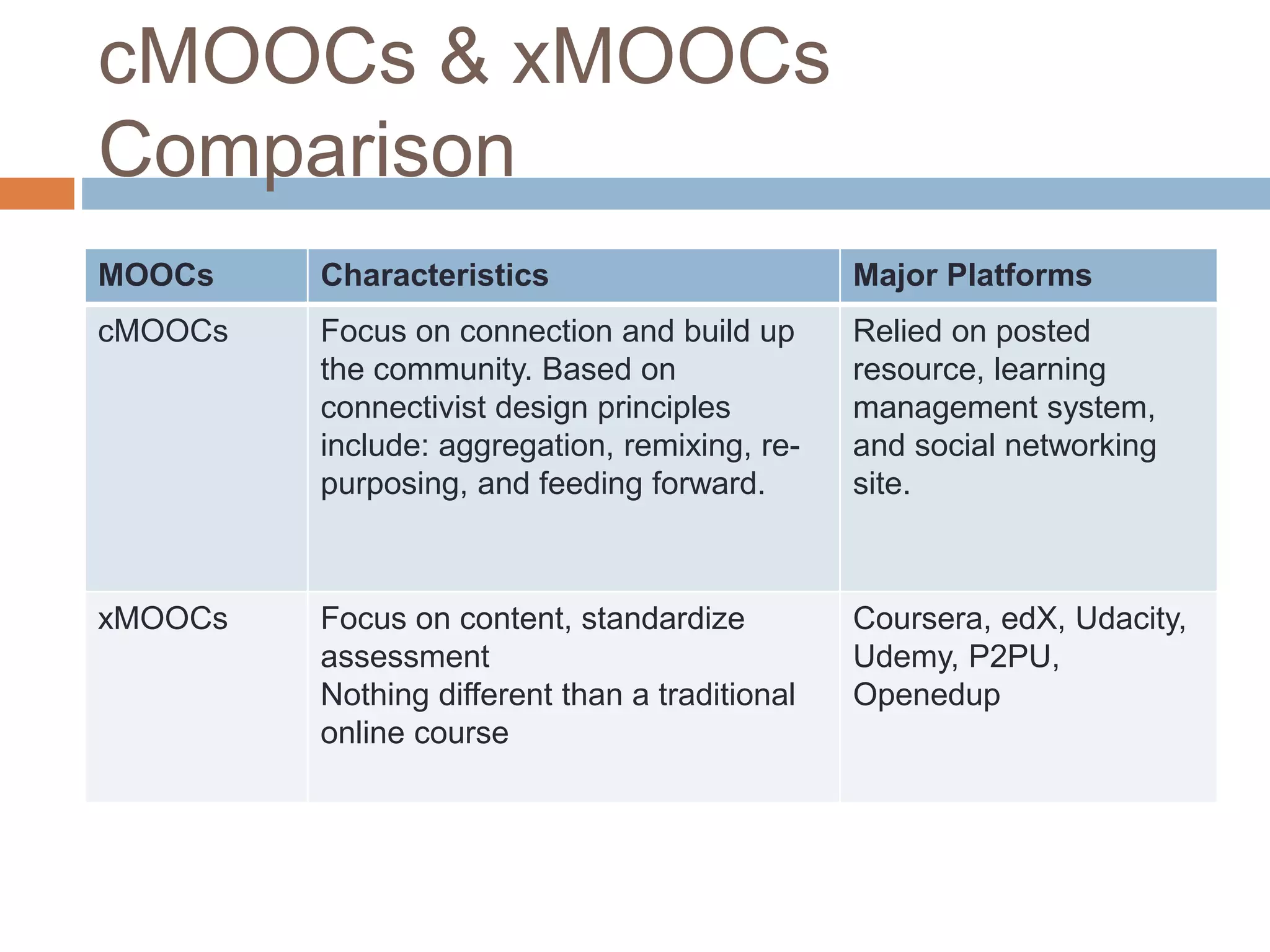
cMOOCs & xMOOCs
Comparison
MOOCs Characteristics Major Platforms
cMOOCs Focus on connection and build up
the community. Based on
connectivist design principles
include: aggregation, remixing, re-
purposing, and feeding forward.
Relied on posted
resource, learning
management system,
and social networking
site.
xMOOCs Focus on content, standardize
assessment
Nothing different than a traditional
online course
Coursera, edX, Udacity,
Udemy, P2PU,
Openedup
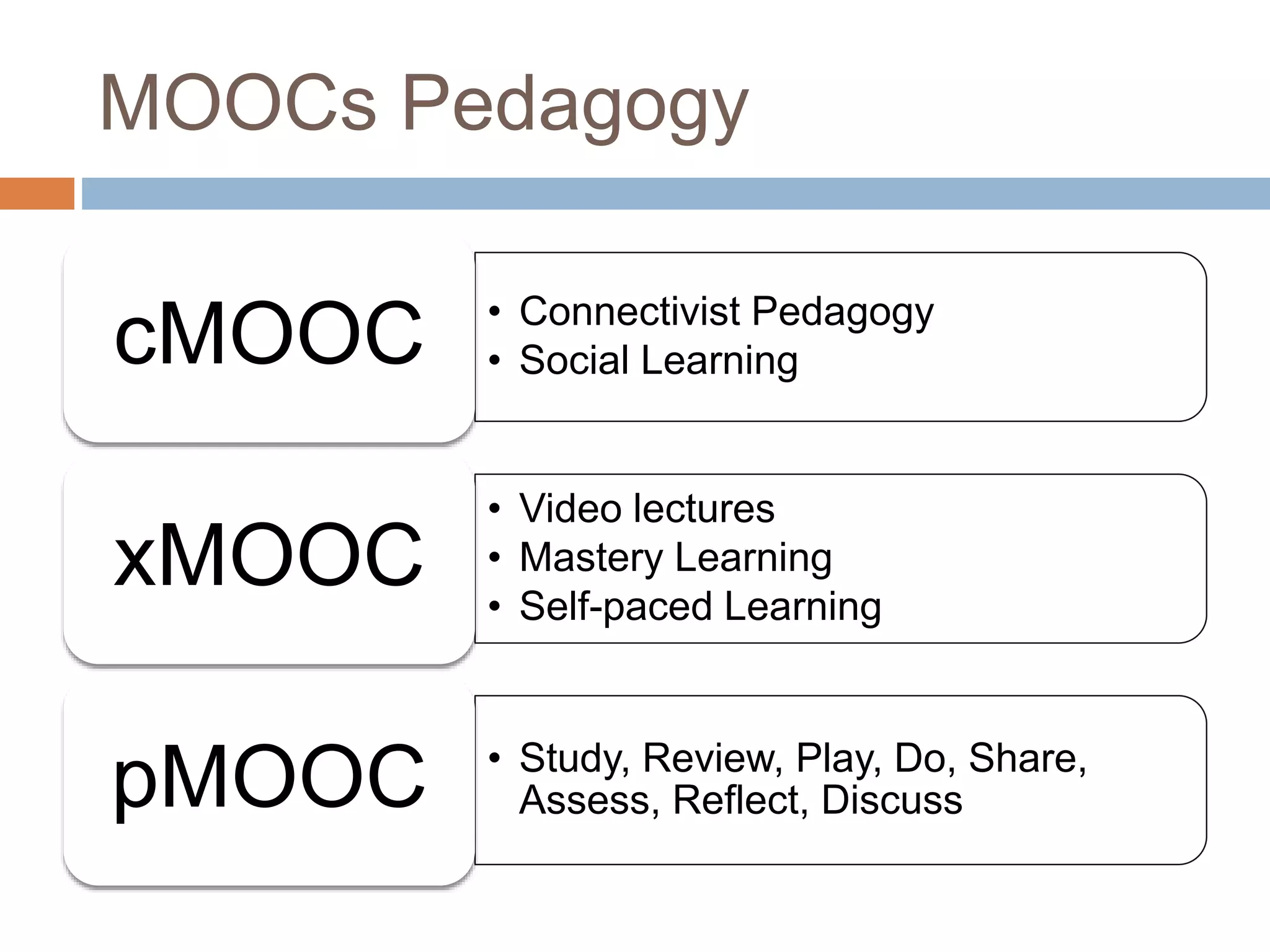
MOOCs Pedagogy
• Connectivist Pedagogy
• Social LearningcMOOC
• Video lectures
• Mastery Learning
• Self-paced Learning
xMOOC
• Study, Review, Play, Do, Share,
Assess, Reflect, DiscusspMOOC
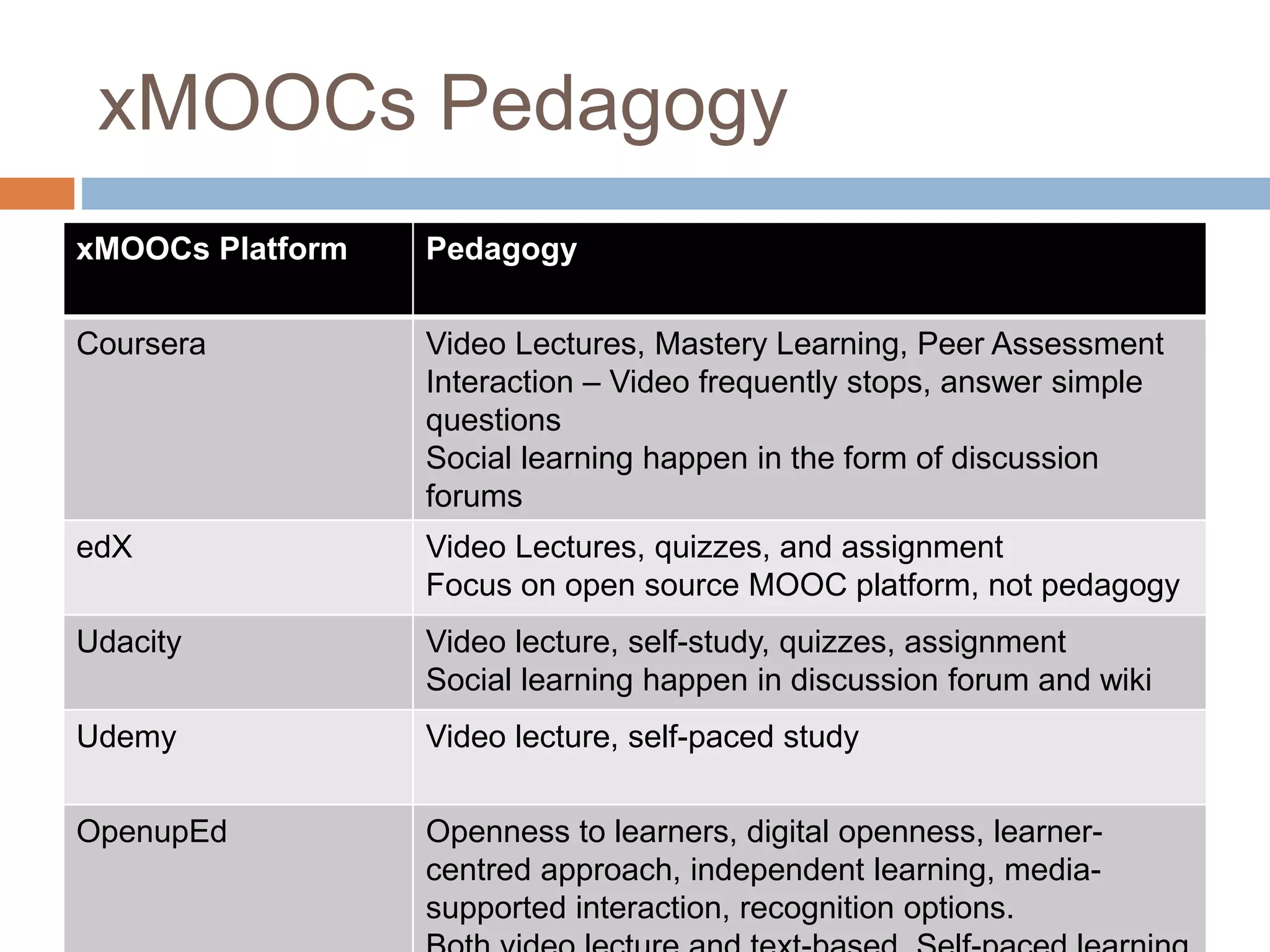
xMOOCs Pedagogy
xMOOCs Platform Pedagogy
Coursera Video Lectures, Mastery Learning, Peer Assessment
Interaction – Video frequently stops, answer simple
questions
Social learning happen in the form of discussion
forums
edX Video Lectures, quizzes, and assignment
Focus on open source MOOC platform, not pedagogy
Udacity Video lecture, self-study, quizzes, assignment
Social learning happen in discussion forum and wiki
Udemy Video lecture, self-paced study
OpenupEd Openness to learners, digital openness, learner-
centred approach, independent learning, media-
supported interaction, recognition options.
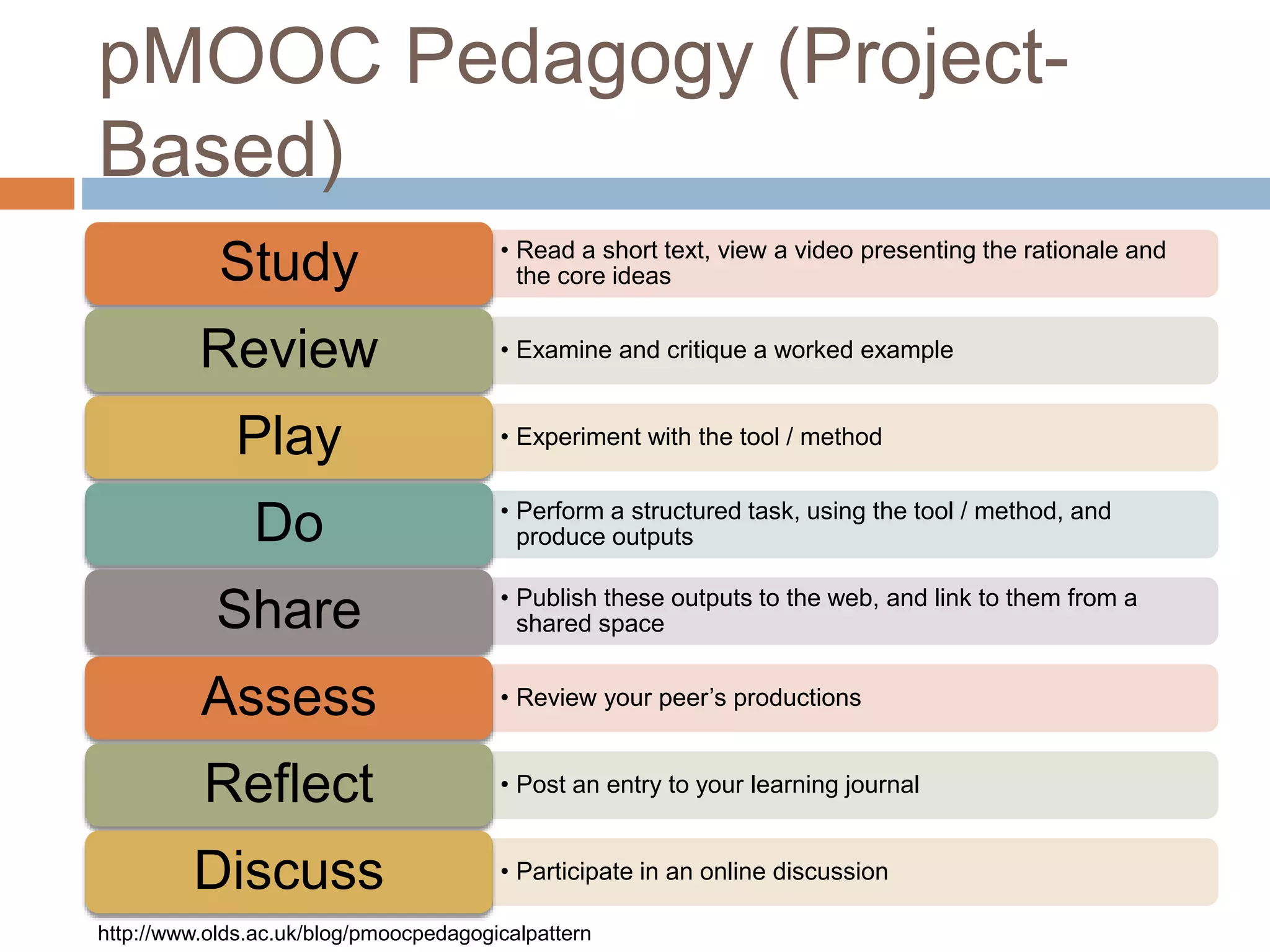
pMOOC Pedagogy (Project-
Based)
• Read a short text, view a video presenting the rationale and
the core ideasStudy
• Examine and critique a worked exampleReview
• Experiment with the tool / methodPlay
• Perform a structured task, using the tool / method, and
produce outputsDo
• Publish these outputs to the web, and link to them from a
shared spaceShare
• Review your peer’s productionsAssess
• Post an entry to your learning journalReflect
• Participate in an online discussionDiscuss
http://www.olds.ac.uk/blog/pmoocpedagogicalpattern
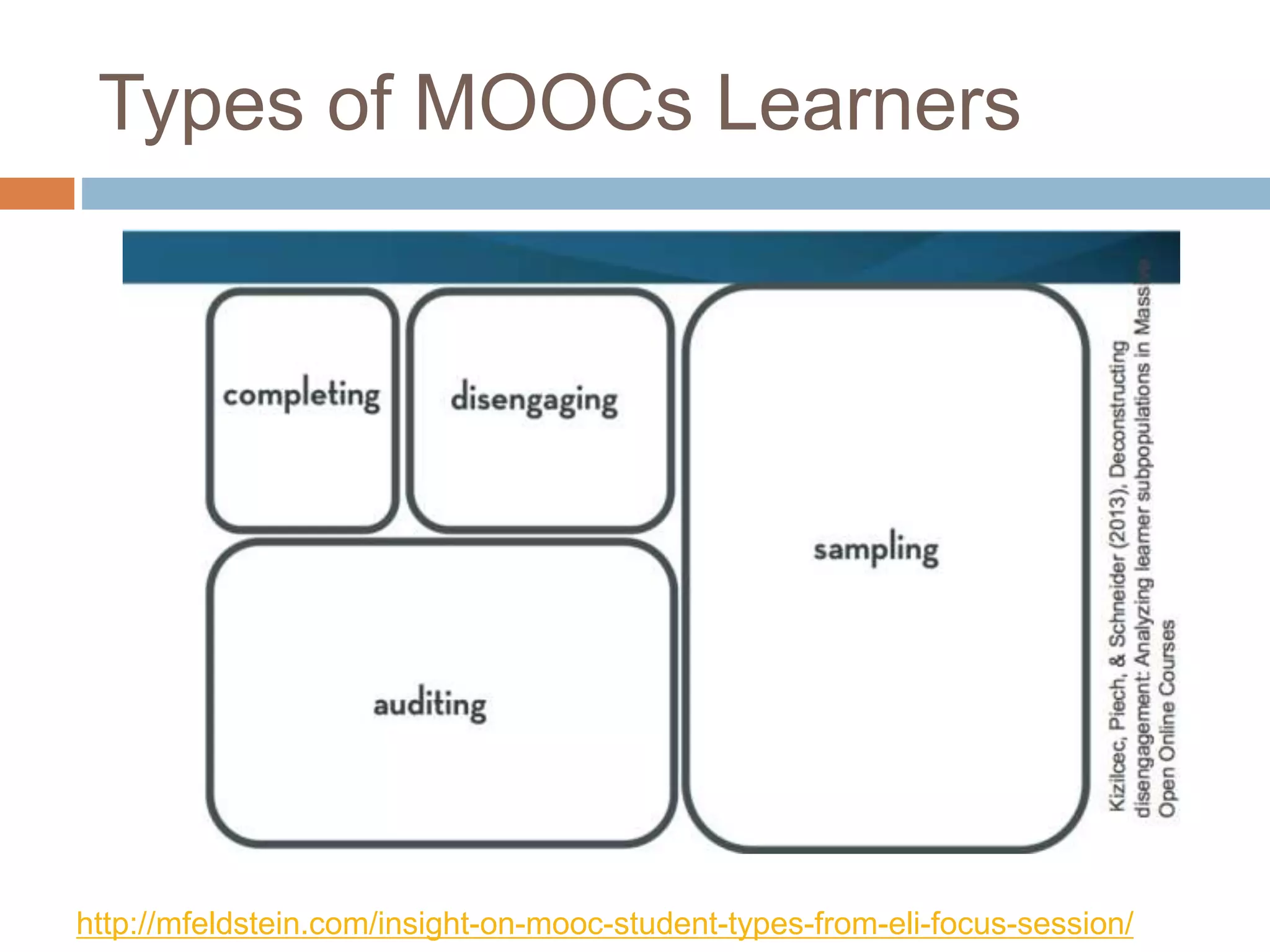
Types of MOOCs Learners
http://mfeldstein.com/insight-on-mooc-student-types-from-eli-focus-session/
Issues in current HEIs
 Globalization & Internationalization
 Students will be reached to 120 million
worldwide by 2020
 Changing learners demographics & increasing
demands for lifelong adults learners
 Increasing numbers of access to personal
technology & social media
 The need for changes in cost, affordability and
economic model for HEI
Reference Yuan, L., & Powell, S. (2012) Moocs and open education: Implications for higher education. Retrieve from
http://publications.cetis.ac.uk/wp-content/uploads/2013/03/MOOCs-and-Open-Education.pdf
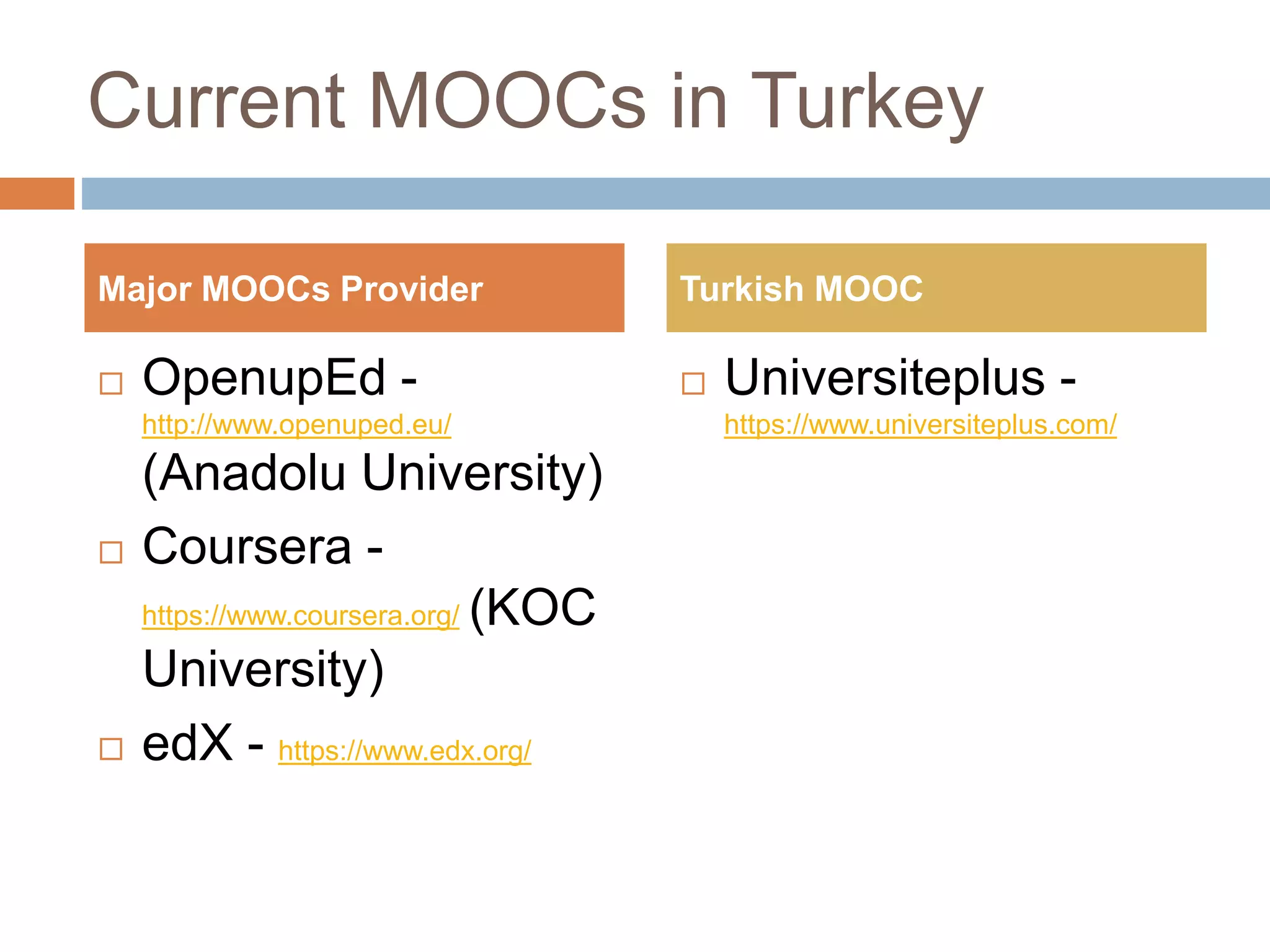
Current MOOCs in Turkey
 OpenupEd -
http://www.openuped.eu/
(Anadolu University)
 Coursera -
https://www.coursera.org/ (KOC
University)
 edX - https://www.edx.org/
 Universiteplus -
https://www.universiteplus.com/
Major MOOCs Provider Turkish MOOC
Q & A
References
 Atkins, D. E., Brown, J. S., & Hammond, A. L. (2007). Review of the open educational resources (OER) movement: Achievements,
challenges, and new opportunities: The William and Flora Hewlett Foundation.
 Butcher, N. (2010). Open educational resources and higher education. Retrieved June 1, 2013, from http://www.nba.co.za/open-
educational-resources-and-higher-education
 Butcher, N. (2011). A basic guide to open educational resources (OER) (A. Kanwar, & Uvalic´-Trumbic´, S. Ed.). Vancouver and Paris:
COL and UNESCO.
 Caswell, T., Henson, S., Jensen, M., & Wiley, D. (2008). Open educational resources: Enabling universal education. The International
Review of Research in Open and Distance Learning, 9(1).
 D'Antoni, S. (2009). Open Educational Resources: reviewing initiatives and issues. Open Learning: The Journal of Open and Distance
Learning, 24(1), 3-10. doi: 10.1080/02680510802625443
 Nasongkhla, J., Thammetar, T., Chen, S-H., & Photipussa, P. (2015, in press). Thailand OERs and MOOCs Country Report. Knou
Press.
 OECD. (2007). Giving knowledge for free: The emergence of open educational resources: OECD Publishing.
 UNESCO. (2002). Forum on the impact of open courseware for higher education in developing countries. from
http://unesdoc.unesco.org/images/0012/001285/128515e.pdf
 UNESCO. (2012a). 2012 Paris OER Declaration. from http://www.unesco.org/new/fileadmin/MULTIMEDIA/HQ/CI/CI/pdf/Events/Paris
OER Declaration_01.pdf
 Wiley, D. (2009). Impediments to learning object reuse and openness as a potential solution. Revista Brasileira de Informática na
Educação, 17(3).
 Wiley, D. (2010a). The open future: Openness as catalyst for an educational reformation. Educase Review, 15-20.
 Wiley, D. (2010b). Openness as catalyst for an educational reformation. EDUCUASE, 45(4), 14-20.
 Wiley, D. (2014a). The access compromise and the 5th R. from http://opencontent.org/blog/archives/3221
 Wiley, D. (2014b). Defining the open in open content. from http://opencontent.org/definition/
 Wiley, D., Bliss, T. J., & McEwen, M. (2014). Open educational resources: A review of the literature. In J. M. Spector (Ed.), Handbook of
Research on Educational Communications and Technology. New York: Springer.
Thank you for Listening
Questions ? Comments?
ava1019@gmail.com avachen.org

Trends and issues in open educational resources and massive open online courses

  • 1.
    Trends and Issuesin Open Educational Resources (OER) & Massive Open Online Courses (MOOCs) Seminar Discussion in College of Education, Ege University August 25th 2015 Presented by Ava (Shu-Hsiang) Chen, Ph.D. avachen.org This work is licensed under a Creative Commons Attribution 4.0 International License
  • 2.
    Open Educational Resources ImageSource http://vle.du.ac.in/file.php/1/home_page/wordle1.jpg
  • 3.
    History of OER 1994 LearningObject (Wayne Hodgins) 1998 Open Content (David Wiley) 2001 Creative Commons (Larry Lessing) 2001 MIT OpenCourseWare Initiative 2002 OER (UNESCO) Reference: Wiley, D. (2006). The current state of open educational resources. Paper for Expert Meeting on Open Educational Resources. Malmo: OECD-CERI. From http://www.oecd.org/edu/ceri/36224377.pdf Source:http://www.unesco. org/webworld/download/oe r/EN/oer_logo_EN_1_RGB .jpg Sourcehttp://www.oerasi a.org/
  • 4.
    Concept Map ofOER  OER = Content Infrastructure  Platform for Education Innovation (Wiley, 2009) Image Source http://edtechdigest.wordpress.com/2012/09/13/trends-innovation-in-education/
  • 5.
    Openness in HigherEducation  Plays an important role in driving educational innovation & transforming HEI  Is the fundamental value & critical attribute HEI  Offers opportunities for sharing ideas, collaborating between institutions, educators, and learners locally & internationally (Wiley, et al., 2009).
  • 6.
    Result of Openness Open Source  Open Educational Resources (OER)  Open Courses  Open Research  Open Data  Open APIs  Open Access Publishing  Open Education (Cape Town Open Education Declaration, 2008) Reference: Weller, M. (2012). The openness-creativity cycle in education – A perspective. Retrieve from http://jime.open.ac.uk/article/2012-
  • 7.
    Open / Opennessin OER 4 Freedoms to copy, to modify, to distribute, to redistribute modified versions (Foote, 2005). Convenient, effective, affordable, sustainable, available (Walker, 2005). 4As Accessible, Appropriate, Accredited, Affordable (Daniel, 2006). 5Rs Retain, Reuse, Redistribute, Revise, Remix (Wiley, et al., 2010, 2014).
  • 8.
    Definitions of OER OERis teaching, learning, and research resources that reside in the public domain or have been released under an intellectual property license (such as Creative Commons) that permits their free use or re-purposing by others (Atkins, Brown, & Hammond, 2007, p. 4) Is the simple and powerful idea that the world’s knowledge is a public good and that technology in general and the World Wide Web in particular provide an extraordinary opportunity for everyone to share, use, and reuse knowledge (D’Anton, 2012) Source:
  • 9.
    Redefined of OER OERs are any type of educational resources in either print or digital format that reside in the public domain and have released under an intellectual property license or open license such as Creative Commons that permits users with 5Rs openness framework: Retain, Reuse, Revise, Remix, Redistribute (Wiley, 2015) to support knowledge building, sharing, and learning to the worldwide community.
  • 10.
    What consider tobe OER?  Course materials, websites, textbooks, audio materials, podcast, video, multimedia applications, visual materials, archived discussions, simulations, or animations, maps, ancient or historical manuscripts, software, and any other tools or technique used to allow access to knowledge.
  • 11.
    OER Attribute Map Tools:Open source software for development and delivery of resources Content Management Systems (CMS) Social Software: Wikis, H20, OSLO research Development Tools: Connexions Learning Management Systems: Moodle, Sakai Content: Materials published for learning or reference Learning Resources • Courseware: MIT OCW, Paris Tech, Japan OCW • Consortium Learning Objects: MERLOT, Connexions, ARIADNE Reference Collection: Internet archive, Google Scholar, Library of Congress, Wikis. MOOC Implementation Resources Licensing Tools: Creative Commons, GNU Free Documentation License Interoperability: IMS, SCORM, OKI Best Practices: CMU design principles (Margulies , 2005, as cited in OECD 2007, p.
  • 12.
  • 13.
    OER World Map- Open CourseWare Consortium Members Image Source http://oerworldmap.oerknowledgecloud.org/
  • 14.
    Current Status ofOER  Over 150 universities in China participate in China Open Resources  11 universities in France have formed the ParisTech OCT project  7 universities in Japan have formed the Japanese OCW  7 universities in U.S. with OER projects, and offer over 1400 courses (Wiley, 2006) Sourcehttps://www.fac ebook.com/COL4D
  • 15.
    Benefits of OER Freedom of access.  Freedom from proprietary systems and corporations.  Save time and effort for content development.  Co-creation empowers more collaboration and creativity.  Sharing development costs among institutions.  Contributes to the local and global community.  Accessibility of resources previously unavailable to specific groups of people.  Lowers costs to students. Reference: Zaid Ali Alsagoff (2013). Embracing OER & MOOCs to Transforming Education? & SteveYuen.Org
  • 16.
    Challenges of OER Quality varies.  Varying degrees of time commitment.  Teachers sometimes not rewarded by the system for their efforts.  May not meet accessibility requirements for persons with disabilities.  May need a high degree of customization (or localization).  Technical requirements vary and some require you to use a particular software.  Requires varying degrees of continual financial support.  Licensing and obtaining copyright clearance can be difficult.  Some institutions may be concerned about “giving itReference: Zaid Ali Alsagoff (2013). Embracing OER & MOOCs to Transforming Education? & SteveYuen.Org
  • 17.
    Open License –Creative Commons  Share knowledge & creativity with the world (CC)  Use copyright to enforce sharing (Wiley, 2009) Image Source http://wisesearch.weebly.com/uploads/1/1/3/6/11361394/1762233_orig.gif
  • 18.
    Current Research AreaAssociated with OER Concept Relevant Managerial Pedagogical System Contextualization Ethical Policy & Strategy
  • 19.
    MOOC (Massive OpenOnline Course) Image Source http://upload.wikimedia.org/wikipedia/commons/c/cb/MOOC_poster_mathplourde.jpg
  • 20.
  • 21.
  • 22.
  • 23.
    Mooc World Map Image source from http://edutechnica.com/moocmap/#
  • 24.
  • 25.
    Current Issues ofMOOCs  All of these MOOC platforms appear to justify their status by promoting curricula that are equivalent to campus-based courses, with a strong focus on content delivery (Online Newsletter, 2012).  Acceptance of open academic practice and difficulty in establishing an academic identity in an unpredictable virtual environment (Mackness, Waite, Roberts, & Lovegrove, 2013).  Most MOOC discourse reflects strategic, institutional, economical, social and technological concerns. A deep pedagogical debate is still missing (Guardia, Maina, Sangra, 2013).
  • 26.
    Issues of MOOCfrom Management Perspective Accreditation Administration Regulation Dropout Privacy Piracy Proficiency / Evaluation Intellectual Property Quality Assurance
  • 27.
    Issues of MOOCfrom Pedagogical Perspective Core of Learning Design Demanding Innovative and Appropriate Approaches to Teaching & Learning Learning Across Distributed Platforms Social Construction of Knowledge Open Academic Practice & Building an Identity Embracing Uncertainty
  • 28.
    cMOOCs & xMOOCs Comparison MOOCsCharacteristics Major Platforms cMOOCs Focus on connection and build up the community. Based on connectivist design principles include: aggregation, remixing, re- purposing, and feeding forward. Relied on posted resource, learning management system, and social networking site. xMOOCs Focus on content, standardize assessment Nothing different than a traditional online course Coursera, edX, Udacity, Udemy, P2PU, Openedup
  • 29.
    MOOCs Pedagogy • ConnectivistPedagogy • Social LearningcMOOC • Video lectures • Mastery Learning • Self-paced Learning xMOOC • Study, Review, Play, Do, Share, Assess, Reflect, DiscusspMOOC
  • 30.
    xMOOCs Pedagogy xMOOCs PlatformPedagogy Coursera Video Lectures, Mastery Learning, Peer Assessment Interaction – Video frequently stops, answer simple questions Social learning happen in the form of discussion forums edX Video Lectures, quizzes, and assignment Focus on open source MOOC platform, not pedagogy Udacity Video lecture, self-study, quizzes, assignment Social learning happen in discussion forum and wiki Udemy Video lecture, self-paced study OpenupEd Openness to learners, digital openness, learner- centred approach, independent learning, media- supported interaction, recognition options.
  • 31.
    pMOOC Pedagogy (Project- Based) •Read a short text, view a video presenting the rationale and the core ideasStudy • Examine and critique a worked exampleReview • Experiment with the tool / methodPlay • Perform a structured task, using the tool / method, and produce outputsDo • Publish these outputs to the web, and link to them from a shared spaceShare • Review your peer’s productionsAssess • Post an entry to your learning journalReflect • Participate in an online discussionDiscuss http://www.olds.ac.uk/blog/pmoocpedagogicalpattern
  • 32.
    Types of MOOCsLearners http://mfeldstein.com/insight-on-mooc-student-types-from-eli-focus-session/
  • 33.
    Issues in currentHEIs  Globalization & Internationalization  Students will be reached to 120 million worldwide by 2020  Changing learners demographics & increasing demands for lifelong adults learners  Increasing numbers of access to personal technology & social media  The need for changes in cost, affordability and economic model for HEI Reference Yuan, L., & Powell, S. (2012) Moocs and open education: Implications for higher education. Retrieve from http://publications.cetis.ac.uk/wp-content/uploads/2013/03/MOOCs-and-Open-Education.pdf
  • 34.
    Current MOOCs inTurkey  OpenupEd - http://www.openuped.eu/ (Anadolu University)  Coursera - https://www.coursera.org/ (KOC University)  edX - https://www.edx.org/  Universiteplus - https://www.universiteplus.com/ Major MOOCs Provider Turkish MOOC
  • 35.
  • 36.
    References  Atkins, D.E., Brown, J. S., & Hammond, A. L. (2007). Review of the open educational resources (OER) movement: Achievements, challenges, and new opportunities: The William and Flora Hewlett Foundation.  Butcher, N. (2010). Open educational resources and higher education. Retrieved June 1, 2013, from http://www.nba.co.za/open- educational-resources-and-higher-education  Butcher, N. (2011). A basic guide to open educational resources (OER) (A. Kanwar, & Uvalic´-Trumbic´, S. Ed.). Vancouver and Paris: COL and UNESCO.  Caswell, T., Henson, S., Jensen, M., & Wiley, D. (2008). Open educational resources: Enabling universal education. The International Review of Research in Open and Distance Learning, 9(1).  D'Antoni, S. (2009). Open Educational Resources: reviewing initiatives and issues. Open Learning: The Journal of Open and Distance Learning, 24(1), 3-10. doi: 10.1080/02680510802625443  Nasongkhla, J., Thammetar, T., Chen, S-H., & Photipussa, P. (2015, in press). Thailand OERs and MOOCs Country Report. Knou Press.  OECD. (2007). Giving knowledge for free: The emergence of open educational resources: OECD Publishing.  UNESCO. (2002). Forum on the impact of open courseware for higher education in developing countries. from http://unesdoc.unesco.org/images/0012/001285/128515e.pdf  UNESCO. (2012a). 2012 Paris OER Declaration. from http://www.unesco.org/new/fileadmin/MULTIMEDIA/HQ/CI/CI/pdf/Events/Paris OER Declaration_01.pdf  Wiley, D. (2009). Impediments to learning object reuse and openness as a potential solution. Revista Brasileira de Informática na Educação, 17(3).  Wiley, D. (2010a). The open future: Openness as catalyst for an educational reformation. Educase Review, 15-20.  Wiley, D. (2010b). Openness as catalyst for an educational reformation. EDUCUASE, 45(4), 14-20.  Wiley, D. (2014a). The access compromise and the 5th R. from http://opencontent.org/blog/archives/3221  Wiley, D. (2014b). Defining the open in open content. from http://opencontent.org/definition/  Wiley, D., Bliss, T. J., & McEwen, M. (2014). Open educational resources: A review of the literature. In J. M. Spector (Ed.), Handbook of Research on Educational Communications and Technology. New York: Springer.
  • 37.
    Thank you forListening Questions ? Comments? ava1019@gmail.com avachen.org

Editor's Notes

  • #3 OER are a global phenomenon representing an innovative approach to promote unrestricted access as a possible for bridging the knowledge divide in HE. OER are perceived as a way to provide strategic opportunities, improve the quality of education, facilitate policy and strategic planning, and share knowledge and build up capacity.
  • #4 Open Object– the idea of open object was quickly adopted by educators due to the digital materials that can be used and reused in a variety of pedagogical situations. Open Content – has influenced the idea of open source and free software Creative Commons – Aimed to increase in credibility and confidence, and provide a flexible set of licenses to the open content community MIT OCW – the first university initiative to publish university course with free publish access for noncommercial use. This is an example of OER commitment at the Institutional level OER – first adopted at UNESCO 2002’s forum
  • #6 Technologies have enable openness in HEI than ever before. The concept of openness plays an important role in driving educational innovation & transforming, and is the fundamental values & critical attribute for HEI. It offers opportunities for sharing ideas, collaborating between institutions, educators, and learners locally and internationally
  • #7 Result of Openness as approach that is relevant to the current education movement includes as follows. Accordingly, there is a clear need for global higher education institutions to consider a new educational paradigm, business model, and innovation in order to meet the challenges of social and economic changes in the longer term and to meet the needs of global market.
  • #8 In order to support the right degree of openness that come alone with OER, the meaning of openness should be considered as follows.
  • #12 OER are materials including learning content, software tools to develop, use, and distribute content, and implementation resources such as open licenses, which used to support education that may be freely accessed, reused, modified, and shared (UNSECO & COL, 2011)
  • #13 This image is not intended to compare OERs with commercial products but was developed to illustrate the value in considering the different roles that exist in the production and use/re-use of OERs and to highlight the importance of considering end users
  • #14 Open CourseWare Consortium Members  White: Markers 1, 2, 3  Yellow: Institution of Higher Education  Red: Organizational Member  Green: Associate Consortia
  • #20 MOOC is defined as “an online course with the option of free and open registration, a publicly-shared curriculum, and open-ended outcomes. MOOCs integrate social networking, accessible online resources and are facilitated by leading practitioners in the field of study.
  • #21 This image provides the emerging landscape of educational delivery models look like, which has categorized the models not just in terms of modality - ranging from face-to-face to fully online—but also in terms of the method of course design. These two dimensions allow a richer understanding of the new landscape of educational delivery models. Within this landscape, the following primary models have emerged:
  • #22 ad hoc online courses and programs, fully online programs, School-as-a-Service, educational partnerships, competency-based education, blended/hybrid courses and the flipped classroom, and MOOCs
  • #23 The image provides the movement of Moocs. The potential of Moocs will be based on further development of techniques. The examples that attempt to tackle the four barriers of revenue, credentials, course-completion rates, and student authentication
  • #34 There is number of implications are facing by HEI. For example, the effects of globalization & internationalization in HEI have affected individuals, but also influence the structures of HEI in terms of thinking, learning, teaching, and working. One of study has projected that students will be reached to 120 million worldwide by 2020. In addition, the implication for HEI includes the changing learners’ demographic and increasing demands for lifelong adults’ learners, increasing numbers of access to personal technology & social media, and the need for changes in cost affordability and economic model have triggered every HEI to make adjustments and to take serious consideration. Globalization  Skill demands & Human life Internationalization  Change & reform Technology Innovation