MOOC PRESENTATION
HUMAIRA CACHALIA
201033707
humaira.cachalia@gmail.com
MOOCS
M- Massive
O- Open
O- Online
C- Courses
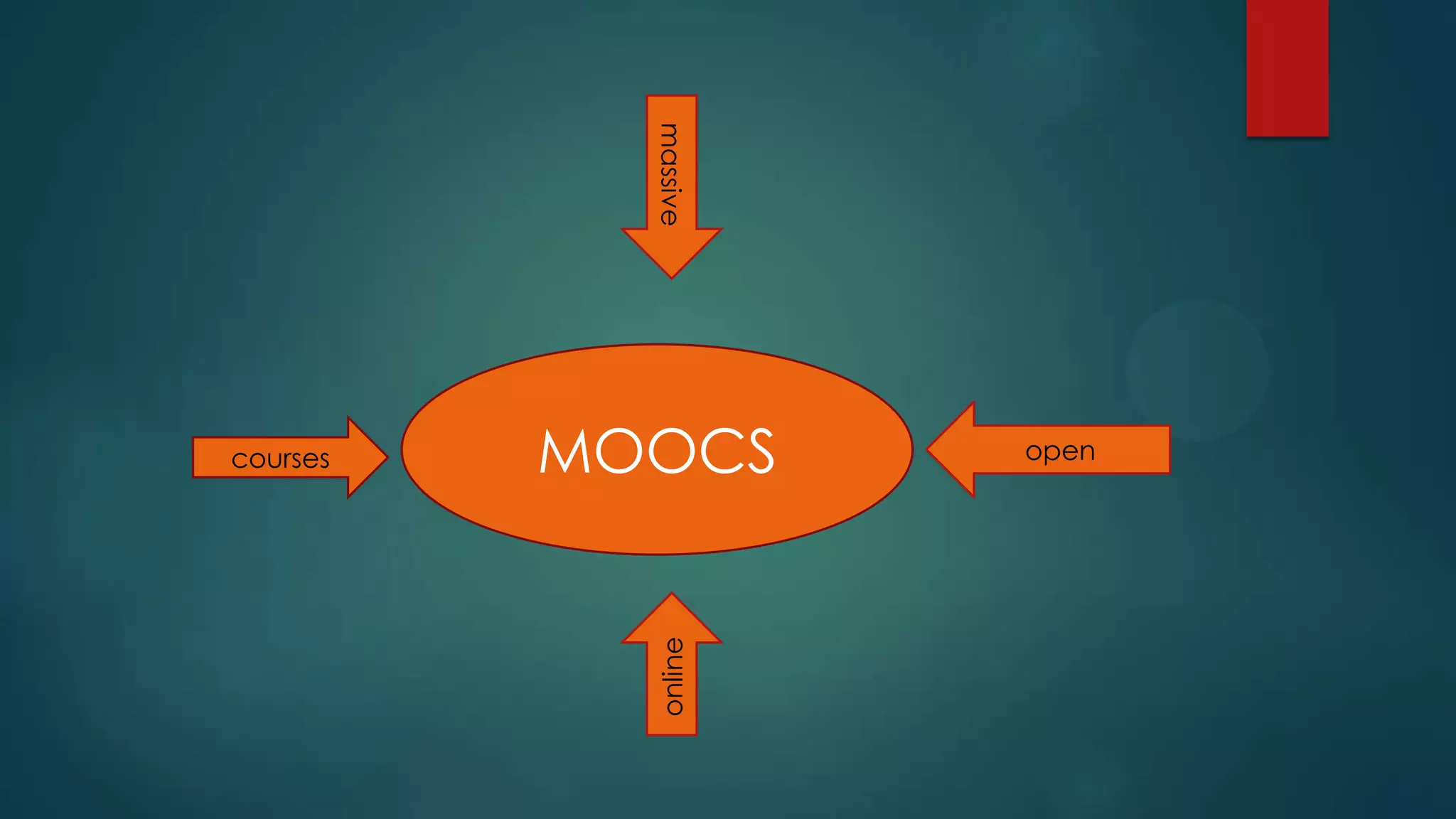
MOOCS
massive
online
opencourses
TABLE OF CONTENT
 What are Moocs?
 History of Moocs
 Aims of Moocs
 Types of Moocs
 Xmoocs vs Cmoocs
 Conclusion
What are Moocs?
 Moocs are online courses which are opened unlimited to
everyone who is willing to learn.
 Moocs are free of charge education.
 Moocs shape what learners can do in and outside the
school.
 Moocs has no age description.
 Moocs are about openness.
 Easier to commit to Moocs.
Short history of Moocs
 Moocs was first introduced in 2008 by Dave Cormier to
describe Siemens and Downes “Connectivism and
Connective Knowledge” course.
 It was designed for group of 25 enrolled fee paying
students to study for credit.
 It was opened up for registered only learners worldwide
 The founders promoted Open Education Movement.
Main aims of Moocs
 Provide free access to university level for as many
students as possible.
 Cutting the edge courses that could drive down the cost
of university level education.
 Encourage universities to put their courses online to set
up open learning.
Different types of Moocs
 Transfer Moocs
 Made Moocs
 Synch Moocs
 Asynch Moocs
 Adaptive Moocs
 Group Moocs
 Connectivist Moocs
 Mini Moocs
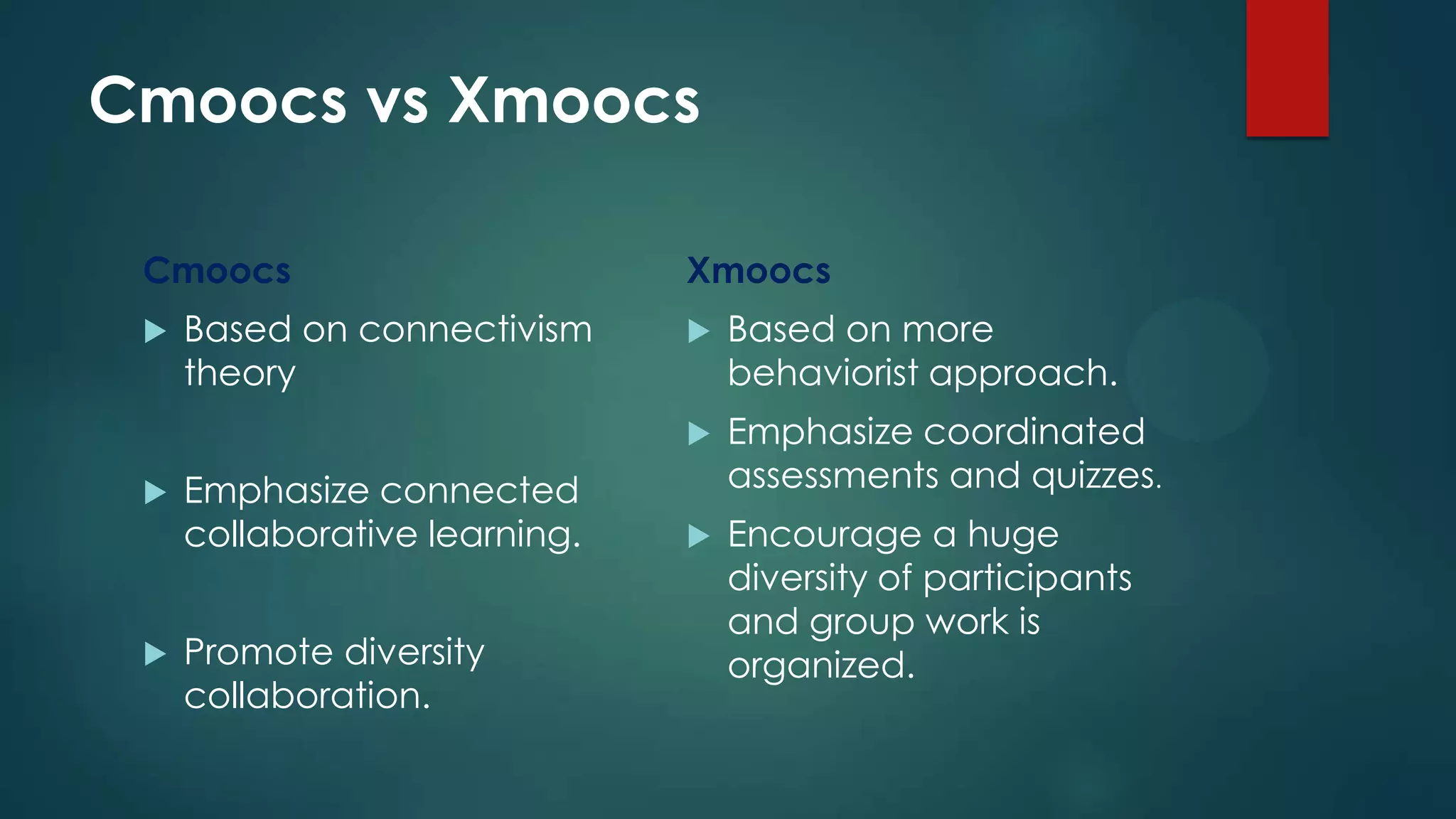
Cmoocs vs Xmoocs
Cmoocs
 Based on connectivism
theory
 Emphasize connected
collaborative learning.
 Promote diversity
collaboration.
Xmoocs
 Based on more
behaviorist approach.
 Emphasize coordinated
assessments and quizzes.
 Encourage a huge
diversity of participants
and group work is
organized.
Fields of interest…
 As a future teacher of ENGLISH my interests it to teach online and I
like to pursue Shakespearean literature. I would like to share this
topic with other teachers and students because it seems that
learners experience problems with these topics and since Moocs
are free I think most leaners will comment and share their opinions
online rather than in class.
 Moocs will help me as a future teacher to approach and support
students who struggling with English literature because I can access
Moocs at anytime at anywhere.
References
 https://www.google.co.za/?gws_rd=cr&ei=jYMEU82LB8SJ7AaBzIA4#
q=moocs&tbm=bks

MOOC INTRODUCTION

  • 1.
  • 2.
  • 3.
  • 4.
    TABLE OF CONTENT What are Moocs?  History of Moocs  Aims of Moocs  Types of Moocs  Xmoocs vs Cmoocs  Conclusion
  • 5.
    What are Moocs? Moocs are online courses which are opened unlimited to everyone who is willing to learn.  Moocs are free of charge education.  Moocs shape what learners can do in and outside the school.  Moocs has no age description.  Moocs are about openness.  Easier to commit to Moocs.
  • 6.
    Short history ofMoocs  Moocs was first introduced in 2008 by Dave Cormier to describe Siemens and Downes “Connectivism and Connective Knowledge” course.  It was designed for group of 25 enrolled fee paying students to study for credit.  It was opened up for registered only learners worldwide  The founders promoted Open Education Movement.
  • 7.
    Main aims ofMoocs  Provide free access to university level for as many students as possible.  Cutting the edge courses that could drive down the cost of university level education.  Encourage universities to put their courses online to set up open learning.
  • 8.
    Different types ofMoocs  Transfer Moocs  Made Moocs  Synch Moocs  Asynch Moocs  Adaptive Moocs  Group Moocs  Connectivist Moocs  Mini Moocs
  • 9.
    Cmoocs vs Xmoocs Cmoocs Based on connectivism theory  Emphasize connected collaborative learning.  Promote diversity collaboration. Xmoocs  Based on more behaviorist approach.  Emphasize coordinated assessments and quizzes.  Encourage a huge diversity of participants and group work is organized.
  • 10.
    Fields of interest… As a future teacher of ENGLISH my interests it to teach online and I like to pursue Shakespearean literature. I would like to share this topic with other teachers and students because it seems that learners experience problems with these topics and since Moocs are free I think most leaners will comment and share their opinions online rather than in class.  Moocs will help me as a future teacher to approach and support students who struggling with English literature because I can access Moocs at anytime at anywhere.
  • 11.