Thulani Maphanga
MOOCS
Presentation
Company Logo
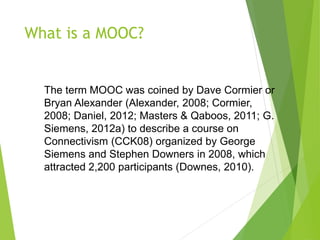
What is a MOOC?
The term MOOC was coined by Dave Cormier or
Bryan Alexander (Alexander, 2008; Cormier,
2008; Daniel, 2012; Masters & Qaboos, 2011; G.
Siemens, 2012a) to describe a course on
Connectivism (CCK08) organized by George
Siemens and Stephen Downers in 2008, which
attracted 2,200 participants (Downes, 2010).
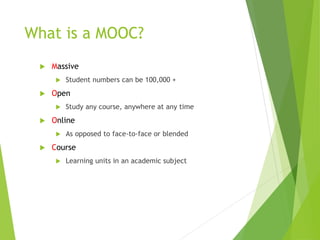
What is a MOOC?
 Massive
 Student numbers can be 100,000 +
 Open
 Study any course, anywhere at any time
 Online
 As opposed to face-to-face or blended
 Course
 Learning units in an academic subject
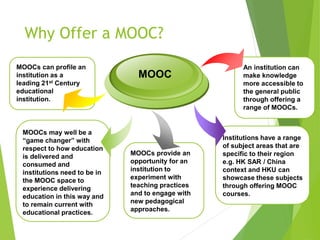
Why Offer a MOOC?
MOOCs can profile an
institution as a
leading 21st Century
educational
institution.
MOOC
MOOCs may well be a
“game changer” with
respect to how education
is delivered and
consumed and
institutions need to be in
the MOOC space to
experience delivering
education in this way and
to remain current with
educational practices.
MOOCs provide an
opportunity for an
institution to
experiment with
teaching practices
and to engage with
new pedagogical
approaches.
Institutions have a range
of subject areas that are
specific to their region
e.g. HK SAR / China
context and HKU can
showcase these subjects
through offering MOOC
courses.
An institution can
make knowledge
more accessible to
the general public
through offering a
range of MOOCs.
MOOCs in Context
 The history of introducing technologies into teaching
and learning has been one of over promise and under
delivery (Daniel, 2012; Reiser, 2001).
 Already seen the failure of two significant online
ventures – Fathom from Columbia University and
ALLLearn backed by Oxford, Stanford, Yale and
Princeton (Knight, 2012).
 Technologies will only be successfully integrated into
teaching and learning when teachers change the way
that they teach (Zemsky & Massy, 2004).
MOOCs in Context
 Although we have seen different teaching models (King,
1993; McWilliam, 2008; George Siemens, 2005), wholesale
changes in teaching approaches have not come about and,
as we shall see, they are not occurring to any particular
degree with MOOCs.
 We need to move beyond the use of technologies for the
purposes of information transmission.
 There has been progress in this area but too often we still
see the Learning Management System – the enterprise tool
of choice – used poorly for teaching and learning (Beer,
Jones, & Clark, 2009; Browne, Jenkins, & Walker, 2006;
Malikowski, 2011).
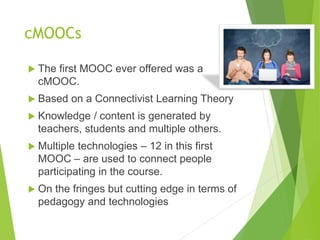
cMOOCs
 The first MOOC ever offered was a
cMOOC.
 Based on a Connectivist Learning Theory
 Knowledge / content is generated by
teachers, students and multiple others.
 Multiple technologies – 12 in this first
MOOC – are used to connect people
participating in the course.
 On the fringes but cutting edge in terms of
pedagogy and technologies
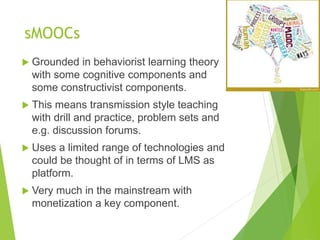
sMOOCs
 Grounded in behaviorist learning theory
with some cognitive components and
some constructivist components.
 This means transmission style teaching
with drill and practice, problem sets and
e.g. discussion forums.
 Uses a limited range of technologies and
could be thought of in terms of LMS as
platform.
 Very much in the mainstream with
monetization a key component.
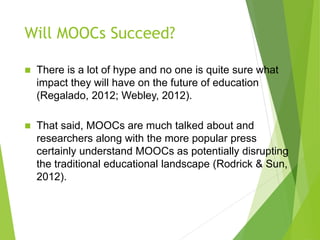
Will MOOCs Succeed?
 There is a lot of hype and no one is quite sure what
impact they will have on the future of education
(Regalado, 2012; Webley, 2012).
 That said, MOOCs are much talked about and
researchers along with the more popular press
certainly understand MOOCs as potentially disrupting
the traditional educational landscape (Rodrick & Sun,
2012).
Find ways
to satisfy
employers
Learning
and identity
issues
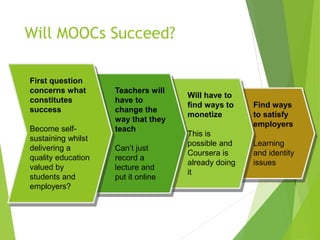
Will MOOCs Succeed?
Will have to
find ways to
monetize
This is
possible and
Coursera is
already doing
it
Teachers will
have to
change the
way that they
teach
Can’t just
record a
lecture and
put it online
First question
concerns what
constitutes
success
Become self-
sustaining whilst
delivering a
quality education
valued by
students and
employers?
References
 Alexander, B. (2008). Connectivism Course Draws Night,
or Behold the MOOC. Infocult: Uncanny Informatics.
Retrieved April 4, 2013, from
http://infocult.typepad.com/infocult/2008/07/connectivism-
course-draws-night-or-behold-the-mooc.html
 Armstrong, L. (2012). Coursera and MITx - Sustaining or
Disruptive. Changing Higher Education. Retrieved April 11,
2013, from
http://www.changinghighereducation.com/2012/08/
coursera-.html

MOOC presentation

  • 1.
  • 2.
    What is aMOOC? The term MOOC was coined by Dave Cormier or Bryan Alexander (Alexander, 2008; Cormier, 2008; Daniel, 2012; Masters & Qaboos, 2011; G. Siemens, 2012a) to describe a course on Connectivism (CCK08) organized by George Siemens and Stephen Downers in 2008, which attracted 2,200 participants (Downes, 2010).
  • 3.
    What is aMOOC?  Massive  Student numbers can be 100,000 +  Open  Study any course, anywhere at any time  Online  As opposed to face-to-face or blended  Course  Learning units in an academic subject
  • 4.
    Why Offer aMOOC? MOOCs can profile an institution as a leading 21st Century educational institution. MOOC MOOCs may well be a “game changer” with respect to how education is delivered and consumed and institutions need to be in the MOOC space to experience delivering education in this way and to remain current with educational practices. MOOCs provide an opportunity for an institution to experiment with teaching practices and to engage with new pedagogical approaches. Institutions have a range of subject areas that are specific to their region e.g. HK SAR / China context and HKU can showcase these subjects through offering MOOC courses. An institution can make knowledge more accessible to the general public through offering a range of MOOCs.
  • 5.
    MOOCs in Context The history of introducing technologies into teaching and learning has been one of over promise and under delivery (Daniel, 2012; Reiser, 2001).  Already seen the failure of two significant online ventures – Fathom from Columbia University and ALLLearn backed by Oxford, Stanford, Yale and Princeton (Knight, 2012).  Technologies will only be successfully integrated into teaching and learning when teachers change the way that they teach (Zemsky & Massy, 2004).
  • 6.
    MOOCs in Context Although we have seen different teaching models (King, 1993; McWilliam, 2008; George Siemens, 2005), wholesale changes in teaching approaches have not come about and, as we shall see, they are not occurring to any particular degree with MOOCs.  We need to move beyond the use of technologies for the purposes of information transmission.  There has been progress in this area but too often we still see the Learning Management System – the enterprise tool of choice – used poorly for teaching and learning (Beer, Jones, & Clark, 2009; Browne, Jenkins, & Walker, 2006; Malikowski, 2011).
  • 7.
    cMOOCs  The firstMOOC ever offered was a cMOOC.  Based on a Connectivist Learning Theory  Knowledge / content is generated by teachers, students and multiple others.  Multiple technologies – 12 in this first MOOC – are used to connect people participating in the course.  On the fringes but cutting edge in terms of pedagogy and technologies
  • 8.
    sMOOCs  Grounded inbehaviorist learning theory with some cognitive components and some constructivist components.  This means transmission style teaching with drill and practice, problem sets and e.g. discussion forums.  Uses a limited range of technologies and could be thought of in terms of LMS as platform.  Very much in the mainstream with monetization a key component.
  • 9.
    Will MOOCs Succeed? There is a lot of hype and no one is quite sure what impact they will have on the future of education (Regalado, 2012; Webley, 2012).  That said, MOOCs are much talked about and researchers along with the more popular press certainly understand MOOCs as potentially disrupting the traditional educational landscape (Rodrick & Sun, 2012).
  • 10.
    Find ways to satisfy employers Learning andidentity issues Will MOOCs Succeed? Will have to find ways to monetize This is possible and Coursera is already doing it Teachers will have to change the way that they teach Can’t just record a lecture and put it online First question concerns what constitutes success Become self- sustaining whilst delivering a quality education valued by students and employers?
  • 11.
    References  Alexander, B.(2008). Connectivism Course Draws Night, or Behold the MOOC. Infocult: Uncanny Informatics. Retrieved April 4, 2013, from http://infocult.typepad.com/infocult/2008/07/connectivism- course-draws-night-or-behold-the-mooc.html  Armstrong, L. (2012). Coursera and MITx - Sustaining or Disruptive. Changing Higher Education. Retrieved April 11, 2013, from http://www.changinghighereducation.com/2012/08/ coursera-.html