JANESH SANZGIRI (THE OPEN UNIVERSITY, UK) @JANESHSANZGIRI
SUPERVISORS: PROF. MARTIN WELLER, DR. LEIGH-ANNE PERRYMAN, DR. ROBERT
FARROW
A Comparative Study Of Indian Learners In
Massive Open Online Courses(MOOCS)
PRESENTATION OUTLINE
• MOOCs as Open Education
• The Indian Context – MOOCs in India
• Research Questions
• Research Design
• Survey Findings
• Emerging themes from Interviews
• The PhD process so far
MOOCS AS OPEN EDUCATION
• The original conception of MOOCs vs Commercial MOOC providers
• The original promises of Commercial MOOC providers
• The constant moves away from Openness
• Research into MOOCs - Openness forgotten?
THE INDIAN CONTEXT – MOOCS IN INDIA
• Significant enrolments from Indians on the three major US MOOC platforms
(Coursera, edX, Udacity)
• Between 10-15% of all total enrolments (Bhattacharyya 2013)
• Largest cohort of learners outside of the US
THE NEED FOR RESEARCH
• Research into non-Western MOOC users currently lacking
• According to Veletsianos and Sheperdson (2016), only 8% of empirical MOOC
research came out of Asia – 5.4% from China, and less than 1% from India.
• There is an increasing use of learning analytics and log-data to try and make sense of
learning in MOOCs
• There is a need for more studies into the learner experience, and the learner voice,
to try and make sense of some of the findings from the quantitative study.
• Most importantly, there is a need to explore the ways in which MOOCs are currently
being used my learners in the developing world.
RESEARCH QUESTION
• What are the demographics, motivations and experiences of Indian learners in
Massive Open Online Courses?
• What, if any, are the differences in the demographics, motivations and experiences of
Indian learners between global and local MOOC platforms?
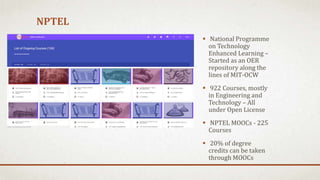
NPTEL
 National Programme
on Technology
Enhanced Learning –
Started as an OER
repository along the
lines of MIT-OCW
 922 Courses, mostly
in Engineering and
Technology – All
under Open License
 NPTEL MOOCs - 225
Courses
 20% of degree
credits can be taken
through MOOCs
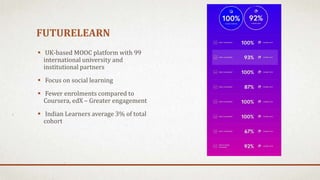
FUTURELEARN
 UK-based MOOC platform with 99
international university and
institutional partners
 Focus on social learning
 Fewer enrolments compared to
Coursera, edX – Greater engagement
 Indian Learners average 3% of total
cohort
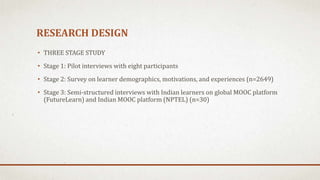
RESEARCH DESIGN
• THREE STAGE STUDY
• Stage 1: Pilot interviews with eight participants
• Stage 2: Survey on learner demographics, motivations, and experiences (n=2649)
• Stage 3: Semi-structured interviews with Indian learners on global MOOC platform
(FutureLearn) and Indian MOOC platform (NPTEL) (n=30)
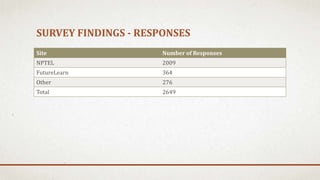
SURVEY FINDINGS - RESPONSES
Site Number of Responses
NPTEL 2009
FutureLearn 364
Other 276
Total 2649
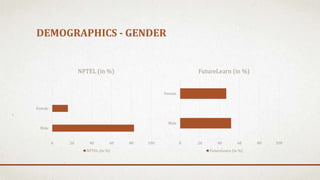
DEMOGRAPHICS - GENDER
0 20 40 60 80 100
Male
Female
NPTEL (in %)
NPTEL (in %)
0 20 40 60 80 100
Male
Female
FutureLearn (in %)
FutureLearn (in %)
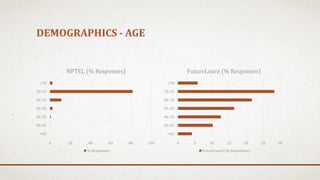
DEMOGRAPHICS - AGE
0 20 40 60 80 100
>65
56-65
46-55
36-45
26-35
18-25
<18
NPTEL (% Responses)
% Responses
0 5 10 15 20 25 30
>65
56-65
46-55
36-45
26-35
18-25
<18
FutureLearn (% Responses)
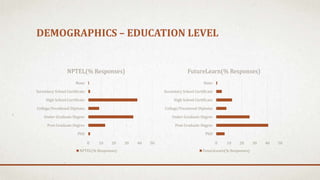
DEMOGRAPHICS – EDUCATION LEVEL
0 10 20 30 40 50
PhD
Post-Graduate Degree
Under-Graduate Degree
College/Vocational Diploma
High School Certificate
Secondary School Certificate
None
NPTEL(% Responses)
NPTEL(% Responses)
0 10 20 30 40 50
PhD
Post-Graduate Degree
Under-Graduate Degree
College/Vocational Diploma
High School Certificate
Secondary School Certificate
None
FutureLearn(% Responses)
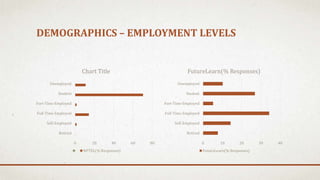
DEMOGRAPHICS – EMPLOYMENT LEVELS
0 20 40 60 80
Retired
Self-Employed
Full-Time Employed
Part-Time Employed
Student
Unemployed
Chart Title
NPTEL(% Responses)
0 10 20 30 40
Retired
Self-Employed
Full-Time Employed
Part-Time Employed
Student
Unemployed
FutureLearn(% Responses)
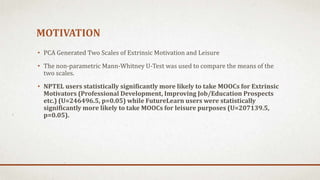
MOTIVATION
• PCA Generated Two Scales of Extrinsic Motivation and Leisure
• The non-parametric Mann-Whitney U-Test was used to compare the means of the
two scales.
• NPTEL users statistically significantly more likely to take MOOCs for Extrinsic
Motivators (Professional Development, Improving Job/Education Prospects
etc.) (U=246496.5, p=0.05) while FutureLearn users were statistically
significantly more likely to take MOOCs for leisure purposes (U=207139.5,
p=0.05).
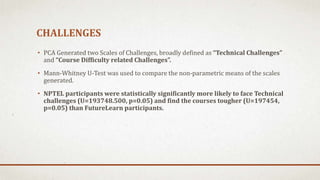
CHALLENGES
• PCA Generated two Scales of Challenges, broadly defined as “Technical Challenges”
and “Course Difficulty related Challenges”.
• Mann-Whitney U-Test was used to compare the non-parametric means of the scales
generated.
• NPTEL participants were statistically significantly more likely to face Technical
challenges (U=193748.500, p=0.05) and find the courses tougher (U=197454,
p=0.05) than FutureLearn participants.
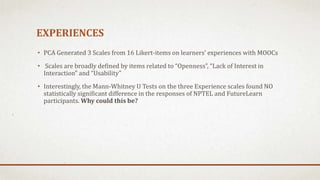
EXPERIENCES
• PCA Generated 3 Scales from 16 Likert-items on learners’ experiences with MOOCs
• Scales are broadly defined by items related to “Openness”, “Lack of Interest in
Interaction” and “Usability”
• Interestingly, the Mann-Whitney U Tests on the three Experience scales found NO
statistically significant difference in the responses of NPTEL and FutureLearn
participants. Why could this be?
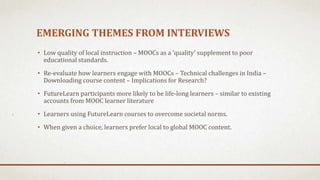
EMERGING THEMES FROM INTERVIEWS
• Low quality of local instruction – MOOCs as a ‘quality’ supplement to poor
educational standards.
• Re-evaluate how learners engage with MOOCs – Technical challenges in India –
Downloading course content – Implications for Research?
• FutureLearn participants more likely to be life-long learners – similar to existing
accounts from MOOC learner literature
• Learners using FutureLearn courses to overcome societal norms.
• When given a choice, learners prefer local to global MOOC content.
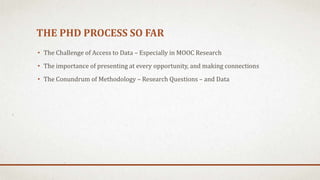
THE PHD PROCESS SO FAR
• The Challenge of Access to Data – Especially in MOOC Research
• The importance of presenting at every opportunity, and making connections
• The Conundrum of Methodology – Research Questions – and Data
THANK YOU!
A Comparative of Indian Learners in Massive Open Online Courses
Janesh Sanzgiri
Supervisors: Professor Martin Weller, Dr. Robert Farrow, Dr. Leigh-Anne Perryman
Contact: janesh.sanzgiri@open.ac.uk
Twitter: @janeshsanzgiri

A Study on Indian Learners in MOOCs - GO-GN Presentation

  • 1.
    JANESH SANZGIRI (THEOPEN UNIVERSITY, UK) @JANESHSANZGIRI SUPERVISORS: PROF. MARTIN WELLER, DR. LEIGH-ANNE PERRYMAN, DR. ROBERT FARROW A Comparative Study Of Indian Learners In Massive Open Online Courses(MOOCS)
  • 2.
    PRESENTATION OUTLINE • MOOCsas Open Education • The Indian Context – MOOCs in India • Research Questions • Research Design • Survey Findings • Emerging themes from Interviews • The PhD process so far
  • 3.
    MOOCS AS OPENEDUCATION • The original conception of MOOCs vs Commercial MOOC providers • The original promises of Commercial MOOC providers • The constant moves away from Openness • Research into MOOCs - Openness forgotten?
  • 4.
    THE INDIAN CONTEXT– MOOCS IN INDIA • Significant enrolments from Indians on the three major US MOOC platforms (Coursera, edX, Udacity) • Between 10-15% of all total enrolments (Bhattacharyya 2013) • Largest cohort of learners outside of the US
  • 5.
    THE NEED FORRESEARCH • Research into non-Western MOOC users currently lacking • According to Veletsianos and Sheperdson (2016), only 8% of empirical MOOC research came out of Asia – 5.4% from China, and less than 1% from India. • There is an increasing use of learning analytics and log-data to try and make sense of learning in MOOCs • There is a need for more studies into the learner experience, and the learner voice, to try and make sense of some of the findings from the quantitative study. • Most importantly, there is a need to explore the ways in which MOOCs are currently being used my learners in the developing world.
  • 6.
    RESEARCH QUESTION • Whatare the demographics, motivations and experiences of Indian learners in Massive Open Online Courses? • What, if any, are the differences in the demographics, motivations and experiences of Indian learners between global and local MOOC platforms?
  • 7.
    NPTEL  National Programme onTechnology Enhanced Learning – Started as an OER repository along the lines of MIT-OCW  922 Courses, mostly in Engineering and Technology – All under Open License  NPTEL MOOCs - 225 Courses  20% of degree credits can be taken through MOOCs
  • 8.
    FUTURELEARN  UK-based MOOCplatform with 99 international university and institutional partners  Focus on social learning  Fewer enrolments compared to Coursera, edX – Greater engagement  Indian Learners average 3% of total cohort
  • 9.
    RESEARCH DESIGN • THREESTAGE STUDY • Stage 1: Pilot interviews with eight participants • Stage 2: Survey on learner demographics, motivations, and experiences (n=2649) • Stage 3: Semi-structured interviews with Indian learners on global MOOC platform (FutureLearn) and Indian MOOC platform (NPTEL) (n=30)
  • 10.
    SURVEY FINDINGS -RESPONSES Site Number of Responses NPTEL 2009 FutureLearn 364 Other 276 Total 2649
  • 11.
    DEMOGRAPHICS - GENDER 020 40 60 80 100 Male Female NPTEL (in %) NPTEL (in %) 0 20 40 60 80 100 Male Female FutureLearn (in %) FutureLearn (in %)
  • 12.
    DEMOGRAPHICS - AGE 020 40 60 80 100 >65 56-65 46-55 36-45 26-35 18-25 <18 NPTEL (% Responses) % Responses 0 5 10 15 20 25 30 >65 56-65 46-55 36-45 26-35 18-25 <18 FutureLearn (% Responses) FutureLearn (% Responses)
  • 13.
    DEMOGRAPHICS – EDUCATIONLEVEL 0 10 20 30 40 50 PhD Post-Graduate Degree Under-Graduate Degree College/Vocational Diploma High School Certificate Secondary School Certificate None NPTEL(% Responses) NPTEL(% Responses) 0 10 20 30 40 50 PhD Post-Graduate Degree Under-Graduate Degree College/Vocational Diploma High School Certificate Secondary School Certificate None FutureLearn(% Responses) FutureLearn(% Responses)
  • 14.
    DEMOGRAPHICS – EMPLOYMENTLEVELS 0 20 40 60 80 Retired Self-Employed Full-Time Employed Part-Time Employed Student Unemployed Chart Title NPTEL(% Responses) 0 10 20 30 40 Retired Self-Employed Full-Time Employed Part-Time Employed Student Unemployed FutureLearn(% Responses) FutureLearn(% Responses)
  • 15.
    MOTIVATION • PCA GeneratedTwo Scales of Extrinsic Motivation and Leisure • The non-parametric Mann-Whitney U-Test was used to compare the means of the two scales. • NPTEL users statistically significantly more likely to take MOOCs for Extrinsic Motivators (Professional Development, Improving Job/Education Prospects etc.) (U=246496.5, p=0.05) while FutureLearn users were statistically significantly more likely to take MOOCs for leisure purposes (U=207139.5, p=0.05).
  • 16.
    CHALLENGES • PCA Generatedtwo Scales of Challenges, broadly defined as “Technical Challenges” and “Course Difficulty related Challenges”. • Mann-Whitney U-Test was used to compare the non-parametric means of the scales generated. • NPTEL participants were statistically significantly more likely to face Technical challenges (U=193748.500, p=0.05) and find the courses tougher (U=197454, p=0.05) than FutureLearn participants.
  • 17.
    EXPERIENCES • PCA Generated3 Scales from 16 Likert-items on learners’ experiences with MOOCs • Scales are broadly defined by items related to “Openness”, “Lack of Interest in Interaction” and “Usability” • Interestingly, the Mann-Whitney U Tests on the three Experience scales found NO statistically significant difference in the responses of NPTEL and FutureLearn participants. Why could this be?
  • 18.
    EMERGING THEMES FROMINTERVIEWS • Low quality of local instruction – MOOCs as a ‘quality’ supplement to poor educational standards. • Re-evaluate how learners engage with MOOCs – Technical challenges in India – Downloading course content – Implications for Research? • FutureLearn participants more likely to be life-long learners – similar to existing accounts from MOOC learner literature • Learners using FutureLearn courses to overcome societal norms. • When given a choice, learners prefer local to global MOOC content.
  • 19.
    THE PHD PROCESSSO FAR • The Challenge of Access to Data – Especially in MOOC Research • The importance of presenting at every opportunity, and making connections • The Conundrum of Methodology – Research Questions – and Data
  • 20.
    THANK YOU! A Comparativeof Indian Learners in Massive Open Online Courses Janesh Sanzgiri Supervisors: Professor Martin Weller, Dr. Robert Farrow, Dr. Leigh-Anne Perryman Contact: janesh.sanzgiri@open.ac.uk Twitter: @janeshsanzgiri