


Learning 2.0 Presentation on Presentation to
Agenda Principles of Connectivism Impact on Instructional Design Impact on design of Learning Solutions Possible Framework Our Services
Principles of Connectivism Learning is the process of making new connections Connections are a primary point of focus and could be to people or devices Networked learning occurs at neural, conceptual and social levels Types of connections define certain types of learning Strength and nature of connections define how we learn Networks are differentiated from Groups (autonomy, diversity, control…) Knowledge is the network, is to be in a certain state of connectedness All knowledge is associative in nature and resides in our connections Connectivism is a new theory of learning that embraces and extends these principles Connectivism is very different from existing theories of Behaviorism, Cognitivism and Constructivism and is more readily and efectively applied to today’s learners and their needs
Impact on Instructional Design ID has evolved under the influence of traditional theories, but needs reinterpretation in the context of the new theory of connectivism Contextualization, sequence of content and interaction complexity are typical factors in design Ecology, learnscape (Jay Cross) – engendering connections through creation of learning architectures or landscapes is a new key factor Being able to create capacity in learners to adapt as situations and circumstances change is a new key factor in a fast changing world Patterning – learning is pattern recognition and adaptation Wayfinding – is a key skill in an overwhelming abundant information climate Sensemaking- making sense or arriving at a framework to make sense of patterns and knowledge Currency of learning is another key factor because of the fast moving nature of knowledge. It is not sufficient to just take a course, we need to learn continuously Learning is not deterministic and linear. There is  chaos  and  complexity  in learning Chaos theory tells us that learning is sensitive to initial conditions that can have a dramatic influence on the final outcome and that there is a degree of hidden order/structure within the chaos of learning Complexity theory suggests that multiple interacting elements that result in particular outcomes. Outcomes are not something we draw out on a piece of paper. There are too many variables in the learning experience itself. Challenge for educators and instructional designer is now to achieve particular outcomes through distributed approaches Educator metaphors – curator, master artist, weaver, network administrator etc Learning ecologies – web 2.0 tools, learning organization, learnscapes, social network analysis applied to learning
Impact on design of learning solutions Content, context and connections form the fabric of the new learning experience Web 2.0 and evolving technologies provide the technical infrastructure for collaboration, information negotiation and connection making Blogs, Wikis, RSS, Podcasts Organizations need to rethink the roles of learning managers, instructional designers, experts and learners as well as curricula and content New forms of collaboration and sense making need to be utilized Communities of Practice Concept Maps Journaling and collaborative content creation Structured very differently than traditional modes and technology such as LMS (LMS + Web 2.0 does not equal Learning 2.0)
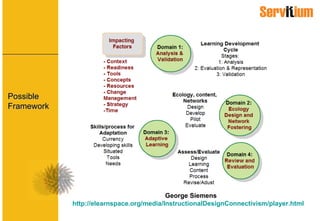
Possible Framework  George Siemens http://elearnspace.org/media/InstructionalDesignConnectivism/player.html   
Our Services Custom consultative solutions for every company Training for existing training and development teams engaged in the process of administering, developing and delivering training Communities of Practice as primary tools for creating learning experiences Formal Social Network Analysis from a learning perspective to evaluate connection forming patterns Tools for learners to self organize and collaborate Tools for administrators to track learning activities Tools for migrating existing connections and content to new formats Creation of new modes of delivery of new information (RSS servers, collaboration activities design
Thank You

Learning 2.0

  • 1.
    Learning 2.0 Presentationon Presentation to
  • 2.
    Agenda Principles ofConnectivism Impact on Instructional Design Impact on design of Learning Solutions Possible Framework Our Services
  • 3.
    Principles of ConnectivismLearning is the process of making new connections Connections are a primary point of focus and could be to people or devices Networked learning occurs at neural, conceptual and social levels Types of connections define certain types of learning Strength and nature of connections define how we learn Networks are differentiated from Groups (autonomy, diversity, control…) Knowledge is the network, is to be in a certain state of connectedness All knowledge is associative in nature and resides in our connections Connectivism is a new theory of learning that embraces and extends these principles Connectivism is very different from existing theories of Behaviorism, Cognitivism and Constructivism and is more readily and efectively applied to today’s learners and their needs
  • 4.
    Impact on InstructionalDesign ID has evolved under the influence of traditional theories, but needs reinterpretation in the context of the new theory of connectivism Contextualization, sequence of content and interaction complexity are typical factors in design Ecology, learnscape (Jay Cross) – engendering connections through creation of learning architectures or landscapes is a new key factor Being able to create capacity in learners to adapt as situations and circumstances change is a new key factor in a fast changing world Patterning – learning is pattern recognition and adaptation Wayfinding – is a key skill in an overwhelming abundant information climate Sensemaking- making sense or arriving at a framework to make sense of patterns and knowledge Currency of learning is another key factor because of the fast moving nature of knowledge. It is not sufficient to just take a course, we need to learn continuously Learning is not deterministic and linear. There is chaos and complexity in learning Chaos theory tells us that learning is sensitive to initial conditions that can have a dramatic influence on the final outcome and that there is a degree of hidden order/structure within the chaos of learning Complexity theory suggests that multiple interacting elements that result in particular outcomes. Outcomes are not something we draw out on a piece of paper. There are too many variables in the learning experience itself. Challenge for educators and instructional designer is now to achieve particular outcomes through distributed approaches Educator metaphors – curator, master artist, weaver, network administrator etc Learning ecologies – web 2.0 tools, learning organization, learnscapes, social network analysis applied to learning
  • 5.
    Impact on designof learning solutions Content, context and connections form the fabric of the new learning experience Web 2.0 and evolving technologies provide the technical infrastructure for collaboration, information negotiation and connection making Blogs, Wikis, RSS, Podcasts Organizations need to rethink the roles of learning managers, instructional designers, experts and learners as well as curricula and content New forms of collaboration and sense making need to be utilized Communities of Practice Concept Maps Journaling and collaborative content creation Structured very differently than traditional modes and technology such as LMS (LMS + Web 2.0 does not equal Learning 2.0)
  • 6.
    Possible Framework George Siemens http://elearnspace.org/media/InstructionalDesignConnectivism/player.html   
  • 7.
    Our Services Customconsultative solutions for every company Training for existing training and development teams engaged in the process of administering, developing and delivering training Communities of Practice as primary tools for creating learning experiences Formal Social Network Analysis from a learning perspective to evaluate connection forming patterns Tools for learners to self organize and collaborate Tools for administrators to track learning activities Tools for migrating existing connections and content to new formats Creation of new modes of delivery of new information (RSS servers, collaboration activities design
  • 8.