What is a health
system?
ICHS 2
www.hpsa-africa.org
@hpsa_africa
www.slideshare.net/hpsa_africa
Introduction to Complex Health
Systems
Outline
• Definition of health system
• Conceptual frameworks that help think
about health systems as basis for action
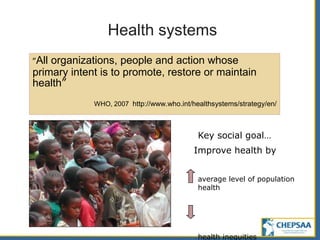
Key social goal…
Improve health by
average level of population
health
health inequities
Health systems
“All organizations, people and action whose
primary intent is to promote, restore or maintain
health”
WHO, 2007 http://www.who.int/healthsystems/strategy/en/
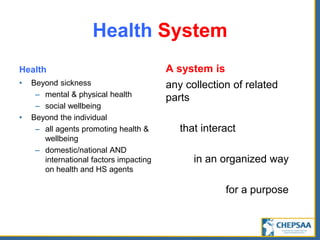
Health System
Health
• Beyond sickness
– mental & physical health
– social wellbeing
• Beyond the individual
– all agents promoting health &
wellbeing
– domestic/national AND
international factors impacting
on health and HS agents
A system is
any collection of related
parts
that interact
in an organized way
for a purpose
STARTING POINTS: WHAT ARE
THE BASIC BUILDING BLOCKS?
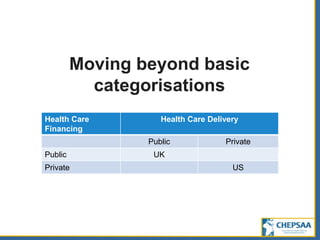
Moving beyond basic
categorisations
Health Care
Financing
Health Care Delivery
Public Private
Public UK
Private US
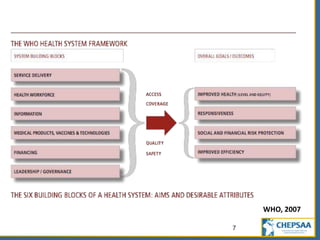
WHO, 2007
7
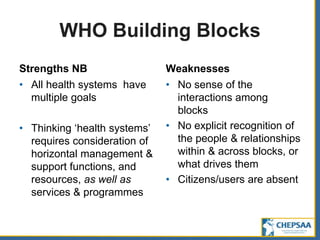
WHO Building Blocks
Strengths NB
• All health systems have
multiple goals
• Thinking ‘health systems’
requires consideration of
horizontal management &
support functions, and
resources, as well as
services & programmes
Weaknesses
• No sense of the
interactions among
blocks
• No explicit recognition of
the people & relationships
within & across blocks, or
what drives them
• Citizens/users are absent
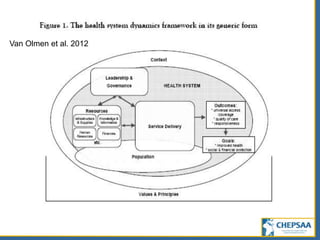
Van Olmen et al. 2012
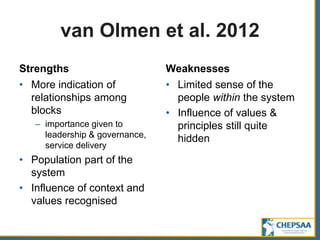
van Olmen et al. 2012
Strengths
• More indication of
relationships among
blocks
– importance given to
leadership & governance,
service delivery
• Population part of the
system
• Influence of context and
values recognised
Weaknesses
• Limited sense of the
people within the system
• Influence of values &
principles still quite
hidden
ACKNOWLEDGING ACTORS
AND RELATIONSHIPS
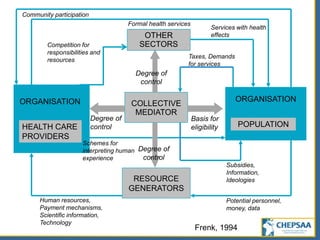
COLLECTIVE
MEDIATOR
HEALTH CARE
PROVIDERS
ORGANISATION
POPULATION
ORGANISATION
RESOURCE
GENERATORS
OTHER
SECTORS
Basis for
eligibility
Degree of
control
Degree of
control
Degree of
control
Taxes, Demands
for services
Services with health
effects
Subsidies,
Information,
Ideologies
Potential personnel,
money, data
Schemes for
interpreting human
experience
Human resources,
Payment mechanisms,
Scientific information,
Technology
Formal health services
Community participation
Frenk, 1994
Competition for
responsibilities and
resources
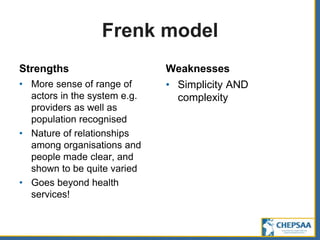
Frenk model
Strengths
• More sense of range of
actors in the system e.g.
providers as well as
population recognised
• Nature of relationships
among organisations and
people made clear, and
shown to be quite varied
• Goes beyond health
services!
Weaknesses
• Simplicity AND
complexity
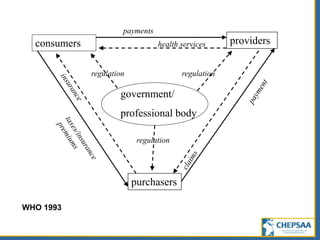
consumers providers
purchasers
government/
professional body
payments
health services
regulation
regulationregulation
WHO 1993
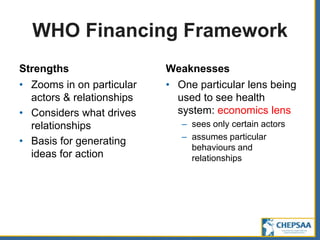
WHO Financing Framework
Strengths
• Zooms in on particular
actors & relationships
• Considers what drives
relationships
• Basis for generating
ideas for action
Weaknesses
• One particular lens being
used to see health
system: economics lens
– sees only certain actors
– assumes particular
behaviours and
relationships
16
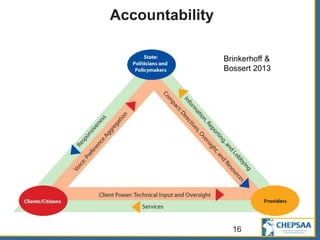
Accountability
Brinkerhoff &
Bossert 2013
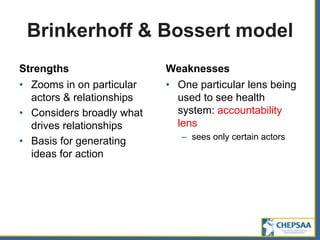
Brinkerhoff & Bossert model
Strengths
• Zooms in on particular
actors & relationships
• Considers broadly what
drives relationships
• Basis for generating
ideas for action
Weaknesses
• One particular lens being
used to see health
system: accountability
lens
– sees only certain actors
RECOGNISING SYSTEM
COMPLEXITY
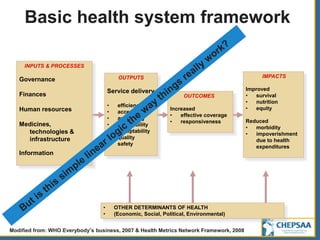
Basic health system framework
INPUTS & PROCESSES
Governance
Finances
Human resources
Medicines,
technologies &
infrastructure
Information
OUTPUTS
Service delivery
• efficiency
• access
• availability
• affordability
• acceptability
• quality
• safety
OUTCOMES
Increased
• effective coverage
• responsiveness
IMPACTS
Improved
• survival
• nutrition
• equity
Reduced
• morbidity
• impoverishment
due to health
expenditures
• OTHER DETERMINANTS OF HEALTH
• (Economic, Social, Political, Environmental)
Modified from: WHO Everybody’s business, 2007 & Health Metrics Network Framework, 2008
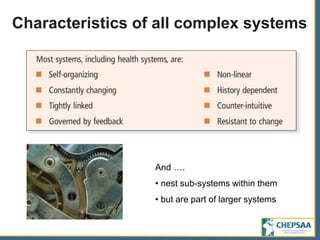
Characteristics of all complex systems
And ….
• nest sub-systems within them
• but are part of larger systems
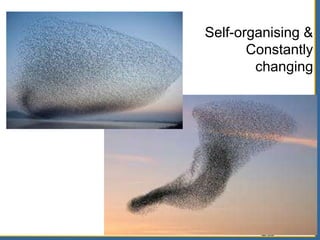
Self-organising &
Constantly
changing
Source
Of Funds
Procurement
Agent/Body
Point of 1st
warehousing
Point of 2nd
warehousing
MEDICAL STORE
PRIMARY HEALTH CARE FACILITYDISTRICT STORE
ZONAL MEDICAL STORE
ESSENTIAL
MEDICINES
ARVs MALARIA TB OI
ARVs
Ped
REAGENT
Blood safety
(+ HIV test)
VACCINES CONDOMS CONTRACEPTIVES
MEDICAL
SUPPLIES
REGIONAL/DISTRI
CT
VACCINE STORE
HEALTH FACILITY
GOVERNMENT
MULTILATERA
L DONOR
BILATERAL
DONOR
NGO/PRIVATE
AXIOS
TEC
&CC
T
CRS IMA CUAMMHOSPITAL COLUMBIA HOSPITAL
TEC
&CC
T
HEALTH FACILITY
HEALTH FACILITY HOSPITAL
TEC
&CC
T
ZONAL BLOOD
SAFETY CENTRE
Point of
Distribution
GOVERNMENT
W
BGLOBAL
FUND
S
I
D
A
P
E
P
F
A
R
U
S
A
I
D
U
N
I
C
E
F
W
H
O
A
B
B
O
T
T
C
S
S
C
C
O
L
U
M
B
I
A
P
F
I
Z
E
R
J
I
C
A
C
L
I
N
T
O
N
U
N
I
T
A
I
D
C
I
D
A
C
D
C
G
A
V
I
C
U
A
M
M
H
A
V
A
R
D
N
O
R
A
D
HOSPITAL
TEC
&
CCT
C
L
I
N
T
O
N
H
A
V
A
R
D
MEDICAL
STORE
C
R
S
S
C
M
S
E
G
P
A
F
MOH
&
SW
A
X
I
O
S
U
N
I
C
E
F
J
I
C
A
C
D
C
C
O
L
U
M
B
I
A
A
B
B
O
T
T
G
A
V
I
C
U
A
M
M
CROWN
AGENTS
U
S
A
I
D
T
M
A
P
A
X
I
O
S
PATIENT
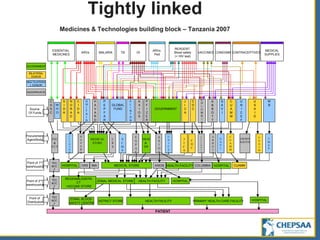
Tightly linked
Medicines & Technologies building block – Tanzania 2007
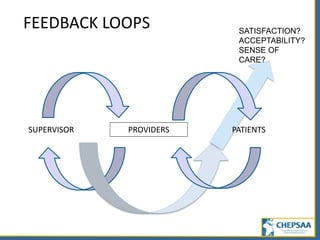
SUPERVISOR PROVIDERS PATIENTS
FEEDBACK LOOPS SATISFACTION?
ACCEPTABILITY?
SENSE OF
CARE?
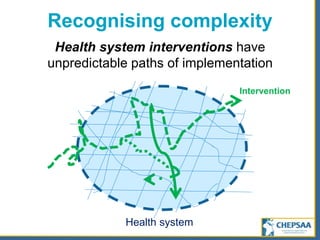
Health system interventions have
unpredictable paths of implementation
Health system
Intervention
Recognising complexity
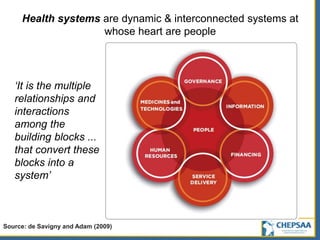
Health systems are dynamic & interconnected systems at
whose heart are people
Source: de Savigny and Adam (2009)
‘It is the multiple
relationships and
interactions
among the
building blocks ...
that convert these
blocks into a
system’
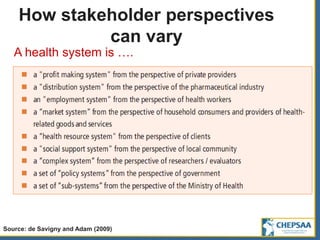
How stakeholder perspectives
can vary
A health system is ….
Source: de Savigny and Adam (2009)
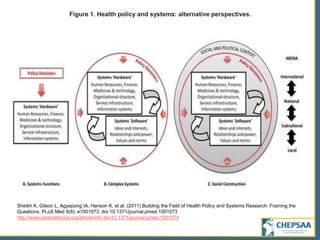
Figure 1. Health policy and systems: alternative perspectives.
Sheikh K, Gilson L, Agyepong IA, Hanson K, et al. (2011) Building the Field of Health Policy and Systems Research: Framing the
Questions. PLoS Med 8(8): e1001073. doi:10.1371/journal.pmed.1001073
http://www.plosmedicine.org/article/info:doi/10.1371/journal.pmed.1001073
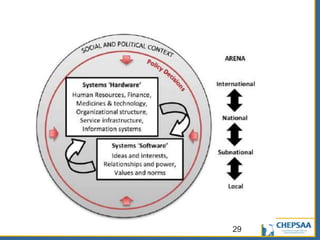
29
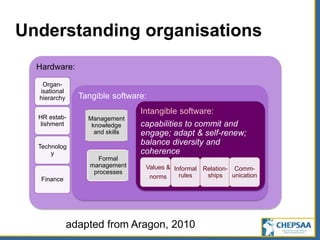
Hardware:
Tangible software:
Intangible software:
capabilities to commit and
engage; adapt & self-renew;
balance diversity and
coherence
Organ-
isational
hierarchy
HR estab-
lishment
Technolog
y
Finance
Management
knowledge
and skills
Formal
management
processes
Values &
norms
Informal
rules
Relation-
ships
Comm-
unication
Understanding organisations
adapted from Aragon, 2010
All these ‘conceptual frameworks’
provide the basis for
• understanding
• investigating
• strengthening
health systems (or facets of them)
• and so, for working within them!
(and researching them!)
CAVEAT – NO EASY ANSWERS
TO HOW TO IMPROVE A HEALTH
SYSTEM!
POLITICS AND VALUES
MATTER….
Copyright
Funding
You are free:
To Share – to copy, distribute and transmit the work
To Remix – to adapt the work
Under the following conditions:
Attribution You must attribute the work in the manner
specified by the author or licensor (but not in any way that
suggests that they endorse you or your use of the work).
Non-commercial You may not use this work for commercial
purposes.
Share Alike If you alter, transform, or build upon this work,
you may distribute the resulting work but only under the same
or similar license to this one.
Other conditions
For any reuse or distribution, you must make clear to
others the license terms of this work.
Nothing in this license impairs or restricts the authors’
moral rights.
Nothing in this license impairs or restricts the rights of
authors whose work is referenced in this document.
Cited works used in this document must be cited following
usual academic conventions.
Citation of this work must follow normal academic
conventions. Suggested citation:
Introduction to Complex Health Systems, Presentation
2. Copyright CHEPSAA (Consortium for Health Policy &
Systems Analysis in Africa) 2014, www.hpsa-africa.org
www.slideshare.net/hpsa_africa
This document is an output from a project funded by the European Commission (EC) FP7-Africa (Grant no.
265482). The views expressed are not necessarily those of the EC.
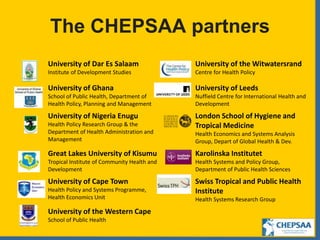
The CHEPSAA partners
University of Dar Es Salaam
Institute of Development Studies
University of the Witwatersrand
Centre for Health Policy
University of Ghana
School of Public Health, Department of
Health Policy, Planning and Management
University of Leeds
Nuffield Centre for International Health and
Development
University of Nigeria Enugu
Health Policy Research Group & the
Department of Health Administration and
Management
London School of Hygiene and
Tropical Medicine
Health Economics and Systems Analysis
Group, Depart of Global Health & Dev.
Great Lakes University of Kisumu
Tropical Institute of Community Health and
Development
Karolinska Institutet
Health Systems and Policy Group,
Department of Public Health Sciences
University of Cape Town
Health Policy and Systems Programme,
Health Economics Unit
Swiss Tropical and Public Health
Institute
Health Systems Research Group
University of the Western Cape
School of Public Health

What is a health system?

  • 1.
    What is ahealth system? ICHS 2 www.hpsa-africa.org @hpsa_africa www.slideshare.net/hpsa_africa Introduction to Complex Health Systems
  • 2.
    Outline • Definition ofhealth system • Conceptual frameworks that help think about health systems as basis for action
  • 3.
    Key social goal… Improvehealth by average level of population health health inequities Health systems “All organizations, people and action whose primary intent is to promote, restore or maintain health” WHO, 2007 http://www.who.int/healthsystems/strategy/en/
  • 4.
    Health System Health • Beyondsickness – mental & physical health – social wellbeing • Beyond the individual – all agents promoting health & wellbeing – domestic/national AND international factors impacting on health and HS agents A system is any collection of related parts that interact in an organized way for a purpose
  • 5.
    STARTING POINTS: WHATARE THE BASIC BUILDING BLOCKS?
  • 6.
    Moving beyond basic categorisations HealthCare Financing Health Care Delivery Public Private Public UK Private US
  • 7.
  • 8.
    WHO Building Blocks StrengthsNB • All health systems have multiple goals • Thinking ‘health systems’ requires consideration of horizontal management & support functions, and resources, as well as services & programmes Weaknesses • No sense of the interactions among blocks • No explicit recognition of the people & relationships within & across blocks, or what drives them • Citizens/users are absent
  • 9.
    Van Olmen etal. 2012
  • 10.
    van Olmen etal. 2012 Strengths • More indication of relationships among blocks – importance given to leadership & governance, service delivery • Population part of the system • Influence of context and values recognised Weaknesses • Limited sense of the people within the system • Influence of values & principles still quite hidden
  • 11.
  • 12.
    COLLECTIVE MEDIATOR HEALTH CARE PROVIDERS ORGANISATION POPULATION ORGANISATION RESOURCE GENERATORS OTHER SECTORS Basis for eligibility Degreeof control Degree of control Degree of control Taxes, Demands for services Services with health effects Subsidies, Information, Ideologies Potential personnel, money, data Schemes for interpreting human experience Human resources, Payment mechanisms, Scientific information, Technology Formal health services Community participation Frenk, 1994 Competition for responsibilities and resources
  • 13.
    Frenk model Strengths • Moresense of range of actors in the system e.g. providers as well as population recognised • Nature of relationships among organisations and people made clear, and shown to be quite varied • Goes beyond health services! Weaknesses • Simplicity AND complexity
  • 14.
  • 15.
    WHO Financing Framework Strengths •Zooms in on particular actors & relationships • Considers what drives relationships • Basis for generating ideas for action Weaknesses • One particular lens being used to see health system: economics lens – sees only certain actors – assumes particular behaviours and relationships
  • 16.
  • 17.
    Brinkerhoff & Bossertmodel Strengths • Zooms in on particular actors & relationships • Considers broadly what drives relationships • Basis for generating ideas for action Weaknesses • One particular lens being used to see health system: accountability lens – sees only certain actors
  • 18.
  • 19.
    Basic health systemframework INPUTS & PROCESSES Governance Finances Human resources Medicines, technologies & infrastructure Information OUTPUTS Service delivery • efficiency • access • availability • affordability • acceptability • quality • safety OUTCOMES Increased • effective coverage • responsiveness IMPACTS Improved • survival • nutrition • equity Reduced • morbidity • impoverishment due to health expenditures • OTHER DETERMINANTS OF HEALTH • (Economic, Social, Political, Environmental) Modified from: WHO Everybody’s business, 2007 & Health Metrics Network Framework, 2008
  • 20.
    Characteristics of allcomplex systems And …. • nest sub-systems within them • but are part of larger systems
  • 21.
  • 22.
    Source Of Funds Procurement Agent/Body Point of1st warehousing Point of 2nd warehousing MEDICAL STORE PRIMARY HEALTH CARE FACILITYDISTRICT STORE ZONAL MEDICAL STORE ESSENTIAL MEDICINES ARVs MALARIA TB OI ARVs Ped REAGENT Blood safety (+ HIV test) VACCINES CONDOMS CONTRACEPTIVES MEDICAL SUPPLIES REGIONAL/DISTRI CT VACCINE STORE HEALTH FACILITY GOVERNMENT MULTILATERA L DONOR BILATERAL DONOR NGO/PRIVATE AXIOS TEC &CC T CRS IMA CUAMMHOSPITAL COLUMBIA HOSPITAL TEC &CC T HEALTH FACILITY HEALTH FACILITY HOSPITAL TEC &CC T ZONAL BLOOD SAFETY CENTRE Point of Distribution GOVERNMENT W BGLOBAL FUND S I D A P E P F A R U S A I D U N I C E F W H O A B B O T T C S S C C O L U M B I A P F I Z E R J I C A C L I N T O N U N I T A I D C I D A C D C G A V I C U A M M H A V A R D N O R A D HOSPITAL TEC & CCT C L I N T O N H A V A R D MEDICAL STORE C R S S C M S E G P A F MOH & SW A X I O S U N I C E F J I C A C D C C O L U M B I A A B B O T T G A V I C U A M M CROWN AGENTS U S A I D T M A P A X I O S PATIENT Tightly linked Medicines & Technologies building block – Tanzania 2007
  • 23.
    SUPERVISOR PROVIDERS PATIENTS FEEDBACKLOOPS SATISFACTION? ACCEPTABILITY? SENSE OF CARE?
  • 24.
    Health system interventionshave unpredictable paths of implementation Health system Intervention Recognising complexity
  • 25.
    Health systems aredynamic & interconnected systems at whose heart are people Source: de Savigny and Adam (2009) ‘It is the multiple relationships and interactions among the building blocks ... that convert these blocks into a system’
  • 27.
    How stakeholder perspectives canvary A health system is …. Source: de Savigny and Adam (2009)
  • 28.
    Figure 1. Healthpolicy and systems: alternative perspectives. Sheikh K, Gilson L, Agyepong IA, Hanson K, et al. (2011) Building the Field of Health Policy and Systems Research: Framing the Questions. PLoS Med 8(8): e1001073. doi:10.1371/journal.pmed.1001073 http://www.plosmedicine.org/article/info:doi/10.1371/journal.pmed.1001073
  • 29.
  • 30.
    Hardware: Tangible software: Intangible software: capabilitiesto commit and engage; adapt & self-renew; balance diversity and coherence Organ- isational hierarchy HR estab- lishment Technolog y Finance Management knowledge and skills Formal management processes Values & norms Informal rules Relation- ships Comm- unication Understanding organisations adapted from Aragon, 2010
  • 31.
    All these ‘conceptualframeworks’ provide the basis for • understanding • investigating • strengthening health systems (or facets of them) • and so, for working within them! (and researching them!)
  • 32.
    CAVEAT – NOEASY ANSWERS TO HOW TO IMPROVE A HEALTH SYSTEM! POLITICS AND VALUES MATTER….
  • 33.
    Copyright Funding You are free: ToShare – to copy, distribute and transmit the work To Remix – to adapt the work Under the following conditions: Attribution You must attribute the work in the manner specified by the author or licensor (but not in any way that suggests that they endorse you or your use of the work). Non-commercial You may not use this work for commercial purposes. Share Alike If you alter, transform, or build upon this work, you may distribute the resulting work but only under the same or similar license to this one. Other conditions For any reuse or distribution, you must make clear to others the license terms of this work. Nothing in this license impairs or restricts the authors’ moral rights. Nothing in this license impairs or restricts the rights of authors whose work is referenced in this document. Cited works used in this document must be cited following usual academic conventions. Citation of this work must follow normal academic conventions. Suggested citation: Introduction to Complex Health Systems, Presentation 2. Copyright CHEPSAA (Consortium for Health Policy & Systems Analysis in Africa) 2014, www.hpsa-africa.org www.slideshare.net/hpsa_africa This document is an output from a project funded by the European Commission (EC) FP7-Africa (Grant no. 265482). The views expressed are not necessarily those of the EC.
  • 34.
    The CHEPSAA partners Universityof Dar Es Salaam Institute of Development Studies University of the Witwatersrand Centre for Health Policy University of Ghana School of Public Health, Department of Health Policy, Planning and Management University of Leeds Nuffield Centre for International Health and Development University of Nigeria Enugu Health Policy Research Group & the Department of Health Administration and Management London School of Hygiene and Tropical Medicine Health Economics and Systems Analysis Group, Depart of Global Health & Dev. Great Lakes University of Kisumu Tropical Institute of Community Health and Development Karolinska Institutet Health Systems and Policy Group, Department of Public Health Sciences University of Cape Town Health Policy and Systems Programme, Health Economics Unit Swiss Tropical and Public Health Institute Health Systems Research Group University of the Western Cape School of Public Health