Quality
• Learning Aim- to understand quality
systems and the importance of quality
to a business.
• Success Criteria – To explain the effect
of good/bad quality on a business
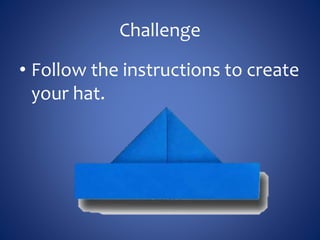
Challenge
• Follow the instructions to create
your hat.
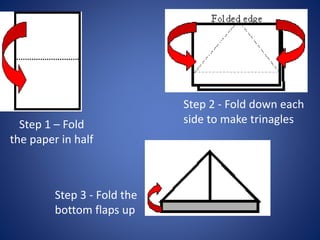
Step 1 – Fold
the paper in half
Step 2 - Fold down each
side to make trinagles
Step 3 - Fold the
bottom flaps up
Quality
• Check each-others hats
• Who has the best
• Which is the best quality?
• How could we improve quality?
• How could we ensure quality across the
classroom
• This is what we will learn today
Why is quality important?
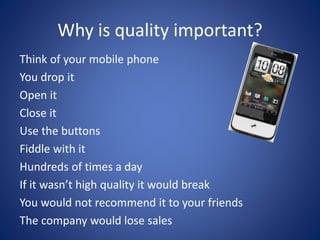
Think of your mobile phone
You drop it
Open it
Close it
Use the buttons
Fiddle with it
Hundreds of times a day
If it wasn’t high quality it would break
You would not recommend it to your friends
The company would lose sales
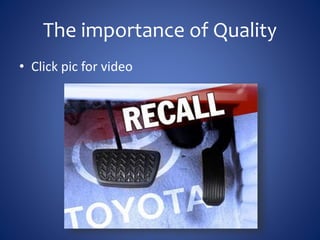
The importance of Quality
• Click pic for video
What is Quality?
• Quality is subjective –a matter of
personal opinion –and views of it will
vary from individual to individual.
• Quality: Those features of a product or
service that allow it to satisfy (or delight)
customers.
• Think of 1 product that you think is high
quality
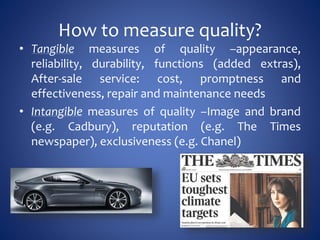
How to measure quality?
• Tangible measures of quality –appearance,
reliability, durability, functions (added extras),
After-sale service: cost, promptness and
effectiveness, repair and maintenance needs
• Intangible measures of quality –Image and brand
(e.g. Cadbury), reputation (e.g. The Times
newspaper), exclusiveness (e.g. Chanel)
Benefits of having a quality
system
• Impact on sales volume –a business is more
likely to retain customers who are happy
with the quality of their products - Waitrose
• Creating a unique selling point –businesses
can use the level of quality as a USP for their
product – The Ritz
• Impact on selling price –businesses can
charge a higher price if their goods and
services are of high quality – Hotel Chocolat
Why might
they be
introducing
special
deals???
Benefits of having a quality
system
• Cost reductions –a quality system can
reduce the amount of wastage and
therefore the business’s costs
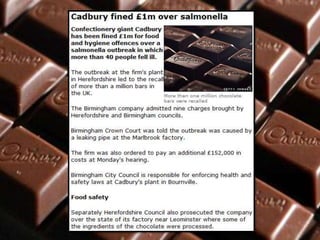
• The firm’s reputation –A good
reputation is important for a firm’s
competitiveness/profitability. – Cadbury
Salmonella scare
Quality Control & Quality Assurance
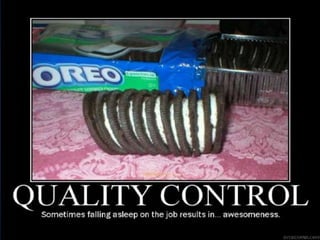
Quality control where finished products are
checked by inspectors to see if they meet the
set standard.
Quality assurance where quality is built into
the production process. For example, all staff
check all items at all stages of the production
process for faults. In this way everyone takes
responsibility for delivering quality. Successful
quality assurance results in zero defect
production.
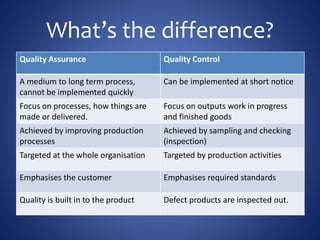
What’s the difference?
Quality Assurance Quality Control
A medium to long term process,
cannot be implemented quickly
Can be implemented at short notice
Focus on processes, how things are
made or delivered.
Focus on outputs work in progress
and finished goods
Achieved by improving production
processes
Achieved by sampling and checking
(inspection)
Targeted at the whole organisation Targeted by production activities
Emphasises the customer Emphasises required standards
Quality is built in to the product Defect products are inspected out.
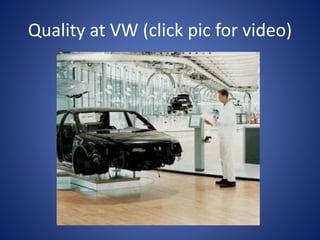
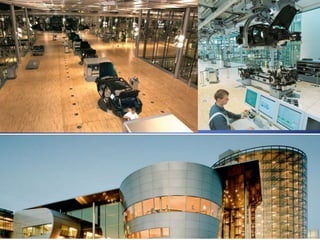
Quality at VW (click pic for video)
Managing a Quality system
• Costs – Quality procedures are expensive to
set up. Continual monitoring of production
involves significant costs.
• Training – Any system of quality relies on a
well trained workforce. Training can be
costly.
• Disruption to production – Workers need to
be trained before new systems are
introduced
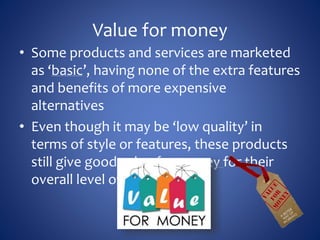
Value for money
• Some products and services are marketed
as ‘basic’, having none of the extra features
and benefits of more expensive
alternatives
• Even though it may be ‘low quality’ in
terms of style or features, these products
still give good value for money for their
overall level of quality.
Value for money
• Select one company that benefits from basic
quality products. How does this affect the
quality bullet points below?
• Improves sales?
• Creates a unique selling point?
• Impact on Price?
• Improves companies reputation?
Quality
• Learning Aim- to understand the
concepts of TQM, Kaizen, and quality
standards
• Success Criteria – To explain the
importance for businesses
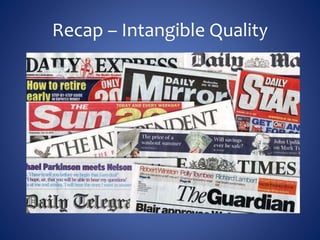
Recap – Intangible Quality
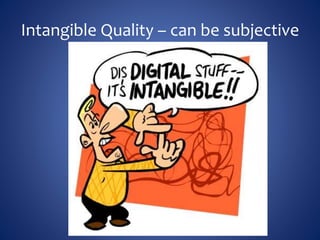
Intangible Quality – can be subjective
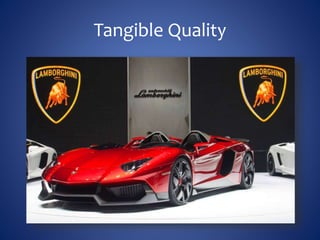
Tangible Quality
But quality can be measured
Failure or reject rates
Level of product returns
Customer complaints
Customer satisfaction – usually measured by a
survey
Customer loyalty – evident from repeat
purchases, or renewal rates
Total Quality Management
• TQM is an example of a Quality Assurance
system.
• It is based on the principle that everyone
within a business has a contribution to
make to the overall quality of the finished
product or service.
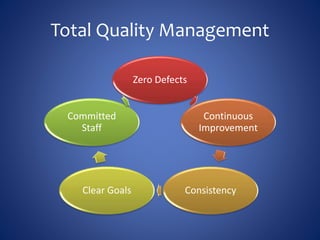
Total Quality Management
Zero Defects
Continuous
Improvement
ConsistencyClear Goals
Committed
Staff
TQM - Issues
• TQM is not an easy concept to introduce into
businesses - In fact - many attempts to
introduce TQM fail!
• It requires that management give employees a
say in the production processes that they are
involved in.
• So "empowerment" is a crucial part of TQM.
The key to success is to identify the
management culture before attempting to
install TQM.
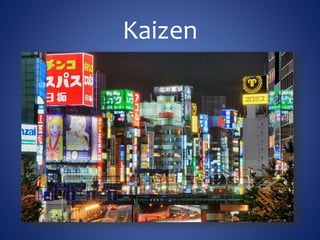
Kaizen
Kaizen
• Kaizen , or ‘Continuous Improvement’ is a
policy of constantly introducing small
incremental changes in a business in order to
improve quality and/or efficiency.
• This approach assumes that employees are the
best people to identify room for improvement,
since they see the processes in action all the
time.
• A firm that uses this approach therefore has to
have a culture that encourages and rewards
employees for their contribution to the process.
ISO 9001
• Awarded to Businesses in the EU
• The award does not prove that every
product produced or service provided by the
business is of good quality. It is an indication
that a business has a system of quality in
place that has relevant targets set and
activities ready to deal with a quality
problem.
Click for video hyperlink
BS5750
• BS5750 is a British Standard for quality assurance
and ISO 9000 is the EU equivalent.
• This approach was very common in the 1980s
and 1990s and many major organisations would
only buy products and services from firms that
possessed BS5750 accreditation.
• Furthermore, just because a firm holds BS5750
and is delivering a consistent service, it does not
guarantee that the service is better than a firm
that does not have the award.
CE Marking
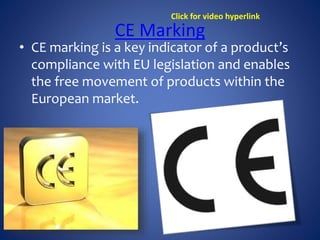
• CE marking is a key indicator of a product’s
compliance with EU legislation and enables
the free movement of products within the
European market.
Click for video hyperlink
Royal Seal of Approval
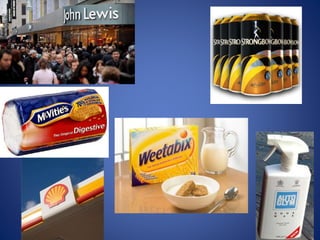
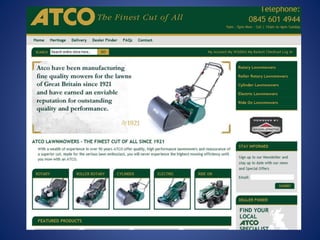
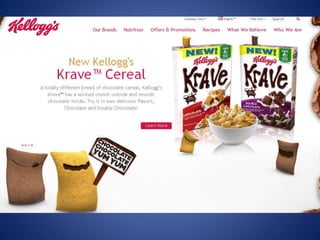
• Royal Warrant - video
• Some British firms are fortunate to gain a ‘Royal
Warrant’, which allows them to state that they
are endorsed by Royal Appointment to Her
Majesty the Queen, to the Duke of Edinburgh or
to the Prince of Wales. This accreditation will be
proudly displayed on the product packaging
and on the firm’s correspondence and
marketing literature.
• List of companies with a royal warrant
Activity
• Choose a company from the list and research
how quality helps their business. Think about :
• Tangible/intangible quality
• Benefits of quality (increased sales,
reputation?)
• Quality control & assurance
• Quality standards
• TQM/Kaizen
• Are employees involved in quality?
• How do they manage quality?
Quality & quality_control

Quality & quality_control

  • 1.
    Quality • Learning Aim-to understand quality systems and the importance of quality to a business. • Success Criteria – To explain the effect of good/bad quality on a business
  • 2.
    Challenge • Follow theinstructions to create your hat.
  • 3.
    Step 1 –Fold the paper in half Step 2 - Fold down each side to make trinagles Step 3 - Fold the bottom flaps up
  • 4.
    Quality • Check each-othershats • Who has the best • Which is the best quality? • How could we improve quality? • How could we ensure quality across the classroom • This is what we will learn today
  • 5.
    Why is qualityimportant? Think of your mobile phone You drop it Open it Close it Use the buttons Fiddle with it Hundreds of times a day If it wasn’t high quality it would break You would not recommend it to your friends The company would lose sales
  • 6.
    The importance ofQuality • Click pic for video
  • 7.
    What is Quality? •Quality is subjective –a matter of personal opinion –and views of it will vary from individual to individual. • Quality: Those features of a product or service that allow it to satisfy (or delight) customers. • Think of 1 product that you think is high quality
  • 8.
    How to measurequality? • Tangible measures of quality –appearance, reliability, durability, functions (added extras), After-sale service: cost, promptness and effectiveness, repair and maintenance needs • Intangible measures of quality –Image and brand (e.g. Cadbury), reputation (e.g. The Times newspaper), exclusiveness (e.g. Chanel)
  • 9.
    Benefits of havinga quality system • Impact on sales volume –a business is more likely to retain customers who are happy with the quality of their products - Waitrose • Creating a unique selling point –businesses can use the level of quality as a USP for their product – The Ritz • Impact on selling price –businesses can charge a higher price if their goods and services are of high quality – Hotel Chocolat
  • 10.
  • 11.
    Benefits of havinga quality system • Cost reductions –a quality system can reduce the amount of wastage and therefore the business’s costs • The firm’s reputation –A good reputation is important for a firm’s competitiveness/profitability. – Cadbury Salmonella scare
  • 13.
    Quality Control &Quality Assurance Quality control where finished products are checked by inspectors to see if they meet the set standard. Quality assurance where quality is built into the production process. For example, all staff check all items at all stages of the production process for faults. In this way everyone takes responsibility for delivering quality. Successful quality assurance results in zero defect production.
  • 14.
    What’s the difference? QualityAssurance Quality Control A medium to long term process, cannot be implemented quickly Can be implemented at short notice Focus on processes, how things are made or delivered. Focus on outputs work in progress and finished goods Achieved by improving production processes Achieved by sampling and checking (inspection) Targeted at the whole organisation Targeted by production activities Emphasises the customer Emphasises required standards Quality is built in to the product Defect products are inspected out.
  • 15.
    Quality at VW(click pic for video)
  • 18.
    Managing a Qualitysystem • Costs – Quality procedures are expensive to set up. Continual monitoring of production involves significant costs. • Training – Any system of quality relies on a well trained workforce. Training can be costly. • Disruption to production – Workers need to be trained before new systems are introduced
  • 19.
    Value for money •Some products and services are marketed as ‘basic’, having none of the extra features and benefits of more expensive alternatives • Even though it may be ‘low quality’ in terms of style or features, these products still give good value for money for their overall level of quality.
  • 20.
    Value for money •Select one company that benefits from basic quality products. How does this affect the quality bullet points below? • Improves sales? • Creates a unique selling point? • Impact on Price? • Improves companies reputation?
  • 22.
    Quality • Learning Aim-to understand the concepts of TQM, Kaizen, and quality standards • Success Criteria – To explain the importance for businesses
  • 23.
  • 24.
    Intangible Quality –can be subjective
  • 25.
  • 26.
    But quality canbe measured Failure or reject rates Level of product returns Customer complaints Customer satisfaction – usually measured by a survey Customer loyalty – evident from repeat purchases, or renewal rates
  • 27.
    Total Quality Management •TQM is an example of a Quality Assurance system. • It is based on the principle that everyone within a business has a contribution to make to the overall quality of the finished product or service.
  • 28.
    Total Quality Management ZeroDefects Continuous Improvement ConsistencyClear Goals Committed Staff
  • 29.
    TQM - Issues •TQM is not an easy concept to introduce into businesses - In fact - many attempts to introduce TQM fail! • It requires that management give employees a say in the production processes that they are involved in. • So "empowerment" is a crucial part of TQM. The key to success is to identify the management culture before attempting to install TQM.
  • 30.
  • 31.
    Kaizen • Kaizen ,or ‘Continuous Improvement’ is a policy of constantly introducing small incremental changes in a business in order to improve quality and/or efficiency. • This approach assumes that employees are the best people to identify room for improvement, since they see the processes in action all the time. • A firm that uses this approach therefore has to have a culture that encourages and rewards employees for their contribution to the process.
  • 32.
    ISO 9001 • Awardedto Businesses in the EU • The award does not prove that every product produced or service provided by the business is of good quality. It is an indication that a business has a system of quality in place that has relevant targets set and activities ready to deal with a quality problem. Click for video hyperlink
  • 33.
    BS5750 • BS5750 isa British Standard for quality assurance and ISO 9000 is the EU equivalent. • This approach was very common in the 1980s and 1990s and many major organisations would only buy products and services from firms that possessed BS5750 accreditation. • Furthermore, just because a firm holds BS5750 and is delivering a consistent service, it does not guarantee that the service is better than a firm that does not have the award.

  • 34.
    CE Marking • CEmarking is a key indicator of a product’s compliance with EU legislation and enables the free movement of products within the European market. Click for video hyperlink
  • 37.
    Royal Seal ofApproval • Royal Warrant - video • Some British firms are fortunate to gain a ‘Royal Warrant’, which allows them to state that they are endorsed by Royal Appointment to Her Majesty the Queen, to the Duke of Edinburgh or to the Prince of Wales. This accreditation will be proudly displayed on the product packaging and on the firm’s correspondence and marketing literature. • List of companies with a royal warrant
  • 41.
    Activity • Choose acompany from the list and research how quality helps their business. Think about : • Tangible/intangible quality • Benefits of quality (increased sales, reputation?) • Quality control & assurance • Quality standards • TQM/Kaizen • Are employees involved in quality? • How do they manage quality?