Devi Ahilya Vishva VidhyalyaDevi Ahilya Vishva Vidhyalya
Taksha Shila Campus, Khandwa Road, IndoreTaksha Shila Campus, Khandwa Road, Indore
Bibliographic CouplingBibliographic Coupling
&&
ObsolescenceObsolescence
A presentation submitted against the unit test-3 (707) for the completion of M.A presentation submitted against the unit test-3 (707) for the completion of M.
Phil. In Library & Information Science, Second Semester (Session 2010-11)Phil. In Library & Information Science, Second Semester (Session 2010-11)
Submitted by:Submitted by: Guided By:Guided By:
Ritesh Tiwari Ms. Aarti SharmaRitesh Tiwari Ms. Aarti Sharma
Roll No. 16 Lecturer (SLIS, UTD, DAVV)Roll No. 16 Lecturer (SLIS, UTD, DAVV)
ContentsContents
What is Bibliographic CouplingWhat is Bibliographic Coupling
Progress of Bibliographic CouplingProgress of Bibliographic Coupling
Criticism of Bibliographic CouplingCriticism of Bibliographic Coupling
Similar term: Co-Citation CouplingSimilar term: Co-Citation Coupling
Bibliographic Coupling V/s Co-citationBibliographic Coupling V/s Co-citation
Use of Bibliographic CouplingUse of Bibliographic Coupling
What is ObsolescenceWhat is Obsolescence
Reasons for Declination in usageReasons for Declination in usage
Criteria used for measuring theCriteria used for measuring the
DeclinationDeclination
ConclusionConclusion
ReferencesReferences
What is Bibliographic Coupling ?What is Bibliographic Coupling ?
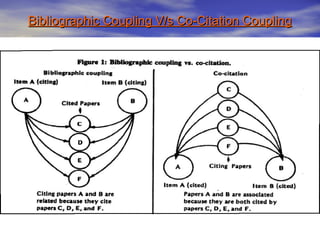
When two works refer the commonWhen two works refer the common
work(s) then the relation between twowork(s) then the relation between two
referring documents is calledreferring documents is called
Bibliographic coupling.Bibliographic coupling. We can sayWe can say
The coupling strength is higher whenThe coupling strength is higher when
more citations, the two referring worksmore citations, the two referring works
have in common. This coupling showshave in common. This coupling shows
the similarity of subject matter of the twothe similarity of subject matter of the two
works. Bibliographic coupling isworks. Bibliographic coupling is
respectively valuable in all fields ofrespectively valuable in all fields of
research since it helps the researcher toresearch since it helps the researcher to
find related research done in the past.find related research done in the past.
The term "bibliographic coupling" wasThe term "bibliographic coupling" was
first introduced by MM Kessler in a paperfirst introduced by MM Kessler in a paper
published in 1963, and has beenpublished in 1963, and has been
embraced in the work of the informationembraced in the work of the information
scientist Eugene Garfield.scientist Eugene Garfield.
Progress of Bibliographic Coupling:Progress of Bibliographic Coupling:
 There was a progression of citation studyThere was a progression of citation study
methods from “bibliographic coupling” tomethods from “bibliographic coupling” to
“co-citation analysis” (1973) to “author co-“co-citation analysis” (1973) to “author co-
citation analysis”(1981).citation analysis”(1981).
In 1973, Henry Small introduced what heIn 1973, Henry Small introduced what he
concluded was a better indicator of subjectconcluded was a better indicator of subject
similarity, document co-citation analysis.similarity, document co-citation analysis.
In 1981 Howard White and Belver GriffithIn 1981 Howard White and Belver Griffith
moved to author cocitation analysis (ACA).moved to author cocitation analysis (ACA).
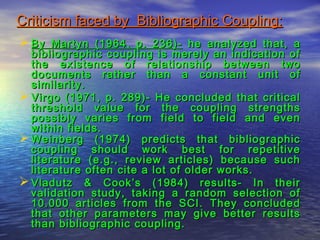
Criticism faced by Bibliographic Coupling:Criticism faced by Bibliographic Coupling:
 By Martyn (1964, p. 236)-By Martyn (1964, p. 236)- he analyzed that, ahe analyzed that, a
bibliographic coupling is merely an indication ofbibliographic coupling is merely an indication of
the existence of relationship between twothe existence of relationship between two
documents rather than a constant unit ofdocuments rather than a constant unit of
similarity.similarity.
 Virgo (1971, p. 289)- He concluded that criticalVirgo (1971, p. 289)- He concluded that critical
threshold value for the coupling strengthsthreshold value for the coupling strengths
possibly varies from field to field and evenpossibly varies from field to field and even
within fields.within fields.
 Weinberg (1974) predicts that bibliographicWeinberg (1974) predicts that bibliographic
coupling should work best for repetitivecoupling should work best for repetitive
literature (e.g., review articles) because suchliterature (e.g., review articles) because such
literature often cite a lot of older works.literature often cite a lot of older works.
 Vladutz & Cook’s (1984) results- In theirVladutz & Cook’s (1984) results- In their
validation study, taking a random selection ofvalidation study, taking a random selection of
10.000 articles from the SCI. They concluded10.000 articles from the SCI. They concluded
that other parameters may give better resultsthat other parameters may give better results
than bibliographic coupling.than bibliographic coupling.
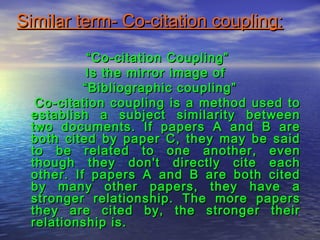
Similar term- Co-citation coupling:Similar term- Co-citation coupling:
““Co-citation Coupling”Co-citation Coupling”
Is the mirror image ofIs the mirror image of
““Bibliographic coupling”Bibliographic coupling”
Co-citation coupling is a method used toCo-citation coupling is a method used to
establish a subject similarity betweenestablish a subject similarity between
two documents. If papers A and B aretwo documents. If papers A and B are
both cited by paper C, they may be saidboth cited by paper C, they may be said
to be related to one another, evento be related to one another, even
though they don't directly cite eachthough they don't directly cite each
other. If papers A and B are both citedother. If papers A and B are both cited
by many other papers, they have aby many other papers, they have a
stronger relationship. The more papersstronger relationship. The more papers
they are cited by, the stronger theirthey are cited by, the stronger their
relationship is.relationship is.
Bibliographic Coupling V/s Co-Citation CouplingBibliographic Coupling V/s Co-Citation Coupling
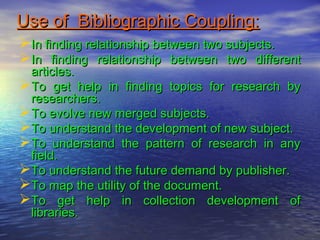
Use of Bibliographic Coupling:Use of Bibliographic Coupling:
In finding relationship between two subjects.In finding relationship between two subjects.
In finding relationship between two differentIn finding relationship between two different
articles.articles.
To get help in finding topics for research byTo get help in finding topics for research by
researchers.researchers.
To evolve new merged subjects.To evolve new merged subjects.
To understand the development of new subject.To understand the development of new subject.
To understand the pattern of research in anyTo understand the pattern of research in any
field.field.
To understand the future demand by publisher.To understand the future demand by publisher.
To map the utility of the document.To map the utility of the document.
To get help in collection development ofTo get help in collection development of
libraries.libraries.
What is Obsolescence?What is Obsolescence?
Obsolescence is the phenomenon of “ theObsolescence is the phenomenon of “ the
reduced use or decline in the use of informationreduced use or decline in the use of information
(on a certain topic) by the time”.(on a certain topic) by the time”.
Obsolescence study might be useful for solvingObsolescence study might be useful for solving
following questions:following questions:
 when to discard older Volumes,when to discard older Volumes,
 how long to keep new ones,how long to keep new ones,
 what sort of retrospective storage and accesswhat sort of retrospective storage and access
in information retrieval system should providein information retrieval system should provide
Reasons for Declination in usageReasons for Declination in usage
If the concern is with knowledge,If the concern is with knowledge,
obsolescence may be defined as a declineobsolescence may be defined as a decline
over time in the validity or utility of Information.over time in the validity or utility of Information.
Such decline may be occurred by followingSuch decline may be occurred by following
reasons:reasons:
 The information is valid, but incorporated inThe information is valid, but incorporated in
later work.later work.
 The information is valid, but superseded byThe information is valid, but superseded by
later work.later work.
 The information is valid, but is in a field ofThe information is valid, but is in a field of
declining interest;declining interest;
 The information is no longer valid.The information is no longer valid.
Criteria used for measuring the Declination:Criteria used for measuring the Declination:
 Age of the document.Age of the document.
 Citation to the document in the subsequentCitation to the document in the subsequent
literature.literature.
 Utilization of document.Utilization of document.
Following termsFollowing terms are also important if, we discuss aboutare also important if, we discuss about
the obsolescence and required to be put here:the obsolescence and required to be put here:
Age:Age: Period From origin to the actual use of thePeriod From origin to the actual use of the
document is called age of thatdocument is called age of that
particularparticular document.document.
Useful Age:Useful Age: Period of time during which the citationPeriod of time during which the citation
gettinggetting by a particular literature or periodical.by a particular literature or periodical.
Half Life:Half Life: Time from the origin of the document to itsTime from the origin of the document to its
useful life on its maximum use up to that timeuseful life on its maximum use up to that time
isis called Half life of that document.called Half life of that document.
Conclusion:Conclusion:
Bibliographic coupling, Co-citation Coupling andBibliographic coupling, Co-citation Coupling and
obsolescence all are the important part ofobsolescence all are the important part of
Bibliographic study as well as Research. TheseBibliographic study as well as Research. These
tools are helpful, to Researchers, Libraries,tools are helpful, to Researchers, Libraries,
Publishers, and Authors up to great extant.Publishers, and Authors up to great extant.
Bibliographic Coupling and Co-citation couplingBibliographic Coupling and Co-citation coupling
help to understand the pattern of new subjectshelp to understand the pattern of new subjects
and development of new subjects as well andand development of new subjects as well and
Obsolescence provide help to analyze the utilityObsolescence provide help to analyze the utility
and useful life of the document or Information.and useful life of the document or Information.
Obsolescence is also very useful for the librariesObsolescence is also very useful for the libraries
and publisher as well as it could help inand publisher as well as it could help in
understanding the demand and utility of theunderstanding the demand and utility of the
particular document.particular document.
Reference:Reference:
Class notes of Ms. Aarti SharmaClass notes of Ms. Aarti Sharma
http://http://en.wikipedi.orgen.wikipedi.org//
http://www.iva.dk/http://www.iva.dk/
http://http://www.ischool.utexas.eduwww.ischool.utexas.edu//
ANY QUESTIONANY QUESTION
PLEASEPLEASE
??
ThankThank YouYou

Bibliographic coupling

  • 1.
    Devi Ahilya VishvaVidhyalyaDevi Ahilya Vishva Vidhyalya Taksha Shila Campus, Khandwa Road, IndoreTaksha Shila Campus, Khandwa Road, Indore Bibliographic CouplingBibliographic Coupling && ObsolescenceObsolescence A presentation submitted against the unit test-3 (707) for the completion of M.A presentation submitted against the unit test-3 (707) for the completion of M. Phil. In Library & Information Science, Second Semester (Session 2010-11)Phil. In Library & Information Science, Second Semester (Session 2010-11) Submitted by:Submitted by: Guided By:Guided By: Ritesh Tiwari Ms. Aarti SharmaRitesh Tiwari Ms. Aarti Sharma Roll No. 16 Lecturer (SLIS, UTD, DAVV)Roll No. 16 Lecturer (SLIS, UTD, DAVV)
  • 2.
    ContentsContents What is BibliographicCouplingWhat is Bibliographic Coupling Progress of Bibliographic CouplingProgress of Bibliographic Coupling Criticism of Bibliographic CouplingCriticism of Bibliographic Coupling Similar term: Co-Citation CouplingSimilar term: Co-Citation Coupling Bibliographic Coupling V/s Co-citationBibliographic Coupling V/s Co-citation Use of Bibliographic CouplingUse of Bibliographic Coupling What is ObsolescenceWhat is Obsolescence Reasons for Declination in usageReasons for Declination in usage Criteria used for measuring theCriteria used for measuring the DeclinationDeclination ConclusionConclusion ReferencesReferences
  • 3.
    What is BibliographicCoupling ?What is Bibliographic Coupling ? When two works refer the commonWhen two works refer the common work(s) then the relation between twowork(s) then the relation between two referring documents is calledreferring documents is called Bibliographic coupling.Bibliographic coupling. We can sayWe can say The coupling strength is higher whenThe coupling strength is higher when more citations, the two referring worksmore citations, the two referring works have in common. This coupling showshave in common. This coupling shows the similarity of subject matter of the twothe similarity of subject matter of the two works. Bibliographic coupling isworks. Bibliographic coupling is respectively valuable in all fields ofrespectively valuable in all fields of research since it helps the researcher toresearch since it helps the researcher to find related research done in the past.find related research done in the past. The term "bibliographic coupling" wasThe term "bibliographic coupling" was first introduced by MM Kessler in a paperfirst introduced by MM Kessler in a paper published in 1963, and has beenpublished in 1963, and has been embraced in the work of the informationembraced in the work of the information scientist Eugene Garfield.scientist Eugene Garfield.
  • 4.
    Progress of BibliographicCoupling:Progress of Bibliographic Coupling:  There was a progression of citation studyThere was a progression of citation study methods from “bibliographic coupling” tomethods from “bibliographic coupling” to “co-citation analysis” (1973) to “author co-“co-citation analysis” (1973) to “author co- citation analysis”(1981).citation analysis”(1981). In 1973, Henry Small introduced what heIn 1973, Henry Small introduced what he concluded was a better indicator of subjectconcluded was a better indicator of subject similarity, document co-citation analysis.similarity, document co-citation analysis. In 1981 Howard White and Belver GriffithIn 1981 Howard White and Belver Griffith moved to author cocitation analysis (ACA).moved to author cocitation analysis (ACA).
  • 5.
    Criticism faced byBibliographic Coupling:Criticism faced by Bibliographic Coupling:  By Martyn (1964, p. 236)-By Martyn (1964, p. 236)- he analyzed that, ahe analyzed that, a bibliographic coupling is merely an indication ofbibliographic coupling is merely an indication of the existence of relationship between twothe existence of relationship between two documents rather than a constant unit ofdocuments rather than a constant unit of similarity.similarity.  Virgo (1971, p. 289)- He concluded that criticalVirgo (1971, p. 289)- He concluded that critical threshold value for the coupling strengthsthreshold value for the coupling strengths possibly varies from field to field and evenpossibly varies from field to field and even within fields.within fields.  Weinberg (1974) predicts that bibliographicWeinberg (1974) predicts that bibliographic coupling should work best for repetitivecoupling should work best for repetitive literature (e.g., review articles) because suchliterature (e.g., review articles) because such literature often cite a lot of older works.literature often cite a lot of older works.  Vladutz & Cook’s (1984) results- In theirVladutz & Cook’s (1984) results- In their validation study, taking a random selection ofvalidation study, taking a random selection of 10.000 articles from the SCI. They concluded10.000 articles from the SCI. They concluded that other parameters may give better resultsthat other parameters may give better results than bibliographic coupling.than bibliographic coupling.
  • 6.
    Similar term- Co-citationcoupling:Similar term- Co-citation coupling: ““Co-citation Coupling”Co-citation Coupling” Is the mirror image ofIs the mirror image of ““Bibliographic coupling”Bibliographic coupling” Co-citation coupling is a method used toCo-citation coupling is a method used to establish a subject similarity betweenestablish a subject similarity between two documents. If papers A and B aretwo documents. If papers A and B are both cited by paper C, they may be saidboth cited by paper C, they may be said to be related to one another, evento be related to one another, even though they don't directly cite eachthough they don't directly cite each other. If papers A and B are both citedother. If papers A and B are both cited by many other papers, they have aby many other papers, they have a stronger relationship. The more papersstronger relationship. The more papers they are cited by, the stronger theirthey are cited by, the stronger their relationship is.relationship is.
  • 7.
    Bibliographic Coupling V/sCo-Citation CouplingBibliographic Coupling V/s Co-Citation Coupling
  • 8.
    Use of BibliographicCoupling:Use of Bibliographic Coupling: In finding relationship between two subjects.In finding relationship between two subjects. In finding relationship between two differentIn finding relationship between two different articles.articles. To get help in finding topics for research byTo get help in finding topics for research by researchers.researchers. To evolve new merged subjects.To evolve new merged subjects. To understand the development of new subject.To understand the development of new subject. To understand the pattern of research in anyTo understand the pattern of research in any field.field. To understand the future demand by publisher.To understand the future demand by publisher. To map the utility of the document.To map the utility of the document. To get help in collection development ofTo get help in collection development of libraries.libraries.
  • 9.
    What is Obsolescence?Whatis Obsolescence? Obsolescence is the phenomenon of “ theObsolescence is the phenomenon of “ the reduced use or decline in the use of informationreduced use or decline in the use of information (on a certain topic) by the time”.(on a certain topic) by the time”. Obsolescence study might be useful for solvingObsolescence study might be useful for solving following questions:following questions:  when to discard older Volumes,when to discard older Volumes,  how long to keep new ones,how long to keep new ones,  what sort of retrospective storage and accesswhat sort of retrospective storage and access in information retrieval system should providein information retrieval system should provide
  • 10.
    Reasons for Declinationin usageReasons for Declination in usage If the concern is with knowledge,If the concern is with knowledge, obsolescence may be defined as a declineobsolescence may be defined as a decline over time in the validity or utility of Information.over time in the validity or utility of Information. Such decline may be occurred by followingSuch decline may be occurred by following reasons:reasons:  The information is valid, but incorporated inThe information is valid, but incorporated in later work.later work.  The information is valid, but superseded byThe information is valid, but superseded by later work.later work.  The information is valid, but is in a field ofThe information is valid, but is in a field of declining interest;declining interest;  The information is no longer valid.The information is no longer valid.
  • 11.
    Criteria used formeasuring the Declination:Criteria used for measuring the Declination:  Age of the document.Age of the document.  Citation to the document in the subsequentCitation to the document in the subsequent literature.literature.  Utilization of document.Utilization of document. Following termsFollowing terms are also important if, we discuss aboutare also important if, we discuss about the obsolescence and required to be put here:the obsolescence and required to be put here: Age:Age: Period From origin to the actual use of thePeriod From origin to the actual use of the document is called age of thatdocument is called age of that particularparticular document.document. Useful Age:Useful Age: Period of time during which the citationPeriod of time during which the citation gettinggetting by a particular literature or periodical.by a particular literature or periodical. Half Life:Half Life: Time from the origin of the document to itsTime from the origin of the document to its useful life on its maximum use up to that timeuseful life on its maximum use up to that time isis called Half life of that document.called Half life of that document.
  • 12.
    Conclusion:Conclusion: Bibliographic coupling, Co-citationCoupling andBibliographic coupling, Co-citation Coupling and obsolescence all are the important part ofobsolescence all are the important part of Bibliographic study as well as Research. TheseBibliographic study as well as Research. These tools are helpful, to Researchers, Libraries,tools are helpful, to Researchers, Libraries, Publishers, and Authors up to great extant.Publishers, and Authors up to great extant. Bibliographic Coupling and Co-citation couplingBibliographic Coupling and Co-citation coupling help to understand the pattern of new subjectshelp to understand the pattern of new subjects and development of new subjects as well andand development of new subjects as well and Obsolescence provide help to analyze the utilityObsolescence provide help to analyze the utility and useful life of the document or Information.and useful life of the document or Information. Obsolescence is also very useful for the librariesObsolescence is also very useful for the libraries and publisher as well as it could help inand publisher as well as it could help in understanding the demand and utility of theunderstanding the demand and utility of the particular document.particular document.
  • 13.
    Reference:Reference: Class notes ofMs. Aarti SharmaClass notes of Ms. Aarti Sharma http://http://en.wikipedi.orgen.wikipedi.org// http://www.iva.dk/http://www.iva.dk/ http://http://www.ischool.utexas.eduwww.ischool.utexas.edu//
  • 14.
  • 15.

Editor's Notes

  • #6 http://www.iva.dk/bh/core%20concepts%20in%20lis/articles%20a-z/Bibliographic%20coupling.htm
  • #7 http://www.ischool.utexas.edu/~palmquis/courses/biblio.html