SCOPE OF
MICROBIOLOGY
PRESENTED TO : Ma’am Maria
PRESENTED BY : Samawia
Iqbal
CONTEXT
 BACKGROUND
 HISTORY
 DEFINITION
 COMPOSITION OF MICROBIAL WORLD
 DIVISION OF ORGANISMS
 SCOPE OF MICROBIOLOGY
 FIELDS OF INTEREST
 FUTURE OF MICROBIOLOGY
BACKGROUND
 Microorganisms are everywhere ; almost every
natural Surface is colonized by microbes , from body
to oceans.
 Most microorganisms are harmless ; you swallow
million of microbes every second with no ill effects.
 Microorganisms are relevent to all of us in a
multitude of ways . The influence of microorganisms
is both beneficial and detrimental also .
HISTORY
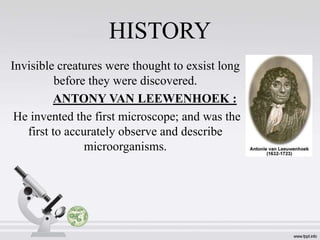
Invisible creatures were thought to exsist long
before they were discovered.
ANTONY VAN LEEWENHOEK :
He invented the first microscope; and was the
first to accurately observe and describe
microorganisms.
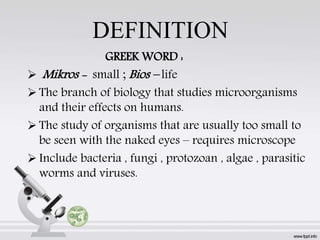
DEFINITION
GREEK WORD :
 Mikros - small ; Bios – life
 The branch of biology that studies microorganisms
and their effects on humans.
 The study of organisms that are usually too small to
be seen with the naked eyes – requires microscope
 Include bacteria , fungi , protozoan , algae , parasitic
worms and viruses.
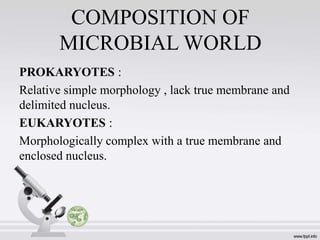
COMPOSITION OF
MICROBIAL WORLD
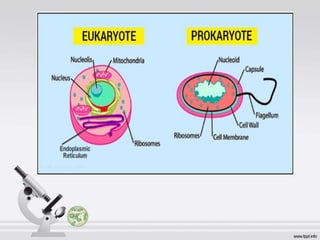
PROKARYOTES :
Relative simple morphology , lack true membrane and
delimited nucleus.
EUKARYOTES :
Morphologically complex with a true membrane and
enclosed nucleus.
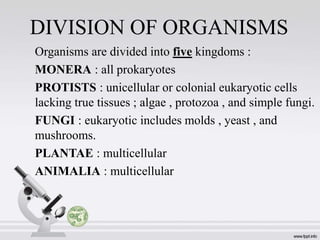
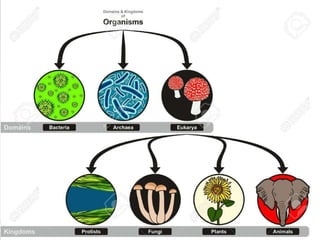
DIVISION OF ORGANISMS
Organisms are divided into five kingdoms :
MONERA : all prokaryotes
PROTISTS : unicellular or colonial eukaryotic cells
lacking true tissues ; algae , protozoa , and simple fungi.
FUNGI : eukaryotic includes molds , yeast , and
mushrooms.
PLANTAE : multicellular
ANIMALIA : multicellular
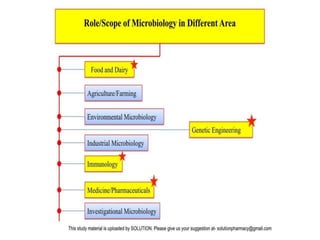
SCOPE OF MICROBIOLOGY
 There is vast scope in the field of microbiology due to
the advancement in the field of science and
technology.
 The scope in this field is immense due to the
involvement of microbiology in many fields like
medicine, pharmacy, diary, industry, clinical research,
water industry, agriculture and chemical technology.
FIELDS OF INTEREST
• Genetics
• Agriculture
• Food science
• Immunology
• Medicine
• Industry
Ecology and environment
 Bacteria are primary decomposers – recycle nutrients
back into the environment (sewage treatment plants)
 Winogradsky and M. Beijerinck ; studied soil
microbes and their role in the biochemical cycles of
sulfur, carbon, nitrogen etc.
 Insect Pest Control: some bacteria are used as bio-
pesticides to control Insects pest. Eg. Bacillus
thuringiensis
 Bioremediation: microbes are also used
to clean up pollutants and toxic wastes.
Eg. Pseudomonas putida; used to remove
petroleum spill .
Food microbiology
• Microbes are used in various food and dairy
industries to produce various food products
– cheese, pickles, green olives
– yogurt, soy sauce, vinegar, bread
– Beer, Wine, Alcohol
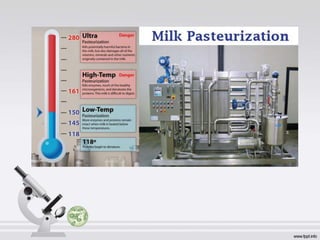
• Pasteur (1856) describe fermentation technology.
• He also developed the pasteurization technique to
preserve liquids.
•
Medicine: clinical and
pharmaceutical microbiology
 Disease Treatment: Microbes are used to produce
Antibiotics.
 Eg. Penicillium notatum (Penicillin); discovered by
Alexander Fleming (1928)
 Bacteria also synthesize vitamins which is needed for
our body.
 Example: E. coli
 Vitamin-B; needed for metabolism
 Vitamin-K; needed for blood
clotting
 Gene therapy for treatment of
genetic diseases.
Vaccine and immunology
 Vaccine activates immune response.
 Edward Jenner ; inoculated people with cowpox to
protect against smallpox.
 Pasteur developed the rabies vaccine (1885).
 Von Behring and Kitasato (1890) produced toxoid
vaccine against diphtheria and tetanus.
 Metchnikoff (1884) described the role of phagocytic
cells in defense.
Genetic engineering
• Microorganisms are used in Recombinant DNA
Technology or Genetic Engineering to manipulate
their gene for the production of useful products such
as enzymes, hormones, interferons, etc.
• Microorganisms are used as model organism in
molecular biology.
Biochemistry and physiology
 Microorganisms are used as a model for study of
many biochemical and physiological processes.
 study the synthesis of antibiotics and toxins,
microbial energy production, microbial nitrogen
fixation, effects of chemical and physical agents on
microbial growth and survival etc.
Industrial microbiology
 Microbes are used in economic and industrial
purposes.
 Biotechnology, fermentation technology, food and
beverages etc. are now established on large industrial
scale for income.
 Used to make products such as antibiotics, vaccines,
steroids, alcohols and other solvents, vitamins, amino
acids and enzymes.
Agriculture microbiology
 Genetic engineering is used for the production of
transgenic plants and animals.
 Animal and plant improvement by biotechnology for
better production, resistant to environmental
fluctuation.
 Molecular farming: transgenic animal or plant are
used as bioreactor for mass production.
Geochemical microbiology
Bioleaching: recovery of minerals from low
grade ores
 Geomicrobiology studies microorganisms that are
driving the Earth's biogeochemical cycles,
 mediating mineral precipitation and dissolution.
Exomicrobiology
Exploring for life in outer space.
 Astrobiology's efforts are aimed at understanding the
origins of life and the search for life other than on
Earth. Because microorganisms are the most
widespread form of life on Earth, and are capable of
colonizing almost any environment, scientists usually
focus on microbial life in the field of astrobiology.
 Moreover, small and simple cells usually
evolve first on a planet rather than
larger, multicellular organisms, and have an
increased likelihood of being transported from
one planet to other.
FUTURE OF
MICROBIOLOGY
 Future challenges such as finding new ways to
combat disease, reduce pollution and feed the world’s
population.
 AIDS, hemorrhagic fevers and other infectious
diseases.
 Create new drugs, vaccines. Use the techniques in
molecular biology and rDNA to solve the prob.
 Study the role of microorganisms as
Sources of high-quality food and other practical
products such as enzymes for industrial application
 Degrade pollutants and toxic wastes
 Used as vectors to treat diseases and enhance
agricultural productivity
REFERENCES
 https://microbenotes.com/scope-and-applications-of-microbiology/
 https://www.onlinebiologynotes.com/fields-scope-microbiology
 https://www.slideshare.net/naveebimal/scope-of-microbiology
 https://slideplayer.com/slide/11580148/
 https://www.jagranjosh.com/general-knowledge/what-is-the-difference-
between-prokaryotic-and-eukaryotic-cells-1523518350-1
 https://www.google.com/search?q=SCOPE+OF+MICROBIOLOGY+I
N+PHARMACY&hl.
Microbiology presentation

Microbiology presentation

  • 1.
    SCOPE OF MICROBIOLOGY PRESENTED TO: Ma’am Maria PRESENTED BY : Samawia Iqbal
  • 2.
    CONTEXT  BACKGROUND  HISTORY DEFINITION  COMPOSITION OF MICROBIAL WORLD  DIVISION OF ORGANISMS  SCOPE OF MICROBIOLOGY  FIELDS OF INTEREST  FUTURE OF MICROBIOLOGY
  • 3.
    BACKGROUND  Microorganisms areeverywhere ; almost every natural Surface is colonized by microbes , from body to oceans.  Most microorganisms are harmless ; you swallow million of microbes every second with no ill effects.  Microorganisms are relevent to all of us in a multitude of ways . The influence of microorganisms is both beneficial and detrimental also .
  • 4.
    HISTORY Invisible creatures werethought to exsist long before they were discovered. ANTONY VAN LEEWENHOEK : He invented the first microscope; and was the first to accurately observe and describe microorganisms.
  • 5.
    DEFINITION GREEK WORD : Mikros - small ; Bios – life  The branch of biology that studies microorganisms and their effects on humans.  The study of organisms that are usually too small to be seen with the naked eyes – requires microscope  Include bacteria , fungi , protozoan , algae , parasitic worms and viruses.
  • 6.
    COMPOSITION OF MICROBIAL WORLD PROKARYOTES: Relative simple morphology , lack true membrane and delimited nucleus. EUKARYOTES : Morphologically complex with a true membrane and enclosed nucleus.
  • 8.
    DIVISION OF ORGANISMS Organismsare divided into five kingdoms : MONERA : all prokaryotes PROTISTS : unicellular or colonial eukaryotic cells lacking true tissues ; algae , protozoa , and simple fungi. FUNGI : eukaryotic includes molds , yeast , and mushrooms. PLANTAE : multicellular ANIMALIA : multicellular
  • 10.
    SCOPE OF MICROBIOLOGY There is vast scope in the field of microbiology due to the advancement in the field of science and technology.  The scope in this field is immense due to the involvement of microbiology in many fields like medicine, pharmacy, diary, industry, clinical research, water industry, agriculture and chemical technology.
  • 11.
    FIELDS OF INTEREST •Genetics • Agriculture • Food science • Immunology • Medicine • Industry
  • 13.
    Ecology and environment Bacteria are primary decomposers – recycle nutrients back into the environment (sewage treatment plants)  Winogradsky and M. Beijerinck ; studied soil microbes and their role in the biochemical cycles of sulfur, carbon, nitrogen etc.  Insect Pest Control: some bacteria are used as bio- pesticides to control Insects pest. Eg. Bacillus thuringiensis
  • 14.
     Bioremediation: microbesare also used to clean up pollutants and toxic wastes. Eg. Pseudomonas putida; used to remove petroleum spill .
  • 15.
    Food microbiology • Microbesare used in various food and dairy industries to produce various food products – cheese, pickles, green olives – yogurt, soy sauce, vinegar, bread – Beer, Wine, Alcohol • Pasteur (1856) describe fermentation technology. • He also developed the pasteurization technique to preserve liquids. •
  • 17.
    Medicine: clinical and pharmaceuticalmicrobiology  Disease Treatment: Microbes are used to produce Antibiotics.  Eg. Penicillium notatum (Penicillin); discovered by Alexander Fleming (1928)  Bacteria also synthesize vitamins which is needed for our body.  Example: E. coli
  • 18.
     Vitamin-B; neededfor metabolism  Vitamin-K; needed for blood clotting  Gene therapy for treatment of genetic diseases.
  • 19.
    Vaccine and immunology Vaccine activates immune response.  Edward Jenner ; inoculated people with cowpox to protect against smallpox.  Pasteur developed the rabies vaccine (1885).  Von Behring and Kitasato (1890) produced toxoid vaccine against diphtheria and tetanus.  Metchnikoff (1884) described the role of phagocytic cells in defense.
  • 20.
    Genetic engineering • Microorganismsare used in Recombinant DNA Technology or Genetic Engineering to manipulate their gene for the production of useful products such as enzymes, hormones, interferons, etc. • Microorganisms are used as model organism in molecular biology.
  • 21.
    Biochemistry and physiology Microorganisms are used as a model for study of many biochemical and physiological processes.  study the synthesis of antibiotics and toxins, microbial energy production, microbial nitrogen fixation, effects of chemical and physical agents on microbial growth and survival etc.
  • 22.
    Industrial microbiology  Microbesare used in economic and industrial purposes.  Biotechnology, fermentation technology, food and beverages etc. are now established on large industrial scale for income.  Used to make products such as antibiotics, vaccines, steroids, alcohols and other solvents, vitamins, amino acids and enzymes.
  • 23.
    Agriculture microbiology  Geneticengineering is used for the production of transgenic plants and animals.  Animal and plant improvement by biotechnology for better production, resistant to environmental fluctuation.  Molecular farming: transgenic animal or plant are used as bioreactor for mass production.
  • 24.
    Geochemical microbiology Bioleaching: recoveryof minerals from low grade ores  Geomicrobiology studies microorganisms that are driving the Earth's biogeochemical cycles,  mediating mineral precipitation and dissolution.
  • 25.
    Exomicrobiology Exploring for lifein outer space.  Astrobiology's efforts are aimed at understanding the origins of life and the search for life other than on Earth. Because microorganisms are the most widespread form of life on Earth, and are capable of colonizing almost any environment, scientists usually focus on microbial life in the field of astrobiology.
  • 26.
     Moreover, smalland simple cells usually evolve first on a planet rather than larger, multicellular organisms, and have an increased likelihood of being transported from one planet to other.
  • 27.
    FUTURE OF MICROBIOLOGY  Futurechallenges such as finding new ways to combat disease, reduce pollution and feed the world’s population.  AIDS, hemorrhagic fevers and other infectious diseases.  Create new drugs, vaccines. Use the techniques in molecular biology and rDNA to solve the prob.
  • 28.
     Study therole of microorganisms as Sources of high-quality food and other practical products such as enzymes for industrial application  Degrade pollutants and toxic wastes  Used as vectors to treat diseases and enhance agricultural productivity
  • 29.
    REFERENCES  https://microbenotes.com/scope-and-applications-of-microbiology/  https://www.onlinebiologynotes.com/fields-scope-microbiology https://www.slideshare.net/naveebimal/scope-of-microbiology  https://slideplayer.com/slide/11580148/  https://www.jagranjosh.com/general-knowledge/what-is-the-difference- between-prokaryotic-and-eukaryotic-cells-1523518350-1  https://www.google.com/search?q=SCOPE+OF+MICROBIOLOGY+I N+PHARMACY&hl.