Dr. Archana Dutta
Study material for M.Sc Botany First
semester
Assistant Professor(Guest Faculty)
Dept. of Botany, MLT College, Saharsa
archana77.das@gmail.com
Mob No. - 9065558829
DEFINITION, SCOPE AND
HISTORY OF MICROBIOLOGY.
DEFINITION AND SCOPE OF MICROBIOLOGY
Microbiology is a branch of science that deals with the structure, function, classes and
economic importance of microorganisms. Microbiology is one of the exciting; ever
developing field of science with greater scopes as the microbes play a major role in our day
to day life. This chapter introduces the subject of microbiology to the undergraduate
beginners who have little knowledge about this subject.
1.1. DEFINITION OF MICROBIOLOGY
Microbiology is defined as the study of organisms and agents that are too small to be seen
clearly by the unaided eye. To be more simple, microbiology is the study of microorganisms
which are the living organisms of microscopic size. Microorganisms are the living
organisms that are less than 1 millimeter in diameter which cannot be seen by our naked eye.
Microorganisms can be viewed through microscopes and they can exist as single cells or
clusters. Microorganisms include the cellular organisms like bacteria, fungi, algae and
protozoa. Viruses are also included as one of the microorganism but they are acellular.
1.2. DIFFERENCE BETWEEN MICROBIAL CELL AND PLANT/ANIMAL CELL
S. No Microbial cell Plant/Animal cell
(a) A microbial cell can live alone Plant or animal cell exist only as part of
organisms
(b) Growth, energy generation and
reproduction by a microbial cell are
independent
Plant or animal cell depend on other cells for
all processes
1.3. OCCURRENCE OF MICROORGANISMS
One of the interesting things about the microorganism is that, they occur everywhere, even
in the atmosphere, water and soil. Almost all natural surfaces are colonized by microbes.
Some microorganisms are even adapted to live comfortably in boiling hot springs and frozen
sea ice. Microbes are the dominant form of life in the universe. More than 50 per cent of the
biomass on earth consists of microorganisms compared to animals which constitute only 15
per cent of the mass of living organisms on earth. Majority of the microorganisms are not
dangerous to humans. In fact, microbes help to digest our food and protect our bodies from
pathogens. Additionally, they are considered as beneficial ones as they keep the biosphere
running by carrying out essential functions such as decomposition of dead animals and plants,
nutrient cycling which enhances the soil health and crop productivity.
1.4. MEMBERS OF THE MICROBIAL WORLD
Based on the structure of nucleus, fundamentally two types of cells exist. They are
i. Prokaryotes and
ii. Eukaryotes
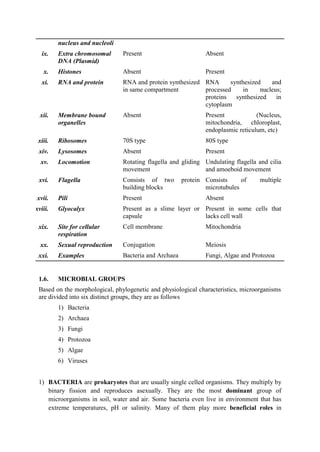
PROKARYOTIC CELLS
Prokayote is a Greek word, pro - before and karyon - nut or kernel. Prokaryotes are the
organism with a primordial nucleus. They have a much simpler morphology than eukaryotic
cells and lack a true membrane bound nucleus and cell organelles like mitochondria, golgi
bodies, endoplasmic reticulum, etc. All bacteria and archaea are prokaryotic.
EUKARYOTIC CELLS
Eukaryote is a Greek word, eu - true and karyon - nut or kernel. Eukaryotes posses a
membrane enclosed nucleus and cell organelles. They are more complex morphologically and
are usually larger than prokaryotes. Algae, fungi, protozoa, higher plants and animals are
eukaryotic.
1.5. DIFFERENCE BETWEEN PROKARYOTES AND EUKARYOTES
Characteristics Prokaryotes Eukaryotes
i. Cell size Generally 1 to 10 µm in
linear dimension
Generally 5 to 100 µm in
linear dimension
ii. Cell division Binary fission Mitosis
iii. Cellular organism Unicellular Mostly multicellular with
differentiation of many types
iv. Cell wall Complex structure with
peptidoglycan layer, protein
and lipids
Absent or composed of
cellulose or chitin
v. Plasma membrane Present, no sterols except in
mycoplasma
Present, contain sterols
vi. Metabolism Anaerobic or aerobic Aerobic
vii. DNA Circular DNA in cytoplasm Very long, linear DNA
molecule bounded by
nuclear envelope
viii. Membrane bound Absent Present
nucleus and nucleoli
ix. Extra chromosomal
DNA (Plasmid)
Present Absent
x. Histones Absent Present
xi. RNA and protein RNA and protein synthesized
in same compartment
RNA synthesized and
processed in nucleus;
proteins synthesized in
cytoplasm
xii. Membrane bound
organelles
Absent Present (Nucleus,
mitochondria, chloroplast,
endoplasmic reticulum, etc)
xiii. Ribosomes 70S type 80S type
xiv. Lysosomes Absent Present
xv. Locomotion Rotating flagella and gliding
movement
Undulating flagella and cilia
and amoeboid movement
xvi. Flagella Consists of two protein
building blocks
Consists of multiple
microtubules
xvii. Pili Present Absent
xviii. Glyocalyx Present as a slime layer or
capsule
Present in some cells that
lacks cell wall
xix. Site for cellular
respiration
Cell membrane Mitochondria
xx. Sexual reproduction Conjugation Meiosis
xxi. Examples Bacteria and Archaea Fungi, Algae and Protozoa
1.6. MICROBIAL GROUPS
Based on the morphological, phylogenetic and physiological characteristics, microorganisms
are divided into six distinct groups, they are as follows
1) Bacteria
2) Archaea
3) Fungi
4) Protozoa
5) Algae
6) Viruses
1) BACTERIA are prokaryotes that are usually single celled organisms. They multiply by
binary fission and reproduces asexually. They are the most dominant group of
microorganisms in soil, water and air. Some bacteria even live in environment that has
extreme temperatures, pH or salinity. Many of them play more beneficial roles in
nutrient cycling, decomposition of organic matter, production of commercial industrial
products like vitamins, antibiotics, etc. Wherein, some of them cause diseases and food
spoilage. Ex: Bacillus, Pseudomonas.
2) ARCHAEA are phylogenetically related prokaryotes that are distinguished from
bacteria by many features, most notably their unique ribosomal RNA sequences. Many
archaea are found in extreme environments. Some have unusual metabolic
characteristics, such as the methanogens, which generate methane gas. Ex:
Methanobacterium.
3) ALGAE are eukaryotes that contain chlorophyll and are capable of performing
photosynthesis. Algae are found most commonly in aquatic environments. They
reproduce either sexually or asexually. Mostly they are used as food supplements. They
are mainly used in the preparation of agar. Ex: Spirulina, Gelidium.
4) FUNGI are eukaryotes. Next to bacteria, they are the most dominant organism in the
soil. In general, fungi range in size and shape from single-celled microscopic yeasts to
gaint multicellular mushrooms. They possess filamentous mycelium composed of
individual hyphae and reproduce either sexually or asexually by fission, budding or by
means of spores borne on fruiting structures. Unicellular fungi like yeast are involved in
the production of alcoholic beverages like wine and beer. Multicellular fungi like molds
are useful for industrial production of antibiotics like penicillin. Ex: Mucor, Rhizopus.
5) PROTOZOA are unicellular eukaryotes that are usually motile and lack cell wall.
Many free living protozoa function as the primary hunters and grazers of the microbial
world. They can be found in many different environments and some are normal
inhabitants of the intestinal tracts of animals, where they aid in digestion of complex
materials such as cellulose. Some of them are parasitic and can cause diseases. Ex:
Amoeba, Paramecium.
6) VIRUSES are acellular (non cellular) organisms that are too small and can be visualized
only using electron microscopes. All are obligate parasites that require a living cell for
reproduction. They are pathogenic to plants, animals and humans. At most of the cases
they cause human diseases. Ex: Cauliflower mosaic virus, Cucumber mosaic virus.
1.7. SCOPE OF MICROBIOLOGY
Currently, we are in the era of Microbiology. Microorganisms are recognized as the basic
research tools as they help to understand the chemical and physical basis of life as they are
the dominant group of living organisms in the biosphere and are actively involved in our day
to day activities. Microbiology primarily paves way to analyze the biochemical and genetic
background of living things. Moreover as microbes are the excellent models for
understanding the cell functions and as they play important role in the field of medicine,
agriculture and industry that assures human welfare, microbiology is considered as one of the
vital branch of science with utmost promising scopes. Microbiology is not just one small
subject to be explored. It has nearly six major branches. They are as follows,
1. Agricultural Microbiology deals with soil nutrient cycling by microbes, microbial
decomposition of organic wastes, plant associated microbes that enhance soil fertility,
etc.
2. Food Microbiology covers information about the microbes involved in food spoilage,
food borne diseases, commercial food products prepared using microbes, etc.
3. Industrial Microbiology explores the utility of microbes in the production of
antibiotics, enzymes, alcoholic beverages, fermented food products, etc.
4. Medical Microbiology deals with the studies related to the microbes that causes
diseases, their diagnostic and preventive measures, drug designing, etc.
5. Aquatic Microbiology deals with water purification and biological degradation of
wastes in aquatic ecosystems by microbes.
6. Aero Microbiology talks about the microorganisms prevalent in air, their abundance
and beneficial or harmful issues.
7. Exomicrobiology is all about the exploration of life in outer space.
8. Geochemical Microbiology analyses the microbial life and their contribution in coal,
oil and gas formation areas.
As each branch of microbiology have got their own specialization that contribute to the
development of science and technology, always microbiology are crowned as innovate, ever
green branch of biology that have wider scopes for the emerging scientists to be explored. We
are living in the world of microbes without which life won’t be trouble-free and comfy.
LETURE 2 &3 Biogenesis and a biogenesis theory. Contributions by Antonie Van
Leeuwenhoek, Louis Pasteur, Contributions of John Tyndall, Joseph Lister, Edward
Jenner, Robert Koch, Alexander Fleming and Waksman. Germ theory of
fermentation and disease
The field of microbiology developed further and gained its importance after the fascinating
discoveries later than 1600’s by the discovery of microscopes by pioneer scientists. The
important discoveries that contributed much to the discipline of microbiology is the conflict
over the ā€˜Theory of Spontaneous Generation’ followed by ā€˜Koch’s Postulates’ that
completely changed the view of microorganisms. This chapter gives a vivid outlook on the
contributions of many pioneers like Pasteur, Koch, etc.
2.1. ROBERT HOOKE (1635 – 1700)
Hooke was the first person to discover the cell (honey comb like structures) from the cross
sections of a cork. He noticed some microscopic fungi too. He also developed simple
microscopes of 30x magnification and observed few microorganisms.
2.2. ANTONY VAN LEEUWENHOEK (1632 – 1723)
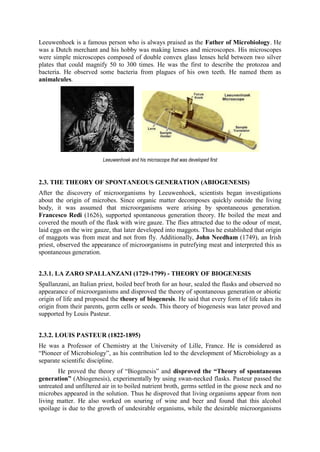
Leeuwenhoek is a famous person who is always praised as the Father of Microbiology. He
was a Dutch merchant and his hobby was making lenses and microscopes. His microscopes
were simple microscopes composed of double convex glass lenses held between two silver
plates that could magnify 50 to 300 times. He was the first to describe the protozoa and
bacteria. He observed some bacteria from plagues of his own teeth. He named them as
animalcules.
Leeuwenhoek and his microscope that was developed first
2.3. THE THEORY OF SPONTANEOUS GENERATION (ABIOGENESIS)
After the discovery of microorganisms by Leeuwenhoek, scientists began investigations
about the origin of microbes. Since organic matter decomposes quickly outside the living
body, it was assumed that microorganisms were arising by spontaneous generation.
Francesco Redi (1626), supported spontaneous generation theory. He boiled the meat and
covered the mouth of the flask with wire gauze. The flies attracted due to the odour of meat,
laid eggs on the wire gauze, that later developed into maggots. Thus he established that origin
of maggots was from meat and not from fly. Additionally, John Needham (1749), an Irish
priest, observed the appearance of microorganisms in putrefying meat and interpreted this as
spontaneous generation.
2.3.1. LA ZARO SPALLANZANI (1729-1799) - THEORY OF BIOGENESIS
Spallanzani, an Italian priest, boiled beef broth for an hour, sealed the flasks and observed no
appearance of microorganisms and disproved the theory of spontaneous generation or abiotic
origin of life and proposed the theory of biogenesis. He said that every form of life takes its
origin from their parents, germ cells or seeds. This theory of biogenesis was later proved and
supported by Louis Pasteur.
2.3.2. LOUIS PASTEUR (1822-1895)
He was a Professor of Chemistry at the University of Lille, France. He is considered as
ā€œPioneer of Microbiologyā€, as his contribution led to the development of Microbiology as a
separate scientific discipline.
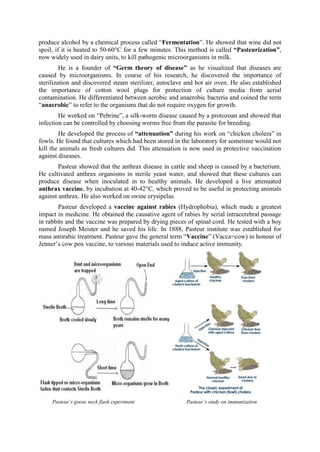
He proved the theory of ā€œBiogenesisā€ and disproved the ā€œTheory of spontaneous
generationā€ (Abiogenesis), experimentally by using swan-necked flasks. Pasteur passed the
untreated and unfiltered air in to boiled nutrient broth, germs settled in the goose neck and no
microbes appeared in the solution. Thus he disproved that living organisms appear from non
living matter. He also worked on souring of wine and beer and found that this alcohol
spoilage is due to the growth of undesirable organisms, while the desirable microorganisms
produce alcohol by a chemical process called ā€œFermentationā€. He showed that wine did not
spoil, if it is heated to 50-60°C for a few minutes. This method is called ā€œPasteurizationā€,
now widely used in dairy units, to kill pathogenic microorganisms in milk.
He is a founder of ā€œGerm theory of diseaseā€ as he visualized that diseases are
caused by microorganisms. In course of his research, he discovered the importance of
sterilization and discovered steam sterilizer, autoclave and hot air oven. He also established
the importance of cotton wool plugs for protection of culture media from aerial
contamination. He differentiated between aerobic and anaerobic bacteria and coined the term
ā€œanaerobicā€ to refer to the organisms that do not require oxygen for growth.
He worked on ā€œPebrineā€, a silk-worm disease caused by a protozoan and showed that
infection can be controlled by choosing worms free from the parasite for breeding.
He developed the process of ā€œattenuationā€ during his work on ā€œchicken choleraā€ in
fowls. He found that cultures which had been stored in the laboratory for sometime would not
kill the animals as fresh cultures did. This attenuation is now used in protective vaccination
against diseases.
Pasteur showed that the anthrax disease in cattle and sheep is caused by a bacterium.
He cultivated anthrax organisms in sterile yeast water, and showed that these cultures can
produce disease when inoculated in to healthy animals. He developed a live attenuated
anthrax vaccine, by incubation at 40-42°C, which proved to be useful in protecting animals
against anthrax. He also worked on swine erysipelas.
Pasteur developed a vaccine against rabies (Hydrophobia), which made a greatest
impact in medicine. He obtained the causative agent of rabies by serial intracerebral passage
in rabbits and the vaccine was prepared by drying pieces of spinal cord. He tested with a boy
named Joseph Meister and he saved his life. In 1888, Pasteur institute was established for
mass antirabic treatment. Pasteur gave the general term ā€œVaccineā€ (Vacca=cow) in honour of
Jenner’s cow pox vaccine, to various materials used to induce active immunity.
Pasteur’s goose neck flask experiment Pasteur’s study on immunization
2.3.3. JOHN TYNDALL (1820-1893)
He designed a special chamber to free the dust in the air and kept the sterile broth in the
chamber. No microbial growth was observed when a sterilized broth was kept in the chamber.
Thus, he proved that dust in the air carried the germs and this is the source for the growth of
microorganisms and not the spontaneous generation. He also developed a sterilization method
called tyndallization. Tyndallization is otherwise called as the intermittent or fractional
sterilization. In case of tyndallization, subsequent heating and cooling by steam for 3 days
will remove the germs and their spores. Heating at 100o
C kills the vegetative cells. The spore
forms are killed on subsequent heating upon germination of spores.
2.4. ROBERT KOCH (1843-1912)/KOCH’S POSTULATES
He was a German country Doctor who later became the Professor of hygiene and Director of
institute of infective diseases at Berlin. He perfected many bacteriological techniques and
known as ā€œFather of Practical Bacteriologyā€.
He discovered rod shaped organisms in the blood of animals that died of anthrax. He
experimentally obtained the anthrax organisms in pure culture on a depression slide by
inoculation of infected blood into the aqueous humour of a bullock’s eye. He observed
multiplication of bacteria and spore formation. He injected these spores into mice and
reproduced the disease. He found that in certain conditions, the anthrax bacillus forms spores,
that can survive on earth for years. He passed anthrax bacilli, from the blood of an infected
animal, from one mouse to another through twenty generations, and found that they bred true.
He worked out its life-history.
He introduced staining techniques. He prepared dried bacterial films (Smears) on
glass slides and stained them with aniline dyes for producing a better contrast under
microscope. He discovered tubercle bacillus (Mycobacterium tuberculosis) which is
popularly called as Koch’s bacillus. He injected tubercle bacilli into laboratory animals and
reproduced the disease, satisfying all Koch’s postulates.
He discovered Vibrio cholerae, the causative agent of cholera disease. He developed
pure culture techniques by introducing solid media. The use of agar-agar obtained from dried
sea weeds (Gelidium Sp.) in the preparation of solid bacteriological media was first suggested
by Frau Hesse, the wife of Koch’ student. This agar-agar is totally inert with no nutritive
value, solidifies at 45°C and melts at 90°C, and was found to be most suitable solidifying
agent in the preparation of culture media. Koch isolated bacteria in pure cultures on these
solid media. It revolutionized bacteriology.
He discovered ā€œOld Tuberculinā€. Koch noted that when tubercle bacilli or its protein
extract was injected into a Guinea-pig already infected with the bacillus, an exaggerated
reaction took place and the reaction remains localized. This is popularly called ā€œKoch
Phenomenonā€ and it is a demonstration of cell mediated immunity. The tuberculin test is
based on Koch’s phenomenon. He erroneously thought that protein extracted from tubercle
bacilli, called ā€œOld tuberculinā€, could be used in the treatment of tuberculosis. Koch did a
series of experiments to fulfill the criteria laid by his teacher Henle to establish the causative
role between a particular microorganism and a particular disease. They are popularly known
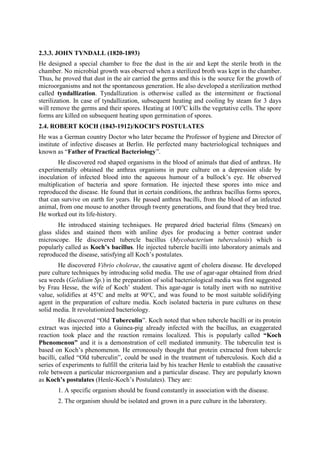
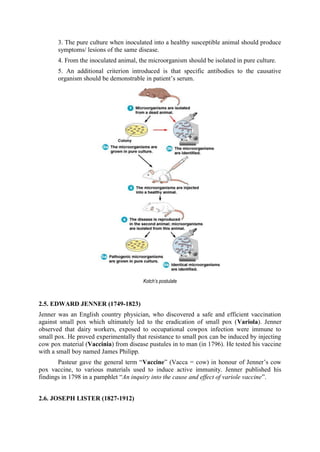
as Koch’s postulates (Henle-Koch’s Postulates). They are:
1. A specific organism should be found constantly in association with the disease.
2. The organism should be isolated and grown in a pure culture in the laboratory.
3. The pure culture when inoculated into a healthy susceptible animal should produce
symptoms/ lesions of the same disease.
4. From the inoculated animal, the microorganism should be isolated in pure culture.
5. An additional criterion introduced is that specific antibodies to the causative
organism should be demonstrable in patient’s serum.
Kotch’s postulate
2.5. EDWARD JENNER (1749-1823)
Jenner was an English country physician, who discovered a safe and efficient vaccination
against small pox which ultimately led to the eradication of small pox (Variola). Jenner
observed that dairy workers, exposed to occupational cowpox infection were immune to
small pox. He proved experimentally that resistance to small pox can be induced by injecting
cow pox material (Vaccinia) from disease pustules in to man (in 1796). He tested his vaccine
with a small boy named James Philipp.
Pasteur gave the general term ā€œVaccineā€ (Vacca = cow) in honour of Jenner’s cow
pox vaccine, to various materials used to induce active immunity. Jenner published his
findings in 1798 in a pamphlet ā€œAn inquiry into the cause and effect of variole vaccineā€.
2.6. JOSEPH LISTER (1827-1912)
He is popularly known as ā€œFather of antiseptic surgeryā€. He was a professor of surgey at
University of Glasgow and Edinburg and later at King’s College, London. He was deeply
interested in the prevention of post-operative sepsis. He was attracted by Pasteur’s germ
theory of disease and concluded that sepsis or wound infection may be due to microbial
growth, derived from the atmosphere.
He successfully prevented post-operative sepsis by introducing antiseptic techniques.
He chose carbolic acid (Phenol) and used as spray on the wound or during surgery. He
applied dressings soaked in carbolic acid on wounds. As a result, there was a marked
reduction of post-operative sepsis, wound inflammation and suppuration. It saved millions of
lives from the jaws of death due to wound infections.
Lister’s antiseptic surgery later led to the development of aseptic surgery. He suffered
much criticism but never lose courage and followed his own ideas and revolutionized the
science of surgery by introducing antiseptic system in 1867.
2.7. IWANOWSKY (1892)
Dmitri Iwanowsky, a Russian botanist, occupies a pivotal position in the history of virology.
In 1866, Adeolf E. Meyer, a Dutch agricultural chemist described a disease of tobacco called
ā€œMosaicā€ and showed that the disease could be transmitted to healthy plants through the sap
of the diseased plant.
Iwanowsky (1892) demonstrated that this disease was caused by an agent which could
pass through the filter, which withholds bacteria. He obtained the sap from infected leaves
and passed it through a bacterial filter, called chamberland candle filter, which retained all
bacteria and the filtered sap still retained infectivity when applied to healthy leaves.
Beijerinck (1898), a Dutch Microbiologist, showed that this infectious agent could
diffuse through an agar gel and that it was a non-corpuscular ā€œContagion vivum fluidumā€
which he called ā€œVirusā€.
Stanley (1935), a British Mycologist was able to obtain the infectious agent of
tobacco mosaic in a crystalline form.
2.8. METCHNIKOFF (1845-1916)
Elie Metchnikoff, the Russian-French biologist, discovered the phenomenon of phagocytosis,
the cellular concept of immunity. In Italy, where he had gone on a research visit, he studied
the transparent larvae of starfish and noticed some of their cells could engulf and digest
foreign protein particles. These cell eaters are called ā€œPhagocytesā€.
He continued his work on phagocytic action, at Pasteur Institure, Paris and found that
in human blood a large proportion of the leucocytes (White blood cells) are phagocytic and
attack invading bacteria.
This, in turn, results in increased numbers of leucocytes in the infected areas followed
by the inflamed area becoming hot, red, swelled and painful due to dead phagocytes forming
pus. He spent his last two decades on the study of human aging, since he believed that
phagocytes eventually begin to digest the host cells aided by the effects of intestinal bacteria
and that effectively combating them would increase the life span of human being.
2.9. SELMAN A WAKSMAN (1945)
He is an American microbiologist. He isolated Thiobacillus thiooxidans which is an
important discovery before he identified Streptomycin antibiotic from soil bacterium. In
1939 Waksman and his colleagues undertook a systematic effort to identify soil organisms
producing soluble substances that might be useful in the control of infectious diseases, what
are now known as antibiotics. Within a decade ten antibiotics were isolated and
characterized. Three of them with important clinical applications - actinomycin in 1940,
streptomycin in 1944, and neomycin in 1949. Eighteen antibiotics were discovered under his
general direction.
2.10. ALEXANDER FLEMMING (1881-1955)
He was an English scientist worked at St. Mary’s hospital in London. Flemming was
associated with two major discoveries - lysozyme and penicillin. In 1922, he discovered
lysozyme by demonstrating that the nasal secretion has the power of dissolving or lysing
certain kinds of bacteria. Subsequently, he showed that lysozyme was present in many tissues
of the body.
In 1929, Flemming made an accidental discovery that the fungus Penicillium notatum
produces an antibacterial substance which he called penicillin. Flemming was culturing
Staphylococci in Petridishes and some of his cultures were contaminated with a mold,
subsquently indetified as Penicillium notatum.
Around the mold colony, there were clear zones, where Staphylococci disappeared.
Flemming attributed this to the production of an antibacterial substance by the mold.
Flemming cultured the fungus Penicilium notatum in broth cultures, filtered the fungal mat
and obtained the penicillin in soluble form in the culture filtrate.
In 1940, Howard Florey and Ernst Chain demonstrated its antibacterial action in vivo.
Working in U.S.A., they were able to produce large quantities of penicillin in pure form. In
1945, Flemming, Florey and Chain shared the nobel prize in physiology and medicine for the
discovery of penicillin.
2.11. PAUL EHRLICH (1854-1915)
He was a German Bacteriologist, who pioneered the technique of chemotheraphy in
medicine. From his discovery that certain tissues have a specific affinity, he reasoned that
organisms causing diseases could be selectively killed with chemical drugs. This led him to
produce ā€œarsphenamineā€ (an arsenic compound), the first synthetic drug, which destroyed the
syphilis microbe in the body.
Ehrlich observed that organic arsenicals killed trypanosomes in an infected animal,
but, if smaller doses were administered, the trypanosomes acquired tolerance to the drug.
Therefore, he aimed at ā€œtherapia magna sterilansā€ i.e., the introduction into the blood of a
single dose of chemotherapeutic agent sufficient to kill the parasite. He also observed that
drug would undergo certain changes in the body after it would produce the desired action.
2.12. MARTINUS W. BEIJERINCK, (1851-1931)
He developed the enrichment culture technique, simultaneously with Sergey Winogradsky,
which permits the isolation of highly specialized microorganisms. Beijerinck cultivated and
isolated Bacillus radicicola (later named as Rhizobium leguminosarum), a bacteria that fixes
free nitrogen and causes the formation of nodules on the roots of Legumes. He also
characterized Azobacter as nitrogen-fixing, and isolated the new genus, Aerobacter. Isolated
sulphur reducing bacteria and sulphur oxidizing bacteria from soil. In studying tobacco
mosaic disease, he concluded that the filterable pathogen was a contagium vivum fluidum, a
term coined to convey his concept of a living infectious agent in a fluid (noncellular) form.
2.13. SERGEY WINOGRADSKY (1856 – 1953)
He developed Enrichment Culture Technique for the isolation of Beggiatoa sp. He
explained the chemoautotrophic nature of bacteria and initially called them as
"anorgoxydants." He also identified the process of Nitrification; isolated the nitrifying
bacteria Nitrobacter and isolated Azotobacter chroococcum and proved its nitrogen fixing
capacity. Due to his varied contributions in soil microbiology he is considered as the ā€œFather
of Soil Microbiologyā€. Additionally, he identified the Chemolithotrophic nutrition of soil
bacteria and also discovered anaerobic nitrogen fixing bacterium Clostridium pasteurianum.

Scope-and-history-of-Microbiology.pdf

  • 1.
    Dr. Archana Dutta Studymaterial for M.Sc Botany First semester Assistant Professor(Guest Faculty) Dept. of Botany, MLT College, Saharsa archana77.das@gmail.com Mob No. - 9065558829 DEFINITION, SCOPE AND HISTORY OF MICROBIOLOGY.
  • 2.
    DEFINITION AND SCOPEOF MICROBIOLOGY Microbiology is a branch of science that deals with the structure, function, classes and economic importance of microorganisms. Microbiology is one of the exciting; ever developing field of science with greater scopes as the microbes play a major role in our day to day life. This chapter introduces the subject of microbiology to the undergraduate beginners who have little knowledge about this subject. 1.1. DEFINITION OF MICROBIOLOGY Microbiology is defined as the study of organisms and agents that are too small to be seen clearly by the unaided eye. To be more simple, microbiology is the study of microorganisms which are the living organisms of microscopic size. Microorganisms are the living organisms that are less than 1 millimeter in diameter which cannot be seen by our naked eye. Microorganisms can be viewed through microscopes and they can exist as single cells or clusters. Microorganisms include the cellular organisms like bacteria, fungi, algae and protozoa. Viruses are also included as one of the microorganism but they are acellular. 1.2. DIFFERENCE BETWEEN MICROBIAL CELL AND PLANT/ANIMAL CELL S. No Microbial cell Plant/Animal cell (a) A microbial cell can live alone Plant or animal cell exist only as part of organisms (b) Growth, energy generation and reproduction by a microbial cell are independent Plant or animal cell depend on other cells for all processes 1.3. OCCURRENCE OF MICROORGANISMS One of the interesting things about the microorganism is that, they occur everywhere, even in the atmosphere, water and soil. Almost all natural surfaces are colonized by microbes. Some microorganisms are even adapted to live comfortably in boiling hot springs and frozen sea ice. Microbes are the dominant form of life in the universe. More than 50 per cent of the biomass on earth consists of microorganisms compared to animals which constitute only 15 per cent of the mass of living organisms on earth. Majority of the microorganisms are not dangerous to humans. In fact, microbes help to digest our food and protect our bodies from pathogens. Additionally, they are considered as beneficial ones as they keep the biosphere running by carrying out essential functions such as decomposition of dead animals and plants, nutrient cycling which enhances the soil health and crop productivity. 1.4. MEMBERS OF THE MICROBIAL WORLD Based on the structure of nucleus, fundamentally two types of cells exist. They are i. Prokaryotes and ii. Eukaryotes
  • 3.
    PROKARYOTIC CELLS Prokayote isa Greek word, pro - before and karyon - nut or kernel. Prokaryotes are the organism with a primordial nucleus. They have a much simpler morphology than eukaryotic cells and lack a true membrane bound nucleus and cell organelles like mitochondria, golgi bodies, endoplasmic reticulum, etc. All bacteria and archaea are prokaryotic. EUKARYOTIC CELLS Eukaryote is a Greek word, eu - true and karyon - nut or kernel. Eukaryotes posses a membrane enclosed nucleus and cell organelles. They are more complex morphologically and are usually larger than prokaryotes. Algae, fungi, protozoa, higher plants and animals are eukaryotic. 1.5. DIFFERENCE BETWEEN PROKARYOTES AND EUKARYOTES Characteristics Prokaryotes Eukaryotes i. Cell size Generally 1 to 10 µm in linear dimension Generally 5 to 100 µm in linear dimension ii. Cell division Binary fission Mitosis iii. Cellular organism Unicellular Mostly multicellular with differentiation of many types iv. Cell wall Complex structure with peptidoglycan layer, protein and lipids Absent or composed of cellulose or chitin v. Plasma membrane Present, no sterols except in mycoplasma Present, contain sterols vi. Metabolism Anaerobic or aerobic Aerobic vii. DNA Circular DNA in cytoplasm Very long, linear DNA molecule bounded by nuclear envelope viii. Membrane bound Absent Present
  • 4.
    nucleus and nucleoli ix.Extra chromosomal DNA (Plasmid) Present Absent x. Histones Absent Present xi. RNA and protein RNA and protein synthesized in same compartment RNA synthesized and processed in nucleus; proteins synthesized in cytoplasm xii. Membrane bound organelles Absent Present (Nucleus, mitochondria, chloroplast, endoplasmic reticulum, etc) xiii. Ribosomes 70S type 80S type xiv. Lysosomes Absent Present xv. Locomotion Rotating flagella and gliding movement Undulating flagella and cilia and amoeboid movement xvi. Flagella Consists of two protein building blocks Consists of multiple microtubules xvii. Pili Present Absent xviii. Glyocalyx Present as a slime layer or capsule Present in some cells that lacks cell wall xix. Site for cellular respiration Cell membrane Mitochondria xx. Sexual reproduction Conjugation Meiosis xxi. Examples Bacteria and Archaea Fungi, Algae and Protozoa 1.6. MICROBIAL GROUPS Based on the morphological, phylogenetic and physiological characteristics, microorganisms are divided into six distinct groups, they are as follows 1) Bacteria 2) Archaea 3) Fungi 4) Protozoa 5) Algae 6) Viruses 1) BACTERIA are prokaryotes that are usually single celled organisms. They multiply by binary fission and reproduces asexually. They are the most dominant group of microorganisms in soil, water and air. Some bacteria even live in environment that has extreme temperatures, pH or salinity. Many of them play more beneficial roles in
  • 5.
    nutrient cycling, decompositionof organic matter, production of commercial industrial products like vitamins, antibiotics, etc. Wherein, some of them cause diseases and food spoilage. Ex: Bacillus, Pseudomonas. 2) ARCHAEA are phylogenetically related prokaryotes that are distinguished from bacteria by many features, most notably their unique ribosomal RNA sequences. Many archaea are found in extreme environments. Some have unusual metabolic characteristics, such as the methanogens, which generate methane gas. Ex: Methanobacterium. 3) ALGAE are eukaryotes that contain chlorophyll and are capable of performing photosynthesis. Algae are found most commonly in aquatic environments. They reproduce either sexually or asexually. Mostly they are used as food supplements. They are mainly used in the preparation of agar. Ex: Spirulina, Gelidium. 4) FUNGI are eukaryotes. Next to bacteria, they are the most dominant organism in the soil. In general, fungi range in size and shape from single-celled microscopic yeasts to gaint multicellular mushrooms. They possess filamentous mycelium composed of individual hyphae and reproduce either sexually or asexually by fission, budding or by means of spores borne on fruiting structures. Unicellular fungi like yeast are involved in the production of alcoholic beverages like wine and beer. Multicellular fungi like molds are useful for industrial production of antibiotics like penicillin. Ex: Mucor, Rhizopus. 5) PROTOZOA are unicellular eukaryotes that are usually motile and lack cell wall. Many free living protozoa function as the primary hunters and grazers of the microbial world. They can be found in many different environments and some are normal inhabitants of the intestinal tracts of animals, where they aid in digestion of complex materials such as cellulose. Some of them are parasitic and can cause diseases. Ex: Amoeba, Paramecium. 6) VIRUSES are acellular (non cellular) organisms that are too small and can be visualized only using electron microscopes. All are obligate parasites that require a living cell for reproduction. They are pathogenic to plants, animals and humans. At most of the cases they cause human diseases. Ex: Cauliflower mosaic virus, Cucumber mosaic virus. 1.7. SCOPE OF MICROBIOLOGY Currently, we are in the era of Microbiology. Microorganisms are recognized as the basic research tools as they help to understand the chemical and physical basis of life as they are the dominant group of living organisms in the biosphere and are actively involved in our day to day activities. Microbiology primarily paves way to analyze the biochemical and genetic background of living things. Moreover as microbes are the excellent models for understanding the cell functions and as they play important role in the field of medicine, agriculture and industry that assures human welfare, microbiology is considered as one of the vital branch of science with utmost promising scopes. Microbiology is not just one small subject to be explored. It has nearly six major branches. They are as follows,
  • 6.
    1. Agricultural Microbiologydeals with soil nutrient cycling by microbes, microbial decomposition of organic wastes, plant associated microbes that enhance soil fertility, etc. 2. Food Microbiology covers information about the microbes involved in food spoilage, food borne diseases, commercial food products prepared using microbes, etc. 3. Industrial Microbiology explores the utility of microbes in the production of antibiotics, enzymes, alcoholic beverages, fermented food products, etc. 4. Medical Microbiology deals with the studies related to the microbes that causes diseases, their diagnostic and preventive measures, drug designing, etc. 5. Aquatic Microbiology deals with water purification and biological degradation of wastes in aquatic ecosystems by microbes. 6. Aero Microbiology talks about the microorganisms prevalent in air, their abundance and beneficial or harmful issues. 7. Exomicrobiology is all about the exploration of life in outer space. 8. Geochemical Microbiology analyses the microbial life and their contribution in coal, oil and gas formation areas. As each branch of microbiology have got their own specialization that contribute to the development of science and technology, always microbiology are crowned as innovate, ever green branch of biology that have wider scopes for the emerging scientists to be explored. We are living in the world of microbes without which life won’t be trouble-free and comfy. LETURE 2 &3 Biogenesis and a biogenesis theory. Contributions by Antonie Van Leeuwenhoek, Louis Pasteur, Contributions of John Tyndall, Joseph Lister, Edward Jenner, Robert Koch, Alexander Fleming and Waksman. Germ theory of fermentation and disease The field of microbiology developed further and gained its importance after the fascinating discoveries later than 1600’s by the discovery of microscopes by pioneer scientists. The important discoveries that contributed much to the discipline of microbiology is the conflict over the ā€˜Theory of Spontaneous Generation’ followed by ā€˜Koch’s Postulates’ that completely changed the view of microorganisms. This chapter gives a vivid outlook on the contributions of many pioneers like Pasteur, Koch, etc. 2.1. ROBERT HOOKE (1635 – 1700) Hooke was the first person to discover the cell (honey comb like structures) from the cross sections of a cork. He noticed some microscopic fungi too. He also developed simple microscopes of 30x magnification and observed few microorganisms. 2.2. ANTONY VAN LEEUWENHOEK (1632 – 1723)
  • 7.
    Leeuwenhoek is afamous person who is always praised as the Father of Microbiology. He was a Dutch merchant and his hobby was making lenses and microscopes. His microscopes were simple microscopes composed of double convex glass lenses held between two silver plates that could magnify 50 to 300 times. He was the first to describe the protozoa and bacteria. He observed some bacteria from plagues of his own teeth. He named them as animalcules. Leeuwenhoek and his microscope that was developed first 2.3. THE THEORY OF SPONTANEOUS GENERATION (ABIOGENESIS) After the discovery of microorganisms by Leeuwenhoek, scientists began investigations about the origin of microbes. Since organic matter decomposes quickly outside the living body, it was assumed that microorganisms were arising by spontaneous generation. Francesco Redi (1626), supported spontaneous generation theory. He boiled the meat and covered the mouth of the flask with wire gauze. The flies attracted due to the odour of meat, laid eggs on the wire gauze, that later developed into maggots. Thus he established that origin of maggots was from meat and not from fly. Additionally, John Needham (1749), an Irish priest, observed the appearance of microorganisms in putrefying meat and interpreted this as spontaneous generation. 2.3.1. LA ZARO SPALLANZANI (1729-1799) - THEORY OF BIOGENESIS Spallanzani, an Italian priest, boiled beef broth for an hour, sealed the flasks and observed no appearance of microorganisms and disproved the theory of spontaneous generation or abiotic origin of life and proposed the theory of biogenesis. He said that every form of life takes its origin from their parents, germ cells or seeds. This theory of biogenesis was later proved and supported by Louis Pasteur. 2.3.2. LOUIS PASTEUR (1822-1895) He was a Professor of Chemistry at the University of Lille, France. He is considered as ā€œPioneer of Microbiologyā€, as his contribution led to the development of Microbiology as a separate scientific discipline. He proved the theory of ā€œBiogenesisā€ and disproved the ā€œTheory of spontaneous generationā€ (Abiogenesis), experimentally by using swan-necked flasks. Pasteur passed the untreated and unfiltered air in to boiled nutrient broth, germs settled in the goose neck and no microbes appeared in the solution. Thus he disproved that living organisms appear from non living matter. He also worked on souring of wine and beer and found that this alcohol spoilage is due to the growth of undesirable organisms, while the desirable microorganisms
  • 8.
    produce alcohol bya chemical process called ā€œFermentationā€. He showed that wine did not spoil, if it is heated to 50-60°C for a few minutes. This method is called ā€œPasteurizationā€, now widely used in dairy units, to kill pathogenic microorganisms in milk. He is a founder of ā€œGerm theory of diseaseā€ as he visualized that diseases are caused by microorganisms. In course of his research, he discovered the importance of sterilization and discovered steam sterilizer, autoclave and hot air oven. He also established the importance of cotton wool plugs for protection of culture media from aerial contamination. He differentiated between aerobic and anaerobic bacteria and coined the term ā€œanaerobicā€ to refer to the organisms that do not require oxygen for growth. He worked on ā€œPebrineā€, a silk-worm disease caused by a protozoan and showed that infection can be controlled by choosing worms free from the parasite for breeding. He developed the process of ā€œattenuationā€ during his work on ā€œchicken choleraā€ in fowls. He found that cultures which had been stored in the laboratory for sometime would not kill the animals as fresh cultures did. This attenuation is now used in protective vaccination against diseases. Pasteur showed that the anthrax disease in cattle and sheep is caused by a bacterium. He cultivated anthrax organisms in sterile yeast water, and showed that these cultures can produce disease when inoculated in to healthy animals. He developed a live attenuated anthrax vaccine, by incubation at 40-42°C, which proved to be useful in protecting animals against anthrax. He also worked on swine erysipelas. Pasteur developed a vaccine against rabies (Hydrophobia), which made a greatest impact in medicine. He obtained the causative agent of rabies by serial intracerebral passage in rabbits and the vaccine was prepared by drying pieces of spinal cord. He tested with a boy named Joseph Meister and he saved his life. In 1888, Pasteur institute was established for mass antirabic treatment. Pasteur gave the general term ā€œVaccineā€ (Vacca=cow) in honour of Jenner’s cow pox vaccine, to various materials used to induce active immunity. Pasteur’s goose neck flask experiment Pasteur’s study on immunization
  • 9.
    2.3.3. JOHN TYNDALL(1820-1893) He designed a special chamber to free the dust in the air and kept the sterile broth in the chamber. No microbial growth was observed when a sterilized broth was kept in the chamber. Thus, he proved that dust in the air carried the germs and this is the source for the growth of microorganisms and not the spontaneous generation. He also developed a sterilization method called tyndallization. Tyndallization is otherwise called as the intermittent or fractional sterilization. In case of tyndallization, subsequent heating and cooling by steam for 3 days will remove the germs and their spores. Heating at 100o C kills the vegetative cells. The spore forms are killed on subsequent heating upon germination of spores. 2.4. ROBERT KOCH (1843-1912)/KOCH’S POSTULATES He was a German country Doctor who later became the Professor of hygiene and Director of institute of infective diseases at Berlin. He perfected many bacteriological techniques and known as ā€œFather of Practical Bacteriologyā€. He discovered rod shaped organisms in the blood of animals that died of anthrax. He experimentally obtained the anthrax organisms in pure culture on a depression slide by inoculation of infected blood into the aqueous humour of a bullock’s eye. He observed multiplication of bacteria and spore formation. He injected these spores into mice and reproduced the disease. He found that in certain conditions, the anthrax bacillus forms spores, that can survive on earth for years. He passed anthrax bacilli, from the blood of an infected animal, from one mouse to another through twenty generations, and found that they bred true. He worked out its life-history. He introduced staining techniques. He prepared dried bacterial films (Smears) on glass slides and stained them with aniline dyes for producing a better contrast under microscope. He discovered tubercle bacillus (Mycobacterium tuberculosis) which is popularly called as Koch’s bacillus. He injected tubercle bacilli into laboratory animals and reproduced the disease, satisfying all Koch’s postulates. He discovered Vibrio cholerae, the causative agent of cholera disease. He developed pure culture techniques by introducing solid media. The use of agar-agar obtained from dried sea weeds (Gelidium Sp.) in the preparation of solid bacteriological media was first suggested by Frau Hesse, the wife of Koch’ student. This agar-agar is totally inert with no nutritive value, solidifies at 45°C and melts at 90°C, and was found to be most suitable solidifying agent in the preparation of culture media. Koch isolated bacteria in pure cultures on these solid media. It revolutionized bacteriology. He discovered ā€œOld Tuberculinā€. Koch noted that when tubercle bacilli or its protein extract was injected into a Guinea-pig already infected with the bacillus, an exaggerated reaction took place and the reaction remains localized. This is popularly called ā€œKoch Phenomenonā€ and it is a demonstration of cell mediated immunity. The tuberculin test is based on Koch’s phenomenon. He erroneously thought that protein extracted from tubercle bacilli, called ā€œOld tuberculinā€, could be used in the treatment of tuberculosis. Koch did a series of experiments to fulfill the criteria laid by his teacher Henle to establish the causative role between a particular microorganism and a particular disease. They are popularly known as Koch’s postulates (Henle-Koch’s Postulates). They are: 1. A specific organism should be found constantly in association with the disease. 2. The organism should be isolated and grown in a pure culture in the laboratory.
  • 10.
    3. The pureculture when inoculated into a healthy susceptible animal should produce symptoms/ lesions of the same disease. 4. From the inoculated animal, the microorganism should be isolated in pure culture. 5. An additional criterion introduced is that specific antibodies to the causative organism should be demonstrable in patient’s serum. Kotch’s postulate 2.5. EDWARD JENNER (1749-1823) Jenner was an English country physician, who discovered a safe and efficient vaccination against small pox which ultimately led to the eradication of small pox (Variola). Jenner observed that dairy workers, exposed to occupational cowpox infection were immune to small pox. He proved experimentally that resistance to small pox can be induced by injecting cow pox material (Vaccinia) from disease pustules in to man (in 1796). He tested his vaccine with a small boy named James Philipp. Pasteur gave the general term ā€œVaccineā€ (Vacca = cow) in honour of Jenner’s cow pox vaccine, to various materials used to induce active immunity. Jenner published his findings in 1798 in a pamphlet ā€œAn inquiry into the cause and effect of variole vaccineā€. 2.6. JOSEPH LISTER (1827-1912)
  • 11.
    He is popularlyknown as ā€œFather of antiseptic surgeryā€. He was a professor of surgey at University of Glasgow and Edinburg and later at King’s College, London. He was deeply interested in the prevention of post-operative sepsis. He was attracted by Pasteur’s germ theory of disease and concluded that sepsis or wound infection may be due to microbial growth, derived from the atmosphere. He successfully prevented post-operative sepsis by introducing antiseptic techniques. He chose carbolic acid (Phenol) and used as spray on the wound or during surgery. He applied dressings soaked in carbolic acid on wounds. As a result, there was a marked reduction of post-operative sepsis, wound inflammation and suppuration. It saved millions of lives from the jaws of death due to wound infections. Lister’s antiseptic surgery later led to the development of aseptic surgery. He suffered much criticism but never lose courage and followed his own ideas and revolutionized the science of surgery by introducing antiseptic system in 1867. 2.7. IWANOWSKY (1892) Dmitri Iwanowsky, a Russian botanist, occupies a pivotal position in the history of virology. In 1866, Adeolf E. Meyer, a Dutch agricultural chemist described a disease of tobacco called ā€œMosaicā€ and showed that the disease could be transmitted to healthy plants through the sap of the diseased plant. Iwanowsky (1892) demonstrated that this disease was caused by an agent which could pass through the filter, which withholds bacteria. He obtained the sap from infected leaves and passed it through a bacterial filter, called chamberland candle filter, which retained all bacteria and the filtered sap still retained infectivity when applied to healthy leaves. Beijerinck (1898), a Dutch Microbiologist, showed that this infectious agent could diffuse through an agar gel and that it was a non-corpuscular ā€œContagion vivum fluidumā€ which he called ā€œVirusā€. Stanley (1935), a British Mycologist was able to obtain the infectious agent of tobacco mosaic in a crystalline form. 2.8. METCHNIKOFF (1845-1916) Elie Metchnikoff, the Russian-French biologist, discovered the phenomenon of phagocytosis, the cellular concept of immunity. In Italy, where he had gone on a research visit, he studied the transparent larvae of starfish and noticed some of their cells could engulf and digest foreign protein particles. These cell eaters are called ā€œPhagocytesā€. He continued his work on phagocytic action, at Pasteur Institure, Paris and found that in human blood a large proportion of the leucocytes (White blood cells) are phagocytic and attack invading bacteria. This, in turn, results in increased numbers of leucocytes in the infected areas followed by the inflamed area becoming hot, red, swelled and painful due to dead phagocytes forming pus. He spent his last two decades on the study of human aging, since he believed that phagocytes eventually begin to digest the host cells aided by the effects of intestinal bacteria and that effectively combating them would increase the life span of human being. 2.9. SELMAN A WAKSMAN (1945)
  • 12.
    He is anAmerican microbiologist. He isolated Thiobacillus thiooxidans which is an important discovery before he identified Streptomycin antibiotic from soil bacterium. In 1939 Waksman and his colleagues undertook a systematic effort to identify soil organisms producing soluble substances that might be useful in the control of infectious diseases, what are now known as antibiotics. Within a decade ten antibiotics were isolated and characterized. Three of them with important clinical applications - actinomycin in 1940, streptomycin in 1944, and neomycin in 1949. Eighteen antibiotics were discovered under his general direction. 2.10. ALEXANDER FLEMMING (1881-1955) He was an English scientist worked at St. Mary’s hospital in London. Flemming was associated with two major discoveries - lysozyme and penicillin. In 1922, he discovered lysozyme by demonstrating that the nasal secretion has the power of dissolving or lysing certain kinds of bacteria. Subsequently, he showed that lysozyme was present in many tissues of the body. In 1929, Flemming made an accidental discovery that the fungus Penicillium notatum produces an antibacterial substance which he called penicillin. Flemming was culturing Staphylococci in Petridishes and some of his cultures were contaminated with a mold, subsquently indetified as Penicillium notatum. Around the mold colony, there were clear zones, where Staphylococci disappeared. Flemming attributed this to the production of an antibacterial substance by the mold. Flemming cultured the fungus Penicilium notatum in broth cultures, filtered the fungal mat and obtained the penicillin in soluble form in the culture filtrate. In 1940, Howard Florey and Ernst Chain demonstrated its antibacterial action in vivo. Working in U.S.A., they were able to produce large quantities of penicillin in pure form. In 1945, Flemming, Florey and Chain shared the nobel prize in physiology and medicine for the discovery of penicillin. 2.11. PAUL EHRLICH (1854-1915) He was a German Bacteriologist, who pioneered the technique of chemotheraphy in medicine. From his discovery that certain tissues have a specific affinity, he reasoned that organisms causing diseases could be selectively killed with chemical drugs. This led him to produce ā€œarsphenamineā€ (an arsenic compound), the first synthetic drug, which destroyed the syphilis microbe in the body. Ehrlich observed that organic arsenicals killed trypanosomes in an infected animal, but, if smaller doses were administered, the trypanosomes acquired tolerance to the drug. Therefore, he aimed at ā€œtherapia magna sterilansā€ i.e., the introduction into the blood of a single dose of chemotherapeutic agent sufficient to kill the parasite. He also observed that drug would undergo certain changes in the body after it would produce the desired action. 2.12. MARTINUS W. BEIJERINCK, (1851-1931) He developed the enrichment culture technique, simultaneously with Sergey Winogradsky, which permits the isolation of highly specialized microorganisms. Beijerinck cultivated and isolated Bacillus radicicola (later named as Rhizobium leguminosarum), a bacteria that fixes
  • 13.
    free nitrogen andcauses the formation of nodules on the roots of Legumes. He also characterized Azobacter as nitrogen-fixing, and isolated the new genus, Aerobacter. Isolated sulphur reducing bacteria and sulphur oxidizing bacteria from soil. In studying tobacco mosaic disease, he concluded that the filterable pathogen was a contagium vivum fluidum, a term coined to convey his concept of a living infectious agent in a fluid (noncellular) form. 2.13. SERGEY WINOGRADSKY (1856 – 1953) He developed Enrichment Culture Technique for the isolation of Beggiatoa sp. He explained the chemoautotrophic nature of bacteria and initially called them as "anorgoxydants." He also identified the process of Nitrification; isolated the nitrifying bacteria Nitrobacter and isolated Azotobacter chroococcum and proved its nitrogen fixing capacity. Due to his varied contributions in soil microbiology he is considered as the ā€œFather of Soil Microbiologyā€. Additionally, he identified the Chemolithotrophic nutrition of soil bacteria and also discovered anaerobic nitrogen fixing bacterium Clostridium pasteurianum.