Presented by
Miss. Ashvini Vijay Govande
Assistant Professor
Kandhar College of Pharmacy, Kandhar
Introduction, history and scope of
microbiology
Content
 Introduction of microbiology
 History
 Branches of microbiology
 Scope and importance of microbiology
Introduction
 Microbiology-
 Micro- Small living organisms
 Bios-life
 Logos- Study
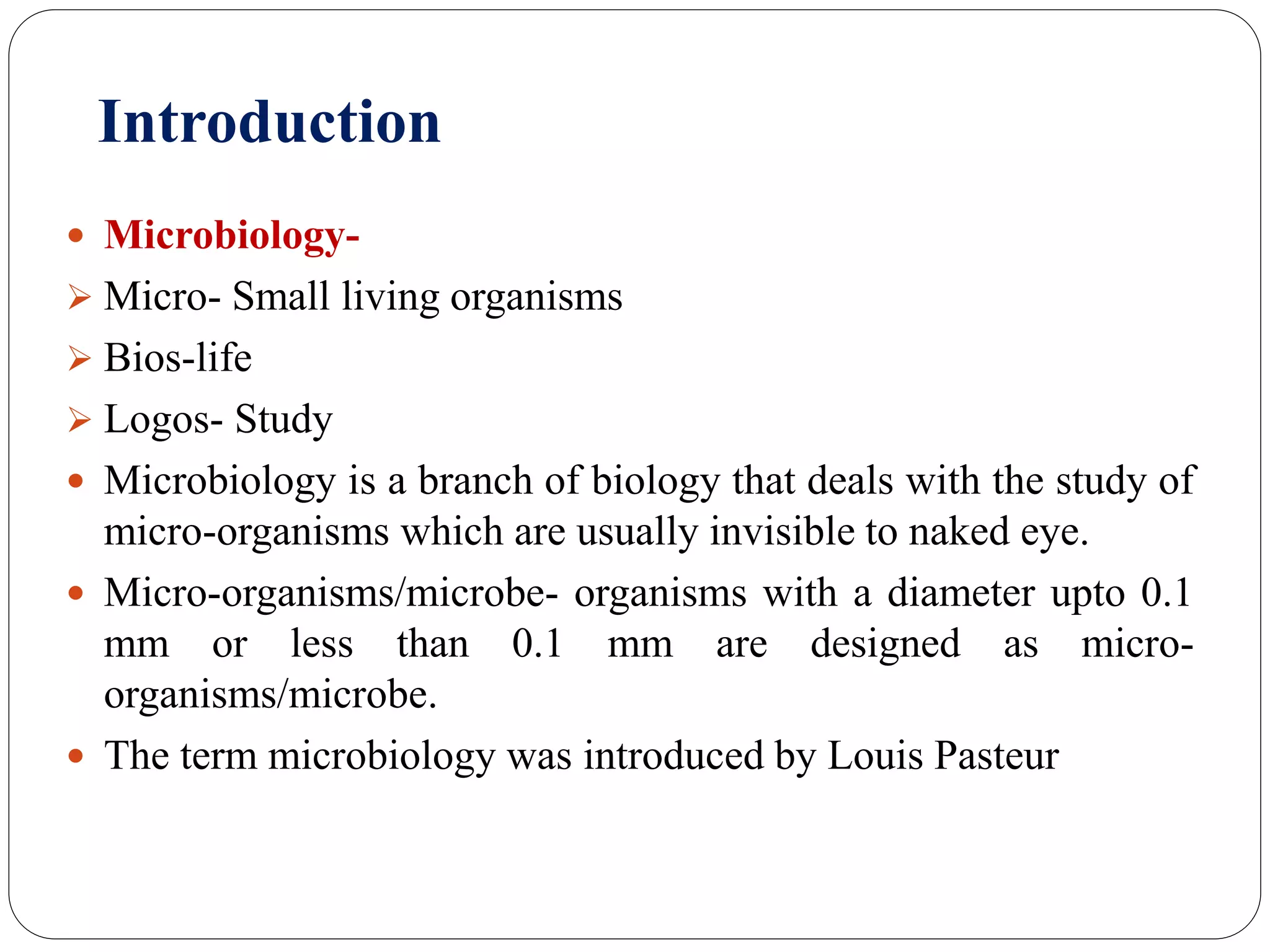
 Microbiology is a branch of biology that deals with the study of
micro-organisms which are usually invisible to naked eye.
 Micro-organisms/microbe- organisms with a diameter upto 0.1
mm or less than 0.1 mm are designed as micro-
organisms/microbe.
 The term microbiology was introduced by Louis Pasteur
Continue…
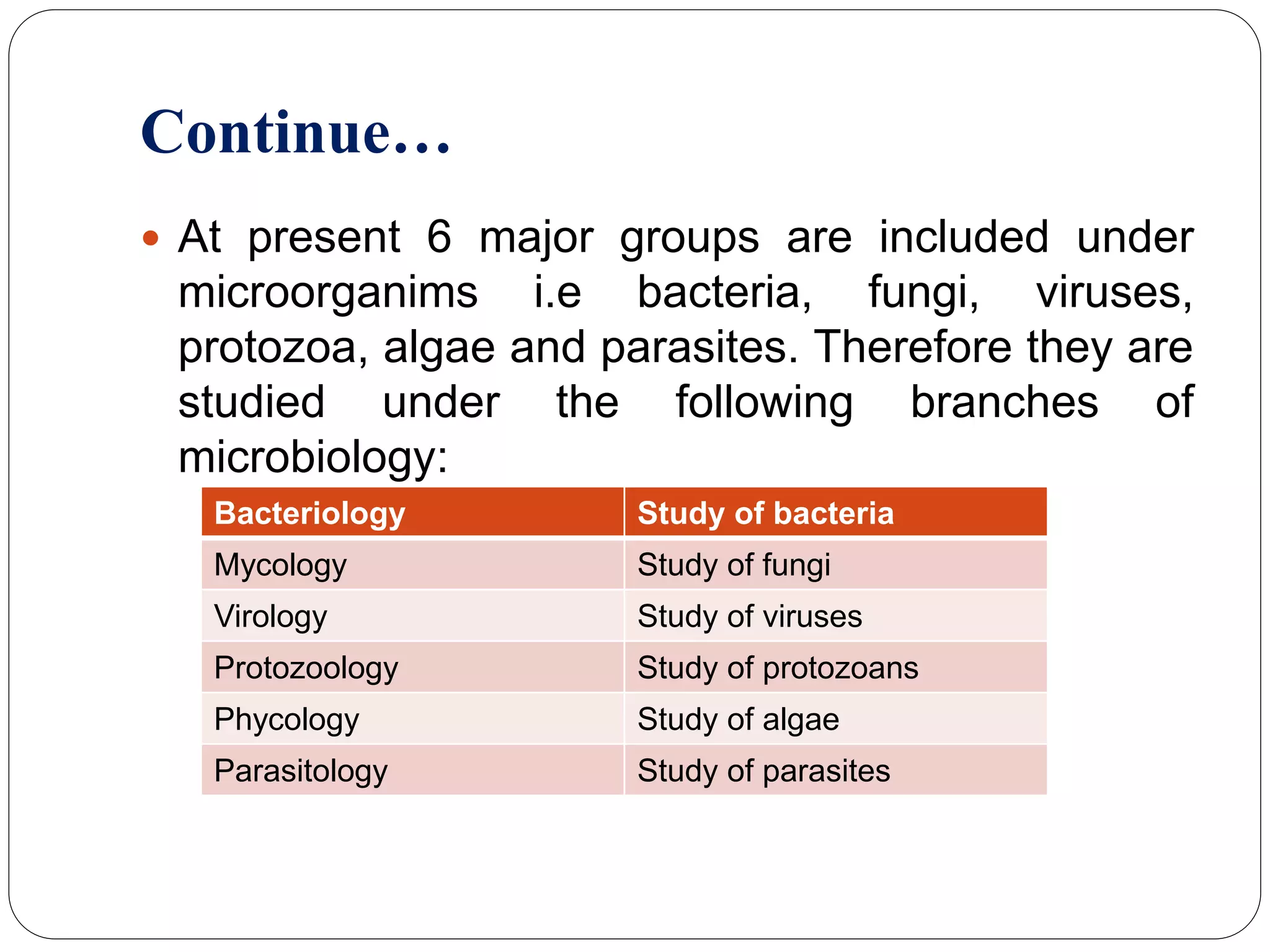
 At present 6 major groups are included under
microorganims i.e bacteria, fungi, viruses,
protozoa, algae and parasites. Therefore they are
studied under the following branches of
microbiology:
Bacteriology Study of bacteria
Mycology Study of fungi
Virology Study of viruses
Protozoology Study of protozoans
Phycology Study of algae
Parasitology Study of parasites
History
 History of microbiology is divided into 3 stages:
1) Discovery stage
2) Transition stage
3) Modern microbiology
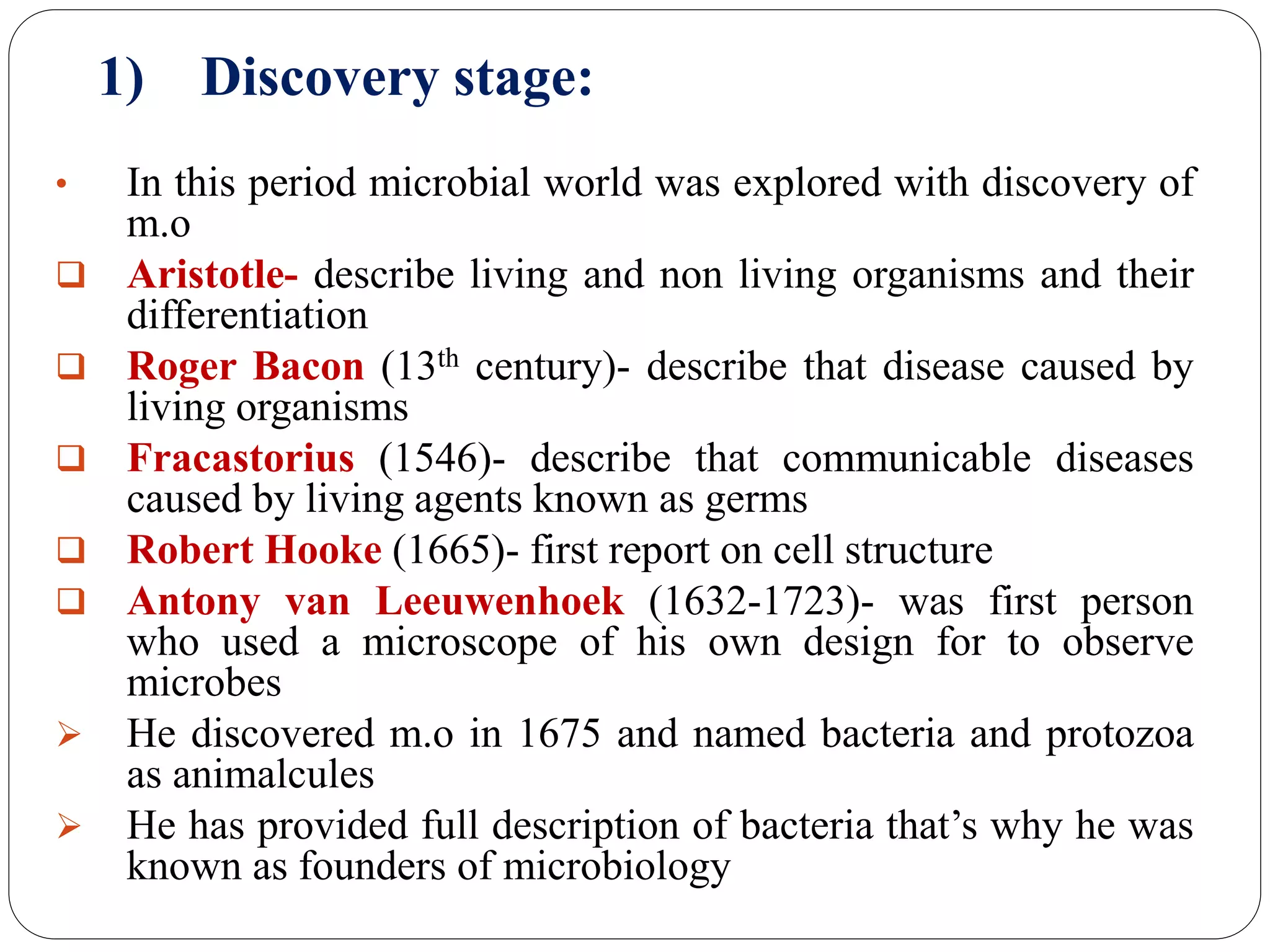
1) Discovery stage:
• In this period microbial world was explored with discovery of
m.o
 Aristotle- describe living and non living organisms and their
differentiation
 Roger Bacon (13th century)- describe that disease caused by
living organisms
 Fracastorius (1546)- describe that communicable diseases
caused by living agents known as germs
 Robert Hooke (1665)- first report on cell structure
 Antony van Leeuwenhoek (1632-1723)- was first person
who used a microscope of his own design for to observe
microbes
 He discovered m.o in 1675 and named bacteria and protozoa
as animalcules
 He has provided full description of bacteria that’s why he was
known as founders of microbiology
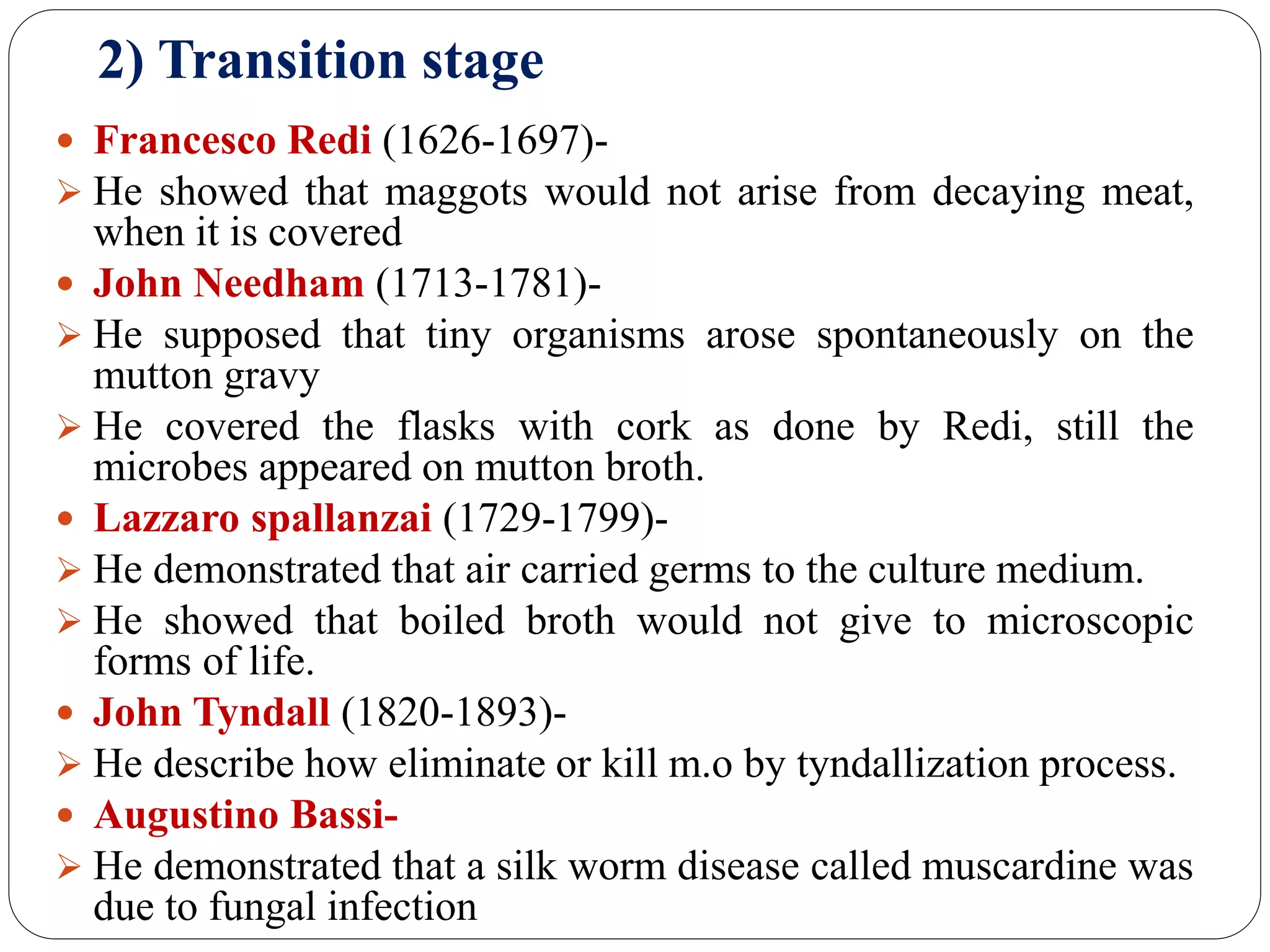
2) Transition stage
 Francesco Redi (1626-1697)-
 He showed that maggots would not arise from decaying meat,
when it is covered
 John Needham (1713-1781)-
 He supposed that tiny organisms arose spontaneously on the
mutton gravy
 He covered the flasks with cork as done by Redi, still the
microbes appeared on mutton broth.
 Lazzaro spallanzai (1729-1799)-
 He demonstrated that air carried germs to the culture medium.
 He showed that boiled broth would not give to microscopic
forms of life.
 John Tyndall (1820-1893)-
 He describe how eliminate or kill m.o by tyndallization process.
 Augustino Bassi-
 He demonstrated that a silk worm disease called muscardine was
due to fungal infection
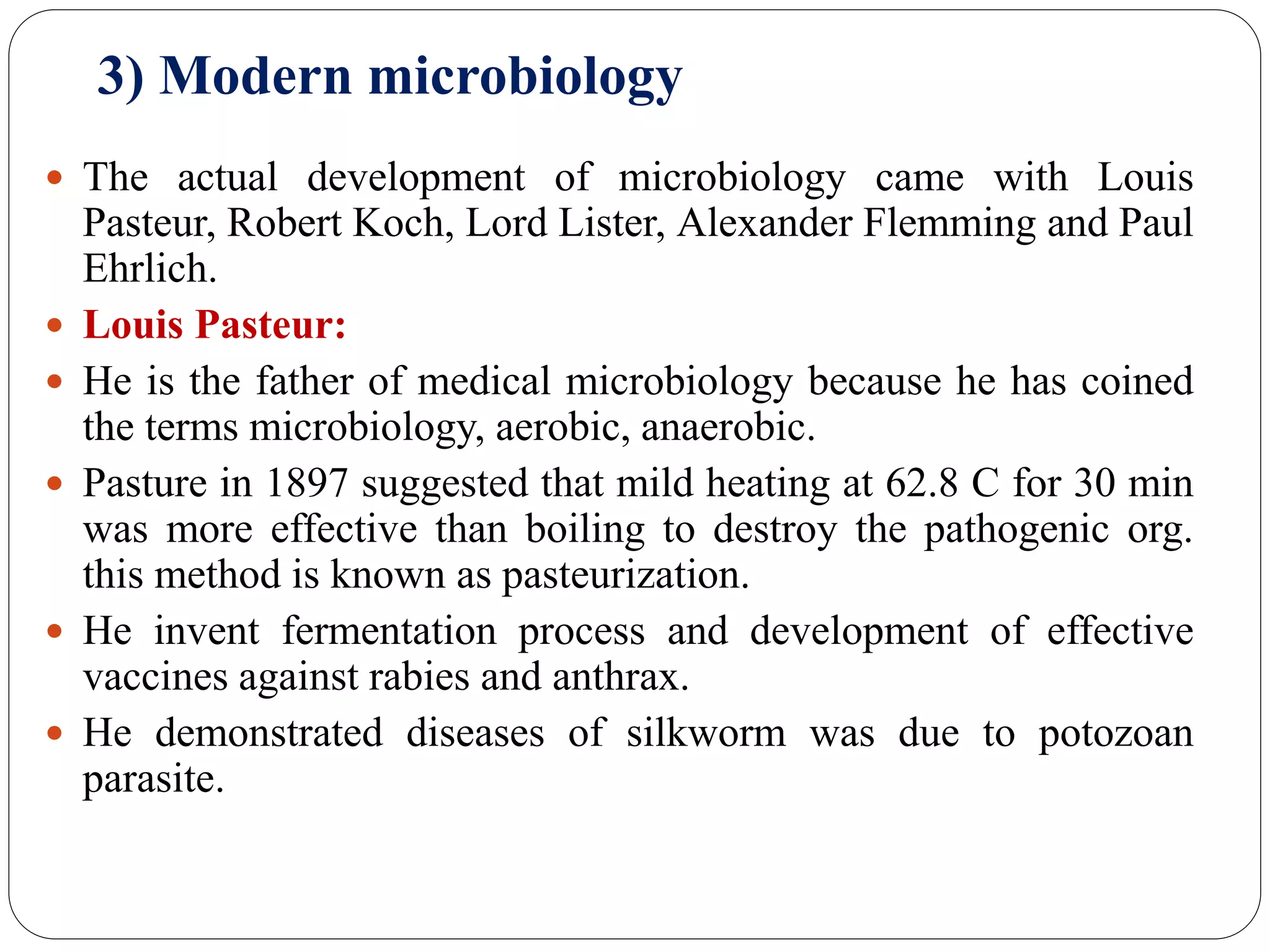
3) Modern microbiology
 The actual development of microbiology came with Louis
Pasteur, Robert Koch, Lord Lister, Alexander Flemming and Paul
Ehrlich.
 Louis Pasteur:
 He is the father of medical microbiology because he has coined
the terms microbiology, aerobic, anaerobic.
 Pasture in 1897 suggested that mild heating at 62.8 C for 30 min
was more effective than boiling to destroy the pathogenic org.
this method is known as pasteurization.
 He invent fermentation process and development of effective
vaccines against rabies and anthrax.
 He demonstrated diseases of silkworm was due to potozoan
parasite.
Continue…
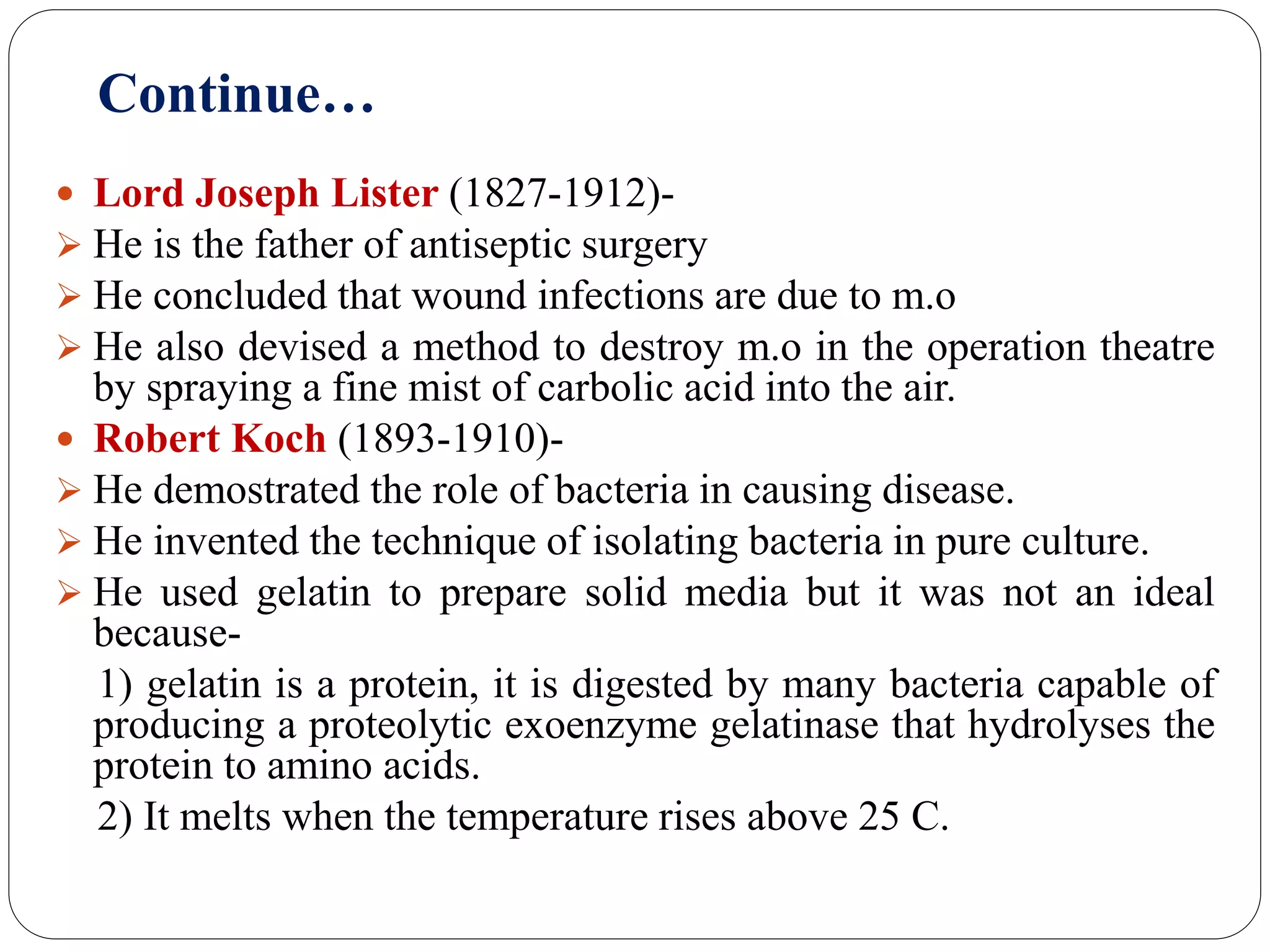
 Lord Joseph Lister (1827-1912)-
 He is the father of antiseptic surgery
 He concluded that wound infections are due to m.o
 He also devised a method to destroy m.o in the operation theatre
by spraying a fine mist of carbolic acid into the air.
 Robert Koch (1893-1910)-
 He demostrated the role of bacteria in causing disease.
 He invented the technique of isolating bacteria in pure culture.
 He used gelatin to prepare solid media but it was not an ideal
because-
1) gelatin is a protein, it is digested by many bacteria capable of
producing a proteolytic exoenzyme gelatinase that hydrolyses the
protein to amino acids.
2) It melts when the temperature rises above 25 C.
Continue…
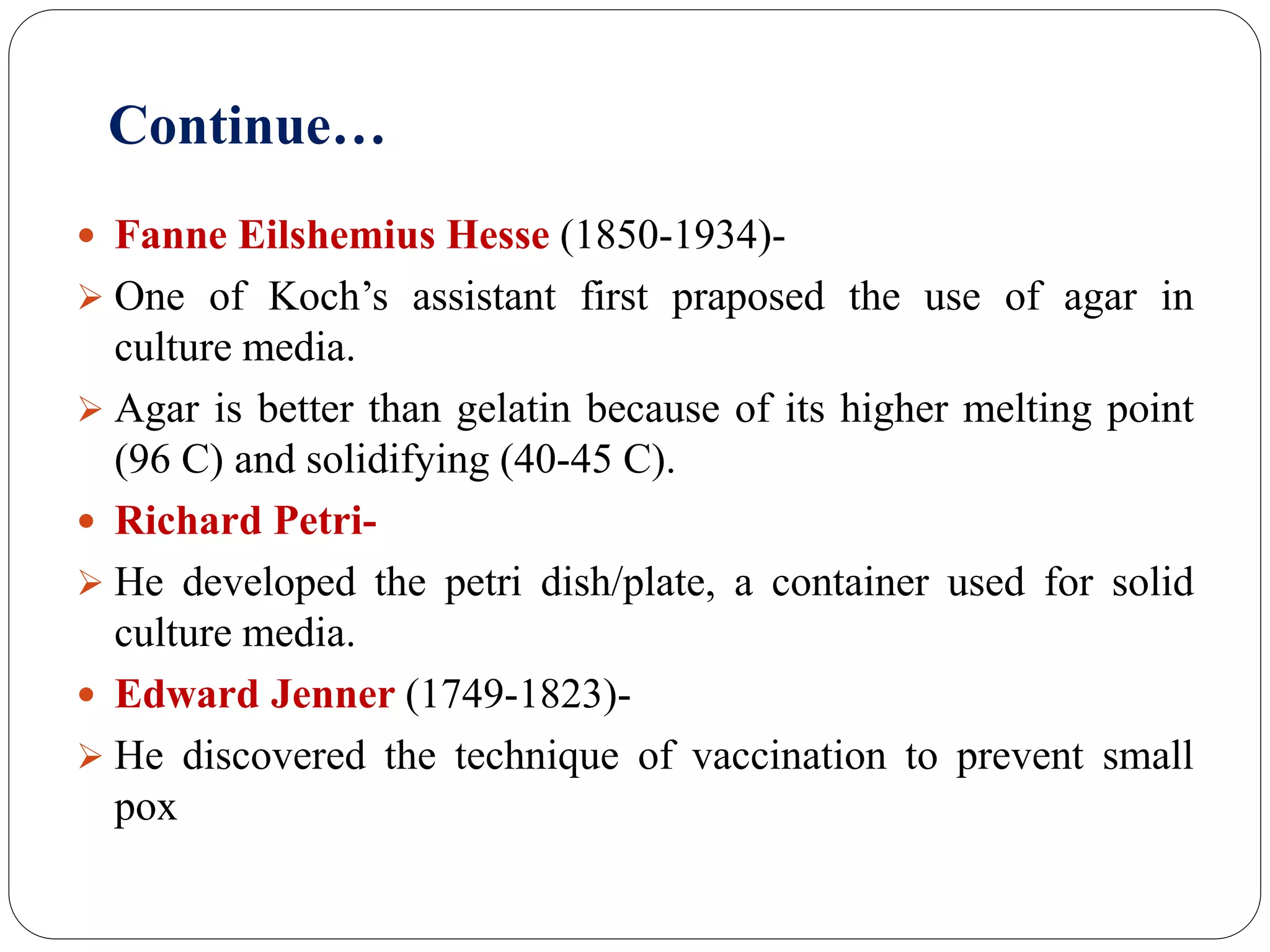
 Fanne Eilshemius Hesse (1850-1934)-
 One of Koch’s assistant first praposed the use of agar in
culture media.
 Agar is better than gelatin because of its higher melting point
(96 C) and solidifying (40-45 C).
 Richard Petri-
 He developed the petri dish/plate, a container used for solid
culture media.
 Edward Jenner (1749-1823)-
 He discovered the technique of vaccination to prevent small
pox
Continue…
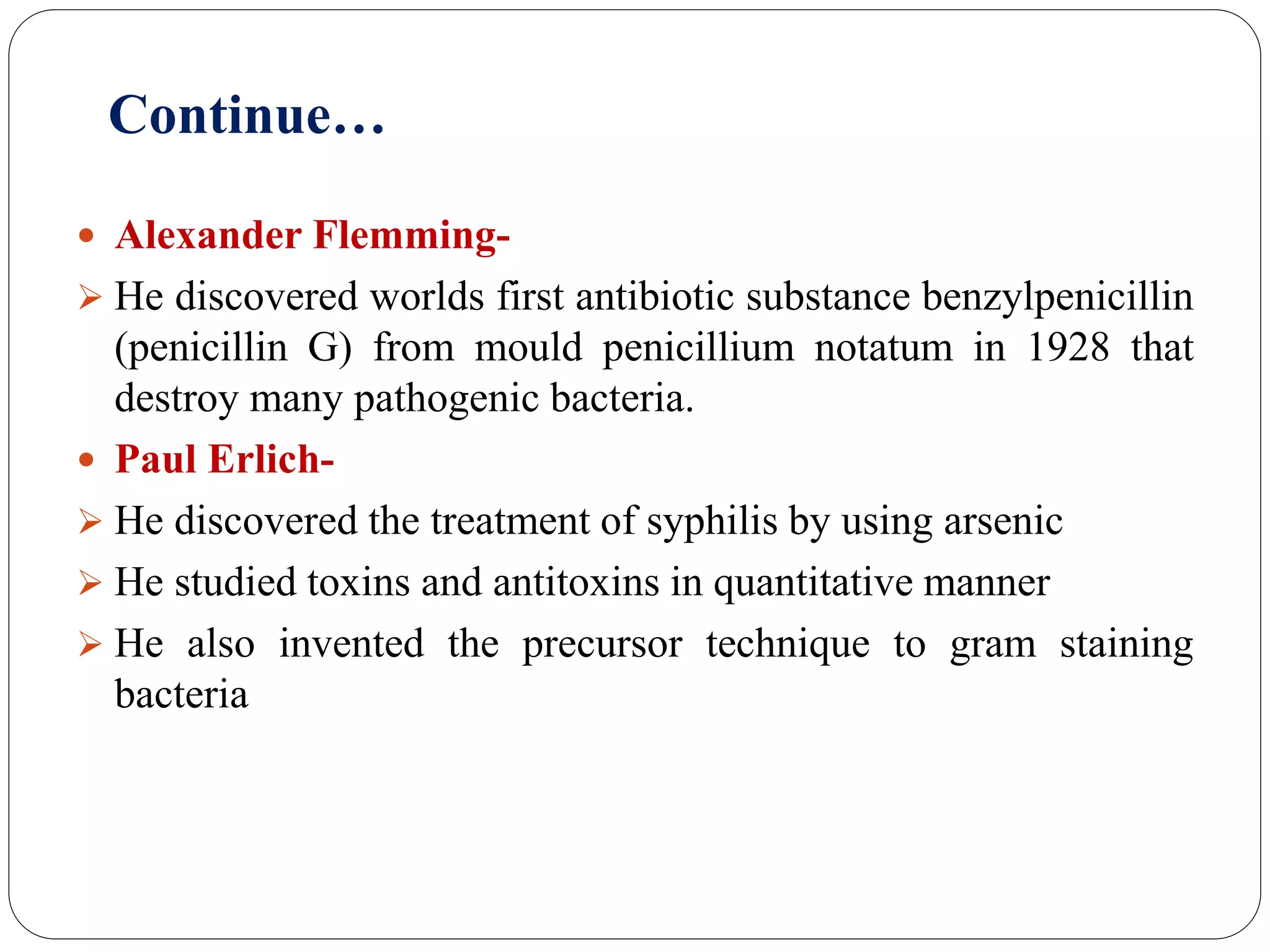
 Alexander Flemming-
 He discovered worlds first antibiotic substance benzylpenicillin
(penicillin G) from mould penicillium notatum in 1928 that
destroy many pathogenic bacteria.
 Paul Erlich-
 He discovered the treatment of syphilis by using arsenic
 He studied toxins and antitoxins in quantitative manner
 He also invented the precursor technique to gram staining
bacteria
Branches of microbiology
 Medical microbiology
 Pharmaceutical microbiology
 Industrial microbiology
 Microbial biotechnology
 Food microbiology
 Soil microbiology
 Agricultural microbiology
 Aquatic microbiology
 Air microbiology
 Epidemiology
Scope and importance of microbiology
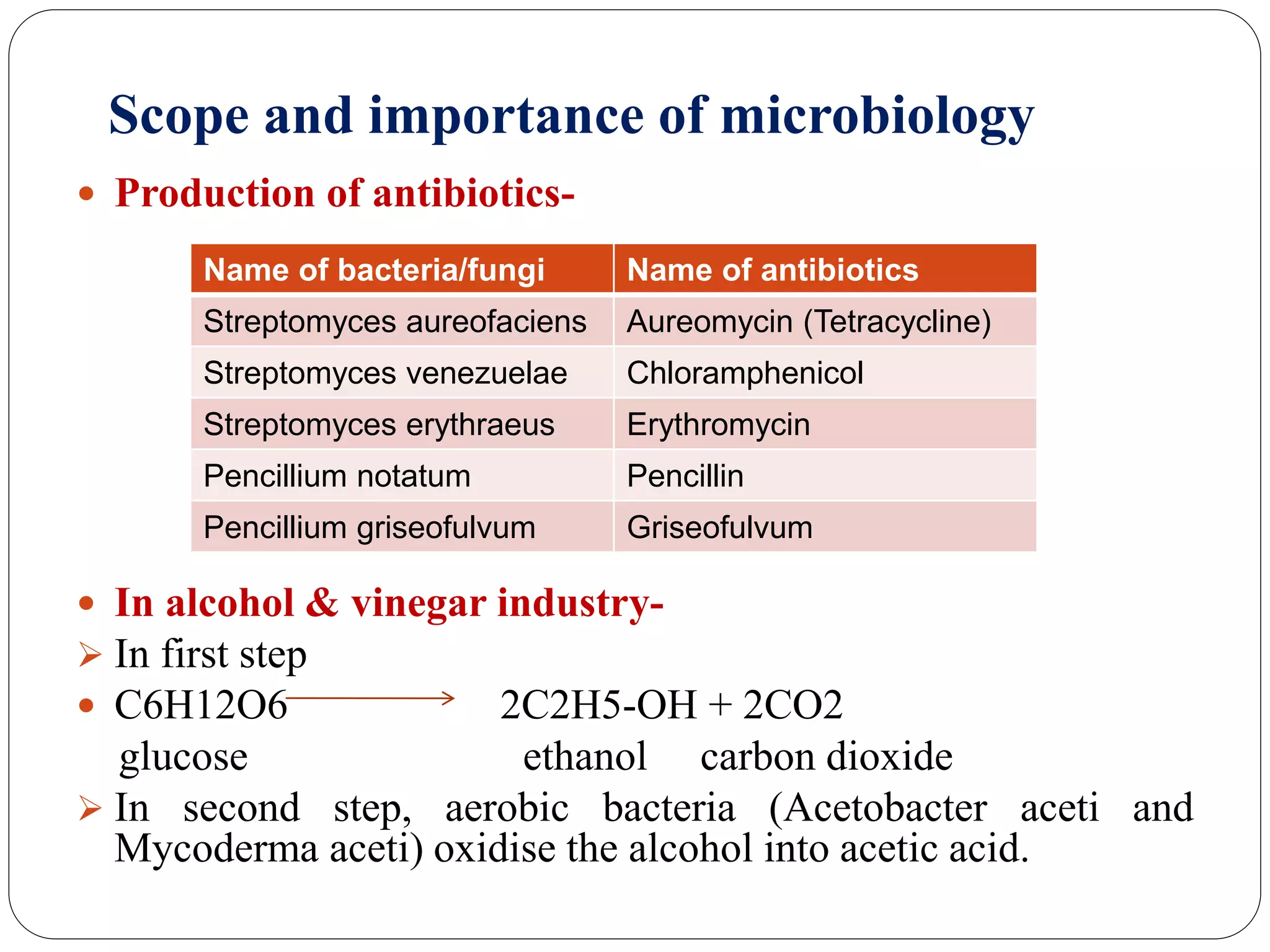
 Production of antibiotics-
 In alcohol & vinegar industry-
 In first step
 C6H12O6 2C2H5-OH + 2CO2
glucose ethanol carbon dioxide
 In second step, aerobic bacteria (Acetobacter aceti and
Mycoderma aceti) oxidise the alcohol into acetic acid.
Name of bacteria/fungi Name of antibiotics
Streptomyces aureofaciens Aureomycin (Tetracycline)
Streptomyces venezuelae Chloramphenicol
Streptomyces erythraeus Erythromycin
Pencillium notatum Pencillin
Pencillium griseofulvum Griseofulvum
Continue…
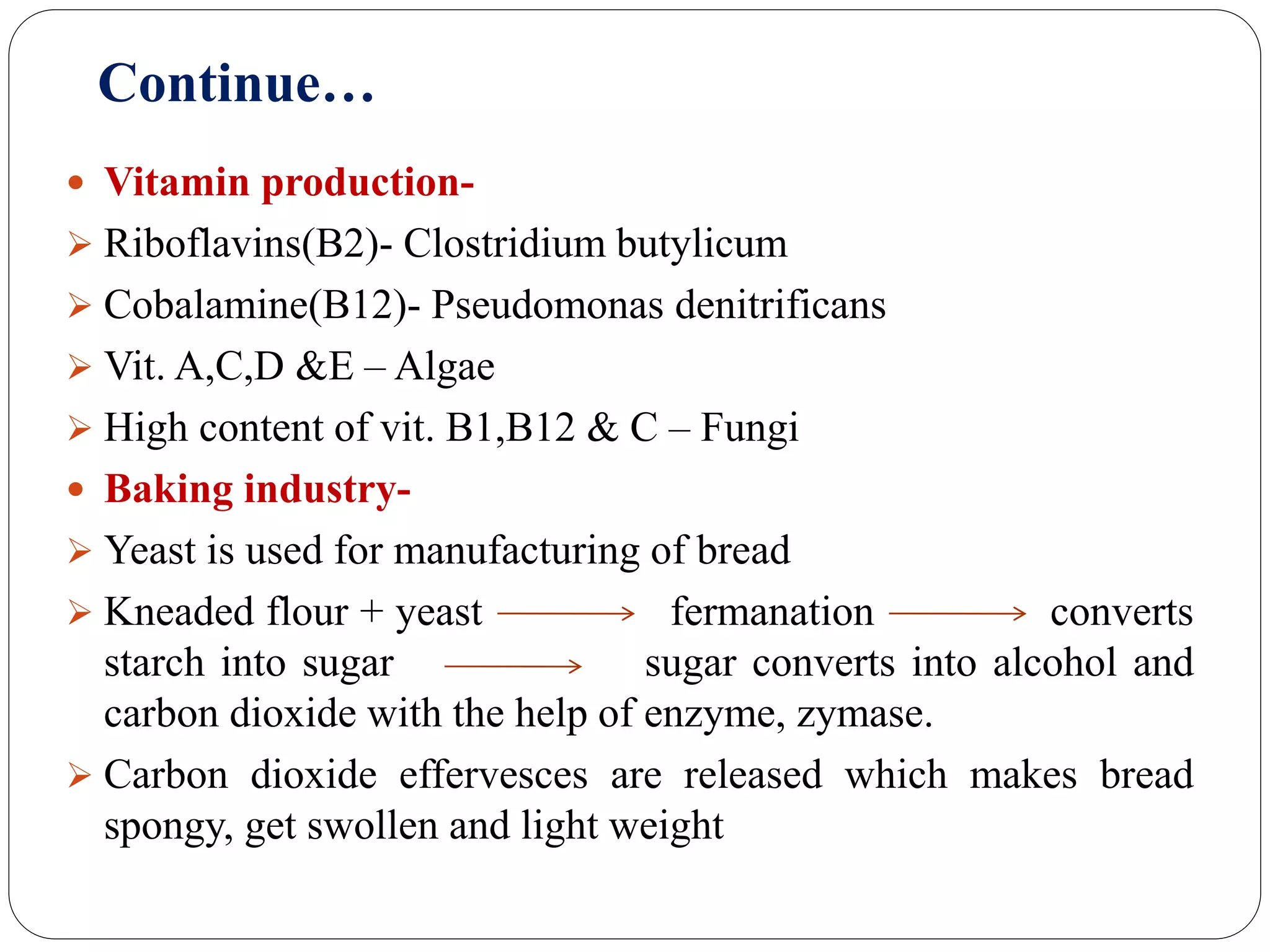
 Vitamin production-
 Riboflavins(B2)- Clostridium butylicum
 Cobalamine(B12)- Pseudomonas denitrificans
 Vit. A,C,D &E – Algae
 High content of vit. B1,B12 & C – Fungi
 Baking industry-
 Yeast is used for manufacturing of bread
 Kneaded flour + yeast fermanation converts
starch into sugar sugar converts into alcohol and
carbon dioxide with the help of enzyme, zymase.
 Carbon dioxide effervesces are released which makes bread
spongy, get swollen and light weight
Continue…
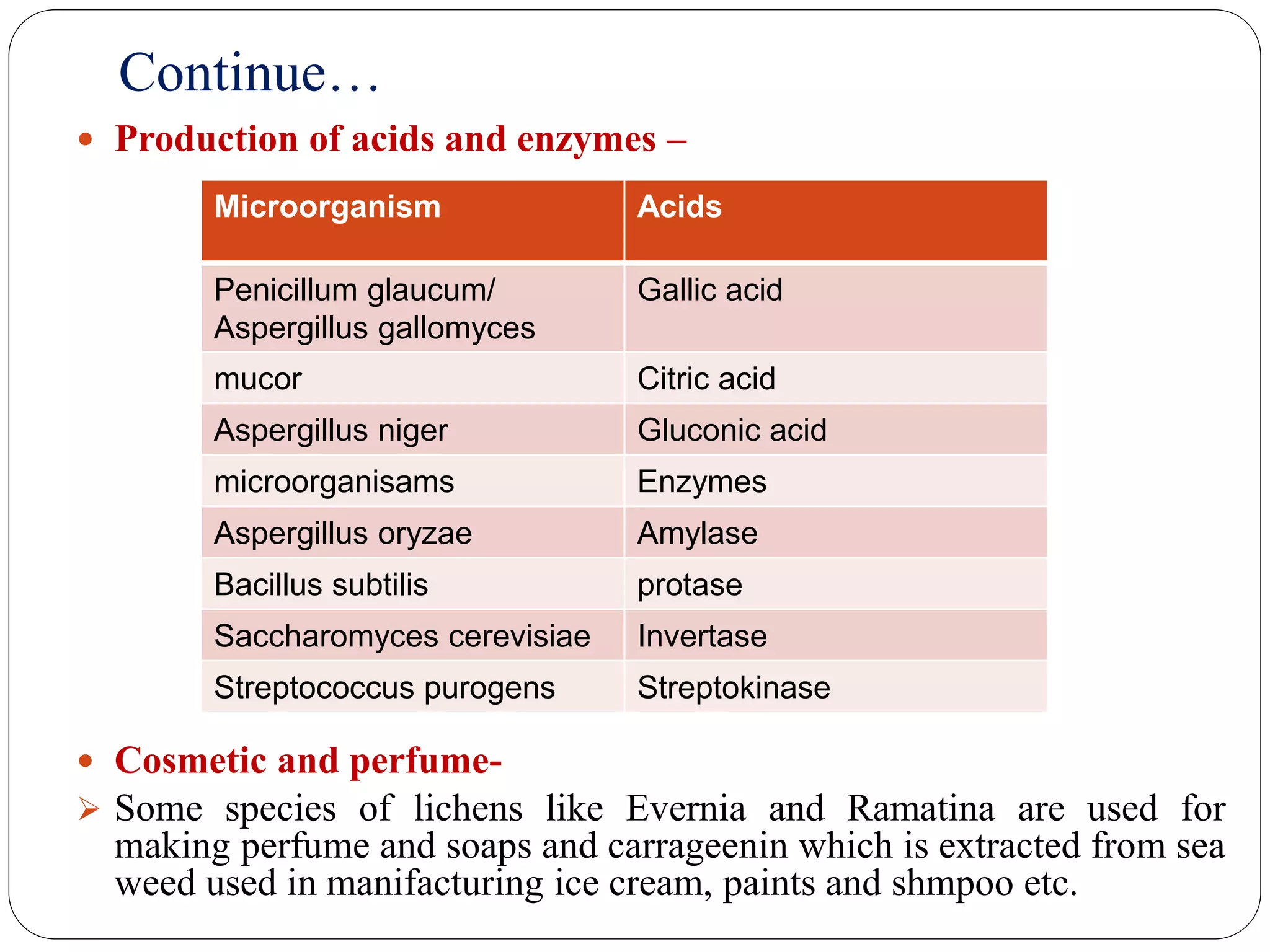
 Production of acids and enzymes –
 Cosmetic and perfume-
 Some species of lichens like Evernia and Ramatina are used for
making perfume and soaps and carrageenin which is extracted from sea
weed used in manifacturing ice cream, paints and shmpoo etc.
Microorganism Acids
Penicillum glaucum/
Aspergillus gallomyces
Gallic acid
mucor Citric acid
Aspergillus niger Gluconic acid
microorganisams Enzymes
Aspergillus oryzae Amylase
Bacillus subtilis protase
Saccharomyces cerevisiae Invertase
Streptococcus purogens Streptokinase
Continue…
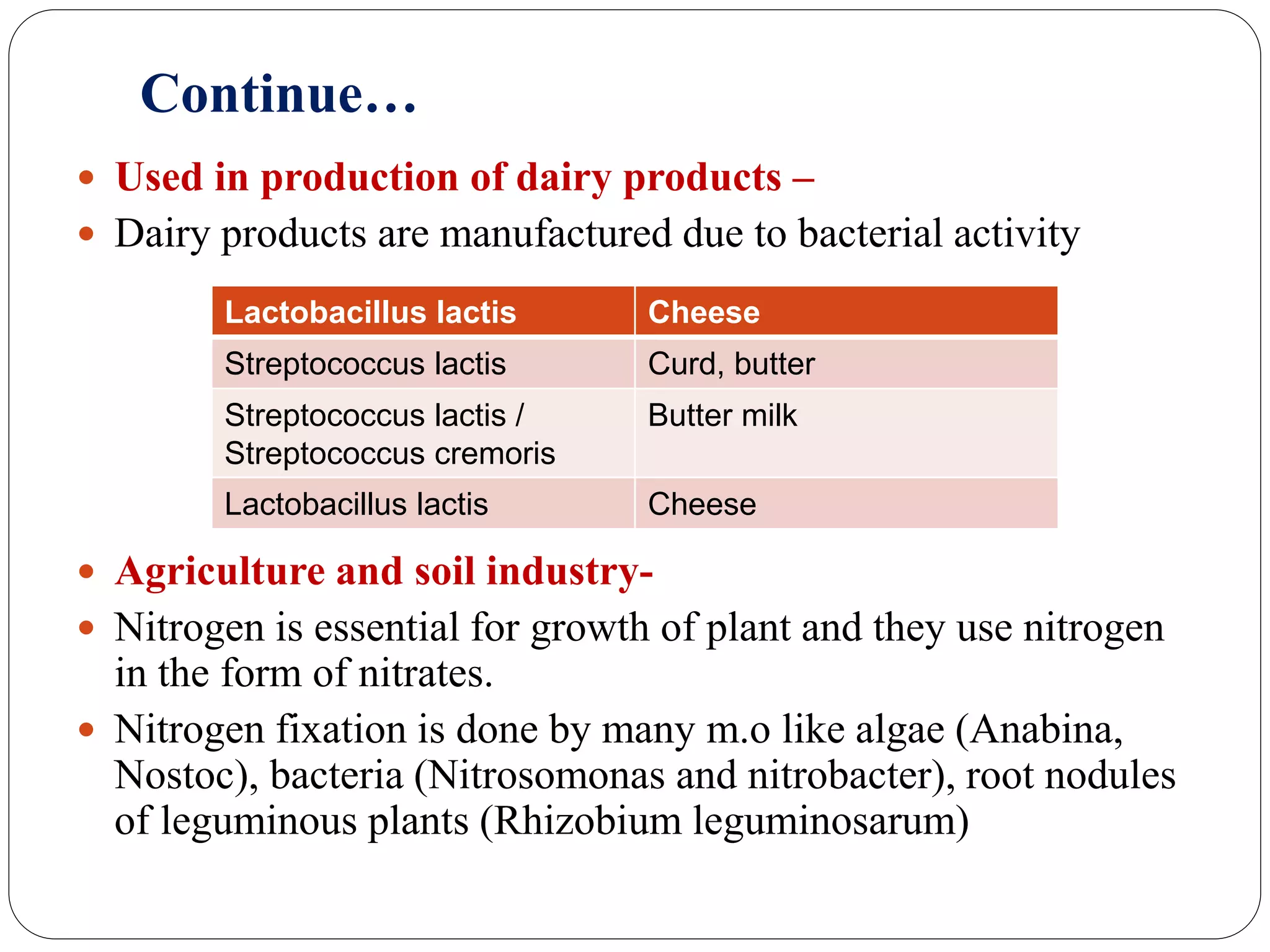
 Used in production of dairy products –
 Dairy products are manufactured due to bacterial activity
 Agriculture and soil industry-
 Nitrogen is essential for growth of plant and they use nitrogen
in the form of nitrates.
 Nitrogen fixation is done by many m.o like algae (Anabina,
Nostoc), bacteria (Nitrosomonas and nitrobacter), root nodules
of leguminous plants (Rhizobium leguminosarum)
Lactobacillus lactis Cheese
Streptococcus lactis Curd, butter
Streptococcus lactis /
Streptococcus cremoris
Butter milk
Lactobacillus lactis Cheese
Continue…
 Used as food-
 Algae Gelidium, Gracilaria produce agar agar (jelly sub.)
used for manifacturing ice cream.
 Laminaria (seaweeds) contain lot of iodine which is imp.
Mineral for thyroid gland
Thank you

Introduction, history and scope of microbiology

  • 1.
    Presented by Miss. AshviniVijay Govande Assistant Professor Kandhar College of Pharmacy, Kandhar Introduction, history and scope of microbiology
  • 2.
    Content  Introduction ofmicrobiology  History  Branches of microbiology  Scope and importance of microbiology
  • 3.
    Introduction  Microbiology-  Micro-Small living organisms  Bios-life  Logos- Study  Microbiology is a branch of biology that deals with the study of micro-organisms which are usually invisible to naked eye.  Micro-organisms/microbe- organisms with a diameter upto 0.1 mm or less than 0.1 mm are designed as micro- organisms/microbe.  The term microbiology was introduced by Louis Pasteur
  • 4.
    Continue…  At present6 major groups are included under microorganims i.e bacteria, fungi, viruses, protozoa, algae and parasites. Therefore they are studied under the following branches of microbiology: Bacteriology Study of bacteria Mycology Study of fungi Virology Study of viruses Protozoology Study of protozoans Phycology Study of algae Parasitology Study of parasites
  • 5.
    History  History ofmicrobiology is divided into 3 stages: 1) Discovery stage 2) Transition stage 3) Modern microbiology
  • 6.
    1) Discovery stage: •In this period microbial world was explored with discovery of m.o  Aristotle- describe living and non living organisms and their differentiation  Roger Bacon (13th century)- describe that disease caused by living organisms  Fracastorius (1546)- describe that communicable diseases caused by living agents known as germs  Robert Hooke (1665)- first report on cell structure  Antony van Leeuwenhoek (1632-1723)- was first person who used a microscope of his own design for to observe microbes  He discovered m.o in 1675 and named bacteria and protozoa as animalcules  He has provided full description of bacteria that’s why he was known as founders of microbiology
  • 7.
    2) Transition stage Francesco Redi (1626-1697)-  He showed that maggots would not arise from decaying meat, when it is covered  John Needham (1713-1781)-  He supposed that tiny organisms arose spontaneously on the mutton gravy  He covered the flasks with cork as done by Redi, still the microbes appeared on mutton broth.  Lazzaro spallanzai (1729-1799)-  He demonstrated that air carried germs to the culture medium.  He showed that boiled broth would not give to microscopic forms of life.  John Tyndall (1820-1893)-  He describe how eliminate or kill m.o by tyndallization process.  Augustino Bassi-  He demonstrated that a silk worm disease called muscardine was due to fungal infection
  • 8.
    3) Modern microbiology The actual development of microbiology came with Louis Pasteur, Robert Koch, Lord Lister, Alexander Flemming and Paul Ehrlich.  Louis Pasteur:  He is the father of medical microbiology because he has coined the terms microbiology, aerobic, anaerobic.  Pasture in 1897 suggested that mild heating at 62.8 C for 30 min was more effective than boiling to destroy the pathogenic org. this method is known as pasteurization.  He invent fermentation process and development of effective vaccines against rabies and anthrax.  He demonstrated diseases of silkworm was due to potozoan parasite.
  • 9.
    Continue…  Lord JosephLister (1827-1912)-  He is the father of antiseptic surgery  He concluded that wound infections are due to m.o  He also devised a method to destroy m.o in the operation theatre by spraying a fine mist of carbolic acid into the air.  Robert Koch (1893-1910)-  He demostrated the role of bacteria in causing disease.  He invented the technique of isolating bacteria in pure culture.  He used gelatin to prepare solid media but it was not an ideal because- 1) gelatin is a protein, it is digested by many bacteria capable of producing a proteolytic exoenzyme gelatinase that hydrolyses the protein to amino acids. 2) It melts when the temperature rises above 25 C.
  • 10.
    Continue…  Fanne EilshemiusHesse (1850-1934)-  One of Koch’s assistant first praposed the use of agar in culture media.  Agar is better than gelatin because of its higher melting point (96 C) and solidifying (40-45 C).  Richard Petri-  He developed the petri dish/plate, a container used for solid culture media.  Edward Jenner (1749-1823)-  He discovered the technique of vaccination to prevent small pox
  • 11.
    Continue…  Alexander Flemming- He discovered worlds first antibiotic substance benzylpenicillin (penicillin G) from mould penicillium notatum in 1928 that destroy many pathogenic bacteria.  Paul Erlich-  He discovered the treatment of syphilis by using arsenic  He studied toxins and antitoxins in quantitative manner  He also invented the precursor technique to gram staining bacteria
  • 12.
    Branches of microbiology Medical microbiology  Pharmaceutical microbiology  Industrial microbiology  Microbial biotechnology  Food microbiology  Soil microbiology  Agricultural microbiology  Aquatic microbiology  Air microbiology  Epidemiology
  • 13.
    Scope and importanceof microbiology  Production of antibiotics-  In alcohol & vinegar industry-  In first step  C6H12O6 2C2H5-OH + 2CO2 glucose ethanol carbon dioxide  In second step, aerobic bacteria (Acetobacter aceti and Mycoderma aceti) oxidise the alcohol into acetic acid. Name of bacteria/fungi Name of antibiotics Streptomyces aureofaciens Aureomycin (Tetracycline) Streptomyces venezuelae Chloramphenicol Streptomyces erythraeus Erythromycin Pencillium notatum Pencillin Pencillium griseofulvum Griseofulvum
  • 14.
    Continue…  Vitamin production- Riboflavins(B2)- Clostridium butylicum  Cobalamine(B12)- Pseudomonas denitrificans  Vit. A,C,D &E – Algae  High content of vit. B1,B12 & C – Fungi  Baking industry-  Yeast is used for manufacturing of bread  Kneaded flour + yeast fermanation converts starch into sugar sugar converts into alcohol and carbon dioxide with the help of enzyme, zymase.  Carbon dioxide effervesces are released which makes bread spongy, get swollen and light weight
  • 15.
    Continue…  Production ofacids and enzymes –  Cosmetic and perfume-  Some species of lichens like Evernia and Ramatina are used for making perfume and soaps and carrageenin which is extracted from sea weed used in manifacturing ice cream, paints and shmpoo etc. Microorganism Acids Penicillum glaucum/ Aspergillus gallomyces Gallic acid mucor Citric acid Aspergillus niger Gluconic acid microorganisams Enzymes Aspergillus oryzae Amylase Bacillus subtilis protase Saccharomyces cerevisiae Invertase Streptococcus purogens Streptokinase
  • 16.
    Continue…  Used inproduction of dairy products –  Dairy products are manufactured due to bacterial activity  Agriculture and soil industry-  Nitrogen is essential for growth of plant and they use nitrogen in the form of nitrates.  Nitrogen fixation is done by many m.o like algae (Anabina, Nostoc), bacteria (Nitrosomonas and nitrobacter), root nodules of leguminous plants (Rhizobium leguminosarum) Lactobacillus lactis Cheese Streptococcus lactis Curd, butter Streptococcus lactis / Streptococcus cremoris Butter milk Lactobacillus lactis Cheese
  • 17.
    Continue…  Used asfood-  Algae Gelidium, Gracilaria produce agar agar (jelly sub.) used for manifacturing ice cream.  Laminaria (seaweeds) contain lot of iodine which is imp. Mineral for thyroid gland
  • 18.