Anatomy of a Buffer
  Overflow Attack
     Rob Gillen
       @argodev
CodeStock is proudly partnered with:


                RecruitWise and Staff with Excellence - www.recruitwise.jobs


      Send instant feedback on this session via Twitter:
        Send a direct message with the room number to @CodeStock
        d codestock 413a This session is great!

      For more information on sending feedback using Twitter while at
      CodeStock, please see the “CodeStock README” in your CodeStock guide.
Don’t Be Stupid
The following presentation describes
real attacks on real systems. Please
note that most of the attacks
described would be considered ILLEGAL
if attempted on machines that you do
not have explicit permission to test
and attack. I assume no responsibility
for any actions you perform based on
the content of this presentation or
subsequent conversations. Please
remember this basic guideline: With
knowledge comes responsibility.
Disclaimer
The content of this presentation
represents my personal views and
thoughts at the present time. This
content is not endorsed by, or
representative in any way of my
employer nor is it intended to be a
view into my work or a reflection on
the type of work that I or my group
performs. It is simply a hobby and
personal interest and should be
considered as such.
Credits
The vulnerability that we’ll be discussing
was initially discovered by C4SS!0 G0M3S
(louredo_@hotmail.com) and was published
on June 17, 2011.
http://www.exploit-db.com/exploits/17539/

James Fitts created a MetaSploit module
that I also reviewed while building this
module
http://www.exploit-db.com/exploits/17540/
Example Overview
• Scenario
  – Machine 1: BackTrack 5 SR1
  – Machine 2:
    • Windows 7 Professional x64, SP1,
      fully patched
    • Freefloat FTP Server v1.0
• Tasks
  – Discover a vulnerability exists
  – Craft & test an exploit
• Goal: Obtain reverse shell
Attack Process
• Identify target of interest
• Identify software/versions being
  used
• Setup local Instance
• Fuzz to identify vulnerability
• Design/Develop Exploit
• Test
• Package/Weaponize
Terminology
•   CPU Registers
•   Assembler Debugger
•   Buffer Overflows
•   Fuzzing
•   Shellcode
•   Encoding
•   Bind Shell/Reverse Shell
CPU Registers (8086)
•   EAX    –   Accumulator Register
•   EBX    –   Base Register
•   ECX    –   Counter Register
•   EDX    –   Data Register
•   ESI    –   Source Index
•   EDI    –   Destination Index
•   EBP    –   Base Pointer
•   ESP    –   Stack Pointer
    Content from: http://www.swansontec.com/sregisters.html
CPU Registers (8086)
• EIP – program counter or commonly
  “instruction pointer” – a processor
  register that indicates where a
  computer is in its program sequence.
• Holds the memory address of (“points
  to”) the next instruction that would
  be executed.

• Any thoughts on why this specific
  register is particularly
  interesting?
 Content from: http://en.wikipedia.org/wiki/Instruction_pointer
Assembler Debugger
Buffer Overflow
• Software accepts input, but doesn’t ensure
  that it is only as long as supported.
• In this case, software accepts a value into
  the variable A, but the user sends an
  overly-long string (“excessive”) and
  overflows the space allocated to A and
  overwrites the integer previously stored in
  B


 Content from: http://en.wikipedia.org/wiki/Buffer_overflow
Fuzzing
• Identify points where application
  or service accepts data
• Send varying lengths/types of data
  until we crash the service and/or
  overwrite key buffers.
• Increase buffer length until no
  longer successful (identify upper
  bounds of memory space available
  for exploit)
Shellcode
• Small piece of code used as the
  payload in the exploitation of a
  software vulnerability
• Name comes from the purpose –
  usually spawns a shell and
  performs some action
• Often written in assembly code
• Types:
  – “normal”, Staged, Egg-hunt, Omelette
 Content from: http://en.wikipedia.org/wiki/Shellcode
Shellcode Example
[BITS 32]
mov ebx, 0x00424F52
push ebx
mov esi, esp
xor eax, eax
push eax
push esi
push esi
push eax
mov eax, 0x7E45058A
call eax
[BITS 32]
mov ebx, 0x00424F52 ; Loads a null-terminated string “ROB” to
                      ebx
push ebx            ; pushes ebx to the stack
mov esi, esp        ; saves null-terminated string “ROB” in esi
xor eax, eax        ; Zero our eax (eax=0)
push eax            ; Push the fourth parameter (uType) to the
                      stack (value 0)
push esi            ; Push the third parameter (lpCaption) to
                      the stack (value ROB00)
push esi            ; Push the second parameter (lpText) to the
                      stack (value ROB00)
push eax            ; Push the first parameter (hWnd) to the
                      stack (value 0)
mov eax, 0x7E45058A ; Move the MessageBoxA address in to eax
call eax            ; Call the MessageBoxA function with all
                      parameters supplied.
Shellcode Example
BB 52 4F 42 00 53 89 E6
31 C0 50 56 56 50 B8 8A
05 45 7E FF D0
Encoding
• There are often restrictions as to
  what data can be sent via the
  exploit (NULLs, etc.)
• Self-extracting (smaller
  shellcode)
• Self-decrypting (avoid IDS
  signatures)
• Tools such as msfencode offer many
  options.
Encoded Shellcode
xbex13xafx49x81xdaxc7
xd9x74x24xf4x58x31xc9
xb1x06x83xe8xfcx31x70
x0fx03x70x1cx4dxbcx3a
x70xdex7dx3dx27x69x67
x0cx07x39x3ex39xd7x02
x34xc0x92x0cxb6x1b
Bind Shell/Reverse Shell
• Bind Shell
  – Target exposes a shell on a given port
  – Attacker connects to that port and
    executes commands
  – Remote Administration
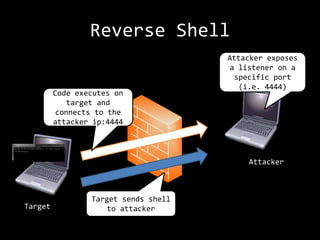
• Reverse Shell
  – Attacker listens for connections on a
    given port
  – Shell code on target connects to
    attacker and sends a shell
  – NAT-safe
Bind Shell
 Code executes on
target and exposes
  a listener on a       Attacker connects
   specific port        (Binds) to client
    (i.e. 4444)              ip:4444


                                            Attacker


                 Target sends shell
                     to attacker
     Target
Reverse Shell
                                      Attacker exposes
                                      a listener on a
                                       specific port
                                        (i.e. 4444)
         Code executes on
             target and
          connects to the
         attacker ip:4444


                                          Attacker


                 Target sends shell
Target               to attacker
Fuzzing Pseudo-Code
• Build array of increasing length
  strings (“A”)
• Build array of valid commands
• For each command in arrayOfCommands
  – For each string in arrayOfStrings
    • Establish FTP connection
    • Submit command + string
• Watch for application hang/crash
• Inspect register values/pointers
Demonstration

FUZZING THE SERVICE
Design The Exploit
• Iterate with various malicious
  buffer sizes to see how much space
  is available
• Locate where within the evil
  buffer we actually overwrite EIP
• Locate where within the evil
  buffer we can locate our shellcode
  (pointed to by other register)
Design The Exploit
• Select / configure / encode
  shellcode
• Integrate into exploit script (NOP
  slide, breakpoints, etc)
• Identify reusable jump address to
  consistently move to shellcode
• Test with breakpoints
• Test in “real world” scenario
Demonstration

DESIGNING THE EXPLOIT
Solutions?
• Bounds checking is critical!
• Fuzz your own applications
• Address Space Layout Randomization
  (ASLR)
• Operating System Support
  – Data Execution Prevention
Questions/Contact


Rob Gillen
rob@gillenfamily.net
http://rob.gillenfamily.net
@argodev

Anatomy of a Buffer Overflow Attack

  • 1.
    Anatomy of aBuffer Overflow Attack Rob Gillen @argodev
  • 2.
    CodeStock is proudlypartnered with: RecruitWise and Staff with Excellence - www.recruitwise.jobs Send instant feedback on this session via Twitter: Send a direct message with the room number to @CodeStock d codestock 413a This session is great! For more information on sending feedback using Twitter while at CodeStock, please see the “CodeStock README” in your CodeStock guide.
  • 4.
    Don’t Be Stupid Thefollowing presentation describes real attacks on real systems. Please note that most of the attacks described would be considered ILLEGAL if attempted on machines that you do not have explicit permission to test and attack. I assume no responsibility for any actions you perform based on the content of this presentation or subsequent conversations. Please remember this basic guideline: With knowledge comes responsibility.
  • 5.
    Disclaimer The content ofthis presentation represents my personal views and thoughts at the present time. This content is not endorsed by, or representative in any way of my employer nor is it intended to be a view into my work or a reflection on the type of work that I or my group performs. It is simply a hobby and personal interest and should be considered as such.
  • 6.
    Credits The vulnerability thatwe’ll be discussing was initially discovered by C4SS!0 G0M3S (louredo_@hotmail.com) and was published on June 17, 2011. http://www.exploit-db.com/exploits/17539/ James Fitts created a MetaSploit module that I also reviewed while building this module http://www.exploit-db.com/exploits/17540/
  • 7.
    Example Overview • Scenario – Machine 1: BackTrack 5 SR1 – Machine 2: • Windows 7 Professional x64, SP1, fully patched • Freefloat FTP Server v1.0 • Tasks – Discover a vulnerability exists – Craft & test an exploit • Goal: Obtain reverse shell
  • 8.
    Attack Process • Identifytarget of interest • Identify software/versions being used • Setup local Instance • Fuzz to identify vulnerability • Design/Develop Exploit • Test • Package/Weaponize
  • 9.
    Terminology • CPU Registers • Assembler Debugger • Buffer Overflows • Fuzzing • Shellcode • Encoding • Bind Shell/Reverse Shell
  • 10.
    CPU Registers (8086) • EAX – Accumulator Register • EBX – Base Register • ECX – Counter Register • EDX – Data Register • ESI – Source Index • EDI – Destination Index • EBP – Base Pointer • ESP – Stack Pointer Content from: http://www.swansontec.com/sregisters.html
  • 11.
    CPU Registers (8086) •EIP – program counter or commonly “instruction pointer” – a processor register that indicates where a computer is in its program sequence. • Holds the memory address of (“points to”) the next instruction that would be executed. • Any thoughts on why this specific register is particularly interesting? Content from: http://en.wikipedia.org/wiki/Instruction_pointer
  • 12.
  • 13.
    Buffer Overflow • Softwareaccepts input, but doesn’t ensure that it is only as long as supported. • In this case, software accepts a value into the variable A, but the user sends an overly-long string (“excessive”) and overflows the space allocated to A and overwrites the integer previously stored in B Content from: http://en.wikipedia.org/wiki/Buffer_overflow
  • 14.
    Fuzzing • Identify pointswhere application or service accepts data • Send varying lengths/types of data until we crash the service and/or overwrite key buffers. • Increase buffer length until no longer successful (identify upper bounds of memory space available for exploit)
  • 15.
    Shellcode • Small pieceof code used as the payload in the exploitation of a software vulnerability • Name comes from the purpose – usually spawns a shell and performs some action • Often written in assembly code • Types: – “normal”, Staged, Egg-hunt, Omelette Content from: http://en.wikipedia.org/wiki/Shellcode
  • 16.
    Shellcode Example [BITS 32] movebx, 0x00424F52 push ebx mov esi, esp xor eax, eax push eax push esi push esi push eax mov eax, 0x7E45058A call eax
  • 17.
    [BITS 32] mov ebx,0x00424F52 ; Loads a null-terminated string “ROB” to ebx push ebx ; pushes ebx to the stack mov esi, esp ; saves null-terminated string “ROB” in esi xor eax, eax ; Zero our eax (eax=0) push eax ; Push the fourth parameter (uType) to the stack (value 0) push esi ; Push the third parameter (lpCaption) to the stack (value ROB00) push esi ; Push the second parameter (lpText) to the stack (value ROB00) push eax ; Push the first parameter (hWnd) to the stack (value 0) mov eax, 0x7E45058A ; Move the MessageBoxA address in to eax call eax ; Call the MessageBoxA function with all parameters supplied.
  • 18.
    Shellcode Example BB 524F 42 00 53 89 E6 31 C0 50 56 56 50 B8 8A 05 45 7E FF D0
  • 19.
    Encoding • There areoften restrictions as to what data can be sent via the exploit (NULLs, etc.) • Self-extracting (smaller shellcode) • Self-decrypting (avoid IDS signatures) • Tools such as msfencode offer many options.
  • 20.
  • 21.
    Bind Shell/Reverse Shell •Bind Shell – Target exposes a shell on a given port – Attacker connects to that port and executes commands – Remote Administration • Reverse Shell – Attacker listens for connections on a given port – Shell code on target connects to attacker and sends a shell – NAT-safe
  • 22.
    Bind Shell Codeexecutes on target and exposes a listener on a Attacker connects specific port (Binds) to client (i.e. 4444) ip:4444 Attacker Target sends shell to attacker Target
  • 23.
    Reverse Shell Attacker exposes a listener on a specific port (i.e. 4444) Code executes on target and connects to the attacker ip:4444 Attacker Target sends shell Target to attacker
  • 24.
    Fuzzing Pseudo-Code • Buildarray of increasing length strings (“A”) • Build array of valid commands • For each command in arrayOfCommands – For each string in arrayOfStrings • Establish FTP connection • Submit command + string • Watch for application hang/crash • Inspect register values/pointers
  • 25.
  • 26.
    Design The Exploit •Iterate with various malicious buffer sizes to see how much space is available • Locate where within the evil buffer we actually overwrite EIP • Locate where within the evil buffer we can locate our shellcode (pointed to by other register)
  • 27.
    Design The Exploit •Select / configure / encode shellcode • Integrate into exploit script (NOP slide, breakpoints, etc) • Identify reusable jump address to consistently move to shellcode • Test with breakpoints • Test in “real world” scenario
  • 28.
  • 29.
    Solutions? • Bounds checkingis critical! • Fuzz your own applications • Address Space Layout Randomization (ASLR) • Operating System Support – Data Execution Prevention
  • 30.