Hardware Backdooring is practical


   Jonathan Brossard (Toucan System)
DISCLAIMER
   We are not « terrorists ». We won't release our
    PoC backdoor.
   The x86 architecture is plagued by legacy.
    Governments know. The rest of the industry :
    not so much.
   There is a need to discuss the problems in
    order to find solutions...
   This is belived to be order of
    magnitudes better over existing
    backdoors/malware
Agenda

    Motivation : state level backdooring ?

    Coreboot & x86 architecture

    State of the art in rootkitting, romkitting

    Introducing Rakshasa

    Epic evil remote carnal pwnage (of death)

    Why cryptography (Truecrypt/Bitlocker/TPM)
    won't save us...

    Backdooring like a state
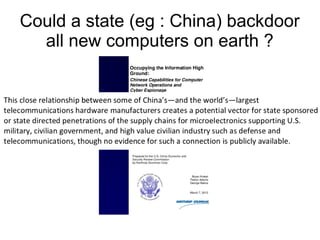
Could a state (eg : China) backdoor
  all new computers on earth ?
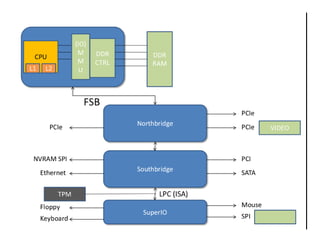
A bit of x86 architecture
State of the art, previous work
Previous work

    Early 80s : Brain virus, targets the MBR

    80s, 90s : thousands of such viruses

    2007, John Heasman (NGS Software) Blackhat US:
    backdoor EFI bootloader

    2009, Anibal Saco and Alfredo Ortega (Core security),
    CanSecWest : patch/flash a Pheonix-Award Bios

    2009, Kleissner, Blackhat US : Stoned bootkit. Bootkit
    Windows, Truecrypt. Load arbitrary unsigned kernel
    module.

    2010, Kumar and Kumar (HITB Malaysia) : vbootkit
    bootkitting of Windows 7.

    Piotr Bania, Konboot : bootkit any Windows (32/64b)

    2012 : Snare (Syscan) : EFI rootkitting
DEMO : Bootkitting Windows
Introducing Rakshasa
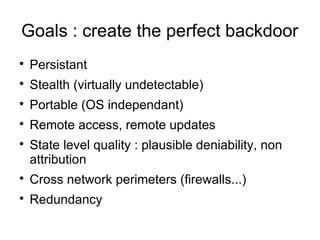
Goals : create the perfect backdoor

    Persistant

    Stealth (virtually undetectable)

    Portable (OS independant)

    Remote access, remote updates

    State level quality : plausible deniability, non
    attribution

    Cross network perimeters (firewalls...)

    Redundancy
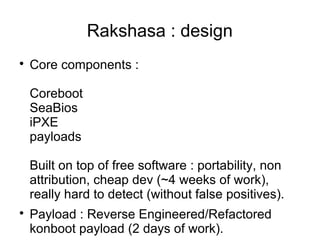
Rakshasa : design

    Core components :

    Coreboot
    SeaBios
    iPXE
    payloads

    Built on top of free software : portability, non
    attribution, cheap dev (~4 weeks of work),
    really hard to detect (without false positives).

    Payload : Reverse Engineered/Refactored
    konboot payload (2 days of work).
Rakshasa

    Flash the BIOS (Coreboot + PCI roms such as
    iPXE)

    Flash the network card or any other PCI device
    (redundancy)

    Boot a payload over the network (bootkit)

    Boot a payload over wifi/wimax (breach the
    network perimeter, bypasses network detection,
    I(P|D)S )

    Remotely reflash the BIOS/network card if
    necessary
Rakshasa : embedded features

    Remove NX bit (from BIOS or PCI)
    → executable heap/stack.

    Remove CPU updates (microcodes)

    Remove anti-SMM protections (=>local root)
    → Permantent lowering of the security level on
    any OS. Welcome back to the security level of
    1999.
    → Persistant, even if HD is remove/restored.
Optionally : Disable ASLR (bootkitting) by
 patching the seed in kernel land on the fly on
 Windows.
Rakshasa : remote payload

    Bootkit future OSes

    Update/remove/reflash firmwares (PCI, BIOS)

    Currently capable of Bootkitting any version of
    Windows (32b/64b)

    Use a minimal linux initrd in case we want to
    mount/modify the filesystem (/etc/shadow on
    any UNIX like, add new account with ADMIN
    privileges on Windows, enable remote desktop
    – possibly enable dual remote desktop on
    Windows XP Pro by patching 2 dlls...)
Rakshasa : stealthness

    We don't touch the disk. 0 evidence on the
    filesystem.

    We can remotely boot from an alternate
    payload or even OS : fake Truecrypt/Bitlocker
    prompt !

    Optionally boot from a WIFI/WMAX stack : 0
    network evidence on the LAN.

    Fake BIOS menus if necessary. We use an
    embedded CMOS image. We can use the real
    CMOS nvram to store encryption
    keys/backdoor states between reboots.
Rakshasa : why using
Coreboot/SeaBios/iPXE is the good
           approach

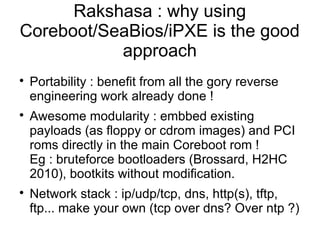
    Portability : benefit from all the gory reverse
    engineering work already done !

    Awesome modularity : embbed existing
    payloads (as floppy or cdrom images) and PCI
    roms directly in the main Coreboot rom !
    Eg : bruteforce bootloaders (Brossard, H2HC
    2010), bootkits without modification.

    Network stack : ip/udp/tcp, dns, http(s), tftp,
    ftp... make your own (tcp over dns? Over ntp ?)
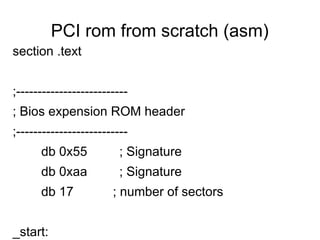
PCI rom from scratch (asm)
section .text


;--------------------------
; Bios expension ROM header
;--------------------------
      db 0x55            ; Signature
      db 0xaa            ; Signature
      db 17            ; number of sectors


_start:
DEMO : Evil remote carnal pwnage
            (of death)

   I can write blogs too... Muhahahaha...
DEMO : Evil remote carnal pwnage
            (of death)

   I can write blogs too... Muhahahaha...
How to properly build a botnet ?

    HTTPS + assymetric cryptography (client side
    certificates, signed updates)

    Fastflux and/or precomputed IP addresses

    If Microsoft can do secure remote updates, so
    can a malware !



    Avoid DNS take overs by law enforcement
    agencies by directing the C&C rotatively on
    innocent web sites (are you gonna shut down
    Google.com?), use assymetric crypto to push
    updates.
Why crypto won't save you...

    We can fake the bootking/password prompt by
    booting a remote OS (Truecrypt/Bitlocker)

    Once we know the password, the BIOS
    backdoor can emulate keyboard typing in 16b
    real mode by programming the
    keyboard/motherboard PIC microcontrolers
    (Brossard, Defcon 2008)

    If necessary, patch back original
    BIOS/firmwares remotely.
DEMOS
How about Avs ??

    Putting an AV on a server to protect against
    unknown threats is purely cosmetic.

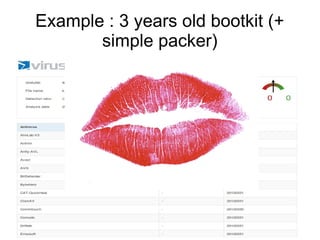
    You may as well put lipstick on your servers...
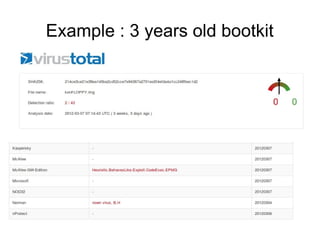
Example : 3 years old bootkit
Example : 3 years old bootkit (+
       simple packer)
Realistic attack scenarii

    Physical access :
Anybody in the supply chain can backdoor your
 hardware. Period.
 Flash from a bootable USB stick (< 3mins).

    Remote root compromise :
    If (OS == Linux) {
          flash_bios;
    } else {
      Pivot_over_the_MBR ;
    }
Realistic attack scenarii

    Purchase pre-backdoored hardware
BONUS : Backdooring the
     datacenter
Remediation
Remediation (leads)

    Flash any firmware uppon reception of new hardware with
    open source software

    Perform checksums of all firmwares by physically
    extracting them (FPGA..) : costly !

    Verify the integrity of all firmwares from time to time

    Update forensics best practices :
    1) Include firmwares in SoW
    2) Throw away your computer in case of intrusion

    Even then... not entirely satisfying : the backdoor can flash
    the original firmwares back remotely.
Side note on remote flashing

    BIOS flashing isn't a problem : the flasher
    (Linux based) is universal.

    PCI roms flashing is (a bit of) a problem :
    vendor dependant...
Detecting network card
manufacturer from the remote C&C

    IPXE allows scripting. Eg : sending the MAC
    address as an URL parameter.

    From the MAC, get the OUI number serverside.

    From the OUI number, deduce manufacturer

    Send the proper flashing tool as an embedded
    OS to the backdoor...
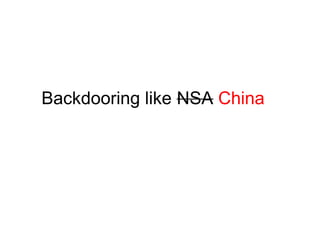
Backdooring like NSA China
Backdooring like a state
Rule #1 : non attribution
- you didn't write the free software in first place.
- add a few misleading strings, eg : in mandarin ;)

Rule #2 : plausible deniability
- use a bootstrap known remote vulnerability in a
   network card firmware
   (eg : Duflot's CVE-2010-0104)
    → « honest mistake » if discovered.
- remotely flash the BIOS.
- do your evil thing.
- restore the BIOS remotely.
Questions ?

DefCon 2012 - Hardware Backdooring (Slides)

  • 1.
    Hardware Backdooring ispractical Jonathan Brossard (Toucan System)
  • 2.
    DISCLAIMER  We are not « terrorists ». We won't release our PoC backdoor.  The x86 architecture is plagued by legacy. Governments know. The rest of the industry : not so much.  There is a need to discuss the problems in order to find solutions...  This is belived to be order of magnitudes better over existing backdoors/malware
  • 3.
    Agenda  Motivation : state level backdooring ?  Coreboot & x86 architecture  State of the art in rootkitting, romkitting  Introducing Rakshasa  Epic evil remote carnal pwnage (of death)  Why cryptography (Truecrypt/Bitlocker/TPM) won't save us...  Backdooring like a state
  • 4.
    Could a state(eg : China) backdoor all new computers on earth ?
  • 5.
    A bit ofx86 architecture
  • 7.
    State of theart, previous work
  • 8.
    Previous work  Early 80s : Brain virus, targets the MBR  80s, 90s : thousands of such viruses  2007, John Heasman (NGS Software) Blackhat US: backdoor EFI bootloader  2009, Anibal Saco and Alfredo Ortega (Core security), CanSecWest : patch/flash a Pheonix-Award Bios  2009, Kleissner, Blackhat US : Stoned bootkit. Bootkit Windows, Truecrypt. Load arbitrary unsigned kernel module.  2010, Kumar and Kumar (HITB Malaysia) : vbootkit bootkitting of Windows 7.  Piotr Bania, Konboot : bootkit any Windows (32/64b)  2012 : Snare (Syscan) : EFI rootkitting
  • 9.
  • 10.
  • 11.
    Goals : createthe perfect backdoor  Persistant  Stealth (virtually undetectable)  Portable (OS independant)  Remote access, remote updates  State level quality : plausible deniability, non attribution  Cross network perimeters (firewalls...)  Redundancy
  • 12.
    Rakshasa : design  Core components : Coreboot SeaBios iPXE payloads Built on top of free software : portability, non attribution, cheap dev (~4 weeks of work), really hard to detect (without false positives).  Payload : Reverse Engineered/Refactored konboot payload (2 days of work).
  • 13.
    Rakshasa  Flash the BIOS (Coreboot + PCI roms such as iPXE)  Flash the network card or any other PCI device (redundancy)  Boot a payload over the network (bootkit)  Boot a payload over wifi/wimax (breach the network perimeter, bypasses network detection, I(P|D)S )  Remotely reflash the BIOS/network card if necessary
  • 14.
    Rakshasa : embeddedfeatures  Remove NX bit (from BIOS or PCI) → executable heap/stack.  Remove CPU updates (microcodes)  Remove anti-SMM protections (=>local root) → Permantent lowering of the security level on any OS. Welcome back to the security level of 1999. → Persistant, even if HD is remove/restored. Optionally : Disable ASLR (bootkitting) by patching the seed in kernel land on the fly on Windows.
  • 15.
    Rakshasa : remotepayload  Bootkit future OSes  Update/remove/reflash firmwares (PCI, BIOS)  Currently capable of Bootkitting any version of Windows (32b/64b)  Use a minimal linux initrd in case we want to mount/modify the filesystem (/etc/shadow on any UNIX like, add new account with ADMIN privileges on Windows, enable remote desktop – possibly enable dual remote desktop on Windows XP Pro by patching 2 dlls...)
  • 16.
    Rakshasa : stealthness  We don't touch the disk. 0 evidence on the filesystem.  We can remotely boot from an alternate payload or even OS : fake Truecrypt/Bitlocker prompt !  Optionally boot from a WIFI/WMAX stack : 0 network evidence on the LAN.  Fake BIOS menus if necessary. We use an embedded CMOS image. We can use the real CMOS nvram to store encryption keys/backdoor states between reboots.
  • 17.
    Rakshasa : whyusing Coreboot/SeaBios/iPXE is the good approach  Portability : benefit from all the gory reverse engineering work already done !  Awesome modularity : embbed existing payloads (as floppy or cdrom images) and PCI roms directly in the main Coreboot rom ! Eg : bruteforce bootloaders (Brossard, H2HC 2010), bootkits without modification.  Network stack : ip/udp/tcp, dns, http(s), tftp, ftp... make your own (tcp over dns? Over ntp ?)
  • 18.
    PCI rom fromscratch (asm) section .text ;-------------------------- ; Bios expension ROM header ;-------------------------- db 0x55 ; Signature db 0xaa ; Signature db 17 ; number of sectors _start:
  • 19.
    DEMO : Evilremote carnal pwnage (of death) I can write blogs too... Muhahahaha...
  • 20.
    DEMO : Evilremote carnal pwnage (of death) I can write blogs too... Muhahahaha...
  • 21.
    How to properlybuild a botnet ?  HTTPS + assymetric cryptography (client side certificates, signed updates)  Fastflux and/or precomputed IP addresses If Microsoft can do secure remote updates, so can a malware !  Avoid DNS take overs by law enforcement agencies by directing the C&C rotatively on innocent web sites (are you gonna shut down Google.com?), use assymetric crypto to push updates.
  • 22.
    Why crypto won'tsave you...
  • 23.
    Why crypto won'tsave you...  We can fake the bootking/password prompt by booting a remote OS (Truecrypt/Bitlocker)  Once we know the password, the BIOS backdoor can emulate keyboard typing in 16b real mode by programming the keyboard/motherboard PIC microcontrolers (Brossard, Defcon 2008)  If necessary, patch back original BIOS/firmwares remotely.
  • 24.
  • 25.
    How about Avs??  Putting an AV on a server to protect against unknown threats is purely cosmetic.  You may as well put lipstick on your servers...
  • 26.
    Example : 3years old bootkit
  • 27.
    Example : 3years old bootkit (+ simple packer)
  • 28.
  • 29.
    Realistic attack scenarii  Physical access : Anybody in the supply chain can backdoor your hardware. Period. Flash from a bootable USB stick (< 3mins).  Remote root compromise : If (OS == Linux) { flash_bios; } else { Pivot_over_the_MBR ; }
  • 30.
    Realistic attack scenarii  Purchase pre-backdoored hardware
  • 31.
    BONUS : Backdooringthe datacenter
  • 33.
  • 34.
    Remediation (leads)  Flash any firmware uppon reception of new hardware with open source software  Perform checksums of all firmwares by physically extracting them (FPGA..) : costly !  Verify the integrity of all firmwares from time to time  Update forensics best practices : 1) Include firmwares in SoW 2) Throw away your computer in case of intrusion Even then... not entirely satisfying : the backdoor can flash the original firmwares back remotely.
  • 35.
    Side note onremote flashing  BIOS flashing isn't a problem : the flasher (Linux based) is universal.  PCI roms flashing is (a bit of) a problem : vendor dependant...
  • 36.
    Detecting network card manufacturerfrom the remote C&C  IPXE allows scripting. Eg : sending the MAC address as an URL parameter.  From the MAC, get the OUI number serverside.  From the OUI number, deduce manufacturer  Send the proper flashing tool as an embedded OS to the backdoor...
  • 37.
  • 38.
    Backdooring like astate Rule #1 : non attribution - you didn't write the free software in first place. - add a few misleading strings, eg : in mandarin ;) Rule #2 : plausible deniability - use a bootstrap known remote vulnerability in a network card firmware (eg : Duflot's CVE-2010-0104) → « honest mistake » if discovered. - remotely flash the BIOS. - do your evil thing. - restore the BIOS remotely.
  • 39.