0x0000


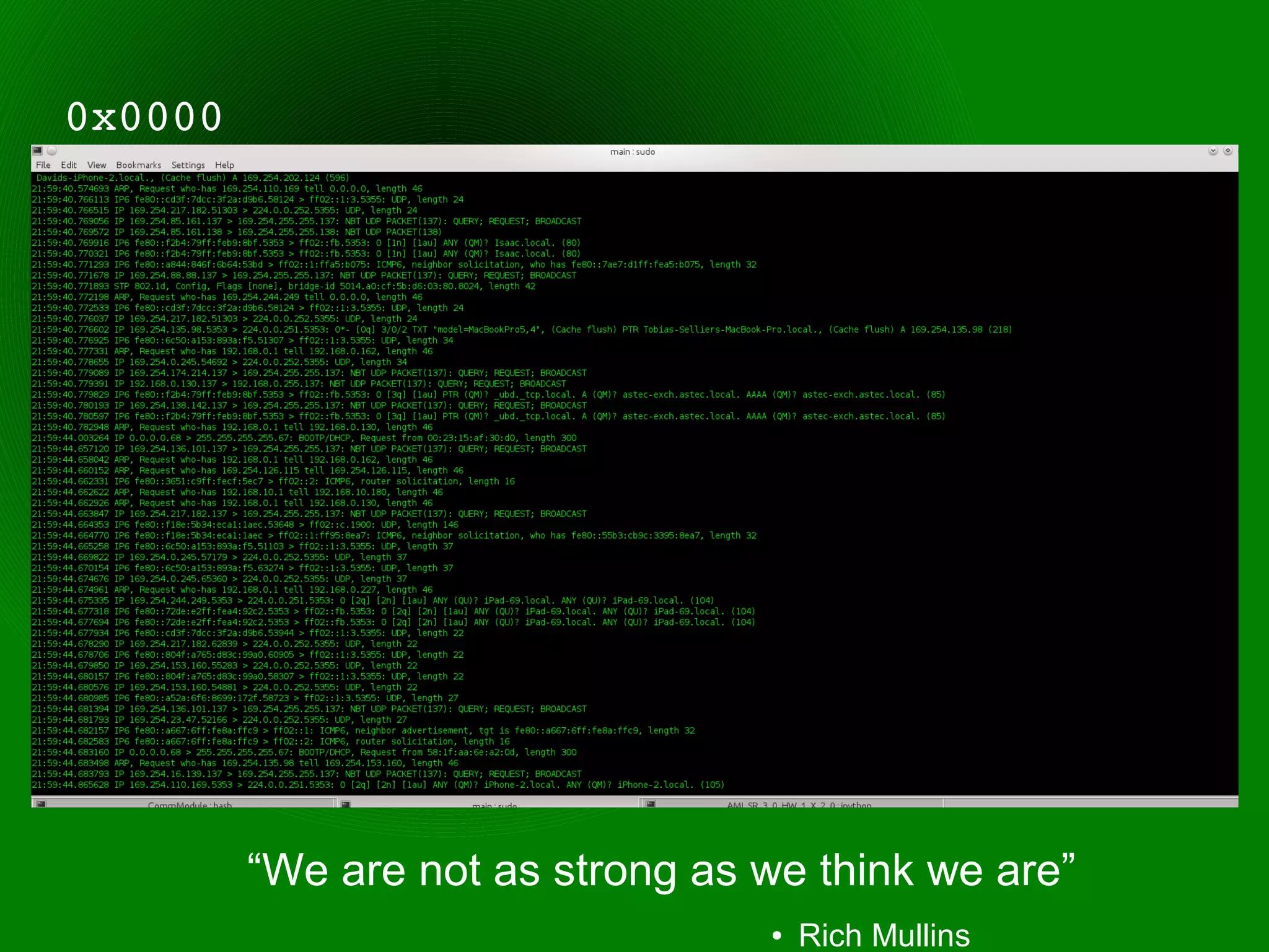
         “We are not as strong as we think we are”
                                  ●   Rich Mullins
<GHz or bust!


     leveraging the power of the 
             chipcon 1111
              (and RFCAT)
0x1000 – intro to <GHz
●   FCC Rules(title 47) parts 15 and 18 allocate and govern parts of the
    RF spectrum for unlicensed ISM in the US (US adaptation of the ITU-
    R 5.138, 5.150, and 5.280 rules)
         –   Industrial – power grid stuff and more!
         –   Science – microwave ovens?
         –   Medical – insulin pumps and the like
●   US ISM bands:
         –   300 : 300
         –   433 : 433.050 – 434.790 MHz
         –   915 : 902.000 – 928.000 MHz
         –   cc1111 does 300-348, 372-460, 779-928... but we've seen more.
●   Popular European ISM band:
         –   868 : 863.000 – 870.000 MHz
●   Other ISM includes 2.4 GHz and 5.8 GHz
         –   cc2531.... hmmm... maybe another toy?
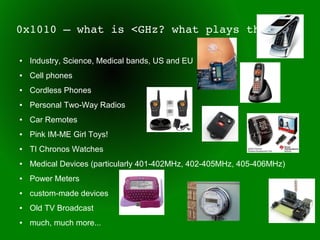
0x1010 – what is <GHz? what plays there?

●   Industry, Science, Medical bands, US and EU
●   Cell phones
●   Cordless Phones
●   Personal Two-Way Radios
●   Car Remotes
●   Pink IM-ME Girl Toys!
●   TI Chronos Watches
●   Medical Devices (particularly 401-402MHz, 402-405MHz, 405-406MHz)
●   Power Meters
●   custom-made devices
●   Old TV Broadcast
●   much, much more...
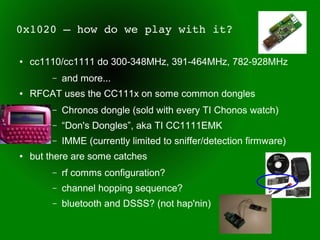
0x1020 – how do we play with it?

●   cc1110/cc1111 do 300-348MHz, 391-464MHz, 782-928MHz
         –   and more...
●   RFCAT uses the CC111x on some common dongles
         –   Chronos dongle (sold with every TI Chonos watch)
         –   “Don's Dongles”, aka TI CC1111EMK
         –   IMME (currently limited to sniffer/detection firmware)
●   but there are some catches
         –   rf comms configuration?
         –   channel hopping sequence?
         –   bluetooth and DSSS? (not hap'nin)
0x1030 – why do i care!?

●   the inner rf geek in all of us
●   your security research may require that you consider
    comms with a wireless device
●   your organization may have 900MHz devices that
    should be protected!
0x2000 – cc1111 summary ­SPEED READER!

●   modified 8051 core
        –   8-bit mcu
        –   single-tick instructions
        –   256 bytes of iram
        –   4kb of xram
        –   XDATA includes all code, iram, xram
        –   execution happens anywhere :)
●   Full Speed USB
●   RfCat hides most of these details by default!
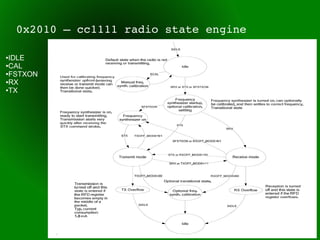
0x2010 – cc1111 radio state engine

●IDLE
●CAL

●FSTXON

●RX

●TX
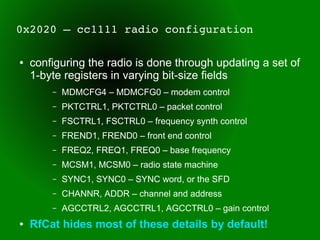
0x2020 – cc1111 radio configuration

●   configuring the radio is done through updating a set of
    1-byte registers in varying bit-size fields
        –   MDMCFG4 – MDMCFG0 – modem control
        –   PKTCTRL1, PKTCTRL0 – packet control
        –   FSCTRL1, FSCTRL0 – frequency synth control
        –   FREND1, FREND0 – front end control
        –   FREQ2, FREQ1, FREQ0 – base frequency
        –   MCSM1, MCSM0 – radio state machine
        –   SYNC1, SYNC0 – SYNC word, or the SFD
        –   CHANNR, ADDR – channel and address
        –   AGCCTRL2, AGCCTRL1, AGCCTRL0 – gain control
●   RfCat hides most of these details by default!
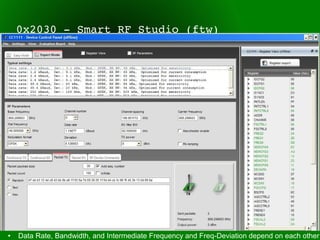
0x2030 ­ Smart RF Studio (ftw)


●   Data Rate, Bandwidth, and Intermediate Frequency and Freq-Deviation depend on each other
0x2100 – RfCat for devs
●   cc1111usb.c provides usb descriptors and framework
          –   shouldn't need much tinkering
●   cc1111rf.c provides the core of the radio firmware
          –   shouldn't need much tinkering
●   application.c provides the template for new apps
          –   copy it and make your amazing toy
●   txdata(buffer, length) to send data IN to host
●   registerCbEP5OUT() to register a callback function to handle data
    OUT from host
          –   data is in ep5iobuf[]
●   transmit(*buf, length) allows you to send on the RF pipeline
●   appMainLoop() – modify this for handling RF packets, etc...
●   follow the examples, luke!
          –   RfCat's “application” source is appFHSSNIC.c
0x3000 – radio info we want to know

●   frequencies
●   modulation (2FSK/GFSK, MSK, ASK/OOK, other)
●   intermediate frequency (IF)
●   baud rate
●   channel width/spacing/hopping?
●   bandwidth filter
●   sync words / bit-sync
●   variable length/fixed length packets
●   crc
●   data whitening?
●   any encoding (manchester, fec, enc, etc...)
0x3010 – interesting frequencies

●   315MHz – car fobs
●   433MHz – medical devices, garage door openers
●   868MHz – EU loves this range
●   915MHz – NA stuff of all sorts (power meters, insulin
    pumps, industrial plant equipment, industrial backhaul)
●   2.4GHz – 802.11/wifi, 802.15.4/zigbee/6lowpan, bluetooth
●   5.8GHz – cordless phones
●   FREQ2, FREQ1, FREQ0
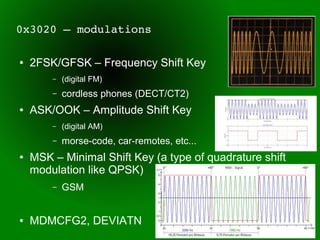
0x3020 – modulations
                                                   `
●   2FSK/GFSK – Frequency Shift Key
        –   (digital FM)
        –   cordless phones (DECT/CT2)
●   ASK/OOK – Amplitude Shift Key
        –   (digital AM)
        –   morse-code, car-remotes, etc...
●   MSK – Minimal Shift Key (a type of quadrature shift
    modulation like QPSK)
        –   GSM


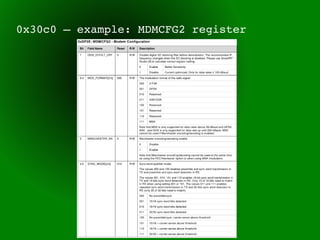
●   MDMCFG2, DEVIATN
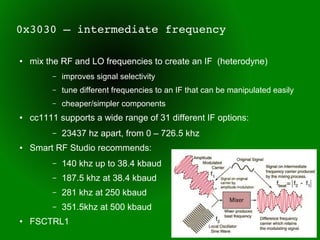
0x3030 – intermediate frequency

●   mix the RF and LO frequencies to create an IF (heterodyne)
         –   improves signal selectivity
         –   tune different frequencies to an IF that can be manipulated easily
         –   cheaper/simpler components
●   cc1111 supports a wide range of 31 different IF options:
         –   23437 hz apart, from 0 – 726.5 khz
●   Smart RF Studio recommends:
         –   140 khz up to 38.4 kbaud
         –   187.5 khz at 38.4 kbaud
         –   281 khz at 250 kbaud
         –   351.5khz at 500 kbaud
●   FSCTRL1
0x3040 – data rate (baud)

●   much like your modems or old
●   the frequency of bits
        –   some can overlap and get garbage!
                garbage can be good...
                ●


●   baud has significant impact on IF, Deviation and
    Channel BW
●   seeing use of 2400, 19200, 38400, 250000
●   MDMCFG3 / 4
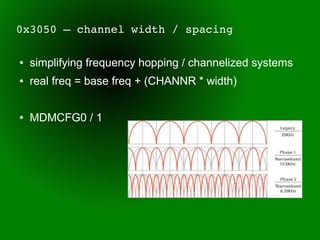
0x3050 – channel width / spacing

●   simplifying frequency hopping / channelized systems
●   real freq = base freq + (CHANNR * width)


●   MDMCFG0 / 1
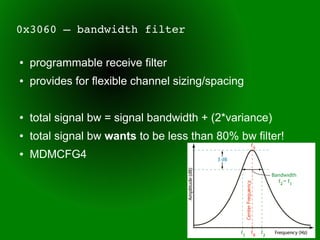
0x3060 – bandwidth filter

●   programmable receive filter
●   provides for flexible channel sizing/spacing


●   total signal bw = signal bandwidth + (2*variance)
●   total signal bw wants to be less than 80% bw filter!
●   MDMCFG4
0x3070 – preamble / sync words

●   identify when real messages are being received!
●   starts out with a preamble (1 0 1 0 1 0 1 0...)
●   then a sync word (programmable bytes)
         –   marking the end of the preamble
         –   aka 'SFD' – start of frame delimiter
●   configurable to:
         –   nothing (just dump received crap)
         –   carrier detect (if the RSSI value indicates a message)
         –   15 or 16 bits of the SYNC WORD identified
         –   30 out of 32 bits of double-SYNC WORD
●   SYNC1, SYNC0, MDMCFG2
0x3080 – variable / fixed­length packets

●   packets can be fixed length or variable length
●   variable length assumes first byte is the length byte
●   both modes use the PKTLEN register:
        –   Fixed: the length
        –   Variable: MAX length
●   PKTCTRL0, PKTLEN
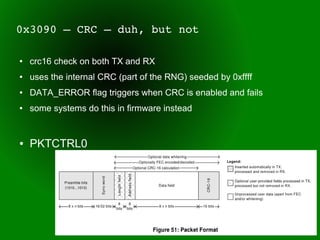
0x3090 – CRC – duh, but not

●   crc16 check on both TX and RX
●   uses the internal CRC (part of the RNG) seeded by 0xffff
●   DATA_ERROR flag triggers when CRC is enabled and fails
●   some systems do this in firmware instead


●   PKTCTRL0
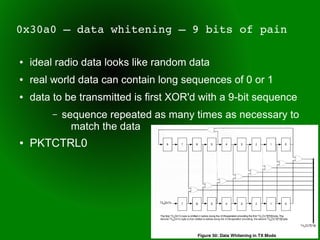
0x30a0 – data whitening – 9 bits of pain

●   ideal radio data looks like random data
●   real world data can contain long sequences of 0 or 1
●   data to be transmitted is first XOR'd with a 9-bit sequence
         –   sequence repeated as many times as necessary to
               match the data
●   PKTCTRL0
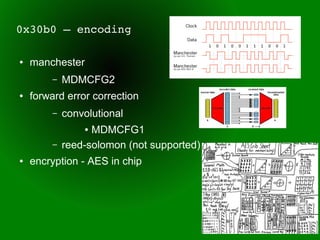
0x30b0 – encoding

●   manchester
         –   MDMCFG2
●   forward error correction
         –   convolutional
                 ● MDMCFG1
         –   reed-solomon (not supported)
●   encryption - AES in chip
0x30c0 – example: MDMCFG2 register
sorry, couldn't resist
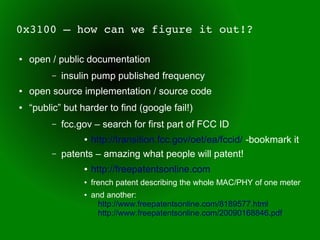
0x3100 – how can we figure it out!?

●   open / public documentation
         –   insulin pump published frequency
●   open source implementation / source code
●   “public” but harder to find (google fail!)
         –   fcc.gov – search for first part of FCC ID
                  ● http://transition.fcc.gov/oet/ea/fccid/ -bookmark it
         –   patents – amazing what people will patent!
                  ●   http://freepatentsonline.com
                  ●   french patent describing the whole MAC/PHY of one meter
                  ●   and another:
                        http://www.freepatentsonline.com/8189577.html
                        http://www.freepatentsonline.com/20090168846.pdf
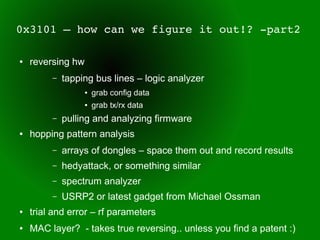
0x3101 – how can we figure it out!? ­part2

●   reversing hw
         –   tapping bus lines – logic analyzer
                   ●   grab config data
                   ●   grab tx/rx data
         –   pulling and analyzing firmware
●   hopping pattern analysis
         –   arrays of dongles – space them out and record results
         –   hedyattack, or something similar
         –   spectrum analyzer
         –   USRP2 or latest gadget from Michael Ossman
●   trial and error – rf parameters
●   MAC layer? - takes true reversing.. unless you find a patent :)
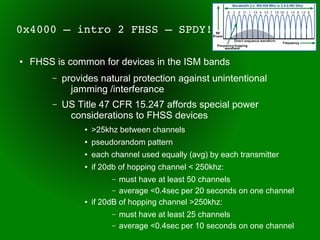
0x4000 – intro 2 FHSS – SPDY!

●   FHSS is common for devices in the ISM bands
        –   provides natural protection against unintentional
              jamming /interferance
        –   US Title 47 CFR 15.247 affords special power
             considerations to FHSS devices
                 ●   >25khz between channels
                 ●   pseudorandom pattern
                 ●   each channel used equally (avg) by each transmitter
                 ●   if 20db of hopping channel < 250khz:
                          –  must have at least 50 channels
                           – average <0.4sec per 20 seconds on one channel
                 ●   if 20dB of hopping channel >250khz:
                          –   must have at least 25 channels
                          –   average <0.4sec per 10 seconds on one channel
0x4010 – FHSS, the one and only ­ NOT!
●   different technologies:
          –   DSSS – Direct Sequence Spread Spectrum
                     ●   hops happen more often than bytes (ugh)

                     ●   typically requires special PHY layer
          –   “FHSS”
                     ●   hops occur after a few symbols are transmitted
●   different topologies: (allow for different synch methods)
          –   point-to-point (only two endpoints)
          –   multiple access systems (couple different options)
                     ●   each cell has their own hopping pattern
                     ●   each node has own hopping pattern
●   different customers:
          –   military has used frequency hopping since Hedy and George submitted the
                 patent in 1941.
          –   commercial folks (WiFi, Bluetooth, proprietary stuff like power meters)
0x4020 – FHSS intricacies
●   what's so hard about FHSS?
          –   must know or be able to come up with the hopping pattern
                    ●   can be anywhere from 50 to a million distinct channel hops
                          before the pattern repeats (or more)
          –   must be able to synchronize with an existing cell or partner
                    ●   or become your own master!
          –   must know channel spacing
          –   must know channel dwell time (time to sit on each channel)
          –   likely need to reverse engineer your target
          –   DSSS requires that you have special hardware
●   military application will be very hard to crack, as it typically will have hops
    based on a synchronized PRNG to select channels
0x4030 – FHSS, the saving graces 
●   any adhoc FHSS multi-node network:                    (power meters / sensor-nets)

        –   node sync in a reasonable timeframe
                 ●   limited channels in the repeated pattern
        –   each node knows how to talk to a cell
                 ●   let one figure it out, then tap the SPI bus to see what the
                       pattern is...
●   two keys to determining hopping pattern:
        –   hop pattern generation algorithm
                 ●   often based on the CELL ID
                           – one pattern gets you the whole cell :)
                 ●   others generate a unique pattern per node
        –   some sync information the cell gives away for free
                 ●   gotta tell the n00bs how to sync up, right?
                 ●   for single-pass repeating sequences, it's just the channel
0x4040 – FHSS summary

●   FHSS comes in different forms for different uses and
    different users
●   FHSS is naturally tolerant to interference, and allows a
    device to transmit higher power than nonFHSS comms
●   getting the FHSS pattern, timing, and appropriate sync
     method for proprietary comms can be a reversing
    challenge
●   getting a NIC to do something with the knowledge
    gained above has – to date – been very difficult
0x5000 – intro to RfCat

●   RfCat: RF Chipcon-based Attack Toolset
●   RfCat is many things, but I like to think of it as an interactive
    python access to the <GHz spectrum!
0x5010 – rfcat background

●   the power grid
         –   power meters and the folks who love them (yo cutaway,
               q, travis and josh!)
         –   no availability of good attack tools for RF
●   vendor at Distributech 2008:
             “Our Frequency Hopping Spread Spectrum is too fast
               for hackers to attack.”
                  ●   OMFW! really?
0x5020 – rfcat goals

●   RE tools - “how does this work?”
●   security analysis tools - “your FHSS and Crypto is weak!”
●   satiate my general love of RF


●   a little of Nevil Maskelyne
●   “I will not demonstrate to any man who throws doubt upon the
    system” - Guglielmo Marconi, 1903
         –   lulwut?
0x5030 – rfcat's interface

●   rfcat
            –   FHSS-capable NIC
                     ●   some assembly may be required for FHSS to arbitrary devices
            –   toolset for discovering/interfacing with RF devices
●   rfcat_server
            –   access the <GHz band over an IP network or locally and
                  configure on the fly
            –   connect to tcp port 1900 for raw data channel
            –   connect also to tcp port 1899 for configuration
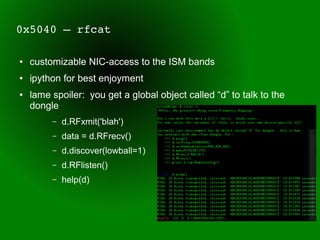
0x5040 – rfcat

●   customizable NIC-access to the ISM bands
●   ipython for best enjoyment
●   lame spoiler: you get a global object called “d” to talk to the
    dongle
         –   d.RFxmit('blah')
         –   data = d.RFrecv()
         –   d.discover(lowball=1)
         –   d.RFlisten()
         –   help(d)
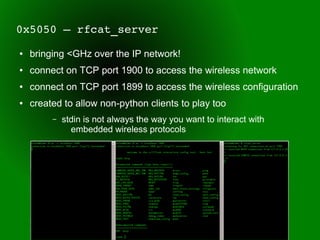
0x5050 – rfcat_server
●   bringing <GHz over the IP network!
●   connect on TCP port 1900 to access the wireless network
●   connect on TCP port 1899 to access the wireless configuration
●   created to allow non-python clients to play too
         –   stdin is not always the way you want to interact with
               embedded wireless protocols
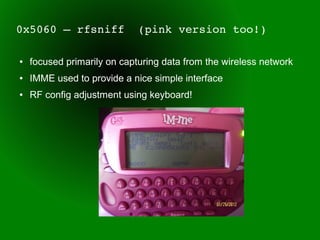
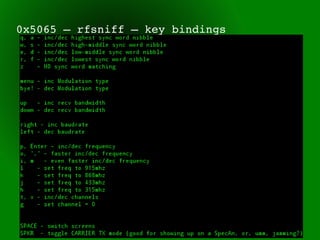
0x5060 – rfsniff  (pink version too!)

●   focused primarily on capturing data from the wireless network
●   IMME used to provide a nice simple interface
●   RF config adjustment using keyboard!
0x5065 – rfsniff – key bindings
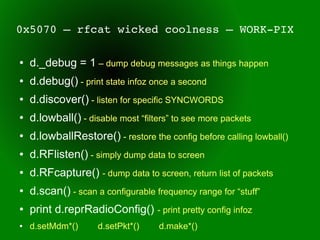
0x5070 – rfcat wicked coolness – WORK­PIX

●   d._debug = 1 – dump debug messages as things happen
●   d.debug() - print state infoz once a second
●   d.discover() - listen for specific SYNCWORDS
●   d.lowball() - disable most “filters” to see more packets
●   d.lowballRestore() - restore the config before calling lowball()
●   d.RFlisten() - simply dump data to screen
●   d.RFcapture() - dump data to screen, return list of packets
●   d.scan() - scan a configurable frequency range for “stuff”
●   print d.reprRadioConfig() - print pretty config infoz
●   d.setMdm*()      d.setPkt*()    d.make*()
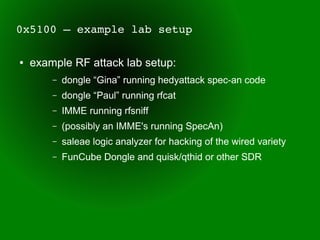
0x5100 – example lab setup

●   example RF attack lab setup:
        –   dongle “Gina” running hedyattack spec-an code
        –   dongle “Paul” running rfcat
        –   IMME running rfsniff
        –   (possibly an IMME's running SpecAn)
        –   saleae logic analyzer for hacking of the wired variety
        –   FunCube Dongle and quisk/qthid or other SDR
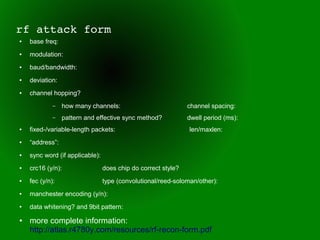
rf attack form
●   base freq:
●   modulation:
●   baud/bandwidth:
●   deviation:
●   channel hopping?
             –   how many channels:                            channel spacing:
             –   pattern and effective sync method?            dwell period (ms):
●   fixed-/variable-length packets:                            len/maxlen:
●   “address”:
●   sync word (if applicable):
●   crc16 (y/n):                 does chip do correct style?
●   fec (y/n):                   type (convolutional/reed-soloman/other):
●   manchester encoding (y/n):
●   data whitening? and 9bit pattern:
●   more complete information:
    http://atlas.r4780y.com/resources/rf-recon-form.pdf
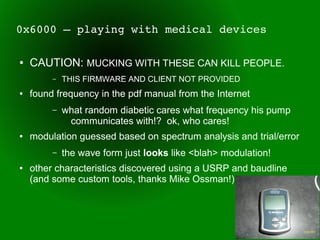
0x6000 – playing with medical devices

●   CAUTION: MUCKING WITH THESE CAN KILL PEOPLE.
         –   THIS FIRMWARE AND CLIENT NOT PROVIDED
●   found frequency in the pdf manual from the Internet
         –   what random diabetic cares what frequency his pump
              communicates with!? ok, who cares!
●   modulation guessed based on spectrum analysis and trial/error
         –   the wave form just looks like <blah> modulation!
●   other characteristics discovered using a USRP and baudline
    (and some custom tools, thanks Mike Ossman!)
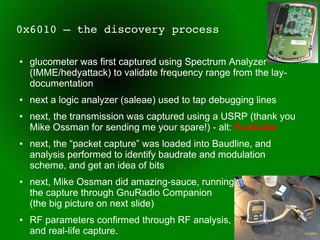
0x6010 – the discovery process

●   glucometer was first captured using Spectrum Analyzer
    (IMME/hedyattack) to validate frequency range from the lay-
    documentation
●   next a logic analyzer (saleae) used to tap debugging lines
●   next, the transmission was captured using a USRP (thank you
    Mike Ossman for sending me your spare!) - alt: FunCube
●   next, the “packet capture” was loaded into Baudline, and
    analysis performed to identify baudrate and modulation
    scheme, and get an idea of bits
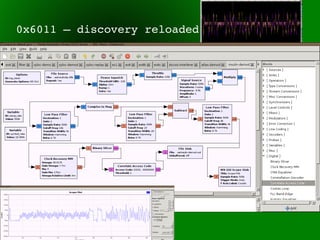
●   next, Mike Ossman did amazing-sauce, running
    the capture through GnuRadio Companion
    (the big picture on next slide)
●   RF parameters confirmed through RF analysis,
    and real-life capture.
0x6011 – discovery reloaded
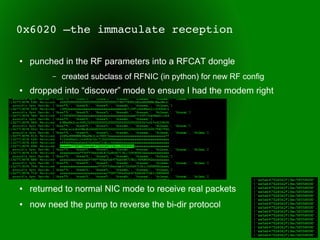
0x6020 –the immaculate reception

●   punched in the RF parameters into a RFCAT dongle
         –   created subclass of RFNIC (in python) for new RF config
●   dropped into “discover” mode to ensure I had the modem right
●


●


●


●


●


●   returned to normal NIC mode to receive real packets
●   now need the pump to reverse the bi-dir protocol
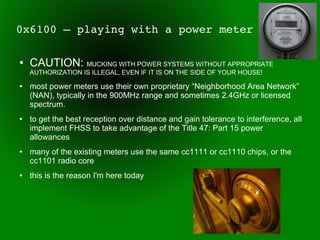
0x6100 – playing with a power meter

●   CAUTION: MUCKING WITH POWER SYSTEMS WITHOUT APPROPRIATE
    AUTHORIZATION IS ILLEGAL, EVEN IF IT IS ON THE SIDE OF YOUR HOUSE!
●   most power meters use their own proprietary “Neighborhood Area Network”
    (NAN), typically in the 900MHz range and sometimes 2.4GHz or licensed
    spectrum.
●   to get the best reception over distance and gain tolerance to interference, all
    implement FHSS to take advantage of the Title 47: Part 15 power
    allowances
●   many of the existing meters use the same cc1111 or cc1110 chips, or the
    cc1101 radio core
●   this is the reason I'm here today
0x6110 – as sands through the hourglass

●   power meter RF comms have long been “unavailable” for
    most security researchers
●   some vendors understand the benefits of security
    rigor by outside researchers
        –   others, however, do not.
●   the gear used in my presentation was given to me by one
    who understands
        –   for various reasons, they have asked to remain
              anonymous, however, their security team has a
              well founded approach to finding out “how their
              baby is ugly” I would like to give them credit for
              their commitment to the improved security of their
              products.
atlas, tell us what you really think
0x6120 – smart meter – the complication

●   power meters are not so simple as glucometers
         –   proprietary FHSS in a multiple-access topology
         –   have to endure the RF abuse of the large metropolis
●   complex mac sync/net-registration
●   not easy to show with a single meter without a Master node.
●   initial analysis was performed via my saleae LA:
●   SpecAn code on IMME's and hedyattack dongles
         –   good for identifying periods of scanning
●   although the dongle can hop along with the meter, we won't be
    demoing synching with the meter today
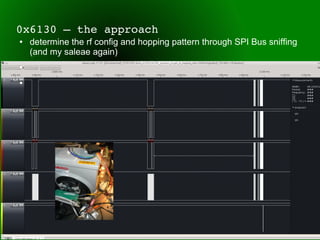
0x6130 – the approach
●   determine the rf config and hopping pattern through SPI Bus sniffing
    (and my saleae again)
●


●
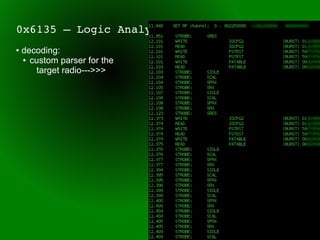
0x6135 – Logic Analyzer
●   decoding:
    ● custom parser for the

       target radio--->>>
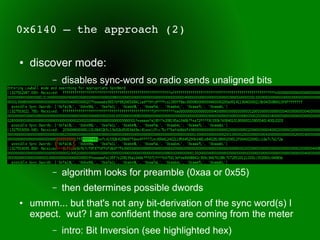
0x6140 – the approach (2)

●   discover mode:
         –   disables sync-word so radio sends unaligned bits


         –   algorithm looks for preamble (0xaa or 0x55)
         –   then determines possible dwords
●   ummm... but that's not any bit-derivation of the sync word(s) I
    expect. wut? I am confident those are coming from the meter
         –   intro: Bit Inversion (see highlighted hex)
0x6145 – new developments

●   vendors have filed numerous patents with hopping
    pattern calculations, comms parameters, etc...
        –   WIN!
        –   plenty of work to be done! jump right in!
                   ●   http://www.patentstorm.us/patents/7064679/fulltext.html
                   ●   http://www.patentstorm.us/patents/7962101/fulltext.html
                   ●   http://www.patentstorm.us/applications/20080204272/fulltext.html
                   ●   http://www.patentstorm.us/applications/20080238716/fulltext.html
“Abuse is no argument”
  - Nevil Maskelyne
0x6150 ­ conclusions

●   rfcat discover mode roxors
●   rfcat is a foundation for your attack tool
        –   way more than just a tool in itself
●   we are responsible for ensuring our devices use
    appropriate security. do not simply expect someone
    else to do it. the first med-device death could be your
    best friend.
References
●   http://rfcat.googlecode.com
●   http://en.wikipedia.org/wiki/Part_15_(FCC_rules)
●   http://en.wikipedia.org/wiki/ISM_band
●   http://www.ti.com/lit/ds/swrs033g/swrs033g.pdf - “the” manual
●   http://edge.rit.edu/content/P11207/public/CC1111_USB_HW_User_s_Guide.pdf
●   http://www.ti.com/litv/pdf/swru082b
●   http://www.ti.com/product/cc1111f32#technicaldocuments
●   http://www.ti.com/lit/an/swra077/swra077.pdf
●   http://www.newscientist.com/article/mg21228440.700-dotdashdiss-the-gentleman-hackers-1903-lulz.html

●   http://saleae.com/
●   http://zone.ni.com/devzone/cda/epd/p/id/5150 - FSK details (worthwhile!)
●   http://www.radagast.org/~dplatt/hamradio/FARS_presentation_on_modulation.pdf
            –   very good detailed discussion on deviation/modulation
●   http://en.wikipedia.org/wiki/Frequency_modulation
●   http://en.wikipedia.org/wiki/Minimum-shift_keying
0xgreetz

●   power hardware folk who play nice with security researchers
●   cutaway and q (awesome hedyattackers)
●   gerard van den bosch
●   travis and mossman
●   sk0d0 and the four J's
●   invisigoth and kenshoto
●   Jewel, bug, ringwraith, diva
●   Jesus Christ

DefCon 2012 - Sub-1 GHz Radio Frequency Security

  • 1.
    0x0000 “We are not as strong as we think we are” ● Rich Mullins
  • 2.
    <GHz or bust! leveraging the power of the  chipcon 1111 (and RFCAT)
  • 3.
    0x1000 – intro to <GHz ● FCC Rules(title 47) parts 15 and 18 allocate and govern parts of the RF spectrum for unlicensed ISM in the US (US adaptation of the ITU- R 5.138, 5.150, and 5.280 rules) – Industrial – power grid stuff and more! – Science – microwave ovens? – Medical – insulin pumps and the like ● US ISM bands: – 300 : 300 – 433 : 433.050 – 434.790 MHz – 915 : 902.000 – 928.000 MHz – cc1111 does 300-348, 372-460, 779-928... but we've seen more. ● Popular European ISM band: – 868 : 863.000 – 870.000 MHz ● Other ISM includes 2.4 GHz and 5.8 GHz – cc2531.... hmmm... maybe another toy?
  • 4.
    0x1010 – what is <GHz? what plays there? ● Industry, Science, Medical bands, US and EU ● Cell phones ● Cordless Phones ● Personal Two-Way Radios ● Car Remotes ● Pink IM-ME Girl Toys! ● TI Chronos Watches ● Medical Devices (particularly 401-402MHz, 402-405MHz, 405-406MHz) ● Power Meters ● custom-made devices ● Old TV Broadcast ● much, much more...
  • 5.
    0x1020 – how do we play with it? ● cc1110/cc1111 do 300-348MHz, 391-464MHz, 782-928MHz – and more... ● RFCAT uses the CC111x on some common dongles – Chronos dongle (sold with every TI Chonos watch) – “Don's Dongles”, aka TI CC1111EMK – IMME (currently limited to sniffer/detection firmware) ● but there are some catches – rf comms configuration? – channel hopping sequence? – bluetooth and DSSS? (not hap'nin)
  • 6.
    0x1030 – why do i care!? ● the inner rf geek in all of us ● your security research may require that you consider comms with a wireless device ● your organization may have 900MHz devices that should be protected!
  • 7.
    0x2000 – cc1111 summary ­SPEED READER! ● modified 8051 core – 8-bit mcu – single-tick instructions – 256 bytes of iram – 4kb of xram – XDATA includes all code, iram, xram – execution happens anywhere :) ● Full Speed USB ● RfCat hides most of these details by default!
  • 8.
  • 9.
    0x2020 – cc1111 radio configuration ● configuring the radio is done through updating a set of 1-byte registers in varying bit-size fields – MDMCFG4 – MDMCFG0 – modem control – PKTCTRL1, PKTCTRL0 – packet control – FSCTRL1, FSCTRL0 – frequency synth control – FREND1, FREND0 – front end control – FREQ2, FREQ1, FREQ0 – base frequency – MCSM1, MCSM0 – radio state machine – SYNC1, SYNC0 – SYNC word, or the SFD – CHANNR, ADDR – channel and address – AGCCTRL2, AGCCTRL1, AGCCTRL0 – gain control ● RfCat hides most of these details by default!
  • 10.
    0x2030 ­ Smart RF Studio (ftw) ● Data Rate, Bandwidth, and Intermediate Frequency and Freq-Deviation depend on each other
  • 11.
    0x2100 – RfCat for devs ● cc1111usb.c provides usb descriptors and framework – shouldn't need much tinkering ● cc1111rf.c provides the core of the radio firmware – shouldn't need much tinkering ● application.c provides the template for new apps – copy it and make your amazing toy ● txdata(buffer, length) to send data IN to host ● registerCbEP5OUT() to register a callback function to handle data OUT from host – data is in ep5iobuf[] ● transmit(*buf, length) allows you to send on the RF pipeline ● appMainLoop() – modify this for handling RF packets, etc... ● follow the examples, luke! – RfCat's “application” source is appFHSSNIC.c
  • 12.
    0x3000 – radio info we want to know ● frequencies ● modulation (2FSK/GFSK, MSK, ASK/OOK, other) ● intermediate frequency (IF) ● baud rate ● channel width/spacing/hopping? ● bandwidth filter ● sync words / bit-sync ● variable length/fixed length packets ● crc ● data whitening? ● any encoding (manchester, fec, enc, etc...)
  • 13.
    0x3010 – interesting frequencies ● 315MHz – car fobs ● 433MHz – medical devices, garage door openers ● 868MHz – EU loves this range ● 915MHz – NA stuff of all sorts (power meters, insulin pumps, industrial plant equipment, industrial backhaul) ● 2.4GHz – 802.11/wifi, 802.15.4/zigbee/6lowpan, bluetooth ● 5.8GHz – cordless phones ● FREQ2, FREQ1, FREQ0
  • 14.
    0x3020 – modulations ` ● 2FSK/GFSK – Frequency Shift Key – (digital FM) – cordless phones (DECT/CT2) ● ASK/OOK – Amplitude Shift Key – (digital AM) – morse-code, car-remotes, etc... ● MSK – Minimal Shift Key (a type of quadrature shift modulation like QPSK) – GSM ● MDMCFG2, DEVIATN
  • 15.
    0x3030 – intermediate frequency ● mix the RF and LO frequencies to create an IF (heterodyne) – improves signal selectivity – tune different frequencies to an IF that can be manipulated easily – cheaper/simpler components ● cc1111 supports a wide range of 31 different IF options: – 23437 hz apart, from 0 – 726.5 khz ● Smart RF Studio recommends: – 140 khz up to 38.4 kbaud – 187.5 khz at 38.4 kbaud – 281 khz at 250 kbaud – 351.5khz at 500 kbaud ● FSCTRL1
  • 16.
    0x3040 – data rate (baud) ● much like your modems or old ● the frequency of bits – some can overlap and get garbage! garbage can be good... ● ● baud has significant impact on IF, Deviation and Channel BW ● seeing use of 2400, 19200, 38400, 250000 ● MDMCFG3 / 4
  • 17.
    0x3050 – channel width / spacing ● simplifying frequency hopping / channelized systems ● real freq = base freq + (CHANNR * width) ● MDMCFG0 / 1
  • 18.
    0x3060 – bandwidth filter ● programmable receive filter ● provides for flexible channel sizing/spacing ● total signal bw = signal bandwidth + (2*variance) ● total signal bw wants to be less than 80% bw filter! ● MDMCFG4
  • 19.
    0x3070 – preamble / sync words ● identify when real messages are being received! ● starts out with a preamble (1 0 1 0 1 0 1 0...) ● then a sync word (programmable bytes) – marking the end of the preamble – aka 'SFD' – start of frame delimiter ● configurable to: – nothing (just dump received crap) – carrier detect (if the RSSI value indicates a message) – 15 or 16 bits of the SYNC WORD identified – 30 out of 32 bits of double-SYNC WORD ● SYNC1, SYNC0, MDMCFG2
  • 20.
    0x3080 – variable / fixed­length packets ● packets can be fixed length or variable length ● variable length assumes first byte is the length byte ● both modes use the PKTLEN register: – Fixed: the length – Variable: MAX length ● PKTCTRL0, PKTLEN
  • 21.
    0x3090 – CRC – duh, but not ● crc16 check on both TX and RX ● uses the internal CRC (part of the RNG) seeded by 0xffff ● DATA_ERROR flag triggers when CRC is enabled and fails ● some systems do this in firmware instead ● PKTCTRL0
  • 22.
    0x30a0 – data whitening – 9 bits of pain ● ideal radio data looks like random data ● real world data can contain long sequences of 0 or 1 ● data to be transmitted is first XOR'd with a 9-bit sequence – sequence repeated as many times as necessary to match the data ● PKTCTRL0
  • 23.
    0x30b0 – encoding ● manchester – MDMCFG2 ● forward error correction – convolutional ● MDMCFG1 – reed-solomon (not supported) ● encryption - AES in chip
  • 24.
  • 25.
  • 26.
    0x3100 – how can we figure it out!? ● open / public documentation – insulin pump published frequency ● open source implementation / source code ● “public” but harder to find (google fail!) – fcc.gov – search for first part of FCC ID ● http://transition.fcc.gov/oet/ea/fccid/ -bookmark it – patents – amazing what people will patent! ● http://freepatentsonline.com ● french patent describing the whole MAC/PHY of one meter ● and another: http://www.freepatentsonline.com/8189577.html http://www.freepatentsonline.com/20090168846.pdf
  • 27.
    0x3101 – how can we figure it out!? ­part2 ● reversing hw – tapping bus lines – logic analyzer ● grab config data ● grab tx/rx data – pulling and analyzing firmware ● hopping pattern analysis – arrays of dongles – space them out and record results – hedyattack, or something similar – spectrum analyzer – USRP2 or latest gadget from Michael Ossman ● trial and error – rf parameters ● MAC layer? - takes true reversing.. unless you find a patent :)
  • 28.
    0x4000 – intro 2 FHSS – SPDY! ● FHSS is common for devices in the ISM bands – provides natural protection against unintentional jamming /interferance – US Title 47 CFR 15.247 affords special power considerations to FHSS devices ● >25khz between channels ● pseudorandom pattern ● each channel used equally (avg) by each transmitter ● if 20db of hopping channel < 250khz: – must have at least 50 channels – average <0.4sec per 20 seconds on one channel ● if 20dB of hopping channel >250khz: – must have at least 25 channels – average <0.4sec per 10 seconds on one channel
  • 29.
    0x4010 – FHSS, the one and only ­ NOT! ● different technologies: – DSSS – Direct Sequence Spread Spectrum ● hops happen more often than bytes (ugh) ● typically requires special PHY layer – “FHSS” ● hops occur after a few symbols are transmitted ● different topologies: (allow for different synch methods) – point-to-point (only two endpoints) – multiple access systems (couple different options) ● each cell has their own hopping pattern ● each node has own hopping pattern ● different customers: – military has used frequency hopping since Hedy and George submitted the patent in 1941. – commercial folks (WiFi, Bluetooth, proprietary stuff like power meters)
  • 30.
    0x4020 – FHSS intricacies ● what's so hard about FHSS? – must know or be able to come up with the hopping pattern ● can be anywhere from 50 to a million distinct channel hops before the pattern repeats (or more) – must be able to synchronize with an existing cell or partner ● or become your own master! – must know channel spacing – must know channel dwell time (time to sit on each channel) – likely need to reverse engineer your target – DSSS requires that you have special hardware ● military application will be very hard to crack, as it typically will have hops based on a synchronized PRNG to select channels
  • 31.
    0x4030 – FHSS, the saving graces  ● any adhoc FHSS multi-node network: (power meters / sensor-nets) – node sync in a reasonable timeframe ● limited channels in the repeated pattern – each node knows how to talk to a cell ● let one figure it out, then tap the SPI bus to see what the pattern is... ● two keys to determining hopping pattern: – hop pattern generation algorithm ● often based on the CELL ID – one pattern gets you the whole cell :) ● others generate a unique pattern per node – some sync information the cell gives away for free ● gotta tell the n00bs how to sync up, right? ● for single-pass repeating sequences, it's just the channel
  • 32.
    0x4040 – FHSS summary ● FHSS comes in different forms for different uses and different users ● FHSS is naturally tolerant to interference, and allows a device to transmit higher power than nonFHSS comms ● getting the FHSS pattern, timing, and appropriate sync method for proprietary comms can be a reversing challenge ● getting a NIC to do something with the knowledge gained above has – to date – been very difficult
  • 33.
    0x5000 – intro to RfCat ● RfCat: RF Chipcon-based Attack Toolset ● RfCat is many things, but I like to think of it as an interactive python access to the <GHz spectrum!
  • 34.
    0x5010 – rfcat background ● the power grid – power meters and the folks who love them (yo cutaway, q, travis and josh!) – no availability of good attack tools for RF ● vendor at Distributech 2008: “Our Frequency Hopping Spread Spectrum is too fast for hackers to attack.” ● OMFW! really?
  • 35.
    0x5020 – rfcat goals ● RE tools - “how does this work?” ● security analysis tools - “your FHSS and Crypto is weak!” ● satiate my general love of RF ● a little of Nevil Maskelyne ● “I will not demonstrate to any man who throws doubt upon the system” - Guglielmo Marconi, 1903 – lulwut?
  • 36.
    0x5030 – rfcat's interface ● rfcat – FHSS-capable NIC ● some assembly may be required for FHSS to arbitrary devices – toolset for discovering/interfacing with RF devices ● rfcat_server – access the <GHz band over an IP network or locally and configure on the fly – connect to tcp port 1900 for raw data channel – connect also to tcp port 1899 for configuration
  • 37.
    0x5040 – rfcat ● customizable NIC-access to the ISM bands ● ipython for best enjoyment ● lame spoiler: you get a global object called “d” to talk to the dongle – d.RFxmit('blah') – data = d.RFrecv() – d.discover(lowball=1) – d.RFlisten() – help(d)
  • 38.
    0x5050 – rfcat_server ● bringing <GHz over the IP network! ● connect on TCP port 1900 to access the wireless network ● connect on TCP port 1899 to access the wireless configuration ● created to allow non-python clients to play too – stdin is not always the way you want to interact with embedded wireless protocols
  • 39.
    0x5060 – rfsniff  (pink version too!) ● focused primarily on capturing data from the wireless network ● IMME used to provide a nice simple interface ● RF config adjustment using keyboard!
  • 40.
  • 41.
    0x5070 – rfcat wicked coolness – WORK­PIX ● d._debug = 1 – dump debug messages as things happen ● d.debug() - print state infoz once a second ● d.discover() - listen for specific SYNCWORDS ● d.lowball() - disable most “filters” to see more packets ● d.lowballRestore() - restore the config before calling lowball() ● d.RFlisten() - simply dump data to screen ● d.RFcapture() - dump data to screen, return list of packets ● d.scan() - scan a configurable frequency range for “stuff” ● print d.reprRadioConfig() - print pretty config infoz ● d.setMdm*() d.setPkt*() d.make*()
  • 42.
    0x5100 – example lab setup ● example RF attack lab setup: – dongle “Gina” running hedyattack spec-an code – dongle “Paul” running rfcat – IMME running rfsniff – (possibly an IMME's running SpecAn) – saleae logic analyzer for hacking of the wired variety – FunCube Dongle and quisk/qthid or other SDR
  • 43.
    rf attack form ● base freq: ● modulation: ● baud/bandwidth: ● deviation: ● channel hopping? – how many channels: channel spacing: – pattern and effective sync method? dwell period (ms): ● fixed-/variable-length packets: len/maxlen: ● “address”: ● sync word (if applicable): ● crc16 (y/n): does chip do correct style? ● fec (y/n): type (convolutional/reed-soloman/other): ● manchester encoding (y/n): ● data whitening? and 9bit pattern: ● more complete information: http://atlas.r4780y.com/resources/rf-recon-form.pdf
  • 44.
    0x6000 – playing with medical devices ● CAUTION: MUCKING WITH THESE CAN KILL PEOPLE. – THIS FIRMWARE AND CLIENT NOT PROVIDED ● found frequency in the pdf manual from the Internet – what random diabetic cares what frequency his pump communicates with!? ok, who cares! ● modulation guessed based on spectrum analysis and trial/error – the wave form just looks like <blah> modulation! ● other characteristics discovered using a USRP and baudline (and some custom tools, thanks Mike Ossman!)
  • 45.
    0x6010 – the discovery process ● glucometer was first captured using Spectrum Analyzer (IMME/hedyattack) to validate frequency range from the lay- documentation ● next a logic analyzer (saleae) used to tap debugging lines ● next, the transmission was captured using a USRP (thank you Mike Ossman for sending me your spare!) - alt: FunCube ● next, the “packet capture” was loaded into Baudline, and analysis performed to identify baudrate and modulation scheme, and get an idea of bits ● next, Mike Ossman did amazing-sauce, running the capture through GnuRadio Companion (the big picture on next slide) ● RF parameters confirmed through RF analysis, and real-life capture.
  • 46.
  • 47.
    0x6020 –the immaculate reception ● punched in the RF parameters into a RFCAT dongle – created subclass of RFNIC (in python) for new RF config ● dropped into “discover” mode to ensure I had the modem right ● ● ● ● ● ● returned to normal NIC mode to receive real packets ● now need the pump to reverse the bi-dir protocol
  • 48.
    0x6100 – playing with a power meter ● CAUTION: MUCKING WITH POWER SYSTEMS WITHOUT APPROPRIATE AUTHORIZATION IS ILLEGAL, EVEN IF IT IS ON THE SIDE OF YOUR HOUSE! ● most power meters use their own proprietary “Neighborhood Area Network” (NAN), typically in the 900MHz range and sometimes 2.4GHz or licensed spectrum. ● to get the best reception over distance and gain tolerance to interference, all implement FHSS to take advantage of the Title 47: Part 15 power allowances ● many of the existing meters use the same cc1111 or cc1110 chips, or the cc1101 radio core ● this is the reason I'm here today
  • 49.
    0x6110 – as sands through the hourglass ● power meter RF comms have long been “unavailable” for most security researchers ● some vendors understand the benefits of security rigor by outside researchers – others, however, do not. ● the gear used in my presentation was given to me by one who understands – for various reasons, they have asked to remain anonymous, however, their security team has a well founded approach to finding out “how their baby is ugly” I would like to give them credit for their commitment to the improved security of their products.
  • 50.
  • 51.
    0x6120 – smart meter – the complication ● power meters are not so simple as glucometers – proprietary FHSS in a multiple-access topology – have to endure the RF abuse of the large metropolis ● complex mac sync/net-registration ● not easy to show with a single meter without a Master node. ● initial analysis was performed via my saleae LA: ● SpecAn code on IMME's and hedyattack dongles – good for identifying periods of scanning ● although the dongle can hop along with the meter, we won't be demoing synching with the meter today
  • 52.
    0x6130 – the approach ● determine the rf config and hopping pattern through SPI Bus sniffing (and my saleae again) ● ●
  • 53.
    0x6135 – Logic Analyzer ● decoding: ● custom parser for the target radio--->>>
  • 54.
    0x6140 – the approach (2) ● discover mode: – disables sync-word so radio sends unaligned bits – algorithm looks for preamble (0xaa or 0x55) – then determines possible dwords ● ummm... but that's not any bit-derivation of the sync word(s) I expect. wut? I am confident those are coming from the meter – intro: Bit Inversion (see highlighted hex)
  • 55.
    0x6145 – new developments ● vendors have filed numerous patents with hopping pattern calculations, comms parameters, etc... – WIN! – plenty of work to be done! jump right in! ● http://www.patentstorm.us/patents/7064679/fulltext.html ● http://www.patentstorm.us/patents/7962101/fulltext.html ● http://www.patentstorm.us/applications/20080204272/fulltext.html ● http://www.patentstorm.us/applications/20080238716/fulltext.html
  • 56.
    “Abuse is noargument” - Nevil Maskelyne
  • 57.
    0x6150 ­ conclusions ● rfcat discover mode roxors ● rfcat is a foundation for your attack tool – way more than just a tool in itself ● we are responsible for ensuring our devices use appropriate security. do not simply expect someone else to do it. the first med-device death could be your best friend.
  • 58.
    References ● http://rfcat.googlecode.com ● http://en.wikipedia.org/wiki/Part_15_(FCC_rules) ● http://en.wikipedia.org/wiki/ISM_band ● http://www.ti.com/lit/ds/swrs033g/swrs033g.pdf - “the” manual ● http://edge.rit.edu/content/P11207/public/CC1111_USB_HW_User_s_Guide.pdf ● http://www.ti.com/litv/pdf/swru082b ● http://www.ti.com/product/cc1111f32#technicaldocuments ● http://www.ti.com/lit/an/swra077/swra077.pdf ● http://www.newscientist.com/article/mg21228440.700-dotdashdiss-the-gentleman-hackers-1903-lulz.html ● http://saleae.com/ ● http://zone.ni.com/devzone/cda/epd/p/id/5150 - FSK details (worthwhile!) ● http://www.radagast.org/~dplatt/hamradio/FARS_presentation_on_modulation.pdf – very good detailed discussion on deviation/modulation ● http://en.wikipedia.org/wiki/Frequency_modulation ● http://en.wikipedia.org/wiki/Minimum-shift_keying
  • 59.
    0xgreetz ● power hardware folk who play nice with security researchers ● cutaway and q (awesome hedyattackers) ● gerard van den bosch ● travis and mossman ● sk0d0 and the four J's ● invisigoth and kenshoto ● Jewel, bug, ringwraith, diva ● Jesus Christ