Vulnerabilities of Wireless
 Water Meter Networks
         John McNabb
    johnmcnabb@comcast.net
          DEF CON 19
         August 6, 2011


                              1
Background
• 13 years - an elected Water Commissioner
• 2 articles in NEWWA Journal on water infrastructure
• 10 years as lobbyist for Clean Water Action; 6 years as lobbyist
  for state environmental regulatory agency (Mass. DEP)
• 6+ years as an IT Pro, mostly doing general tech support
• 2+ years as a security researcher, primarily interested in
  drinking water security & cyber security
• Independent researcher; no school, company, or grant support
• DEF CON 18 last year - Cyberterrorism & Security of the
  National Drinking Water Infrastructure
• March 2011 Hacker Japan article on my DC18 talk.
• Shmoocon 2011 – Hacking SmartWater Water Meters
• NOTE: My BH white paper, revised, will be published next year
  in the book Weapons of Mass Destruction and Terrorism, 2nd
  edition, by Forest and Howard, eds. and possibly also in the
  NEWWA Journal.                                                 2
What this talk is about
• Wireless water meters
• What they are used for and could be
  used for
• Types of meters & wireless water
  meters
• Potential issues, threats, attacks,
  hacks, etc.
• Not very technical talk, no exploits or
  tools
• The need for this talk is that there is a
  lot of attention on the electric smart
  grid, very little on the water smart
  grid
• Drinking water is a critical
  infrastructure.
• My analysis of water infrastructure
  security is in my Black Hat whitepaper,
  email me for a copy .
• I come at this from a ‘water centric’
  view then from the IT perspective           3
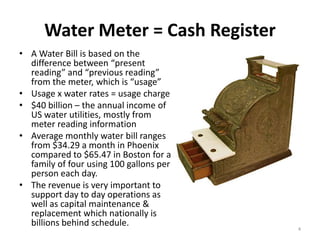
Water Meter = Cash Register
• A Water Bill is based on the
  difference between “present
  reading” and “previous reading”
  from the meter, which is “usage”
• Usage x water rates = usage charge
• $40 billion – the annual income of
  US water utilities, mostly from
  meter reading information
• Average monthly water bill ranges
  from $34.29 a month in Phoenix
  compared to $65.47 in Boston for a
  family of four using 100 gallons per
  person each day.
• The revenue is very important to
  support day to day operations as
  well as capital maintenance &
  replacement which nationally is
  billions behind schedule.
                                         4
What Could Go Wrong?
• Energy theft costs consumers billions
  of dollars every year in the United
  States alone
• Electric utilities assume 10% loss each
  year from theft
• Theft of water. “Theft of water by
  tampering with or bypassing water
  meters costs BWSC [Boston]
  thousands of dollars a year & ..
  imposes costs every paying customer.”
• Revenue is also lost when meters get
  old and sediment buildup results in
  lower readings.
• Or if the water utility doesn’t replace
  meters often enough, doesn’t manage
  them properly, and doesn’t use the
  information properly in the billing
  system.
                                            5
•
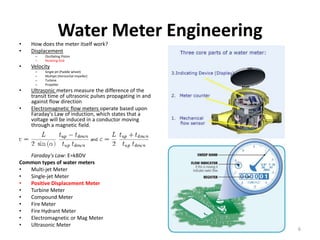
                   Water Meter Engineering
    How does the meter itself work?
•   Displacement
     –    Oscillating Piston
     –    Nutating Disk
•   Velocity
     –    Single jet (Paddle wheel)
     –    Multijet (Horizontal impeller)
     –    Turbine
     –    Propeller
•   Ultrasonic meters measure the difference of the
    transit time of ultrasonic pulses propagating in and
    against flow direction
•   Electromagnetic flow meters operate based upon
    Faraday's Law of induction, which states that a
    voltage will be induced in a conductor moving
    through a magnetic field.


   Faraday's Law: E=kBDV
Common types of water meters
•  Multi-jet Meter
•  Single-jet Meter
•  Positive Displacement Meter
•  Turbine Meter
•  Compound Meter
•  Fire Meter
•  Fire Hydrant Meter
•  Electromagnetic or Mag Meter
•  Ultrasonic Meter
                                                           6
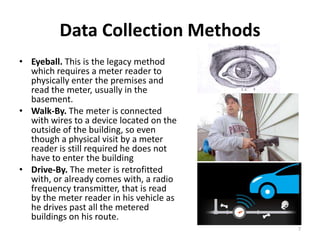
Data Collection Methods
• Eyeball. This is the legacy method
  which requires a meter reader to
  physically enter the premises and
  read the meter, usually in the
  basement.
• Walk-By. The meter is connected
  with wires to a device located on the
  outside of the building, so even
  though a physical visit by a meter
  reader is still required he does not
  have to enter the building
• Drive-By. The meter is retrofitted
  with, or already comes with, a radio
  frequency transmitter, that is read
  by the meter reader in his vehicle as
  he drives past all the metered
  buildings on his route.
                                          7
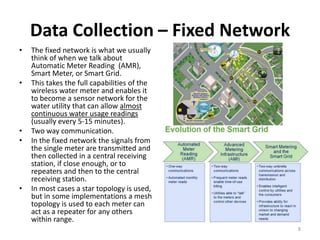
Data Collection – Fixed Network
•   The fixed network is what we usually
    think of when we talk about
    Automatic Meter Reading (AMR),
    Smart Meter, or Smart Grid.
•   This takes the full capabilities of the
    wireless water meter and enables it
    to become a sensor network for the
    water utility that can allow almost
    continuous water usage readings
    (usually every 5-15 minutes).
•   Two way communication.
•   In the fixed network the signals from
    the single meter are transmitted and
    then collected in a central receiving
    station, if close enough, or to
    repeaters and then to the central
    receiving station.
•   In most cases a star topology is used,
    but in some implementations a mesh
    topology is used to each meter can
    act as a repeater for any others
    within range.
                                              8
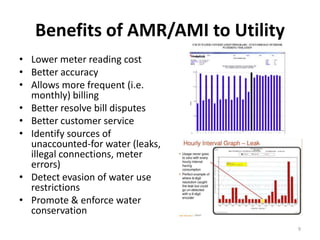
Benefits of AMR/AMI to Utility
• Lower meter reading cost
• Better accuracy
• Allows more frequent (i.e.
  monthly) billing
• Better resolve bill disputes
• Better customer service
• Identify sources of
  unaccounted-for water (leaks,
  illegal connections, meter
  errors)
• Detect evasion of water use
  restrictions
• Promote & enforce water
  conservation
                                    9
Growth of Smart Water Meters
•   The U.S. advanced metering
    infrastructure (AMI) market
    [electricity+gas+water] will grow from
    $2.54 billion in 2010 to $5.82 billion in
    2015 -- an 18% compound annual
    growth rate
•   The world smart water meter market is
    expected to total $4.2 billion between
    2010 and 2016.
•   The worldwide installed base of smart
    water meters is expected to increase
    from 5.2 million in 2009 to 31.8 million
    by 2016.
•   USA. Most water meters in the US are
    read manually; only 28 percent of water
    utilities have AMR meters.
•   Only about 7% have ‘smart’ water
    meters.
•   About 50% of California water utilities
    have smart meters, driven by state
    mandate to cut water consumption 20%
    by 2020.
                                                10
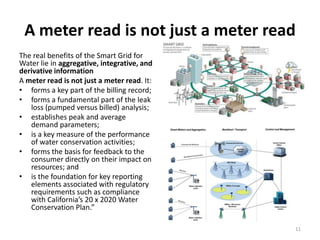
A meter read is not just a meter read
The real benefits of the Smart Grid for
Water lie in aggregative, integrative, and
derivative information
A meter read is not just a meter read. It:
• forms a key part of the billing record;
• forms a fundamental part of the leak
   loss (pumped versus billed) analysis;
• establishes peak and average
   demand parameters;
• is a key measure of the performance
   of water conservation activities;
• forms the basis for feedback to the
   consumer directly on their impact on
   resources; and
• is the foundation for key reporting
   elements associated with regulatory
   requirements such as compliance
   with California’s 20 x 2020 Water
   Conservation Plan.”

                                             11
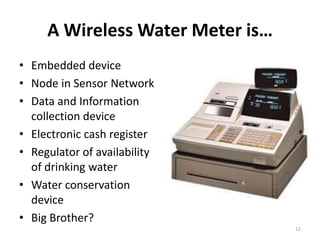
A Wireless Water Meter is…
• Embedded device
• Node in Sensor Network
• Data and Information
  collection device
• Electronic cash register
• Regulator of availability
  of drinking water
• Water conservation
  device
• Big Brother?
                                  12
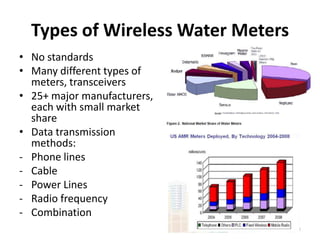
Types of Wireless Water Meters
• No standards
• Many different types of
  meters, transceivers
• 25+ major manufacturers,
  each with small market
  share
• Data transmission
  methods:
- Phone lines
- Cable
- Power Lines
- Radio frequency
- Combination
                                   13
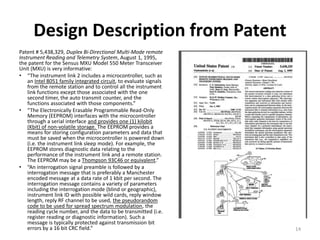
Design Description from Patent
Patent # 5,438,329, Duplex Bi-Directional Multi-Mode remote
Instrument Reading and Telemetry System, August 1, 1995,
the patent for the Sensus MXU Model 550 Meter Transceiver
Unit (MXU) is very informative:
• “The instrument link 2 includes a microcontroller, such as
    an Intel 8051 family integrated circuit, to evaluate signals
    from the remote station and to control all the instrument
    link functions except those associated with the one
    second timer, the auto transmit counter, and the
    functions associated with those components.”
• “The Electronically Erasable Programmable Read-Only
    Memory (EEPROM) interfaces with the microcontroller
    through a serial interface and provides one (1) kilobit
    (Kbit) of non-volatile storage. The EEPROM provides a
    means for storing configuration parameters and data that
    must be saved when the microcontroller is powered down
    (i.e. the instrument link sleep mode). For example, the
    EEPROM stores diagnostic data relating to the
    performance of the instrument link and a remote station.
    The EEPROM may be a Thompson 93C46 or equivalent.”
• “An interrogation signal preamble is followed by a
    interrogation message that is preferably a Manchester
    encoded message at a data rate of 1 kbit per second. The
    interrogation message contains a variety of parameters
    including the interrogation mode (blind or geographic),
    instrument link ID with possible wild cards, reply window
    length, reply RF channel to be used, the pseudorandom
    code to be used for spread spectrum modulation, the
    reading cycle number, and the data to be transmitted (i.e.
    register reading or diagnostic information). Such a
    message is typically protected against transmission bit
    errors by a 16 bit CRC field.”                                 14
Water AMR: Wireless Sensor Network
                                WSN Inherent Vulnerabilities:
A wireless water meter
                                - the wireless medium itself,
network is a kind of Wireless   - unattended operation,
Sensor Network, which is        - random topology, and
                                - hard to protect against insider attacks
defined as
• “a large network of           •   Low Power Processor. A typical sensor
                                    node processor is of 4-8 MHz, having
  resource-constrained sensor       4KB of RAM, 128KB flash and ideally
  nodes with multiple preset        916 MHz of radio frequency.
                                •   Low Energy: Sensor nodes typically
  function, such as sensing         have a small form factor with a limited
  and processing… the major         amount of battery power.
                                •   Small Memory: Sensor nodes usually
  elements of a WSN are the         have a small amount of memory.
                                    Hence, sensor network protocols
  sensor nodes and the base         should not require the storage of a
  station.”                         large amount of information at the
                                    sensor node.
• Each individual water meter
  is a “sensor node.”                                                    15
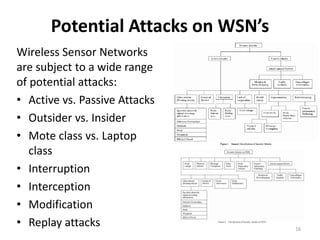
Potential Attacks on WSN’s
Wireless Sensor Networks
are subject to a wide range
of potential attacks:
• Active vs. Passive Attacks
• Outsider vs. Insider
• Mote class vs. Laptop
   class
• Interruption
• Interception
• Modification
• Replay attacks                   16
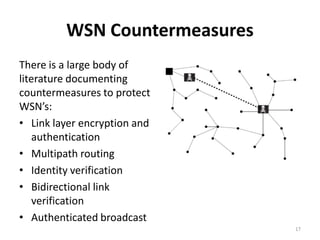
WSN Countermeasures
There is a large body of
literature documenting
countermeasures to protect
WSN’s:
• Link layer encryption and
   authentication
• Multipath routing
• Identity verification
• Bidirectional link
   verification
• Authenticated broadcast
                               17
Why Hack Into Water Meters?
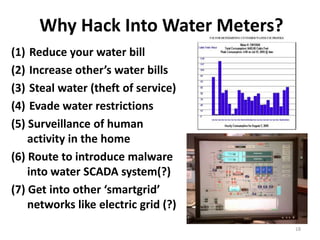
(1) Reduce your water bill
(2) Increase other’s water bills
(3) Steal water (theft of service)
(4) Evade water restrictions
(5) Surveillance of human
    activity in the home
(6) Route to introduce malware
    into water SCADA system(?)
(7) Get into other ‘smartgrid’
    networks like electric grid (?)
                                      18
Evil Consumer
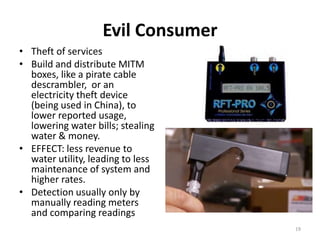
• Theft of services
• Build and distribute MITM
  boxes, like a pirate cable
  descrambler, or an
  electricity theft device
  (being used in China), to
  lower reported usage,
  lowering water bills; stealing
  water & money.
• EFFECT: less revenue to
  water utility, leading to less
  maintenance of system and
  higher rates.
• Detection usually only by
  manually reading meters
  and comparing readings
                                   19
Terrorist Attack
• Recon. Terrorist sends worm to
  intercept all signals to build
  hydraulic map of system for
  optimum results when inject
  poison into distribution system
• Disruption. Terrorist sends
  worm to shut off all water on
  certain date and time,
  coinciding with other attacks,
  updates firmware to keeps
  water turned off until utility can
  update them all.
• This obviously conflicts with
  objective to poison water.
  However, a DDos would also be
  a potentially devastating
  attack., especially as part of a
  larger attack.                       20
Smart Grid is very “worm-able”
• Thanassis Giannetsos
  demonstrated a worm
  attack on wireless sensor
  networks with his SENSYS
  attack tool [BH Spain
  2010]
• IOactive successfully ran a
  worm in a simulated city
  of 225,000 smart electric
  meters [BH USA 2009]
• Water smart grid could be
  just as vulnerable
                                     21
Evil Water Utility: Big Brother?
• “Cary's citizens are right to be
  concerned about the information
  about our private lives that our
  Town staff will be able to collect if
  the Aquastar/AMI water meter
  system is implemented as planned.
• According to Daniel Burrus, a
  technology futurist and keynote
  speaker at the Autovation
  conference last September, "As a
  utility, I could know exactly when
  you take a shower, exactly when you
  water the plants or wash the dishes.
  I could figure out how much water
  or electricity you are using at any
  point in time, and probably figure
  out what you are using it for.“
• This is turning out to be a big
  concern as more water utilities
  switch to AMR.
                                          22
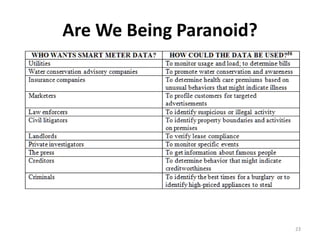
Are We Being Paranoid?


                         23
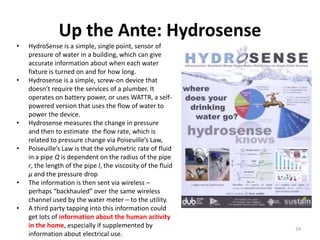
Up the Ante: Hydrosense
•   HydroSense is a simple, single point, sensor of
    pressure of water in a building, which can give
    accurate information about when each water
    fixture is turned on and for how long.
•   Hydrosense is a simple, screw-on device that
    doesn’t require the services of a plumber. It
    operates on battery power, or uses WATTR, a self-
    powered version that uses the flow of water to
    power the device.
•   Hydrosense measures the change in pressure
    and then to estimate the flow rate, which is
    related to pressure change via Poiseuille’s Law,
•   Poiseuille’s Law is that the volumetric rate of fluid
    in a pipe Q is dependent on the radius of the pipe
    r, the length of the pipe l, the viscosity of the fluid
    µ and the pressure drop
•   The information is then sent via wireless –
    perhaps “backhauled” over the same wireless
    channel used by the water meter – to the utility.
•   A third party tapping into this information could
    get lots of information about the human activity
    in the home, especially if supplemented by                24
    information about electrical use.
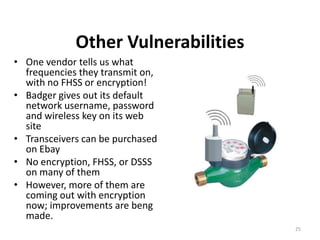
Other Vulnerabilities
• One vendor tells us what
  frequencies they transmit on,
  with no FHSS or encryption!
• Badger gives out its default
  network username, password
  and wireless key on its web
  site
• Transceivers can be purchased
  on Ebay
• No encryption, FHSS, or DSSS
  on many of them
• However, more of them are
  coming out with encryption
  now; improvements are beng
  made.
                                     25
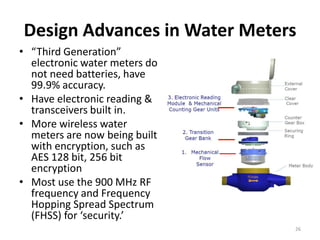
Design Advances in Water Meters
• “Third Generation”
  electronic water meters do
  not need batteries, have
  99.9% accuracy.
• Have electronic reading &
  transceivers built in.
• More wireless water
  meters are now being built
  with encryption, such as
  AES 128 bit, 256 bit
  encryption
• Most use the 900 MHz RF
  frequency and Frequency
  Hopping Spread Spectrum
  (FHSS) for ‘security.’
                               26
Sniffing FHSS Transceivers
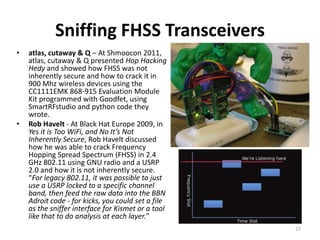
•   atlas, cutaway & Q – At Shmoocon 2011,
    atlas, cutaway & Q presented Hop Hacking
    Hedy and showed how FHSS was not
    inherently secure and how to crack it in
    900 Mhz wireless devices using the
    CC1111EMK 868-915 Evaluation Module
    Kit programmed with Goodfet, using
    SmartRFstudio and python code they
    wrote.
•   Rob Havelt - At Black Hat Europe 2009, in
    Yes it is Too WiFi, and No It’s Not
    Inherently Secure, Rob Havelt discussed
    how he was able to crack Frequency
    Hopping Spread Spectrum (FHSS) in 2.4
    GHz 802.11 using GNU radio and a USRP
    2.0 and how it is not inherently secure.
    “For legacy 802.11, it was possible to just
    use a USRP locked to a specific channel
    band, then feed the raw data into the BBN
    Adroit code - for kicks, you could set a file
    as the sniffer interface for Kismet or a tool
    like that to do analysis at each layer.”
                                                    27
FAIL!
• I was hoping to supplement this
  talk with results of sniffing packets
  from my 900 MHZ FHSS wireless
  water meter.
• But, didn’t have time or resources
  to do this before this talk, but the
  work is still ongoing.
• Tried Amtel RZ600, also FUNcube
  software radio peripheral,
  couldn’t get them to work yet.
• Continuing work on RZ600,
  FUNcube, Texas Instruments
  CC1111 868-915 Mhz Evaluation
  Module Kit, RFM DNT900DK, IM-
  ME, and Arduino, and perhaps
  others.
                                          28
Wrapping Up
•   Water meters are an integral
    component of the national drinking
    water infrastructure
•   Highest profile concern in some areas is
    lack of privacy from information
    provided by wireless water meters.
•   Most critical issue may be potential
    electronic theft of water.
•   Tampering with water meters, either
    mechanically or electronically, costs
    money for local water systems
•   Wireless water meters need to be
    better secured to prevent potential
    financial loss to water suppliers and to
    reduce potential security vulnerability
    to the water system.
•   This is a ‘growth industry” for water
    utilities as well as for hackers.
•   Email me at johnmcnabb@comcast.net
    for questions or if you want a copy of
    my white paper.
                                               29

DefCon 2011 - Vulnerabilities in Wireless Water Meters

  • 1.
    Vulnerabilities of Wireless Water Meter Networks John McNabb johnmcnabb@comcast.net DEF CON 19 August 6, 2011 1
  • 2.
    Background • 13 years- an elected Water Commissioner • 2 articles in NEWWA Journal on water infrastructure • 10 years as lobbyist for Clean Water Action; 6 years as lobbyist for state environmental regulatory agency (Mass. DEP) • 6+ years as an IT Pro, mostly doing general tech support • 2+ years as a security researcher, primarily interested in drinking water security & cyber security • Independent researcher; no school, company, or grant support • DEF CON 18 last year - Cyberterrorism & Security of the National Drinking Water Infrastructure • March 2011 Hacker Japan article on my DC18 talk. • Shmoocon 2011 – Hacking SmartWater Water Meters • NOTE: My BH white paper, revised, will be published next year in the book Weapons of Mass Destruction and Terrorism, 2nd edition, by Forest and Howard, eds. and possibly also in the NEWWA Journal. 2
  • 3.
    What this talkis about • Wireless water meters • What they are used for and could be used for • Types of meters & wireless water meters • Potential issues, threats, attacks, hacks, etc. • Not very technical talk, no exploits or tools • The need for this talk is that there is a lot of attention on the electric smart grid, very little on the water smart grid • Drinking water is a critical infrastructure. • My analysis of water infrastructure security is in my Black Hat whitepaper, email me for a copy . • I come at this from a ‘water centric’ view then from the IT perspective 3
  • 4.
    Water Meter =Cash Register • A Water Bill is based on the difference between “present reading” and “previous reading” from the meter, which is “usage” • Usage x water rates = usage charge • $40 billion – the annual income of US water utilities, mostly from meter reading information • Average monthly water bill ranges from $34.29 a month in Phoenix compared to $65.47 in Boston for a family of four using 100 gallons per person each day. • The revenue is very important to support day to day operations as well as capital maintenance & replacement which nationally is billions behind schedule. 4
  • 5.
    What Could GoWrong? • Energy theft costs consumers billions of dollars every year in the United States alone • Electric utilities assume 10% loss each year from theft • Theft of water. “Theft of water by tampering with or bypassing water meters costs BWSC [Boston] thousands of dollars a year & .. imposes costs every paying customer.” • Revenue is also lost when meters get old and sediment buildup results in lower readings. • Or if the water utility doesn’t replace meters often enough, doesn’t manage them properly, and doesn’t use the information properly in the billing system. 5
  • 6.
    Water Meter Engineering How does the meter itself work? • Displacement – Oscillating Piston – Nutating Disk • Velocity – Single jet (Paddle wheel) – Multijet (Horizontal impeller) – Turbine – Propeller • Ultrasonic meters measure the difference of the transit time of ultrasonic pulses propagating in and against flow direction • Electromagnetic flow meters operate based upon Faraday's Law of induction, which states that a voltage will be induced in a conductor moving through a magnetic field. Faraday's Law: E=kBDV Common types of water meters • Multi-jet Meter • Single-jet Meter • Positive Displacement Meter • Turbine Meter • Compound Meter • Fire Meter • Fire Hydrant Meter • Electromagnetic or Mag Meter • Ultrasonic Meter 6
  • 7.
    Data Collection Methods •Eyeball. This is the legacy method which requires a meter reader to physically enter the premises and read the meter, usually in the basement. • Walk-By. The meter is connected with wires to a device located on the outside of the building, so even though a physical visit by a meter reader is still required he does not have to enter the building • Drive-By. The meter is retrofitted with, or already comes with, a radio frequency transmitter, that is read by the meter reader in his vehicle as he drives past all the metered buildings on his route. 7
  • 8.
    Data Collection –Fixed Network • The fixed network is what we usually think of when we talk about Automatic Meter Reading (AMR), Smart Meter, or Smart Grid. • This takes the full capabilities of the wireless water meter and enables it to become a sensor network for the water utility that can allow almost continuous water usage readings (usually every 5-15 minutes). • Two way communication. • In the fixed network the signals from the single meter are transmitted and then collected in a central receiving station, if close enough, or to repeaters and then to the central receiving station. • In most cases a star topology is used, but in some implementations a mesh topology is used to each meter can act as a repeater for any others within range. 8
  • 9.
    Benefits of AMR/AMIto Utility • Lower meter reading cost • Better accuracy • Allows more frequent (i.e. monthly) billing • Better resolve bill disputes • Better customer service • Identify sources of unaccounted-for water (leaks, illegal connections, meter errors) • Detect evasion of water use restrictions • Promote & enforce water conservation 9
  • 10.
    Growth of SmartWater Meters • The U.S. advanced metering infrastructure (AMI) market [electricity+gas+water] will grow from $2.54 billion in 2010 to $5.82 billion in 2015 -- an 18% compound annual growth rate • The world smart water meter market is expected to total $4.2 billion between 2010 and 2016. • The worldwide installed base of smart water meters is expected to increase from 5.2 million in 2009 to 31.8 million by 2016. • USA. Most water meters in the US are read manually; only 28 percent of water utilities have AMR meters. • Only about 7% have ‘smart’ water meters. • About 50% of California water utilities have smart meters, driven by state mandate to cut water consumption 20% by 2020. 10
  • 11.
    A meter readis not just a meter read The real benefits of the Smart Grid for Water lie in aggregative, integrative, and derivative information A meter read is not just a meter read. It: • forms a key part of the billing record; • forms a fundamental part of the leak loss (pumped versus billed) analysis; • establishes peak and average demand parameters; • is a key measure of the performance of water conservation activities; • forms the basis for feedback to the consumer directly on their impact on resources; and • is the foundation for key reporting elements associated with regulatory requirements such as compliance with California’s 20 x 2020 Water Conservation Plan.” 11
  • 12.
    A Wireless WaterMeter is… • Embedded device • Node in Sensor Network • Data and Information collection device • Electronic cash register • Regulator of availability of drinking water • Water conservation device • Big Brother? 12
  • 13.
    Types of WirelessWater Meters • No standards • Many different types of meters, transceivers • 25+ major manufacturers, each with small market share • Data transmission methods: - Phone lines - Cable - Power Lines - Radio frequency - Combination 13
  • 14.
    Design Description fromPatent Patent # 5,438,329, Duplex Bi-Directional Multi-Mode remote Instrument Reading and Telemetry System, August 1, 1995, the patent for the Sensus MXU Model 550 Meter Transceiver Unit (MXU) is very informative: • “The instrument link 2 includes a microcontroller, such as an Intel 8051 family integrated circuit, to evaluate signals from the remote station and to control all the instrument link functions except those associated with the one second timer, the auto transmit counter, and the functions associated with those components.” • “The Electronically Erasable Programmable Read-Only Memory (EEPROM) interfaces with the microcontroller through a serial interface and provides one (1) kilobit (Kbit) of non-volatile storage. The EEPROM provides a means for storing configuration parameters and data that must be saved when the microcontroller is powered down (i.e. the instrument link sleep mode). For example, the EEPROM stores diagnostic data relating to the performance of the instrument link and a remote station. The EEPROM may be a Thompson 93C46 or equivalent.” • “An interrogation signal preamble is followed by a interrogation message that is preferably a Manchester encoded message at a data rate of 1 kbit per second. The interrogation message contains a variety of parameters including the interrogation mode (blind or geographic), instrument link ID with possible wild cards, reply window length, reply RF channel to be used, the pseudorandom code to be used for spread spectrum modulation, the reading cycle number, and the data to be transmitted (i.e. register reading or diagnostic information). Such a message is typically protected against transmission bit errors by a 16 bit CRC field.” 14
  • 15.
    Water AMR: WirelessSensor Network WSN Inherent Vulnerabilities: A wireless water meter - the wireless medium itself, network is a kind of Wireless - unattended operation, Sensor Network, which is - random topology, and - hard to protect against insider attacks defined as • “a large network of • Low Power Processor. A typical sensor node processor is of 4-8 MHz, having resource-constrained sensor 4KB of RAM, 128KB flash and ideally nodes with multiple preset 916 MHz of radio frequency. • Low Energy: Sensor nodes typically function, such as sensing have a small form factor with a limited and processing… the major amount of battery power. • Small Memory: Sensor nodes usually elements of a WSN are the have a small amount of memory. Hence, sensor network protocols sensor nodes and the base should not require the storage of a station.” large amount of information at the sensor node. • Each individual water meter is a “sensor node.” 15
  • 16.
    Potential Attacks onWSN’s Wireless Sensor Networks are subject to a wide range of potential attacks: • Active vs. Passive Attacks • Outsider vs. Insider • Mote class vs. Laptop class • Interruption • Interception • Modification • Replay attacks 16
  • 17.
    WSN Countermeasures There isa large body of literature documenting countermeasures to protect WSN’s: • Link layer encryption and authentication • Multipath routing • Identity verification • Bidirectional link verification • Authenticated broadcast 17
  • 18.
    Why Hack IntoWater Meters? (1) Reduce your water bill (2) Increase other’s water bills (3) Steal water (theft of service) (4) Evade water restrictions (5) Surveillance of human activity in the home (6) Route to introduce malware into water SCADA system(?) (7) Get into other ‘smartgrid’ networks like electric grid (?) 18
  • 19.
    Evil Consumer • Theftof services • Build and distribute MITM boxes, like a pirate cable descrambler, or an electricity theft device (being used in China), to lower reported usage, lowering water bills; stealing water & money. • EFFECT: less revenue to water utility, leading to less maintenance of system and higher rates. • Detection usually only by manually reading meters and comparing readings 19
  • 20.
    Terrorist Attack • Recon.Terrorist sends worm to intercept all signals to build hydraulic map of system for optimum results when inject poison into distribution system • Disruption. Terrorist sends worm to shut off all water on certain date and time, coinciding with other attacks, updates firmware to keeps water turned off until utility can update them all. • This obviously conflicts with objective to poison water. However, a DDos would also be a potentially devastating attack., especially as part of a larger attack. 20
  • 21.
    Smart Grid isvery “worm-able” • Thanassis Giannetsos demonstrated a worm attack on wireless sensor networks with his SENSYS attack tool [BH Spain 2010] • IOactive successfully ran a worm in a simulated city of 225,000 smart electric meters [BH USA 2009] • Water smart grid could be just as vulnerable 21
  • 22.
    Evil Water Utility:Big Brother? • “Cary's citizens are right to be concerned about the information about our private lives that our Town staff will be able to collect if the Aquastar/AMI water meter system is implemented as planned. • According to Daniel Burrus, a technology futurist and keynote speaker at the Autovation conference last September, "As a utility, I could know exactly when you take a shower, exactly when you water the plants or wash the dishes. I could figure out how much water or electricity you are using at any point in time, and probably figure out what you are using it for.“ • This is turning out to be a big concern as more water utilities switch to AMR. 22
  • 23.
    Are We BeingParanoid? 23
  • 24.
    Up the Ante:Hydrosense • HydroSense is a simple, single point, sensor of pressure of water in a building, which can give accurate information about when each water fixture is turned on and for how long. • Hydrosense is a simple, screw-on device that doesn’t require the services of a plumber. It operates on battery power, or uses WATTR, a self- powered version that uses the flow of water to power the device. • Hydrosense measures the change in pressure and then to estimate the flow rate, which is related to pressure change via Poiseuille’s Law, • Poiseuille’s Law is that the volumetric rate of fluid in a pipe Q is dependent on the radius of the pipe r, the length of the pipe l, the viscosity of the fluid µ and the pressure drop • The information is then sent via wireless – perhaps “backhauled” over the same wireless channel used by the water meter – to the utility. • A third party tapping into this information could get lots of information about the human activity in the home, especially if supplemented by 24 information about electrical use.
  • 25.
    Other Vulnerabilities • Onevendor tells us what frequencies they transmit on, with no FHSS or encryption! • Badger gives out its default network username, password and wireless key on its web site • Transceivers can be purchased on Ebay • No encryption, FHSS, or DSSS on many of them • However, more of them are coming out with encryption now; improvements are beng made. 25
  • 26.
    Design Advances inWater Meters • “Third Generation” electronic water meters do not need batteries, have 99.9% accuracy. • Have electronic reading & transceivers built in. • More wireless water meters are now being built with encryption, such as AES 128 bit, 256 bit encryption • Most use the 900 MHz RF frequency and Frequency Hopping Spread Spectrum (FHSS) for ‘security.’ 26
  • 27.
    Sniffing FHSS Transceivers • atlas, cutaway & Q – At Shmoocon 2011, atlas, cutaway & Q presented Hop Hacking Hedy and showed how FHSS was not inherently secure and how to crack it in 900 Mhz wireless devices using the CC1111EMK 868-915 Evaluation Module Kit programmed with Goodfet, using SmartRFstudio and python code they wrote. • Rob Havelt - At Black Hat Europe 2009, in Yes it is Too WiFi, and No It’s Not Inherently Secure, Rob Havelt discussed how he was able to crack Frequency Hopping Spread Spectrum (FHSS) in 2.4 GHz 802.11 using GNU radio and a USRP 2.0 and how it is not inherently secure. “For legacy 802.11, it was possible to just use a USRP locked to a specific channel band, then feed the raw data into the BBN Adroit code - for kicks, you could set a file as the sniffer interface for Kismet or a tool like that to do analysis at each layer.” 27
  • 28.
    FAIL! • I washoping to supplement this talk with results of sniffing packets from my 900 MHZ FHSS wireless water meter. • But, didn’t have time or resources to do this before this talk, but the work is still ongoing. • Tried Amtel RZ600, also FUNcube software radio peripheral, couldn’t get them to work yet. • Continuing work on RZ600, FUNcube, Texas Instruments CC1111 868-915 Mhz Evaluation Module Kit, RFM DNT900DK, IM- ME, and Arduino, and perhaps others. 28
  • 29.
    Wrapping Up • Water meters are an integral component of the national drinking water infrastructure • Highest profile concern in some areas is lack of privacy from information provided by wireless water meters. • Most critical issue may be potential electronic theft of water. • Tampering with water meters, either mechanically or electronically, costs money for local water systems • Wireless water meters need to be better secured to prevent potential financial loss to water suppliers and to reduce potential security vulnerability to the water system. • This is a ‘growth industry” for water utilities as well as for hackers. • Email me at johnmcnabb@comcast.net for questions or if you want a copy of my white paper. 29