Hunting for APT in network
logs
$cat user_info.txt
● Senior Security Systems Engineer at EPAM
● Security researcher for last 5 years
● Started my career as penetration tester at UnderDefense
● Malware analyst in the past
● Splunk enthusiast
● Maintaining blog about Threat hunting and Malware Analysis in
my free time (https://bogdanvennyk.medium.com/)
● Twitter: @bogdanvennyk
$cat user_info.2.txt
● Senior Cyber Threat Investigator
● Security researcher for last 4 years
● Started my career as Security Analyst at UnderDefense
● Anti-malware laboratory malware analyst in the past
● Twitter: @LeOleg97
$cat our_team.about.txt
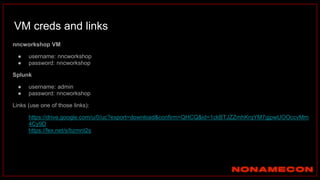
VM creds and links
nncworkshop VM
● username: nncworkshop
● password: nncworkshop
Splunk
● username: admin
● password: nncworkshop
Links (use one of those links):
● https://drive.google.com/u/0/uc?export=download&confirm=QHCQ&id=1ckBTJZZmhKrqYM7gjpwUOOccvMm
4Cy9D
● https://fex.net/s/bzmnt2s
Your Splunk knowledge?
1. No experience
2. Basic
3. Middle
4. Senior
Your Wireshark knowledge?
1. No experience
2. Basic
3. Middle
4. Senior
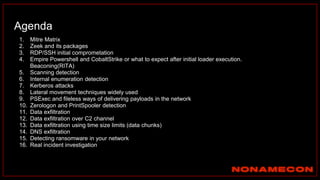
Agenda
1. Mitre Matrix
2. Zeek and its packages
3. RDP/SSH initial comprometation
4. Empire Powershell and CobaltStrike or what to expect after initial loader execution.
Beaconing(RITA)
5. Scanning detection
6. Internal enumeration detection
7. Kerberos attacks
8. Lateral movement techniques widely used
9. PSExec and fileless ways of delivering payloads in the network
10. Zerologon and PrintSpooler detection
11. Data exfiltration
12. Data exfiltration over C2 channel
13. Data exfiltration using time size limits (data chunks)
14. DNS exfiltration
15. Detecting ransomware in your network
16. Real incident investigation
What is not going to be covered in this workshop?
● Suricata/Snort
● Ja3/Ja3s
● NTLM and LDAP protocols detections
● Host based detections
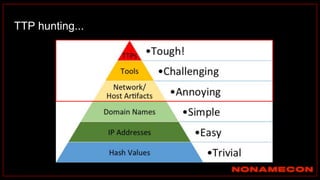
TTP hunting...
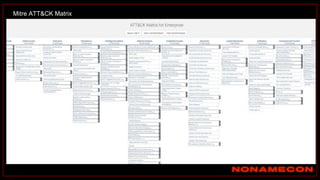
Mitre ATT&CK Matrix
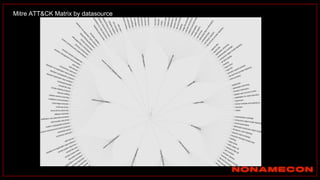
Mitre ATT&CK Matrix by datasource
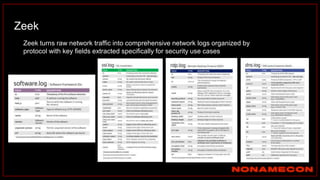
Zeek
Zeek turns raw network traffic into comprehensive network logs organized by
protocol with key fields extracted specifically for security use cases
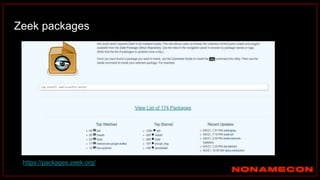
Zeek packages
https://packages.zeek.org/
How to install zeek packages?
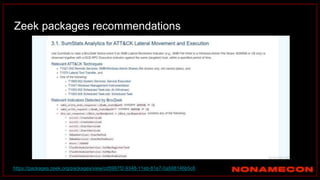
Zeek packages recommendations
https://packages.zeek.org/packages/view/cd5997f2-9348-11eb-81e7-0a598146b5c6
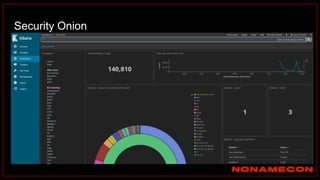
Security Onion
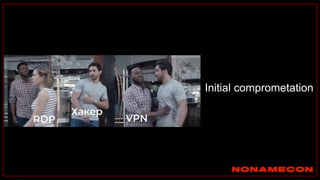
Initial comprometation
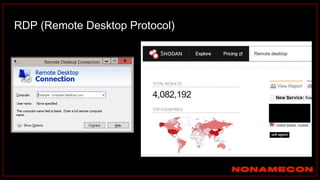
RDP (Remote Desktop Protocol)
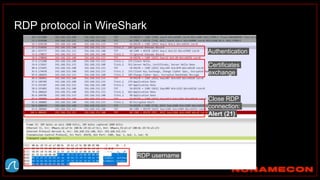
RDP protocol in WireShark
Authentication
Certificates
exchange
Close RDP
connection:
Alert (21)
RDP username
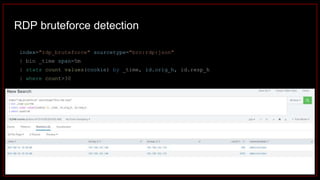
RDP bruteforce detection
index="rdp_bruteforce" sourcetype="bro:rdp:json"
| bin _time span=5m
| stats count values(cookie) by _time, id.orig_h, id.resp_h
| where count>30
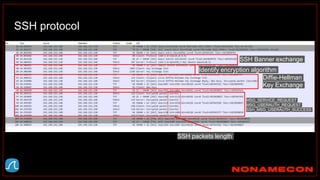
SSH protocol
SSH Banner exchange
Identify encryption algorithm
Diffie-Hellman
Key Exchange
MSG_SERVICE_REQUEST
MSG_USERAUTH_REQUEST
SSH_MSG_USERAUTH_SUCCESS
SSH packets length
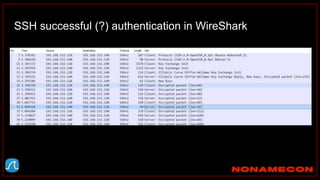
SSH successful (?) authentication in WireShark
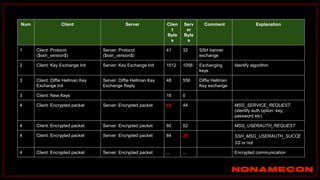
Num Client Server Clien
t
Byte
s
Serv
er
Byte
s
Comment Explanation
1 Client: Protocol
($ssh_version$)
Server: Protocol
($ssh_version$)
41 32 SSH banner
exchange
2 Client: Key Exchange Init Server: Key Exchange Init 1512 1056 Exchanging
keys
Identify algorithm
3 Client: Diffie Hellman Key
Exchange Init
Server: Diffie Hellman Key
Exchange Reply
48 556 Diffie Hellman
Key exchange
3 Client: New Keys 16 0
4 Client: Encrypted packet Server: Encrypted packet 44 44 MSG_SERVICE_REQUEST
(identify auth option: key,
password etc)
4 Client: Encrypted packet Server: Encrypted packet 60 52 MSG_USERAUTH_REQUEST
4 Client: Encrypted packet Server: Encrypted packet 84 28 SSH_MSG_USERAUTH_SUCCE
SS or not
4 Client: Encrypted packet Server: Encrypted packet ... ... Encrypted communication
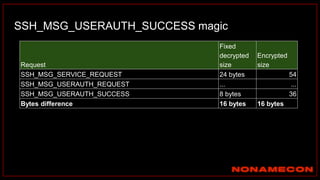
SSH_MSG_USERAUTH_SUCCESS magic
Request
Fixed
decrypted
size
Encrypted
size
SSH_MSG_SERVICE_REQUEST 24 bytes 54
SSH_MSG_USERAUTH_REQUEST ... ...
SSH_MSG_USERAUTH_SUCCESS 8 bytes 36
Bytes difference 16 bytes 16 bytes
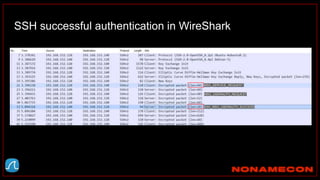
SSH successful authentication in WireShark
MSG_SERVICE_REQUEST
MSG_USERAUTH_REQUEST
SSH_MSG_USERAUTH_SUCCESS
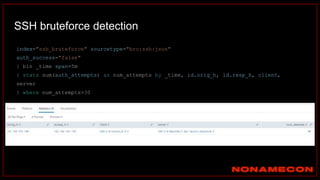
SSH bruteforce detection
index="ssh_bruteforce" sourcetype="bro:ssh:json"
auth_success="false"
| bin _time span=5m
| stats sum(auth_attempts) as num_attempts by _time, id.orig_h, id.resp_h, client,
server
| where num_attempts>30
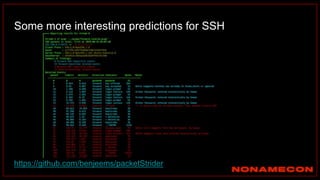
Some more interesting predictions for SSH
https://github.com/benjeems/packetStrider
Empire Powershell and CobaltStrike
or what to expect after initial loader execution
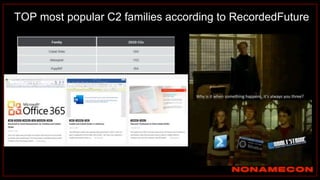
TOP most popular C2 families according to RecordedFuture
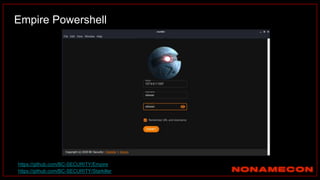
Empire Powershell
https://github.com/BC-SECURITY/Empire
https://github.com/BC-SECURITY/Starkiller
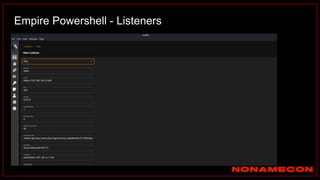
Empire Powershell - Listeners
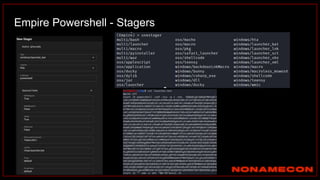
Empire Powershell - Stagers
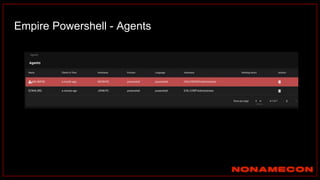
Empire Powershell - Agents
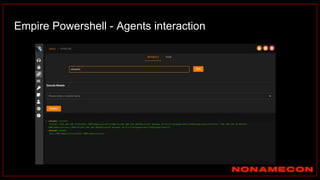
Empire Powershell - Agents interaction
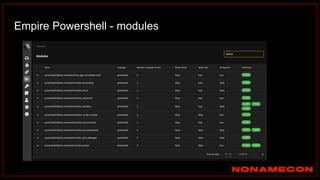
Empire Powershell - modules
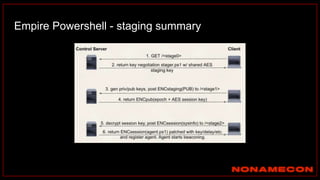
Empire Powershell - staging summary
Empire Powershell - Command & Control beacons
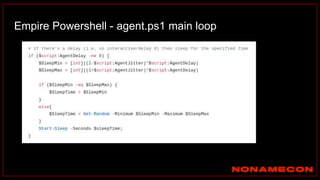
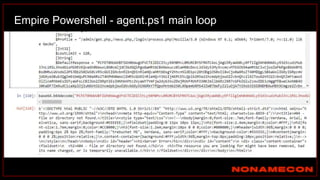
Empire Powershell - agent.ps1 main loop
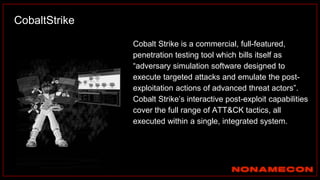
Cobalt Strike is a commercial, full-featured,
penetration testing tool which bills itself as
“adversary simulation software designed to
execute targeted attacks and emulate the post-
exploitation actions of advanced threat actors”.
Cobalt Strike’s interactive post-exploit capabilities
cover the full range of ATT&CK tactics, all
executed within a single, integrated system.
CobaltStrike
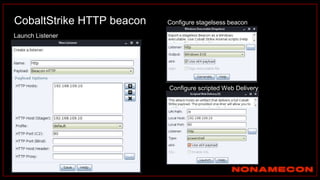
CobaltStrike HTTP beacon
Launch Listener
Configure stagelsess beacon
Configure scripted Web Delivery
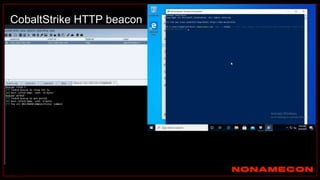
CobaltStrike HTTP beacon
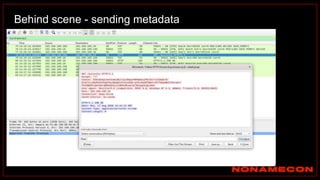
Behind scene - sending metadata
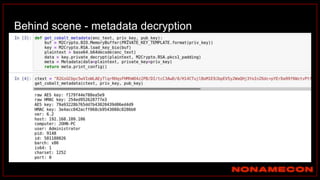
Behind scene - metadata decryption
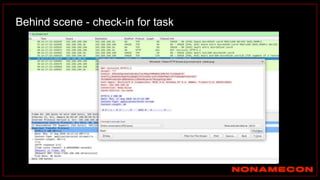
Behind scene - check-in for task
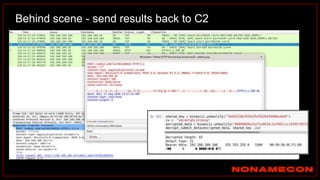
Behind scene - send results back to C2
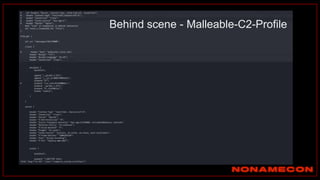
Behind scene - Malleable-C2-Profile
Behind scene - Summary
● Beacon sends metadata to teamserver using HTTP GET method (by default) with certain interval
which can be changed with command sleep. Also jitter can be used to randomize connections
interval.
● If there is task available beacon will get task in response instead of default one
● Beacon sends results back to Teamserver using HTTP POST method (by default)
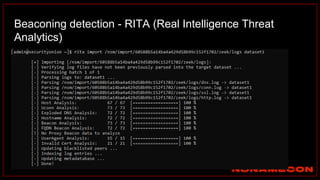
Beaconing detection - RITA (Real Intelligence Threat
Analytics)
RITA is an open source framework for network traffic analysis.
The framework ingests Zeek Logs in TSV format, and currently
supports the following major features:
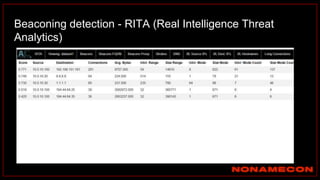
Beaconing Detection: Search for signs of beaconing behavior in
and out of your network
DNS Tunneling Detection Search for signs of DNS based
covert channels
Blacklist Checking: Query blacklists to search for suspicious
domains and hosts
Beaconing detection - RITA (Real Intelligence Threat
Analytics)
Beaconing detection - RITA (Real Intelligence Threat
Analytics)
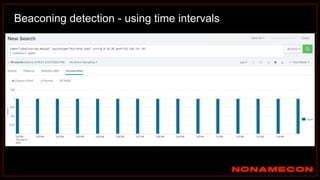
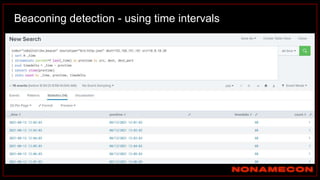
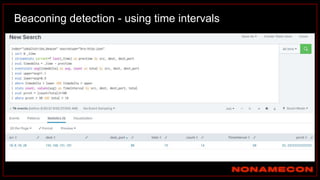
Beaconing detection - using time intervals
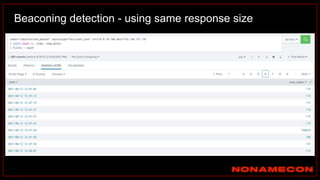
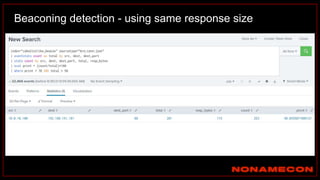
Beaconing detection - using same response size
Reconnaissance
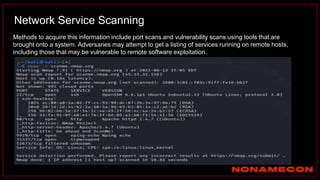
Network Service Scanning
Methods to acquire this information include port scans and vulnerability scans using tools that are
brought onto a system. Adversaries may attempt to get a listing of services running on remote hosts,

including those that may be vulnerable to remote software exploitation.
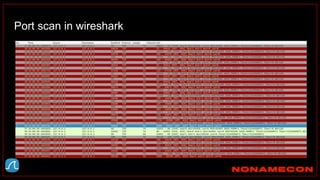
Port scan in wireshark
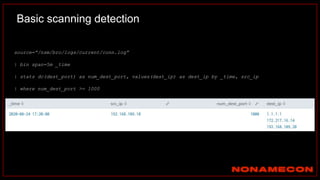
Basic scanning detection
source=”/nsm/bro/logs/current/conn.log”
| bin span=5m _time
| stats dc(dest_port) as num_dest_port, values(dest_ip) as dest_ip by _time, src_ip
| where num_dest_port >= 1000
https://docs.splunksecurityessentials.com/content-detail/basic_scanning/
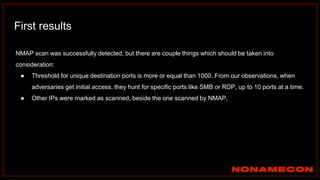
First results
NMAP scan was successfully detected, but there are couple things which should be taken into
consideration:
● Threshold for unique destination ports is more or equal than 1000. From our observations, when
adversaries get initial access, they hunt for specific ports like SMB or RDP, up to 10 ports at a time.
● Other IPs were marked as scanned, beside the one scanned by NMAP.
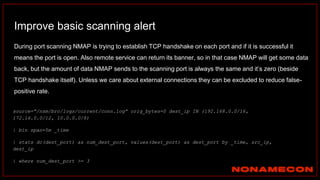
Improve basic scanning alert
During port scanning NMAP is trying to establish TCP handshake on each port and if it is successful it
means the port is open. Also remote service can return its banner, so in that case NMAP will get some data
back, but the amount of data NMAP sends to the scanning port is always the same and it’s zero (beside
TCP handshake itself). Unless we care about external connections they can be excluded to reduce false-
positive rate.
source=”/nsm/bro/logs/current/conn.log” orig_bytes=0 dest_ip IN (192.168.0.0/16,
172.16.0.0/12, 10.0.0.0/8)
| bin span=5m _time
| stats dc(dest_port) as num_dest_port, values(dest_port) as dest_port by _time, src_ip,
dest_ip
| where num_dest_port >= 3
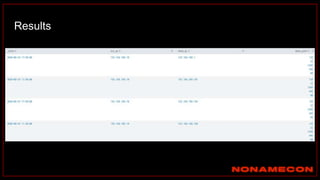
Results
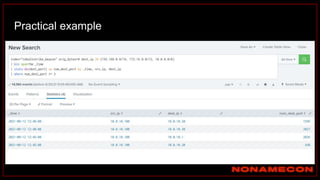
Practical example
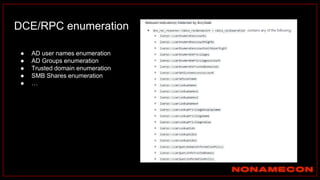
DCE/RPC enumeration
● AD user names enumeration
● AD Groups enumeration
● Trusted domain enumeration
● SMB Shares enumeration
● …
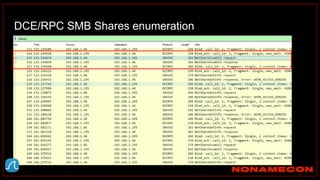
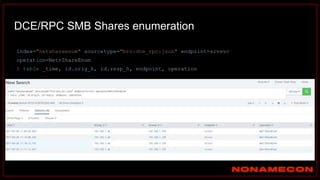
DCE/RPC SMB Shares enumeration
index="netshareenum" sourcetype="bro:dce_rpc:json" endpoint=srvsvc
operation=NetrShareEnum
| table _time, id.orig_h, id.resp_h, endpoint, operation
Credential access
Security
team
Golden
ticket attack
Kerberos
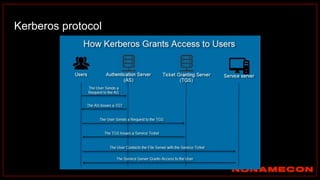
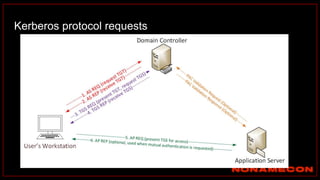
Kerberos protocol
Kerberos protocol requests
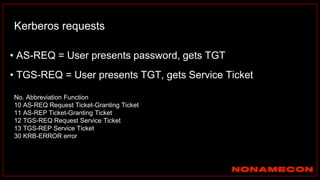
Kerberos requests
• AS-REQ = User presents password, gets TGT
• TGS-REQ = User presents TGT, gets Service Ticket
No. Abbreviation Function
10 AS-REQ Request Ticket-Granting Ticket
11 AS-REP Ticket-Granting Ticket
12 TGS-REQ Request Service Ticket
13 TGS-REP Service Ticket
30 KRB-ERROR error
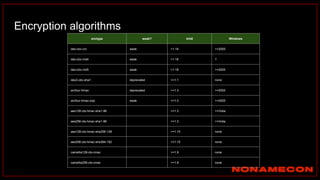
Encryption algorithms
enctype weak? krb5 Windows
des-cbc-crc weak <1.18 >=2000
des-cbc-md4 weak <1.18 ?
des-cbc-md5 weak <1.18 >=2000
des3-cbc-sha1 deprecated >=1.1 none
arcfour-hmac deprecated >=1.3 >=2000
arcfour-hmac-exp weak >=1.3 >=2000
aes128-cts-hmac-sha1-96 >=1.3 >=Vista
aes256-cts-hmac-sha1-96 >=1.3 >=Vista
aes128-cts-hmac-sha256-128 >=1.15 none
aes256-cts-hmac-sha384-192 >=1.15 none
camellia128-cts-cmac >=1.9 none
camellia256-cts-cmac >=1.9 none
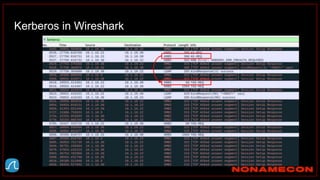
Kerberos in Wireshark
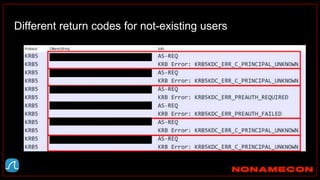
Different return codes for not-existing users
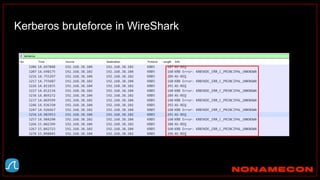
Kerberos bruteforce in WireShark
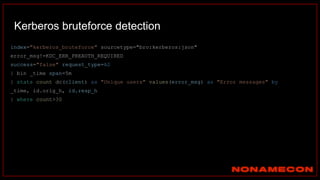
Kerberos bruteforce detection
index="kerberos_bruteforce" sourcetype="bro:kerberos:json"
error_msg!=KDC_ERR_PREAUTH_REQUIRED
success="false" request_type=AS
| bin _time span=5m
| stats count dc(client) as "Unique users" values(error_msg) as "Error messages" by
_time, id.orig_h, id.resp_h
| where count>30
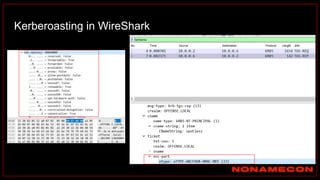
Kerberoasting in WireShark
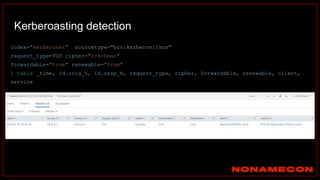
Kerberoasting detection
index="kerberoast" sourcetype="bro:kerberos:json"
request_type=TGS cipher="rc4-hmac"
forwardable="true" renewable="true"
| table _time, id.orig_h, id.resp_h, request_type, cipher, forwardable, renewable, client,
service
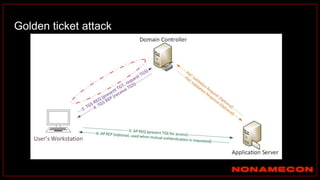
Golden ticket attack
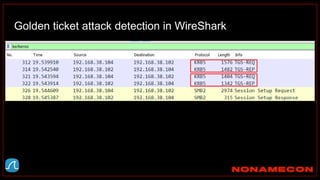
Golden ticket attack detection in WireShark
Golden ticket attack detection using script
(kali)-[~/Desktop/pcaps]
$ ./detect_kerberos_attacks.sh golden_ticket_try.pcap all
Found forged TGT ticket. No initial AS-REQ and AS-REP was observed.
Detected stolen TGT ticket in pass-the-ticket or golden ticket attack.
Incomplete packet capture can also cause this.
Ticket information:
Source IP+Destination IP+Service used
192.168.38.104+192.168.38.102+
192.168.38.104+192.168.38.102+
Detected Skeleton Key!
Host is supporting AES, but was downgraded to RC4
Affected host: 192.168.38.104
Link: https://github.com/exp0se/detect_kerberos_attacks/blob/master/detect_kerberos_attacks.sh
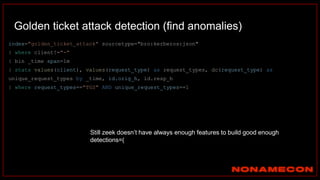
Golden ticket attack detection (find anomalies)
index="golden_ticket_attack" sourcetype="bro:kerberos:json"
| where client!="-"
| bin _time span=1m
| stats values(client), values(request_type) as request_types, dc(request_type) as
unique_request_types by _time, id.orig_h, id.resp_h
| where request_types=="TGS" AND unique_request_types==1
Still zeek doesn’t have always enough features to build good enough
detections=(
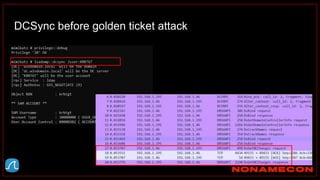
DCSync before golden ticket attack
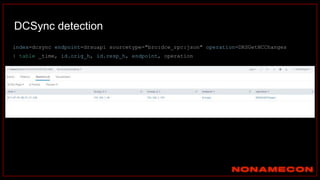
DCSync detection
index=dcsync endpoint=drsuapi sourcetype="bro:dce_rpc:json" operation=DRSGetNCChanges
| table _time, id.orig_h, id.resp_h, endpoint, operation
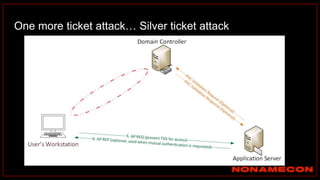
One more ticket attack… Silver ticket attack
Lateral movement
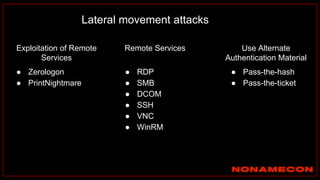
Lateral movement attacks
● Zerologon
● PrintNightmare
● RDP
● SMB
● DCOM
● SSH
● VNC
● WinRM
● Pass-the-hash
● Pass-the-ticket
Exploitation of Remote
Services
Remote Services Use Alternate
Authentication Material
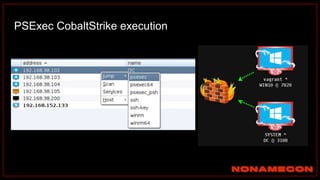
PSExec CobaltStrike execution
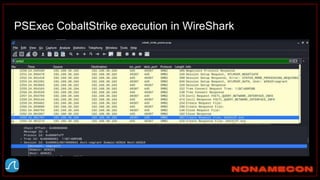
PSExec CobaltStrike execution in WireShark
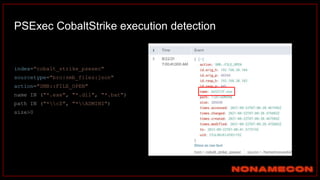
PSExec CobaltStrike execution detection
index="cobalt_strike_psexec"
sourcetype="bro:smb_files:json"
action="SMB::FILE_OPEN"
name IN ("*.exe", "*.dll", "*.bat")
path IN ("*c$", "*ADMIN$")
size>0
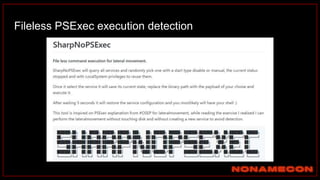
Fileless PSExec execution detection
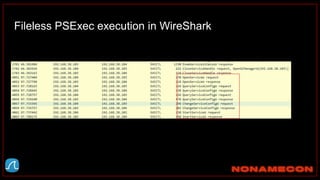
Fileless PSExec execution in WireShark
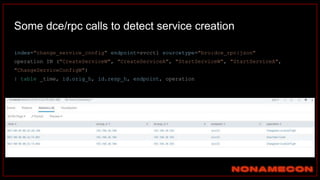
Some dce/rpc calls to detect service creation
index="change_service_config" endpoint=svcctl sourcetype="bro:dce_rpc:json"
operation IN ("CreateServiceW", "CreateServiceA", "StartServiceW", "StartServiceA",
"ChangeServiceConfigW")
| table _time, id.orig_h, id.resp_h, endpoint, operation
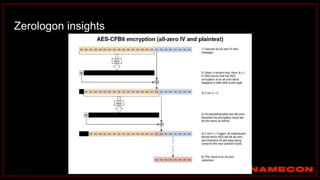
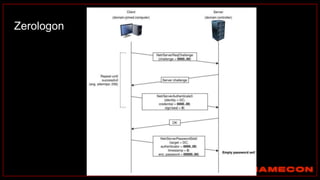
Zerologon insights
Zerologon
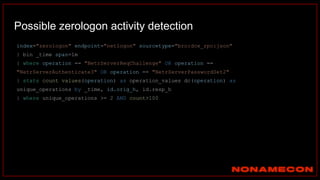
Possible zerologon activity detection
index="zerologon" endpoint="netlogon" sourcetype="bro:dce_rpc:json"
| bin _time span=1m
| where operation == "NetrServerReqChallenge" OR operation ==
"NetrServerAuthenticate3" OR operation == "NetrServerPasswordSet2"
| stats count values(operation) as operation_values dc(operation) as
unique_operations by _time, id.orig_h, id.resp_h
| where unique_operations >= 2 AND count>100
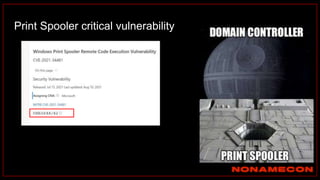
Print Spooler critical vulnerability
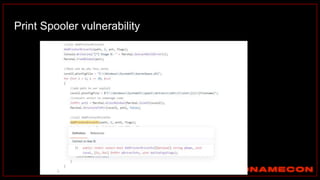
Print Spooler vulnerability
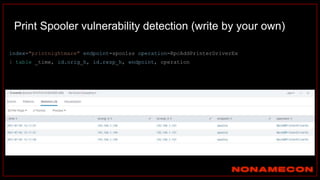
Print Spooler vulnerability detection (write by your own)
index="printnightmare" endpoint=spoolss operation=RpcAddPrinterDriverEx
| table _time, id.orig_h, id.resp_h, endpoint, operation
DCOM execution
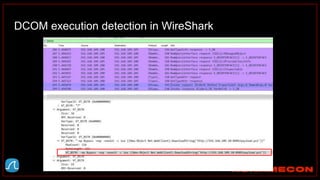
DCOM execution detection in WireShark
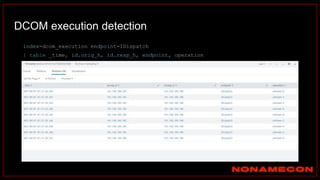
DCOM execution detection
index=dcom_execution endpoint=IDispatch
| table _time, id.orig_h, id.resp_h, endpoint, operation
Exfiltration
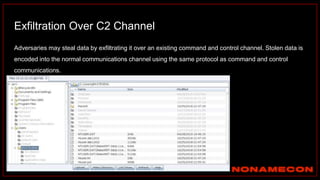
Exfiltration Over C2 Channel
Adversaries may steal data by exfiltrating it over an existing command and control channel. Stolen data is
encoded into the normal communications channel using the same protocol as command and control
communications.
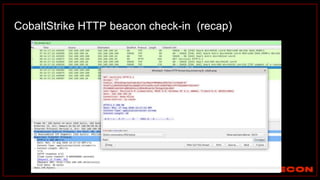
CobaltStrike HTTP beacon check-in (recap)
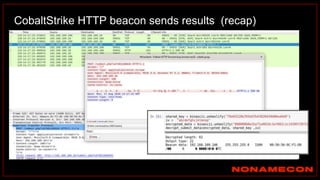
CobaltStrike HTTP beacon sends results (recap)
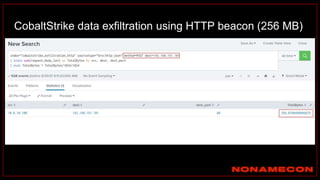
CobaltStrike data exfiltration detection steps
1. Filter out check-in beacon data
2. In case of HTTP beacons, they are using GET requests, so we can just look for POST requests
payload data (packet content without HTTP header).
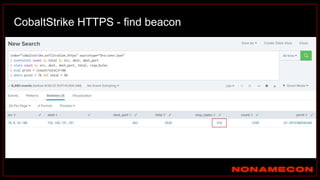
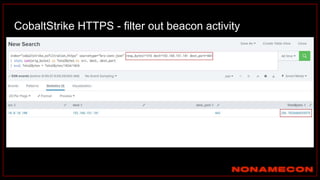
3. In case of HTTPS beaconing you need to find this value statistically and filter it out manually.
CobaltStrike data exfiltration using HTTP beacon (256 MB)
CobaltStrike HTTPS - find beacon
CobaltStrike HTTPS - filter out beacon activity
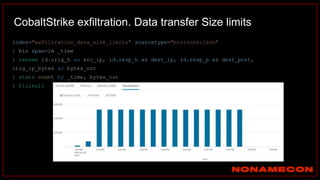
CobaltStrike exfiltration. Data transfer Size limits
index="exfiltration_data_size_limits" sourcetype="bro:conn:json"
| bin span=1m _time
| rename id.orig_h as src_ip, id.resp_h as dest_ip, id.resp_p as dest_port,
orig_ip_bytes as bytes_out
| stats count by _time, bytes_out
| fillnull
CobaltStrike exfiltration. Data transfer Size limits
index="exfiltration_data_size_limits" sourcetype="bro:conn:json"
| bin _time span=1h
| stats count by id.orig_h, id.resp_h, _time, id.resp_p, orig_ip_bytes
| rename id.orig_h as src_ip, id.resp_h as dest_ip, id.resp_p as dest_port,
orig_ip_bytes as bytes_out
| eval bytes_out_round=bytes_out-(bytes_out%10000)
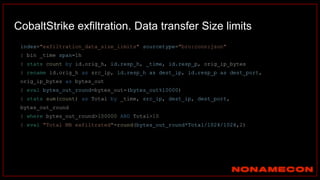
| stats sum(count) as Total by _time, src_ip, dest_ip, dest_port,
bytes_out_round
| where bytes_out_round>100000 AND Total>10
| eval "Total MB exfiltrated"=round(bytes_out_round*Total/1024/1024,2)
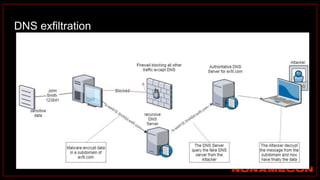
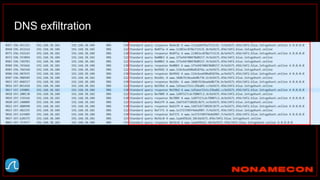
DNS exfiltration
DNS exfiltration
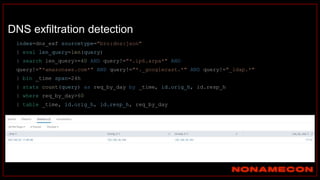
DNS exfiltration detection
index=dns_exf sourcetype="bro:dns:json"
| eval len_query=len(query)
| search len_query>=40 AND query!="*.ip6.arpa*" AND
query!="*amazonaws.com*" AND query!="*._googlecast.*" AND query!="_ldap.*"
| bin _time span=24h
| stats count(query) as req_by_day by _time, id.orig_h, id.resp_h
| where req_by_day>60
| table _time, id.orig_h, id.resp_h, req_by_day
Ransomware detection
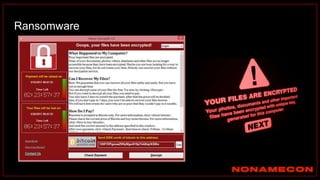
Ransomware
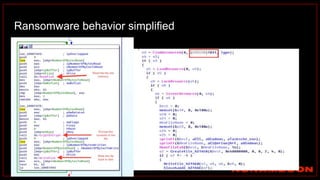
Ransomware behavior simplified
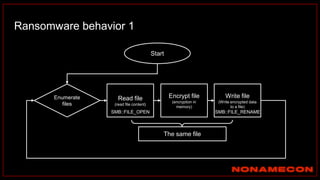
Ransomware behavior 1
Enumerate
files
Read file
(read file content)
Write file
(Write encrypted data
to a file)
Encrypt file
(encryption in
memory)
Start
The same file
SMB::FILE_RENAME
SMB::FILE_OPEN
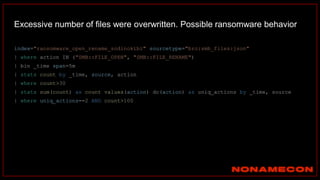
index="ransomware_open_rename_sodinokibi" sourcetype="bro:smb_files:json"
| where action IN ("SMB::FILE_OPEN", "SMB::FILE_RENAME")
| bin _time span=5m
| stats count by _time, source, action
| where count>30
| stats sum(count) as count values(action) dc(action) as uniq_actions by _time, source
| where uniq_actions==2 AND count>100
Excessive number of files were overwritten. Possible ransomware behavior
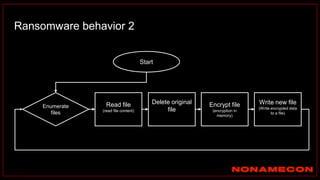
Ransomware behavior 2
Enumerate
files
Read file
(read file content)
Write new file
(Write encrypted data
to a file)
Encrypt file
(encryption in
memory)
Start
Delete original
file
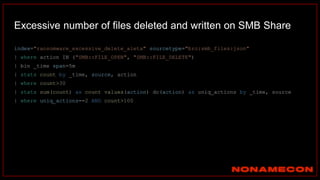
index="ransomware_excessive_delete_aleta" sourcetype="bro:smb_files:json"
| where action IN ("SMB::FILE_OPEN", "SMB::FILE_DELETE")
| bin _time span=5m
| stats count by _time, source, action
| where count>30
| stats sum(count) as count values(action) dc(action) as uniq_actions by _time, source
| where uniq_actions==2 AND count>100
Excessive number of files deleted and written on SMB Share
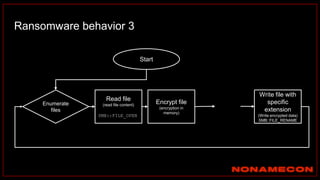
Ransomware behavior 3
Enumerate
files
Read file
(read file content)
SMB::FILE_OPEN
Write file with
specific
extension
(Write encrypted data)
SMB::FILE_RENAME
Encrypt file
(encryption in
memory)
Start
...
index="ransomware_new_file_extension_ctbl_ocker" sourcetype="bro:smb_files:json"
action="SMB::FILE_RENAME"
| bin _time span=5m
| rex field="name" ".(?<new_file_name_extension>[^.]*$)"
| rex field="prev_name" ".(?<old_file_name_extension>[^.]*$)"
| stats count by _time, id.orig_h, id.resp_p, name, source, old_file_name_extension,
new_file_name_extension,
| where new_file_name_extension!=old_file_name_extension
| stats count by _time, id.orig_h, id.resp_p, source, new_file_name_extension
| where count>20
| sort -count
Excessive number of files written on SMB Share with the same file name extension
Ransomware extensions
● https://docs.google.com/spreadsheets/d/e/2PACX-
1vRCVzG9JCzak3hNqqrVCTQQIzH0ty77BWiLEbDu-
q9oxkhAamqnlYgtQ4gF85pF6j6g3GmQxivuvO1U/pubhtml
● https://github.com/corelight/detect-ransomware-filenames
○ https://fsrm.experiant.ca/
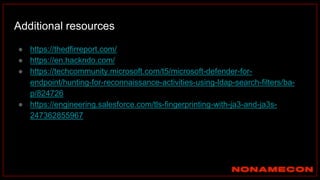
Additional resources
● https://thedfirreport.com/
● https://en.hackndo.com/
● https://techcommunity.microsoft.com/t5/microsoft-defender-for-
endpoint/hunting-for-reconnaissance-activities-using-ldap-search-filters/ba-
p/824726
● https://engineering.salesforce.com/tls-fingerprinting-with-ja3-and-ja3s-
247362855967
You know my methods, Watson
Apply Them!
Let’s start real incident investigation=)
Q/A?
Thanks for attending our workshop =)

Hunting for APT in network logs workshop presentation

  • 1.
    Hunting for APTin network logs
  • 2.
    $cat user_info.txt ● SeniorSecurity Systems Engineer at EPAM ● Security researcher for last 5 years ● Started my career as penetration tester at UnderDefense ● Malware analyst in the past ● Splunk enthusiast ● Maintaining blog about Threat hunting and Malware Analysis in my free time (https://bogdanvennyk.medium.com/) ● Twitter: @bogdanvennyk
  • 3.
    $cat user_info.2.txt ● SeniorCyber Threat Investigator ● Security researcher for last 4 years ● Started my career as Security Analyst at UnderDefense ● Anti-malware laboratory malware analyst in the past ● Twitter: @LeOleg97
  • 4.
  • 5.
    VM creds andlinks nncworkshop VM ● username: nncworkshop ● password: nncworkshop Splunk ● username: admin ● password: nncworkshop Links (use one of those links): ● https://drive.google.com/u/0/uc?export=download&confirm=QHCQ&id=1ckBTJZZmhKrqYM7gjpwUOOccvMm 4Cy9D ● https://fex.net/s/bzmnt2s
  • 6.
    Your Splunk knowledge? 1.No experience 2. Basic 3. Middle 4. Senior
  • 7.
    Your Wireshark knowledge? 1.No experience 2. Basic 3. Middle 4. Senior
  • 8.
    Agenda 1. Mitre Matrix 2.Zeek and its packages 3. RDP/SSH initial comprometation 4. Empire Powershell and CobaltStrike or what to expect after initial loader execution. Beaconing(RITA) 5. Scanning detection 6. Internal enumeration detection 7. Kerberos attacks 8. Lateral movement techniques widely used 9. PSExec and fileless ways of delivering payloads in the network 10. Zerologon and PrintSpooler detection 11. Data exfiltration 12. Data exfiltration over C2 channel 13. Data exfiltration using time size limits (data chunks) 14. DNS exfiltration 15. Detecting ransomware in your network 16. Real incident investigation
  • 9.
    What is notgoing to be covered in this workshop? ● Suricata/Snort ● Ja3/Ja3s ● NTLM and LDAP protocols detections ● Host based detections
  • 10.
  • 11.
  • 12.
    Mitre ATT&CK Matrixby datasource
  • 13.
    Zeek Zeek turns rawnetwork traffic into comprehensive network logs organized by protocol with key fields extracted specifically for security use cases
  • 14.
  • 15.
    How to installzeek packages?
  • 16.
  • 17.
  • 18.
  • 19.
  • 20.
    RDP protocol inWireShark Authentication Certificates exchange Close RDP connection: Alert (21) RDP username
  • 21.
    RDP bruteforce detection index="rdp_bruteforce"sourcetype="bro:rdp:json" | bin _time span=5m | stats count values(cookie) by _time, id.orig_h, id.resp_h | where count>30
  • 22.
    SSH protocol SSH Bannerexchange Identify encryption algorithm Diffie-Hellman Key Exchange MSG_SERVICE_REQUEST MSG_USERAUTH_REQUEST SSH_MSG_USERAUTH_SUCCESS SSH packets length
  • 23.
    SSH successful (?)authentication in WireShark
  • 24.
    Num Client ServerClien t Byte s Serv er Byte s Comment Explanation 1 Client: Protocol ($ssh_version$) Server: Protocol ($ssh_version$) 41 32 SSH banner exchange 2 Client: Key Exchange Init Server: Key Exchange Init 1512 1056 Exchanging keys Identify algorithm 3 Client: Diffie Hellman Key Exchange Init Server: Diffie Hellman Key Exchange Reply 48 556 Diffie Hellman Key exchange 3 Client: New Keys 16 0 4 Client: Encrypted packet Server: Encrypted packet 44 44 MSG_SERVICE_REQUEST (identify auth option: key, password etc) 4 Client: Encrypted packet Server: Encrypted packet 60 52 MSG_USERAUTH_REQUEST 4 Client: Encrypted packet Server: Encrypted packet 84 28 SSH_MSG_USERAUTH_SUCCE SS or not 4 Client: Encrypted packet Server: Encrypted packet ... ... Encrypted communication
  • 25.
    SSH_MSG_USERAUTH_SUCCESS magic Request Fixed decrypted size Encrypted size SSH_MSG_SERVICE_REQUEST 24bytes 54 SSH_MSG_USERAUTH_REQUEST ... ... SSH_MSG_USERAUTH_SUCCESS 8 bytes 36 Bytes difference 16 bytes 16 bytes
  • 26.
    SSH successful authenticationin WireShark MSG_SERVICE_REQUEST MSG_USERAUTH_REQUEST SSH_MSG_USERAUTH_SUCCESS
  • 27.
    SSH bruteforce detection index="ssh_bruteforce"sourcetype="bro:ssh:json" auth_success="false" | bin _time span=5m | stats sum(auth_attempts) as num_attempts by _time, id.orig_h, id.resp_h, client, server | where num_attempts>30
  • 28.
    Some more interestingpredictions for SSH https://github.com/benjeems/packetStrider
  • 29.
    Empire Powershell andCobaltStrike or what to expect after initial loader execution
  • 30.
    TOP most popularC2 families according to RecordedFuture
  • 32.
  • 33.
  • 34.
  • 35.
  • 36.
    Empire Powershell -Agents interaction
  • 37.
  • 38.
    Empire Powershell -staging summary
  • 39.
    Empire Powershell -Command & Control beacons
  • 40.
    Empire Powershell -agent.ps1 main loop
  • 41.
    Empire Powershell -agent.ps1 main loop
  • 42.
    Cobalt Strike isa commercial, full-featured, penetration testing tool which bills itself as “adversary simulation software designed to execute targeted attacks and emulate the post- exploitation actions of advanced threat actors”. Cobalt Strike’s interactive post-exploit capabilities cover the full range of ATT&CK tactics, all executed within a single, integrated system. CobaltStrike
  • 43.
    CobaltStrike HTTP beacon LaunchListener Configure stagelsess beacon Configure scripted Web Delivery
  • 44.
  • 45.
    Behind scene -sending metadata
  • 46.
    Behind scene -metadata decryption
  • 47.
    Behind scene -check-in for task
  • 48.
    Behind scene -send results back to C2
  • 49.
    Behind scene -Malleable-C2-Profile
  • 50.
    Behind scene -Summary ● Beacon sends metadata to teamserver using HTTP GET method (by default) with certain interval which can be changed with command sleep. Also jitter can be used to randomize connections interval. ● If there is task available beacon will get task in response instead of default one ● Beacon sends results back to Teamserver using HTTP POST method (by default)
  • 51.
    Beaconing detection -RITA (Real Intelligence Threat Analytics) RITA is an open source framework for network traffic analysis. The framework ingests Zeek Logs in TSV format, and currently supports the following major features: Beaconing Detection: Search for signs of beaconing behavior in and out of your network DNS Tunneling Detection Search for signs of DNS based covert channels Blacklist Checking: Query blacklists to search for suspicious domains and hosts
  • 52.
    Beaconing detection -RITA (Real Intelligence Threat Analytics)
  • 53.
    Beaconing detection -RITA (Real Intelligence Threat Analytics)
  • 54.
    Beaconing detection -using time intervals
  • 55.
    Beaconing detection -using time intervals
  • 56.
    Beaconing detection -using time intervals
  • 57.
    Beaconing detection -using same response size
  • 58.
    Beaconing detection -using same response size
  • 59.
  • 60.
    Network Service Scanning Methodsto acquire this information include port scans and vulnerability scans using tools that are brought onto a system. Adversaries may attempt to get a listing of services running on remote hosts, including those that may be vulnerable to remote software exploitation.
  • 61.
    Port scan inwireshark
  • 62.
    Basic scanning detection source=”/nsm/bro/logs/current/conn.log” |bin span=5m _time | stats dc(dest_port) as num_dest_port, values(dest_ip) as dest_ip by _time, src_ip | where num_dest_port >= 1000 https://docs.splunksecurityessentials.com/content-detail/basic_scanning/
  • 63.
    First results NMAP scanwas successfully detected, but there are couple things which should be taken into consideration: ● Threshold for unique destination ports is more or equal than 1000. From our observations, when adversaries get initial access, they hunt for specific ports like SMB or RDP, up to 10 ports at a time. ● Other IPs were marked as scanned, beside the one scanned by NMAP.
  • 64.
    Improve basic scanningalert During port scanning NMAP is trying to establish TCP handshake on each port and if it is successful it means the port is open. Also remote service can return its banner, so in that case NMAP will get some data back, but the amount of data NMAP sends to the scanning port is always the same and it’s zero (beside TCP handshake itself). Unless we care about external connections they can be excluded to reduce false- positive rate. source=”/nsm/bro/logs/current/conn.log” orig_bytes=0 dest_ip IN (192.168.0.0/16, 172.16.0.0/12, 10.0.0.0/8) | bin span=5m _time | stats dc(dest_port) as num_dest_port, values(dest_port) as dest_port by _time, src_ip, dest_ip | where num_dest_port >= 3
  • 65.
  • 66.
  • 67.
    DCE/RPC enumeration ● ADuser names enumeration ● AD Groups enumeration ● Trusted domain enumeration ● SMB Shares enumeration ● …
  • 68.
    DCE/RPC SMB Sharesenumeration
  • 69.
    DCE/RPC SMB Sharesenumeration index="netshareenum" sourcetype="bro:dce_rpc:json" endpoint=srvsvc operation=NetrShareEnum | table _time, id.orig_h, id.resp_h, endpoint, operation
  • 70.
  • 71.
  • 72.
  • 73.
  • 74.
    Kerberos requests • AS-REQ= User presents password, gets TGT • TGS-REQ = User presents TGT, gets Service Ticket No. Abbreviation Function 10 AS-REQ Request Ticket-Granting Ticket 11 AS-REP Ticket-Granting Ticket 12 TGS-REQ Request Service Ticket 13 TGS-REP Service Ticket 30 KRB-ERROR error
  • 75.
    Encryption algorithms enctype weak?krb5 Windows des-cbc-crc weak <1.18 >=2000 des-cbc-md4 weak <1.18 ? des-cbc-md5 weak <1.18 >=2000 des3-cbc-sha1 deprecated >=1.1 none arcfour-hmac deprecated >=1.3 >=2000 arcfour-hmac-exp weak >=1.3 >=2000 aes128-cts-hmac-sha1-96 >=1.3 >=Vista aes256-cts-hmac-sha1-96 >=1.3 >=Vista aes128-cts-hmac-sha256-128 >=1.15 none aes256-cts-hmac-sha384-192 >=1.15 none camellia128-cts-cmac >=1.9 none camellia256-cts-cmac >=1.9 none
  • 77.
  • 78.
    Different return codesfor not-existing users
  • 79.
  • 80.
    Kerberos bruteforce detection index="kerberos_bruteforce"sourcetype="bro:kerberos:json" error_msg!=KDC_ERR_PREAUTH_REQUIRED success="false" request_type=AS | bin _time span=5m | stats count dc(client) as "Unique users" values(error_msg) as "Error messages" by _time, id.orig_h, id.resp_h | where count>30
  • 81.
  • 82.
    Kerberoasting detection index="kerberoast" sourcetype="bro:kerberos:json" request_type=TGScipher="rc4-hmac" forwardable="true" renewable="true" | table _time, id.orig_h, id.resp_h, request_type, cipher, forwardable, renewable, client, service
  • 83.
  • 84.
    Golden ticket attackdetection in WireShark
  • 85.
    Golden ticket attackdetection using script (kali)-[~/Desktop/pcaps] $ ./detect_kerberos_attacks.sh golden_ticket_try.pcap all Found forged TGT ticket. No initial AS-REQ and AS-REP was observed. Detected stolen TGT ticket in pass-the-ticket or golden ticket attack. Incomplete packet capture can also cause this. Ticket information: Source IP+Destination IP+Service used 192.168.38.104+192.168.38.102+ 192.168.38.104+192.168.38.102+ Detected Skeleton Key! Host is supporting AES, but was downgraded to RC4 Affected host: 192.168.38.104 Link: https://github.com/exp0se/detect_kerberos_attacks/blob/master/detect_kerberos_attacks.sh
  • 86.
    Golden ticket attackdetection (find anomalies) index="golden_ticket_attack" sourcetype="bro:kerberos:json" | where client!="-" | bin _time span=1m | stats values(client), values(request_type) as request_types, dc(request_type) as unique_request_types by _time, id.orig_h, id.resp_h | where request_types=="TGS" AND unique_request_types==1 Still zeek doesn’t have always enough features to build good enough detections=(
  • 87.
    DCSync before goldenticket attack
  • 88.
    DCSync detection index=dcsync endpoint=drsuapisourcetype="bro:dce_rpc:json" operation=DRSGetNCChanges | table _time, id.orig_h, id.resp_h, endpoint, operation
  • 89.
    One more ticketattack… Silver ticket attack
  • 90.
  • 91.
    Lateral movement attacks ●Zerologon ● PrintNightmare ● RDP ● SMB ● DCOM ● SSH ● VNC ● WinRM ● Pass-the-hash ● Pass-the-ticket Exploitation of Remote Services Remote Services Use Alternate Authentication Material
  • 92.
  • 93.
  • 94.
    PSExec CobaltStrike executiondetection index="cobalt_strike_psexec" sourcetype="bro:smb_files:json" action="SMB::FILE_OPEN" name IN ("*.exe", "*.dll", "*.bat") path IN ("*c$", "*ADMIN$") size>0
  • 95.
  • 96.
  • 97.
    Some dce/rpc callsto detect service creation index="change_service_config" endpoint=svcctl sourcetype="bro:dce_rpc:json" operation IN ("CreateServiceW", "CreateServiceA", "StartServiceW", "StartServiceA", "ChangeServiceConfigW") | table _time, id.orig_h, id.resp_h, endpoint, operation
  • 98.
  • 99.
  • 100.
    Possible zerologon activitydetection index="zerologon" endpoint="netlogon" sourcetype="bro:dce_rpc:json" | bin _time span=1m | where operation == "NetrServerReqChallenge" OR operation == "NetrServerAuthenticate3" OR operation == "NetrServerPasswordSet2" | stats count values(operation) as operation_values dc(operation) as unique_operations by _time, id.orig_h, id.resp_h | where unique_operations >= 2 AND count>100
  • 101.
  • 102.
  • 103.
    Print Spooler vulnerabilitydetection (write by your own) index="printnightmare" endpoint=spoolss operation=RpcAddPrinterDriverEx | table _time, id.orig_h, id.resp_h, endpoint, operation
  • 104.
  • 105.
  • 106.
    DCOM execution detection index=dcom_executionendpoint=IDispatch | table _time, id.orig_h, id.resp_h, endpoint, operation
  • 107.
  • 108.
    Exfiltration Over C2Channel Adversaries may steal data by exfiltrating it over an existing command and control channel. Stolen data is encoded into the normal communications channel using the same protocol as command and control communications.
  • 109.
    CobaltStrike HTTP beaconcheck-in (recap)
  • 110.
    CobaltStrike HTTP beaconsends results (recap)
  • 111.
    CobaltStrike data exfiltrationdetection steps 1. Filter out check-in beacon data 2. In case of HTTP beacons, they are using GET requests, so we can just look for POST requests payload data (packet content without HTTP header). 3. In case of HTTPS beaconing you need to find this value statistically and filter it out manually.
  • 112.
    CobaltStrike data exfiltrationusing HTTP beacon (256 MB)
  • 113.
  • 114.
    CobaltStrike HTTPS -filter out beacon activity
  • 115.
    CobaltStrike exfiltration. Datatransfer Size limits index="exfiltration_data_size_limits" sourcetype="bro:conn:json" | bin span=1m _time | rename id.orig_h as src_ip, id.resp_h as dest_ip, id.resp_p as dest_port, orig_ip_bytes as bytes_out | stats count by _time, bytes_out | fillnull
  • 116.
    CobaltStrike exfiltration. Datatransfer Size limits index="exfiltration_data_size_limits" sourcetype="bro:conn:json" | bin _time span=1h | stats count by id.orig_h, id.resp_h, _time, id.resp_p, orig_ip_bytes | rename id.orig_h as src_ip, id.resp_h as dest_ip, id.resp_p as dest_port, orig_ip_bytes as bytes_out | eval bytes_out_round=bytes_out-(bytes_out%10000) | stats sum(count) as Total by _time, src_ip, dest_ip, dest_port, bytes_out_round | where bytes_out_round>100000 AND Total>10 | eval "Total MB exfiltrated"=round(bytes_out_round*Total/1024/1024,2)
  • 117.
  • 118.
  • 119.
    DNS exfiltration detection index=dns_exfsourcetype="bro:dns:json" | eval len_query=len(query) | search len_query>=40 AND query!="*.ip6.arpa*" AND query!="*amazonaws.com*" AND query!="*._googlecast.*" AND query!="_ldap.*" | bin _time span=24h | stats count(query) as req_by_day by _time, id.orig_h, id.resp_h | where req_by_day>60 | table _time, id.orig_h, id.resp_h, req_by_day
  • 120.
  • 121.
  • 122.
  • 123.
    Ransomware behavior 1 Enumerate files Readfile (read file content) Write file (Write encrypted data to a file) Encrypt file (encryption in memory) Start The same file SMB::FILE_RENAME SMB::FILE_OPEN
  • 124.
    index="ransomware_open_rename_sodinokibi" sourcetype="bro:smb_files:json" | whereaction IN ("SMB::FILE_OPEN", "SMB::FILE_RENAME") | bin _time span=5m | stats count by _time, source, action | where count>30 | stats sum(count) as count values(action) dc(action) as uniq_actions by _time, source | where uniq_actions==2 AND count>100 Excessive number of files were overwritten. Possible ransomware behavior
  • 125.
    Ransomware behavior 2 Enumerate files Readfile (read file content) Write new file (Write encrypted data to a file) Encrypt file (encryption in memory) Start Delete original file
  • 126.
    index="ransomware_excessive_delete_aleta" sourcetype="bro:smb_files:json" | whereaction IN ("SMB::FILE_OPEN", "SMB::FILE_DELETE") | bin _time span=5m | stats count by _time, source, action | where count>30 | stats sum(count) as count values(action) dc(action) as uniq_actions by _time, source | where uniq_actions==2 AND count>100 Excessive number of files deleted and written on SMB Share
  • 127.
    Ransomware behavior 3 Enumerate files Readfile (read file content) SMB::FILE_OPEN Write file with specific extension (Write encrypted data) SMB::FILE_RENAME Encrypt file (encryption in memory) Start ...
  • 128.
    index="ransomware_new_file_extension_ctbl_ocker" sourcetype="bro:smb_files:json" action="SMB::FILE_RENAME" | bin_time span=5m | rex field="name" ".(?<new_file_name_extension>[^.]*$)" | rex field="prev_name" ".(?<old_file_name_extension>[^.]*$)" | stats count by _time, id.orig_h, id.resp_p, name, source, old_file_name_extension, new_file_name_extension, | where new_file_name_extension!=old_file_name_extension | stats count by _time, id.orig_h, id.resp_p, source, new_file_name_extension | where count>20 | sort -count Excessive number of files written on SMB Share with the same file name extension
  • 129.
  • 131.
    Additional resources ● https://thedfirreport.com/ ●https://en.hackndo.com/ ● https://techcommunity.microsoft.com/t5/microsoft-defender-for- endpoint/hunting-for-reconnaissance-activities-using-ldap-search-filters/ba- p/824726 ● https://engineering.salesforce.com/tls-fingerprinting-with-ja3-and-ja3s- 247362855967
  • 132.
    You know mymethods, Watson Apply Them!
  • 133.
    Let’s start realincident investigation=)
  • 134.
  • 135.
    Thanks for attendingour workshop =)

Editor's Notes

  • #13 https://attack.mitre.org/docs/visualizations/TechData.png
  • #57 index="cobaltstrike_beacon" sourcetype="bro:http:json" | sort 0 _time | streamstats current=f last(_time) as prevtime by src, dest, dest_port | eval timedelta = _time - prevtime | eventstats avg(timedelta) as avg, count as total by src, dest, dest_port | eval upper=avg*1.1 | eval lower=avg*0.9 | where timedelta > lower AND timedelta < upper | stats count, values(avg) as TimeInterval by src, dest, dest_port, total | eval prcnt = (count/total)*100 | where prcnt > 90 AND total > 10
  • #58 index="cobaltstrike_beacon" sourcetype="bro:conn:json" | eventstats count as total by src, dest, dest_port | stats count by src, dest, dest_port, total, resp_bytes | eval prcnt = (count/total)*100 | where prcnt > 70 AND total > 50
  • #59 index="cobaltstrike_beacon" sourcetype="bro:conn:json" | eventstats count as total by src, dest, dest_port | stats count by src, dest, dest_port, total, resp_bytes | eval prcnt = (count/total)*100 | where prcnt > 70 AND total > 50
  • #67 index="cobaltstrike_beacon" orig_bytes=0 dest_ip IN (192.168.0.0/16, 172.16.0.0/12, 10.0.0.0/8) | bin span=5m _time | stats dc(dest_port) as num_dest_port by _time, src_ip, dest_ip | where num_dest_port >= 3
  • #68 https://github.com/mitre-attack/bzar
  • #89 index=dcsync endpoint=drsuapi operation=DRSGetNCChanges
  • #98 index="change_service_config" endpoint=svcctl operation IN ("CreateServiceW", "CreateServiceA", "StartServiceW", "StartServiceA", "ChangeServiceConfigW")
  • #113 index="cobaltstrike_exfiltration_http" sourcetype="bro:http:json" method=POST dest=192.168.151.181 | stats sum(request_body_len) as TotalBytes by src, dest, dest_port | eval TotalBytes = TotalBytes/1024/1024
  • #114 index="cobaltstrike_exfiltration_https" sourcetype="bro:conn:json" | eventstats count as total by src, dest, dest_port | stats count by src, dest, dest_port, total, resp_bytes | eval prcnt = (count/total)*100 | where prcnt > 70 AND total > 50
  • #115 index="cobaltstrike_exfiltration_https" sourcetype="bro:conn:json" resp_bytes!=316 dest=192.168.151.181 dest_port=443 | stats sum(orig_bytes) as TotalBytes by src, dest, dest_port | eval TotalBytes = TotalBytes/1024/1024
  • #120 index=dns_exf sourcetype="bro:dns:json" | eval len_query=len(query) | search len_query>=40 AND query!="*.ip6.arpa*" AND query!="*amazonaws.com*" AND query!="*._googlecast.*" AND query!="_ldap.*" | bucket _time span=24h | stats count(query) as req_by_day by _time, id.orig_h, id.resp_h | where req_by_day>60 | table _time, id.orig_h, id.resp_h, req_by_day
  • #125 index="ransomware_open_rename_sodinokibi" | where action IN ("SMB::FILE_OPEN", "SMB::FILE_RENAME") | bin _time span=5m | stats count by _time, source, action | where count>30 | stats sum(count) as count values(action) dc(action) as uniq_actions by _time, source | where uniq_actions==2 AND count>100
  • #127 index="ransomware_excessive_delete_aleta" | where action IN ("SMB::FILE_OPEN", "SMB::FILE_DELETE") | bin _time span=5m | stats count by _time, source, action | where count>30 | stats sum(count) as count values(action) dc(action) as uniq_actions by _time, source | where uniq_actions==2
  • #129 index="ransomware_new_file_extension_ctbl_ocker" action="SMB::FILE_RENAME" | bin _time span=5m | rex field="name" "\.(?<new_file_name_extension>[^\.]*$)" | rex field="prev_name" "\.(?<old_file_name_extension>[^\.]*$)" | stats count by _time, id.orig_h, id.resp_p, name, source, old_file_name_extension, new_file_name_extension, | where new_file_name_extension!=old_file_name_extension | stats count by _time, id.orig_h, id.resp_p, source, new_file_name_extension | where count>20 | sort -count