December 2008 Kingdom Drilling Services Ltd.
Deepwater Rig and
equipment selection
Peter Aird:
Schiedam
December 2008
Objective
Continue to present the
key construction and
well life cycle
opportunities to
construct and manage
safer, more effective
and cost efficient
operations.
Rig build operational activities?
 Exploratory, appraisal and
development well drilling
including Deepwater, deep, ERD,
HPHT wells?
 Able to batch-drill multiple well
clusters
 Well testing systems in place
 Subsea Completions, Batch
installation
 Installation of subsea facility
components
 Well work-over & intervention
Improvement Opportunities
 Reduce operating loss and unplanned events
 Tubular, riser handling
 Offline Pickup and Lay-down of Pipe
 Offline BHA handling
 Improved Tripping Efficiency
 Casing Handling
 Advanced Hoisting Systems
 Advanced well control
 New generation of BOP’a
 High pressure slim hole riser and surface BOP
 BOP, marine Riser running, pulling operations
 Subsea tools and equipment handling, running, installing etc.
5
Reducing failures
Proven components, standardization
 built in redundancy
 Eliminate single point failures
 Use of early warning systems
 E.g. Water Alarms, Ground Fault Monitor etc.
 Training, Seminars & Personnel Motivation
 Equipment Ownership
 Systems Audits
 Project Management, Logistic Support
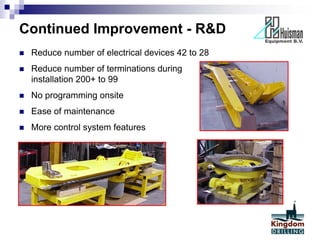
 Reduce number of electrical devices 42 to 28
 Reduce number of terminations during
installation 200+ to 99
 No programming onsite
 Ease of maintenance
 More control system features
Continued Improvement - R&D
Efficient Zone operation Management
Reducing Well times = costs
PRS-8i can access these
traditionally “dead” spaces
 Increased
setback
capacity
 Overcome
space
limitations
 Ideal for
smaller rigs
Others
 Tubular & riser handling equipment
 Compensation equipment.
 Storage, logistic requirements
 Subsea equipment
Remote operated vehicles (ROV’s)
Wellheads, templates, manifolds
Xmas trees
 Drilling measurement tools
 Directional drilling equipment
Concurrent Operations
 Drilling
 Riserless drilling; Make-up and
run drilling assemblies and
casing offline
 Run/Pull BOP & riser
 Completion
 Tubing spool, tree, BOP/riser,
Completion riser
 Facilities Installation
 Heave-compensated Crane for
module deployment
 Keelhaul to Rotary B for heavier
modules (> 100Mton)
Pipe
handling
with block retract
Tubular handling operations
13
Running 135ft, 180ft? stands
17.6
9
19.7
24.8
45
23
30
40
21
45
0
5
10
15
20
25
30
35
40
45
C
ontractorG
O
M
Average
Singles
No
VFD
U
pg.
Singles
w
ith
V
FD
Upg.
13
3/8
in
D
oubles
13
5/8
in
Triples
9
5/8
in
D
oubles
11
3/4
in
D
oubles
TargetD
oubles
16
in
Triples
18
in
Triples
14
Automatic Pipe handling
15
Pipe handling
16
Pipe handling, RBS system.
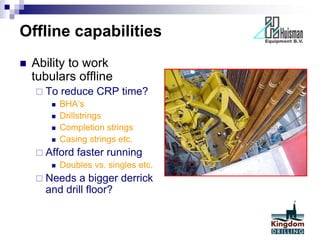
Offline capabilities
 Ability to work
tubulars offline
 To reduce CRP time?
 BHA’s
 Drillstrings
 Completion strings
 Casing strings etc.
 Afford faster running
 Doubles vs. singles etc.
 Needs a bigger derrick
and drill floor?
18
Casing running
19
Hi-tech drillers & roughnecks
Derrick Drilling machines
Other efficiency focus areas?
1. Derrick and Substructure loads
2. Power & Power Management
3. Riser and tensioning
4. Logistics
1. Derrick & substructure loads
 Based upon 3 Loads acting simultaneously and
independently
1. Maximum Set Back Load (air weight of drillstring)
2. Maximum Load on the Slips or Derrick
3. Marine Riser Tension Load
Note: Maximum Loads may not occur simultaneously
Sub-Structure Combined Loads
Maximum Set Back Load
(air weight of drillstring)
Usually occurs @
intermediate casing point.*
• Maximum Load on the
Slips or Hook
• Usually Surf. or Int. Casing
(buoyed weight of heaviest
casing)*
• Highest Mud Weight
(assuming no
environmental factors,
currents, etc..)*
• Maximum Marine Riser
Tensioner Load
• Dynamic Loading
(Deepwater)
Rig loading examples
 Present calcs to demonstrate rig loadings.
Variable Deck Loads (VDL)
Maximum Weight of Consumable Materials.
Ship Shape vs. Semi-Submersible
Available Storage Space
Mooring & Riser Tensioning Loads
Drilling, Transit, & Survival Loads
Logistics
Semi-sub Top Deck Min Load
8000' Water Depth
Short
Tons Percent
Riser 2500 34%
BOP's 250 3%
Casing 300 4% Long String
Third Party Equip 200 3% ROV, Log Unit, etc.
Drillstring 600 8%
Misc, Tools, etc. 500 7%
Mud 2100 29% 6500 bbls 15.0 ppg
Barite 400 6% 8000 sx
Cement 400 6% 8500 sx
7250 100%
Riser
BOP's
Casing
Third Party
Equip
Drillstring
Misc, Tools,
etc.
Mud
Barite
Cement
New build example
Item Description
Water Depth 10,000 ft; 3000m
Drill Depth Ca. 40000 ft; 12000m
Payload,
Drilling Draft
13500mT (53,000 mT
displacement)
Payload,
Transit Draft
7000mT
Positioning DP-2 +, 8 pt mooring
w/600m chain for PIMS
(provisions for 12 pt
system)
Power 8x 4800 kW (Total 38.4
MW; 51800 hp)
Personnel 180
* Payload is VDL plus column load
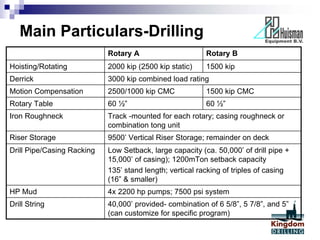
Main Particulars-Drilling
Rotary A Rotary B
Hoisting/Rotating 2000 kip (2500 kip static) 1500 kip
Derrick 3000 kip combined load rating
Motion Compensation 2500/1000 kip CMC 1500 kip CMC
Rotary Table 60 ½” 60 ½”
Iron Roughneck Track -mounted for each rotary; casing roughneck or
combination tong unit
Riser Storage 9500’ Vertical Riser Storage; remainder on deck
Drill Pipe/Casing Racking Low Setback, large capacity (ca. 50,000’ of drill pipe +
15,000’ of casing); 1200mTon setback capacity
135’ stand length; vertical racking of triples of casing
(16” & smaller)
HP Mud 4x 2200 hp pumps; 7500 psi system
Drill String 40,000’ provided- combination of 6 5/8”, 5 7/8”, and 5”
(can customize for specific program)
Loading exercise
 Present a typical drilling engineering
loading exercise.
2. Power and power management
Total HP required vs. available
 Minimum Hoisting Horsepower
 Minimum Rotary Horsepower
 Minimum Hydraulic Horsepower
 Minimum DP Horsepower
 Minimum Overall Rig Horsepower
Power Management & Plan
 Distribution System
 SCR & Switchgear
 Fuel Conservation
 Power Management Plan
 Emergency & Back-up Supply
Power exercises
 Present a typical draworks power required
exercise.
3. Riser & tensioning systems
Loading and dynamic
considerations
 Riser handling & running
 Connections
 Riser, wellhead & mooring
analysis
 Tensioners
 Disconnect
 Redundancy
Riser handling
Riser considerations
 Riser cleaning (lost circulation)
 Boost lines, valves, pumping capabilities
 Anti-collapse
 Wall thickness?
 Valve or seawater influx capability
 Inspection, maintenance and repair
 Riser management systems and riser analysis
 Choke and kill lines
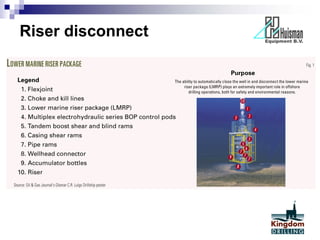
Riser disconnect
Riser recoil device?
 Dampens release of riser ‘tension’ energy
when riser is dis-connected.
 Therefore facilitates for a safe disconnect
i.e.
Lifts LMRP clear of BOP
Minimise damage to BOP
Minimise damage to riser components
Riser re-coil requirements
 Converts energy/forced stored and
potential acceleration into controlled
disconnect.
Dissipate energy in tensioner cylinders
Strain energy in tensioner cables
Strain energy in marine riser itself.
 Three types of systems
Passive manual, automatic and active
Riser Weight: 365 Kips
BOP Wet: 535
Hoisting/running eqpt: 100
Heave Induced Dynamic: 200
Start / Stop Acceleration” 100
TOTAL: 1,300 Kips
Riser Management
Riser management system (RMS)
 Watch circles based on physics
 Lower riser angle
 Upper riser angle
 Stroke
 Advise for optimal position
RMS summary view
 Flex joints
 Riser tension
 Slip joint stroke
 Time to go
 Reposition advice
 Alarm status
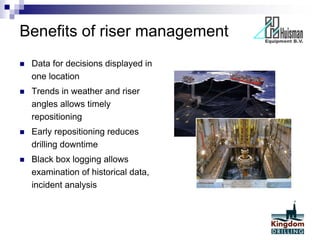
Benefits of riser management
 Data for decisions displayed in
one location
 Trends in weather and riser
angles allows timely
repositioning
 Early repositioning reduces
drilling downtime
 Black box logging allows
examination of historical data,
incident analysis
4. Deck & loading capacities
• Drilling fluids and bulk
capacities
• Deck space
• Cranes and hoisting
equipment
• Storage
• Utilities
Logistics Management
Main Particulars - Storage
Item Imperial Metric
Fuel 25160 bbl 4000 m3
Drill Water 12580 bbl 2000 m3
Weighted Mud,
Surface
9435 bbl 1500 m3
Weighted Mud,
Pontoons
9435 bbl 1500 m3
Brine 4718 bbl 750 m3
Base oil 4718 bbl 750 m3
Bulk Mud 24,000 ft 3 680 m3
Bulk Cement 24,000 ft 3 680 m3
December 2008 Kingdom Drilling Services Ltd.
Questions?

Deepwater rig improvement ops

  • 1.
    December 2008 KingdomDrilling Services Ltd. Deepwater Rig and equipment selection Peter Aird: Schiedam December 2008
  • 2.
    Objective Continue to presentthe key construction and well life cycle opportunities to construct and manage safer, more effective and cost efficient operations.
  • 3.
    Rig build operationalactivities?  Exploratory, appraisal and development well drilling including Deepwater, deep, ERD, HPHT wells?  Able to batch-drill multiple well clusters  Well testing systems in place  Subsea Completions, Batch installation  Installation of subsea facility components  Well work-over & intervention
  • 4.
    Improvement Opportunities  Reduceoperating loss and unplanned events  Tubular, riser handling  Offline Pickup and Lay-down of Pipe  Offline BHA handling  Improved Tripping Efficiency  Casing Handling  Advanced Hoisting Systems  Advanced well control  New generation of BOP’a  High pressure slim hole riser and surface BOP  BOP, marine Riser running, pulling operations  Subsea tools and equipment handling, running, installing etc.
  • 5.
    5 Reducing failures Proven components,standardization  built in redundancy  Eliminate single point failures  Use of early warning systems  E.g. Water Alarms, Ground Fault Monitor etc.  Training, Seminars & Personnel Motivation  Equipment Ownership  Systems Audits  Project Management, Logistic Support
  • 6.
     Reduce numberof electrical devices 42 to 28  Reduce number of terminations during installation 200+ to 99  No programming onsite  Ease of maintenance  More control system features Continued Improvement - R&D
  • 7.
  • 8.
    Reducing Well times= costs PRS-8i can access these traditionally “dead” spaces  Increased setback capacity  Overcome space limitations  Ideal for smaller rigs
  • 9.
    Others  Tubular &riser handling equipment  Compensation equipment.  Storage, logistic requirements  Subsea equipment Remote operated vehicles (ROV’s) Wellheads, templates, manifolds Xmas trees  Drilling measurement tools  Directional drilling equipment
  • 10.
    Concurrent Operations  Drilling Riserless drilling; Make-up and run drilling assemblies and casing offline  Run/Pull BOP & riser  Completion  Tubing spool, tree, BOP/riser, Completion riser  Facilities Installation  Heave-compensated Crane for module deployment  Keelhaul to Rotary B for heavier modules (> 100Mton)
  • 11.
  • 12.
  • 13.
    13 Running 135ft, 180ft?stands 17.6 9 19.7 24.8 45 23 30 40 21 45 0 5 10 15 20 25 30 35 40 45 C ontractorG O M Average Singles No VFD U pg. Singles w ith V FD Upg. 13 3/8 in D oubles 13 5/8 in Triples 9 5/8 in D oubles 11 3/4 in D oubles TargetD oubles 16 in Triples 18 in Triples
  • 14.
  • 15.
  • 16.
  • 17.
    Offline capabilities  Abilityto work tubulars offline  To reduce CRP time?  BHA’s  Drillstrings  Completion strings  Casing strings etc.  Afford faster running  Doubles vs. singles etc.  Needs a bigger derrick and drill floor?
  • 18.
  • 19.
  • 20.
  • 21.
    Other efficiency focusareas? 1. Derrick and Substructure loads 2. Power & Power Management 3. Riser and tensioning 4. Logistics
  • 22.
    1. Derrick &substructure loads  Based upon 3 Loads acting simultaneously and independently 1. Maximum Set Back Load (air weight of drillstring) 2. Maximum Load on the Slips or Derrick 3. Marine Riser Tension Load Note: Maximum Loads may not occur simultaneously
  • 23.
    Sub-Structure Combined Loads MaximumSet Back Load (air weight of drillstring) Usually occurs @ intermediate casing point.* • Maximum Load on the Slips or Hook • Usually Surf. or Int. Casing (buoyed weight of heaviest casing)* • Highest Mud Weight (assuming no environmental factors, currents, etc..)* • Maximum Marine Riser Tensioner Load • Dynamic Loading (Deepwater)
  • 24.
    Rig loading examples Present calcs to demonstrate rig loadings.
  • 25.
    Variable Deck Loads(VDL) Maximum Weight of Consumable Materials. Ship Shape vs. Semi-Submersible Available Storage Space Mooring & Riser Tensioning Loads Drilling, Transit, & Survival Loads Logistics
  • 26.
    Semi-sub Top DeckMin Load 8000' Water Depth Short Tons Percent Riser 2500 34% BOP's 250 3% Casing 300 4% Long String Third Party Equip 200 3% ROV, Log Unit, etc. Drillstring 600 8% Misc, Tools, etc. 500 7% Mud 2100 29% 6500 bbls 15.0 ppg Barite 400 6% 8000 sx Cement 400 6% 8500 sx 7250 100% Riser BOP's Casing Third Party Equip Drillstring Misc, Tools, etc. Mud Barite Cement
  • 27.
    New build example ItemDescription Water Depth 10,000 ft; 3000m Drill Depth Ca. 40000 ft; 12000m Payload, Drilling Draft 13500mT (53,000 mT displacement) Payload, Transit Draft 7000mT Positioning DP-2 +, 8 pt mooring w/600m chain for PIMS (provisions for 12 pt system) Power 8x 4800 kW (Total 38.4 MW; 51800 hp) Personnel 180 * Payload is VDL plus column load
  • 28.
    Main Particulars-Drilling Rotary ARotary B Hoisting/Rotating 2000 kip (2500 kip static) 1500 kip Derrick 3000 kip combined load rating Motion Compensation 2500/1000 kip CMC 1500 kip CMC Rotary Table 60 ½” 60 ½” Iron Roughneck Track -mounted for each rotary; casing roughneck or combination tong unit Riser Storage 9500’ Vertical Riser Storage; remainder on deck Drill Pipe/Casing Racking Low Setback, large capacity (ca. 50,000’ of drill pipe + 15,000’ of casing); 1200mTon setback capacity 135’ stand length; vertical racking of triples of casing (16” & smaller) HP Mud 4x 2200 hp pumps; 7500 psi system Drill String 40,000’ provided- combination of 6 5/8”, 5 7/8”, and 5” (can customize for specific program)
  • 29.
    Loading exercise  Presenta typical drilling engineering loading exercise.
  • 30.
    2. Power andpower management Total HP required vs. available  Minimum Hoisting Horsepower  Minimum Rotary Horsepower  Minimum Hydraulic Horsepower  Minimum DP Horsepower  Minimum Overall Rig Horsepower
  • 31.
    Power Management &Plan  Distribution System  SCR & Switchgear  Fuel Conservation  Power Management Plan  Emergency & Back-up Supply
  • 32.
    Power exercises  Presenta typical draworks power required exercise.
  • 33.
    3. Riser &tensioning systems Loading and dynamic considerations  Riser handling & running  Connections  Riser, wellhead & mooring analysis  Tensioners  Disconnect  Redundancy
  • 34.
  • 35.
    Riser considerations  Risercleaning (lost circulation)  Boost lines, valves, pumping capabilities  Anti-collapse  Wall thickness?  Valve or seawater influx capability  Inspection, maintenance and repair  Riser management systems and riser analysis  Choke and kill lines
  • 36.
  • 37.
    Riser recoil device? Dampens release of riser ‘tension’ energy when riser is dis-connected.  Therefore facilitates for a safe disconnect i.e. Lifts LMRP clear of BOP Minimise damage to BOP Minimise damage to riser components
  • 38.
    Riser re-coil requirements Converts energy/forced stored and potential acceleration into controlled disconnect. Dissipate energy in tensioner cylinders Strain energy in tensioner cables Strain energy in marine riser itself.  Three types of systems Passive manual, automatic and active
  • 39.
    Riser Weight: 365Kips BOP Wet: 535 Hoisting/running eqpt: 100 Heave Induced Dynamic: 200 Start / Stop Acceleration” 100 TOTAL: 1,300 Kips Riser Management
  • 40.
    Riser management system(RMS)  Watch circles based on physics  Lower riser angle  Upper riser angle  Stroke  Advise for optimal position RMS summary view  Flex joints  Riser tension  Slip joint stroke  Time to go  Reposition advice  Alarm status
  • 41.
    Benefits of risermanagement  Data for decisions displayed in one location  Trends in weather and riser angles allows timely repositioning  Early repositioning reduces drilling downtime  Black box logging allows examination of historical data, incident analysis
  • 42.
    4. Deck &loading capacities • Drilling fluids and bulk capacities • Deck space • Cranes and hoisting equipment • Storage • Utilities
  • 43.
  • 44.
    Main Particulars -Storage Item Imperial Metric Fuel 25160 bbl 4000 m3 Drill Water 12580 bbl 2000 m3 Weighted Mud, Surface 9435 bbl 1500 m3 Weighted Mud, Pontoons 9435 bbl 1500 m3 Brine 4718 bbl 750 m3 Base oil 4718 bbl 750 m3 Bulk Mud 24,000 ft 3 680 m3 Bulk Cement 24,000 ft 3 680 m3
  • 45.
    December 2008 KingdomDrilling Services Ltd. Questions?