Drilling Operations
Offshore Drilling
Content
• Inland barges (submersible)
• Jackup rigs
– Wildcats
– Shallow water templates
– Cantilevered over platform
• Platform rigs
• Floaters - semi’s and drillships
• Science programs
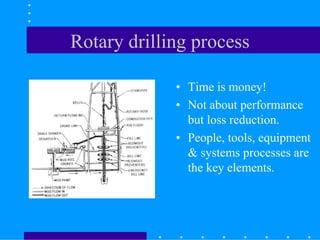
Rotary drilling process
• Time is money!
• Not about performance
but loss reduction.
• People, tools, equipment
& systems processes are
the key elements.
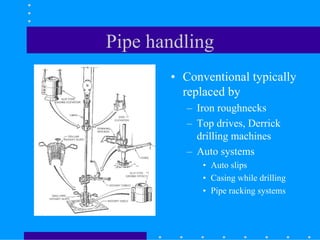
Pipe handling
• Conventional typically
replaced by
– Iron roughnecks
– Top drives, Derrick
drilling machines
– Auto systems
• Auto slips
• Casing while drilling
• Pipe racking systems
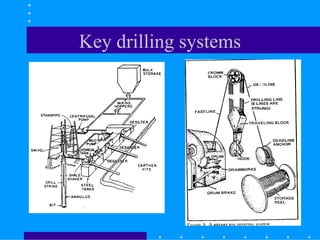
Key drilling systems
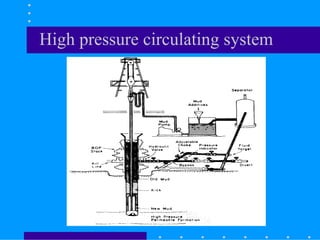
High pressure circulating system
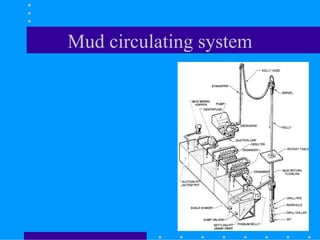
Mud circulating system
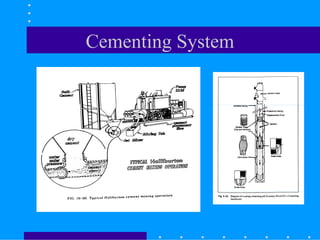
Cementing System
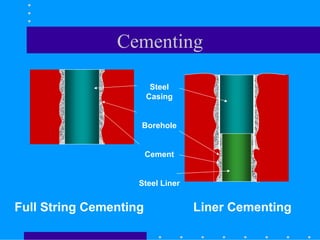
Cementing
Full String Cementing
Steel
Casing
Borehole
Cement
Steel Liner
Liner Cementing
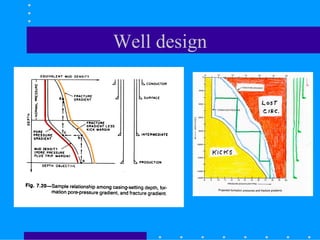
Well design
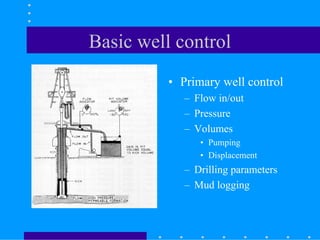
Basic well control
• Primary well control
– Flow in/out
– Pressure
– Volumes
• Pumping
• Displacement
– Drilling parameters
– Mud logging
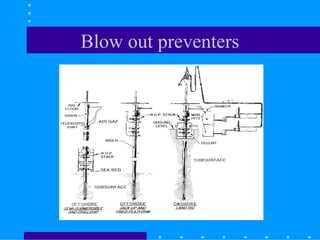
Blow out preventers
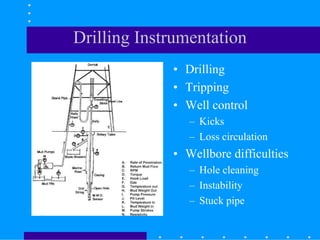
Drilling Instrumentation
• Drilling
• Tripping
• Well control
– Kicks
– Loss circulation
• Wellbore difficulties
– Hole cleaning
– Instability
– Stuck pipe
Offshore Rig Types
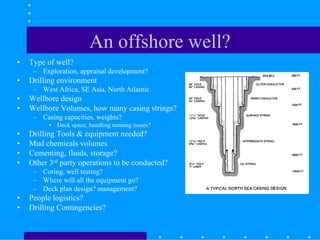
An offshore well?
• Type of well?
– Exploration, appraisal development?
• Drilling environment
– West Africa, SE Asia, North Atlantic
• Wellbore design
• Wellbore Volumes, how many casing strings?
– Casing capacities, weights?
• Deck space, handling running issues?
• Drilling Tools & equipment needed?
• Mud chemicals volumes
• Cementing, fluids, storage?
• Other 3rd party operations to be conducted?
– Coring, well testing?
– Where will all the equipment go?
– Deck plan design? management?
• People logistics?
• Drilling Contingencies?
Inland barge
• Used in swamps, bays, inland water,
shallow offshore.
• Floated and towed to location
• On location these rigs are submerged
• Well is drilled
• Personnel and supplies are brought in by
boat.
Jackup rigs
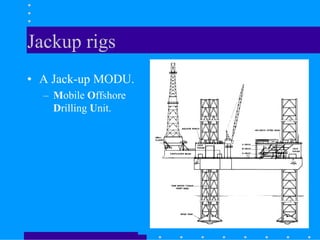
• A Jack-up MODU.
– Mobile Offshore
Drilling Unit.
Jackup rigs
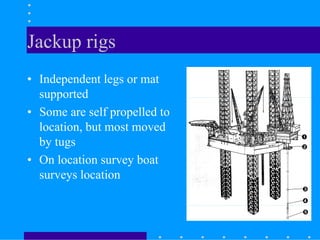
• Independent legs or mat
supported
• Some are self propelled to
location, but most moved
by tugs
• On location survey boat
surveys location
Jackup rigs
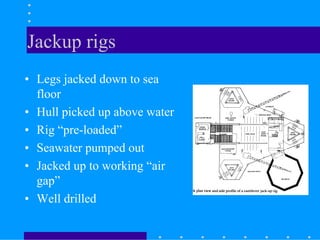
• Legs jacked down to sea
floor
• Hull picked up above water
• Rig “pre-loaded”
• Seawater pumped out
• Jacked up to working “air
gap”
• Well drilled
Jackup rigs
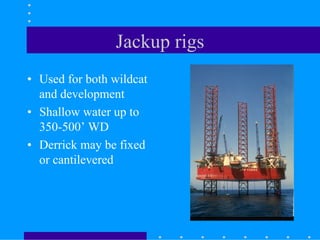
• Used for both wildcat
and development
• Shallow water up to
350-500’ WD
• Derrick may be fixed
or cantilevered
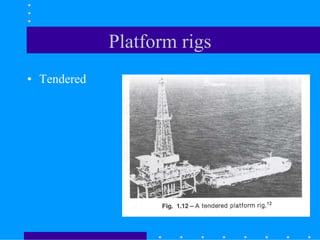
Platform rigs
• Tendered
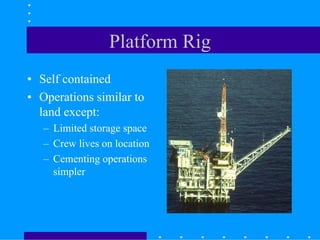
Platform Rig
• Self contained
• Operations similar to
land except:
– Limited storage space
– Crew lives on location
– Cementing operations
simpler
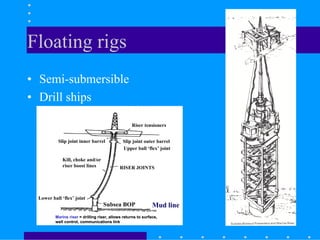
Floating rigs
• Semi-submersible
• Drill ships
Subsea BOP
RISER JOINTS
Kill, choke and/or
riser boost lines
Slip joint outer barrel
Upper ball ‘flex’ joint
Slip joint inner barrel
Riser tensioners
Lower ball ‘flex’ joint
Mud line
Marine riser = drilling riser, allows returns to surface,
well control, communications link
Subsea BOP
RISER JOINTS
Kill, choke and/or
riser boost lines
Slip joint outer barrel
Upper ball ‘flex’ joint
Slip joint inner barrel
Riser tensioners
Lower ball ‘flex’ joint
Mud line
Marine riser = drilling riser, allows returns to surface,
well control, communications link
Subsea BOP
RISER JOINTS
Kill, choke and/or
riser boost lines
Slip joint outer barrel
Upper ball ‘flex’ joint
Slip joint inner barrel
Riser tensioners
Lower ball ‘flex’ joint
Mud line
Marine riser = drilling riser, allows returns to surface,
well control, communications link
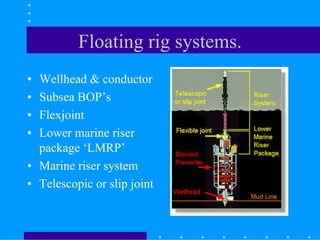
Floating rig systems.
• Wellhead & conductor
• Subsea BOP’s
• Flexjoint
• Lower marine riser
package ‘LMRP’
• Marine riser system
• Telescopic or slip joint
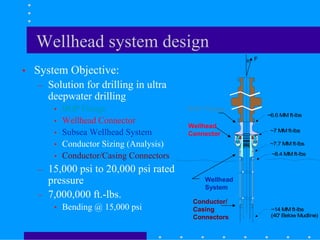
Wellhead system design
• System Objective:
– Solution for drilling in ultra
deepwater drilling
• BOP Flange
• Wellhead Connector
• Subsea Wellhead System
• Conductor Sizing (Analysis)
• Conductor/Casing Connectors
– 15,000 psi to 20,000 psi rated
pressure
– 7,000,000 ft.-lbs.
• Bending @ 15,000 psi
F
~6.6 MM ft-lbs
~7 MM ft-lbs
~7.7 MM ft-lbs
~14 MM ft-lbs
(40' Below Mudline)
~8.4 MM ft-lbs

BOP Flange
Wellhead
Connector
Wellhead
System
Conductor/
Casing
Connectors
F
~6.6 MM ft-lbs
~7 MM ft-lbs
~7.7 MM ft-lbs
~14 MM ft-lbs
(40' Below Mudline)
~8.4 MM ft-lbs

BOP Flange
Wellhead
Connector
Wellhead
System
Conductor/
Casing
Connectors
BOP Flange
Wellhead
Connector
Wellhead
System
Conductor/
Casing
Connectors
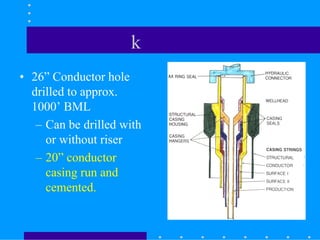
k
• 26” Conductor hole
drilled to approx.
1000’ BML
– Can be drilled with
or without riser
– 20” conductor
casing run and
cemented.
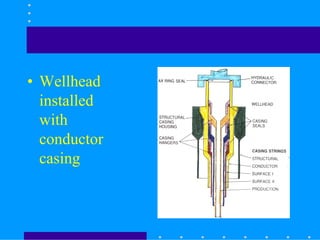
• Wellhead
installed
with
conductor
casing
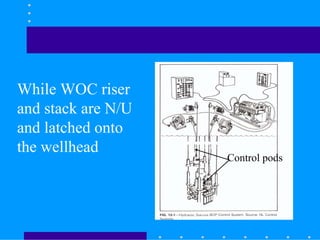
While WOC riser
and stack are N/U
and latched onto
the wellhead
Control pods
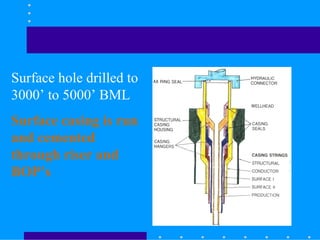
Surface hole drilled to
3000’ to 5000’ BML
Surface casing is run
and cemented
through riser and
BOP’s
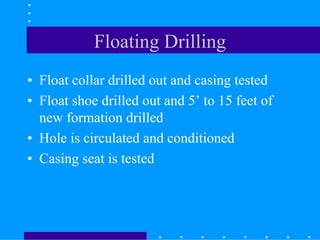
Floating Drilling
• Float collar drilled out and casing tested
• Float shoe drilled out and 5’ to 15 feet of
new formation drilled
• Hole is circulated and conditioned
• Casing seat is tested
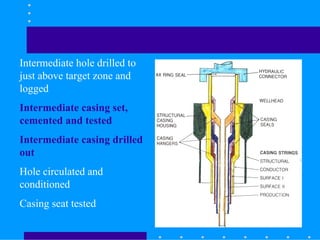
Intermediate hole drilled to
just above target zone and
logged
Intermediate casing set,
cemented and tested
Intermediate casing drilled
out
Hole circulated and
conditioned
Casing seat tested
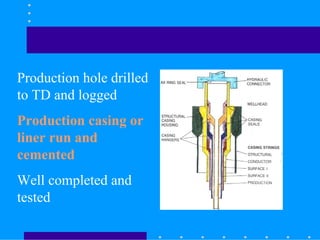
Production hole drilled
to TD and logged
Production casing or
liner run and
cemented
Well completed and
tested
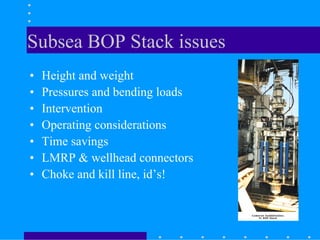
Subsea BOP Stack issues
• Height and weight
• Pressures and bending loads
• Intervention
• Operating considerations
• Time savings
• LMRP & wellhead connectors
• Choke and kill line, id’s!
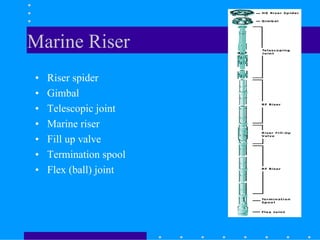
Marine Riser
• Riser spider
• Gimbal
• Telescopic joint
• Marine riser
• Fill up valve
• Termination spool
• Flex (ball) joint
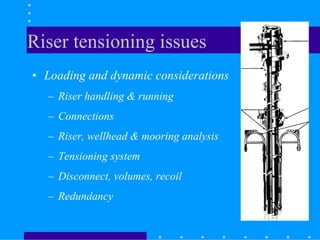
Riser tensioning issues
• Loading and dynamic considerations
– Riser handling & running
– Connections
– Riser, wellhead & mooring analysis
– Tensioning system
– Disconnect, volumes, recoil
– Redundancy
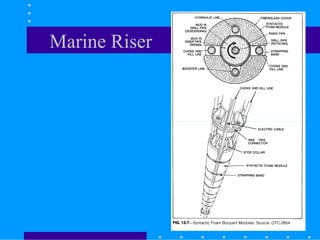
Marine Riser
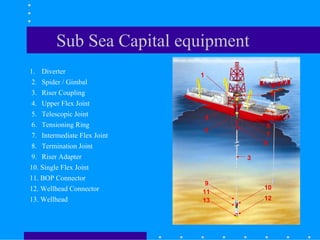
Sub Sea Capital equipment
1. Diverter
2. Spider / Gimbal
3. Riser Coupling
4. Upper Flex Joint
5. Telescopic Joint
6. Tensioning Ring
7. Intermediate Flex Joint
8. Termination Joint
9. Riser Adapter
10. Single Flex Joint
11. BOP Connector
12. Wellhead Connector
13. Wellhead
3
1
2
6
4
7
9
13
5
8
10
11
12
3
1
2
6
4
7
9
13
5
8
10
11
12
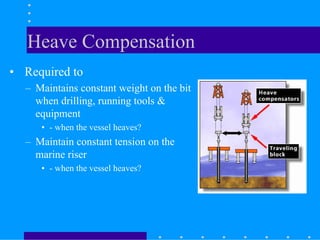
Heave Compensation
• Required to
– Maintains constant weight on the bit
when drilling, running tools &
equipment
• - when the vessel heaves?
– Maintain constant tension on the
marine riser
• - when the vessel heaves?
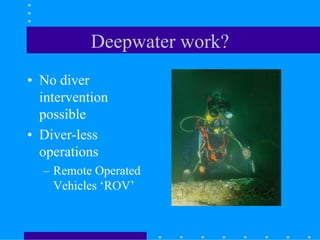
Deepwater work?
• No diver
intervention
possible
• Diver-less
operations
– Remote Operated
Vehicles ‘ROV’
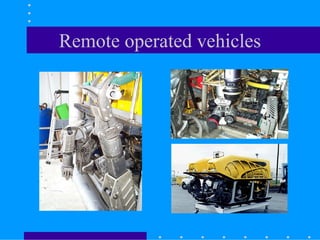
Remote operated vehicles
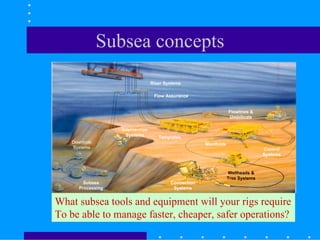
Subsea concepts
Wellheads &
Tree Systems
Connection
Systems
Control
Systems
Manifolds
Templates
Intervention
Systems
Downhole
Systems
Subsea
Processing
Flow Assurance
Riser Systems
Flowlines &
Umbilicals
What subsea tools and equipment will your rigs require
To be able to manage faster, cheaper, safer operations?
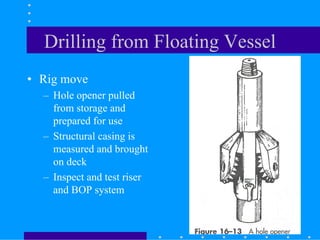
Drilling from Floating Vessel
• Rig move
– Hole opener pulled
from storage and
prepared for use
– Structural casing is
measured and brought
on deck
– Inspect and test riser
and BOP system
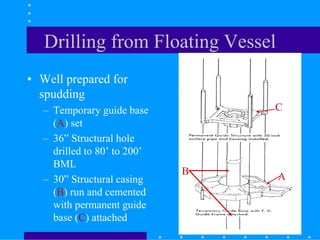
Drilling from Floating Vessel
• Well prepared for
spudding
– Temporary guide base
(A) set
– 36” Structural hole
drilled to 80’ to 200’
BML
– 30” Structural casing
(B) run and cemented
with permanent guide
base (C) attached
A
B
C
Drilling from Floating Vessel
– Water depth at new location verified
– Tide tables obtained
– Choke manifold inspected and tested
• Site surveyed and marked with buoys
Drilling from Floating Vessel
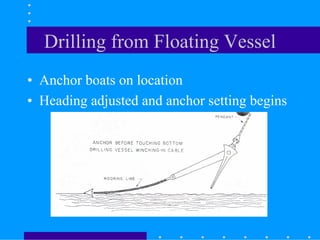
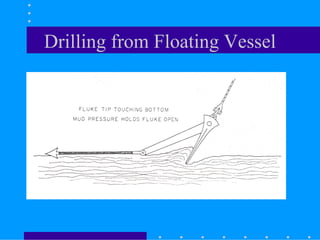
• Anchor boats on location
• Heading adjusted and anchor setting begins
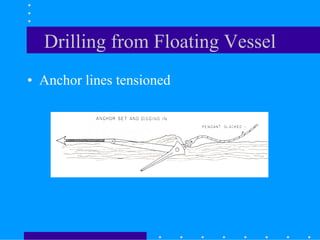
Drilling from Floating Vessel
• Anchor lines tensioned
Floating Drilling
• After testing, hole prepared for
abandonment
– P&A, PNA
– TA, T&A, TNA
• Perfs squeezed, and cement plugs set
according to regulatore rules and
regulations
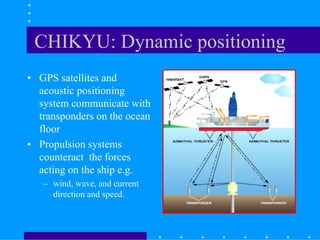
CHIKYU: Dynamic positioning
• GPS satellites and
acoustic positioning
system communicate with
transponders on the ocean
floor
• Propulsion systems
counteract the forces
acting on the ship e.g.
– wind, wave, and current
direction and speed.
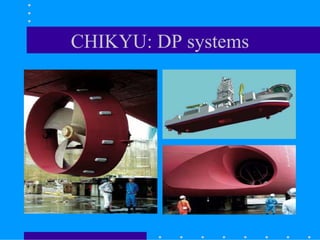
CHIKYU: DP systems
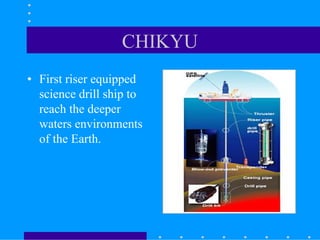
CHIKYU
• First riser equipped
science drill ship to
reach the deeper
waters environments
of the Earth.
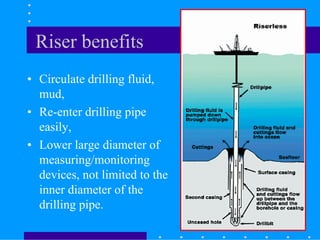
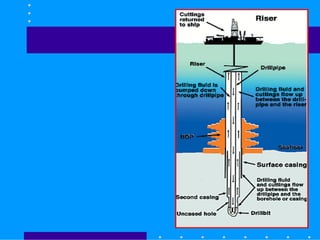
Riser benefits
• Circulate drilling fluid,
mud,
• Re-enter drilling pipe
easily,
• Lower large diameter of
measuring/monitoring
devices, not limited to the
inner diameter of the
drilling pipe.
Circulating system
• Increase mud water weight, to counter-balance the
formation pressure,
• reinforce wall of the borehole by mud ingredients
(mud cake),
• exploit viscosity of mud to displace drilling
cuttings (scraped formation particles) smoothly
• sample drilling cuttings (scraped formation
particles) on board to evaluate formation layers
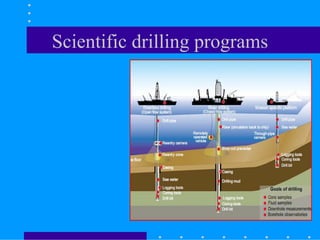
Scientific drilling programs
Floating Drilling
• Riser and BOP retrieved
• Casing cut approx. 10’ BML if PNA
• Temporary and permanent guide base
retrieved
• Anchors pulled
• Vessel under way to next location
End of presentation
Offshore Drilling

Intro to offshore drilling

  • 1.
  • 2.
    Content • Inland barges(submersible) • Jackup rigs – Wildcats – Shallow water templates – Cantilevered over platform • Platform rigs • Floaters - semi’s and drillships • Science programs
  • 3.
    Rotary drilling process •Time is money! • Not about performance but loss reduction. • People, tools, equipment & systems processes are the key elements.
  • 4.
    Pipe handling • Conventionaltypically replaced by – Iron roughnecks – Top drives, Derrick drilling machines – Auto systems • Auto slips • Casing while drilling • Pipe racking systems
  • 5.
  • 6.
  • 7.
  • 8.
  • 9.
  • 10.
  • 11.
    Basic well control •Primary well control – Flow in/out – Pressure – Volumes • Pumping • Displacement – Drilling parameters – Mud logging
  • 12.
  • 13.
    Drilling Instrumentation • Drilling •Tripping • Well control – Kicks – Loss circulation • Wellbore difficulties – Hole cleaning – Instability – Stuck pipe
  • 14.
  • 15.
    An offshore well? •Type of well? – Exploration, appraisal development? • Drilling environment – West Africa, SE Asia, North Atlantic • Wellbore design • Wellbore Volumes, how many casing strings? – Casing capacities, weights? • Deck space, handling running issues? • Drilling Tools & equipment needed? • Mud chemicals volumes • Cementing, fluids, storage? • Other 3rd party operations to be conducted? – Coring, well testing? – Where will all the equipment go? – Deck plan design? management? • People logistics? • Drilling Contingencies?
  • 16.
    Inland barge • Usedin swamps, bays, inland water, shallow offshore. • Floated and towed to location • On location these rigs are submerged • Well is drilled • Personnel and supplies are brought in by boat.
  • 17.
    Jackup rigs • AJack-up MODU. – Mobile Offshore Drilling Unit.
  • 18.
    Jackup rigs • Independentlegs or mat supported • Some are self propelled to location, but most moved by tugs • On location survey boat surveys location
  • 19.
    Jackup rigs • Legsjacked down to sea floor • Hull picked up above water • Rig “pre-loaded” • Seawater pumped out • Jacked up to working “air gap” • Well drilled
  • 20.
    Jackup rigs • Usedfor both wildcat and development • Shallow water up to 350-500’ WD • Derrick may be fixed or cantilevered
  • 21.
  • 22.
    Platform Rig • Selfcontained • Operations similar to land except: – Limited storage space – Crew lives on location – Cementing operations simpler
  • 23.
    Floating rigs • Semi-submersible •Drill ships Subsea BOP RISER JOINTS Kill, choke and/or riser boost lines Slip joint outer barrel Upper ball ‘flex’ joint Slip joint inner barrel Riser tensioners Lower ball ‘flex’ joint Mud line Marine riser = drilling riser, allows returns to surface, well control, communications link Subsea BOP RISER JOINTS Kill, choke and/or riser boost lines Slip joint outer barrel Upper ball ‘flex’ joint Slip joint inner barrel Riser tensioners Lower ball ‘flex’ joint Mud line Marine riser = drilling riser, allows returns to surface, well control, communications link Subsea BOP RISER JOINTS Kill, choke and/or riser boost lines Slip joint outer barrel Upper ball ‘flex’ joint Slip joint inner barrel Riser tensioners Lower ball ‘flex’ joint Mud line Marine riser = drilling riser, allows returns to surface, well control, communications link
  • 24.
    Floating rig systems. •Wellhead & conductor • Subsea BOP’s • Flexjoint • Lower marine riser package ‘LMRP’ • Marine riser system • Telescopic or slip joint
  • 25.
    Wellhead system design •System Objective: – Solution for drilling in ultra deepwater drilling • BOP Flange • Wellhead Connector • Subsea Wellhead System • Conductor Sizing (Analysis) • Conductor/Casing Connectors – 15,000 psi to 20,000 psi rated pressure – 7,000,000 ft.-lbs. • Bending @ 15,000 psi F ~6.6 MM ft-lbs ~7 MM ft-lbs ~7.7 MM ft-lbs ~14 MM ft-lbs (40' Below Mudline) ~8.4 MM ft-lbs  BOP Flange Wellhead Connector Wellhead System Conductor/ Casing Connectors F ~6.6 MM ft-lbs ~7 MM ft-lbs ~7.7 MM ft-lbs ~14 MM ft-lbs (40' Below Mudline) ~8.4 MM ft-lbs  BOP Flange Wellhead Connector Wellhead System Conductor/ Casing Connectors BOP Flange Wellhead Connector Wellhead System Conductor/ Casing Connectors
  • 26.
    k • 26” Conductorhole drilled to approx. 1000’ BML – Can be drilled with or without riser – 20” conductor casing run and cemented.
  • 27.
  • 28.
    While WOC riser andstack are N/U and latched onto the wellhead Control pods
  • 29.
    Surface hole drilledto 3000’ to 5000’ BML Surface casing is run and cemented through riser and BOP’s
  • 30.
    Floating Drilling • Floatcollar drilled out and casing tested • Float shoe drilled out and 5’ to 15 feet of new formation drilled • Hole is circulated and conditioned • Casing seat is tested
  • 31.
    Intermediate hole drilledto just above target zone and logged Intermediate casing set, cemented and tested Intermediate casing drilled out Hole circulated and conditioned Casing seat tested
  • 32.
    Production hole drilled toTD and logged Production casing or liner run and cemented Well completed and tested
  • 33.
    Subsea BOP Stackissues • Height and weight • Pressures and bending loads • Intervention • Operating considerations • Time savings • LMRP & wellhead connectors • Choke and kill line, id’s!
  • 34.
    Marine Riser • Riserspider • Gimbal • Telescopic joint • Marine riser • Fill up valve • Termination spool • Flex (ball) joint
  • 35.
    Riser tensioning issues •Loading and dynamic considerations – Riser handling & running – Connections – Riser, wellhead & mooring analysis – Tensioning system – Disconnect, volumes, recoil – Redundancy
  • 36.
  • 37.
    Sub Sea Capitalequipment 1. Diverter 2. Spider / Gimbal 3. Riser Coupling 4. Upper Flex Joint 5. Telescopic Joint 6. Tensioning Ring 7. Intermediate Flex Joint 8. Termination Joint 9. Riser Adapter 10. Single Flex Joint 11. BOP Connector 12. Wellhead Connector 13. Wellhead 3 1 2 6 4 7 9 13 5 8 10 11 12 3 1 2 6 4 7 9 13 5 8 10 11 12
  • 38.
    Heave Compensation • Requiredto – Maintains constant weight on the bit when drilling, running tools & equipment • - when the vessel heaves? – Maintain constant tension on the marine riser • - when the vessel heaves?
  • 39.
    Deepwater work? • Nodiver intervention possible • Diver-less operations – Remote Operated Vehicles ‘ROV’
  • 40.
  • 41.
    Subsea concepts Wellheads & TreeSystems Connection Systems Control Systems Manifolds Templates Intervention Systems Downhole Systems Subsea Processing Flow Assurance Riser Systems Flowlines & Umbilicals What subsea tools and equipment will your rigs require To be able to manage faster, cheaper, safer operations?
  • 42.
    Drilling from FloatingVessel • Rig move – Hole opener pulled from storage and prepared for use – Structural casing is measured and brought on deck – Inspect and test riser and BOP system
  • 43.
    Drilling from FloatingVessel • Well prepared for spudding – Temporary guide base (A) set – 36” Structural hole drilled to 80’ to 200’ BML – 30” Structural casing (B) run and cemented with permanent guide base (C) attached A B C
  • 44.
    Drilling from FloatingVessel – Water depth at new location verified – Tide tables obtained – Choke manifold inspected and tested • Site surveyed and marked with buoys
  • 45.
    Drilling from FloatingVessel • Anchor boats on location • Heading adjusted and anchor setting begins
  • 46.
  • 47.
    Drilling from FloatingVessel • Anchor lines tensioned
  • 48.
    Floating Drilling • Aftertesting, hole prepared for abandonment – P&A, PNA – TA, T&A, TNA • Perfs squeezed, and cement plugs set according to regulatore rules and regulations
  • 49.
    CHIKYU: Dynamic positioning •GPS satellites and acoustic positioning system communicate with transponders on the ocean floor • Propulsion systems counteract the forces acting on the ship e.g. – wind, wave, and current direction and speed.
  • 50.
  • 51.
    CHIKYU • First riserequipped science drill ship to reach the deeper waters environments of the Earth.
  • 52.
    Riser benefits • Circulatedrilling fluid, mud, • Re-enter drilling pipe easily, • Lower large diameter of measuring/monitoring devices, not limited to the inner diameter of the drilling pipe.
  • 53.
    Circulating system • Increasemud water weight, to counter-balance the formation pressure, • reinforce wall of the borehole by mud ingredients (mud cake), • exploit viscosity of mud to displace drilling cuttings (scraped formation particles) smoothly • sample drilling cuttings (scraped formation particles) on board to evaluate formation layers
  • 54.
  • 56.
    Floating Drilling • Riserand BOP retrieved • Casing cut approx. 10’ BML if PNA • Temporary and permanent guide base retrieved • Anchors pulled • Vessel under way to next location
  • 57.