Deep Learning and Application in
       Neural Networks


   Hugo Larochelle    Geoffrey Hinton
    Yoshua Bengio       Andrew Ng.
  Jerome Louradour   Andrew L. Nelson
    Pascal Lamblin   R. Salskhutdinov
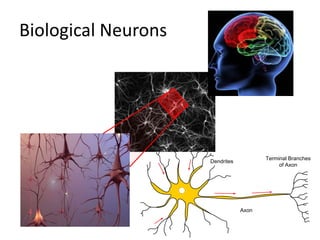
Biological Neurons


                                        Terminal Branches
                     Dendrites
                                             of Axon


                                 Axon
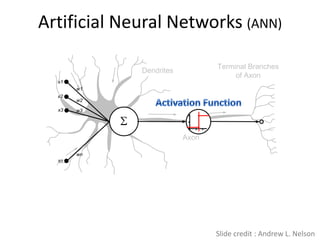
Artificial Neural Networks (ANN)

                                Terminal Branches
             Dendrites
                                     of Axon
  x1
       w1
  x2
       w2
  x3   w3


                         Axon

       wn
  xn


                                Slide credit : Andrew L. Nelson
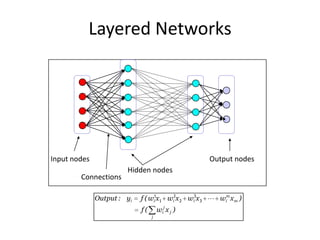
Layered Networks


Input nodes                                        Output nodes
                       Hidden nodes
        Connections

              Output : yi   f ( wi1x1 wi2x 2 wi3x 3  wim x m )
                            f(       wij x j )
                                 j
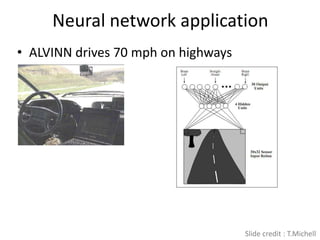
Neural network application
• ALVINN drives 70 mph on highways


                                     Slide credit : T.Michell
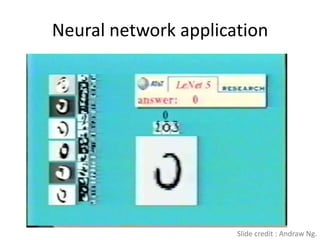
Neural network application


                      Slide credit : Andraw Ng.
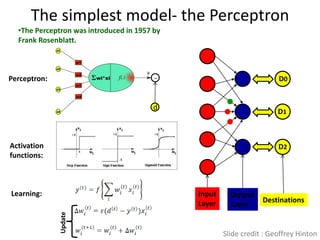
The simplest model- the Perceptron
  •The Perceptron was introduced in 1957 by
  Frank Rosenblatt.


Perceptron:                              -                             D0


                                        d
                                                                       D1


Activation                                                             D2
functions:


Learning:                                     Input     Output
                                              Layer               Destinations
                                                        Layer
              Update


                                                      Slide credit : Geoffrey Hinton
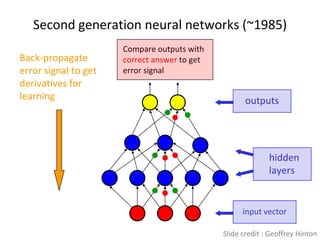
Second generation neural networks (~1985)
                      Compare outputs with
Back-propagate        correct answer to get
error signal to get   error signal
derivatives for
learning                                             outputs


                                                            hidden
                                                            layers


                                                    input vector

                                              Slide credit : Geoffrey Hinton
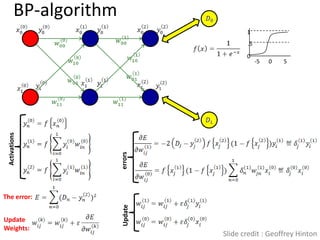
BP-algorithm
                                       1
                                       .5

                                       0
                                            -5   0   5
 Activations


                       errors


The error:
                       Update


Update
Weights:
                                Slide credit : Geoffrey Hinton
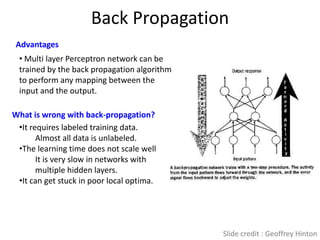
Back Propagation
 Advantages
 • Multi layer Perceptron network can be
 trained by the back propagation algorithm
 to perform any mapping between the
 input and the output.

What is wrong with back-propagation?
 •It requires labeled training data.
       Almost all data is unlabeled.
 •The learning time does not scale well
       It is very slow in networks with
       multiple hidden layers.
 •It can get stuck in poor local optima.


                                             Slide credit : Geoffrey Hinton
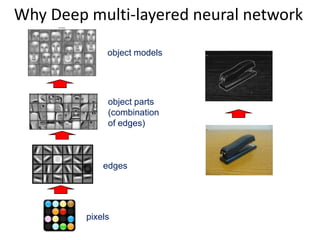
Why Deep multi-layered neural network

              object models


              object parts
              (combination
              of edges)


             edges


         pixels
Deep Neural Networks
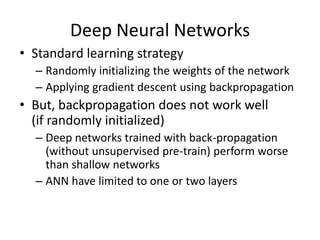
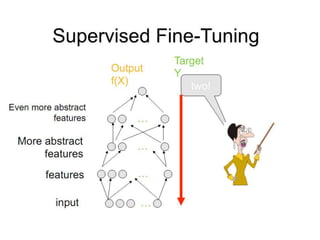
• Standard learning strategy
  – Randomly initializing the weights of the network
  – Applying gradient descent using backpropagation
• But, backpropagation does not work well
  (if randomly initialized)
  – Deep networks trained with back-propagation
    (without unsupervised pre-train) perform worse
    than shallow networks
  – ANN have limited to one or two layers
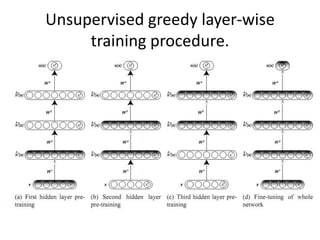
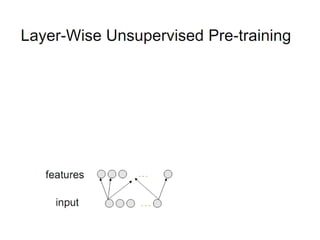
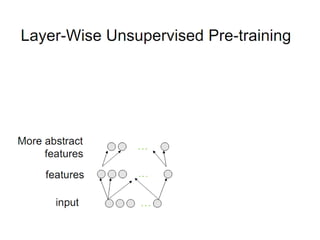
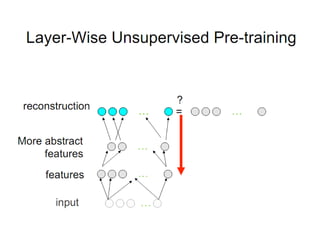
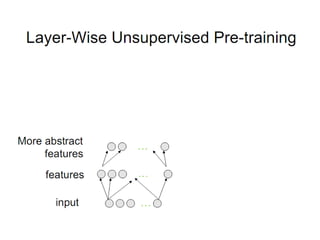
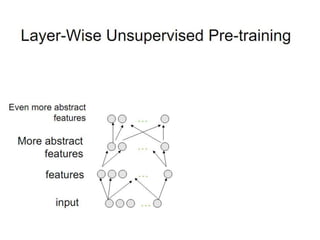
Unsupervised greedy layer-wise
     training procedure.
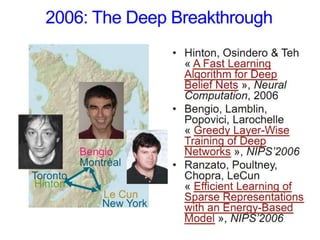
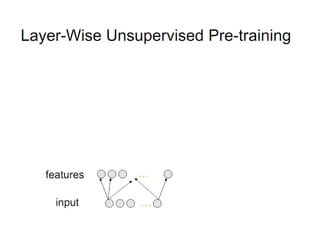
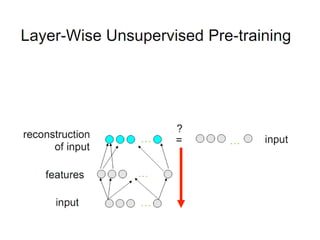
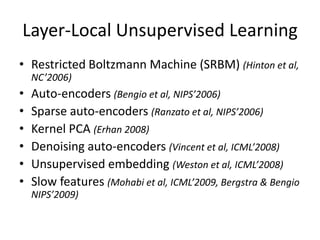
Layer-Local Unsupervised Learning
• Restricted Boltzmann Machine (SRBM) (Hinton et al,
    NC’2006)
•   Auto-encoders (Bengio et al, NIPS’2006)
•   Sparse auto-encoders (Ranzato et al, NIPS’2006)
•   Kernel PCA (Erhan 2008)
•   Denoising auto-encoders (Vincent et al, ICML’2008)
•   Unsupervised embedding (Weston et al, ICML’2008)
•   Slow features (Mohabi et al, ICML’2009, Bergstra & Bengio
    NIPS’2009)
Experiments
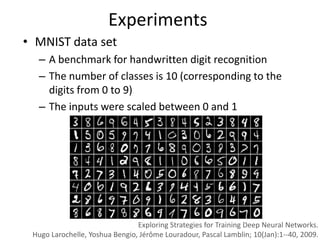
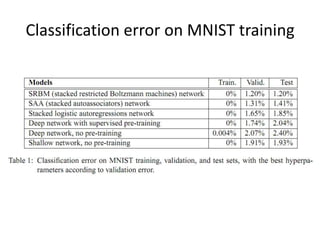
• MNIST data set
  – A benchmark for handwritten digit recognition
  – The number of classes is 10 (corresponding to the
    digits from 0 to 9)
  – The inputs were scaled between 0 and 1


                                Exploring Strategies for Training Deep Neural Networks.
 Hugo Larochelle, Yoshua Bengio, Jérôme Louradour, Pascal Lamblin; 10(Jan):1--40, 2009.
Classification error on MNIST training
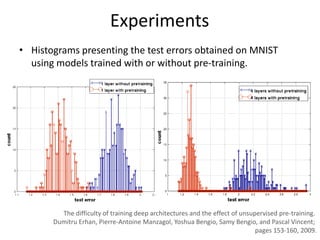
Experiments
• Histograms presenting the test errors obtained on MNIST
  using models trained with or without pre-training.


         The difficulty of training deep architectures and the effect of unsupervised pre-training.
       Dumitru Erhan, Pierre-Antoine Manzagol, Yoshua Bengio, Samy Bengio, and Pascal Vincent;
                                                                              pages 153-160, 2009.
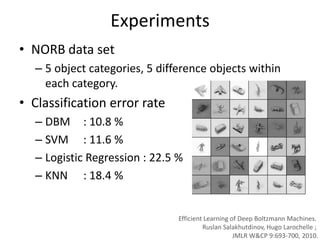
Experiments
• NORB data set
  – 5 object categories, 5 difference objects within
    each category.
• Classification error rate
  – DBM : 10.8 %
  – SVM : 11.6 %
  – Logistic Regression : 22.5 %
  – KNN : 18.4 %


                               Efficient Learning of Deep Boltzmann Machines.
                                        Ruslan Salakhutdinov, Hugo Larochelle ;
                                                   JMLR W&CP 9:693-700, 2010.
Conclusion
• Deep Learning : powerful arguments &
  generalization priciples
• Unsupervised Feature Learning is crucial
  many new algorithms and applications in
  recent years
• Deep Learning suited for multi-task learning,
  domain adaptation and semi-learning with
  few labels
Application
• Classification (Bengio et al., 2007; Ranzato et al., 2007b;
    Larochelle et al., 2007; Ranzato et al.,2008)
• Regression (Salakhutdinov and Hinton, 2008)
• Dimensionality Reduction (Hinton Salakhutdinov, 2006;
    Salakhutdinov and Hinton, 2007)
•   Modeling Textures (Osindero and Hinton, 2008)
•   Information Retrieval (Salakhutdinov and Hinton, 2007)
•   Robotics (Hadsell et al., 2008)
•   Natural Language Processing (Collobert and Weston, 2008;
    Weston et al., 2008)
• Collaborative Filtering (Salakhutdinov et al., 2007)
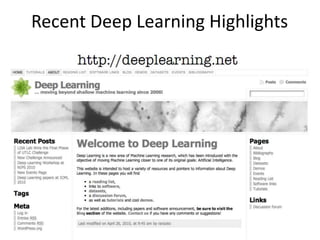
Recent Deep Learning Highlights
• Google Goggles uses Stacked Sparse Auto Encoders
  (Hartmut Neven @ ICML 2011)
• The monograph or review paper Learning Deep Architectures for AI
  (Foundations & Trends in Machine Learning, 2009).
• Exploring Strategies for Training Deep Neural Networks, Hugo
  Larochelle, Yoshua Bengio, Jerome Louradour and Pascal Lamblin
  in: The Journal of Machine Learning Research, pages 1-40, 2009.
• The LISA publications database contains a deep architectures
  category. http://www.iro.umontreal.ca/~lisa/twiki/bin/view.cgi/Public/
  ReadingOnDeepNetworks
• Deep Machine Learning – A New Frontier in Artificial Intelligence
  Research – a survey paper by Itamar Arel, Derek C. Rose, and
  Thomas P. Karnowski.
Thank You

Deep neural networks

  • 1.
    Deep Learning andApplication in Neural Networks Hugo Larochelle Geoffrey Hinton Yoshua Bengio Andrew Ng. Jerome Louradour Andrew L. Nelson Pascal Lamblin R. Salskhutdinov
  • 2.
    Biological Neurons Terminal Branches Dendrites of Axon Axon
  • 3.
    Artificial Neural Networks(ANN) Terminal Branches Dendrites of Axon x1 w1 x2 w2 x3 w3 Axon wn xn Slide credit : Andrew L. Nelson
  • 4.
    Layered Networks Input nodes Output nodes Hidden nodes Connections Output : yi f ( wi1x1 wi2x 2 wi3x 3  wim x m ) f( wij x j ) j
  • 5.
    Neural network application •ALVINN drives 70 mph on highways Slide credit : T.Michell
  • 6.
    Neural network application Slide credit : Andraw Ng.
  • 7.
    The simplest model-the Perceptron •The Perceptron was introduced in 1957 by Frank Rosenblatt. Perceptron: - D0 d D1 Activation D2 functions: Learning: Input Output Layer Destinations Layer Update Slide credit : Geoffrey Hinton
  • 8.
    Second generation neuralnetworks (~1985) Compare outputs with Back-propagate correct answer to get error signal to get error signal derivatives for learning outputs hidden layers input vector Slide credit : Geoffrey Hinton
  • 9.
    BP-algorithm 1 .5 0 -5 0 5 Activations errors The error: Update Update Weights: Slide credit : Geoffrey Hinton
  • 10.
    Back Propagation Advantages • Multi layer Perceptron network can be trained by the back propagation algorithm to perform any mapping between the input and the output. What is wrong with back-propagation? •It requires labeled training data. Almost all data is unlabeled. •The learning time does not scale well It is very slow in networks with multiple hidden layers. •It can get stuck in poor local optima. Slide credit : Geoffrey Hinton
  • 11.
    Why Deep multi-layeredneural network object models object parts (combination of edges) edges pixels
  • 13.
    Deep Neural Networks •Standard learning strategy – Randomly initializing the weights of the network – Applying gradient descent using backpropagation • But, backpropagation does not work well (if randomly initialized) – Deep networks trained with back-propagation (without unsupervised pre-train) perform worse than shallow networks – ANN have limited to one or two layers
  • 17.
  • 27.
    Layer-Local Unsupervised Learning •Restricted Boltzmann Machine (SRBM) (Hinton et al, NC’2006) • Auto-encoders (Bengio et al, NIPS’2006) • Sparse auto-encoders (Ranzato et al, NIPS’2006) • Kernel PCA (Erhan 2008) • Denoising auto-encoders (Vincent et al, ICML’2008) • Unsupervised embedding (Weston et al, ICML’2008) • Slow features (Mohabi et al, ICML’2009, Bergstra & Bengio NIPS’2009)
  • 28.
    Experiments • MNIST dataset – A benchmark for handwritten digit recognition – The number of classes is 10 (corresponding to the digits from 0 to 9) – The inputs were scaled between 0 and 1 Exploring Strategies for Training Deep Neural Networks. Hugo Larochelle, Yoshua Bengio, Jérôme Louradour, Pascal Lamblin; 10(Jan):1--40, 2009.
  • 29.
  • 30.
    Experiments • Histograms presentingthe test errors obtained on MNIST using models trained with or without pre-training. The difficulty of training deep architectures and the effect of unsupervised pre-training. Dumitru Erhan, Pierre-Antoine Manzagol, Yoshua Bengio, Samy Bengio, and Pascal Vincent; pages 153-160, 2009.
  • 31.
    Experiments • NORB dataset – 5 object categories, 5 difference objects within each category. • Classification error rate – DBM : 10.8 % – SVM : 11.6 % – Logistic Regression : 22.5 % – KNN : 18.4 % Efficient Learning of Deep Boltzmann Machines. Ruslan Salakhutdinov, Hugo Larochelle ; JMLR W&CP 9:693-700, 2010.
  • 32.
    Conclusion • Deep Learning: powerful arguments & generalization priciples • Unsupervised Feature Learning is crucial many new algorithms and applications in recent years • Deep Learning suited for multi-task learning, domain adaptation and semi-learning with few labels
  • 33.
    Application • Classification (Bengioet al., 2007; Ranzato et al., 2007b; Larochelle et al., 2007; Ranzato et al.,2008) • Regression (Salakhutdinov and Hinton, 2008) • Dimensionality Reduction (Hinton Salakhutdinov, 2006; Salakhutdinov and Hinton, 2007) • Modeling Textures (Osindero and Hinton, 2008) • Information Retrieval (Salakhutdinov and Hinton, 2007) • Robotics (Hadsell et al., 2008) • Natural Language Processing (Collobert and Weston, 2008; Weston et al., 2008) • Collaborative Filtering (Salakhutdinov et al., 2007)
  • 34.
  • 35.
    Recent Deep LearningHighlights • Google Goggles uses Stacked Sparse Auto Encoders (Hartmut Neven @ ICML 2011) • The monograph or review paper Learning Deep Architectures for AI (Foundations & Trends in Machine Learning, 2009). • Exploring Strategies for Training Deep Neural Networks, Hugo Larochelle, Yoshua Bengio, Jerome Louradour and Pascal Lamblin in: The Journal of Machine Learning Research, pages 1-40, 2009. • The LISA publications database contains a deep architectures category. http://www.iro.umontreal.ca/~lisa/twiki/bin/view.cgi/Public/ ReadingOnDeepNetworks • Deep Machine Learning – A New Frontier in Artificial Intelligence Research – a survey paper by Itamar Arel, Derek C. Rose, and Thomas P. Karnowski.
  • 36.