Separating Hype from Reality in
Deep Learning
Presented June 2018 @
Sameer Farooqui
Slides:
http://bit.ly/hype-deep-learning
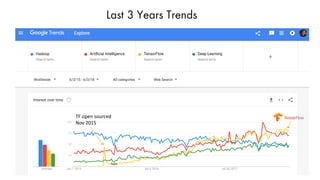
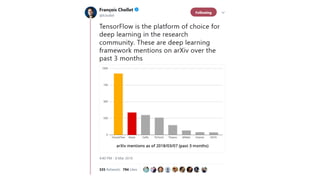
Last 3 Years Trends
TF open sourced
Nov 2015
https://twitter.com/tensorflow
https://github.com/tensorflow/tensorflow
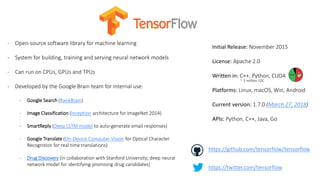
- Open-source software library for machine learning
- System for building, training and serving neural network models
- Can run on CPUs, GPUs and TPUs
- Developed by the Google Brain team for internal use:
- Google Search (RankBrain)
- Image Classification (Inception architecture for ImageNet 2014)
- SmartReply (Deep LSTM model to auto-generate email responses)
- Google Translate (On-Device Computer Vision for Optical Character
Recognition for real time translations)
- Drug Discovery (in collaboration with Stanford University; deep neural
network model for identifying promising drug candidates)
Initial Release: November 2015
License: Apache 2.0
Written in: C++, Python, CUDA
Platforms: Linux, macOS, Win, Android
Current version: 1.7.0 (March 27, 2018)
APIs: Python, C++, Java, Go
~ 1 million LOC
Common Neural Networks
• Deep Feed Forward Neural Network: Regression or Classification
• Convolutional Neural Network: Computer Vision
• Recurrent Neural Network (or LSTM): Time Series or Language
• Generative Adversarial Network: Creating fake images, Creativity
(predict a #) (predict a category)
Who am I?
Sameer Farooqui
Resigned from Databricks in Dec 2016 to study Deep Learning
Currently: Strategic Cloud Engineer for Big Data @ Google assigned to Twitter
Taught 150+ classes on Hadoop, NoSQL, Cassandra, HBase, Apache Spark
Nerd famous. YouTube videos with 328k, 120k and 60k views.
Traveled to 40+ countries ( : Palau, Machu Picchu, Andaman Islands)
When not in front of laptop: Snowboarding, Scuba diving, Wakeboarding
- 300+ PB in HDFS
- 20k+ Hadoop nodes
This Talk
• Introduction: 15 min – technical introduction to Neural Networks
• AutoML Vision: 10 min – demo, classify images of clouds
• AutoML Vision: 10 min – How it works… transfer learning & RL
• CNN: 15 min – Convolutional Neural Networks
• Transfer Learning: 5 mins – Steal pre-trained layers
• GANs & MultiModel: Maybe… if there’s time.
Deep Neural Networks
the fastest 15 min crash course in Deep Learning…
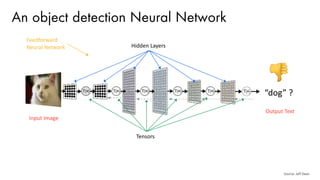
Source: Jeff Dean
An object detection Neural Network
Hidden Layers
Tensors
Input Image
Output Text
Feedforward
Neural Network
“dog” ?
Source: Jeff Dean
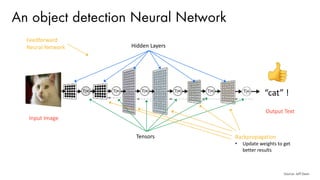
An object detection Neural Network
Hidden Layers
Tensors
Input Image
Feedforward
Neural Network
Backpropagation
• Update weights to get
better results
Output Text
“cat” !
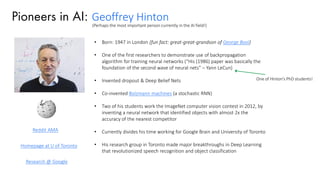
Pioneers in AI: Geoffrey Hinton
• Born: 1947 in London (fun fact: great-great-grandson of George Bool)
• One of the first researchers to demonstrate use of backpropagation
algorithm for training neural networks (“His (1986) paper was basically the
foundation of the second wave of neural nets” – Yann LeCun)
• Invented dropout & Deep Belief Nets
• Co-invented Bolzmann machines (a stochastic RNN)
• Two of his students work the ImageNet computer vision contest in 2012, by
inventing a neural network that identified objects with almost 2x the
accuracy of the nearest competitor
• Currently divides his time working for Google Brain and University of Toronto
• His research group in Toronto made major breakthroughs in Deep Learning
that revolutionized speech recognition and object classification
One of Hinton’s PhD students!
Reddit AMA
Homepage at U of Toronto
Research @ Google
(Perhaps the most important person currently in the AI field!)
What is a Tensor?
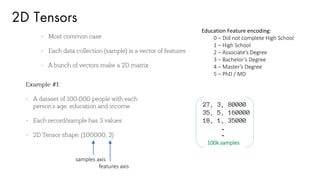
2D Tensors
samples axis
features axis
27, 3, 80000
35, 5, 160000
18, 1, 35000
Education Feature encoding:
0 – Did not complete High School
1 – High School
2 – Associate’s Degree
3 – Bachelor’s Degree
4 – Master’s Degree
5 – PhD / MD
.
.
100k samples
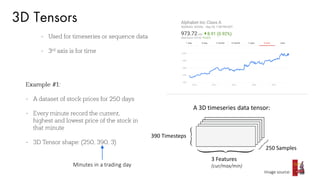
3D Tensors
Minutes in a trading day
A 3D timeseries data tensor:
Image source:
250 Samples
390 Timesteps
3 Features
(cur/max/min)
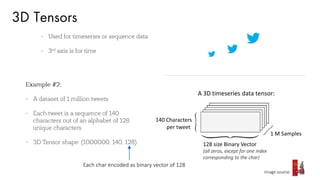
3D Tensors
Each char encoded as binary vector of 128
A 3D timeseries data tensor:
Image source:
1 M Samples
140 Characters
per tweet
128 size Binary Vector
(all zeros, except for one index
corresponding to the char)
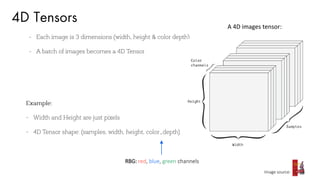
4D Tensors
RBG: red, blue, green channels
A 4D images tensor:
Image source:
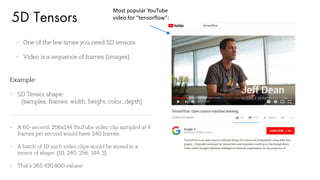
5D Tensors
Most popular YouTube
video for “tensorflow”:
You still need to do feature extraction and standardization if using Deep Learning!
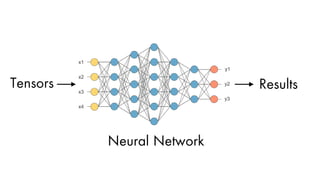
Tensors Results
Neural Network
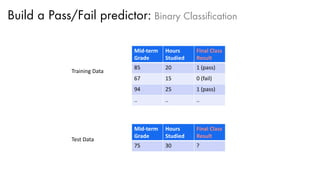
Build a Pass/Fail predictor: Binary Classification
Mid-term
Grade
Hours
Studied
Final Class
Result
85 20 1 (pass)
67 15 0 (fail)
94 25 1 (pass)
.. .. ..
Training Data
Test Data
Mid-term
Grade
Hours
Studied
Final Class
Result
75 30 ?
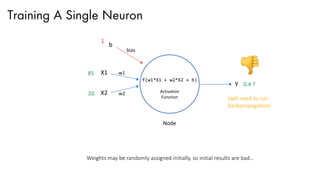
X1
X2
w1
w2 Activation
Function
Training A Single Neuron
f(w1*X1 + w2*X2 + b)
Node
Y
85
20
0.4 ?
Weights may be randomly assigned initially, so initial results are bad…
1
bias
(will need to run
backpropagation)
b
Activation Functions
Sigmoid tanh ReLU Others
- takes a real-valued input
and squashes it to range
between 0 and 1
- takes a real-valued input
and squashes it to the
range [-1, 1]
- ReLU stands for Rectified
Linear Unit. It takes a
real-valued input and
thresholds it at zero
(replaces negative values
with zero)
LeakyReLU:
ELU:
Source:
2016 ELU Paper
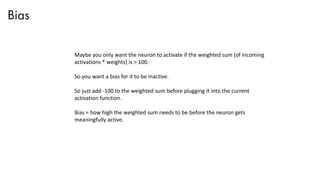
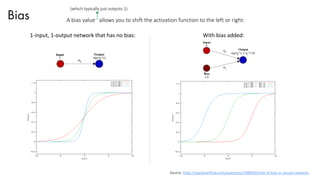
Bias
Maybe you only want the neuron to activate if the weighted sum (of incoming
activations * weights) is > 100.
So you want a bias for it to be inactive.
So just add -100 to the weighted sum before plugging it into the current
activation function.
Bias = how high the weighted sum needs to be before the neuron gets
meaningfully active.
Bias A bias value allows you to shift the activation function to the left or right:
Source: https://stackoverflow.com/questions/2480650/role-of-bias-in-neural-networks
1-input, 1-output network that has no bias: With bias added:
(which typically just outputs 1)
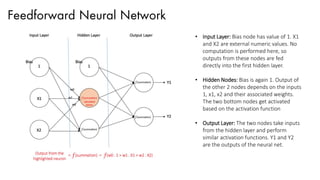
Feedforward Neural Network
• Input Layer: Bias node has value of 1. X1
and X2 are external numeric values. No
computation is performed here, so
outputs from these nodes are fed
directly into the first hidden layer.
• Hidden Nodes: Bias is again 1. Output of
the other 2 nodes depends on the inputs
1, x1, x2 and their associated weights.
The two bottom nodes get activated
based on the activation function
• Output Layer: The two nodes take inputs
from the hidden layer and perform
similar activation functions. Y1 and Y2
are the outputs of the neural net.
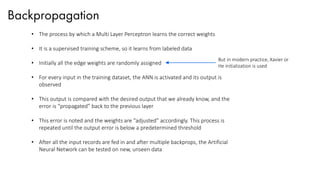
Backpropagation
• The process by which a Multi Layer Perceptron learns the correct weights
• It is a supervised training scheme, so it learns from labeled data
• Initially all the edge weights are randomly assigned
• For every input in the training dataset, the ANN is activated and its output is
observed
• This output is compared with the desired output that we already know, and the
error is “propagated” back to the previous layer
• This error is noted and the weights are “adjusted” accordingly. This process is
repeated until the output error is below a predetermined threshold
• After all the input records are fed in and after multiple backprops, the Artificial
Neural Network can be tested on new, unseen data
But in modern practice, Xavier or
He initialization is used
Backpropagation Details
• Backpropagation is a technique used to train artificial neural networks
• It first computes the gradients of the cost/loss function with regards to every model parameter
(all the weights and biases), and then it performs a Gradient Descent step using these gradients.
• This backpropagation step is typically performed thousands or millions of times, using many
training batches, until the model parameters converge to values that (hopefully) minimize the
cost function.
• To compute the gradients, backpropagation uses reverse-mode autodiff.
• Reverse-mode autodiff performs a forward pass through a computation graph, computing every
node’s value for the current training batch, and then it performs a reverse pass, computing all
the gradients at once
Source:
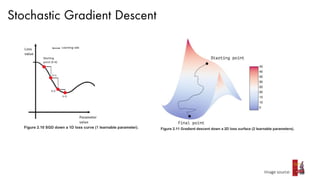
Stochastic Gradient Descent
Image source:
Stochastic Gradient Descent
Image source:
• The term "stochastic" refers to the fact that each record of data is drawn at random
• Minibatch SGD means the NN pulls a batch of data at a time, before running
backprop
• Additionally, there exist multiple variants of SGD that differ by taking into account
previous weight updates when computing the next weight update, rather than just
looking at the current value of the gradients.
• There is, for instance, "SGD with momentum", but also “Adam”, “Adagrad",
RMSprop", and several others. Such variants are known as "optimization methods"
or "optimizers".
Loss vs Optimizer
Image source:
• You have to define a “loss” function and an “optimizer” before running training
• The "loss" is the quantity that you will attempt to minimize during training, so it
should represent a measure of success on the task you are trying to solve.
(Mean Squared Error is commonly used for regression, or binary crossentropy
for binary classification, or categorical crossentropy for multi-class
classification)
• The "optimizer" specifies the exact way in which the gradient of the loss will be
used to update parameters (Most Google ML SCEs are using Adam)
Pop Quiz!
Q) What are the different hyper-parameters you can tune in a basic Multi-Layer
Perceptron (an Artificial Neural Network)?
A)
• # of hidden layers
• # of neurons in each hidden layer
• The activation function used in each hidden layer (typically ReLU or
Leaky ReLU) and the output layer
• For the output layer, use logistic activation function for binary
classification, softmax activation function for multiclass classification, or
no activation function for regression
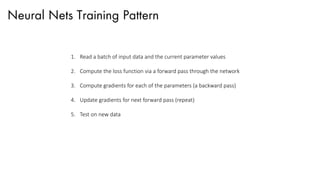
Neural Nets Training Pattern
1. Read a batch of input data and the current parameter values
2. Compute the loss function via a forward pass through the network
3. Compute gradients for each of the parameters (a backward pass)
4. Update gradients for next forward pass (repeat)
5. Test on new data
Cloud AutoML Vision
image analysis simplified
Demo!
ALPHA
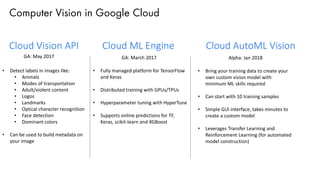
• Fully managed platform for TensorFlow
and Keras
• Distributed training with GPUs/TPUs
• Hyperparameter tuning with HyperTune
• Supports online predictions for TF,
Keras, scikit-learn and XGBoost
Computer Vision in Google Cloud
Cloud Vision API Cloud ML Engine Cloud AutoML Vision
• Detect labels in images like:
• Animals
• Modes of transportation
• Adult/violent content
• Logos
• Landmarks
• Optical character recognition
• Face detection
• Dominant colors
• Can be used to build metadata on
your image
GA: May 2017 GA: March 2017 Alpha: Jan 2018
• Bring your training data to create your
own custom vision model with
minimum ML skills required
• Can start with 10 training samples
• Simple GUI interface, takes minutes to
create a custom model
• Leverages Transfer Learning and
Reinforcement Learning (for automated
model construction)
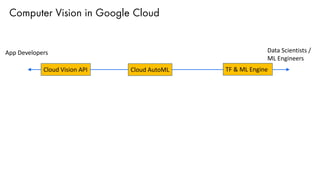
Computer Vision in Google Cloud
Cloud Vision API
App Developers Data Scientists /
ML Engineers
TF & ML EngineCloud AutoML
Machine Learning as an API
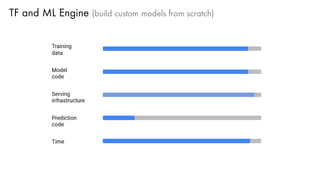
TF and ML Engine (build custom models from scratch)
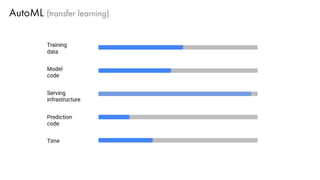
AutoML (transfer learning)
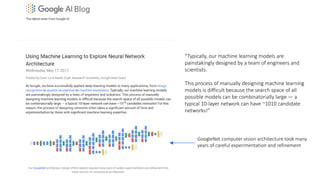
“Typically, our machine learning models are
painstakingly designed by a team of engineers and
scientists.
This process of manually designing machine learning
models is difficult because the search space of all
possible models can be combinatorially large — a
typical 10-layer network can have ~1010 candidate
networks!”
GoogleNet computer vision architecture took many
years of careful experimentation and refinement
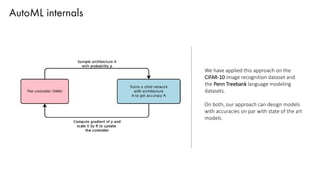
AutoML internals
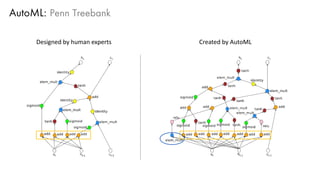
We have applied this approach on the
CIFAR-10 image recognition dataset and
the Penn Treebank language modeling
datasets.
On both, our approach can design models
with accuracies on par with state of the art
models.
AutoML: Penn Treebank
Designed by human experts Created by AutoML
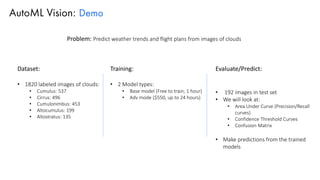
AutoML Vision: Demo
Problem: Predict weather trends and flight plans from images of clouds
Dataset:
• 1820 labeled images of clouds:
• Cumulus: 537
• Cirrus: 496
• Cumulonimbus: 453
• Altocumulus: 199
• Altostratus: 135
Training:
• 2 Model types:
• Base model (Free to train; 1 hour)
• Adv mode ($550, up to 24 hours)
Evaluate/Predict:
• 192 images in test set
• We will look at:
• Area Under Curve (Precision/Recall
curves)
• Confidence Threshold Curves
• Confusion Matrix
• Make predictions from the trained
models
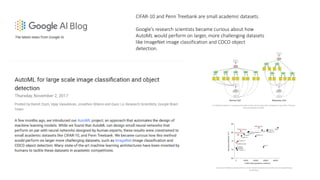
CIFAR-10 and Penn Treebank are small academic datasets.
Google’s research scientists became curious about how
AutoML would perform on larger, more challenging datasets
like ImageNet image classification and COCO object
detection.
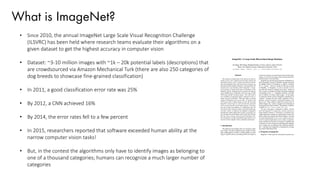
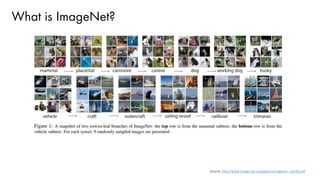
What is ImageNet?
• Since 2010, the annual ImageNet Large Scale Visual Recognition Challenge
(ILSVRC) has been held where research teams evaluate their algorithms on a
given dataset to get the highest accuracy in computer vision
• Dataset: ~3-10 million images with ~1k – 20k potential labels (descriptions) that
are crowdsourced via Amazon Mechanical Turk (there are also 250 categories of
dog breeds to showcase fine-grained classification)
• In 2011, a good classification error rate was 25%
• By 2012, a CNN achieved 16%
• By 2014, the error rates fell to a few percent
• In 2015, researchers reported that software exceeded human ability at the
narrow computer vision tasks!
• But, in the contest the algorithms only have to identify images as belonging to
one of a thousand categories; humans can recognize a much larger number of
categories
What is ImageNet?
Source: http://www.image-net.org/papers/imagenet_cvpr09.pdf
AutoML: (for large scale image classification and object detection)
In Nov 2017, to apply AutoML to ImageNet & COCO:
• We redesigned the search space so that AutoML could find the
best layer which can then be stacked many times in a flexible
manner to create a final network.
• We performed architecture search on CIFAR-10 and transferred
the best learned architecture to ImageNet image classification
and COCO object detection.
With this method, AutoML was able to find the best layers that work well on CIFAR-10
but also work well on ImageNet classification and COCO object detection.
These two layers are combined to form a novel architecture, which we call “NASNet”.
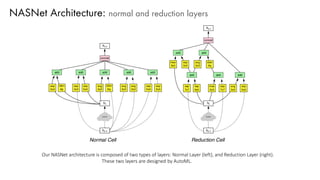
NASNet Architecture: normal and reduction layers
Our NASNet architecture is composed of two types of layers: Normal Layer (left), and Reduction Layer (right).
These two layers are designed by AutoML.
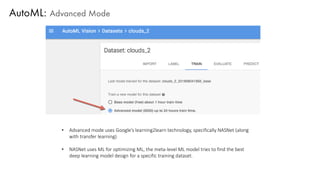
AutoML: Advanced Mode
• Advanced mode uses Google’s learning2learn technology, specifically NASNet (along
with transfer learning)
• NASNet uses ML for optimizing ML, the meta-level ML model tries to find the best
deep learning model design for a specific training dataset.
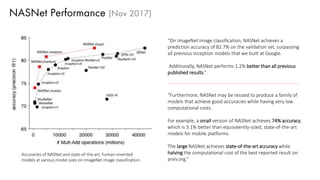
NASNet Performance (Nov 2017)
“On ImageNet image classification, NASNet achieves a
prediction accuracy of 82.7% on the validation set, surpassing
all previous Inception models that we built at Google.
Additionally, NASNet performs 1.2% better than all previous
published results.”
“Furthermore, NASNet may be resized to produce a family of
models that achieve good accuracies while having very low
computational costs.
For example, a small version of NASNet achieves 74% accuracy,
which is 3.1% better than equivalently-sized, state-of-the-art
models for mobile platforms.
The large NASNet achieves state-of-the-art accuracy while
halving the computational cost of the best reported result on
arxiv.org.”
Accuracies of NASNet and state-of-the-art, human-invented
models at various model sizes on ImageNet image classification.
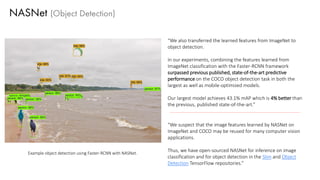
NASNet (Object Detection)
“We also transferred the learned features from ImageNet to
object detection.
In our experiments, combining the features learned from
ImageNet classification with the Faster-RCNN framework
surpassed previous published, state-of-the-art predictive
performance on the COCO object detection task in both the
largest as well as mobile-optimized models.
Our largest model achieves 43.1% mAP which is 4% better than
the previous, published state-of-the-art.”
“We suspect that the image features learned by NASNet on
ImageNet and COCO may be reused for many computer vision
applications.
Thus, we have open-sourced NASNet for inference on image
classification and for object detection in the Slim and Object
Detection TensorFlow repositories.”
Example object detection using Faster-RCNN with NASNet.
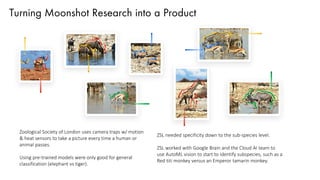
Turning Moonshot Research into a Product
Zoological Society of London uses camera traps w/ motion
& heat sensors to take a picture every time a human or
animal passes.
Using pre-trained models were only good for general
classification (elephant vs tiger).
ZSL needed specificity down to the sub-species level.
ZSL worked with Google Brain and the Cloud AI team to
use AutoML vision to start to identify subspecies, such as a
Red titi monkey versus an Emperor tamarin monkey.
Convolutional Neural Networks
computer vision
Pioneers in AI: Yann LeCun
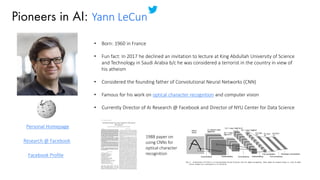
• Born: 1960 in France
• Fun fact: In 2017 he declined an invitation to lecture at King Abdullah University of Science
and Technology in Saudi Arabia b/c he was considered a terrorist in the country in view of
his atheism
• Considered the founding father of Convolutional Neural Networks (CNN)
• Famous for his work on optical character recognition and computer vision
• Currently Director of AI Research @ Facebook and Director of NYU Center for Data Science
Personal Homepage
Research @ Facebook
Facebook Profile
1988 paper on
using CNNs for
optical character
recognition
CNN
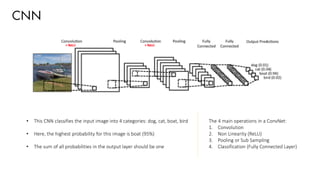
• This CNN classifies the input image into 4 categories: dog, cat, boat, bird
• Here, the highest probability for this image is boat (95%)
• The sum of all probabilities in the output layer should be one
The 4 main operations in a ConvNet:
1. Convolution
2. Non Linearity (ReLU)
3. Pooling or Sub Sampling
4. Classification (Fully Connected Layer)
LeNet5
Source:
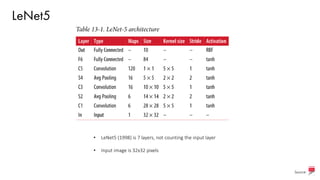
• LeNet5 (1998) is 7 layers, not counting the input layer
• Input image is 32x32 pixels
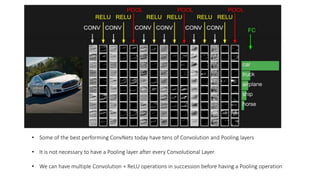
• Some of the best performing ConvNets today have tens of Convolution and Pooling layers
• It is not necessary to have a Pooling layer after every Convolutional Layer
• We can have multiple Convolution + ReLU operations in succession before having a Pooling operation
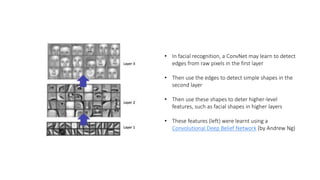
• In facial recognition, a ConvNet may learn to detect
edges from raw pixels in the first layer
• Then use the edges to detect simple shapes in the
second layer
• Then use these shapes to deter higher-level
features, such as facial shapes in higher layers
• These features (left) were learnt using a
Convolutional Deep Belief Network (by Andrew Ng)
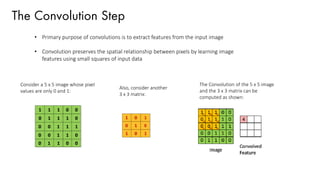
The Convolution Step
• Primary purpose of convolutions is to extract features from the input image
• Convolution preserves the spatial relationship between pixels by learning image
features using small squares of input data
Consider a 5 x 5 image whose pixel
values are only 0 and 1:
Also, consider another
3 x 3 matrix:
The Convolution of the 5 x 5 image
and the 3 x 3 matrix can be
computed as shown:
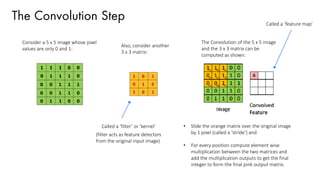
The Convolution Step
Consider a 5 x 5 image whose pixel
values are only 0 and 1:
Also, consider another
3 x 3 matrix:
The Convolution of the 5 x 5 image
and the 3 x 3 matrix can be
computed as shown:
• Slide the orange matrix over the original image
by 1 pixel (called a ‘stride’) and
• For every position compute element wise
multiplication between the two matrices and
add the multiplication outputs to get the final
integer to form the final pink output matrix.
Called a ‘filter’ or ‘kernel’
Called a ‘feature map’
(filter acts as feature detectors
from the original input image)
The Convolution Step
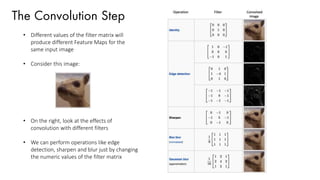
• Different values of the filter matrix will
produce different Feature Maps for the
same input image
• Consider this image:
• On the right, look at the effects of
convolution with different filters
• We can perform operations like edge
detection, sharpen and blur just by changing
the numeric values of the filter matrix
Filters and Feature Map
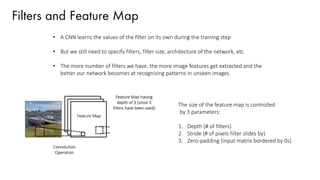
• A CNN learns the values of the filter on its own during the training step
• But we still need to specify filters, filter size, architecture of the network, etc
• The more number of filters we have, the more image features get extracted and the
better our network becomes at recognizing patterns in unseen images
The size of the feature map is controlled
by 3 parameters:
1. Depth (# of filters)
2. Stride (# of pixels filter slides by)
3. Zero-padding (input matrix bordered by 0s)
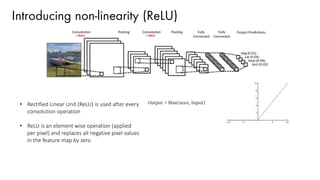
Introducing non-linearity (ReLU)
• Rectified Linear Unit (ReLU) is used after every
convolution operation
• ReLU is an element wise operation (applied
per pixel) and replaces all negative pixel values
in the feature map by zero
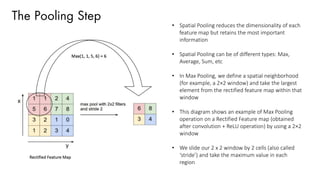
The Pooling Step
• Spatial Pooling reduces the dimensionality of each
feature map but retains the most important
information
• Spatial Pooling can be of different types: Max,
Average, Sum, etc
• In Max Pooling, we define a spatial neighborhood
(for example, a 2×2 window) and take the largest
element from the rectified feature map within that
window
• This diagram shows an example of Max Pooling
operation on a Rectified Feature map (obtained
after convolution + ReLU operation) by using a 2×2
window
• We slide our 2 x 2 window by 2 cells (also called
‘stride’) and take the maximum value in each
region
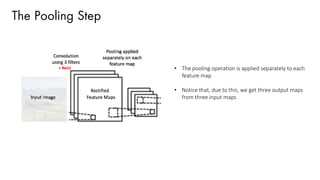
The Pooling Step
• The pooling operation is applied separately to each
feature map
• Notice that, due to this, we get three output maps
from three input maps
The Pooling Step
The function of Pooling is to progressively reduce the spatial size of the input
representation. It does the following:
• makes the input representations (feature dimension) smaller and more
manageable
• reduces the number of parameters and computations in the network, therefore,
controlling overfitting
• makes the network invariant to small transformations, distortions and
translations in the input image (a small distortion in input will not change the
output of Pooling)
• helps us arrive at an almost scale invariant representation of our image (the exact
term is “equivariant”). This is very powerful since we can detect objects in an
image no matter where they are located
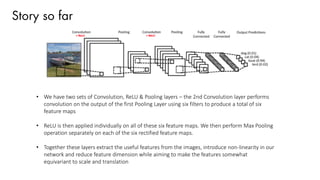
Story so far
• We have two sets of Convolution, ReLU & Pooling layers – the 2nd Convolution layer performs
convolution on the output of the first Pooling Layer using six filters to produce a total of six
feature maps
• ReLU is then applied individually on all of these six feature maps. We then perform Max Pooling
operation separately on each of the six rectified feature maps.
• Together these layers extract the useful features from the images, introduce non-linearity in our
network and reduce feature dimension while aiming to make the features somewhat
equivariant to scale and translation
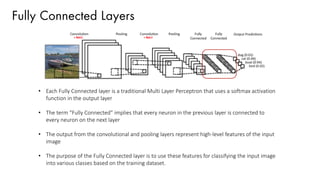
Fully Connected Layers
• Each Fully Connected layer is a traditional Multi Layer Perceptron that uses a softmax activation
function in the output layer
• The term “Fully Connected” implies that every neuron in the previous layer is connected to
every neuron on the next layer
• The output from the convolutional and pooling layers represent high-level features of the input
image
• The purpose of the Fully Connected layer is to use these features for classifying the input image
into various classes based on the training dataset.
Training using Backpropagation
• Since the input image is a boat, the target probability is 1 for Boat class and 0 for other three classes, i.e.
• Input Image = Boat
• Target Vector = [0, 0, 1, 0]
• Use Backpropagation to calculate the gradients of the error with respect to all weights in the network and
use gradient descent to update all filter values / weights and parameter values to minimize the output error.
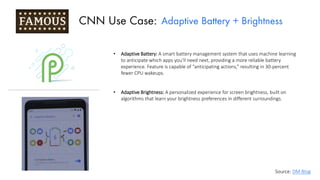
• Adaptive Battery: A smart battery management system that uses machine learning
to anticipate which apps you’ll need next, providing a more reliable battery
experience. Feature is capable of “anticipating actions,” resulting in 30-percent
fewer CPU wakeups.
• Adaptive Brightness: A personalized experience for screen brightness, built on
algorithms that learn your brightness preferences in different surroundings.
CNN Use Case: Adaptive Battery + Brightness
Source: DM Blog
Transfer Learning
steal pre-trained layers from an existing model…
Reusing Pretrained Layers: Transfer Learning
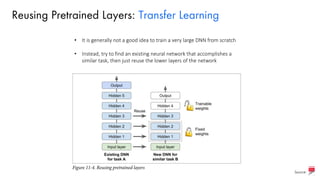
• It is generally not a good idea to train a very large DNN from scratch
• Instead, try to find an existing neural network that accomplishes a
similar task, then just reuse the lower layers of the network
Source:
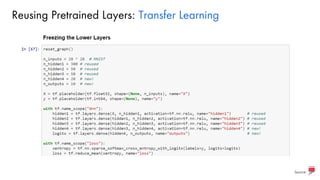
Reusing Pretrained Layers: Transfer Learning
Source:
Not Enough Data?
4 Tricks:
• Use a model zoo
• Transfer Learning
• Unsupervised Pretraining
• One Shot Learning
Generative Adversarial Networks (GANs)
perhaps the most important idea in AI in the past decade…
GANs
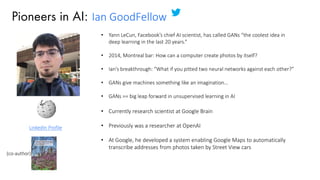
Pioneers in AI: Ian GoodFellow
• Currently research scientist at Google Brain
• Previously was a researcher at OpenAI
• At Google, he developed a system enabling Google Maps to automatically
transcribe addresses from photos taken by Street View cars
LinkedIn Profile
(co-author)
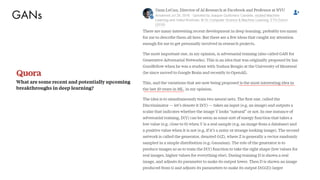
• Yann LeCun, Facebook’s chief AI scientist, has called GANs “the coolest idea in
deep learning in the last 20 years.”
• 2014, Montreal bar: How can a computer create photos by itself?
• Ian’s breakthrough: “What if you pitted two neural networks against each other?”
• GANs give machines something like an imagination…
• GANs == big leap forward in unsupervised learning in AI
Generative Adversarial Networks (GANs)
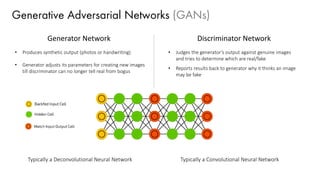
Generator Network Discriminator Network
• Produces synthetic output (photos or handwriting) • Judges the generator’s output against genuine images
and tries to determine which are real/fake
• Reports results back to generator why it thinks an image
may be fake
• Generator adjusts its parameters for creating new images
till discriminator can no longer tell real from bogus
Typically a Deconvolutional Neural Network Typically a Convolutional Neural Network
Future Applications of GANs
Ian: “There are a lot of areas of science and engineering where we need to optimize
something,” such as medicines that need to be more effective or batteries that must get more
efficient. “That’s going to be the next big wave.”
Source:
• Generating fake medical records almost as good as the real thing
• Generate images from text descriptions
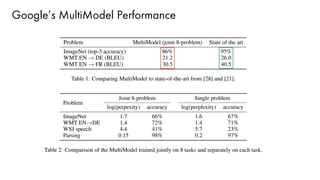
MultiModel Neural Networks
generalizing neural networks…
Future of Deep Learning
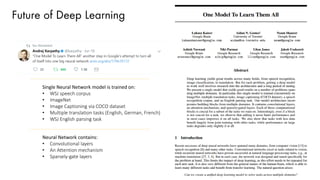
Single Neural Network model is trained on:
• WSJ speech corpus
• ImageNet
• Image Captioning via COCO dataset
• Multiple translation tasks (English, German, French)
• WSJ English parsing task
Neural Network contains:
• Convolutional layers
• An Attention mechanism
• Sparsely-gate layers
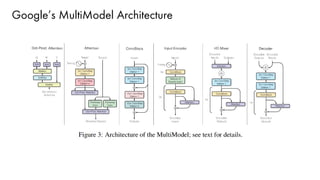
Google’s MultiModel Architecture
Google’s MultiModel Performance
Separating Hype from Reality in
Deep Learning
Presented June 2018 @
Sameer Farooqui
Slides:
http://bit.ly/hype-deep-learning

Separating Hype from Reality in Deep Learning with Sameer Farooqui

  • 1.
    Separating Hype fromReality in Deep Learning Presented June 2018 @ Sameer Farooqui Slides: http://bit.ly/hype-deep-learning
  • 2.
    Last 3 YearsTrends TF open sourced Nov 2015
  • 5.
    https://twitter.com/tensorflow https://github.com/tensorflow/tensorflow - Open-source softwarelibrary for machine learning - System for building, training and serving neural network models - Can run on CPUs, GPUs and TPUs - Developed by the Google Brain team for internal use: - Google Search (RankBrain) - Image Classification (Inception architecture for ImageNet 2014) - SmartReply (Deep LSTM model to auto-generate email responses) - Google Translate (On-Device Computer Vision for Optical Character Recognition for real time translations) - Drug Discovery (in collaboration with Stanford University; deep neural network model for identifying promising drug candidates) Initial Release: November 2015 License: Apache 2.0 Written in: C++, Python, CUDA Platforms: Linux, macOS, Win, Android Current version: 1.7.0 (March 27, 2018) APIs: Python, C++, Java, Go ~ 1 million LOC
  • 6.
    Common Neural Networks •Deep Feed Forward Neural Network: Regression or Classification • Convolutional Neural Network: Computer Vision • Recurrent Neural Network (or LSTM): Time Series or Language • Generative Adversarial Network: Creating fake images, Creativity (predict a #) (predict a category)
  • 7.
    Who am I? SameerFarooqui Resigned from Databricks in Dec 2016 to study Deep Learning Currently: Strategic Cloud Engineer for Big Data @ Google assigned to Twitter Taught 150+ classes on Hadoop, NoSQL, Cassandra, HBase, Apache Spark Nerd famous. YouTube videos with 328k, 120k and 60k views. Traveled to 40+ countries ( : Palau, Machu Picchu, Andaman Islands) When not in front of laptop: Snowboarding, Scuba diving, Wakeboarding - 300+ PB in HDFS - 20k+ Hadoop nodes
  • 8.
    This Talk • Introduction:15 min – technical introduction to Neural Networks • AutoML Vision: 10 min – demo, classify images of clouds • AutoML Vision: 10 min – How it works… transfer learning & RL • CNN: 15 min – Convolutional Neural Networks • Transfer Learning: 5 mins – Steal pre-trained layers • GANs & MultiModel: Maybe… if there’s time.
  • 9.
    Deep Neural Networks thefastest 15 min crash course in Deep Learning…
  • 10.
    Source: Jeff Dean Anobject detection Neural Network Hidden Layers Tensors Input Image Output Text Feedforward Neural Network “dog” ?
  • 11.
    Source: Jeff Dean Anobject detection Neural Network Hidden Layers Tensors Input Image Feedforward Neural Network Backpropagation • Update weights to get better results Output Text “cat” !
  • 12.
    Pioneers in AI:Geoffrey Hinton • Born: 1947 in London (fun fact: great-great-grandson of George Bool) • One of the first researchers to demonstrate use of backpropagation algorithm for training neural networks (“His (1986) paper was basically the foundation of the second wave of neural nets” – Yann LeCun) • Invented dropout & Deep Belief Nets • Co-invented Bolzmann machines (a stochastic RNN) • Two of his students work the ImageNet computer vision contest in 2012, by inventing a neural network that identified objects with almost 2x the accuracy of the nearest competitor • Currently divides his time working for Google Brain and University of Toronto • His research group in Toronto made major breakthroughs in Deep Learning that revolutionized speech recognition and object classification One of Hinton’s PhD students! Reddit AMA Homepage at U of Toronto Research @ Google (Perhaps the most important person currently in the AI field!)
  • 13.
    What is aTensor?
  • 14.
    2D Tensors samples axis featuresaxis 27, 3, 80000 35, 5, 160000 18, 1, 35000 Education Feature encoding: 0 – Did not complete High School 1 – High School 2 – Associate’s Degree 3 – Bachelor’s Degree 4 – Master’s Degree 5 – PhD / MD . . 100k samples
  • 15.
    3D Tensors Minutes ina trading day A 3D timeseries data tensor: Image source: 250 Samples 390 Timesteps 3 Features (cur/max/min)
  • 16.
    3D Tensors Each charencoded as binary vector of 128 A 3D timeseries data tensor: Image source: 1 M Samples 140 Characters per tweet 128 size Binary Vector (all zeros, except for one index corresponding to the char)
  • 17.
    4D Tensors RBG: red,blue, green channels A 4D images tensor: Image source:
  • 18.
    5D Tensors Most popularYouTube video for “tensorflow”:
  • 19.
    You still needto do feature extraction and standardization if using Deep Learning!
  • 20.
  • 21.
    Build a Pass/Failpredictor: Binary Classification Mid-term Grade Hours Studied Final Class Result 85 20 1 (pass) 67 15 0 (fail) 94 25 1 (pass) .. .. .. Training Data Test Data Mid-term Grade Hours Studied Final Class Result 75 30 ?
  • 22.
    X1 X2 w1 w2 Activation Function Training ASingle Neuron f(w1*X1 + w2*X2 + b) Node Y 85 20 0.4 ? Weights may be randomly assigned initially, so initial results are bad… 1 bias (will need to run backpropagation) b
  • 23.
    Activation Functions Sigmoid tanhReLU Others - takes a real-valued input and squashes it to range between 0 and 1 - takes a real-valued input and squashes it to the range [-1, 1] - ReLU stands for Rectified Linear Unit. It takes a real-valued input and thresholds it at zero (replaces negative values with zero) LeakyReLU: ELU: Source: 2016 ELU Paper
  • 24.
    Bias Maybe you onlywant the neuron to activate if the weighted sum (of incoming activations * weights) is > 100. So you want a bias for it to be inactive. So just add -100 to the weighted sum before plugging it into the current activation function. Bias = how high the weighted sum needs to be before the neuron gets meaningfully active.
  • 25.
    Bias A biasvalue allows you to shift the activation function to the left or right: Source: https://stackoverflow.com/questions/2480650/role-of-bias-in-neural-networks 1-input, 1-output network that has no bias: With bias added: (which typically just outputs 1)
  • 26.
    Feedforward Neural Network •Input Layer: Bias node has value of 1. X1 and X2 are external numeric values. No computation is performed here, so outputs from these nodes are fed directly into the first hidden layer. • Hidden Nodes: Bias is again 1. Output of the other 2 nodes depends on the inputs 1, x1, x2 and their associated weights. The two bottom nodes get activated based on the activation function • Output Layer: The two nodes take inputs from the hidden layer and perform similar activation functions. Y1 and Y2 are the outputs of the neural net.
  • 27.
    Backpropagation • The processby which a Multi Layer Perceptron learns the correct weights • It is a supervised training scheme, so it learns from labeled data • Initially all the edge weights are randomly assigned • For every input in the training dataset, the ANN is activated and its output is observed • This output is compared with the desired output that we already know, and the error is “propagated” back to the previous layer • This error is noted and the weights are “adjusted” accordingly. This process is repeated until the output error is below a predetermined threshold • After all the input records are fed in and after multiple backprops, the Artificial Neural Network can be tested on new, unseen data But in modern practice, Xavier or He initialization is used
  • 28.
    Backpropagation Details • Backpropagationis a technique used to train artificial neural networks • It first computes the gradients of the cost/loss function with regards to every model parameter (all the weights and biases), and then it performs a Gradient Descent step using these gradients. • This backpropagation step is typically performed thousands or millions of times, using many training batches, until the model parameters converge to values that (hopefully) minimize the cost function. • To compute the gradients, backpropagation uses reverse-mode autodiff. • Reverse-mode autodiff performs a forward pass through a computation graph, computing every node’s value for the current training batch, and then it performs a reverse pass, computing all the gradients at once Source:
  • 29.
  • 30.
    Stochastic Gradient Descent Imagesource: • The term "stochastic" refers to the fact that each record of data is drawn at random • Minibatch SGD means the NN pulls a batch of data at a time, before running backprop • Additionally, there exist multiple variants of SGD that differ by taking into account previous weight updates when computing the next weight update, rather than just looking at the current value of the gradients. • There is, for instance, "SGD with momentum", but also “Adam”, “Adagrad", RMSprop", and several others. Such variants are known as "optimization methods" or "optimizers".
  • 31.
    Loss vs Optimizer Imagesource: • You have to define a “loss” function and an “optimizer” before running training • The "loss" is the quantity that you will attempt to minimize during training, so it should represent a measure of success on the task you are trying to solve. (Mean Squared Error is commonly used for regression, or binary crossentropy for binary classification, or categorical crossentropy for multi-class classification) • The "optimizer" specifies the exact way in which the gradient of the loss will be used to update parameters (Most Google ML SCEs are using Adam)
  • 32.
    Pop Quiz! Q) Whatare the different hyper-parameters you can tune in a basic Multi-Layer Perceptron (an Artificial Neural Network)? A) • # of hidden layers • # of neurons in each hidden layer • The activation function used in each hidden layer (typically ReLU or Leaky ReLU) and the output layer • For the output layer, use logistic activation function for binary classification, softmax activation function for multiclass classification, or no activation function for regression
  • 33.
    Neural Nets TrainingPattern 1. Read a batch of input data and the current parameter values 2. Compute the loss function via a forward pass through the network 3. Compute gradients for each of the parameters (a backward pass) 4. Update gradients for next forward pass (repeat) 5. Test on new data
  • 34.
    Cloud AutoML Vision imageanalysis simplified Demo! ALPHA
  • 35.
    • Fully managedplatform for TensorFlow and Keras • Distributed training with GPUs/TPUs • Hyperparameter tuning with HyperTune • Supports online predictions for TF, Keras, scikit-learn and XGBoost Computer Vision in Google Cloud Cloud Vision API Cloud ML Engine Cloud AutoML Vision • Detect labels in images like: • Animals • Modes of transportation • Adult/violent content • Logos • Landmarks • Optical character recognition • Face detection • Dominant colors • Can be used to build metadata on your image GA: May 2017 GA: March 2017 Alpha: Jan 2018 • Bring your training data to create your own custom vision model with minimum ML skills required • Can start with 10 training samples • Simple GUI interface, takes minutes to create a custom model • Leverages Transfer Learning and Reinforcement Learning (for automated model construction)
  • 36.
    Computer Vision inGoogle Cloud Cloud Vision API App Developers Data Scientists / ML Engineers TF & ML EngineCloud AutoML
  • 37.
  • 38.
    TF and MLEngine (build custom models from scratch)
  • 39.
  • 41.
    “Typically, our machinelearning models are painstakingly designed by a team of engineers and scientists. This process of manually designing machine learning models is difficult because the search space of all possible models can be combinatorially large — a typical 10-layer network can have ~1010 candidate networks!” GoogleNet computer vision architecture took many years of careful experimentation and refinement
  • 42.
    AutoML internals We haveapplied this approach on the CIFAR-10 image recognition dataset and the Penn Treebank language modeling datasets. On both, our approach can design models with accuracies on par with state of the art models.
  • 43.
    AutoML: Penn Treebank Designedby human experts Created by AutoML
  • 44.
    AutoML Vision: Demo Problem:Predict weather trends and flight plans from images of clouds Dataset: • 1820 labeled images of clouds: • Cumulus: 537 • Cirrus: 496 • Cumulonimbus: 453 • Altocumulus: 199 • Altostratus: 135 Training: • 2 Model types: • Base model (Free to train; 1 hour) • Adv mode ($550, up to 24 hours) Evaluate/Predict: • 192 images in test set • We will look at: • Area Under Curve (Precision/Recall curves) • Confidence Threshold Curves • Confusion Matrix • Make predictions from the trained models
  • 45.
    CIFAR-10 and PennTreebank are small academic datasets. Google’s research scientists became curious about how AutoML would perform on larger, more challenging datasets like ImageNet image classification and COCO object detection.
  • 46.
    What is ImageNet? •Since 2010, the annual ImageNet Large Scale Visual Recognition Challenge (ILSVRC) has been held where research teams evaluate their algorithms on a given dataset to get the highest accuracy in computer vision • Dataset: ~3-10 million images with ~1k – 20k potential labels (descriptions) that are crowdsourced via Amazon Mechanical Turk (there are also 250 categories of dog breeds to showcase fine-grained classification) • In 2011, a good classification error rate was 25% • By 2012, a CNN achieved 16% • By 2014, the error rates fell to a few percent • In 2015, researchers reported that software exceeded human ability at the narrow computer vision tasks! • But, in the contest the algorithms only have to identify images as belonging to one of a thousand categories; humans can recognize a much larger number of categories
  • 47.
    What is ImageNet? Source:http://www.image-net.org/papers/imagenet_cvpr09.pdf
  • 48.
    AutoML: (for largescale image classification and object detection) In Nov 2017, to apply AutoML to ImageNet & COCO: • We redesigned the search space so that AutoML could find the best layer which can then be stacked many times in a flexible manner to create a final network. • We performed architecture search on CIFAR-10 and transferred the best learned architecture to ImageNet image classification and COCO object detection. With this method, AutoML was able to find the best layers that work well on CIFAR-10 but also work well on ImageNet classification and COCO object detection. These two layers are combined to form a novel architecture, which we call “NASNet”.
  • 49.
    NASNet Architecture: normaland reduction layers Our NASNet architecture is composed of two types of layers: Normal Layer (left), and Reduction Layer (right). These two layers are designed by AutoML.
  • 50.
    AutoML: Advanced Mode •Advanced mode uses Google’s learning2learn technology, specifically NASNet (along with transfer learning) • NASNet uses ML for optimizing ML, the meta-level ML model tries to find the best deep learning model design for a specific training dataset.
  • 51.
    NASNet Performance (Nov2017) “On ImageNet image classification, NASNet achieves a prediction accuracy of 82.7% on the validation set, surpassing all previous Inception models that we built at Google. Additionally, NASNet performs 1.2% better than all previous published results.” “Furthermore, NASNet may be resized to produce a family of models that achieve good accuracies while having very low computational costs. For example, a small version of NASNet achieves 74% accuracy, which is 3.1% better than equivalently-sized, state-of-the-art models for mobile platforms. The large NASNet achieves state-of-the-art accuracy while halving the computational cost of the best reported result on arxiv.org.” Accuracies of NASNet and state-of-the-art, human-invented models at various model sizes on ImageNet image classification.
  • 52.
    NASNet (Object Detection) “Wealso transferred the learned features from ImageNet to object detection. In our experiments, combining the features learned from ImageNet classification with the Faster-RCNN framework surpassed previous published, state-of-the-art predictive performance on the COCO object detection task in both the largest as well as mobile-optimized models. Our largest model achieves 43.1% mAP which is 4% better than the previous, published state-of-the-art.” “We suspect that the image features learned by NASNet on ImageNet and COCO may be reused for many computer vision applications. Thus, we have open-sourced NASNet for inference on image classification and for object detection in the Slim and Object Detection TensorFlow repositories.” Example object detection using Faster-RCNN with NASNet.
  • 54.
    Turning Moonshot Researchinto a Product Zoological Society of London uses camera traps w/ motion & heat sensors to take a picture every time a human or animal passes. Using pre-trained models were only good for general classification (elephant vs tiger). ZSL needed specificity down to the sub-species level. ZSL worked with Google Brain and the Cloud AI team to use AutoML vision to start to identify subspecies, such as a Red titi monkey versus an Emperor tamarin monkey.
  • 55.
  • 56.
    Pioneers in AI:Yann LeCun • Born: 1960 in France • Fun fact: In 2017 he declined an invitation to lecture at King Abdullah University of Science and Technology in Saudi Arabia b/c he was considered a terrorist in the country in view of his atheism • Considered the founding father of Convolutional Neural Networks (CNN) • Famous for his work on optical character recognition and computer vision • Currently Director of AI Research @ Facebook and Director of NYU Center for Data Science Personal Homepage Research @ Facebook Facebook Profile 1988 paper on using CNNs for optical character recognition
  • 57.
    CNN • This CNNclassifies the input image into 4 categories: dog, cat, boat, bird • Here, the highest probability for this image is boat (95%) • The sum of all probabilities in the output layer should be one The 4 main operations in a ConvNet: 1. Convolution 2. Non Linearity (ReLU) 3. Pooling or Sub Sampling 4. Classification (Fully Connected Layer)
  • 58.
    LeNet5 Source: • LeNet5 (1998)is 7 layers, not counting the input layer • Input image is 32x32 pixels
  • 59.
    • Some ofthe best performing ConvNets today have tens of Convolution and Pooling layers • It is not necessary to have a Pooling layer after every Convolutional Layer • We can have multiple Convolution + ReLU operations in succession before having a Pooling operation
  • 60.
    • In facialrecognition, a ConvNet may learn to detect edges from raw pixels in the first layer • Then use the edges to detect simple shapes in the second layer • Then use these shapes to deter higher-level features, such as facial shapes in higher layers • These features (left) were learnt using a Convolutional Deep Belief Network (by Andrew Ng)
  • 61.
    The Convolution Step •Primary purpose of convolutions is to extract features from the input image • Convolution preserves the spatial relationship between pixels by learning image features using small squares of input data Consider a 5 x 5 image whose pixel values are only 0 and 1: Also, consider another 3 x 3 matrix: The Convolution of the 5 x 5 image and the 3 x 3 matrix can be computed as shown:
  • 62.
    The Convolution Step Considera 5 x 5 image whose pixel values are only 0 and 1: Also, consider another 3 x 3 matrix: The Convolution of the 5 x 5 image and the 3 x 3 matrix can be computed as shown: • Slide the orange matrix over the original image by 1 pixel (called a ‘stride’) and • For every position compute element wise multiplication between the two matrices and add the multiplication outputs to get the final integer to form the final pink output matrix. Called a ‘filter’ or ‘kernel’ Called a ‘feature map’ (filter acts as feature detectors from the original input image)
  • 63.
    The Convolution Step •Different values of the filter matrix will produce different Feature Maps for the same input image • Consider this image: • On the right, look at the effects of convolution with different filters • We can perform operations like edge detection, sharpen and blur just by changing the numeric values of the filter matrix
  • 64.
    Filters and FeatureMap • A CNN learns the values of the filter on its own during the training step • But we still need to specify filters, filter size, architecture of the network, etc • The more number of filters we have, the more image features get extracted and the better our network becomes at recognizing patterns in unseen images The size of the feature map is controlled by 3 parameters: 1. Depth (# of filters) 2. Stride (# of pixels filter slides by) 3. Zero-padding (input matrix bordered by 0s)
  • 65.
    Introducing non-linearity (ReLU) •Rectified Linear Unit (ReLU) is used after every convolution operation • ReLU is an element wise operation (applied per pixel) and replaces all negative pixel values in the feature map by zero
  • 66.
    The Pooling Step •Spatial Pooling reduces the dimensionality of each feature map but retains the most important information • Spatial Pooling can be of different types: Max, Average, Sum, etc • In Max Pooling, we define a spatial neighborhood (for example, a 2×2 window) and take the largest element from the rectified feature map within that window • This diagram shows an example of Max Pooling operation on a Rectified Feature map (obtained after convolution + ReLU operation) by using a 2×2 window • We slide our 2 x 2 window by 2 cells (also called ‘stride’) and take the maximum value in each region
  • 67.
    The Pooling Step •The pooling operation is applied separately to each feature map • Notice that, due to this, we get three output maps from three input maps
  • 68.
    The Pooling Step Thefunction of Pooling is to progressively reduce the spatial size of the input representation. It does the following: • makes the input representations (feature dimension) smaller and more manageable • reduces the number of parameters and computations in the network, therefore, controlling overfitting • makes the network invariant to small transformations, distortions and translations in the input image (a small distortion in input will not change the output of Pooling) • helps us arrive at an almost scale invariant representation of our image (the exact term is “equivariant”). This is very powerful since we can detect objects in an image no matter where they are located
  • 69.
    Story so far •We have two sets of Convolution, ReLU & Pooling layers – the 2nd Convolution layer performs convolution on the output of the first Pooling Layer using six filters to produce a total of six feature maps • ReLU is then applied individually on all of these six feature maps. We then perform Max Pooling operation separately on each of the six rectified feature maps. • Together these layers extract the useful features from the images, introduce non-linearity in our network and reduce feature dimension while aiming to make the features somewhat equivariant to scale and translation
  • 70.
    Fully Connected Layers •Each Fully Connected layer is a traditional Multi Layer Perceptron that uses a softmax activation function in the output layer • The term “Fully Connected” implies that every neuron in the previous layer is connected to every neuron on the next layer • The output from the convolutional and pooling layers represent high-level features of the input image • The purpose of the Fully Connected layer is to use these features for classifying the input image into various classes based on the training dataset.
  • 71.
    Training using Backpropagation •Since the input image is a boat, the target probability is 1 for Boat class and 0 for other three classes, i.e. • Input Image = Boat • Target Vector = [0, 0, 1, 0] • Use Backpropagation to calculate the gradients of the error with respect to all weights in the network and use gradient descent to update all filter values / weights and parameter values to minimize the output error.
  • 72.
    • Adaptive Battery:A smart battery management system that uses machine learning to anticipate which apps you’ll need next, providing a more reliable battery experience. Feature is capable of “anticipating actions,” resulting in 30-percent fewer CPU wakeups. • Adaptive Brightness: A personalized experience for screen brightness, built on algorithms that learn your brightness preferences in different surroundings. CNN Use Case: Adaptive Battery + Brightness Source: DM Blog
  • 73.
    Transfer Learning steal pre-trainedlayers from an existing model…
  • 74.
    Reusing Pretrained Layers:Transfer Learning • It is generally not a good idea to train a very large DNN from scratch • Instead, try to find an existing neural network that accomplishes a similar task, then just reuse the lower layers of the network Source:
  • 75.
    Reusing Pretrained Layers:Transfer Learning Source:
  • 76.
    Not Enough Data? 4Tricks: • Use a model zoo • Transfer Learning • Unsupervised Pretraining • One Shot Learning
  • 77.
    Generative Adversarial Networks(GANs) perhaps the most important idea in AI in the past decade…
  • 78.
  • 80.
    Pioneers in AI:Ian GoodFellow • Currently research scientist at Google Brain • Previously was a researcher at OpenAI • At Google, he developed a system enabling Google Maps to automatically transcribe addresses from photos taken by Street View cars LinkedIn Profile (co-author) • Yann LeCun, Facebook’s chief AI scientist, has called GANs “the coolest idea in deep learning in the last 20 years.” • 2014, Montreal bar: How can a computer create photos by itself? • Ian’s breakthrough: “What if you pitted two neural networks against each other?” • GANs give machines something like an imagination… • GANs == big leap forward in unsupervised learning in AI
  • 81.
    Generative Adversarial Networks(GANs) Generator Network Discriminator Network • Produces synthetic output (photos or handwriting) • Judges the generator’s output against genuine images and tries to determine which are real/fake • Reports results back to generator why it thinks an image may be fake • Generator adjusts its parameters for creating new images till discriminator can no longer tell real from bogus Typically a Deconvolutional Neural Network Typically a Convolutional Neural Network
  • 82.
    Future Applications ofGANs Ian: “There are a lot of areas of science and engineering where we need to optimize something,” such as medicines that need to be more effective or batteries that must get more efficient. “That’s going to be the next big wave.” Source: • Generating fake medical records almost as good as the real thing • Generate images from text descriptions
  • 83.
  • 84.
    Future of DeepLearning Single Neural Network model is trained on: • WSJ speech corpus • ImageNet • Image Captioning via COCO dataset • Multiple translation tasks (English, German, French) • WSJ English parsing task Neural Network contains: • Convolutional layers • An Attention mechanism • Sparsely-gate layers
  • 85.
  • 86.
  • 87.
    Separating Hype fromReality in Deep Learning Presented June 2018 @ Sameer Farooqui Slides: http://bit.ly/hype-deep-learning