10 Lessons Learned from 
building ML systems 
Xavier Amatriain - Director Algorithms Engineering 
November 2014
Machine Learning 
@ Netflix
Netflix Scale 
▪ > 50M members 
▪ > 40 countries 
▪ > 1000 device types 
▪ > 7B hours in Q2 2014 
▪ Plays: > 70M/day 
▪ Searches: > 4M/day 
▪ Ratings: > 6M/day 
▪ Log 100B events/day 
▪ 31.62% of peak US downstream 
traffic
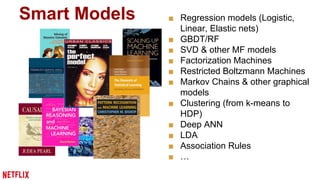
Smart Models ■ Regression models (Logistic, 
Linear, Elastic nets) 
■ GBDT/RF 
■ SVD & other MF models 
■ Factorization Machines 
■ Restricted Boltzmann Machines 
■ Markov Chains & other graphical 
models 
■ Clustering (from k-means to 
HDP) 
■ Deep ANN 
■ LDA 
■ Association Rules 
■ …
10 Lessons
1. More data vs. & Better Models
More data or better models? 
Really? 
Anand Rajaraman: Former Stanford Prof. & 
Senior VP at Walmart
More data or better models? 
Sometimes, it’s not 
about more data
More data or better models? 
[Banko and Brill, 2001] 
Norvig: “Google does not 
have better Algorithms, 
only more Data” 
Many features/ 
low-bias models
More data or better models? 
Sometimes, it’s not 
about more data
2. You might not need all your 
Big Data
How useful is Big Data 
■ “Everybody” has Big Data 
■ But not everybody needs it 
■ E.g. Do you need many millions of users if the goal is to 
compute a MF of, say, 100 factors? 
■ Many times, doing some kind of smart (e.g. stratified) 
sampling can produce as good or even better results as 
using it all
3. The fact that a more complex 
model does not improve things 
does not mean you don’t need one
Better Models and features that “don’t work” 
■ Imagine the following scenario: 
■ You have a linear model and for some time you have been 
selecting and optimizing features for that model 
■ If you try a more complex (e.g. non-linear) model with the same 
features you are not likely to see any improvement 
■ If you try to add more expressive features, the existing model is 
likely not to capture them and you are not likely to see any 
improvement
Better Models and features that “don’t work” 
■ More complex features may require 
a more complex model 
■ A more complex model may not 
show improvements with a feature 
set that is too simple
4. Be thoughtful about your 
training data
Defining training/testing data 
■ Imagine you are training a simple binary 
classifier 
■ Defining positive and negative labels -> Non-trivial 
task 
■ E.g. Is this a positive or a negative? 
■ User watches a movie to completion and rates it 1 
star 
■ User watches the same movie again (maybe 
because she can’t find anything else) 
■ User abandons movie after 5 minutes, or 15 
minutes… or 1 hour 
■ User abandons TV show after 2 episodes, or 10 
episode… or 1 season 
■ User adds something to her list but never watches it
Other training data issues: Time traveling 
■ Time traveling: usage of features that originated after 
the event you are trying to predict 
■ E.g. Your rating a movie is a pretty good prediction of you 
watching that movie, especially because most ratings happen 
AFTER you watch the movie 
■ It can get tricky when you have many features that relate to 
each other 
■ Whenever we see an offline experiment with huge wins, the 
first question we ask ourselves is: “Is there time traveling?”
5. Learn to deal with (The curse 
of) Presentation Bias
2D Navigational Modeling 
More likely 
to see 
Less likely
The curse of presentation bias 
■ User can only click on what you decide to show 
■ But, what you decide to show is the result of what your model 
predicted is good 
■ Simply treating things you show as negatives is not 
likely to work 
■ Better options 
■ Correcting for the probability a user will click on a position -> 
Attention models 
■ Explore/exploit approaches such as MAB
6. The UI is the algorithm’s only 
communication channel with that 
which matters most: the users
UI->Algorithm->UI 
■ The UI generates the user 
feedback that we will input into the 
algorithms 
■ The UI is also where the results of 
our algorithms will be shown 
■ A change in the UI might require a 
change in algorithms and 
viceversa
7. Data and Models are great. You 
know what’s even better? The 
right evaluation approach
Offline/Online testing process
Executing A/B tests 
Measure differences in metrics across statistically 
identical populations that each experience a different 
algorithm. 
■ Decisions on the product always data-driven 
■ Overall Evaluation Criteria (OEC) = member retention 
■ Use long-term metrics whenever possible 
■ Short-term metrics can be informative and allow faster 
decisions 
■ But, not always aligned with OEC
Offline testing 
■ Measure model performance, using 
(IR) metrics 
■ Offline performance used as an 
indication to make informed 
decisions on follow-up A/B tests 
■ A critical (and mostly unsolved) 
issue is how offline metrics can 
correlate with A/B test results. 
Problem 
Data 
Metrics 
Algorithm Model
8. Distributing algorithms is 
important, but knowing at what 
level to do it is even more 
important
The three levels of Distribution/Parallelization 
1. For each subset of the population (e.g. 
region) 
2. For each combination of the 
hyperparameters 
3. For each subset of the training data 
Each level has different requirements
ANN Training over GPUS and AWS
9. It pays off to be smart about 
choosing your hyperparameters
Hyperparameter optimization 
■ Automate hyperparameter 
optimization by choosing the right 
metric. 
■ But, is it enough to choose the value 
that maximizes the metric? 
■ E.g. Is a regularization lambda of 0 
better than a lambda = 1000 that 
decreases your metric by only 1%? 
■ Also, think about using Bayesian 
Optimization (Gaussian Processes) 
instead of grid search
10. There are things you can do 
offline and there are things you 
can’t… and there is nearline for 
everything in between
System Overview 
▪ Blueprint for multiple 
personalization algorithm 
services 
▪ Ranking 
▪ Row selection 
▪ Ratings 
▪ … 
▪ Recommendation involving 
multi-layered Machine 
Learning
Matrix Factorization Example
Conclusions 
1. Choose the right metric 
2. Be thoughtful about your data 
3. Understand dependencies 
between data and models 
4. Optimize only what matters
Xavier Amatriain (@xamat) 
xavier@netflix.com 
Thanks! 
(and yes, we are hiring)

10 Lessons Learned from Building Machine Learning Systems

  • 1.
    10 Lessons Learnedfrom building ML systems Xavier Amatriain - Director Algorithms Engineering November 2014
  • 2.
  • 4.
    Netflix Scale ▪> 50M members ▪ > 40 countries ▪ > 1000 device types ▪ > 7B hours in Q2 2014 ▪ Plays: > 70M/day ▪ Searches: > 4M/day ▪ Ratings: > 6M/day ▪ Log 100B events/day ▪ 31.62% of peak US downstream traffic
  • 5.
    Smart Models ■Regression models (Logistic, Linear, Elastic nets) ■ GBDT/RF ■ SVD & other MF models ■ Factorization Machines ■ Restricted Boltzmann Machines ■ Markov Chains & other graphical models ■ Clustering (from k-means to HDP) ■ Deep ANN ■ LDA ■ Association Rules ■ …
  • 6.
  • 7.
    1. More datavs. & Better Models
  • 8.
    More data orbetter models? Really? Anand Rajaraman: Former Stanford Prof. & Senior VP at Walmart
  • 9.
    More data orbetter models? Sometimes, it’s not about more data
  • 10.
    More data orbetter models? [Banko and Brill, 2001] Norvig: “Google does not have better Algorithms, only more Data” Many features/ low-bias models
  • 11.
    More data orbetter models? Sometimes, it’s not about more data
  • 12.
    2. You mightnot need all your Big Data
  • 13.
    How useful isBig Data ■ “Everybody” has Big Data ■ But not everybody needs it ■ E.g. Do you need many millions of users if the goal is to compute a MF of, say, 100 factors? ■ Many times, doing some kind of smart (e.g. stratified) sampling can produce as good or even better results as using it all
  • 14.
    3. The factthat a more complex model does not improve things does not mean you don’t need one
  • 15.
    Better Models andfeatures that “don’t work” ■ Imagine the following scenario: ■ You have a linear model and for some time you have been selecting and optimizing features for that model ■ If you try a more complex (e.g. non-linear) model with the same features you are not likely to see any improvement ■ If you try to add more expressive features, the existing model is likely not to capture them and you are not likely to see any improvement
  • 16.
    Better Models andfeatures that “don’t work” ■ More complex features may require a more complex model ■ A more complex model may not show improvements with a feature set that is too simple
  • 17.
    4. Be thoughtfulabout your training data
  • 18.
    Defining training/testing data ■ Imagine you are training a simple binary classifier ■ Defining positive and negative labels -> Non-trivial task ■ E.g. Is this a positive or a negative? ■ User watches a movie to completion and rates it 1 star ■ User watches the same movie again (maybe because she can’t find anything else) ■ User abandons movie after 5 minutes, or 15 minutes… or 1 hour ■ User abandons TV show after 2 episodes, or 10 episode… or 1 season ■ User adds something to her list but never watches it
  • 19.
    Other training dataissues: Time traveling ■ Time traveling: usage of features that originated after the event you are trying to predict ■ E.g. Your rating a movie is a pretty good prediction of you watching that movie, especially because most ratings happen AFTER you watch the movie ■ It can get tricky when you have many features that relate to each other ■ Whenever we see an offline experiment with huge wins, the first question we ask ourselves is: “Is there time traveling?”
  • 20.
    5. Learn todeal with (The curse of) Presentation Bias
  • 21.
    2D Navigational Modeling More likely to see Less likely
  • 22.
    The curse ofpresentation bias ■ User can only click on what you decide to show ■ But, what you decide to show is the result of what your model predicted is good ■ Simply treating things you show as negatives is not likely to work ■ Better options ■ Correcting for the probability a user will click on a position -> Attention models ■ Explore/exploit approaches such as MAB
  • 23.
    6. The UIis the algorithm’s only communication channel with that which matters most: the users
  • 24.
    UI->Algorithm->UI ■ TheUI generates the user feedback that we will input into the algorithms ■ The UI is also where the results of our algorithms will be shown ■ A change in the UI might require a change in algorithms and viceversa
  • 25.
    7. Data andModels are great. You know what’s even better? The right evaluation approach
  • 26.
  • 27.
    Executing A/B tests Measure differences in metrics across statistically identical populations that each experience a different algorithm. ■ Decisions on the product always data-driven ■ Overall Evaluation Criteria (OEC) = member retention ■ Use long-term metrics whenever possible ■ Short-term metrics can be informative and allow faster decisions ■ But, not always aligned with OEC
  • 28.
    Offline testing ■Measure model performance, using (IR) metrics ■ Offline performance used as an indication to make informed decisions on follow-up A/B tests ■ A critical (and mostly unsolved) issue is how offline metrics can correlate with A/B test results. Problem Data Metrics Algorithm Model
  • 29.
    8. Distributing algorithmsis important, but knowing at what level to do it is even more important
  • 30.
    The three levelsof Distribution/Parallelization 1. For each subset of the population (e.g. region) 2. For each combination of the hyperparameters 3. For each subset of the training data Each level has different requirements
  • 31.
    ANN Training overGPUS and AWS
  • 32.
    9. It paysoff to be smart about choosing your hyperparameters
  • 33.
    Hyperparameter optimization ■Automate hyperparameter optimization by choosing the right metric. ■ But, is it enough to choose the value that maximizes the metric? ■ E.g. Is a regularization lambda of 0 better than a lambda = 1000 that decreases your metric by only 1%? ■ Also, think about using Bayesian Optimization (Gaussian Processes) instead of grid search
  • 34.
    10. There arethings you can do offline and there are things you can’t… and there is nearline for everything in between
  • 35.
    System Overview ▪Blueprint for multiple personalization algorithm services ▪ Ranking ▪ Row selection ▪ Ratings ▪ … ▪ Recommendation involving multi-layered Machine Learning
  • 36.
  • 37.
    Conclusions 1. Choosethe right metric 2. Be thoughtful about your data 3. Understand dependencies between data and models 4. Optimize only what matters
  • 38.
    Xavier Amatriain (@xamat) xavier@netflix.com Thanks! (and yes, we are hiring)