









What is
Deep Learning?
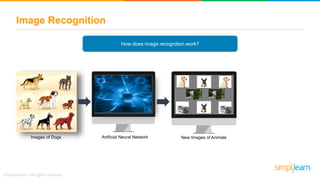
Image Recognition
How does image recognition work?
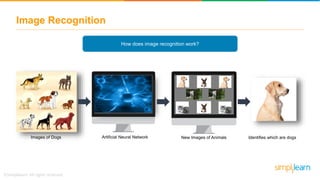
Image Recognition
How does image recognition work?
Images of Dogs
Image Recognition
How does image recognition work?
Images of Dogs Artificial Neural Network
Image Recognition
How does image recognition work?
Images of Dogs New Images of AnimalsArtificial Neural Network
Image Recognition
How does image recognition work?
Images of Dogs Identifies which are dogsNew Images of AnimalsArtificial Neural Network
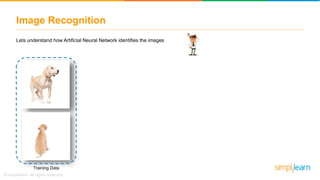
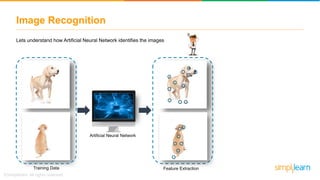
Image Recognition
Lets understand how Artificial Neural Network identifies the images
Image Recognition
Lets understand how Artificial Neural Network identifies the images
Training Data
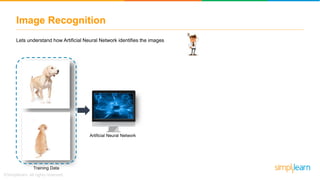
Image Recognition
Lets understand how Artificial Neural Network identifies the images
Training Data
Artificial Neural Network
Image Recognition
Lets understand how Artificial Neural Network identifies the images
Training Data Feature Extraction
Artificial Neural Network
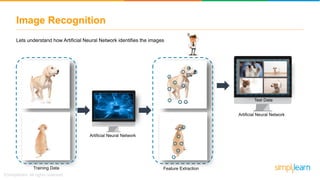
Image Recognition
Lets understand how Artificial Neural Network identifies the images
Training Data Feature Extraction
Artificial Neural Network
Test Data
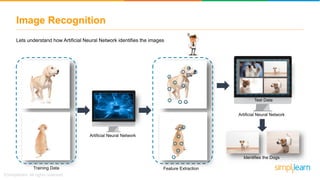
Image Recognition
Lets understand how Artificial Neural Network identifies the images
Training Data Feature Extraction
Identifies the Dogs
Artificial Neural Network
Test Data
What’s in it for you?
What is Deep Learning?
Why do we need Deep Learning?
Applications of Deep Learning
What is a Neural Network?
Activation Functions
Working of a Neural Network
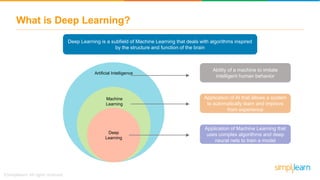
What is Deep Learning?
Deep Learning is a subfield of Machine Learning that deals with algorithms inspired
by the structure and function of the brain
Artificial Intelligence
Machine
Learning
Deep
Learning
Ability of a machine to imitate
intelligent human behavior
Application of AI that allows a system
to automatically learn and improve
from experience
Application of Machine Learning that
uses complex algorithms and deep
neural nets to train a model
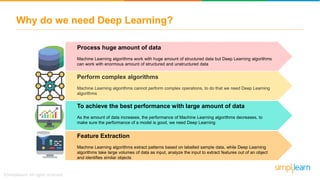
Why do we need Deep Learning?
Process huge amount of data
Machine Learning algorithms work with huge amount of structured data but Deep Learning algorithms
can work with enormous amount of structured and unstructured data
Perform complex algorithms
Machine Learning algorithms cannot perform complex operations, to do that we need Deep Learning
algorithms
To achieve the best performance with large amount of data
As the amount of data increases, the performance of Machine Learning algorithms decreases, to
make sure the performance of a model is good, we need Deep Learning
Feature Extraction
Machine Learning algorithms extract patterns based on labelled sample data, while Deep Learning
algorithms take large volumes of data as input, analyze the input to extract features out of an object
and identifies similar objects
Applications of Deep Learning
Cancer Detection
Deep Learning helps to detect cancerous tumors in the human body
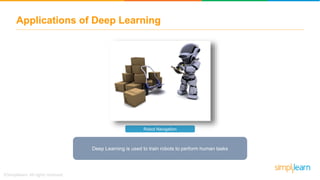
Applications of Deep Learning
Robot Navigation
Deep Learning is used to train robots to perform human tasks
Applications of Deep Learning
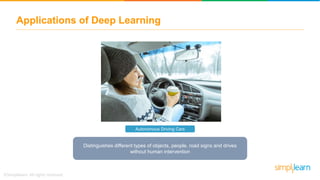
Autonomous Driving Cars
Distinguishes different types of objects, people, road signs and drives
without human intervention
Applications of Deep Learning
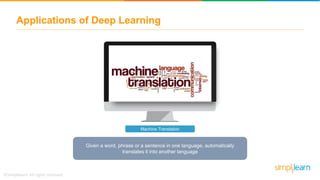
Machine Translation
Given a word, phrase or a sentence in one language, automatically
translates it into another language
Applications of Deep Learning
Music Composition
Deep Neural Nets can be used to produce music by making computers
learn the patterns in a composition
Applications of Deep Learning
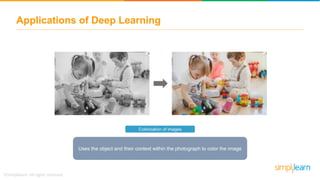
Colorization of images
Uses the object and their context within the photograph to color the image
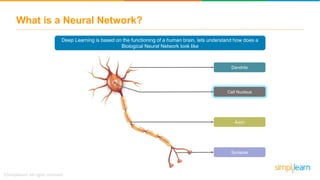
What is a Neural Network?
Deep Learning is based on the functioning of a human brain, lets understand how does a
Biological Neural Network look like
Dendrite
Cell Nucleus
Synapse
Axon
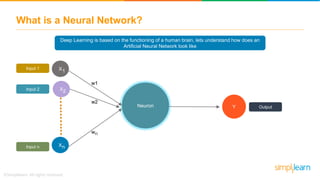
What is a Neural Network?
Deep Learning is based on the functioning of a human brain, lets understand how does an
Artificial Neural Network look like
Neuron
X1
X2
Xn
Input 1
Input 2
Input n
Y Output
w1
w2
wn
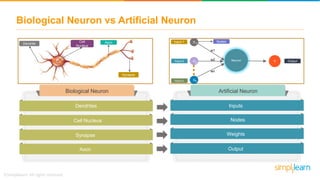
Biological Neuron vs Artificial Neuron
Neuron
X1
X2
Xn
Input 1
Input 2
Input n
Y Output
w1
w2
wn
Biological Neuron
Cell Nucleus
Artificial Neuron
Synapse
Dendrites
Axon
Inputs
Nodes
Weights
Output
AxonCell
Nucleus
Dendrite
Synapse
Nodes
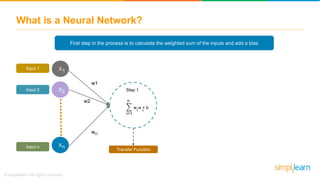
What is a Neural Network?
First step in the process is to calculate the weighted sum of the inputs and add a bias
X1
X2
Xn
Input 1
Input 2
Input n
w1
w2
w
Step 1
i=1
n
w x + b
i i*
n
Transfer Function
What is a Neural Network?
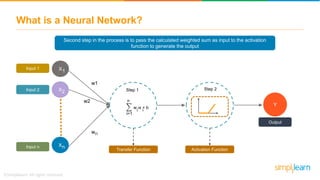
Second step in the process is to pass the calculated weighted sum as input to the activation
function to generate the output
X1
X2
Xn
Input 1
Input 2
Input n
Y
Output
w1
w2
w
Step 1
i=1
n
w x + b
i i*
n
Step 2
Activation FunctionTransfer Function
Activation Functions
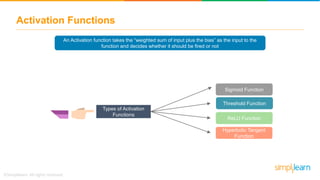
An Activation function takes the “weighted sum of input plus the bias” as the input to the
function and decides whether it should be fired or not
Types of Activation
Functions
Sigmoid Function
Threshold Function
ReLU Function
Hyperbolic Tangent
Function
Activation Functions
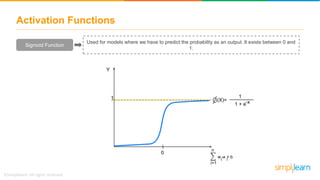
Sigmoid Function
Used for models where we have to predict the probability as an output. It exists between 0 and
1.
i=1
n
w x + b
i i*
0
1
Y
(X)=
1
1 + e-x
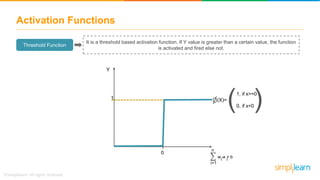
Threshold Function
Activation Functions
It is a threshold based activation function. If Y value is greater than a certain value, the function
is activated and fired else not.
i=1
n
w x + b
i i*
0
1
Y
(X)=
1, if x>=0
0, if x<0( )
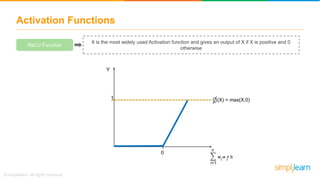
ReLU Function
Activation Functions
It is the most widely used Activation function and gives an output of X if X is positive and 0
otherwise
i=1
n
w x + b
i i*
0
1
Y
(X) = max(X,0)
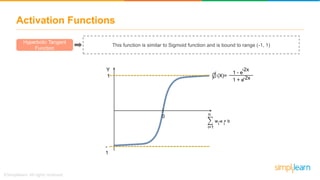
Hyperbolic Tangent
Function
Activation Functions
This function is similar to Sigmoid function and is bound to range (-1, 1)
0
1
Y
(X)=
1 - e
1 + e-2x
i=1
n
w x + b
i i*
-
1
-2x
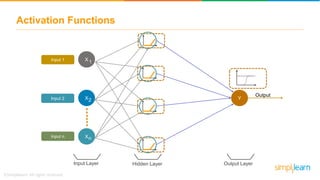
Activation Functions
X
X
X
1
n
2 Y
Output
Input 1
Input 2
Input n
Input Layer Output LayerHidden Layer
Working of a Neural Network
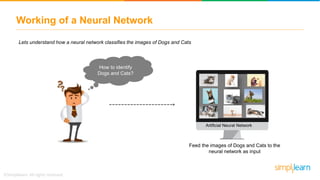
Lets understand how a neural network classifies the images of Dogs and Cats
How to identify
Dogs and Cats?
Feed the images of Dogs and Cats to the
neural network as input
Artificial Neural Network
Working of a Neural Network
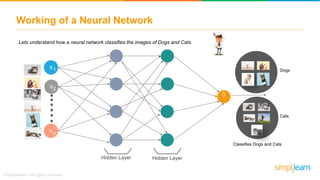
Lets understand how a neural network classifies the images of Dogs and Cats
X
X
1
n
X2
Y^
Classifies Dogs and Cats
Cats
Dogs
Hidden Layer Hidden Layer
Working of a Neural Network
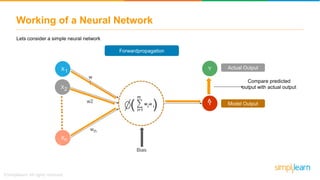
Lets consider a simple neural network
X
X
Y
Y1
2
n
w
1
wn
i=1
m
w x
i i*( ) ^ Model Output
Actual Output
Bias
Forwardpropagation
Compare predicted
output with actual outputX2
w2
Working of a Neural Network
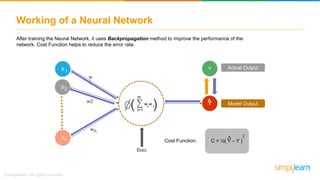
After training the Neural Network, it uses Backpropagation method to improve the performance of the
network. Cost Function helps to reduce the error rate.
X
X
X
Y
Y1
2
n
w
1
wn
i=1
m
w x
i i*( ) ^ Model Output
Actual Output
C = ½( Y – Y )^
2
Cost Function:
w2
Bias
Cost Function
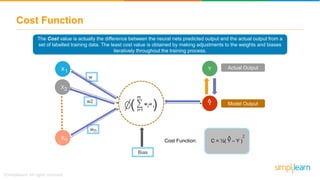
The Cost value is actually the difference between the neural nets predicted output and the actual output from a
set of labelled training data. The least cost value is obtained by making adjustments to the weights and biases
iteratively throughout the training process.
X
X
Y
Y1
n
w
1
w
w2
n
i=1
m
w x
i i*( ) ^ Model Output
Actual Output
C = ½( Y – Y )^
2
Cost Function:
Bias
X2
Why are Deep Neural Nets hard to train?
Training
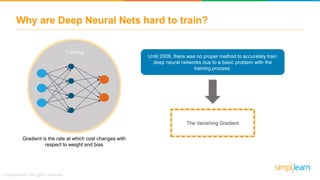
Gradient is the rate at which cost changes with
respect to weight and bias
Until 2006, there was no proper method to accurately train
deep neural networks due to a basic problem with the
training process:
The Vanishing Gradient
Why are Deep Neural Nets hard to train?
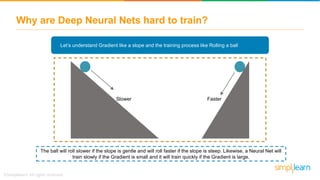
Let’s understand Gradient like a slope and the training process like Rolling a ball
Slower Faster
The ball will roll slower if the slope is gentle and will roll faster if the slope is steep. Likewise, a Neural Net will
train slowly if the Gradient is small and it will train quickly if the Gradient is large.
Gradient Descent
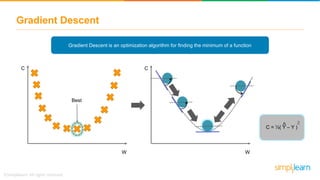
Gradient Descent is an optimization algorithm for finding the minimum of a function
C = ½( Y – Y )^ 2
C
W
C
W
Best
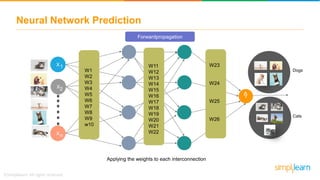
Neural Network Prediction
Forwardpropagation
X
X
X
1
n
2
Y^
Cats
DogsW1
W2
W3
W4
W5
W6
W7
W8
W9
w10
W11
W12
W13
W14
W15
W16
W17
W18
W19
W20
W21
W22
W23
W24
W25
W26
Applying the weights to each interconnection
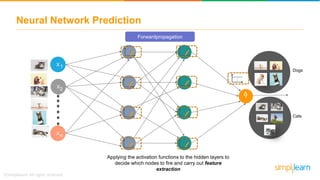
Neural Network Prediction
Forwardpropagation
X
X
X
1
n
2
Y^
Cats
Dogs
Applying the activation functions to the hidden layers to
decide which nodes to fire and carry out feature
extraction
Neural Network Prediction
Forwardpropagation
X
X
X
1
n
2
Y^
Cats
Dogs
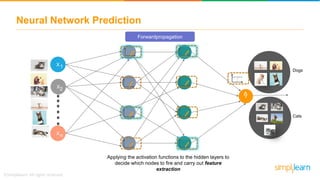
Applying the activation functions to the hidden layers to
decide which nodes to fire and carry out feature
extraction
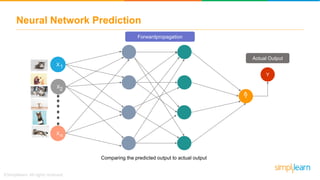
Neural Network Prediction
Forwardpropagation
X
X
X
1
n
2
Y^
Y
Actual Output
Comparing the predicted output to actual output
Neural Network Prediction
Forwardpropagation
X
X
X
1
n
2
Y^
Y
Actual Output
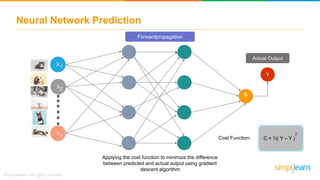
Cost Function:
2
C = ½( Y – Y )
Applying the cost function to minimize the difference
between predicted and actual output using gradient
descent algorithm
Neural Network Prediction
Backpropagation
2
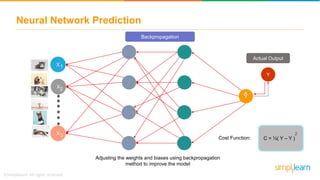
C = ½( Y – Y )
X
X
1
3
Y^
Adjusting the weights and biases using backpropagation
method to improve the model
X2
Y
Actual Output
Cost Function:
W23
W24
W25
W26
Neural Network Prediction
Forwardpropagation
X
X
X
1
n
2
Y^
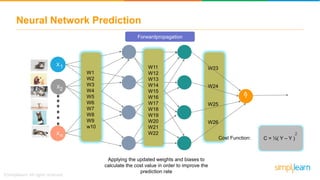
Applying the updated weights and biases to
calculate the cost value in order to improve the
prediction rate
Cost Function:
2
C = ½( Y – Y )
W1
W2
W3
W4
W5
W6
W7
W8
W9
w10
W11
W12
W13
W14
W15
W16
W17
W18
W19
W20
W21
W22
Neural Network Prediction
Forwardpropagation
X
X
X
1
n
2
Y^
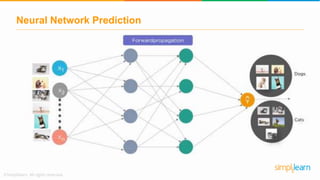
Cats
Dogs
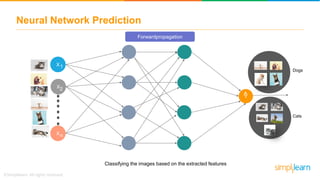
Classifying the images based on the extracted features
Neural Network Prediction
What Is Deep Learning? | Introduction to Deep Learning | Deep Learning Tutorial | Simplilearn

What Is Deep Learning? | Introduction to Deep Learning | Deep Learning Tutorial | Simplilearn

  • 1.
  • 2.
    Image Recognition How doesimage recognition work?
  • 3.
    Image Recognition How doesimage recognition work? Images of Dogs
  • 4.
    Image Recognition How doesimage recognition work? Images of Dogs Artificial Neural Network
  • 5.
    Image Recognition How doesimage recognition work? Images of Dogs New Images of AnimalsArtificial Neural Network
  • 6.
    Image Recognition How doesimage recognition work? Images of Dogs Identifies which are dogsNew Images of AnimalsArtificial Neural Network
  • 7.
    Image Recognition Lets understandhow Artificial Neural Network identifies the images
  • 8.
    Image Recognition Lets understandhow Artificial Neural Network identifies the images Training Data
  • 9.
    Image Recognition Lets understandhow Artificial Neural Network identifies the images Training Data Artificial Neural Network
  • 10.
    Image Recognition Lets understandhow Artificial Neural Network identifies the images Training Data Feature Extraction Artificial Neural Network
  • 11.
    Image Recognition Lets understandhow Artificial Neural Network identifies the images Training Data Feature Extraction Artificial Neural Network Artificial Neural Network Test Data
  • 12.
    Image Recognition Lets understandhow Artificial Neural Network identifies the images Training Data Feature Extraction Identifies the Dogs Artificial Neural Network Artificial Neural Network Test Data
  • 13.
    What’s in itfor you? What is Deep Learning? Why do we need Deep Learning? Applications of Deep Learning What is a Neural Network? Activation Functions Working of a Neural Network
  • 14.
    What is DeepLearning?
  • 15.
    What is DeepLearning? Deep Learning is a subfield of Machine Learning that deals with algorithms inspired by the structure and function of the brain Artificial Intelligence Machine Learning Deep Learning Ability of a machine to imitate intelligent human behavior Application of AI that allows a system to automatically learn and improve from experience Application of Machine Learning that uses complex algorithms and deep neural nets to train a model
  • 16.
    Why do weneed Deep Learning? Process huge amount of data Machine Learning algorithms work with huge amount of structured data but Deep Learning algorithms can work with enormous amount of structured and unstructured data Perform complex algorithms Machine Learning algorithms cannot perform complex operations, to do that we need Deep Learning algorithms To achieve the best performance with large amount of data As the amount of data increases, the performance of Machine Learning algorithms decreases, to make sure the performance of a model is good, we need Deep Learning Feature Extraction Machine Learning algorithms extract patterns based on labelled sample data, while Deep Learning algorithms take large volumes of data as input, analyze the input to extract features out of an object and identifies similar objects
  • 17.
  • 18.
    Applications of DeepLearning Cancer Detection Deep Learning helps to detect cancerous tumors in the human body
  • 19.
    Applications of DeepLearning Robot Navigation Deep Learning is used to train robots to perform human tasks
  • 20.
    Applications of DeepLearning Autonomous Driving Cars Distinguishes different types of objects, people, road signs and drives without human intervention
  • 21.
    Applications of DeepLearning Machine Translation Given a word, phrase or a sentence in one language, automatically translates it into another language
  • 22.
    Applications of DeepLearning Music Composition Deep Neural Nets can be used to produce music by making computers learn the patterns in a composition
  • 23.
    Applications of DeepLearning Colorization of images Uses the object and their context within the photograph to color the image
  • 24.
    What is aNeural Network?
  • 25.
    What is aNeural Network? Deep Learning is based on the functioning of a human brain, lets understand how does a Biological Neural Network look like Dendrite Cell Nucleus Synapse Axon
  • 26.
    What is aNeural Network? Deep Learning is based on the functioning of a human brain, lets understand how does an Artificial Neural Network look like Neuron X1 X2 Xn Input 1 Input 2 Input n Y Output w1 w2 wn
  • 27.
    Biological Neuron vsArtificial Neuron Neuron X1 X2 Xn Input 1 Input 2 Input n Y Output w1 w2 wn Biological Neuron Cell Nucleus Artificial Neuron Synapse Dendrites Axon Inputs Nodes Weights Output AxonCell Nucleus Dendrite Synapse Nodes
  • 28.
    What is aNeural Network? First step in the process is to calculate the weighted sum of the inputs and add a bias X1 X2 Xn Input 1 Input 2 Input n w1 w2 w Step 1 i=1 n w x + b i i* n Transfer Function
  • 29.
    What is aNeural Network? Second step in the process is to pass the calculated weighted sum as input to the activation function to generate the output X1 X2 Xn Input 1 Input 2 Input n Y Output w1 w2 w Step 1 i=1 n w x + b i i* n Step 2 Activation FunctionTransfer Function
  • 30.
    Activation Functions An Activationfunction takes the “weighted sum of input plus the bias” as the input to the function and decides whether it should be fired or not Types of Activation Functions Sigmoid Function Threshold Function ReLU Function Hyperbolic Tangent Function
  • 31.
    Activation Functions Sigmoid Function Usedfor models where we have to predict the probability as an output. It exists between 0 and 1. i=1 n w x + b i i* 0 1 Y (X)= 1 1 + e-x
  • 32.
    Threshold Function Activation Functions Itis a threshold based activation function. If Y value is greater than a certain value, the function is activated and fired else not. i=1 n w x + b i i* 0 1 Y (X)= 1, if x>=0 0, if x<0( )
  • 33.
    ReLU Function Activation Functions Itis the most widely used Activation function and gives an output of X if X is positive and 0 otherwise i=1 n w x + b i i* 0 1 Y (X) = max(X,0)
  • 34.
    Hyperbolic Tangent Function Activation Functions Thisfunction is similar to Sigmoid function and is bound to range (-1, 1) 0 1 Y (X)= 1 - e 1 + e-2x i=1 n w x + b i i* - 1 -2x
  • 35.
    Activation Functions X X X 1 n 2 Y Output Input1 Input 2 Input n Input Layer Output LayerHidden Layer
  • 36.
    Working of aNeural Network
  • 37.
    Working of aNeural Network Lets understand how a neural network classifies the images of Dogs and Cats How to identify Dogs and Cats? Feed the images of Dogs and Cats to the neural network as input Artificial Neural Network
  • 38.
    Working of aNeural Network Lets understand how a neural network classifies the images of Dogs and Cats X X 1 n X2 Y^ Classifies Dogs and Cats Cats Dogs Hidden Layer Hidden Layer
  • 39.
    Working of aNeural Network Lets consider a simple neural network X X Y Y1 2 n w 1 wn i=1 m w x i i*( ) ^ Model Output Actual Output Bias Forwardpropagation Compare predicted output with actual outputX2 w2
  • 40.
    Working of aNeural Network After training the Neural Network, it uses Backpropagation method to improve the performance of the network. Cost Function helps to reduce the error rate. X X X Y Y1 2 n w 1 wn i=1 m w x i i*( ) ^ Model Output Actual Output C = ½( Y – Y )^ 2 Cost Function: w2 Bias
  • 41.
    Cost Function The Costvalue is actually the difference between the neural nets predicted output and the actual output from a set of labelled training data. The least cost value is obtained by making adjustments to the weights and biases iteratively throughout the training process. X X Y Y1 n w 1 w w2 n i=1 m w x i i*( ) ^ Model Output Actual Output C = ½( Y – Y )^ 2 Cost Function: Bias X2
  • 42.
    Why are DeepNeural Nets hard to train? Training Gradient is the rate at which cost changes with respect to weight and bias Until 2006, there was no proper method to accurately train deep neural networks due to a basic problem with the training process: The Vanishing Gradient
  • 43.
    Why are DeepNeural Nets hard to train? Let’s understand Gradient like a slope and the training process like Rolling a ball Slower Faster The ball will roll slower if the slope is gentle and will roll faster if the slope is steep. Likewise, a Neural Net will train slowly if the Gradient is small and it will train quickly if the Gradient is large.
  • 44.
    Gradient Descent Gradient Descentis an optimization algorithm for finding the minimum of a function C = ½( Y – Y )^ 2 C W C W Best
  • 45.
  • 46.
    Neural Network Prediction Forwardpropagation X X X 1 n 2 Y^ Cats Dogs Applyingthe activation functions to the hidden layers to decide which nodes to fire and carry out feature extraction
  • 47.
    Neural Network Prediction Forwardpropagation X X X 1 n 2 Y^ Cats Dogs Applyingthe activation functions to the hidden layers to decide which nodes to fire and carry out feature extraction
  • 48.
    Neural Network Prediction Forwardpropagation X X X 1 n 2 Y^ Y ActualOutput Comparing the predicted output to actual output
  • 49.
    Neural Network Prediction Forwardpropagation X X X 1 n 2 Y^ Y ActualOutput Cost Function: 2 C = ½( Y – Y ) Applying the cost function to minimize the difference between predicted and actual output using gradient descent algorithm
  • 50.
    Neural Network Prediction Backpropagation 2 C= ½( Y – Y ) X X 1 3 Y^ Adjusting the weights and biases using backpropagation method to improve the model X2 Y Actual Output Cost Function:
  • 51.
    W23 W24 W25 W26 Neural Network Prediction Forwardpropagation X X X 1 n 2 Y^ Applyingthe updated weights and biases to calculate the cost value in order to improve the prediction rate Cost Function: 2 C = ½( Y – Y ) W1 W2 W3 W4 W5 W6 W7 W8 W9 w10 W11 W12 W13 W14 W15 W16 W17 W18 W19 W20 W21 W22
  • 52.
  • 53.

Editor's Notes