Dr Mohammed Nishad N
Papilloma of the nose
Definition
Benign locally aggressive neoplasm originating from the
schneiderian membrane of nasal cavity
Male : female 3:1
Age group –30-50
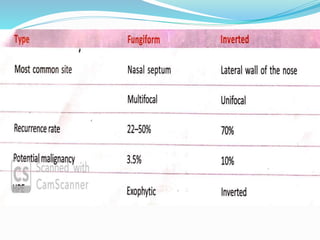
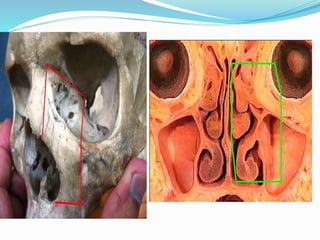
 Most common site – lateral wall (70%)
ethmoid complex
septum
Papilloma are of three types
 Fungiform/ papillary/exophytic/everted papilloma
 Inverted papilloma
 Cylindrical papilloma
Inverted papilloma
 Schneiderian papillomas
 Ringertz tumour
 Transitional cell papilloma
 Polyp with inverting metaplasia
 Epithelial papilloma
 Soft papilloma
 Papillary fibroma
 Squamous papillary epithelioma
DEFINITION
 A Benign epithelial neoplasm arising from
Schneiderian membrane of nose and paranasal
sinuses.
 The mucosal lining of nose and paranasal sinuses is
known as Schneiderian membrane .
 Papillomas arising from this membrane is very unique
in that they are found to be growing inwardly and
hence the term inverted papilloma .
 Inverted papillomas behave like neoplasms, arising
from reserve / replacement cells located at the
basement membrane of the mucosa due to
UNKNOWN stimulus .
 The resulting thickening of the epithelium assumes an
inverting, fungiform or combination growth pattern
 Depending on the degree of metaplasia varying
amounts of respiratory / cylindrical cells may be seen
in Schneiderian papillomas .
 Rarely the papilloma may be composed entirely of
cylindrical cells, and hence the term cylindrical cell
papillomas is used to describe this subtype.
ANATOMIC CLASSIFICATION OF SCHNEIDERIAN
PAPILLOMA
 Inverted papilloma can be classified according to its
site of occurrence i.e. Lateral wall and septal
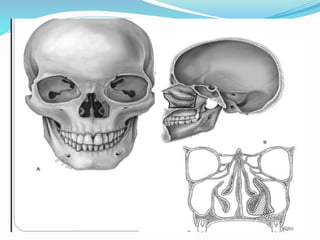
papillomas .
 Septal papillomas remain confined to the nasal
septum and may very rarely involve the roof and floor
of the nasal cavity. Carcinomatous transformation is
rare in septal papillomas & Vice versa in lateral wall
papillomas
INCIDENCE
 M > F, 20 to 70 yrs .
 Mean age is 50 yrs .
ETIOLOGY
HPV (with mutation of genes) 6,11,16,57b
GROSS APPREARANCE
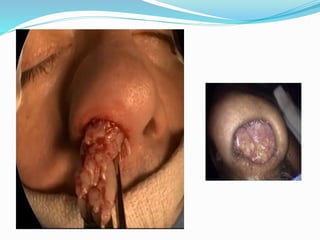
 1. Papillary and exophytic.
 2. Inverted with inwardly invaginating epithelial
growth into underlying stroma.
 A combination of both patterns also can occur
The papillary form/fungiform papilloma tends to
commonly occur in the nasal septum, while the
inverted form often occurs in the lateral wall of the
nose and sinuses
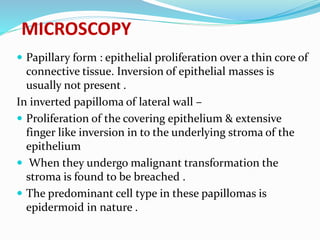
MICROSCOPY
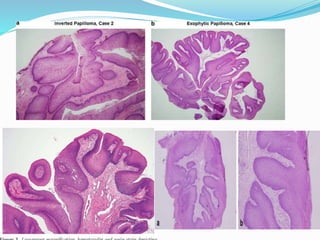
 Papillary form : epithelial proliferation over a thin core of
connective tissue. Inversion of epithelial masses is
usually not present .
In inverted papilloma of lateral wall –
 Proliferation of the covering epithelium & extensive
finger like inversion in to the underlying stroma of the
epithelium
 When they undergo malignant transformation the
stroma is found to be breached .
 The predominant cell type in these papillomas is
epidermoid in nature .

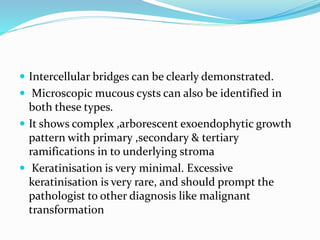
 Intercellular bridges can be clearly demonstrated.
 Microscopic mucous cysts can also be identified in
both these types.
 It shows complex ,arborescent exoendophytic growth
pattern with primary ,secondary & tertiary
ramifications in to underlying stroma
 Keratinisation is very minimal. Excessive
keratinisation is very rare, and should prompt the
pathologist to other diagnosis like malignant
transformation
Clinical features
 Unilateral nasal mass .
 Commonly fleshy in nature .
 Sometimes it may occur behind a sentinel nasal polyp
 It commonly involves the nasal cavity, erodes the
medial wall of maxilla and may present inside the
maxillary sinus
Symptoms:
 Unilateral nasal obstruction .
 Nasal bleeding .
 Nasal discharge .
 Hyposmia/anosmia
 Proptosis , diplopia ,if lamina papyracea is breached
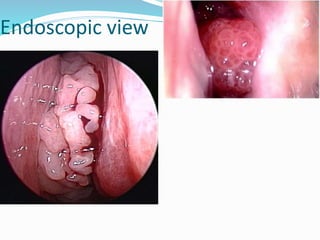
Reddish ,firm , solitary,friable and granular mulberry
/knobby type
KROUSE STAGING SYSTEM
 (1) Tumour confined to nasal cavity with no evidence
of malignancy.
 (2) Tumour involving the ostiomeatal complex,
ethmoid sinuses, and/or medial portion of maxillary
sinus ,with no evidence of malignancy .
 (3) Tumour involving the lateral, inferior, superior,
anterior, or posterior walls of maxillary sinus, the
sphenoid sinus, and/or the frontal sinus with or
without involvement of the nasal cavity.
 (4) All malignant tumours and those tumours with
extra nasal and extra sinus extension.
Schwals staging
 T1 –Confined to nasal cavity
 T2 &T3– Progressive involvement of PNS
 T4– Tumour extended in to orbit or intra cranial cavity
Skolnick et al
 T1 – Tumour confined to one anatomical site with in
the nose
 T2 – Tumour involves two sites with in the nose
 T3– Involvement of sinuses
 T4—Extension outside the nose and sinuses
Can get transformed to
 Transitional cell carcinoma
 Squamous cell carcinoma
Inverted papilloma can coexist with squamous cell
carcinoma in 27% (synchronous)
Endoscopic view
Differential diagnosis
 Antrochoanal polyp
 AFRS
 Esthesionueroblastoma
 Malignancy
Investigation
 Biopsy –For definite diagnosis
 CT Scan with contrast –hyper dense areas and
calcification (linear). Bony destruction & Erosion of
the lateral wall
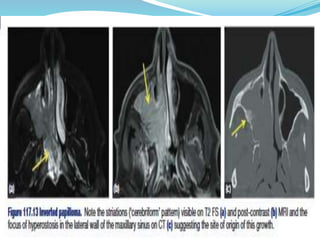
 MRI .. Intracranial & extra cranial extension .
Enhancing mass with heterogeneous conveluted
cerebriform appearance -- characteristic
TREATMENT
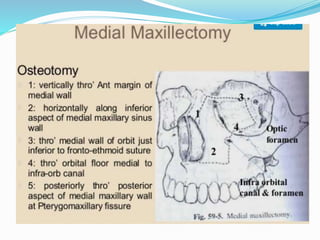
 Medial maxillectomy – TOC
Approches by 1)endoscopic
2) lateral rhinotomy
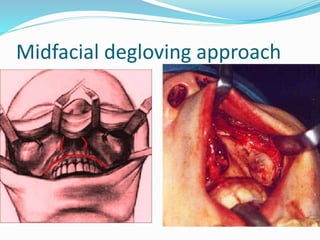
3) sublabial midfacial degloving
Treatment
 Choice –surgery with marginal clearance
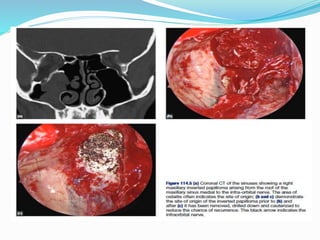
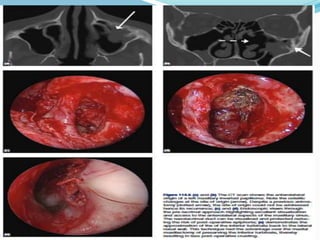
Endoscopic medial maxillectomy
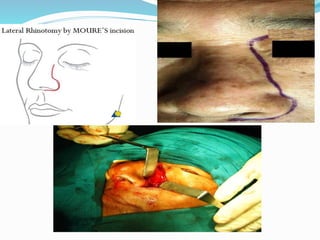
Recurrance ..Lateral rhinotomy (moure”s incision) &
Medial maxillectomy+ with spheno ethmoidal
clearance (en-bloc dissection) depending on extent of
tumour
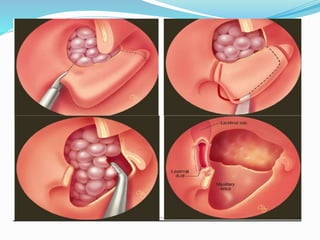
Endoscopic medial maxillectomy
Indications
 Inverted Papilloma (Schneiderian Papilloma)
 Benign sinonasal neoplasms arising from the lateral
nasal wall or maxillary sinus
Highlights:
 Sinonasal landmarks are identified, including the
maxillary sinus ostium, middle & inferior turbinates,
and ethmoid roof
 Attachment of the tumor (stalk) is identified and
transected
 Bulk of the tumor is excised
 Bone at the base of the tumor (stalk attachment site) is
drilled and/or resected in order to clear microscopic
disease
 The entire lateral nasal wall, including the inferior
turbinate, is resected
 At the completion of surgery the maxillary sinus and
nose should be a common cavity, enhancing
postoperative surveillance for tumor recurrence
 Keep in mind:
 If the nasolacrimal duct is transected during surgery, a
lacrimal stent is placed to decrease the likelihood of
postoperative epiphora. This stent is removed one
week after surgery.
 Postoperative nasal saline irrigations are helpful to
clear crusts which commonly form after this surgery
 Sub cranial approach Lateral rhinotomy is generally
reserved if exenteration of the orbit is needed
simultaneously
 BEST Endoscopic Resection
 Caldwell-Luc or the “limited open approach” was
initially used but has fallen out of favour , given the
poor visualization and higher rates of recurrence
associated with this technique
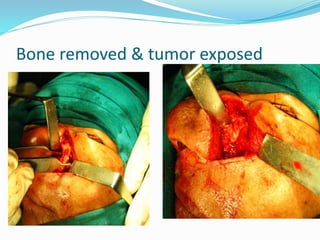
Bone removed & tumor exposed
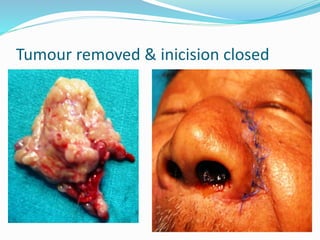
Tumour removed & inicision closed
Midfacial degloving approach
Thank you

Inverted papilloma

  • 1.
  • 2.
    Papilloma of thenose Definition Benign locally aggressive neoplasm originating from the schneiderian membrane of nasal cavity Male : female 3:1 Age group –30-50
  • 3.
     Most commonsite – lateral wall (70%) ethmoid complex septum
  • 4.
    Papilloma are ofthree types  Fungiform/ papillary/exophytic/everted papilloma  Inverted papilloma  Cylindrical papilloma
  • 5.
    Inverted papilloma  Schneiderianpapillomas  Ringertz tumour  Transitional cell papilloma  Polyp with inverting metaplasia  Epithelial papilloma  Soft papilloma  Papillary fibroma  Squamous papillary epithelioma
  • 6.
    DEFINITION  A Benignepithelial neoplasm arising from Schneiderian membrane of nose and paranasal sinuses.  The mucosal lining of nose and paranasal sinuses is known as Schneiderian membrane .  Papillomas arising from this membrane is very unique in that they are found to be growing inwardly and hence the term inverted papilloma .
  • 7.
     Inverted papillomasbehave like neoplasms, arising from reserve / replacement cells located at the basement membrane of the mucosa due to UNKNOWN stimulus .  The resulting thickening of the epithelium assumes an inverting, fungiform or combination growth pattern
  • 8.
     Depending onthe degree of metaplasia varying amounts of respiratory / cylindrical cells may be seen in Schneiderian papillomas .  Rarely the papilloma may be composed entirely of cylindrical cells, and hence the term cylindrical cell papillomas is used to describe this subtype.
  • 9.
    ANATOMIC CLASSIFICATION OFSCHNEIDERIAN PAPILLOMA  Inverted papilloma can be classified according to its site of occurrence i.e. Lateral wall and septal papillomas .  Septal papillomas remain confined to the nasal septum and may very rarely involve the roof and floor of the nasal cavity. Carcinomatous transformation is rare in septal papillomas & Vice versa in lateral wall papillomas
  • 10.
    INCIDENCE  M >F, 20 to 70 yrs .  Mean age is 50 yrs . ETIOLOGY HPV (with mutation of genes) 6,11,16,57b
  • 11.
    GROSS APPREARANCE  1.Papillary and exophytic.  2. Inverted with inwardly invaginating epithelial growth into underlying stroma.  A combination of both patterns also can occur The papillary form/fungiform papilloma tends to commonly occur in the nasal septum, while the inverted form often occurs in the lateral wall of the nose and sinuses
  • 13.
    MICROSCOPY  Papillary form: epithelial proliferation over a thin core of connective tissue. Inversion of epithelial masses is usually not present . In inverted papilloma of lateral wall –  Proliferation of the covering epithelium & extensive finger like inversion in to the underlying stroma of the epithelium  When they undergo malignant transformation the stroma is found to be breached .  The predominant cell type in these papillomas is epidermoid in nature .
  • 14.
  • 15.
     Intercellular bridgescan be clearly demonstrated.  Microscopic mucous cysts can also be identified in both these types.  It shows complex ,arborescent exoendophytic growth pattern with primary ,secondary & tertiary ramifications in to underlying stroma  Keratinisation is very minimal. Excessive keratinisation is very rare, and should prompt the pathologist to other diagnosis like malignant transformation
  • 17.
    Clinical features  Unilateralnasal mass .  Commonly fleshy in nature .  Sometimes it may occur behind a sentinel nasal polyp  It commonly involves the nasal cavity, erodes the medial wall of maxilla and may present inside the maxillary sinus
  • 18.
    Symptoms:  Unilateral nasalobstruction .  Nasal bleeding .  Nasal discharge .  Hyposmia/anosmia  Proptosis , diplopia ,if lamina papyracea is breached Reddish ,firm , solitary,friable and granular mulberry /knobby type
  • 19.
    KROUSE STAGING SYSTEM (1) Tumour confined to nasal cavity with no evidence of malignancy.  (2) Tumour involving the ostiomeatal complex, ethmoid sinuses, and/or medial portion of maxillary sinus ,with no evidence of malignancy .  (3) Tumour involving the lateral, inferior, superior, anterior, or posterior walls of maxillary sinus, the sphenoid sinus, and/or the frontal sinus with or without involvement of the nasal cavity.  (4) All malignant tumours and those tumours with extra nasal and extra sinus extension.
  • 20.
    Schwals staging  T1–Confined to nasal cavity  T2 &T3– Progressive involvement of PNS  T4– Tumour extended in to orbit or intra cranial cavity
  • 21.
    Skolnick et al T1 – Tumour confined to one anatomical site with in the nose  T2 – Tumour involves two sites with in the nose  T3– Involvement of sinuses  T4—Extension outside the nose and sinuses
  • 22.
    Can get transformedto  Transitional cell carcinoma  Squamous cell carcinoma Inverted papilloma can coexist with squamous cell carcinoma in 27% (synchronous)
  • 23.
  • 24.
    Differential diagnosis  Antrochoanalpolyp  AFRS  Esthesionueroblastoma  Malignancy
  • 25.
    Investigation  Biopsy –Fordefinite diagnosis  CT Scan with contrast –hyper dense areas and calcification (linear). Bony destruction & Erosion of the lateral wall  MRI .. Intracranial & extra cranial extension . Enhancing mass with heterogeneous conveluted cerebriform appearance -- characteristic
  • 27.
    TREATMENT  Medial maxillectomy– TOC Approches by 1)endoscopic 2) lateral rhinotomy 3) sublabial midfacial degloving
  • 28.
    Treatment  Choice –surgerywith marginal clearance Endoscopic medial maxillectomy Recurrance ..Lateral rhinotomy (moure”s incision) & Medial maxillectomy+ with spheno ethmoidal clearance (en-bloc dissection) depending on extent of tumour
  • 29.
    Endoscopic medial maxillectomy Indications Inverted Papilloma (Schneiderian Papilloma)  Benign sinonasal neoplasms arising from the lateral nasal wall or maxillary sinus Highlights:  Sinonasal landmarks are identified, including the maxillary sinus ostium, middle & inferior turbinates, and ethmoid roof  Attachment of the tumor (stalk) is identified and transected  Bulk of the tumor is excised
  • 30.
     Bone atthe base of the tumor (stalk attachment site) is drilled and/or resected in order to clear microscopic disease  The entire lateral nasal wall, including the inferior turbinate, is resected  At the completion of surgery the maxillary sinus and nose should be a common cavity, enhancing postoperative surveillance for tumor recurrence
  • 31.
     Keep inmind:  If the nasolacrimal duct is transected during surgery, a lacrimal stent is placed to decrease the likelihood of postoperative epiphora. This stent is removed one week after surgery.  Postoperative nasal saline irrigations are helpful to clear crusts which commonly form after this surgery
  • 35.
     Sub cranialapproach Lateral rhinotomy is generally reserved if exenteration of the orbit is needed simultaneously  BEST Endoscopic Resection  Caldwell-Luc or the “limited open approach” was initially used but has fallen out of favour , given the poor visualization and higher rates of recurrence associated with this technique
  • 40.
    Bone removed &tumor exposed
  • 41.
    Tumour removed &inicision closed
  • 42.
  • 43.