Odontogenic
Infections
Dr. Rida F. Waseem
BDS,
Demonstrator
Department of Oral Surgery
IOD, CMH
Objectives
By the end of this lecture the students
should be able to:
• Describe the sequelae of odontogenic
infections.
• Describe the spread of odontogenic
infections to primary, secondary and
distant spaces.
• Diagnose a patient with odontogenic
infections.
An odontogenic infection is
an acute or chronic infection
originating from a tooth related
pathology.
Periapical
PericoronalPeriodontal
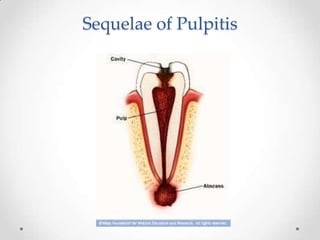
Sequelae of Pulpitis
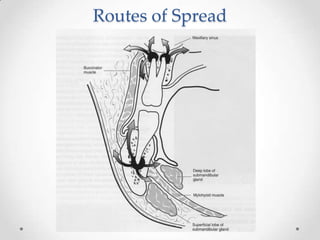
Routes of Spread
1) Localized Soft Tissue Abscess
or
2) Diffused widespread Cellulitis
What will it depend on?
 Number of Microorganisms
 Virulence of Microorganisms
 Host Defense
 In a healthy patient spread is localized and drained
to the buccal or lingual cortex
 In an immune compromised patient spread is
diffused and spreads to the bone  osteomyelitis
Enzymes responsible for
connective tissue degradation
• Hyaluronidase (Produced by aerobes; causes
cellulitis and lowers the pH)
• Collagenase (Produced by anaerobes; cause
liquefactive necrosis; pus)
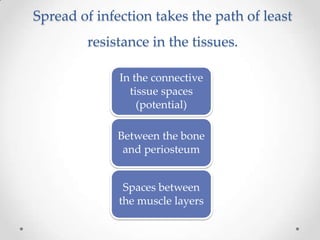
Spread of infection takes the path of least
resistance in the tissues.
In the connective
tissue spaces
(potential)
Between the bone
and periosteum
Spaces between
the muscle layers
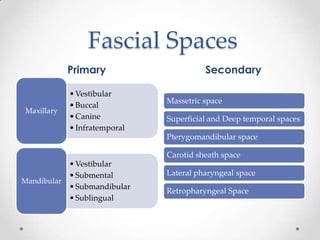
Fascial Spaces
Primary Secondary
•Vestibular
•Buccal
•Canine
•Infratemporal
Maxillary
•Vestibular
•Submental
•Submandibular
•Sublingual
Mandibular
Massetric space
Superficial and Deep temporal spaces
Pterygomandibular space
Carotid sheath space
Lateral pharyngeal space
Retropharyngeal Space
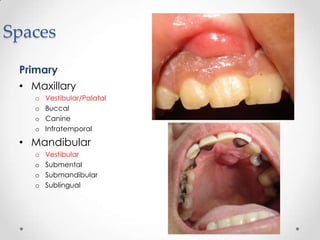
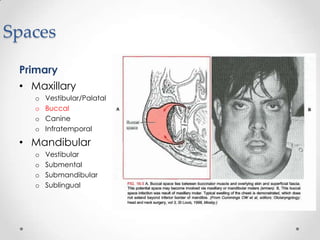
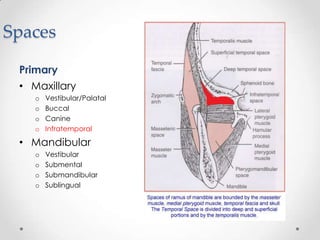
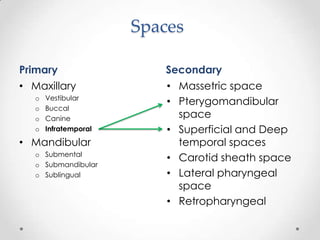
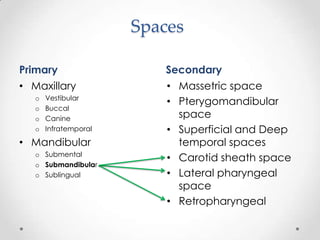
Spaces
Primary
• Maxillary
o Vestibular/Palatal
o Buccal
o Canine
o Infratemporal
• Mandibular
o Vestibular
o Submental
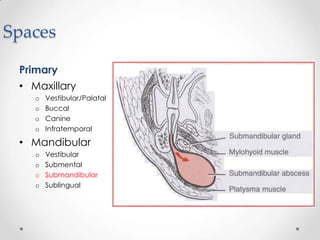
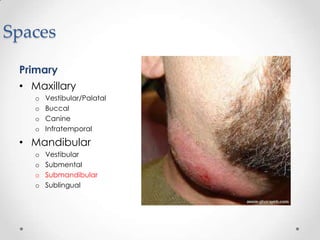
o Submandibular
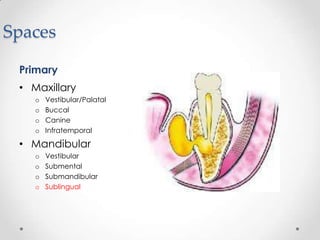
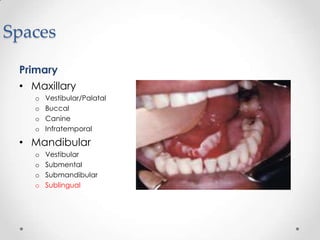
o Sublingual
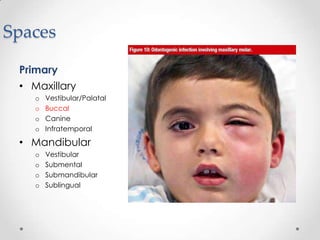
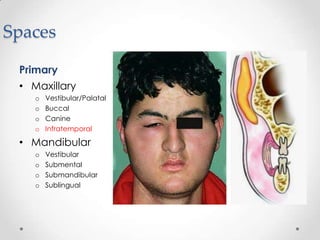
Spaces
Primary
• Maxillary
o Vestibular/Palatal
o Buccal
o Canine
o Infratemporal
• Mandibular
o Vestibular
o Submental
o Submandibular
o Sublingual
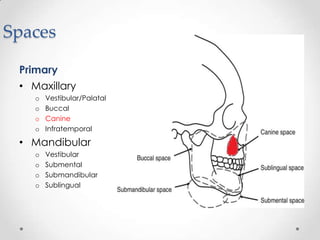
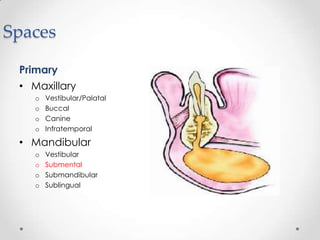
Spaces
Primary
• Maxillary
o Vestibular/Palatal
o Buccal
o Canine
o Infratemporal
• Mandibular
o Vestibular
o Submental
o Submandibular
o Sublingual
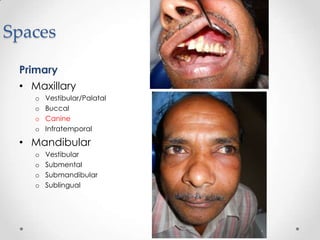
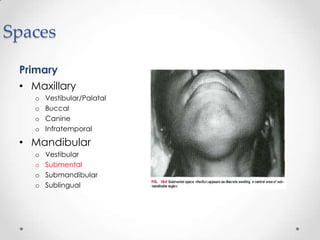
Spaces
Primary
• Maxillary
o Vestibular/Palatal
o Buccal
o Canine
o Infratemporal
• Mandibular
o Vestibular
o Submental
o Submandibular
o Sublingual
Spaces
Primary
• Maxillary
o Vestibular/Palatal
o Buccal
o Canine
o Infratemporal
• Mandibular
o Vestibular
o Submental
o Submandibular
o Sublingual
Spaces
Primary
• Maxillary
o Vestibular/Palatal
o Buccal
o Canine
o Infratemporal
• Mandibular
o Vestibular
o Submental
o Submandibular
o Sublingual
Spaces
Primary
• Maxillary
o Vestibular/Palatal
o Buccal
o Canine
o Infratemporal
• Mandibular
o Vestibular
o Submental
o Submandibular
o Sublingual
Spaces
Primary
• Maxillary
o Vestibular/Palatal
o Buccal
o Canine
o Infratemporal
• Mandibular
o Vestibular
o Submental
o Submandibular
o Sublingual
Spaces
Primary
• Maxillary
o Vestibular/Palatal
o Buccal
o Canine
o Infratemporal
• Mandibular
o Vestibular
o Submental
o Submandibular
o Sublingual
Spaces
Primary
• Maxillary
o Vestibular/Palatal
o Buccal
o Canine
o Infratemporal
• Mandibular
o Vestibular
o Submental
o Submandibular
o Sublingual
Spaces
Primary
• Maxillary
o Vestibular/Palatal
o Buccal
o Canine
o Infratemporal
• Mandibular
o Vestibular
o Submental
o Submandibular
o Sublingual
Spaces
Primary
• Maxillary
o Vestibular/Palatal
o Buccal
o Canine
o Infratemporal
• Mandibular
o Vestibular
o Submental
o Submandibular
o Sublingual
Spaces
Primary
• Maxillary
o Vestibular/Palatal
o Buccal
o Canine
o Infratemporal
• Mandibular
o Vestibular
o Submental
o Submandibular
o Sublingual
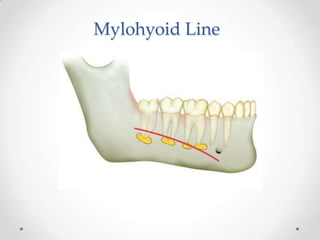
Mylohyoid Line
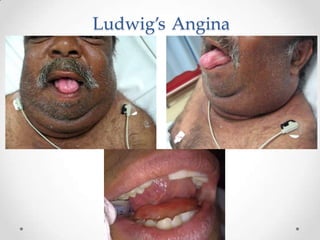
Ludwig’s Angina
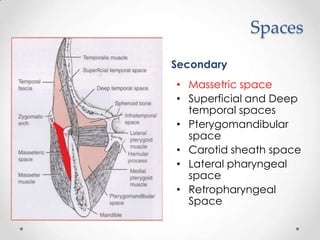
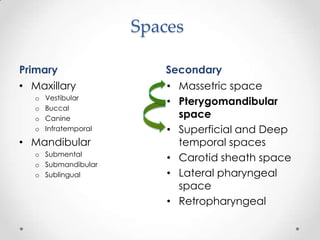
Spaces
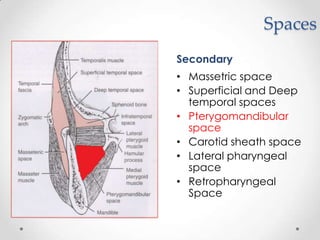
Secondary
• Massetric space
• Superficial and Deep
temporal spaces
• Pterygomandibular
space
• Carotid sheath space
• Lateral pharyngeal
space
• Retropharyngeal
Space
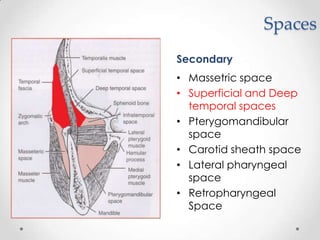
Spaces
Secondary
• Massetric space
• Superficial and Deep
temporal spaces
• Pterygomandibular
space
• Carotid sheath space
• Lateral pharyngeal
space
• Retropharyngeal
Space
Spaces
Secondary
• Massetric space
• Superficial and Deep
temporal spaces
• Pterygomandibular
space
• Carotid sheath space
• Lateral pharyngeal
space
• Retropharyngeal
Space
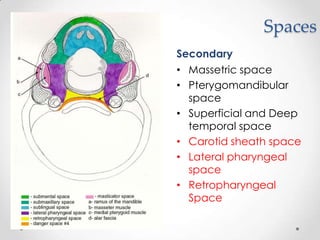
Spaces
Secondary
• Massetric space
• Pterygomandibular
space
• Superficial and Deep
temporal space
• Carotid sheath space
• Lateral pharyngeal
space
• Retropharyngeal
Space
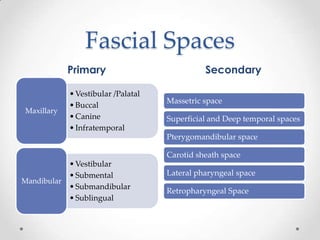
Fascial Spaces
Primary Secondary
•Vestibular /Palatal
•Buccal
•Canine
•Infratemporal
Maxillary
•Vestibular
•Submental
•Submandibular
•Sublingual
Mandibular
Massetric space
Superficial and Deep temporal spaces
Pterygomandibular space
Carotid sheath space
Lateral pharyngeal space
Retropharyngeal Space
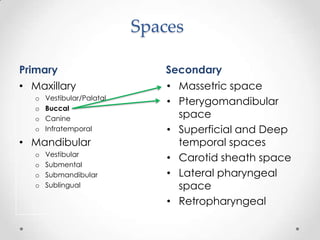
Spaces
Primary Secondary
• Maxillary
o Vestibular/Palatal
o Buccal
o Canine
o Infratemporal
• Mandibular
o Vestibular
o Submental
o Submandibular
o Sublingual
• Massetric space
• Pterygomandibular
space
• Superficial and Deep
temporal spaces
• Carotid sheath space
• Lateral pharyngeal
space
• Retropharyngeal
Spaces
Primary Secondary
• Maxillary
o Vestibular
o Buccal
o Canine
o Infratemporal
• Mandibular
o Submental
o Submandibular
o Sublingual
• Massetric space
• Pterygomandibular
space
• Superficial and Deep
temporal spaces
• Carotid sheath space
• Lateral pharyngeal
space
• Retropharyngeal
Spaces
Primary Secondary
• Maxillary
o Vestibular
o Buccal
o Canine
o Infratemporal
• Mandibular
o Submental
o Submandibular
o Sublingual
• Massetric space
• Pterygomandibular
space
• Superficial and Deep
temporal spaces
• Carotid sheath space
• Lateral pharyngeal
space
• Retropharyngeal
Spaces
Primary Secondary
• Maxillary
o Vestibular
o Buccal
o Canine
o Infratemporal
• Mandibular
o Submental
o Submandibular
o Sublingual
• Massetric space
• Pterygomandibular
space
• Superficial and Deep
temporal spaces
• Carotid sheath space
• Lateral pharyngeal
space
• Retropharyngeal
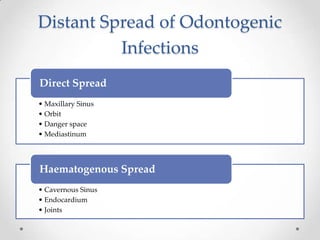
Distant Spread of Odontogenic
Infections
• Maxillary Sinus
• Orbit
• Danger space
• Mediastinum
Direct Spread
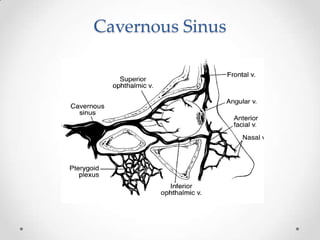
• Cavernous Sinus
• Endocardium
• Joints
Haematogenous Spread
Cavernous Sinus
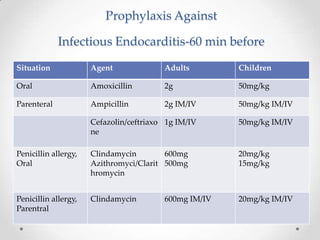
Prophylaxis Against
Infectious Endocarditis-60 min before
Situation Agent Adults Children
Oral Amoxicillin 2g 50mg/kg
Parenteral Ampicillin 2g IM/IV 50mg/kg IM/IV
Cefazolin/ceftriaxo
ne
1g IM/IV 50mg/kg IM/IV
Penicillin allergy,
Oral
Clindamycin
Azithromyci/Clarit
hromycin
600mg
500mg
20mg/kg
15mg/kg
Penicillin allergy,
Parentral
Clindamycin 600mg IM/IV 20mg/kg IM/IV
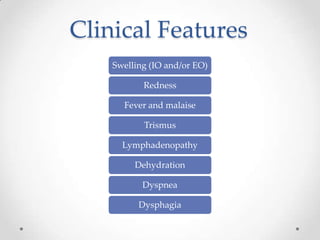
Clinical Features
Swelling (IO and/or EO)
Redness
Fever and malaise
Trismus
Lymphadenopathy
Dehydration
Dyspnea
Dysphagia
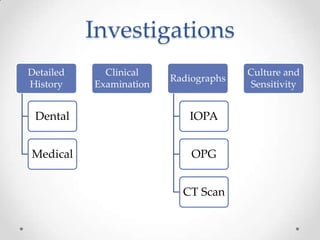
Investigations
Detailed
History
Dental
Medical
Clinical
Examination
Radiographs
IOPA
OPG
CT Scan
Culture and
Sensitivity
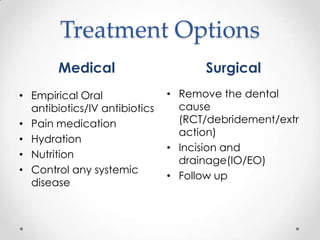
Treatment Options
Medical Surgical
• Empirical Oral
antibiotics/IV antibiotics
• Pain medication
• Hydration
• Nutrition
• Control any systemic
disease
• Remove the dental
cause
(RCT/debridement/extr
action)
• Incision and
drainage(IO/EO)
• Follow up
Objectives
By the end of this lecture the students
should be able to:
• Describe the sequelae of odontogenic
infections.
• Describe the spread of odontogenic
infections to primary, secondary and
distant spaces.
• Diagnose a patient with odontogenic
infections
QUESTIONS?

Odontogenic infections