Copyright2013-2014
DEDUCTION THEOREM
OF PROPOSITIONAL
LOGIC
Saurabh Gupta
Copyright2013-2014
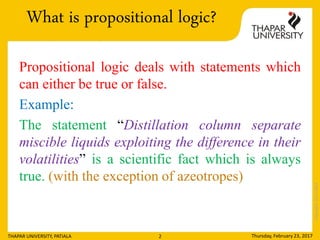
What is propositional logic?
Propositional logic deals with statements which
can either be true or false.
Example:
The statement “Distillation column separate
miscible liquids exploiting the difference in their
volatilities” is a scientific fact which is always
true. (with the exception of azeotropes)
Thursday, February 23, 2017THAPAR UNIVERSITY, PATIALA 2
Copyright2013-2014
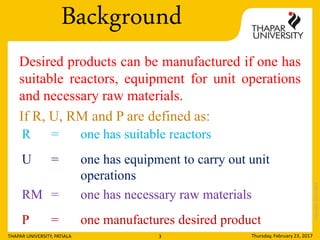
Desired products can be manufactured if one has
suitable reactors, equipment for unit operations
and necessary raw materials.
If R, U, RM and P are defined as:
Thursday, February 23, 2017THAPAR UNIVERSITY, PATIALA 3
Background
R = one has suitable reactors
U = one has equipment to carry out unit
operations
RM = one has necessary raw materials
P = one manufactures desired product
Copyright2013-2014
Background
Thursday, February 23, 2017THAPAR UNIVERSITY, PATIALA 4
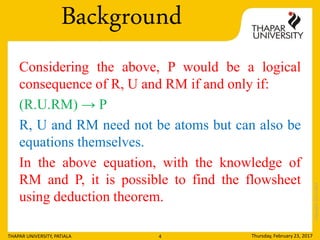
Considering the above, P would be a logical
consequence of R, U and RM if and only if:
(R.U.RM) → P
R, U and RM need not be atoms but can also be
equations themselves.
In the above equation, with the knowledge of
RM and P, it is possible to find the flowsheet
using deduction theorem.
Copyright2013-2014
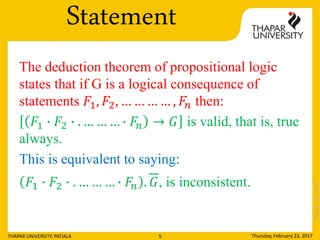
The deduction theorem of propositional logic
states that if G is a logical consequence of
statements 𝐹1, 𝐹2, … … … … , 𝐹𝑛 then:
𝐹1 ∙ 𝐹2 ∙ . … … … ∙ 𝐹𝑛 → 𝐺 is valid, that is, true
always.
This is equivalent to saying:
𝐹1 ∙ 𝐹2 ∙ . … … … ∙ 𝐹𝑛 . 𝐺, is inconsistent.
Thursday, February 23, 2017THAPAR UNIVERSITY, PATIALA 5
Statement
Copyright2013-2014
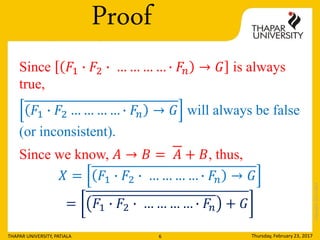
Since 𝐹1 ∙ 𝐹2 ∙ … … … … ∙ 𝐹𝑛 → 𝐺 is always
true,
𝐹1 ∙ 𝐹2 … … … … ∙ 𝐹𝑛 → 𝐺 will always be false
(or inconsistent).
Since we know, 𝐴 → 𝐵 = 𝐴 + 𝐵, thus,
𝑋 = 𝐹1 ∙ 𝐹2 ∙ … … … … ∙ 𝐹𝑛 → 𝐺
= 𝐹1 ∙ 𝐹2 ∙ … … … … ∙ 𝐹𝑛 + 𝐺
Thursday, February 23, 2017THAPAR UNIVERSITY, PATIALA 6
Proof
Copyright2013-2014
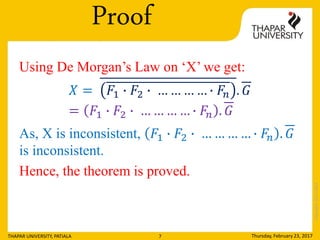
Using De Morgan’s Law on ‘X’ we get:
𝑋 = 𝐹1 ∙ 𝐹2 ∙ … … … … ∙ 𝐹𝑛 . 𝐺
= 𝐹1 ∙ 𝐹2 ∙ … … … … ∙ 𝐹𝑛 . 𝐺
As, X is inconsistent, 𝐹1 ∙ 𝐹2 ∙ … … … … ∙ 𝐹𝑛 . 𝐺
is inconsistent.
Hence, the theorem is proved.
Thursday, February 23, 2017THAPAR UNIVERSITY, PATIALA 7
Proof
Copyright2013-2014
It is a very important relation and is the basis of
reduction based synthesis procedure of flow
sheeting.
Thursday, February 23, 2017THAPAR UNIVERSITY, PATIALA 8
Importance
Copyright2013-2014
Thursday, February 23, 2017THAPAR UNIVERSITY, PATIALA 9

Deduction theorem of propositional logic

  • 1.
  • 2.
    Copyright2013-2014 What is propositionallogic? Propositional logic deals with statements which can either be true or false. Example: The statement “Distillation column separate miscible liquids exploiting the difference in their volatilities” is a scientific fact which is always true. (with the exception of azeotropes) Thursday, February 23, 2017THAPAR UNIVERSITY, PATIALA 2
  • 3.
    Copyright2013-2014 Desired products canbe manufactured if one has suitable reactors, equipment for unit operations and necessary raw materials. If R, U, RM and P are defined as: Thursday, February 23, 2017THAPAR UNIVERSITY, PATIALA 3 Background R = one has suitable reactors U = one has equipment to carry out unit operations RM = one has necessary raw materials P = one manufactures desired product
  • 4.
    Copyright2013-2014 Background Thursday, February 23,2017THAPAR UNIVERSITY, PATIALA 4 Considering the above, P would be a logical consequence of R, U and RM if and only if: (R.U.RM) → P R, U and RM need not be atoms but can also be equations themselves. In the above equation, with the knowledge of RM and P, it is possible to find the flowsheet using deduction theorem.
  • 5.
    Copyright2013-2014 The deduction theoremof propositional logic states that if G is a logical consequence of statements 𝐹1, 𝐹2, … … … … , 𝐹𝑛 then: 𝐹1 ∙ 𝐹2 ∙ . … … … ∙ 𝐹𝑛 → 𝐺 is valid, that is, true always. This is equivalent to saying: 𝐹1 ∙ 𝐹2 ∙ . … … … ∙ 𝐹𝑛 . 𝐺, is inconsistent. Thursday, February 23, 2017THAPAR UNIVERSITY, PATIALA 5 Statement
  • 6.
    Copyright2013-2014 Since 𝐹1 ∙𝐹2 ∙ … … … … ∙ 𝐹𝑛 → 𝐺 is always true, 𝐹1 ∙ 𝐹2 … … … … ∙ 𝐹𝑛 → 𝐺 will always be false (or inconsistent). Since we know, 𝐴 → 𝐵 = 𝐴 + 𝐵, thus, 𝑋 = 𝐹1 ∙ 𝐹2 ∙ … … … … ∙ 𝐹𝑛 → 𝐺 = 𝐹1 ∙ 𝐹2 ∙ … … … … ∙ 𝐹𝑛 + 𝐺 Thursday, February 23, 2017THAPAR UNIVERSITY, PATIALA 6 Proof
  • 7.
    Copyright2013-2014 Using De Morgan’sLaw on ‘X’ we get: 𝑋 = 𝐹1 ∙ 𝐹2 ∙ … … … … ∙ 𝐹𝑛 . 𝐺 = 𝐹1 ∙ 𝐹2 ∙ … … … … ∙ 𝐹𝑛 . 𝐺 As, X is inconsistent, 𝐹1 ∙ 𝐹2 ∙ … … … … ∙ 𝐹𝑛 . 𝐺 is inconsistent. Hence, the theorem is proved. Thursday, February 23, 2017THAPAR UNIVERSITY, PATIALA 7 Proof
  • 8.
    Copyright2013-2014 It is avery important relation and is the basis of reduction based synthesis procedure of flow sheeting. Thursday, February 23, 2017THAPAR UNIVERSITY, PATIALA 8 Importance
  • 9.
    Copyright2013-2014 Thursday, February 23,2017THAPAR UNIVERSITY, PATIALA 9