Logic
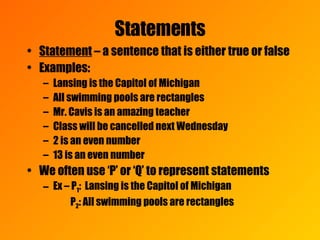
Statements Statement  – a sentence that is either true or false Examples: Lansing is the Capitol of Michigan All swimming pools are rectangles Mr. Cavis is an amazing teacher Class will be cancelled next Wednesday 2 is an even number 13 is an even number We often use ‘P’ or ‘Q’ to represent statements Ex – P 1 :  Lansing is the Capitol of Michigan   P 2 : All swimming pools are rectangles
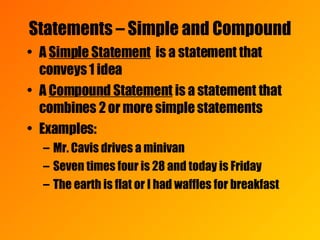
Statements – Simple and Compound A  Simple Statement   is a statement that conveys 1 idea A  Compound Statement  is a statement that combines 2 or more simple statements  Examples: Mr. Cavis drives a minivan Seven times four is 28 and today is Friday The earth is flat or I had waffles for breakfast
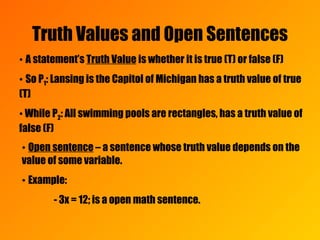
Truth Values and Open Sentences •  A statement’s  Truth Value  is whether it is true (T) or false (F) •  So P 1 : Lansing is the Capitol of Michigan has a truth value of true (T)  •   While P 2 : All swimming pools are rectangles, has a truth value of false (F) •  Open sentence  – a sentence whose truth value depends on the value of some variable. •  Example:  - 3x = 12; is a open math sentence.
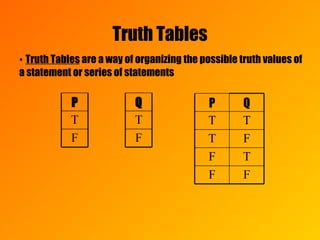
Truth Tables •  Truth Tables  are a way of organizing the possible truth values of a statement or series of statements F T P F T Q F F T F F T T T Q P
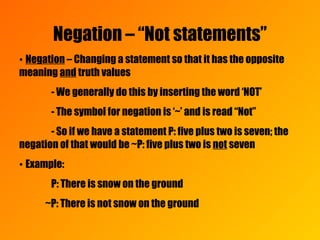
Negation – “Not statements” •  Negation  – Changing a statement so that it has the opposite meaning  and  truth values - We generally do this by inserting the word ‘NOT’ - The symbol for negation is ‘~’ and is read “Not” - So if we have a statement P: five plus two is seven; the negation of that would be ~P: five plus two is  not  seven •  Example: P: There is snow on the ground ~P: There is not snow on the ground
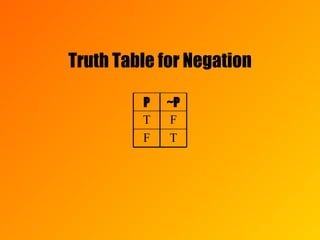
Truth Table for Negation F T P T F ~P
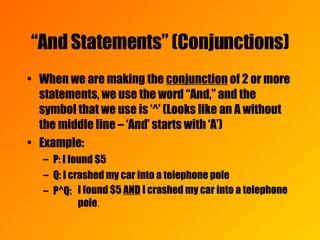
“ And Statements” (Conjunctions) When we are making the  conjunction  of 2 or more statements, we use the word “And,” and the symbol that we use is ‘^’ (Looks like an A without the middle line – ‘And’ starts with ‘A’) Example: P: I found $5 Q: I crashed my car into a telephone pole P^Q:  I found $5  AND  I crashed my car into a telephone pole .
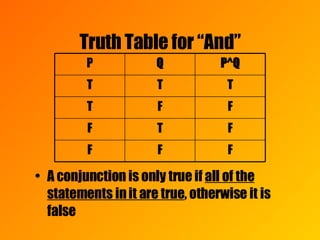
Truth Table for “And” A conjunction is only true if  all of the statements in it are true , otherwise it is false F F F F T F F F T T T T P^Q Q P
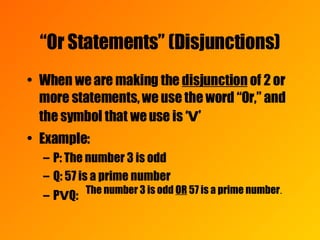
“ Or Statements” (Disjunctions) When we are making the  disjunction  of 2 or more statements, we use the word “Or,” and the symbol that we use is ‘ V ’ Example: P: The number 3 is odd Q: 57 is a prime number P V Q: The number 3 is odd  OR  57 is a prime number .
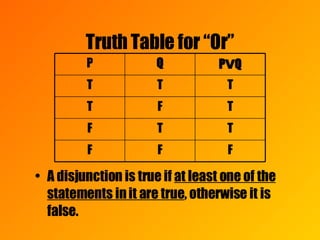
Truth Table for “Or” A disjunction is true if  at least one of the statements in it are true , otherwise it is false. F F F T T F T F T T T T P V Q Q P
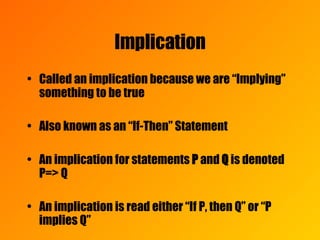
Implication Called an implication because we are “Implying” something to be true Also known as an “If-Then” Statement An implication for statements  P  and  Q  is denoted P=> Q An implication is read either “If P, then Q” or “P implies Q”
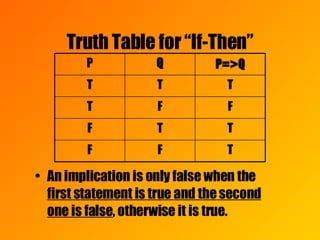
Truth Table for “If-Then” An implication is only false when the  first statement is true and the second one is false , otherwise it is true. T F F T T F F F T T T T P => Q Q P
Example of an “If-Then” Suppose a student in here is getting a B+ and asks me “Is there any way for me to get an ‘A’ in this class?” I tell that student “If you get an ‘A’ on the final exam, then you will get an ‘A’ in the class.” So here are our 2 statements *P: You get an ‘A’ on the Final Exam *Q: You get an ‘A’ in the class
Example of an “If-Then” (Cont.) Think of the combinations of outcomes as if I was telling the truth to that student or not and then consider the possible outcomes: Both P and Q are true - The student got an ‘A’ on the exam and then received an ‘A’ in the class - Therefore, I was telling the truth about the student’s final grade
Example of an “If-Then” (Cont.) 2) P is true, but Q is false - The student got an ‘A’ on the exam and then did not receive an ‘A’ in the class - Therefore, I was not telling the truth about the student’s final grade - What I said was false, which agrees with the 2 nd  row of the truth table
Example of an “If-Then” (Cont.) 3) P is false and Q is true - The student did not get an ‘A’ on the exam (say they got a ‘B’) and then received an ‘A’ in the class - I did not lie when I spoke with the student initially, so I was telling the truth
Example of an “If-Then” (Cont.) 4) Both P and Q are false - The student did not get an ‘A’ on the exam and did not get an ‘A’ in the class - I only promised an ‘A’ in the class  if   the student got an ‘A’ on the exam, so again I was telling the truth, which agrees with the last row in the truth table.
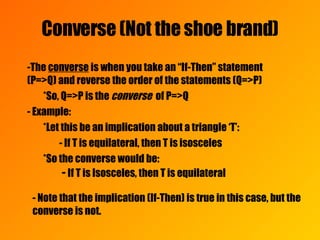
Converse (Not the shoe brand) The  converse  is when you take an “If-Then” statement (P=>Q) and reverse the order of the statements (Q=>P) *So, Q=>P is the  converse   of P=>Q Example: *Let this be an implication about a triangle ‘T’: - If T is equilateral, then T is isosceles *So the converse would be: -  If T is Isosceles, then T is equilateral - Note that the implication (If-Then) is true in this case, but the converse is not.
Biconditional A biconditional of statements P and Q is denoted  P<=>Q  and is read  “P if and only if Q” A biconditional is nothing more than an “if-then” statement joined with its converse by an “And” – [(P=>Q)^(Q=>P)] Note: the prefix “bi” means 2, so biconditional means “2 conditionals (If-Then)’
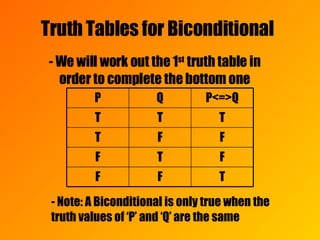
Truth Tables for Biconditional - We will work out the 1 st  truth table in order to complete the bottom one - Note: A Biconditional is only true when the truth values of ‘P’ and ‘Q’ are the same T F F F T F F F T T T T P<=>Q Q P

Logic Notes

  • 1.
  • 2.
    Statements Statement – a sentence that is either true or false Examples: Lansing is the Capitol of Michigan All swimming pools are rectangles Mr. Cavis is an amazing teacher Class will be cancelled next Wednesday 2 is an even number 13 is an even number We often use ‘P’ or ‘Q’ to represent statements Ex – P 1 : Lansing is the Capitol of Michigan P 2 : All swimming pools are rectangles
  • 3.
    Statements – Simpleand Compound A Simple Statement is a statement that conveys 1 idea A Compound Statement is a statement that combines 2 or more simple statements Examples: Mr. Cavis drives a minivan Seven times four is 28 and today is Friday The earth is flat or I had waffles for breakfast
  • 4.
    Truth Values andOpen Sentences • A statement’s Truth Value is whether it is true (T) or false (F) • So P 1 : Lansing is the Capitol of Michigan has a truth value of true (T) • While P 2 : All swimming pools are rectangles, has a truth value of false (F) • Open sentence – a sentence whose truth value depends on the value of some variable. • Example: - 3x = 12; is a open math sentence.
  • 5.
    Truth Tables • Truth Tables are a way of organizing the possible truth values of a statement or series of statements F T P F T Q F F T F F T T T Q P
  • 6.
    Negation – “Notstatements” • Negation – Changing a statement so that it has the opposite meaning and truth values - We generally do this by inserting the word ‘NOT’ - The symbol for negation is ‘~’ and is read “Not” - So if we have a statement P: five plus two is seven; the negation of that would be ~P: five plus two is not seven • Example: P: There is snow on the ground ~P: There is not snow on the ground
  • 7.
    Truth Table forNegation F T P T F ~P
  • 8.
    “ And Statements”(Conjunctions) When we are making the conjunction of 2 or more statements, we use the word “And,” and the symbol that we use is ‘^’ (Looks like an A without the middle line – ‘And’ starts with ‘A’) Example: P: I found $5 Q: I crashed my car into a telephone pole P^Q: I found $5 AND I crashed my car into a telephone pole .
  • 9.
    Truth Table for“And” A conjunction is only true if all of the statements in it are true , otherwise it is false F F F F T F F F T T T T P^Q Q P
  • 10.
    “ Or Statements”(Disjunctions) When we are making the disjunction of 2 or more statements, we use the word “Or,” and the symbol that we use is ‘ V ’ Example: P: The number 3 is odd Q: 57 is a prime number P V Q: The number 3 is odd OR 57 is a prime number .
  • 11.
    Truth Table for“Or” A disjunction is true if at least one of the statements in it are true , otherwise it is false. F F F T T F T F T T T T P V Q Q P
  • 12.
    Implication Called animplication because we are “Implying” something to be true Also known as an “If-Then” Statement An implication for statements P and Q is denoted P=> Q An implication is read either “If P, then Q” or “P implies Q”
  • 13.
    Truth Table for“If-Then” An implication is only false when the first statement is true and the second one is false , otherwise it is true. T F F T T F F F T T T T P => Q Q P
  • 14.
    Example of an“If-Then” Suppose a student in here is getting a B+ and asks me “Is there any way for me to get an ‘A’ in this class?” I tell that student “If you get an ‘A’ on the final exam, then you will get an ‘A’ in the class.” So here are our 2 statements *P: You get an ‘A’ on the Final Exam *Q: You get an ‘A’ in the class
  • 15.
    Example of an“If-Then” (Cont.) Think of the combinations of outcomes as if I was telling the truth to that student or not and then consider the possible outcomes: Both P and Q are true - The student got an ‘A’ on the exam and then received an ‘A’ in the class - Therefore, I was telling the truth about the student’s final grade
  • 16.
    Example of an“If-Then” (Cont.) 2) P is true, but Q is false - The student got an ‘A’ on the exam and then did not receive an ‘A’ in the class - Therefore, I was not telling the truth about the student’s final grade - What I said was false, which agrees with the 2 nd row of the truth table
  • 17.
    Example of an“If-Then” (Cont.) 3) P is false and Q is true - The student did not get an ‘A’ on the exam (say they got a ‘B’) and then received an ‘A’ in the class - I did not lie when I spoke with the student initially, so I was telling the truth
  • 18.
    Example of an“If-Then” (Cont.) 4) Both P and Q are false - The student did not get an ‘A’ on the exam and did not get an ‘A’ in the class - I only promised an ‘A’ in the class if the student got an ‘A’ on the exam, so again I was telling the truth, which agrees with the last row in the truth table.
  • 19.
    Converse (Not theshoe brand) The converse is when you take an “If-Then” statement (P=>Q) and reverse the order of the statements (Q=>P) *So, Q=>P is the converse of P=>Q Example: *Let this be an implication about a triangle ‘T’: - If T is equilateral, then T is isosceles *So the converse would be: - If T is Isosceles, then T is equilateral - Note that the implication (If-Then) is true in this case, but the converse is not.
  • 20.
    Biconditional A biconditionalof statements P and Q is denoted P<=>Q and is read “P if and only if Q” A biconditional is nothing more than an “if-then” statement joined with its converse by an “And” – [(P=>Q)^(Q=>P)] Note: the prefix “bi” means 2, so biconditional means “2 conditionals (If-Then)’
  • 21.
    Truth Tables forBiconditional - We will work out the 1 st truth table in order to complete the bottom one - Note: A Biconditional is only true when the truth values of ‘P’ and ‘Q’ are the same T F F F T F F F T T T T P<=>Q Q P