Experiment #5
CHEM 3
(Organic Chemistry) Group 6:
At the end of this experiment, the student
shall have:
 Purified an organic compound
 Compared the effectiveness of heating
and the addition of color–absorbing
reagents to purify the compound
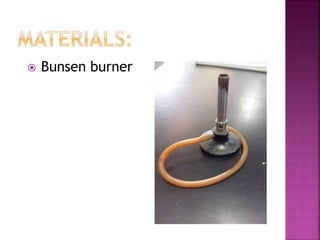
 Bunsen burner
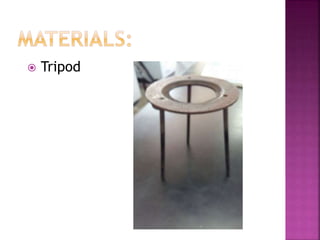
 Tripod
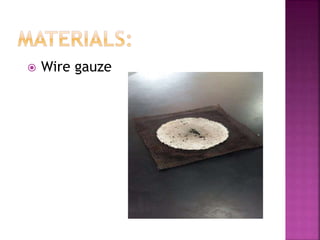
 Wire gauze
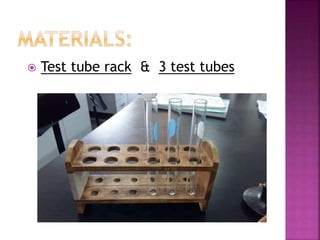
 Test tube rack & 3 test tubes
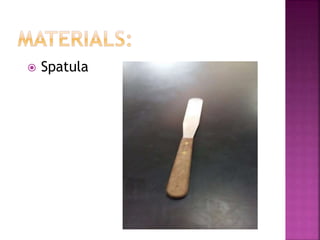
 Spatula
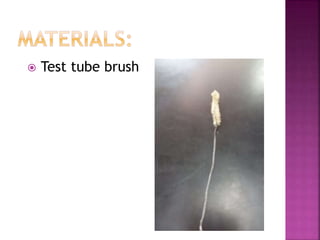
 Test tube brush
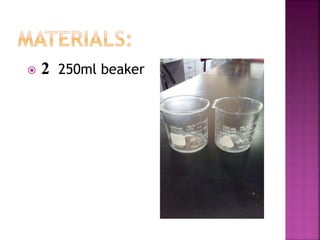
 2 250ml beaker
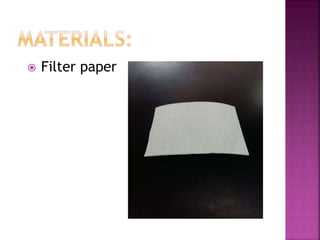
 Filter paper
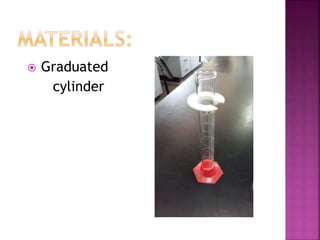
 Graduated
cylinder
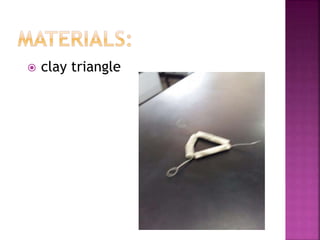
 clay triangle
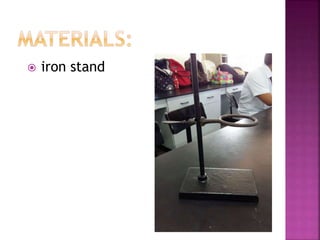
 iron stand
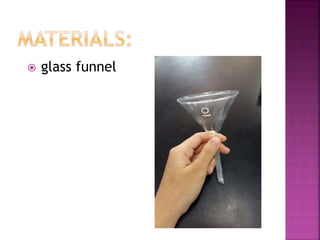
 glass funnel
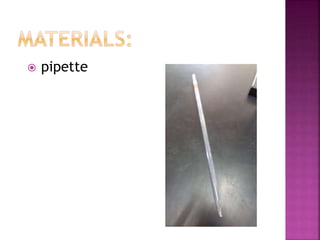
 pipette
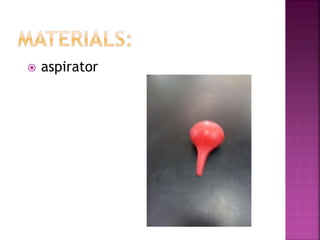
 aspirator
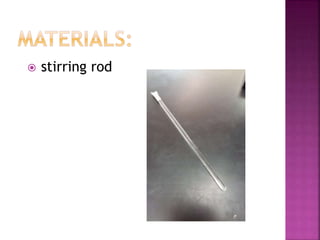
 stirring rod
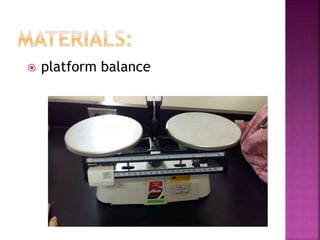
 platform balance
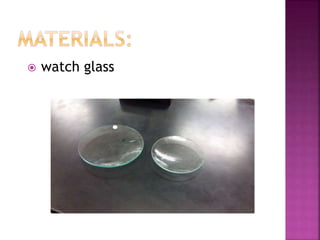
 watch glass
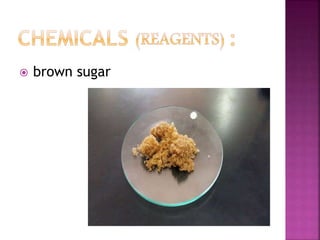
 brown sugar
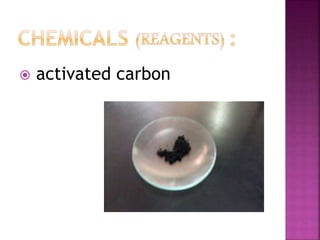
 activated carbon
 distilled water
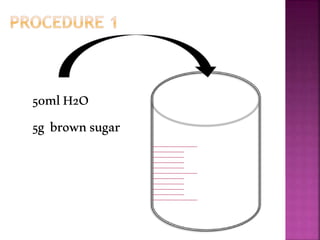
50mlH2O
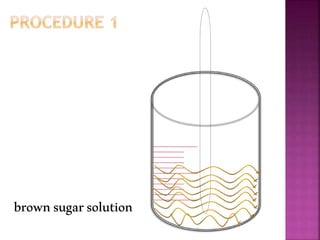
5g brownsugar
brownsugarsolution
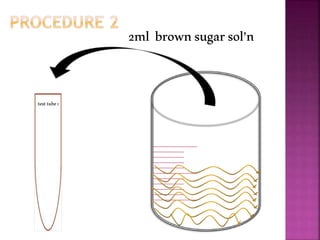
2ml brownsugarsol’n
testtube1
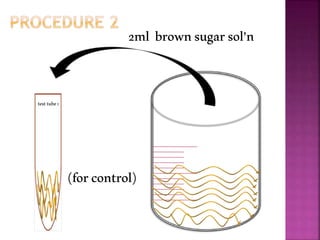
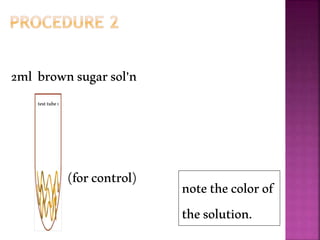
2ml brownsugarsol’n
(forcontrol)
testtube1
2ml brownsugarsol’n
(forcontrol)
notethecolorof
thesolution.
testtube1
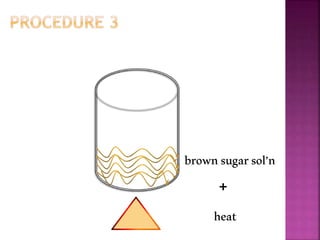
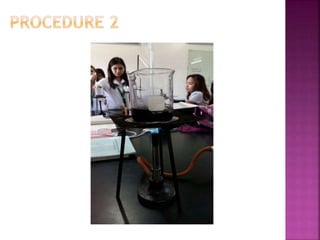
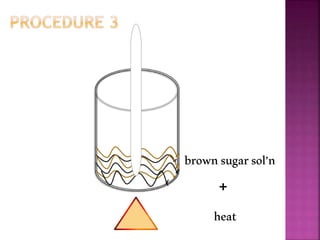
brownsugarsol’n
+
heat
brownsugarsol’n
+
heat
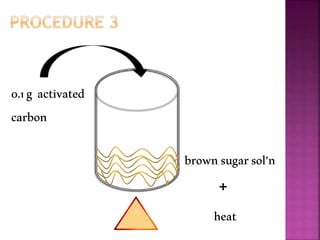
0.1g activated
carbon
brownsugarsol’n
+
heat
testtube2
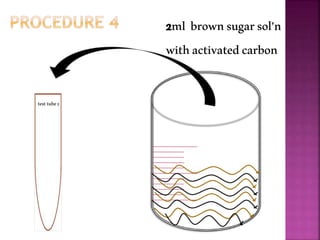
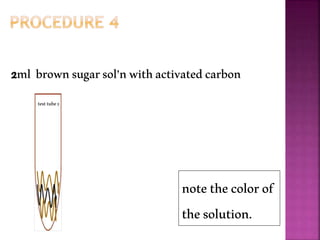
2ml brownsugarsol’n
withactivatedcarbon
testtube2
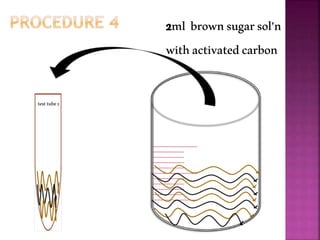
2ml brownsugarsol’n
withactivatedcarbon
testtube2
2ml brownsugarsol’nwithactivatedcarbon
testtube2
notethecolorof
thesolution.
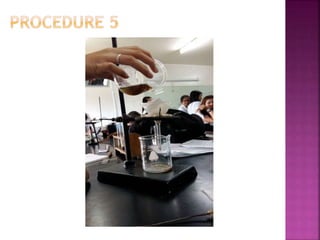
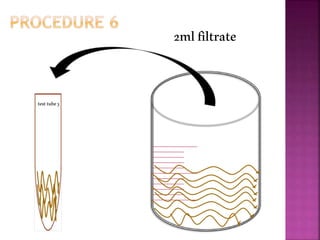
Coolthesolutionforfewminutesandfilterit
usingfilterpaper.
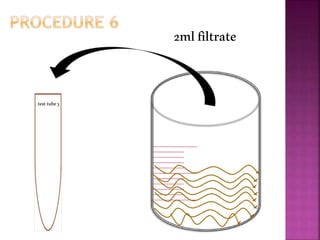
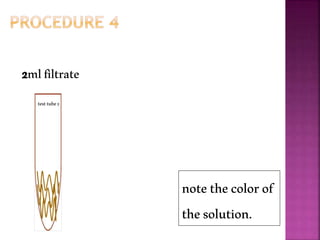
2mlfiltrate
testtube3
2mlfiltrate
testtube3
2mlfiltrate
testtube2
notethecolorof
thesolution.
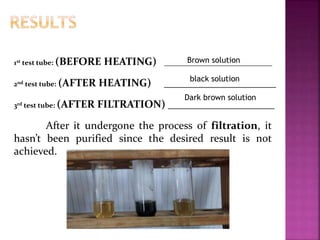
1st test tube: (BEFORE HEATING) ___________________________
2nd test tube: (AFTER HEATING) _____________________
3rd test tube: (AFTER FILTRATION) ____________________
Brown solution
black solution
Dark brown solution
After it undergone the process of filtration, it
hasn’t been purified since the desired result is not
achieved.
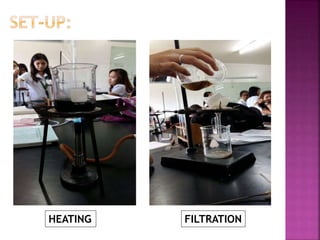
HEATING FILTRATION
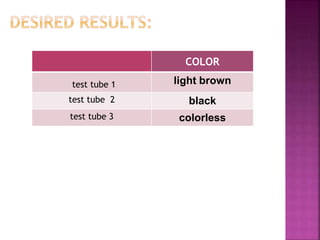
COLOR
test tube 1 light brown
test tube 2 black
test tube 3 colorless
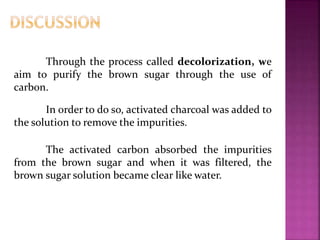
Through the process called decolorization, we
aim to purify the brown sugar through the use of
carbon.
In order to do so, activated charcoal was added to
the solution to remove the impurities.
The activated carbon absorbed the impurities
from the brown sugar and when it was filtered, the
brown sugar solution became clear like water.
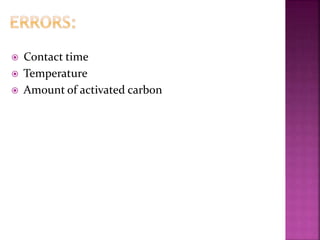
 Contact time
 Temperature
 Amount of activated carbon
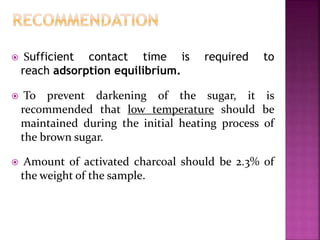
 Sufficient contact time is required to
reach adsorption equilibrium.
 To prevent darkening of the sugar, it is
recommended that low temperature should be
maintained during the initial heating process of
the brown sugar.
 Amount of activated charcoal should be 2.3% of
the weight of the sample.
 Decolorize your solution by adding a small
amount of activated carbon to the warm
(NOT BOILING) sample solution.
Decolorization process is the process of removing
colored impurities in the sol’n.
Activated carbon also called activated charcoal is a
form of carbon processed to have a small, low-
volume pores that increase the surface area available
for absorption.
Temperature: Lower temperatures increase
adsorption capacity.
Activated Carbon is non-polar which results in an
affinity for non-polar compounds such as organics
(eg. Brown sugar).
 When making chemical solutions, always use the
appropriate safety equipment.
 Always follow the appropriate procedures when
doing the experiment
 For a typical experiment, you should plan to
repeat it to obtain the desired result.
 Always consult the instructor for concerns.
 http://www.mctcteach.org/chemistry/C2224
/labman/rc/decolor.htm
 http://www.ids-
environment.com/environment/us/carboche
m/activated_carbon/19_0/s_supplier.html

Decolorization