
UNIT - 11
The p-BLOCK Elements


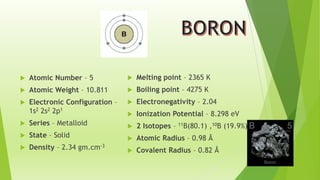
Atomic Number – 5



Melting point – 2365 K



Atomic Weight – 10.811



Boiling point – 4275 K



Electronic Configuration –
1s2 2s2 2p1



Electronegativity – 2.04



Ionization Potential – 8.298 eV



Series – Metalloid



2 Isotopes –



State – Solid



Atomic Radius – 0.98 Å



Density – 2.34 gm.cm-3



Covalent Radius – 0.82 Å

11B(80.1)

,10B (19.9%)




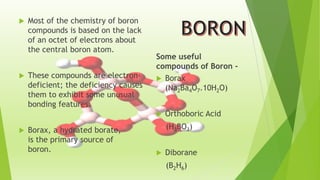
Most of the chemistry of boron
compounds is based on the lack
of an octet of electrons about
the central boron atom.
These compounds are electrondeficient; the deficiency causes
them to exhibit some unusual
bonding features.

Some useful
compounds of Boron  Borax
(Na2Ba4O7.10H2O)




Borax, a hydrated borate,
is the primary source of
boron.

Orthoboric Acid

(H3BO3)


Diborane

(B2H6)
Chemistry Of Boron


Elemental boron is rare and poorly studied because the
material is extremely difficult to prepare.



Most studies on boron involve samples that contain small
amounts of carbon.



Crystalline boron is chemically inert and resistant to attack by
boiling hydrofluoric or hydrochloric acid.



The rate of oxidation of boron depends upon the crystallinity,
particle size, purity and temperature. Boron does not react
with air at room temperature, but at higher temperatures it
burns to form boron trioxide.
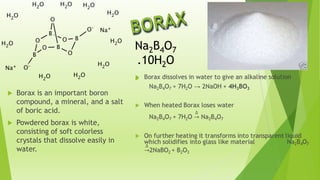
Na2B4O7
.10H2O




Borax is an important boron
compound, a mineral, and a salt
of boric acid.



Powdered borax is white,
consisting of soft colorless
crystals that dissolve easily in
water.
USES



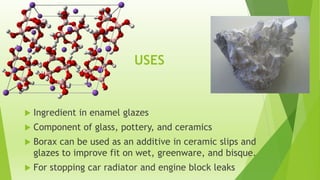
Ingredient in enamel glazes



Component of glass, pottery, and ceramics



Borax can be used as an additive in ceramic slips and
glazes to improve fit on wet, greenware, and bisque.



For stopping car radiator and engine block leaks
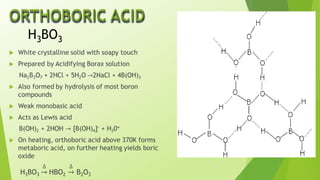
H3BO3

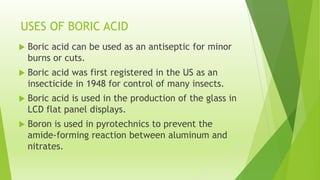
USES OF BORIC ACID


Boric acid can be used as an antiseptic for minor
burns or cuts.



Boric acid was first registered in the US as an
insecticide in 1948 for control of many insects.



Boric acid is used in the production of the glass in
LCD flat panel displays.



Boron is used in pyrotechnics to prevent the
amide-forming reaction between aluminum and
nitrates.
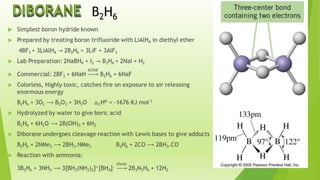
B2H6



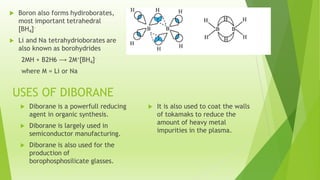
USES OF DIBORANE


Diborane is a powerfull reducing
agent in organic synthesis.



Diborane is largely used in
semiconductor manufacturing.



Diborane is also used for the
production of
borophosphosilicate glasses.



It is also used to coat the walls
of tokamaks to reduce the
amount of heavy metal
impurities in the plasma.
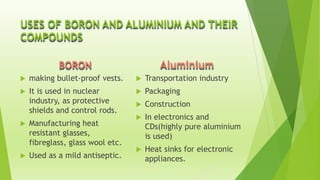
USES OF BORON AND ALUMINIUM AND THEIR
COMPOUNDS
Aluminium

BORON


making bullet-proof vests.



Transportation industry



It is used in nuclear
industry, as protective
shields and control rods.



Packaging



Construction



In electronics and
CDs(highly pure aluminium
is used)



Heat sinks for electronic
appliances.





Manufacturing heat
resistant glasses,
fibreglass, glass wool etc.
Used as a mild antiseptic.
Questions


Why is boric acid considered a weak acid?



Why does boron trifluoride behave as a Lewis
acid?



Is boric acid a protic acid ? Why ?



On heating boric acid, what new compound will
be formed? Which compound of boron will be
formed on further heating?
Group Aman Kumawat
Neil Bhushan
Bosco Chiramel
Rishabh Dev Chawla

P-block elements (Properties of Boron)

  • 1.
    UNIT - 11 Thep-BLOCK Elements
  • 2.
     Atomic Number –5  Melting point – 2365 K  Atomic Weight – 10.811  Boiling point – 4275 K  Electronic Configuration – 1s2 2s2 2p1  Electronegativity – 2.04  Ionization Potential – 8.298 eV  Series – Metalloid  2 Isotopes –  State – Solid  Atomic Radius – 0.98 Å  Density – 2.34 gm.cm-3  Covalent Radius – 0.82 Å 11B(80.1) ,10B (19.9%)
  • 3.
      Most of thechemistry of boron compounds is based on the lack of an octet of electrons about the central boron atom. These compounds are electrondeficient; the deficiency causes them to exhibit some unusual bonding features. Some useful compounds of Boron  Borax (Na2Ba4O7.10H2O)   Borax, a hydrated borate, is the primary source of boron. Orthoboric Acid (H3BO3)  Diborane (B2H6)
  • 4.
    Chemistry Of Boron  Elementalboron is rare and poorly studied because the material is extremely difficult to prepare.  Most studies on boron involve samples that contain small amounts of carbon.  Crystalline boron is chemically inert and resistant to attack by boiling hydrofluoric or hydrochloric acid.  The rate of oxidation of boron depends upon the crystallinity, particle size, purity and temperature. Boron does not react with air at room temperature, but at higher temperatures it burns to form boron trioxide.
  • 5.
    Na2B4O7 .10H2O   Borax is animportant boron compound, a mineral, and a salt of boric acid.  Powdered borax is white, consisting of soft colorless crystals that dissolve easily in water.
  • 6.
    USES  Ingredient in enamelglazes  Component of glass, pottery, and ceramics  Borax can be used as an additive in ceramic slips and glazes to improve fit on wet, greenware, and bisque.  For stopping car radiator and engine block leaks
  • 7.
  • 8.
    USES OF BORICACID  Boric acid can be used as an antiseptic for minor burns or cuts.  Boric acid was first registered in the US as an insecticide in 1948 for control of many insects.  Boric acid is used in the production of the glass in LCD flat panel displays.  Boron is used in pyrotechnics to prevent the amide-forming reaction between aluminum and nitrates.
  • 9.
  • 10.
     USES OF DIBORANE  Diboraneis a powerfull reducing agent in organic synthesis.  Diborane is largely used in semiconductor manufacturing.  Diborane is also used for the production of borophosphosilicate glasses.  It is also used to coat the walls of tokamaks to reduce the amount of heavy metal impurities in the plasma.
  • 11.
    USES OF BORONAND ALUMINIUM AND THEIR COMPOUNDS Aluminium BORON  making bullet-proof vests.  Transportation industry  It is used in nuclear industry, as protective shields and control rods.  Packaging  Construction  In electronics and CDs(highly pure aluminium is used)  Heat sinks for electronic appliances.   Manufacturing heat resistant glasses, fibreglass, glass wool etc. Used as a mild antiseptic.
  • 12.
    Questions  Why is boricacid considered a weak acid?  Why does boron trifluoride behave as a Lewis acid?  Is boric acid a protic acid ? Why ?  On heating boric acid, what new compound will be formed? Which compound of boron will be formed on further heating?
  • 13.
    Group Aman Kumawat NeilBhushan Bosco Chiramel Rishabh Dev Chawla