New Model for  Organic Laboratory  Dell Jensen, Ph.D. Richard Narske, Ph.D.
Commentary - The Problem with Organic Chemistry Labs by Jerry R. Mohrig Mohrig, Jerry R.  J. Chem. Educ.   2004   81  1083.  How to extract knowledge from experimental results is at the heart of science, yet for the most part we don’t attempt to teach this skill in traditional labs.
Problems with Verification Experiments Lack of comprehension and purpose of lab Lack of student engagement/motivation  Poor communication skills Discrepancy between lecture and lab performance/grades
Commentary - The Problem with Organic Chemistry Labs by Jerry R. Mohrig Mohrig, Jerry R.  J. Chem. Educ.   2004   81  1083.  How to extract knowledge from experimental results is at the heart of science, yet for the most part we don’t attempt to teach this skill in traditional labs. “ What we need is to bring thinking about experimental chemistry back into our introductory organic chemistry labs”
Commentary - The Problem with Organic Chemistry Labs by Jerry R. Mohrig Mohrig, Jerry R.  J. Chem. Educ.   2004   81  1083.  How to extract knowledge from experimental results is at the heart of science, yet for the most part we don’t attempt to teach this skill in traditional labs. Goals Interpret results Draw conclusion (extract knowledge) Develop procedures
Recent Literature A New Model for Transitioning Students from the Undergraduate Teaching Laboratory to the Research Laboratory.  Hollenbeck, Jessica J.; Wixson, Emily N.; Geske, Grant D.; Dodge, Matthew W.; Tseng, T. Andrew; Clauss, Allen D.; Blackwell, Helen E.  J. Chem. Educ.   2006,   83,  1835.  A Research-Based Laboratory Course in Organic Chemistry  Newton, Thomas A.; Tracy, Henry J.; Prudenté, Caryn.  J. Chem. Educ.   2006,   83  ,1844.  The State of Organic Teaching Laboratories Horowitz, Gail.  J. Chem. Educ.   2007,   84,  346. Incorporating Guided-Inquiry Learning into the Organic Chemistry Laboratory Gaddis, Barbara A.; Schoffstall, Allen M.  J. Chem. Educ.   2007,   84,  848.  On the Successful Use of Inquiry-Driven Experiments in the Organic Chemistry Laboratory  Mohrig, Jerry R.; Hammond, Christina Noring; Colby, David A.  J. Chem. Educ.   2007,   84,  992.
Laboratory Models Verification (Cookbook) Discovery (Guided-inquiry) Inquiry (Open-ended) Research Based (Projects) Literature Based
Goals for New Laboratory Increase Student Engagement Develop Independence  Improve Communication Skills Close the Grade Gap
A New Model Read Experiments from the Literature Maintain Detailed Notebook Build Lab Skills through trial and error Write Formal Reports
Fall Term Three Techniques Labs (Quals) Unknown Solid and IR spectroscopy Unknown Liquid and NMR Spectroscopy Mixture, Chromatography, and Mass Spectra Mohrig, et. al., Techniques in Organic Chemistry, 2 nd  Ed., W.H. Freeman, 2006 Two Experiments Separation Experiment (choose one of 3) Synthesis Experiment (choose one of 3)
What does this look like? Solid Unknown and IR Spectroscopy: Student will obtain a melting point range of the impure solid and then recrystallized the unknown twice, first in a large test tube (500mg) and then in a Craig Tube (100 mg).  The purity will be verified by a constant melting point range of the recrystallized solid.  The solid may need additional recrystallization to achieve a constant mp.  A solid thin film IR will be taken of the solid and used to characterize the unknown.  The collected data will be used to identify the unknown from a list of possible compounds. Students’ product grade will be based on accuracy of mp, calculation of percent recovery, quality of IR, assignment of the IR peaks and identification of unknown. References:  Melting Point, Mohrig, Chapt. 10, p93-103, Recrystallization, Mohrig, Chapt. 9, p78-92, Infrared, Mohrig, Part 3, Chapt. 18, Solid Film IR, Feist, P.J.; “Sampling Techniques for Organic Solids in IR Spectroscopy:  Thin Solid Films as the Method of Choice in Teaching Laboratories”  J. Chem. Ed .,  78 ,  2001 , 351.
Choose an Experiment Complete one of the following three separation experiments  (only 6 student per experiment per lab section) Exp. 1: Distillation of a Three Component Mixture Craig J. Donahue; "Fractional Distillation and GC Analysis of Hydrocarbon Mixtures."  J. Chem. Ed. ,  79 ,  2002 , 721-723. Exp. 2: Isolation of Rubber L. Volaric and J. Hagen; "The Isolation of Rubber from Milkweed Leaves";  J. Chem. Ed. ,  79 ,  2002 , 91-93. Exp. 3: Extraction of Chlorophyll from Spinach Leaves Quach, Hao T.; Steeper, Robert L.; Griffin, G. William; “An Improved Method for the Extraction and Thin-Layer Chromatography of Chlorophyll a and b from Spinach“  J. Chem. Educ.,   81 ,  2004   385.
Write a Report Title Introduction Experimental (Not a procedure) Results Discussion/Conclusions References Focus on grammar and proper writing style -ACS Style Guide
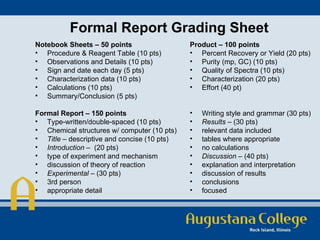
Formal Report Grading Sheet   Notebook Sheets – 50 points Procedure & Reagent Table (10 pts) Observations and Details (10 pts) Sign and date each day (5 pts) Characterization data (10 pts)  Calculations (10 pts) Summary/Conclusion (5 pts) Formal Report – 150 points Type-written/double-spaced (10 pts) Chemical structures w/ computer (10 pts) Title  – descriptive and concise (10 pts) Introduction  –  (20 pts) type of experiment and mechanism discussion of theory of reaction Experimental  – (30 pts) 3rd person appropriate detail Product – 100 points Percent Recovery or Yield (20 pts) Purity (mp, GC) (10 pts) Quality of Spectra (10 pts) Characterization (20 pts) Effort (40 pt)  Writing style and grammar (30 pts) Results  – (30 pts) relevant data included tables where appropriate no calculations Discussion  – (40 pts) explanation and interpretation  discussion of results conclusions focused
Winter Term Complete five experiments from 4 areas Alkenes Alcohols Gringards Dienes & Aromatics Total of sixteen experiments Some double experiments  Formal Reports for all experiments Focus on technical writing Characterization and analysis (interpret)
What does this look like? Alkenes Exp. 1: Poon, T., et al. “Kinetic vs. Thermodynamic Control in Dehydration of 2-Methylcyclopentanol”  J. Chem. Ed .,  1997 ,  74 , 1218.  Double Exp . see Grignards; use GCMS Exp. 2: Centko, R. S., and Mohan, R. S. “Epoxidation of p-Methoxy-trans-b-methylstyrene”  J. Chem. Ed. ,  2001 ,  78 , 77.  Complete both reactions; complete NMR Exp. 3:  Chatla, N., et.al, "An Operationally Simple Hydroboration Experiment.",  J. Chem. Ed.,  1990 ,  67 , 975. Exp. 4: Bromination of Stilbene: "The Evolution of a Green Chemistry Laboratory Experiment:  Greener Bromination of Stilbene." Hutchison, J.E., et.al,  J. Chem. Ed. ,  2005 ,  82 , 306.  Double Exp . Exp. 5: Duty, R.C., and Ryder, B.L., "Grignard Dehydration Reactions.",  J. Chem. Ed. ,  1976 ,  53 , 456.  Double Exp.,  see Grignards, complete at 1/10th in 25 mL RB flask scale, do not flame dry glassware, use oven. GCMS   analysis of both products. Exp. 6: Tomsho, John; McKee, James R.; Zanger, Murray; “A Microscale Synthesis of  the Diastereomers of 2,3-Dibromosuccinic Acid”  J. Chem. Ed.,   76,  1999,  73.
Spring Term Complete two multi-step synthesis experiments Choice of twelve experiments Polished Formal Reports (10-15 pages) Focus on Detailed Discussion and Explanations (Drawing Conclusions)
1 .  “Convergent Synthesis of Betaine-30, a Solvatochromic Dye:  An Advanced Undergraduate Project and Demonstration”; Osterby, Bruce R.; McKelvey, Ronald D.;  J. Chem. Educ.   1996 ,  43 , 260. 2.  “Microscale Synthesis of 1-Bromo-3-chloro-5-iodobenzene:  An Improved Deamination of 4-bromo-2-chloro-6-iodoaniline”; Peter, M.W.; et.al.;  J. Chem. Educ.   2004 ,  80 , 111; Ault, A.; Kraig, R.;  J. Chem. Educ.   1966 , 43 , 213. - Begin this synthesis with the bromination of acetanilide from Ault article and the chlorination is completed using Procedure b. 3.  “A Series of Small Scale, Discover Based Organic Laboratory Experiments Illustrating Concepts of Addition, Substitution, and Rearrangement”; Moroz, J.S.; et.al.  J. Chem. Educ.   2003 ,  80 , 1319. 4.  “Bromination, Elimination, and Polymerization: A 3-Step Sequence for The Preparation of Polystyrene from Ethylbenzene” Sanford, E. M. and Hermann, H. L.;  J. Chem. Ed .,  2000 ,  77 , 1343. & Slough, Greg A. “A Simple, Discovery-Based Laboratory Exercise: The Molecular Mass Determination of Polystyrene”  J. Chem. Ed. ,  1995 ,  72 , 1031.  Characterize the molecular weight of your product using TLC procedure from the Slough article, requires drawing a graph.
Pros & Cons Fine Line between Order & Chaos More initial prep time – no weekly setups More Time Grading Reports, but Fewer Reports Selection of Labs – Flexible and Dynamic No Separate Lab Manual
Results Students more engaged – learn more? Students work independently Students have a choice - ownership Students writing is better Quality of writing improved Rational of arguments stronger Performance better represents ability Stronger correlation between lecture and laboratory
Assessment 5 years of this new Model Literature  Refinements each year No change in ACS Organic Exam All organic students take the Organic Exam Student Evaluations are higher Improvement in Literature Research Course Paper and Oral Presentation
In Closing Copies of the Lab Syllabi Thanks to  Tredway Library, Augustana College Chemistry department colleagues Augustana students  Contact us at: [email_address] [email_address]

Bcce Lab2008

  • 1.
    New Model for Organic Laboratory Dell Jensen, Ph.D. Richard Narske, Ph.D.
  • 2.
    Commentary - TheProblem with Organic Chemistry Labs by Jerry R. Mohrig Mohrig, Jerry R. J. Chem. Educ. 2004 81 1083. How to extract knowledge from experimental results is at the heart of science, yet for the most part we don’t attempt to teach this skill in traditional labs.
  • 3.
    Problems with VerificationExperiments Lack of comprehension and purpose of lab Lack of student engagement/motivation Poor communication skills Discrepancy between lecture and lab performance/grades
  • 4.
    Commentary - TheProblem with Organic Chemistry Labs by Jerry R. Mohrig Mohrig, Jerry R. J. Chem. Educ. 2004 81 1083. How to extract knowledge from experimental results is at the heart of science, yet for the most part we don’t attempt to teach this skill in traditional labs. “ What we need is to bring thinking about experimental chemistry back into our introductory organic chemistry labs”
  • 5.
    Commentary - TheProblem with Organic Chemistry Labs by Jerry R. Mohrig Mohrig, Jerry R. J. Chem. Educ. 2004 81 1083. How to extract knowledge from experimental results is at the heart of science, yet for the most part we don’t attempt to teach this skill in traditional labs. Goals Interpret results Draw conclusion (extract knowledge) Develop procedures
  • 6.
    Recent Literature ANew Model for Transitioning Students from the Undergraduate Teaching Laboratory to the Research Laboratory. Hollenbeck, Jessica J.; Wixson, Emily N.; Geske, Grant D.; Dodge, Matthew W.; Tseng, T. Andrew; Clauss, Allen D.; Blackwell, Helen E. J. Chem. Educ. 2006, 83, 1835. A Research-Based Laboratory Course in Organic Chemistry Newton, Thomas A.; Tracy, Henry J.; Prudenté, Caryn. J. Chem. Educ. 2006, 83 ,1844. The State of Organic Teaching Laboratories Horowitz, Gail. J. Chem. Educ. 2007, 84, 346. Incorporating Guided-Inquiry Learning into the Organic Chemistry Laboratory Gaddis, Barbara A.; Schoffstall, Allen M. J. Chem. Educ. 2007, 84, 848. On the Successful Use of Inquiry-Driven Experiments in the Organic Chemistry Laboratory Mohrig, Jerry R.; Hammond, Christina Noring; Colby, David A. J. Chem. Educ. 2007, 84, 992.
  • 7.
    Laboratory Models Verification(Cookbook) Discovery (Guided-inquiry) Inquiry (Open-ended) Research Based (Projects) Literature Based
  • 8.
    Goals for NewLaboratory Increase Student Engagement Develop Independence Improve Communication Skills Close the Grade Gap
  • 9.
    A New ModelRead Experiments from the Literature Maintain Detailed Notebook Build Lab Skills through trial and error Write Formal Reports
  • 10.
    Fall Term ThreeTechniques Labs (Quals) Unknown Solid and IR spectroscopy Unknown Liquid and NMR Spectroscopy Mixture, Chromatography, and Mass Spectra Mohrig, et. al., Techniques in Organic Chemistry, 2 nd Ed., W.H. Freeman, 2006 Two Experiments Separation Experiment (choose one of 3) Synthesis Experiment (choose one of 3)
  • 11.
    What does thislook like? Solid Unknown and IR Spectroscopy: Student will obtain a melting point range of the impure solid and then recrystallized the unknown twice, first in a large test tube (500mg) and then in a Craig Tube (100 mg). The purity will be verified by a constant melting point range of the recrystallized solid. The solid may need additional recrystallization to achieve a constant mp. A solid thin film IR will be taken of the solid and used to characterize the unknown. The collected data will be used to identify the unknown from a list of possible compounds. Students’ product grade will be based on accuracy of mp, calculation of percent recovery, quality of IR, assignment of the IR peaks and identification of unknown. References: Melting Point, Mohrig, Chapt. 10, p93-103, Recrystallization, Mohrig, Chapt. 9, p78-92, Infrared, Mohrig, Part 3, Chapt. 18, Solid Film IR, Feist, P.J.; “Sampling Techniques for Organic Solids in IR Spectroscopy: Thin Solid Films as the Method of Choice in Teaching Laboratories” J. Chem. Ed ., 78 , 2001 , 351.
  • 12.
    Choose an ExperimentComplete one of the following three separation experiments (only 6 student per experiment per lab section) Exp. 1: Distillation of a Three Component Mixture Craig J. Donahue; "Fractional Distillation and GC Analysis of Hydrocarbon Mixtures." J. Chem. Ed. , 79 , 2002 , 721-723. Exp. 2: Isolation of Rubber L. Volaric and J. Hagen; "The Isolation of Rubber from Milkweed Leaves"; J. Chem. Ed. , 79 , 2002 , 91-93. Exp. 3: Extraction of Chlorophyll from Spinach Leaves Quach, Hao T.; Steeper, Robert L.; Griffin, G. William; “An Improved Method for the Extraction and Thin-Layer Chromatography of Chlorophyll a and b from Spinach“ J. Chem. Educ., 81 , 2004 385.
  • 13.
    Write a ReportTitle Introduction Experimental (Not a procedure) Results Discussion/Conclusions References Focus on grammar and proper writing style -ACS Style Guide
  • 14.
    Formal Report GradingSheet Notebook Sheets – 50 points Procedure & Reagent Table (10 pts) Observations and Details (10 pts) Sign and date each day (5 pts) Characterization data (10 pts) Calculations (10 pts) Summary/Conclusion (5 pts) Formal Report – 150 points Type-written/double-spaced (10 pts) Chemical structures w/ computer (10 pts) Title – descriptive and concise (10 pts) Introduction – (20 pts) type of experiment and mechanism discussion of theory of reaction Experimental – (30 pts) 3rd person appropriate detail Product – 100 points Percent Recovery or Yield (20 pts) Purity (mp, GC) (10 pts) Quality of Spectra (10 pts) Characterization (20 pts) Effort (40 pt) Writing style and grammar (30 pts) Results – (30 pts) relevant data included tables where appropriate no calculations Discussion – (40 pts) explanation and interpretation discussion of results conclusions focused
  • 15.
    Winter Term Completefive experiments from 4 areas Alkenes Alcohols Gringards Dienes & Aromatics Total of sixteen experiments Some double experiments Formal Reports for all experiments Focus on technical writing Characterization and analysis (interpret)
  • 16.
    What does thislook like? Alkenes Exp. 1: Poon, T., et al. “Kinetic vs. Thermodynamic Control in Dehydration of 2-Methylcyclopentanol” J. Chem. Ed ., 1997 , 74 , 1218. Double Exp . see Grignards; use GCMS Exp. 2: Centko, R. S., and Mohan, R. S. “Epoxidation of p-Methoxy-trans-b-methylstyrene” J. Chem. Ed. , 2001 , 78 , 77. Complete both reactions; complete NMR Exp. 3: Chatla, N., et.al, "An Operationally Simple Hydroboration Experiment.", J. Chem. Ed., 1990 , 67 , 975. Exp. 4: Bromination of Stilbene: "The Evolution of a Green Chemistry Laboratory Experiment: Greener Bromination of Stilbene." Hutchison, J.E., et.al, J. Chem. Ed. , 2005 , 82 , 306. Double Exp . Exp. 5: Duty, R.C., and Ryder, B.L., "Grignard Dehydration Reactions.", J. Chem. Ed. , 1976 , 53 , 456. Double Exp., see Grignards, complete at 1/10th in 25 mL RB flask scale, do not flame dry glassware, use oven. GCMS analysis of both products. Exp. 6: Tomsho, John; McKee, James R.; Zanger, Murray; “A Microscale Synthesis of the Diastereomers of 2,3-Dibromosuccinic Acid” J. Chem. Ed., 76, 1999, 73.
  • 17.
    Spring Term Completetwo multi-step synthesis experiments Choice of twelve experiments Polished Formal Reports (10-15 pages) Focus on Detailed Discussion and Explanations (Drawing Conclusions)
  • 18.
    1 . “Convergent Synthesis of Betaine-30, a Solvatochromic Dye: An Advanced Undergraduate Project and Demonstration”; Osterby, Bruce R.; McKelvey, Ronald D.; J. Chem. Educ. 1996 , 43 , 260. 2. “Microscale Synthesis of 1-Bromo-3-chloro-5-iodobenzene: An Improved Deamination of 4-bromo-2-chloro-6-iodoaniline”; Peter, M.W.; et.al.; J. Chem. Educ. 2004 , 80 , 111; Ault, A.; Kraig, R.; J. Chem. Educ. 1966 , 43 , 213. - Begin this synthesis with the bromination of acetanilide from Ault article and the chlorination is completed using Procedure b. 3. “A Series of Small Scale, Discover Based Organic Laboratory Experiments Illustrating Concepts of Addition, Substitution, and Rearrangement”; Moroz, J.S.; et.al. J. Chem. Educ. 2003 , 80 , 1319. 4. “Bromination, Elimination, and Polymerization: A 3-Step Sequence for The Preparation of Polystyrene from Ethylbenzene” Sanford, E. M. and Hermann, H. L.; J. Chem. Ed ., 2000 , 77 , 1343. & Slough, Greg A. “A Simple, Discovery-Based Laboratory Exercise: The Molecular Mass Determination of Polystyrene” J. Chem. Ed. , 1995 , 72 , 1031. Characterize the molecular weight of your product using TLC procedure from the Slough article, requires drawing a graph.
  • 19.
    Pros & ConsFine Line between Order & Chaos More initial prep time – no weekly setups More Time Grading Reports, but Fewer Reports Selection of Labs – Flexible and Dynamic No Separate Lab Manual
  • 20.
    Results Students moreengaged – learn more? Students work independently Students have a choice - ownership Students writing is better Quality of writing improved Rational of arguments stronger Performance better represents ability Stronger correlation between lecture and laboratory
  • 21.
    Assessment 5 yearsof this new Model Literature Refinements each year No change in ACS Organic Exam All organic students take the Organic Exam Student Evaluations are higher Improvement in Literature Research Course Paper and Oral Presentation
  • 22.
    In Closing Copiesof the Lab Syllabi Thanks to Tredway Library, Augustana College Chemistry department colleagues Augustana students Contact us at: [email_address] [email_address]

Editor's Notes

  • #2 Traditional organic laboratory experiments are commonly a series of cookbook procedures that requires little or no engagement on the part of the students. POGIL, open inquiry-based, question-driven laboratories have addressed many of the issues with cookbook chemistry. We would like to present another model, literature-based experiments. “In the Laboratory” was our inspiration and resource for this new laboratory model. Students are provided with a list of articles and are expected to choose an experiment, read and interpret the article, develop an experimental procedure, reproduce the experiment and explain their results. This avenue gives the students a wide range of experiments to select from covering various organic topics within laboratory guidelines. Student use formal reports based on the ACS Style Guide for scientific paper to communicate their results.