PERIODIC VARIATION
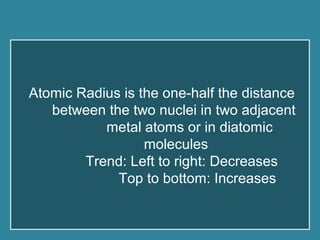
Atomic Radius is the one-half the distance
between the two nuclei in two adjacent
metal atoms or in diatomic
molecules
Trend: Left to right: Decreases
Top to bottom: Increases
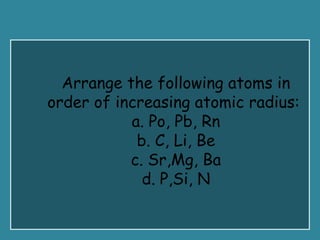
Arrange the following atoms in
order of increasing atomic radius:
a. Po, Pb, Rn
b. C, Li, Be
c. Sr,Mg, Ba
d. P,Si, N
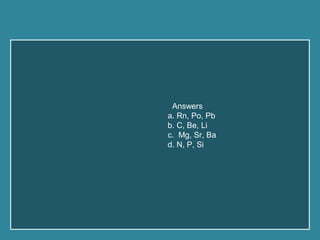
Answers
a. Rn, Po, Pb
b. C, Be, Li
c. Mg, Sr, Ba
d. N, P, Si
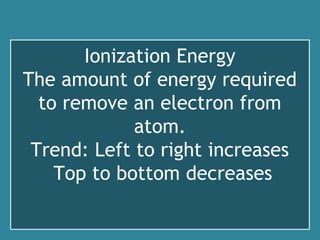
Ionization Energy
The amount of energy required
to remove an electron from
atom.
Trend: Left to right increases
Top to bottom decreases
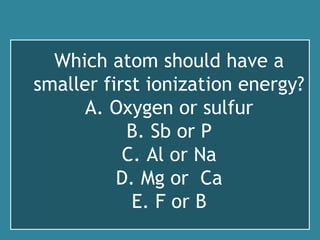
Which atom should have a
smaller first ionization energy?
A. Oxygen or sulfur
B. Sb or P
C. Al or Na
D. Mg or Ca
E. F or B
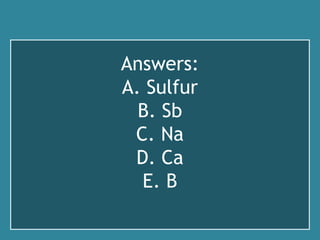
Answers:
A. Sulfur
B. Sb
C. Na
D. Ca
E. B
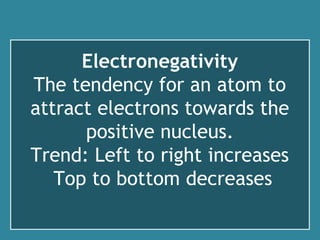
Electronegativity
The tendency for an atom to
attract electrons towards the
positive nucleus.
Trend: Left to right increases
Top to bottom decreases
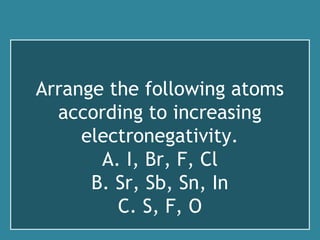
Arrange the following atoms
according to increasing
electronegativity.
A. I, Br, F, Cl
B. Sr, Sb, Sn, In
C. S, F, O
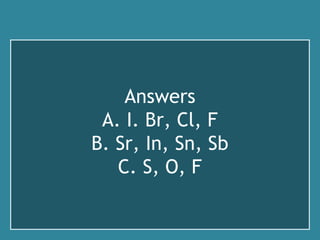
Answers
A. I. Br, Cl, F
B. Sr, In, Sn, Sb
C. S, O, F
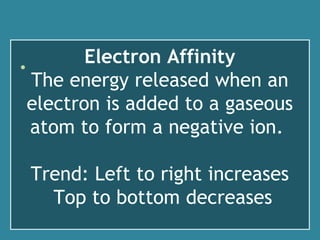
Electron Affinity
The energy released when an
electron is added to a gaseous
atom to form a negative ion.
Trend: Left to right increases
Top to bottom decreases
•
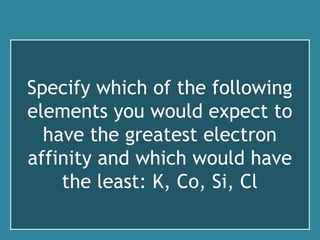
Specify which of the following
elements you would expect to
have the greatest electron
affinity and which would have
the least: K, Co, Si, Cl
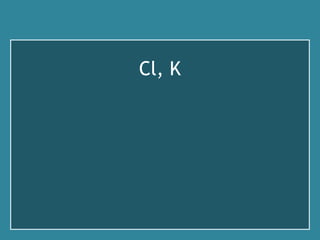
Cl, K

Periodic variations