Steps in Developing Effective
Communication
 Raheel
 Komal
 Faizan
 Salman
 Shahzad
 Ammad
What is Decision Making?
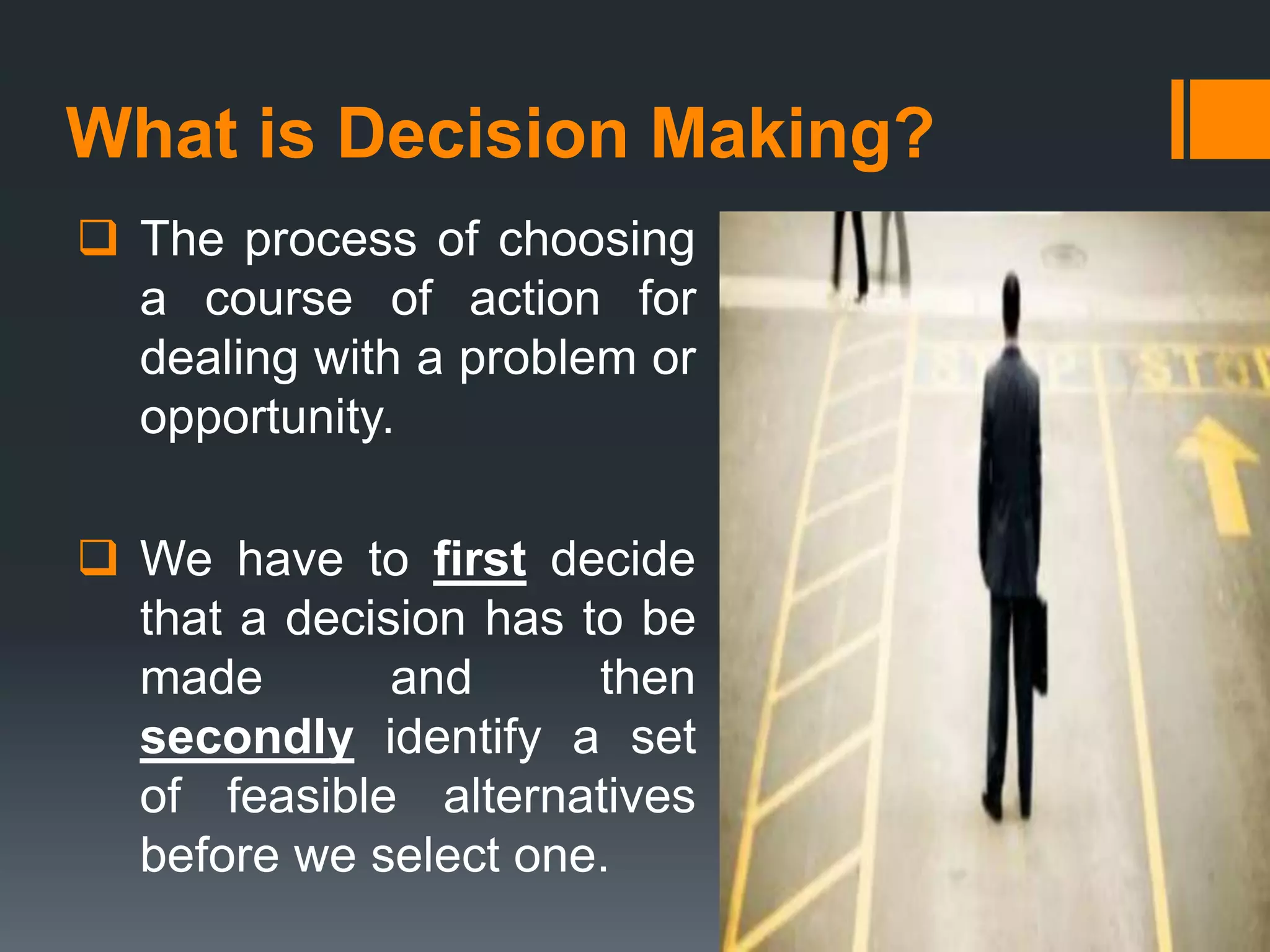
 The process of choosing
a course of action for
dealing with a problem or
opportunity.
 We have to first decide
that a decision has to be
made and then
secondly identify a set
of feasible alternatives
before we select one.
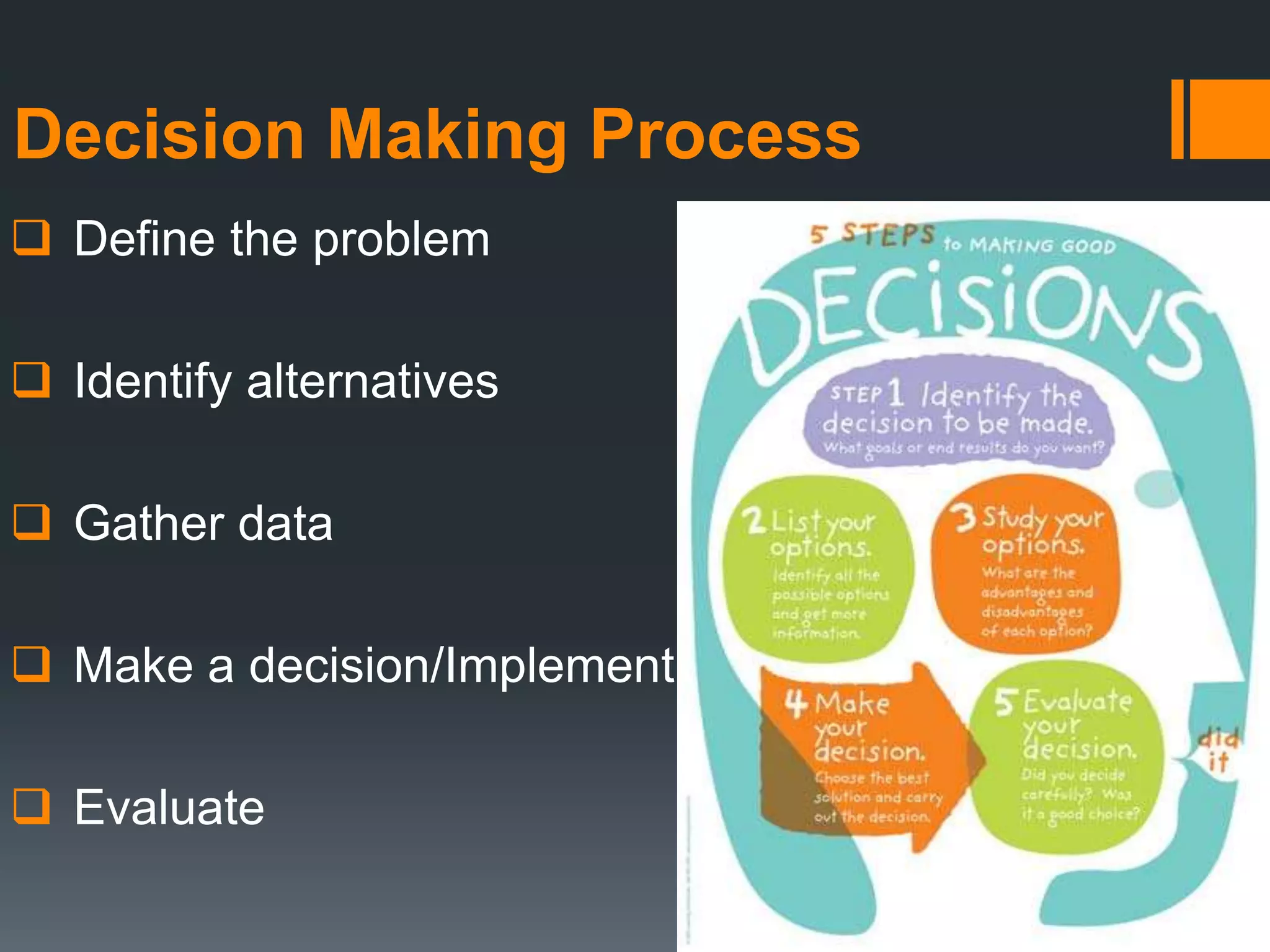
Decision Making Process
 Define the problem
 Identify alternatives
 Gather data
 Make a decision/Implement
 Evaluate
Decision Making in Today’s
Environment
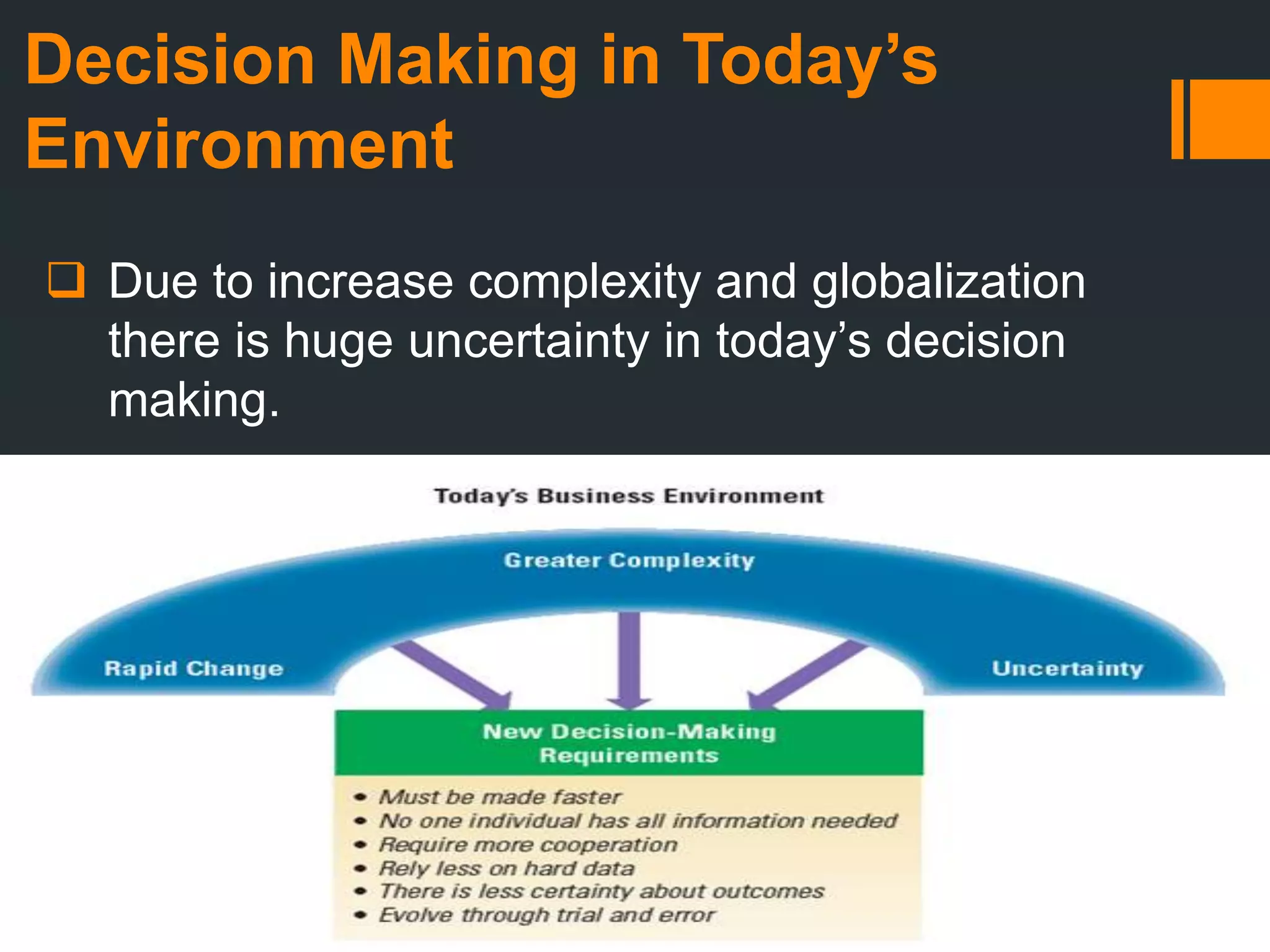
 Due to increase complexity and globalization
there is huge uncertainty in today’s decision
making.
Types of Decisions
 Programmed
Decisions – repetitive
and well defined.
 Nonprogrammed
Decisions – novel
unstructured and occurs
less then programmed
decisions.
Programmed Decisions
 Many decisions regarding
basic operating systems,
procedures and standard
organizational transactions.
 McDonald’s employee are
trained to make the Big Mac
according to specific
procedures.
Nonprogrammed Decisions
 Most of the decisions
made by top managers
involving strategy and
organization design are
nonprogrammed.
 Decisions about mergers,
acquisitions and takeovers.
Decision making Condition
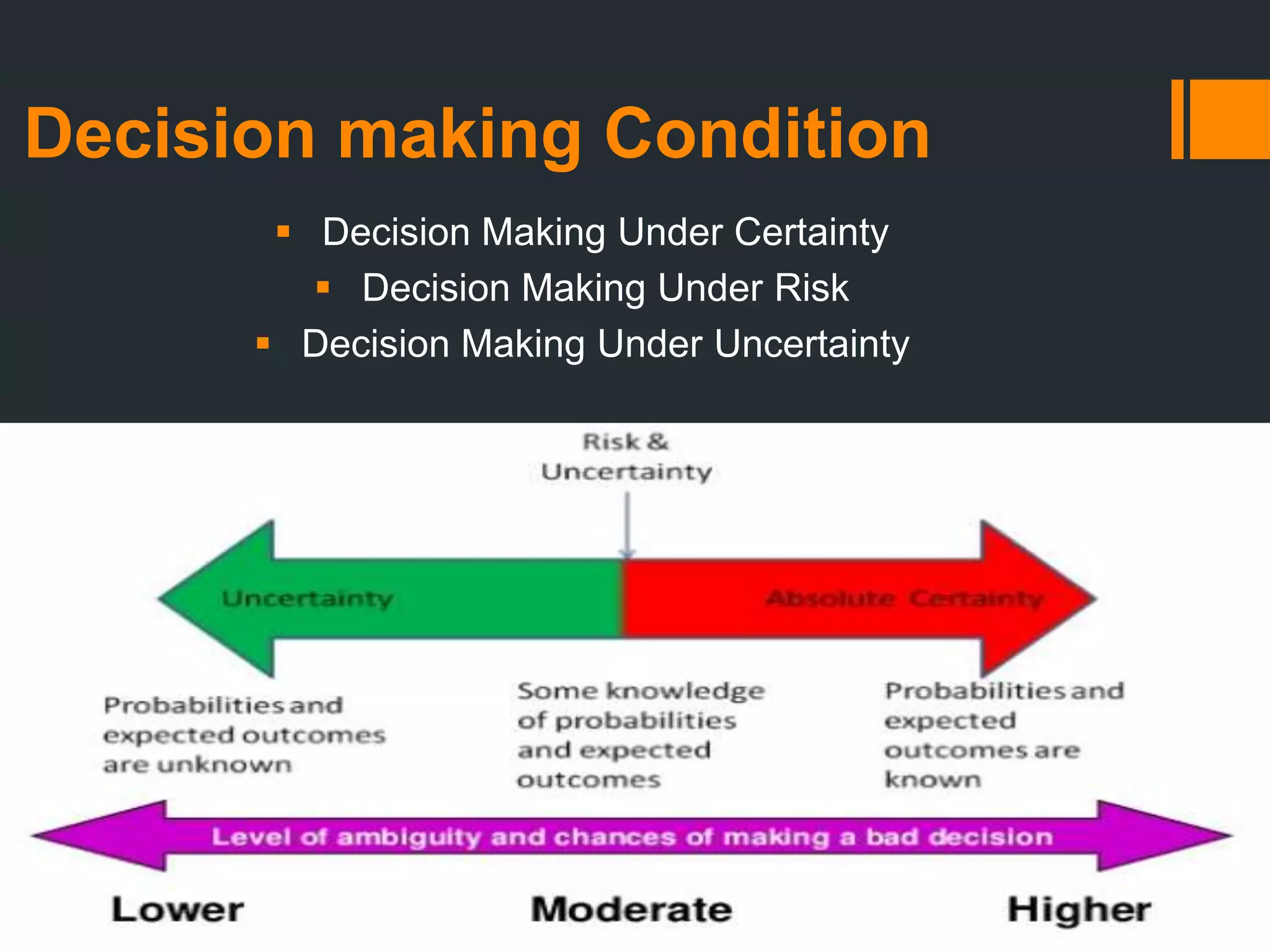
 Decision Making Under Certainty
 Decision Making Under Risk
 Decision Making Under Uncertainty
How to make better Decisions…
 Increase Your Knowledge
 Ask questions.
 Do your research.
 Get experience.
 Use Your Intuition
 A cognitive process whereby a
person instinctively makes a
decision based on his or her
accumulated knowledge and
experience.
Decision Making Shortcuts
 Using a Heuristic
 Applying a rule of thumb or
an approximation as a
shortcut to decision making.
 Anchoring
 Unconsciously giving
disproportionate weight to
the first information
available.
Continue…
 Adopting a Psychological Set
 The tendency to rely on a rigid strategy or
approach when solving a problem.
 Perception (Personal Bias)
 depending on the influence of past
experiences and the person’s present
needs and personality.
Rational Perceptive on Decision
Making
Classical Decision Model:
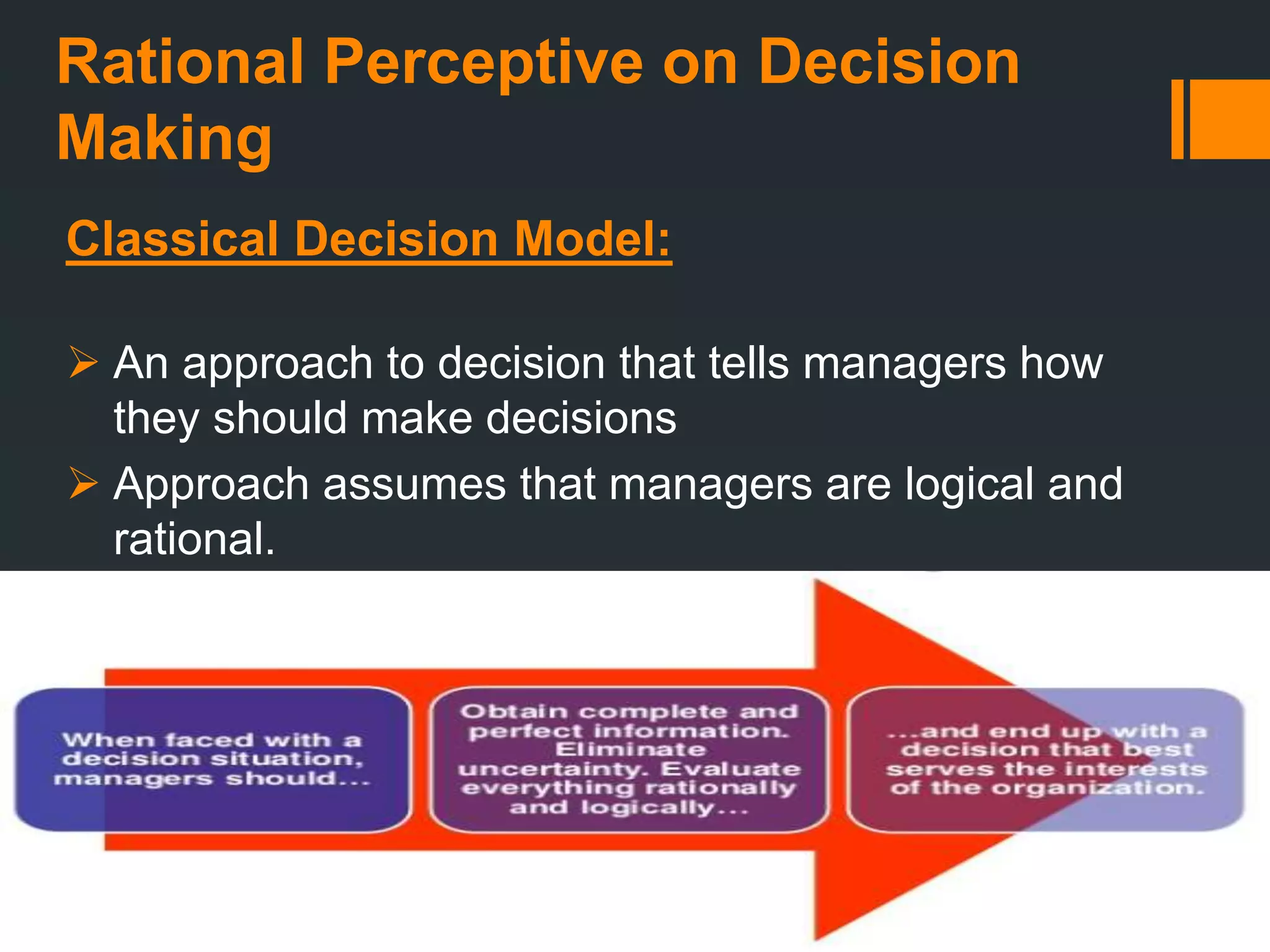
 An approach to decision that tells managers how
they should make decisions
 Approach assumes that managers are logical and
rational.
Rational Perceptive on
Decision Making
Rational Approach:
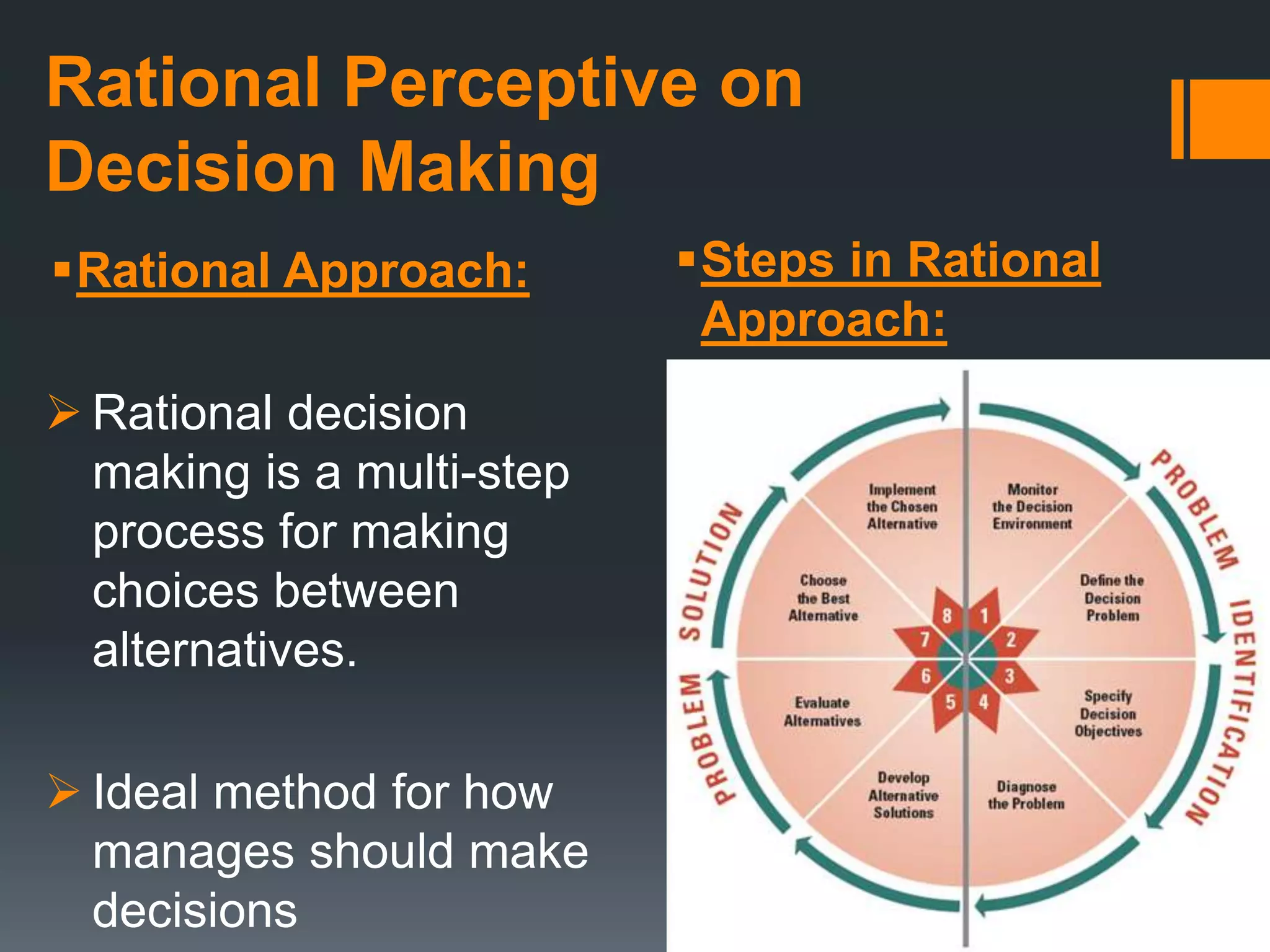
 Rational decision
making is a multi-step
process for making
choices between
alternatives.
 Ideal method for how
manages should make
decisions
Steps in Rational
Approach:
Rational Perceptive on Decision
Making
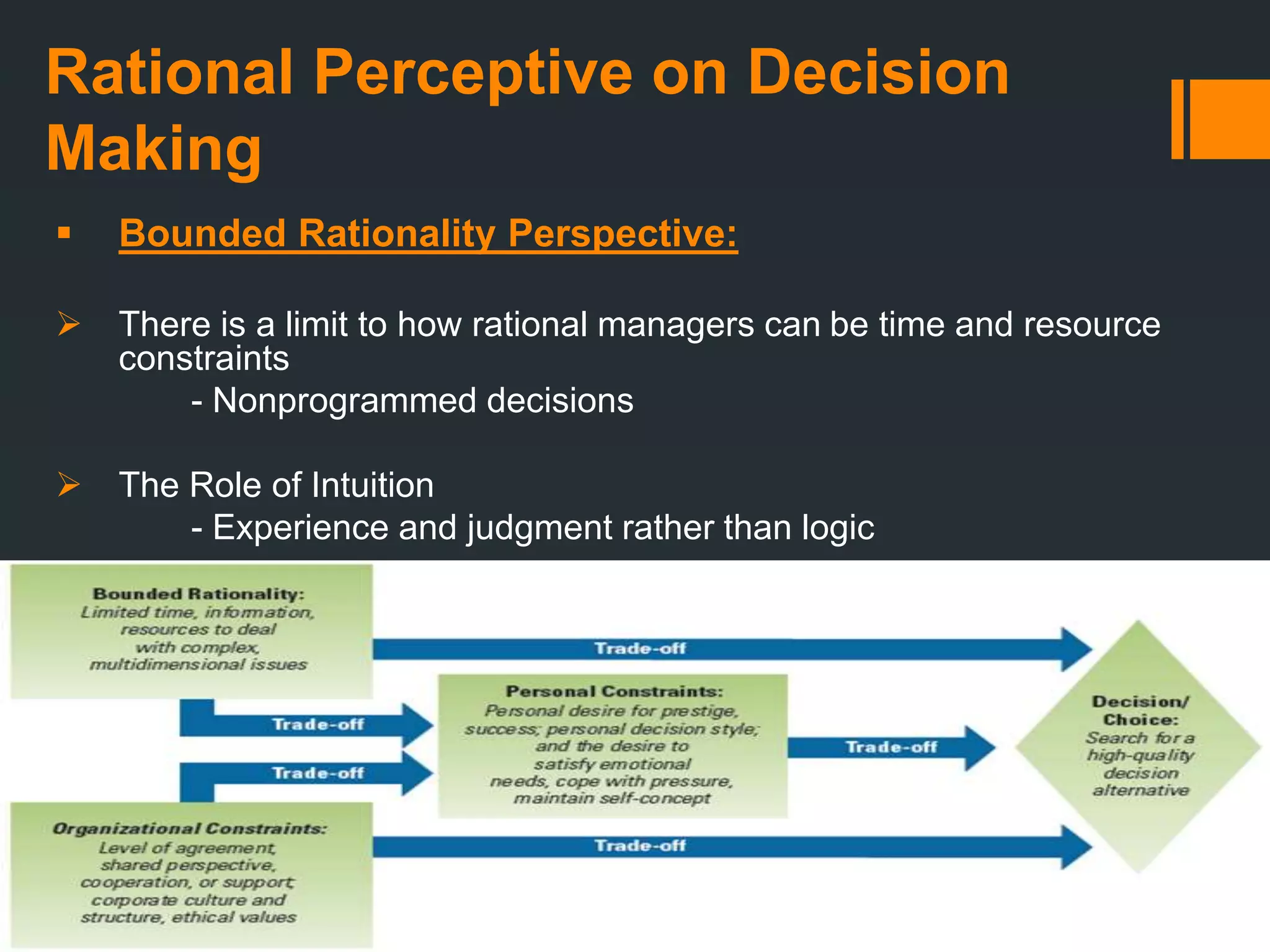
 Bounded Rationality Perspective:
 There is a limit to how rational managers can be time and resource
constraints
- Nonprogrammed decisions
 The Role of Intuition
- Experience and judgment rather than logic
Lesson Learnt…..
All decision-making involves elements of risk
and reward. For every decision there are risks.
Many organizations are structured so that major
decisions are taken at the highest levels. This is
because decisions at the top can have major
effects for the whole organization. At the tactical
and operational levels, the risks are smaller.
Decision making

Decision making

  • 1.
    Steps in DevelopingEffective Communication  Raheel  Komal  Faizan  Salman  Shahzad  Ammad
  • 2.
    What is DecisionMaking?  The process of choosing a course of action for dealing with a problem or opportunity.  We have to first decide that a decision has to be made and then secondly identify a set of feasible alternatives before we select one.
  • 3.
    Decision Making Process Define the problem  Identify alternatives  Gather data  Make a decision/Implement  Evaluate
  • 4.
    Decision Making inToday’s Environment  Due to increase complexity and globalization there is huge uncertainty in today’s decision making.
  • 5.
    Types of Decisions Programmed Decisions – repetitive and well defined.  Nonprogrammed Decisions – novel unstructured and occurs less then programmed decisions.
  • 6.
    Programmed Decisions  Manydecisions regarding basic operating systems, procedures and standard organizational transactions.  McDonald’s employee are trained to make the Big Mac according to specific procedures.
  • 7.
    Nonprogrammed Decisions  Mostof the decisions made by top managers involving strategy and organization design are nonprogrammed.  Decisions about mergers, acquisitions and takeovers.
  • 8.
    Decision making Condition Decision Making Under Certainty  Decision Making Under Risk  Decision Making Under Uncertainty
  • 9.
    How to makebetter Decisions…  Increase Your Knowledge  Ask questions.  Do your research.  Get experience.  Use Your Intuition  A cognitive process whereby a person instinctively makes a decision based on his or her accumulated knowledge and experience.
  • 10.
    Decision Making Shortcuts Using a Heuristic  Applying a rule of thumb or an approximation as a shortcut to decision making.  Anchoring  Unconsciously giving disproportionate weight to the first information available.
  • 11.
    Continue…  Adopting aPsychological Set  The tendency to rely on a rigid strategy or approach when solving a problem.  Perception (Personal Bias)  depending on the influence of past experiences and the person’s present needs and personality.
  • 12.
    Rational Perceptive onDecision Making Classical Decision Model:  An approach to decision that tells managers how they should make decisions  Approach assumes that managers are logical and rational.
  • 13.
    Rational Perceptive on DecisionMaking Rational Approach:  Rational decision making is a multi-step process for making choices between alternatives.  Ideal method for how manages should make decisions Steps in Rational Approach:
  • 14.
    Rational Perceptive onDecision Making  Bounded Rationality Perspective:  There is a limit to how rational managers can be time and resource constraints - Nonprogrammed decisions  The Role of Intuition - Experience and judgment rather than logic
  • 15.
    Lesson Learnt….. All decision-makinginvolves elements of risk and reward. For every decision there are risks. Many organizations are structured so that major decisions are taken at the highest levels. This is because decisions at the top can have major effects for the whole organization. At the tactical and operational levels, the risks are smaller.