What is cochlear implant?
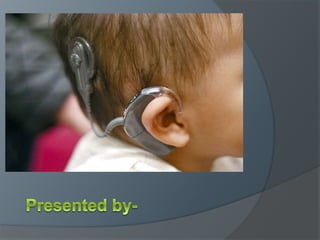
 Cochlear Implant (Bionic Ear) is an
artificial electronic hearing device
designed to produce useful hearing
sensations by stimulating Cochlear
nerve inside the Inner Ear.
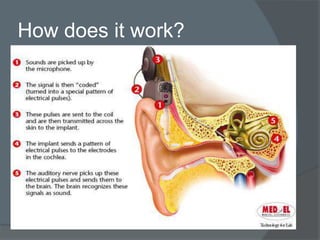
 It transforms the mechanical energy of
sound into electrical energy which
directly excites the remaining auditory
fibers.
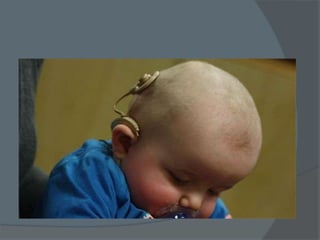
 It is surgically implanted underneath the
skin behind patients ear
Purpose
 A cochlear implant bypass
nonfunctional parts of the ear and
directly stimulating the auditory
nerve.
 It does not merely amplify sound.
 It increases the amount of nervous
response to sound.
 It often improves sound detection
and increases speech understanding
“The more you know about the
past, the better prepared you
are for the future”
Theodore Roosevelt
Historical Background
* In 1751 Benjamin Franklin first suggested
that Electricity could produce hearing
sensation in the Deaf.
* Alessandro Volta (1800) placed metal rods
into both his Ears and connected them to a
source of Electricity. Before he lost
consciousness apparently he heard the
sound of bubbling water.
 *At the end of 19th century, Many famous
Otologists including Politzer, Ritter and
Gradenigo were interested by the finding
that passing an alternating current through
electrodes applied around the ear
produced sound.

In 1934, Andreed, Gersuni and Volkhov
published their report entitled,`Electrical
stimulation of the hearing organ` where an
electrode was placed near the round
window and described various hearing
sensations. Similar finding was reported by
Jones,Stevens and Lurie in 1940. William
F. House began thinking about & working
on possibility of CIs in 1956.
 1957-(French-Algerian surgeons Andre
Djourno and Charles Eyries) ; They were
the first who attempted to produce the first
cochlear implant.
It was single channel device.
The two subject claimed that the devices
helped them greatly with lip reading.
According to Zollner and Keidel(1963),the
Implants in Djurno’s patients were still
functioning 4-5 years later and the auditory
sensations remained unchanged.
 Due to some untoward effects noticed in
subjects implanted by House(1961) and
Simmons et al (1964) leading specialists
urged not to do further Implants until
much more basic animal research had
been completed. This effectively
stopped further clinical work for several
years although much work continued in
laboratory.
 1964- Blair Simmons at Stanford
University implanted some recipients
with a six-channel device.
 However, it was Dr. Michelson's patent
and ultimate device, which are thought
of as the first cochlear implants
 In 1969 human studies began again when
House implanted a further patient. It was a
bold move when House used a six-electrode
system designed by Jack Urban which were
Hardwired. The patient was tested extensively
for two years in the laboratory as, a wearable
external stimulator was not available until
1972. The Result was sufficiently encouraging
and then further 10 patients were Implanted in
1973 and finally despite much criticism the CI
was established as a means of alleviating
Total Deafness. Similar clinical works were
carried out in San Francisco (Merzenich-
1975), France (Chouard et al-1984),Germany
(Benfai et al-1984) and in Austria(Burian et al-
1984) during this period.
 William F. House produced 1st practical CI
in 1984 in conjunction with the House Ear
Inst. & the 3M corporation. With recent
Multichannel Devices it is expected that a
Deaf Child who can Hear with CI will have
the same educational outcome and
employment prospects as a Hearing Child.
 Prof.Graeme Clark of U M is creator &
developer of World’s first M-C Implant &
considered father of CI.
 More Recently, Multichannel Auditory Brain
Stem Implant (ABI) has been developed
based on CI technology. It is indicated in
patients having Bilateral Total Deafness not
suitable for CI (e.g;Bilateral Skull base
fracture, Ossified Cochleas). Here
Electrodes are placed in the entrance of
the 4th Ventricle to stimulate the Auditory
Pathway on the level of 2nd Neuron, the
Cochlear Nucleus Complex. Patients
having ABI have measurable benefits and
reported improvements of life quality.
 The first cochlear implant was invented by
Dr. William House, in 1961.[2] In 1964, Blair
Simmons and Robert J. White implanted a
six channel electrode in a patient's cochlea
at Stanford University.[3]
 The modern multichannel cochlear implant
was independently developed and
commercialized by Graeme Clark from
Australia and Ingeborg Hochmair and her
future husband, Erwin Hochmair, with the
Hochmairs' first implanted in a person in
December 1977 and Clark's in August 1978
Cochlear implant in Bangladesh
 On 13th December,2008 ,3rd time in Sir
Salimullah Medical College& Mitford
Hospital and 1st time in Dhaka Medical
College Hospital 5 Cochlear Implant was
done successfully.
 Now multiple hospitals provide CI
surgery in Bangladesh.
CI in Bangladesh
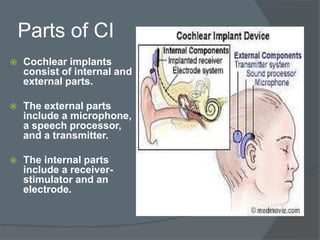
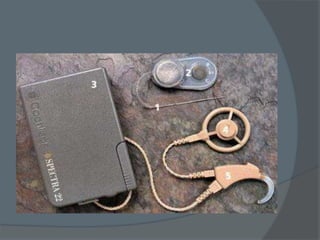
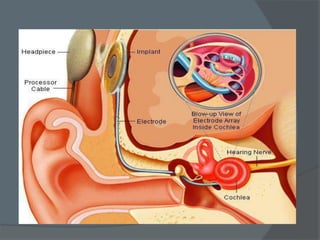
Parts of CI
 Cochlear implants
consist of internal and
external parts.
 The external parts
include a microphone,
a speech processor,
and a transmitter.
 The internal parts
include a receiver-
stimulator and an
electrode.
How does it work?
Selection criteria - children
 pre –lingually deaf children : On child
above 12months below 7 years.
At birth the cochlea is fully formed but the
auditory pathway is not. Auditory pathway is
dependent on stimulation for its maturation
and this stimulation is vital to acquisition of
speech and language skill as well as amount
of cognitive development.
 Post lingual deaf :no age limit
 degree of deafness- profound >90dB SNHL
with poor discrimination in both ears with
cochlear nerve.
 Respond to hearing aid- in those who do not
benefit from a hearing aid ,at least 3 to 6
months of use.
 Absence of contraindications- cochlear aplasia
or absent cochlear nerves are absolute
contraindications to cochlear implantation.
Selection criteria- adult
 Severe or profound hearing loss with
PTA of 70dB or greater heaing level
 Little or no benefit from hearing aids.
 Aided scores on open-set sentence test
of less than 50%.
 No evidence of central auditory lesions
or lack of an auditory nerve.
 No medical or radiological
contraindications for surgery
Pre-Operative Evaluation
 History
• genetic hearing loss
• auditory neuropathydyssynchrony
• Acquired deafness
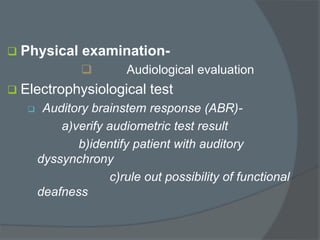
 Physical examination-
 Audiological evaluation
 Electrophysiological test
 Auditory brainstem response (ABR)-
a)verify audiometric test result
b)identify patient with auditory
dyssynchrony
c)rule out possibility of functional
deafness
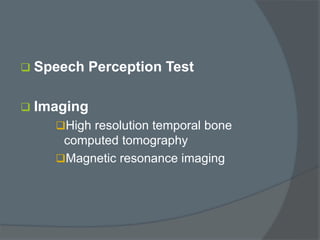
 Speech Perception Test
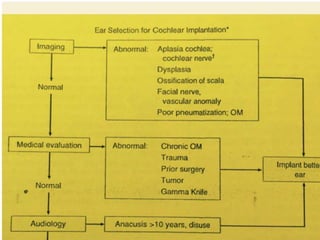
 Imaging
High resolution temporal bone
computed tomography
Magnetic resonance imaging
Cochlear Implant Surgery
 done by an implant team consisting of your
otology surgeon, a cochlear implant
audiologist, a radiologist, and, as needed,
a social worker, a psychologist or
psychiatrist
 Implant surgery is performed under general
anesthesia and lasts from two to three
hours. An incision is made behind the ear
to open the mastoid bone leading to the
middle ear. The procedure may be done as
an outpatient, or may (rarely) require an
overnight stay in the hospital
Post –operative Evaluation
 Device activation after 4-6 weeks
 Auditory rehabilitation after cochlear
implant
- Listening training
- Speech training
- Language training
- Delelopment of communication skills
- Involvement of family members
Rehabilitation
 With children, regular listening, speech
and language therapy would be
maintained for as long as appropriate,
which could be a number of years.
 The goal is to optimize patients’ hearing,
help developing listening and
communication skills, promote speech
and language acquisition and deal with
medical issues.
Complications
As with all operations, there are risks with
this surgery. These include:
 infection at the incision site
 bleeding
 complications related to anesthesia
 transient dizziness
 facial paralysis (rarely)
 temporary taste disturbances
 additional hearing loss
 device failure
 However, it should be noted that serious
surgical complications have been
observed at only one in 10,000
procedures of this type.
 Some long-term risks of the implant
include the unknown effects of
electrical stimulation on the nervous
system.
 It is also possible to damage the
implant's internal components by a
blow to the head, which will render the
device unworkable.
 A further consideration is that the use of(MRI)
for patients with cochlear resonance imaging
implants is not recommended because of the
magnets present in the devices.
 Several companies have developed implants
that do not use magnets or have altered the
receiver-stimulator make up to make it easier
to remove the magnets before testing.
 One fact that reduces the concern about MRI
testing is that for many medical indications,
MRI can be replaced with a computer assisted
tomography scan (CAT or CT scan), which is
not a problem for persons with cochlear
implants.
 Additionally, in July 2002, the Food and
Drug Administration (FDA) issued a
warning about a possible connection
between increased incidence of meningitis
and the presence of a cochlear implant.
 This warning included special vaccine
recommendations for those with implants,
as well as the voluntary removal from the
market of certain devices. Specifically,
those implants that included a positioner to
hold the electrodes in place in the cochlea
appear to be associated with an increased
risk of the disease
Prospect of Cochlear Implant
in Bangladesh
 A good number of patients really need Cochlear
Implant in our country (In USA 500000-700000
could get benefit from CI). In the past we were
not ready to accept the program in our country
due to lack of initiative and high price of the
program. Recently cost (Price of the device,
evaluation, surgery, rehabilitation) of the
program is getting down. Effort is going on for
development of an affordable effective Implant
for developing countries. Very soon we will get a
law-cost high-performance CI.
 We have already done more than 10 Cochlear
Implant Surgery in Dhaka Medical College and
Sir Salimullah Medical College in the
department of Otolaryngology in Bangladesh.
A Cochlear Implant team from India and Uk
help us to complete our dream project.
It is now true that deaf and dumb child will no
longer disable and able to speak again after
Surgery. This arrangement will help
transferring high-tech technology development
of manpower (ENT Surgeons) in Bangladesh
THANK YOU

Cochlear implant

  • 3.
    What is cochlearimplant?  Cochlear Implant (Bionic Ear) is an artificial electronic hearing device designed to produce useful hearing sensations by stimulating Cochlear nerve inside the Inner Ear.
  • 4.
     It transformsthe mechanical energy of sound into electrical energy which directly excites the remaining auditory fibers.  It is surgically implanted underneath the skin behind patients ear
  • 5.
    Purpose  A cochlearimplant bypass nonfunctional parts of the ear and directly stimulating the auditory nerve.  It does not merely amplify sound.  It increases the amount of nervous response to sound.  It often improves sound detection and increases speech understanding
  • 7.
    “The more youknow about the past, the better prepared you are for the future” Theodore Roosevelt
  • 8.
    Historical Background * In1751 Benjamin Franklin first suggested that Electricity could produce hearing sensation in the Deaf. * Alessandro Volta (1800) placed metal rods into both his Ears and connected them to a source of Electricity. Before he lost consciousness apparently he heard the sound of bubbling water.
  • 9.
     *At theend of 19th century, Many famous Otologists including Politzer, Ritter and Gradenigo were interested by the finding that passing an alternating current through electrodes applied around the ear produced sound.
  • 10.
     In 1934, Andreed,Gersuni and Volkhov published their report entitled,`Electrical stimulation of the hearing organ` where an electrode was placed near the round window and described various hearing sensations. Similar finding was reported by Jones,Stevens and Lurie in 1940. William F. House began thinking about & working on possibility of CIs in 1956.
  • 11.
     1957-(French-Algerian surgeonsAndre Djourno and Charles Eyries) ; They were the first who attempted to produce the first cochlear implant. It was single channel device. The two subject claimed that the devices helped them greatly with lip reading. According to Zollner and Keidel(1963),the Implants in Djurno’s patients were still functioning 4-5 years later and the auditory sensations remained unchanged.
  • 12.
     Due tosome untoward effects noticed in subjects implanted by House(1961) and Simmons et al (1964) leading specialists urged not to do further Implants until much more basic animal research had been completed. This effectively stopped further clinical work for several years although much work continued in laboratory.
  • 13.
     1964- BlairSimmons at Stanford University implanted some recipients with a six-channel device.  However, it was Dr. Michelson's patent and ultimate device, which are thought of as the first cochlear implants
  • 14.
     In 1969human studies began again when House implanted a further patient. It was a bold move when House used a six-electrode system designed by Jack Urban which were Hardwired. The patient was tested extensively for two years in the laboratory as, a wearable external stimulator was not available until 1972. The Result was sufficiently encouraging and then further 10 patients were Implanted in 1973 and finally despite much criticism the CI was established as a means of alleviating Total Deafness. Similar clinical works were carried out in San Francisco (Merzenich- 1975), France (Chouard et al-1984),Germany (Benfai et al-1984) and in Austria(Burian et al- 1984) during this period.
  • 15.
     William F.House produced 1st practical CI in 1984 in conjunction with the House Ear Inst. & the 3M corporation. With recent Multichannel Devices it is expected that a Deaf Child who can Hear with CI will have the same educational outcome and employment prospects as a Hearing Child.  Prof.Graeme Clark of U M is creator & developer of World’s first M-C Implant & considered father of CI.
  • 16.
     More Recently,Multichannel Auditory Brain Stem Implant (ABI) has been developed based on CI technology. It is indicated in patients having Bilateral Total Deafness not suitable for CI (e.g;Bilateral Skull base fracture, Ossified Cochleas). Here Electrodes are placed in the entrance of the 4th Ventricle to stimulate the Auditory Pathway on the level of 2nd Neuron, the Cochlear Nucleus Complex. Patients having ABI have measurable benefits and reported improvements of life quality.
  • 17.
     The firstcochlear implant was invented by Dr. William House, in 1961.[2] In 1964, Blair Simmons and Robert J. White implanted a six channel electrode in a patient's cochlea at Stanford University.[3]  The modern multichannel cochlear implant was independently developed and commercialized by Graeme Clark from Australia and Ingeborg Hochmair and her future husband, Erwin Hochmair, with the Hochmairs' first implanted in a person in December 1977 and Clark's in August 1978
  • 18.
    Cochlear implant inBangladesh  On 13th December,2008 ,3rd time in Sir Salimullah Medical College& Mitford Hospital and 1st time in Dhaka Medical College Hospital 5 Cochlear Implant was done successfully.  Now multiple hospitals provide CI surgery in Bangladesh.
  • 19.
  • 20.
    Parts of CI Cochlear implants consist of internal and external parts.  The external parts include a microphone, a speech processor, and a transmitter.  The internal parts include a receiver- stimulator and an electrode.
  • 22.
  • 24.
    Selection criteria -children  pre –lingually deaf children : On child above 12months below 7 years. At birth the cochlea is fully formed but the auditory pathway is not. Auditory pathway is dependent on stimulation for its maturation and this stimulation is vital to acquisition of speech and language skill as well as amount of cognitive development.  Post lingual deaf :no age limit
  • 25.
     degree ofdeafness- profound >90dB SNHL with poor discrimination in both ears with cochlear nerve.  Respond to hearing aid- in those who do not benefit from a hearing aid ,at least 3 to 6 months of use.  Absence of contraindications- cochlear aplasia or absent cochlear nerves are absolute contraindications to cochlear implantation.
  • 26.
    Selection criteria- adult Severe or profound hearing loss with PTA of 70dB or greater heaing level  Little or no benefit from hearing aids.  Aided scores on open-set sentence test of less than 50%.
  • 27.
     No evidenceof central auditory lesions or lack of an auditory nerve.  No medical or radiological contraindications for surgery
  • 28.
    Pre-Operative Evaluation  History •genetic hearing loss • auditory neuropathydyssynchrony • Acquired deafness
  • 29.
     Physical examination- Audiological evaluation  Electrophysiological test  Auditory brainstem response (ABR)- a)verify audiometric test result b)identify patient with auditory dyssynchrony c)rule out possibility of functional deafness
  • 30.
     Speech PerceptionTest  Imaging High resolution temporal bone computed tomography Magnetic resonance imaging
  • 32.
    Cochlear Implant Surgery done by an implant team consisting of your otology surgeon, a cochlear implant audiologist, a radiologist, and, as needed, a social worker, a psychologist or psychiatrist  Implant surgery is performed under general anesthesia and lasts from two to three hours. An incision is made behind the ear to open the mastoid bone leading to the middle ear. The procedure may be done as an outpatient, or may (rarely) require an overnight stay in the hospital
  • 33.
    Post –operative Evaluation Device activation after 4-6 weeks  Auditory rehabilitation after cochlear implant - Listening training - Speech training - Language training - Delelopment of communication skills - Involvement of family members
  • 34.
    Rehabilitation  With children,regular listening, speech and language therapy would be maintained for as long as appropriate, which could be a number of years.  The goal is to optimize patients’ hearing, help developing listening and communication skills, promote speech and language acquisition and deal with medical issues.
  • 36.
    Complications As with alloperations, there are risks with this surgery. These include:  infection at the incision site  bleeding  complications related to anesthesia  transient dizziness  facial paralysis (rarely)  temporary taste disturbances  additional hearing loss  device failure
  • 37.
     However, itshould be noted that serious surgical complications have been observed at only one in 10,000 procedures of this type.  Some long-term risks of the implant include the unknown effects of electrical stimulation on the nervous system.  It is also possible to damage the implant's internal components by a blow to the head, which will render the device unworkable.
  • 38.
     A furtherconsideration is that the use of(MRI) for patients with cochlear resonance imaging implants is not recommended because of the magnets present in the devices.  Several companies have developed implants that do not use magnets or have altered the receiver-stimulator make up to make it easier to remove the magnets before testing.  One fact that reduces the concern about MRI testing is that for many medical indications, MRI can be replaced with a computer assisted tomography scan (CAT or CT scan), which is not a problem for persons with cochlear implants.
  • 39.
     Additionally, inJuly 2002, the Food and Drug Administration (FDA) issued a warning about a possible connection between increased incidence of meningitis and the presence of a cochlear implant.  This warning included special vaccine recommendations for those with implants, as well as the voluntary removal from the market of certain devices. Specifically, those implants that included a positioner to hold the electrodes in place in the cochlea appear to be associated with an increased risk of the disease
  • 40.
    Prospect of CochlearImplant in Bangladesh  A good number of patients really need Cochlear Implant in our country (In USA 500000-700000 could get benefit from CI). In the past we were not ready to accept the program in our country due to lack of initiative and high price of the program. Recently cost (Price of the device, evaluation, surgery, rehabilitation) of the program is getting down. Effort is going on for development of an affordable effective Implant for developing countries. Very soon we will get a law-cost high-performance CI.
  • 41.
     We havealready done more than 10 Cochlear Implant Surgery in Dhaka Medical College and Sir Salimullah Medical College in the department of Otolaryngology in Bangladesh. A Cochlear Implant team from India and Uk help us to complete our dream project. It is now true that deaf and dumb child will no longer disable and able to speak again after Surgery. This arrangement will help transferring high-tech technology development of manpower (ENT Surgeons) in Bangladesh
  • 42.