Hearing Aids & Implantable
Hearing Devices
HEARING AIDS
 Conventional
 Bone

hearing aids

anchored hearing aids (BAHA)

 Implantable

bridge)

hearing aids (vibrant sound
1) Conventional hearing aids


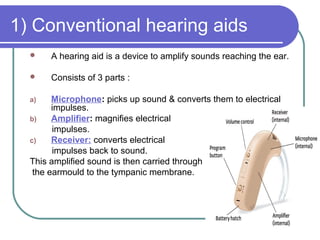
A hearing aid is a device to amplify sounds reaching the ear.



Consists of 3 parts :

Microphone: picks up sound & converts them to electrical
impulses.
b)
Amplifier: magnifies electrical
impulses.
c)
Receiver: converts electrical
impulses back to sound.
This amplified sound is then carried through
the earmould to the tympanic membrane.
a)
Types of Hearing Aids
1)

Air conduction hearing aid- the amplified sound is
transmitted via the ear canal to the tympanic
membrane.
Most of the aids are air conduction type.
They can be of 5 types.


Body-worn types: most common; microphone and
amplifier along with the battery are in one case worn at
the chest level while receiver is situated at the ear
level.
allows high degree of amplification.
useful in severely deaf persons or children with
congenital deafness.


Behind-the-ear (BTE) types: microphone, amplifier
receiver and battery are all in one unit which is worn
behind the ear.
It is coupled to the ear canal with a tubing and an
earmould.
useful for slight to moderate cases of hearing loss.


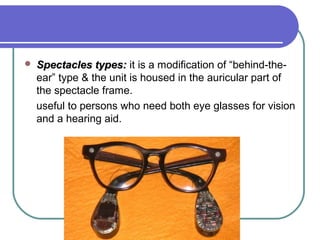
Spectacles types: it is a modification of “behind-theear” type & the unit is housed in the auricular part of
the spectacle frame.
useful to persons who need both eye glasses for vision
and a hearing aid.


In-the-ear (ITE) types: The entire hearing aid is
housed in an earmould which can be worn in the ear.
useful in mild to moderate hearing loss.
very popular because of their cosmetic appeal.


Canal types (ITC & CIC): The hearing aid is so small
that the entire aid can be worn in the ear canal without
projecting into the concha.
For using this aid, it is required that the ear canal
should be large and wide and the patient should have
dexterity to manipulate the minute controls in the aid.
useful in mild to moderate hearing loss.
2 types available- in the canal (ITC) &still smaller and
invisible type, completely in the canal (CIC).
2)

Bone conduction hearing aidinstead of a receiver, it has a bone vibrator which
snugly fits on the mastoid & directly stimulates the
cochlea.
useful in persons with actively draining ears, otitis
externa or atresia of the ear canal when ear-inserts
cannot be worn.
Indications for Hearing Aid


Any individual who has a hearing problem that
cannot be helped by medical or surgical
means is a candidate of hearing aid.
Fitting a Hearing Aid
Consideration is given to :






Degree of hearing loss
Configuration of hearing loss (type of frequencies
affected)
Type of hearing loss (conductive or sensorineural)
Presence of recruitment
Uncomfortable loudness level






Age & dexterity of patient
Condition of the outer and middle ear
Cosmetic acceptance of the aid
Type of earmould
The type of fitting; whether it is monoaural (one aid
only), binaural (one aid for each ear), binaural with yconnection (one aid but two receivers, one for each
ear) or the CROS type.
CROS (contralateral routing of signals) –
microphone is fitted on the side of the deaf ear and the
sound thus picked up is passed to the receiver placed
in the better ear.
This is useful for persons with one ear severely
impaired & helps in sound localisation coming from the
side of the deaf ear.
Now bone-anchored hearing aids (BAHA) are being
preferred for single-sided deafness & have replaced
the use of CROS aids.
2) Bone-anchored Hearing Aids
(BAHA)


1)
2)
3)

Based on the principle of bone conduction.
Has 3 components:
Titanium fixture
Titanium abutment
Sound processor
The titanium fixture is surgically embedded in the
skull bone with abutment exposed outside the skin.
The titanium fixture bonds with the surrounding
tissue in a process called osseointegration.
The sound processor is attached to the abutment
once osseointegration is complete which usually
takes 2 to 6 months after implantation.
Indications for BAHA





when air-conduction hearing aid cannot be used.
- canal atresia, congenital or acquired, not amenable
to trtmnt.
- c/c ear discharge, not amenable to trtmnt
- excessive feedback & discomfort from airconduction hearing aid.
Conductive or mixed hearing loss, e.g. otosclerosis &
tympanosclerosis where surgery is contraindicated.
Single-sided hearing loss


BAHA have replaced the use of CROS aids.



The BAHA device can be implanted on the side of
deaf ear, and it transmits the sound by means of bone
conduction to the contralateral cochlea.



The BAHA is fixed on the deaf side & collects sound
waves to transmit to healthy cochlea of the other side.



This process eliminates the head-shadow effect and
allows for hearing from both sides of the head
Surgery




typically performed in a single stage in adults.
Abt 3 months are allowed for osseointegration bfr the
sound processor can be attached.
2 stage procedure is recommended in children in
whom the fixture is placed into the bone in the first
stage. After abt 6 months to allow for osseointegration,
a second stage operation is done to connect the
abutment through the skin to the fixture.
Complications
•

Few

•

Failure to osseointegrate the implant

•

local infections and inflammation at the implant site.
3) Implantable Hearing Aids


Works on a direct drive principle.



Rather than delivering acoustic energy into the
external auditory canal (as with traditional hearing aid
systems), direct drive middle ear implant systems use
mechanical vibrations delivered directly to the
ossicular chain, while leaving the ear canal open.
Implantable middle ear devices are generally available
in 2 types :
 Piezoelectric devices: operates by passing an
electric current into a piezoceramic crystal, which
changes its volume and thereby produce a vibratory
signal. This piezoelectric transducer in turn is coupled
to the ossicles and drives the ossicular chain by
vibration.
 Electromagnetic hearing devices: function by
passing an electric current into a coil, which creates a
magnetic flux that drives an adjacent magnet. The
small magnet is attached to one of the ossicles of the
middle ear to convey vibrations to the cochlea.
Vibrant soundbridge device
•
•
•

•

Semi-implantable device
2 components – internal & external
The internal component is called VORP (Vibrating
Ossicular Prosthesis) and is made up of 3 partsreceiver, FMT (Floating Mass Transducer) and a
receiver
conductor link between the two.
The external component is called the audio
processor which is worn behind the ear. It contains a
microphone that picks up sound from the environment
and transmits it across the skin by radiofrequency
waves to the internal receiver.
Candidacy profile


Adults aged 18 yrs and older with moderate to severe
sensorineural hearing loss.



Candidates should have experience of using traditional
hearing aids and should have a desire for an
alternative hearing system.
Procedure







The internal device is surgically implanted.
Conducted under general anaesthesia.
The receiver of the implant is positioned under the skin
over the mastoid bone via a std cortical
mastoidectomy and posterior tymapanotomy
approach.
The ossicular chain is visualised and the FMT is
attached to the long process of incus.
6 to 8 weeks after the procedure, the patient is fitted
with the external audio processor.
Advantages





A direct drive system provides mechanical energy
directly to the ossicles, bypassing the ear canal and
the tympanic membrane.
Eliminates occlusion, feedback, discomfort and wax
related problems.
Provide improved sound quality to the hearingimpaired subjects.
Disadvantages of conventional hearing aids








Cosmetically unacceptable due to visibility
Acoustic feedback
Spectral distortion
Occlusion of external auditory canal
Collection of wax in the canal and blockage of insert
Sensitivity of canal skin to earmoulds
Problem to use in discharging ears
IMPLANTS
 Cochlear
 Auditory

implants

brainstem implants
1) Cochlear implants


Electronic device that can provide useful hearing and
improved communication abilities for persons who
have severe to profound hearing loss and who cannot
benefit from hearing aids.



Works by producing meaningful electrical stimulation
of the auditory nerve.





Components- external
internal
External component: consists of an external speech
processor and a transmitter.
Internal component: it is surgically implanted and
comprises the receiver/stimulator package with an
electrode array.
Candidacy profile
Used both in children and adults.
 Bilateral severe to profound sensorineural hearing
loss.
 Little or no benefit from hearing aids.
 No medical contraindication for surgery
 Realistic expectation
 Good family & social support toward habilitation
 Adequate cognitive function to be able to use the
device.
Outcomes of cochlear implantation
Factors that predict a successful clinical outcome are :
 Previous auditory experience (post-lingual pts or prior
use of hearing aids)
 Younger age at implantation ( especially for pre-lingual
children)
 Shorter duration of deafness
 Neural plasticity within the auditory system
Surgery


i)

Carried out under general anaesthesia
There are broadly 2 surgical techniques:
The facial recess approach where a simple cortical
mastoidectomy is done first & the short process of the incus and
the lateral semicircular canal are identified.
The facial recess is opened by performing a posterior
tympanotomy.
The stapes, promontory and round window are identified.
Cochleostomy is performed antero-inferior to the round window
membrane to a diameter of 1 to 1.6 mm depending on the
electrode used.
ii) The pericanal technique where a tympanomeatal flap
is elevated to perform a cochleostomy either by
endaural or postaural approach.
a bony tunnel is drilled along the external canal
towards the middle ear.
Complications of Cochlear Implant Surgery
Early complications
 Facial paralysis
 Wound infection
 Wound dehiscence
 Flap necrosis
 Electrode migration
 Device failure
 CSF leak
 Meningitis
Late complications
 Exposure of device and extrusion
 Pain at the site of implant
 Migration/displacement of device
 Late device failure
 Otitis media
2) Auditory Brainstem Implant (ABI)





Designed to stimulate cochlear nuclear complex in the
brainstem directly by placing the implant in the lateral
recess of the fourth ventricle.
Such implant is needed when CN VIII has been
severed in surgery of vestibular schwannoma.
ABI help in communication, awareness and
recognition of environmental sounds; however they
are not efficient as multichannel cochlear implants.
Thank you

Hearing aids & implantable hearing devices

  • 1.
    Hearing Aids &Implantable Hearing Devices
  • 2.
    HEARING AIDS  Conventional Bone hearing aids anchored hearing aids (BAHA)  Implantable bridge) hearing aids (vibrant sound
  • 3.
    1) Conventional hearingaids  A hearing aid is a device to amplify sounds reaching the ear.  Consists of 3 parts : Microphone: picks up sound & converts them to electrical impulses. b) Amplifier: magnifies electrical impulses. c) Receiver: converts electrical impulses back to sound. This amplified sound is then carried through the earmould to the tympanic membrane. a)
  • 4.
    Types of HearingAids 1) Air conduction hearing aid- the amplified sound is transmitted via the ear canal to the tympanic membrane. Most of the aids are air conduction type. They can be of 5 types.
  • 5.
     Body-worn types: mostcommon; microphone and amplifier along with the battery are in one case worn at the chest level while receiver is situated at the ear level. allows high degree of amplification. useful in severely deaf persons or children with congenital deafness.
  • 6.
     Behind-the-ear (BTE) types:microphone, amplifier receiver and battery are all in one unit which is worn behind the ear. It is coupled to the ear canal with a tubing and an earmould. useful for slight to moderate cases of hearing loss.
  • 7.
     Spectacles types: itis a modification of “behind-theear” type & the unit is housed in the auricular part of the spectacle frame. useful to persons who need both eye glasses for vision and a hearing aid.
  • 8.
     In-the-ear (ITE) types:The entire hearing aid is housed in an earmould which can be worn in the ear. useful in mild to moderate hearing loss. very popular because of their cosmetic appeal.
  • 9.
     Canal types (ITC& CIC): The hearing aid is so small that the entire aid can be worn in the ear canal without projecting into the concha. For using this aid, it is required that the ear canal should be large and wide and the patient should have dexterity to manipulate the minute controls in the aid. useful in mild to moderate hearing loss. 2 types available- in the canal (ITC) &still smaller and invisible type, completely in the canal (CIC).
  • 11.
    2) Bone conduction hearingaidinstead of a receiver, it has a bone vibrator which snugly fits on the mastoid & directly stimulates the cochlea. useful in persons with actively draining ears, otitis externa or atresia of the ear canal when ear-inserts cannot be worn.
  • 12.
    Indications for HearingAid  Any individual who has a hearing problem that cannot be helped by medical or surgical means is a candidate of hearing aid.
  • 13.
    Fitting a HearingAid Consideration is given to :      Degree of hearing loss Configuration of hearing loss (type of frequencies affected) Type of hearing loss (conductive or sensorineural) Presence of recruitment Uncomfortable loudness level
  • 14.
         Age & dexterityof patient Condition of the outer and middle ear Cosmetic acceptance of the aid Type of earmould The type of fitting; whether it is monoaural (one aid only), binaural (one aid for each ear), binaural with yconnection (one aid but two receivers, one for each ear) or the CROS type.
  • 15.
    CROS (contralateral routingof signals) – microphone is fitted on the side of the deaf ear and the sound thus picked up is passed to the receiver placed in the better ear. This is useful for persons with one ear severely impaired & helps in sound localisation coming from the side of the deaf ear. Now bone-anchored hearing aids (BAHA) are being preferred for single-sided deafness & have replaced the use of CROS aids.
  • 16.
    2) Bone-anchored HearingAids (BAHA)   1) 2) 3) Based on the principle of bone conduction. Has 3 components: Titanium fixture Titanium abutment Sound processor The titanium fixture is surgically embedded in the skull bone with abutment exposed outside the skin. The titanium fixture bonds with the surrounding tissue in a process called osseointegration. The sound processor is attached to the abutment once osseointegration is complete which usually takes 2 to 6 months after implantation.
  • 18.
    Indications for BAHA    whenair-conduction hearing aid cannot be used. - canal atresia, congenital or acquired, not amenable to trtmnt. - c/c ear discharge, not amenable to trtmnt - excessive feedback & discomfort from airconduction hearing aid. Conductive or mixed hearing loss, e.g. otosclerosis & tympanosclerosis where surgery is contraindicated. Single-sided hearing loss
  • 19.
     BAHA have replacedthe use of CROS aids.  The BAHA device can be implanted on the side of deaf ear, and it transmits the sound by means of bone conduction to the contralateral cochlea.  The BAHA is fixed on the deaf side & collects sound waves to transmit to healthy cochlea of the other side.  This process eliminates the head-shadow effect and allows for hearing from both sides of the head
  • 20.
    Surgery    typically performed ina single stage in adults. Abt 3 months are allowed for osseointegration bfr the sound processor can be attached. 2 stage procedure is recommended in children in whom the fixture is placed into the bone in the first stage. After abt 6 months to allow for osseointegration, a second stage operation is done to connect the abutment through the skin to the fixture.
  • 21.
    Complications • Few • Failure to osseointegratethe implant • local infections and inflammation at the implant site.
  • 22.
    3) Implantable HearingAids  Works on a direct drive principle.  Rather than delivering acoustic energy into the external auditory canal (as with traditional hearing aid systems), direct drive middle ear implant systems use mechanical vibrations delivered directly to the ossicular chain, while leaving the ear canal open.
  • 23.
    Implantable middle eardevices are generally available in 2 types :  Piezoelectric devices: operates by passing an electric current into a piezoceramic crystal, which changes its volume and thereby produce a vibratory signal. This piezoelectric transducer in turn is coupled to the ossicles and drives the ossicular chain by vibration.  Electromagnetic hearing devices: function by passing an electric current into a coil, which creates a magnetic flux that drives an adjacent magnet. The small magnet is attached to one of the ossicles of the middle ear to convey vibrations to the cochlea.
  • 24.
    Vibrant soundbridge device • • • • Semi-implantabledevice 2 components – internal & external The internal component is called VORP (Vibrating Ossicular Prosthesis) and is made up of 3 partsreceiver, FMT (Floating Mass Transducer) and a receiver conductor link between the two. The external component is called the audio processor which is worn behind the ear. It contains a microphone that picks up sound from the environment and transmits it across the skin by radiofrequency waves to the internal receiver.
  • 27.
    Candidacy profile  Adults aged18 yrs and older with moderate to severe sensorineural hearing loss.  Candidates should have experience of using traditional hearing aids and should have a desire for an alternative hearing system.
  • 28.
    Procedure      The internal deviceis surgically implanted. Conducted under general anaesthesia. The receiver of the implant is positioned under the skin over the mastoid bone via a std cortical mastoidectomy and posterior tymapanotomy approach. The ossicular chain is visualised and the FMT is attached to the long process of incus. 6 to 8 weeks after the procedure, the patient is fitted with the external audio processor.
  • 29.
    Advantages    A direct drivesystem provides mechanical energy directly to the ossicles, bypassing the ear canal and the tympanic membrane. Eliminates occlusion, feedback, discomfort and wax related problems. Provide improved sound quality to the hearingimpaired subjects.
  • 30.
    Disadvantages of conventionalhearing aids        Cosmetically unacceptable due to visibility Acoustic feedback Spectral distortion Occlusion of external auditory canal Collection of wax in the canal and blockage of insert Sensitivity of canal skin to earmoulds Problem to use in discharging ears
  • 31.
  • 32.
    1) Cochlear implants  Electronicdevice that can provide useful hearing and improved communication abilities for persons who have severe to profound hearing loss and who cannot benefit from hearing aids.  Works by producing meaningful electrical stimulation of the auditory nerve.
  • 33.
       Components- external internal External component:consists of an external speech processor and a transmitter. Internal component: it is surgically implanted and comprises the receiver/stimulator package with an electrode array.
  • 36.
    Candidacy profile Used bothin children and adults.  Bilateral severe to profound sensorineural hearing loss.  Little or no benefit from hearing aids.  No medical contraindication for surgery  Realistic expectation  Good family & social support toward habilitation  Adequate cognitive function to be able to use the device.
  • 37.
    Outcomes of cochlearimplantation Factors that predict a successful clinical outcome are :  Previous auditory experience (post-lingual pts or prior use of hearing aids)  Younger age at implantation ( especially for pre-lingual children)  Shorter duration of deafness  Neural plasticity within the auditory system
  • 38.
    Surgery   i) Carried out undergeneral anaesthesia There are broadly 2 surgical techniques: The facial recess approach where a simple cortical mastoidectomy is done first & the short process of the incus and the lateral semicircular canal are identified. The facial recess is opened by performing a posterior tympanotomy. The stapes, promontory and round window are identified. Cochleostomy is performed antero-inferior to the round window membrane to a diameter of 1 to 1.6 mm depending on the electrode used.
  • 39.
    ii) The pericanaltechnique where a tympanomeatal flap is elevated to perform a cochleostomy either by endaural or postaural approach. a bony tunnel is drilled along the external canal towards the middle ear.
  • 40.
    Complications of CochlearImplant Surgery Early complications  Facial paralysis  Wound infection  Wound dehiscence  Flap necrosis  Electrode migration  Device failure  CSF leak  Meningitis
  • 41.
    Late complications  Exposureof device and extrusion  Pain at the site of implant  Migration/displacement of device  Late device failure  Otitis media
  • 42.
    2) Auditory BrainstemImplant (ABI)    Designed to stimulate cochlear nuclear complex in the brainstem directly by placing the implant in the lateral recess of the fourth ventricle. Such implant is needed when CN VIII has been severed in surgery of vestibular schwannoma. ABI help in communication, awareness and recognition of environmental sounds; however they are not efficient as multichannel cochlear implants.
  • 44.