

AUDITORY NEUROPATHY
Presenter : Guide:
Alok singh Mr.Ajay Mishra
Introduction:
“Auditory neuropathy is a hearing disorder in which
sound enters the inner ear normally but the transmission of
signals from the inner ear to the brain is impaired. It can
affect the people of all ages, from infancy through
adulthood.”
The term ‘Auditory Neuropathy’ was coined by Starr
and colleagues in 1996. The term auditory dys-synchrony
has been proposed as an alternative to auditory neuropathy
(Berlin et al., 2001).
It is a condition in which the patient displays
auditory characteristics consistent with normal outer
hair cell function and abnormal neural function at the
level of the the 8th nerve.
 Genetic Etiologies:
 » Syndromic:
- Charcot-Marie-Toothdisease;
- Friedrich’sAtaxia;
- Hereditary motor and sensory neuropathy (HSMN)
» Non-syndromic:
- Recessive genetic mutations:
- Otoferlin (OTOF),
- Pejvakin (PJVK)
Rance (2005);Rapin & Gravel (2003);Starr et al. (2003); Hayes
2011
Etiology
 Congenital Conditions:
- Cochlear Nerve Deficiency
 Infectious Processes:
- Viral Infections (e.g. mumps, meningitis)
Risk Factors:
Low birth weight, premature delivery and inadequate
supply of oxygen to the newborn baby.
Drugs used during treatment of medical complications
in a pregnant woman or newborns.
Genetic inheritance.
Pathophysiology:
The condition called auditory neuropathy is likely a group
of disorders affecting the function of:
a) Auditory nerve directly ( Neuropathic disorders)
b) Inner hair cells
c) Synapses between auditory nerve and inner hair cells.
d) The tectorial membrane
e) Afferent as well as efferent pathways may be affected.
f) Abnormality in the release of the neuro-transmitter.
The Hall Mark of Auditory Neuropathy :
1. Absent or abnormal ABR
2. Normal OAE or Cochlear Microphonics
3. Absent Acoustic Reflex
4. Absent Masking Level Differences
5. PTA is SNHL having degree mild to severe
6. Speech Recognition performance is usually poorer
-Stanley A.Gelfand
Audiological Finding
Pure Tone Average
-Audiograms (Sininger & Oba, 2001)
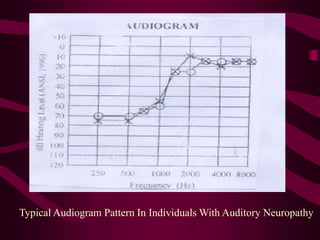
All degrees of hearing loss from slight to profound can be seen
in individuals with AN.
- 82% - Symmetric losses
- 14% - Bilateral asymmetric losses
- 4% - Unilateral
The most dramatic change in auditory status over time is
demonstrated by patients who demonstrate ‘temperature sensitive
AN’. These patients have hearing that is normal when there core
temperature is normal, but with fever they show significant loss of
hearing sensitivity including severe to profound deafness.
Speech Discrimination / (Recognition)
Patients with AN have dysfunction of speech perception
that is out of proportion with their pure tone loss
(Sininger et al. 1995; Starr et al. 1996).
Impedance audiometry in AN
• Mostly “A” type tympanogram will be seen in cases with AN.
Condition being: No Middle Ear Pathology.
• Acoustic Reflex
• Abnormal middle-ear muscle reflexes are a consistently
reported finding for both adults and children with auditory
neuropathy/dys-synchrony type hearing loss.
• They do not conduct rapid trains of action potential very well.
Acoustic middle ear muscle reflexes are typically absents in
subjects with AN, and the mechanism may be the failure of
auditory nerve fibers to develop sufficiently high discharge
rates to activate the motor neurons of the stapedius muscle.
Cochlear Microphonics
• The cochlear microphonics, is thought to be dominated by the activity of
the outer hair cells (Dallos, 1973; Dallos and Cheatham, 1976; Norton et
al., 1989).
• The presence of this response is indicative of at least some degree of
outer hair cell function and is therefore suggestive of neural transmission
abnormality in ears with absent or disrupted brainstem potentials (Chisin
et al., 1979; Starr et al., 1991; Berlin et al., 1993; Starr et al., 1996;
Berlin et al., 1998).
Otoacoustic emissions in AN
• Patients with AN typically have present OAE (HOOD 1995 )
• In patients with AN, OAEs are strong in adults and children.
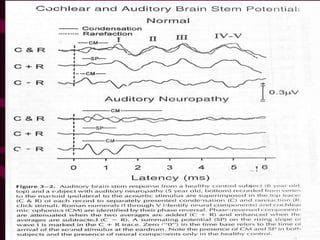
Auditory Brainstem Response
• In ears with auditory neuropathy/dys-synchrony, auditory brainstem
responses are absent or grossly abnormal at maximum stimulus
presentation levels regardless of behavioral hearing level (Starr et al.,
1996; Rance et al., 1999; Sininger and Oba, 2001).
• Reason being disruption of the auditory brainstem response is thought be
the result of either a reduction in the number of neural elements available
to contribute to the response,
Auditory nerve function:
i. Middle ear muscle reflex (ipsi lateral and
contra lateral)
ii. ABR
iii. Masking Level Difference (MLD)
iv. Efferent Suppression of OAE and
v. To a limited extent word recognition with
ipsi lateral competing noise or message.
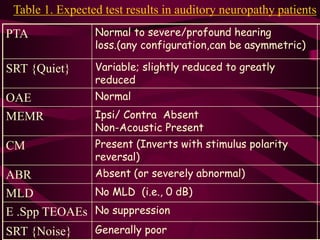
PTA Normal to severe/profound hearing
loss.(any configuration,can be asymmetric)
SRT {Quiet} Variable; slightly reduced to greatly
reduced
OAE Normal
MEMR Ipsi/ Contra Absent
Non-Acoustic Present
CM Present (Inverts with stimulus polarity
reversal)
ABR Absent (or severely abnormal)
MLD No MLD (i.e., 0 dB)
E .Spp TEOAEs No suppression
SRT {Noise} Generally poor
Table 1. Expected test results in auditory neuropathy patients
Typical Audiogram Pattern In Individuals With Auditory Neuropathy
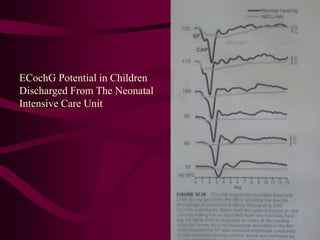
ECochG Potential in Children
Discharged From The Neonatal
Intensive Care Unit
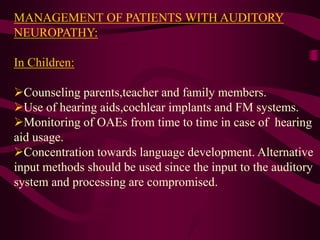
MANAGEMENT OF PATIENTS WITH AUDITORY
NEUROPATHY:
In Children:
Counseling parents,teacher and family members.
Use of hearing aids,cochlear implants and FM systems.
Monitoring of OAEs from time to time in case of hearing
aid usage.
Concentration towards language development. Alternative
input methods should be used since the input to the auditory
system and processing are compromised.
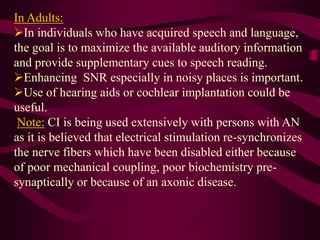
In Adults:
In individuals who have acquired speech and language,
the goal is to maximize the available auditory information
and provide supplementary cues to speech reading.
Enhancing SNR especially in noisy places is important.
Use of hearing aids or cochlear implantation could be
useful.
Note: CI is being used extensively with persons with AN
as it is believed that electrical stimulation re-synchronizes
the nerve fibers which have been disabled either because
of poor mechanical coupling, poor biochemistry pre-
synaptically or because of an axonic disease.
Refrence :
Essential of Audiology – Gelfand
Handbook of Clinical Audiology -Jack Katz
Neuroscience -Bhatnagar
Audiological Diagnosis -Rosser
Auditory neuropathy

Auditory neuropathy

  • 1.
    AUDITORY NEUROPATHY Presenter :Guide: Alok singh Mr.Ajay Mishra
  • 2.
    Introduction: “Auditory neuropathy isa hearing disorder in which sound enters the inner ear normally but the transmission of signals from the inner ear to the brain is impaired. It can affect the people of all ages, from infancy through adulthood.” The term ‘Auditory Neuropathy’ was coined by Starr and colleagues in 1996. The term auditory dys-synchrony has been proposed as an alternative to auditory neuropathy (Berlin et al., 2001).
  • 3.
    It is acondition in which the patient displays auditory characteristics consistent with normal outer hair cell function and abnormal neural function at the level of the the 8th nerve.
  • 4.
     Genetic Etiologies: » Syndromic: - Charcot-Marie-Toothdisease; - Friedrich’sAtaxia; - Hereditary motor and sensory neuropathy (HSMN) » Non-syndromic: - Recessive genetic mutations: - Otoferlin (OTOF), - Pejvakin (PJVK) Rance (2005);Rapin & Gravel (2003);Starr et al. (2003); Hayes 2011 Etiology
  • 5.
     Congenital Conditions: -Cochlear Nerve Deficiency  Infectious Processes: - Viral Infections (e.g. mumps, meningitis)
  • 6.
    Risk Factors: Low birthweight, premature delivery and inadequate supply of oxygen to the newborn baby. Drugs used during treatment of medical complications in a pregnant woman or newborns. Genetic inheritance.
  • 7.
    Pathophysiology: The condition calledauditory neuropathy is likely a group of disorders affecting the function of: a) Auditory nerve directly ( Neuropathic disorders) b) Inner hair cells c) Synapses between auditory nerve and inner hair cells. d) The tectorial membrane e) Afferent as well as efferent pathways may be affected. f) Abnormality in the release of the neuro-transmitter.
  • 8.
    The Hall Markof Auditory Neuropathy : 1. Absent or abnormal ABR 2. Normal OAE or Cochlear Microphonics 3. Absent Acoustic Reflex 4. Absent Masking Level Differences 5. PTA is SNHL having degree mild to severe 6. Speech Recognition performance is usually poorer -Stanley A.Gelfand
  • 9.
  • 10.
    Pure Tone Average -Audiograms(Sininger & Oba, 2001) All degrees of hearing loss from slight to profound can be seen in individuals with AN. - 82% - Symmetric losses - 14% - Bilateral asymmetric losses - 4% - Unilateral The most dramatic change in auditory status over time is demonstrated by patients who demonstrate ‘temperature sensitive AN’. These patients have hearing that is normal when there core temperature is normal, but with fever they show significant loss of hearing sensitivity including severe to profound deafness.
  • 11.
    Speech Discrimination /(Recognition) Patients with AN have dysfunction of speech perception that is out of proportion with their pure tone loss (Sininger et al. 1995; Starr et al. 1996).
  • 12.
    Impedance audiometry inAN • Mostly “A” type tympanogram will be seen in cases with AN. Condition being: No Middle Ear Pathology. • Acoustic Reflex • Abnormal middle-ear muscle reflexes are a consistently reported finding for both adults and children with auditory neuropathy/dys-synchrony type hearing loss. • They do not conduct rapid trains of action potential very well. Acoustic middle ear muscle reflexes are typically absents in subjects with AN, and the mechanism may be the failure of auditory nerve fibers to develop sufficiently high discharge rates to activate the motor neurons of the stapedius muscle.
  • 13.
    Cochlear Microphonics • Thecochlear microphonics, is thought to be dominated by the activity of the outer hair cells (Dallos, 1973; Dallos and Cheatham, 1976; Norton et al., 1989). • The presence of this response is indicative of at least some degree of outer hair cell function and is therefore suggestive of neural transmission abnormality in ears with absent or disrupted brainstem potentials (Chisin et al., 1979; Starr et al., 1991; Berlin et al., 1993; Starr et al., 1996; Berlin et al., 1998).
  • 14.
    Otoacoustic emissions inAN • Patients with AN typically have present OAE (HOOD 1995 ) • In patients with AN, OAEs are strong in adults and children.
  • 15.
    Auditory Brainstem Response •In ears with auditory neuropathy/dys-synchrony, auditory brainstem responses are absent or grossly abnormal at maximum stimulus presentation levels regardless of behavioral hearing level (Starr et al., 1996; Rance et al., 1999; Sininger and Oba, 2001). • Reason being disruption of the auditory brainstem response is thought be the result of either a reduction in the number of neural elements available to contribute to the response,
  • 17.
    Auditory nerve function: i.Middle ear muscle reflex (ipsi lateral and contra lateral) ii. ABR iii. Masking Level Difference (MLD) iv. Efferent Suppression of OAE and v. To a limited extent word recognition with ipsi lateral competing noise or message.
  • 18.
    PTA Normal tosevere/profound hearing loss.(any configuration,can be asymmetric) SRT {Quiet} Variable; slightly reduced to greatly reduced OAE Normal MEMR Ipsi/ Contra Absent Non-Acoustic Present CM Present (Inverts with stimulus polarity reversal) ABR Absent (or severely abnormal) MLD No MLD (i.e., 0 dB) E .Spp TEOAEs No suppression SRT {Noise} Generally poor Table 1. Expected test results in auditory neuropathy patients
  • 19.
    Typical Audiogram PatternIn Individuals With Auditory Neuropathy
  • 21.
    ECochG Potential inChildren Discharged From The Neonatal Intensive Care Unit
  • 22.
    MANAGEMENT OF PATIENTSWITH AUDITORY NEUROPATHY: In Children: Counseling parents,teacher and family members. Use of hearing aids,cochlear implants and FM systems. Monitoring of OAEs from time to time in case of hearing aid usage. Concentration towards language development. Alternative input methods should be used since the input to the auditory system and processing are compromised.
  • 23.
    In Adults: In individualswho have acquired speech and language, the goal is to maximize the available auditory information and provide supplementary cues to speech reading. Enhancing SNR especially in noisy places is important. Use of hearing aids or cochlear implantation could be useful. Note: CI is being used extensively with persons with AN as it is believed that electrical stimulation re-synchronizes the nerve fibers which have been disabled either because of poor mechanical coupling, poor biochemistry pre- synaptically or because of an axonic disease.
  • 24.
    Refrence : Essential ofAudiology – Gelfand Handbook of Clinical Audiology -Jack Katz Neuroscience -Bhatnagar Audiological Diagnosis -Rosser